
Nearly 40% of all landlord-tenant disputes escalated to formal resolution in 2025 involved valuation disagreements that could have been mitigated with better-documented survey evidence. That figure matters enormously now that the Private Rented Sector (PRS) Ombudsman has become a statutory fixture of the rental market. Valuing buy-to-let portfolios under new PRS Ombudsman rules and building surveyor checklists for 2026 dispute risks is no longer a niche compliance exercise — it is the central challenge facing every chartered surveyor who works with residential investment property.
The Renters' Rights Act 2026, the mandatory PRS Database, Awaab's Law, and the abolition of Section 21 notices have collectively reshaped the risk profile of buy-to-let assets. Surveyors who continue to apply pre-2026 valuation frameworks will produce reports that are legally and commercially vulnerable. This guide sets out the key regulatory changes, their direct impact on valuation methodology, and the practical checklists surveyors need to defend their figures in an ombudsman or tribunal setting.
Key Takeaways
- The PRS Ombudsman now creates direct liability exposure that surveyors must factor into buy-to-let portfolio valuations.
- Mandatory PRS Database registration affects a property's marketability and must be verified before any valuation is finalised.
- Awaab's Law compliance status can trigger material upward or downward adjustments to assessed value.
- The abolition of Section 21 warrants a sitting-tenant discount of 10-20% depending on tenancy duration and rent levels relative to market.
- Surveyors must maintain transparent, evidence-based documentation to withstand scrutiny in 2026 dispute resolution proceedings.

The PRS Ombudsman Framework and What It Means for Surveyors
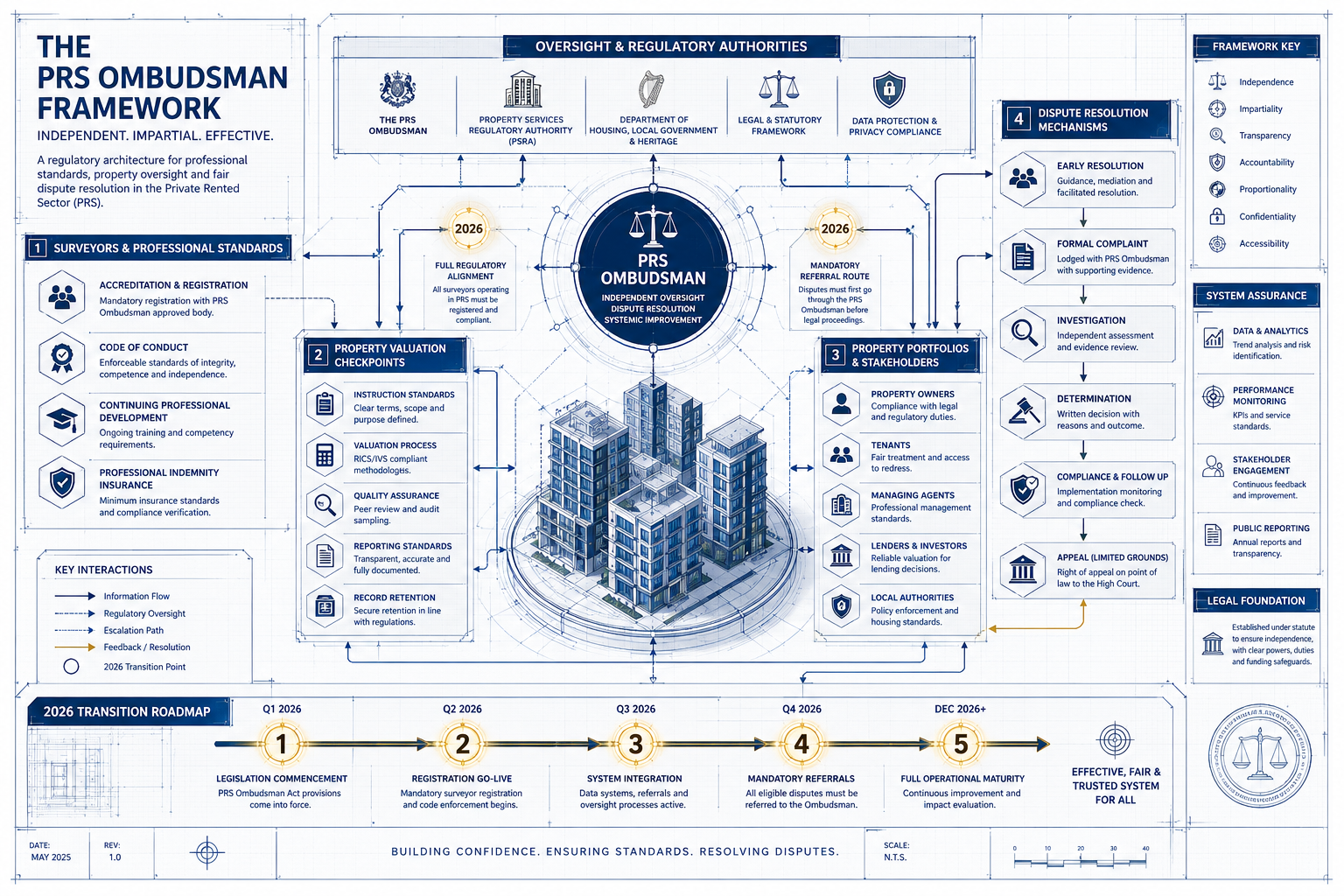
The PRS Ombudsman was established to provide a free, independent dispute resolution service for landlords and tenants in the private rented sector. Membership is now mandatory for all private landlords in England, meaning every buy-to-let property in a portfolio is subject to ombudsman jurisdiction [1]. For surveyors, this shift is significant. A valuation report that fails to account for outstanding ombudsman complaints, unresolved maintenance obligations, or a landlord's compliance history can be challenged as materially incomplete.
Why ombudsman exposure affects capital value
When an ombudsman upholds a tenant complaint, the financial consequences can include compensation payments, mandatory repair orders, and reputational damage that affects void rates. Each of these outcomes has a measurable impact on net operating income — the foundation of any income-based valuation. Surveyors must therefore treat ombudsman risk as a quantifiable variable rather than a background concern.
Key questions to address before completing a valuation:
- Is the landlord registered with the PRS Ombudsman scheme?
- Are there any open complaints or recent upheld decisions against the property or portfolio?
- Has the landlord complied with any remediation orders within the required timeframes?
Failure to investigate these points leaves a valuation report exposed in any subsequent dispute. For portfolios being assessed for sale, refinancing, or inheritance purposes, a RICS Red Book valuation must now incorporate ombudsman risk as a standard line item.
Mandatory PRS Database Registration: A New Marketability Test
Alongside the Ombudsman, all landlords must register their properties on the national PRS Database [1]. Surveyors should treat non-registration as a material valuation risk. An unregistered property cannot legally be let, which means any income projection based on current or projected rent is unreliable until registration is confirmed.
Checklist item: Obtain written confirmation of PRS Database registration status before finalising any income-based valuation. Where registration is absent or lapsed, apply a marketability discount and note the compliance gap explicitly in the report.
How Regulatory Changes Drive Yield Adjustments in 2026
The combined effect of the Renters' Rights Act 2026, Awaab's Law, and the shift to periodic tenancies has materially altered the risk-return profile of buy-to-let assets. Surveyors working on valuing buy-to-let portfolios under new PRS Ombudsman rules must understand how each regulatory layer translates into a numerical adjustment.
Capitalisation Rate Reassessment
Before 2026, a well-located residential investment property in London might have been valued on a 5% yield. The heightened regulatory risk introduced by the Renters' Rights Act — including mandatory periodic tenancies, restricted grounds for possession, and pet permission obligations — now justifies a capitalisation rate of 5.5% to 6% for comparable assets [3]. That adjustment alone can reduce the capital value of a portfolio by 8-12% without any change in the underlying rent.
"A 50 basis point increase in the capitalisation rate on a property generating £24,000 per annum in rent equates to a capital value reduction of approximately £80,000 at the higher end. Across a ten-property portfolio, the aggregate impact is substantial."
Surveyors should document the rationale for any yield adjustment with reference to:
- Current market transaction evidence
- Regulatory risk factors specific to the portfolio
- Comparable sales of similarly encumbered investment properties [5]
Awaab's Law: Compliance as a Valuation Variable
Awaab's Law requires landlords to investigate damp and mould hazards within 14 days of a complaint and begin remediation within a further 7 days for urgent cases. Properties with existing damp or mould problems now carry a dual liability: the cost of physical remediation and the risk of ombudsman complaints or legal action if the timeline is not met [2].
For surveyors, this means:
| Condition | Valuation Adjustment |
|---|---|
| No damp or mould, documented compliance | No adjustment or marginal premium |
| Minor damp, remediation in progress | Deduct estimated remediation cost |
| Significant damp, no action taken | Deduct remediation cost plus risk premium (5-10%) |
| Repeat ombudsman complaints upheld | Additional discount for reputational and legal risk |
A structural survey or specific defect report should be commissioned for any property where damp is suspected before the valuation is finalised. Relying on a desktop assessment in these circumstances creates professional liability exposure.
Section 21 Abolition and the Sitting-Tenant Discount
The abolition of Section 21 "no-fault" eviction notices is the single most consequential change for capital value in the buy-to-let sector. Landlords can no longer regain possession without establishing a statutory ground, making it materially harder to sell with vacant possession [4].
Research indicates that properties with long-term sitting tenants are now valued 10-20% below vacant possession value, depending on:
- Length of the existing tenancy
- Rent relative to current market rent (over-rented or under-rented)
- Tenant payment history and any outstanding disputes
- Likelihood of the tenant exercising rights to remain [4]
Surveyors must state clearly in their reports whether a valuation is on a vacant possession basis or a subject-to-tenancy basis, and must justify any discount applied with comparable evidence of investment sales in the same market.
Periodic Tenancies and Pet Permissions
The Renters' Rights Act 2026 converted all assured shorthold tenancies to periodic tenancies and granted tenants a default right to keep pets with landlord consent (which cannot be unreasonably withheld) [3]. Both changes affect maintenance cost projections and, by extension, net yield calculations.
Impact on valuations:
- Periodic tenancies increase void risk uncertainty, as tenants can give shorter notice to leave
- Pet permissions increase wear-and-tear provisions and insurance costs
- Surveyors should adjust gross-to-net yield assumptions to reflect higher management and maintenance costs
For portfolios in high-demand areas such as central London or west London, the income risk from periodic tenancies may be partially offset by strong re-letting demand, but this must be evidenced rather than assumed.
Surveyor Checklists for 2026 Dispute Risks
Valuing buy-to-let portfolios under new PRS Ombudsman rules requires a structured, documented approach that can withstand challenge in ombudsman proceedings, First-tier Tribunal hearings, or expert witness cross-examination. The following checklists are organised by risk category.

Checklist 1: Compliance and Registration Verification
Before beginning any income-based valuation:
- Confirm PRS Ombudsman membership for the landlord
- Verify PRS Database registration for each property in the portfolio
- Obtain copies of any ombudsman decisions issued in the past 24 months
- Check for outstanding Housing Health and Safety Rating System (HHSRS) notices
- Confirm compliance with the updated Service Charge Residential Management Code (effective April 2026) for leasehold properties [6]
- Review Energy Performance Certificate ratings against minimum EPC requirements
Checklist 2: Physical Condition and Awaab's Law Compliance
- Commission or review a recent structural or condition survey for each asset
- Identify any damp, mould, or condensation issues and document remediation status
- Obtain contractor quotes for any outstanding remediation work
- Confirm that inspection and remediation timelines comply with Awaab's Law obligations
- Note any properties where complaints have been raised but not yet resolved
For properties where physical defects are suspected, a dilapidation survey provides the documented baseline needed to defend valuation adjustments in dispute proceedings. A schedule of dilapidations is particularly valuable when assessing the end-of-tenancy liability profile of a portfolio.
Checklist 3: Income and Rent Evidence Verification
Unsubstantiated rent figures are a leading cause of valuation challenges [5]. Surveyors must:
- Obtain signed tenancy agreements for all occupied properties
- Cross-reference passing rent against current market rent using verifiable comparable evidence
- Document void rates over the past 12-24 months for each asset
- Identify any rent arrears or payment disputes
- Adjust gross-to-net yield assumptions to reflect management costs, maintenance provisions, and insurance uplifts related to pet permissions
Rent review obligations: Under the new rent review framework, landlords must follow a prescribed process before increasing rent, and tenants have the right to challenge increases at the First-tier Tribunal [8]. Any portfolio where rents are significantly below market should be assessed for the realistic prospect of achieving an increase, rather than assuming automatic uplift.
Checklist 4: Tenancy Structure and Possession Risk
- Identify all periodic tenancies and note the date of conversion
- Assess the probability of each tenancy continuing versus ending in the next 12-24 months
- Apply a sitting-tenant discount where possession would require establishing a statutory ground
- Document the basis for any vacant possession assumption
- Flag any tenancies where disputes are active or where the tenant has made formal complaints
Checklist 5: Expert Witness and Dispute Readiness
The rise in rental market disputes has significantly increased demand for expert witness valuations [7]. Surveyors preparing reports for portfolios with known dispute risk should:
- Ensure all methodology is explicitly documented and cross-referenced to RICS guidance
- Retain copies of all comparable evidence used
- Produce a clear audit trail from inspection findings to final valuation figure
- Avoid unsupported assumptions about future rent growth or void rates
- Consider whether an expert witness report is appropriate given the dispute context
For portfolios undergoing valuation as part of a divorce settlement, tax assessment, or probate process, a retrospective valuation may also be required, and the same documentation standards apply.
Rent Review Processes and Service Charge Compliance in 2026
Two further regulatory developments deserve specific attention in any 2026 buy-to-let portfolio valuation.
Revised rent review rules require surveyors to adopt evidence-based methodologies when assessing achievable rent levels. Comparable property analysis must be current, geographically relevant, and adjusted for condition and specification [8]. Relying on historic rent evidence without adjustment for market movement will not withstand scrutiny in a tribunal or ombudsman context.
The updated Service Charge Residential Management Code, effective from April 7, 2026, introduces new standards for managing residential leasehold properties [6]. For portfolios that include leasehold flats or mixed-use buildings, surveyors must assess whether service charge management is compliant and whether any non-compliance creates a contingent liability that should be reflected in the valuation.
Leasehold assets in particular require careful analysis. The valuation factors relevant to leasehold buy-to-let properties now include unexpired lease length, ground rent review clauses, and service charge transparency — all of which interact with the new management code requirements.
Conclusion
The regulatory environment for buy-to-let property in 2026 has fundamentally altered the risk profile of residential investment portfolios. Valuing buy-to-let portfolios under new PRS Ombudsman rules and applying rigorous surveyor checklists for 2026 dispute risks is not optional — it is the professional standard against which every report will be measured.
Actionable next steps for surveyors:
- Update valuation templates to include PRS Ombudsman compliance and PRS Database registration as standard verification items.
- Adopt a tiered yield adjustment framework that explicitly accounts for Awaab's Law compliance status, Section 21 abolition, and periodic tenancy risk.
- Commission physical condition surveys — including damp and structural assessments — before finalising any income-based valuation where defects are suspected.
- Build a robust comparable evidence file for every instruction, with rent evidence verified against signed tenancy agreements and recent market transactions.
- Ensure all reports produced for portfolios with active disputes or litigation risk meet the documentation standards required for expert witness use.
Surveyors who invest in rigorous, transparent methodology now will be best placed to defend their valuations — and their professional reputations — as the 2026 dispute landscape continues to develop.
References
[1] Prs Reform For Landlords In 2026 The Ombudsman The Prs Database And How To Avoid The Most Common Complaint Triggers – https://www.lovelle.co.uk/guides/landlord/prs-reform-for-landlords-in-2026-the-ombudsman-the-prs-database-and-how-to-avoid-the-most-common-complaint-triggers/?utm_source=openai
[2] Valuing Buy To Let Properties In 2026 Lettings Surge Surveyor Strategies For Tenant Demand 2 – https://kingstonsurveyors.com/valuing-buy-to-let-properties-in-2026-lettings-surge-surveyor-strategies-for-tenant-demand-2/?utm_source=openai
[3] Valuing Rental Properties Post Renters Rights Act 2026 Impact Of Periodic Tenancies And Pet Permissions – https://wimbledonsurveyors.com/valuing-rental-properties-post-renters-rights-act-2026-impact-of-periodic-tenancies-and-pet-permissions/?utm_source=openai
[4] Valuing Rental Properties Under The Renters Rights Act 2026 Surveyor Adjustments For Section 21 Abolition – https://www.canterburysurveyors.com/blog/valuing-rental-properties-under-the-renters-rights-act-2026-surveyor-adjustments-for-section-21-abolition/?utm_source=openai
[5] Surveyor Valuation Frameworks For 1m Residential Portfolios Yield Vs Comparable Evidence In 2026 Markets – https://wimbledonsurveyors.com/surveyor-valuation-frameworks-for-1m-residential-portfolios-yield-vs-comparable-evidence-in-2026-markets/?utm_source=openai
[6] Service Charge Residential Management Code – https://www.rpclegal.com/thinking/construction/service-charge-residential-management-code/?utm_source=openai
[7] Expert Witness Valuations For 2026 Rental Market Disputes Navigating Tenant Demand And Landlord Instructions – https://manchestersurveyors.com/expert-witness-valuations-for-2026-rental-market-disputes-navigating-tenant-demand-and-landlord-instructions/?utm_source=openai
[8] Valuing Properties Under New Rent Review Processes Surveyor Tactics For 2026 Landlord Challenges – https://wimbledonsurveyors.com/valuing-properties-under-new-rent-review-processes-surveyor-tactics-for-2026-landlord-challenges/?utm_source=openai