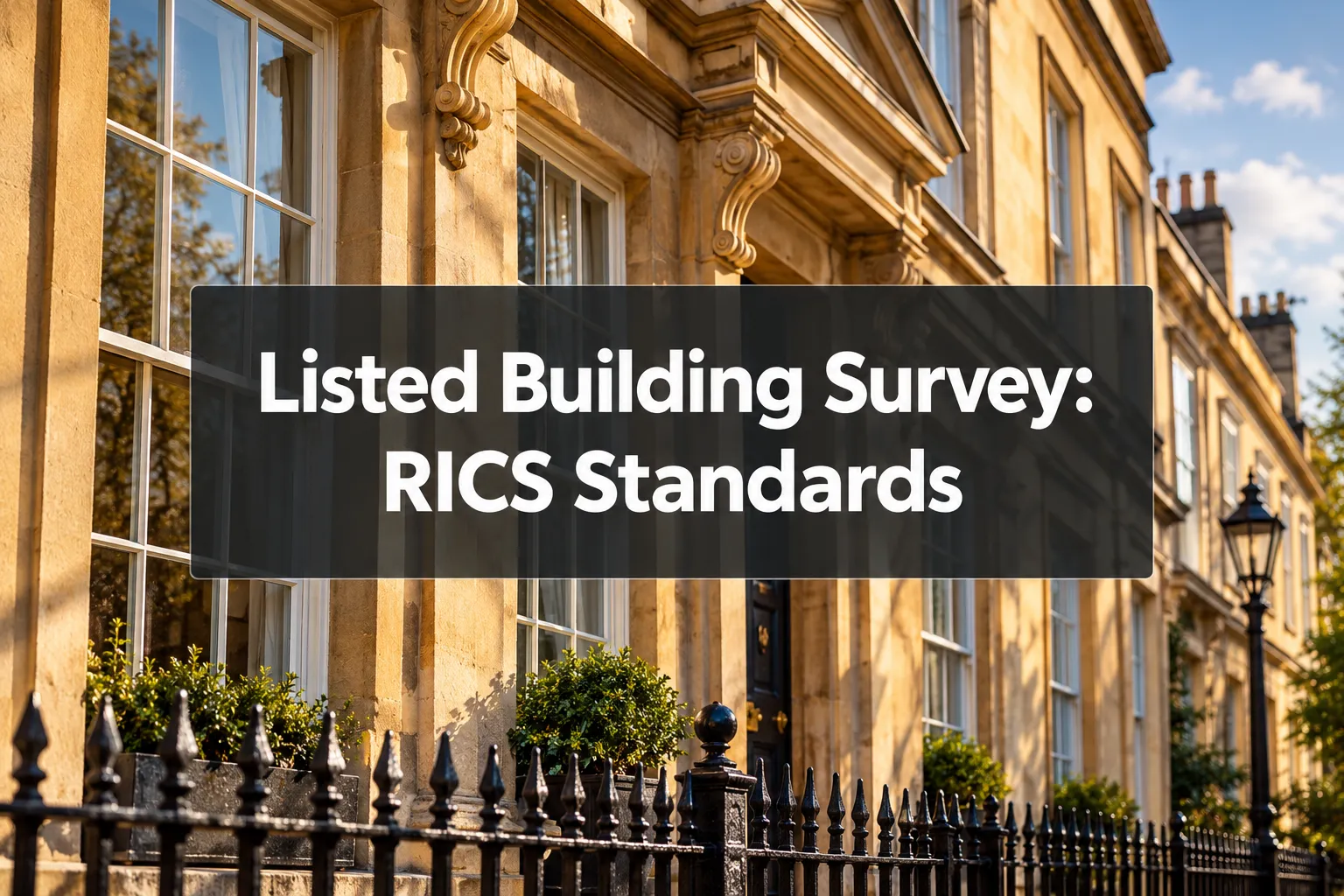
England and Wales contain over 500,000 listed building entries, yet fewer than one in ten buyers commission a survey specifically tailored to the statutory and heritage complexities those properties carry. A standard home inspection simply does not cover the ground. A Listed Building Survey: RICS Standards, Heritage Risks and Valuation Challenges framework exists precisely because these buildings demand a different level of scrutiny, one that blends structural assessment, conservation law, and specialist valuation methodology into a single, coherent professional opinion.
This article explains what separates a listed building survey from a conventional Level 3 inspection, what RICS standards govern the process in 2026, what heritage risks surveyors must identify, and how all of those factors feed into a defensible and accurate valuation.
Key Takeaways
- A listed building survey goes beyond a standard Level 3 inspection by incorporating statutory consent checks, conservation officer expectations, and heritage-specific defect analysis.
- RICS Valuation – Global Standards (Red Book Global), effective 31 January 2025, is the mandatory framework for all valuation work on listed properties, now incorporating IVS 2024 with enhanced ESG and data requirements. [1][2]
- Unauthorised alterations to a listed building can constitute a criminal offence, making pre-purchase survey findings directly relevant to legal liability. [6]
- Heritage constraints, including restricted permitted development rights and the requirement for specialist materials, create measurable valuation challenges that standard comparable evidence rarely captures.
- Buyers, lenders, and investors all benefit from a survey report that integrates condition findings with a clear explanation of how listing status affects value.
How a Listed Building Survey Differs from a Standard Level 3 Inspection
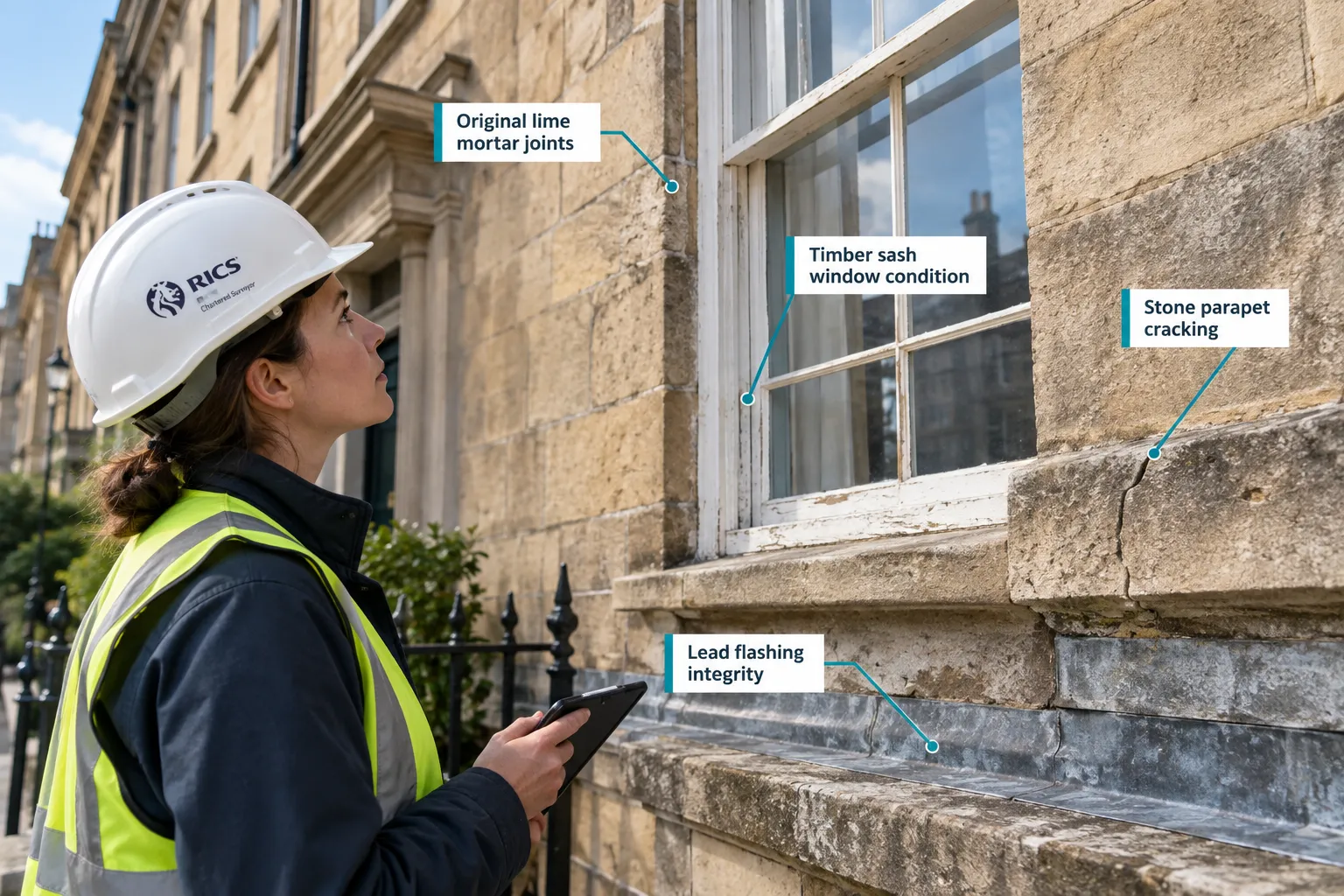
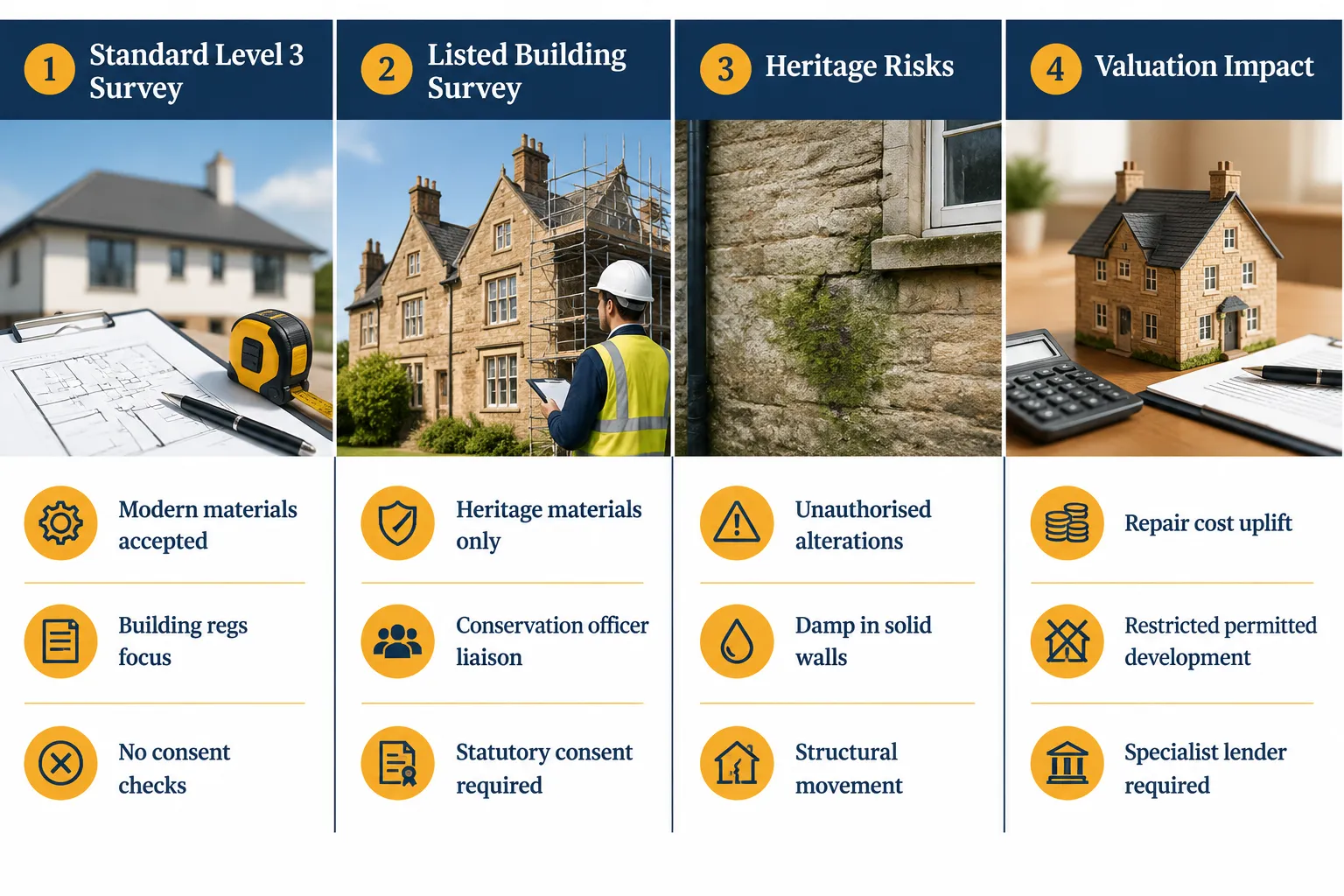
A Level 3 Survey, formerly called a Building Survey, is the most comprehensive inspection available for standard residential property. It covers structure, fabric, drainage, services, and identifies defects across all accessible areas. For most properties built after 1920, it is entirely fit for purpose.
A listed building survey retains all of those elements but adds several layers that a conventional inspection does not address.
Statutory Consent Verification
The first additional layer is legal. Under the Planning (Listed Buildings and Conservation Areas) Act 1990, any works that affect the character of a listed building require Listed Building Consent (LBC) in addition to any planning permission. This applies to both external and internal alterations. A surveyor inspecting a listed property must therefore assess not only whether works have been carried out, but whether those works were lawfully authorised. [6]
A recent RICS Built Environment Journal article by Matthew Williams MRICS, published July 2026, highlights that surveyors have a professional duty to flag where evidence of unauthorised alterations exists, because the criminal liability for such works can transfer to a new owner who continues or fails to remedy them. [6][10]
Key statutory checks a listed building survey must address:
- Evidence of modern extensions, alterations, or internal reconfigurations
- Replacement windows, doors, or roof coverings installed without LBC
- Removal of original features such as fireplaces, cornices, or staircases
- Presence of uPVC, aluminium, or other non-traditional materials inconsistent with the listing
Conservation Officer Expectations
Local authority conservation officers play a significant role in the management of listed buildings. Surveyors undertaking listed building inspections need to understand what a conservation officer would consider acceptable in terms of repair and maintenance, because that shapes both the scope of remedial works and their cost.
For example, a conservation officer will typically require that:
- Lime mortar is used rather than cement-based products on historic masonry
- Timber windows are repaired rather than replaced where possible
- Any new roofing materials match the original specification in type and appearance
- Pointing, render, and decorative finishes are restored using traditional methods
These requirements have a direct cost implication. Lime mortar repointing can cost two to three times more per square metre than standard cement repointing. Specialist joiners working to conservation standards charge premium rates. A survey that fails to identify these requirements will produce a repair cost estimate that is materially understated.
Understanding what affects a property valuation is always important, but for listed buildings, the conservation constraints are among the most significant variables a valuer must account for.
Heritage-Specific Defect Analysis
Beyond the statutory layer, listed buildings present a distinct set of physical defect risks that differ from modern construction. Solid wall construction, lime-based mortars, original timber frames, lead roofing, and single-glazed windows all behave differently from cavity wall or timber-frame modern builds.
Common heritage defects identified in listed building surveys:
| Defect Category | Typical Cause | Heritage-Specific Risk |
|---|---|---|
| Damp penetration | Solid wall construction, failed pointing | Cement repointing trapping moisture |
| Structural movement | Shallow foundations, clay shrinkage | Lime mortar flexibility masking severity |
| Timber decay | Roof voids, embedded beams, window frames | Replacement restrictions under LBC |
| Lead roof failure | Age, thermal movement, poor laps | High replacement cost, specialist contractors |
| Internal plasterwork | Settlement, damp, vibration | Horsehair plaster irreplaceable at scale |
For a deeper understanding of defects commonly found in older London properties, the 10 most common property defects found in a building survey provides a useful reference point, though listed buildings add further layers of complexity to each category.
RICS Standards Governing Listed Building Survey and Valuation Work
The professional framework for a Listed Building Survey: RICS Standards, Heritage Risks and Valuation Challenges sits across two distinct but connected sets of RICS guidance: the survey standards that govern inspection methodology, and the valuation standards that govern how the resulting opinion of value is formed and reported.
The RICS Red Book Global: The Mandatory Valuation Framework
The RICS Valuation – Global Standards, known as the Red Book Global, is effective from 31 January 2025 and represents the primary mandatory framework for all RICS members undertaking valuation work. [1][7] This includes valuations of listed buildings for any purpose, mortgage lending, purchase, probate, matrimonial proceedings, or investment analysis.
The current edition fully incorporates the International Valuation Standards (IVS) 2024, which were published on 31 January 2024. The IVS 2024 introduce a revised structure with an increased focus on ESG factors, data utilisation, and valuation modelling. [2][3] For listed buildings, the ESG dimension is particularly relevant: the energy performance constraints imposed by heritage status, the embodied carbon value of historic fabric, and the sustainability credentials of traditional construction methods are all increasingly factored into market analysis.
For a thorough explanation of what the Red Book requires in practice, the guide to what is a Red Book Valuation sets out the core principles clearly.
Restructured Valuation Practice Statements
The August 2026 update to the Red Book Global summary confirms a restructured set of Valuation Practice Statements (VPS) that all RICS valuers must follow: [7]
- VPS 1 – Terms of engagement
- VPS 2 – Bases of value, assumptions and special assumptions
- VPS 3 – Valuation approaches and methods
- VPS 4 – Inspections, investigations and records
- VPS 5 – Valuation models
- VPS 6 – Valuation reports
For listed buildings, VPS 4 carries particular weight. It requires that the inspection is thorough enough to support the valuation opinion, and that any limitations on access or investigation are clearly recorded. Where a listed building has restricted access to roof voids, cellars, or concealed structural elements, as is common in occupied historic properties, those limitations must be explicitly stated in the report.
VPS 2 is also critical. The selection of the correct basis of value, whether Market Value, Depreciated Replacement Cost, or another basis, must be justified by reference to the nature of the asset. For listed buildings with no direct comparable evidence, the basis selection and any special assumptions become the foundation of the entire valuation opinion.
New Mandatory Standards: AVMs, AI, and ESG
The RICS Basis for Conclusions for the 2024-2025 Red Book confirms that new mandatory standards were added around automated valuation models (AVMs), automation, AI, and ESG. [3][4] This is directly relevant to listed buildings because AVMs, which rely on comparable transaction data, are inherently unreliable for highly individualised heritage assets. A listed building surveyor must understand the limitations of algorithmic valuation tools and be prepared to explain why a manual, evidence-based approach is required.
"The Red Book and IVS recognise three main valuation approaches and the need to select methods appropriate to asset type.", RICS Property Journal, April 2026 [9]
This principle is nowhere more important than in listed building valuation, where the sales comparison approach may be the only viable method for residential assets but requires careful adjustment for heritage-specific factors that automated systems cannot capture.
Heritage Risks and Valuation Challenges in Practice
The intersection of heritage constraints and market value is where a Listed Building Survey: RICS Standards, Heritage Risks and Valuation Challenges delivers its greatest practical value. Buyers and lenders need to understand not just what a property is worth today, but what the ongoing cost of ownership looks like under conservation obligations.
The Valuation Approaches Available
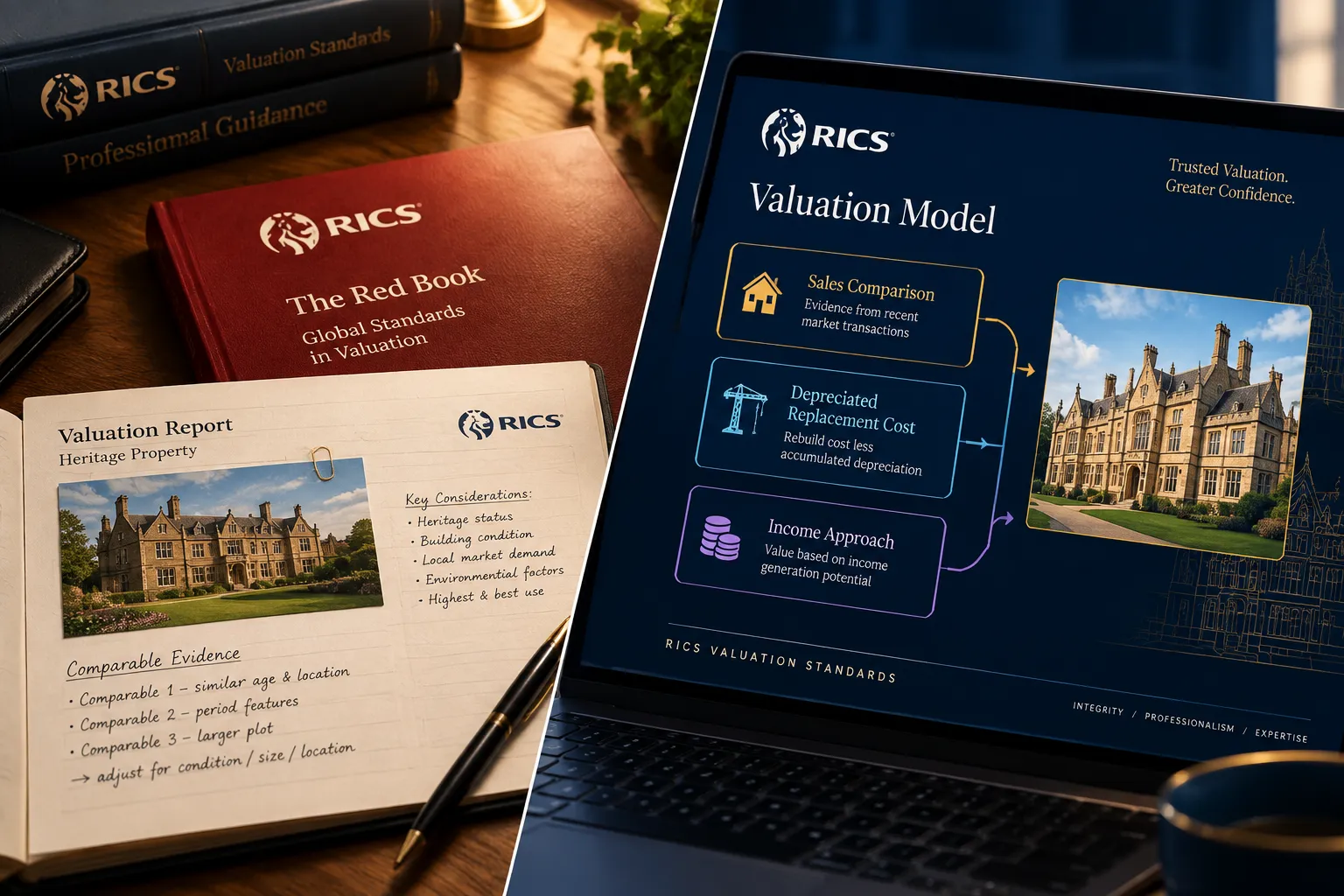
An RICS Property Journal article from April 2026 on valuation approaches, methods, and models confirms that the Red Book and IVS recognise three main valuation approaches: the sales comparison approach, the income approach, and the cost approach. [9] For listed buildings:
Sales Comparison Approach
This is the primary method for most residential listed buildings. The challenge is that comparable evidence is thin. Listed buildings are, by definition, of special architectural or historic interest, meaning no two are truly alike. Adjustments must be made for listing grade (Grade I, II*, or II in England), condition, extent of original fabric retained, and the quantum of outstanding repair liability.
Depreciated Replacement Cost (DRC)
For listed buildings that have no market, specialist ecclesiastical buildings, industrial heritage structures, or unique institutional properties, DRC is often the only viable approach. The challenge here is that the cost to replicate a listed building using traditional materials and methods can be dramatically higher than the market value of the resulting asset, creating a significant depreciation adjustment that requires careful justification.
Income Approach
Where a listed building generates rental income, a listed commercial property or a heritage hotel, for example, the income approach is applicable. Heritage constraints affect yield because potential investors price in the higher maintenance costs and restricted development potential.
For commercial listed properties, commercial valuation in London requires surveyors who understand both the income-based methodology and the specific constraints that heritage status imposes on asset management.
Restricted Permitted Development and Its Value Impact
One of the most significant valuation challenges for listed buildings is the near-total removal of permitted development rights. Standard residential properties benefit from permitted development allowances that allow extensions, loft conversions, and other improvements without full planning permission. Listed buildings require both planning permission and Listed Building Consent for virtually any physical change.
This restriction has a measurable effect on value in several ways:
- Reduced development potential – The uplift in value that an extension or conversion would generate is constrained or eliminated.
- Higher transaction costs – Buyers must budget for LBC applications, heritage consultant fees, and potentially extended planning timescales.
- Lender caution – Some mortgage lenders apply higher risk premiums or restrict loan-to-value ratios on listed buildings, particularly Grade I and II* properties.
For those considering a structural survey in London on a listed property, it is worth noting that the structural findings will need to be interpreted within the context of what remediation is actually permissible under conservation law, not just what would be technically optimal.
Repair Liability and the Insurance Reinstatement Question
A listed building survey must produce a clear picture of outstanding repair liability. This is not simply a schedule of defects, it is a costed programme of works that reflects the conservation requirements applicable to the property. A surveyor who prices repairs using standard trade rates without accounting for specialist heritage contractors will produce an estimate that is systematically too low.
The insurance reinstatement cost for a listed building is also typically higher than for a comparable modern property of the same floor area. The requirement to rebuild using traditional materials and methods, and to obtain all necessary consents before rebuilding can commence, adds both cost and time to any reinstatement scenario. Buyers should ensure that building insurance is arranged on a basis that reflects these factors before exchange of contracts.
Where damp is identified, a common finding in solid-walled listed buildings, the damp survey cost guide provides useful context, though the remediation approach for a listed building will always need to be conservation-compliant rather than relying on standard chemical injection or cavity drainage systems.
Valuation for Specific Purposes
Listed building valuations are commissioned for a range of purposes beyond simple purchase advice:
- Probate valuations – Where a listed building forms part of an estate, a probate valuation in London must reflect the heritage constraints and repair liability accurately to avoid HMRC challenge.
- Matrimonial proceedings – A matrimonial valuation for a listed property requires particular care in justifying comparable evidence adjustments.
- Retrospective valuations – Where a dispute arises about the value of a listed building at a past date, a retrospective valuation must reconstruct the heritage constraints and market conditions applicable at that historical point.
In each case, the RICS Red Book framework, and specifically the requirement under VPS 6 to produce a report that is clear, transparent, and not misleading, applies with full force. [7]
Conclusion
A listed building survey is not simply a more expensive version of a standard inspection. It is a fundamentally different professional exercise that requires expertise in conservation law, heritage construction techniques, and specialist valuation methodology. The consequences of getting it wrong, whether through missed unauthorised alterations, understated repair costs, or a valuation that ignores heritage constraints, can be financially and legally serious for buyers, lenders, and owners alike.
Actionable next steps for anyone involved with a listed building:
- Commission a survey from a surveyor with demonstrable listed building experience, check that they understand conservation officer expectations and can identify heritage-specific defects, not just standard structural issues.
- Request a valuation that explicitly addresses the basis of value and comparable evidence adjustments, a Red Book-compliant report should explain how listing grade, condition, and outstanding repair liability have been factored into the opinion of value. [1][7]
- Verify the consent history before exchange, ask your solicitor to obtain copies of all Listed Building Consents and planning permissions granted since the property was listed, and ensure the surveyor's report addresses any works that appear to lack authorisation. [6]
- Budget for specialist contractors, repair cost estimates for listed buildings should be based on heritage-compliant methods and materials, not standard trade rates.
- Review insurance on a reinstatement cost basis, ensure the sum insured reflects the cost of rebuilding with traditional materials and obtaining all necessary consents.
The RICS Red Book Global, effective from 31 January 2025 and updated through August 2026, provides the mandatory professional framework within which all of this work must be conducted. [1][7] For buyers, owners, and advisers, understanding that framework, and insisting on surveyors and valuers who apply it rigorously, is the most effective protection available when dealing with England and Wales's irreplaceable heritage building stock.
References
[1] Red Book – rics.org
[2] International Valuation Standards – rics.org
[3] Red Book 2024 Basis For Conclusions – rics.org
[4] New Rics Global Red Book Updates Mandatory Standards Data Management Technology Esg Valuation – rics.org
[6] Topics.legal – ww3.rics.org
[7] Red Book Global – rics.org
[9] Valuation Approaches Methods Models – ww3.rics.org
[10] Built Environment Journal – ww3.rics.org