

Agreed Surveyor Party Wall: Your Complete Guide to Streamlining Party Wall Procedures in 2025
When planning construction work that affects a shared wall between properties, property owners face a crucial decision that can save both time and money: appointing an agreed surveyor party wall professional. This single appointment, where both the building owner and adjoining owner consent to use the same surveyor, represents one of the most efficient pathways through the Party Wall etc. Act 1996. Yet many property owners remain unaware of this option or uncertain about how it works in practice.
Understanding the agreed surveyor party wall process can transform what might otherwise become a contentious, expensive dispute into a smooth, collaborative procedure. Whether you’re planning a loft conversion, basement excavation, or structural alterations, knowing when and how to appoint an agreed surveyor could be the difference between a project that proceeds seamlessly and one that stalls in bureaucratic complexity.
Key Takeaways
- ✅ An agreed surveyor party wall arrangement allows both property owners to appoint the same surveyor, reducing costs and simplifying the party wall process
- 📋 Both the building owner and adjoining owner must provide written consent for an agreed surveyor appointment to be valid under the Party Wall Act 1996
- 💰 Using an agreed surveyor typically costs 30-50% less than appointing separate surveyors for each party
- ⚖️ The agreed surveyor must remain impartial and act fairly for both parties, despite being appointed by mutual consent
- 🏗️ This approach works best when both neighbors have a good relationship and agree on the scope and nature of the proposed works
What Is an Agreed Surveyor Party Wall Arrangement?
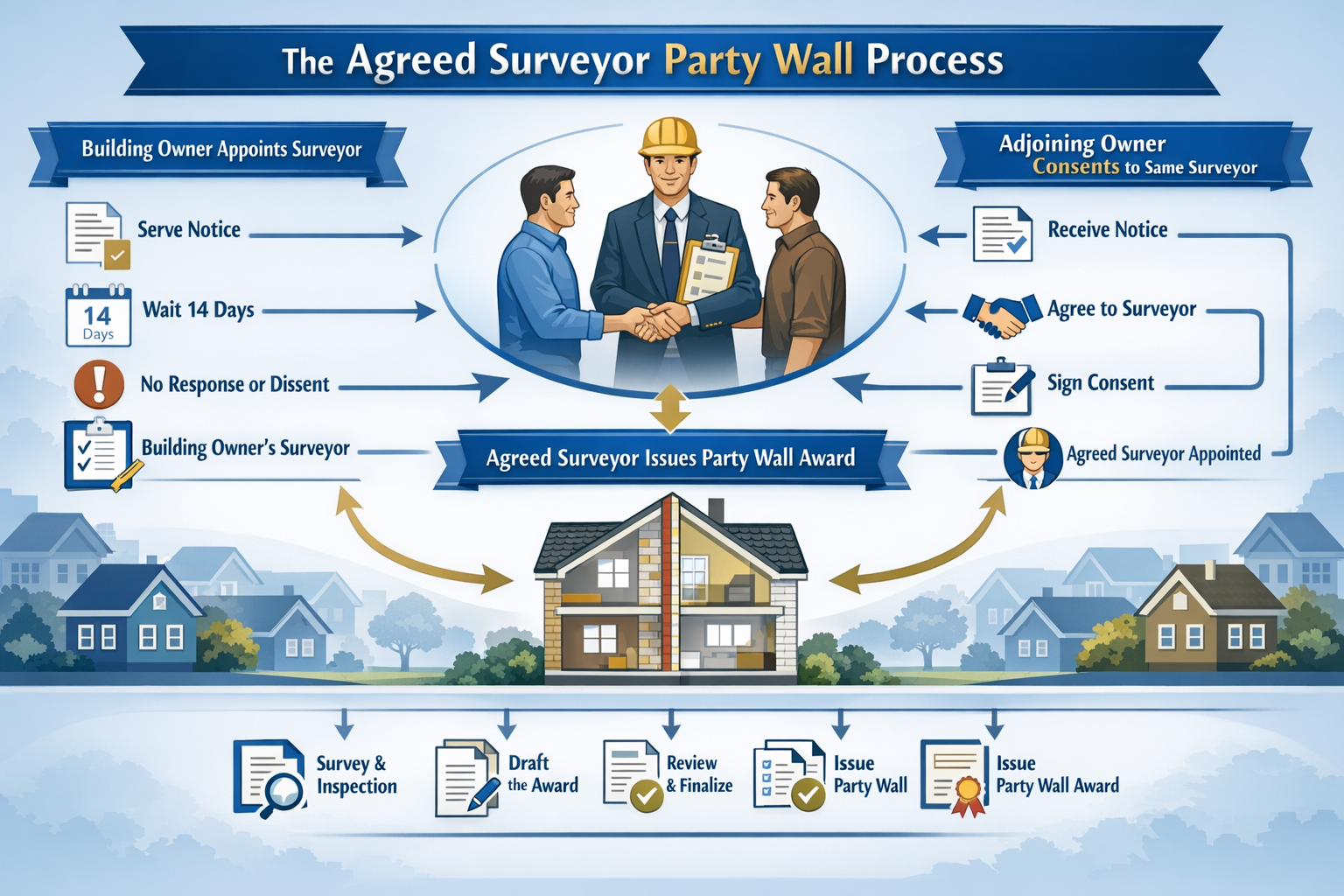
An agreed surveyor party wall arrangement occurs when both the building owner (the person undertaking construction work) and the adjoining owner (the neighbor whose property shares the party wall) mutually consent to appoint the same surveyor to oversee the party wall procedure. This single professional then assumes responsibility for preparing the party wall award, conducting inspections, and ensuring compliance with the Party Wall etc. Act 1996.
This approach differs fundamentally from the alternative scenario where each party appoints their own surveyor. When separate surveyors are appointed, these two professionals must then select a third surveyor to act as an independent arbitrator if disputes arise—a process that inevitably increases both complexity and cost.
The Legal Framework Supporting Agreed Surveyors
The Party Wall etc. Act 1996 explicitly provides for agreed surveyor appointments in Section 10. This legislation recognizes that when neighbors can cooperate, a single impartial professional can effectively manage the process while reducing administrative burden and expense for all parties involved.
Under this framework, the agreed surveyor party wall professional must:
- Act impartially between both parties
- Prepare a comprehensive party wall award documenting the work and protecting both properties
- Conduct condition surveys before work commences
- Resolve disputes that may arise during construction
- Ensure compliance with the Act’s requirements
The surveyor’s duties remain identical whether appointed as an agreed surveyor or as a representative for one party. The critical difference lies in the administrative efficiency and cost savings achieved through a single appointment.
How the Agreed Surveyor Party Wall Process Works
Understanding the step-by-step process of appointing an agreed surveyor helps property owners navigate this pathway with confidence. The procedure follows a specific sequence that ensures legal compliance while maintaining fairness for all parties.
Step 1: Serving the Party Wall Notice
The building owner must first serve a proper party wall notice to the adjoining owner. This notice must include:
- Detailed description of the proposed works
- Commencement date (at least two months in advance for most party wall works)
- Technical drawings showing the extent of work affecting the party wall
- Contact information for the building owner or their representative
This notice triggers a 14-day response period during which the adjoining owner must indicate their consent or dissent to the works.
Step 2: Proposing an Agreed Surveyor
If the adjoining owner consents to the works but a party wall award is still required (which is often the case for significant structural work), the building owner can propose using an agreed surveyor party wall professional. This proposal should be made in writing and include:
- The name and qualifications of the proposed surveyor
- Confirmation that the surveyor is independent and impartial
- An outline of the surveyor’s fee structure
- Assurance that the surveyor will act for both parties fairly
Step 3: Obtaining Written Consent
Both parties must provide written consent to the agreed surveyor appointment. This consent should be explicit and documented. Many surveyors provide standard consent forms that both parties sign, creating a clear record of the mutual appointment.
Without written consent from both the building owner and adjoining owner, the agreed surveyor arrangement cannot proceed. If either party refuses or fails to respond, the process defaults to separate surveyor appointments.
Step 4: The Agreed Surveyor Conducts Their Duties
Once appointed, the agreed surveyor party wall professional proceeds with their responsibilities:
| Task | Description | Timeline |
|---|---|---|
| Initial inspection | Conduct comprehensive condition survey of both properties | Within 7-14 days of appointment |
| Award preparation | Draft party wall award documenting works and protections | 2-4 weeks |
| Award service | Serve the award on both parties | Upon completion |
| Monitoring | Oversee works and address any issues | Duration of project |
| Final inspection | Verify completion and assess any damage | Upon work completion |
The agreed surveyor maintains communication with both parties throughout the process, ensuring transparency and addressing concerns as they arise.
Step 5: Issuing the Party Wall Award
The agreed surveyor prepares and serves a single party wall award on both parties. This legally binding document specifies:
- Scope of permitted works affecting the party wall
- Working hours and access arrangements
- Protection measures to prevent damage
- Dispute resolution procedures if problems arise
- Cost allocation for the surveyor’s fees (typically borne by the building owner)
Both parties have 14 days to appeal the award if they believe it’s unfair or inaccurate. Appeals are rare when an agreed surveyor has been properly appointed and has conducted their duties impartially.
Benefits of Using an Agreed Surveyor Party Wall Professional
Choosing the agreed surveyor party wall route offers numerous advantages over the alternative of separate surveyor appointments. These benefits extend beyond simple cost savings to encompass efficiency, relationship preservation, and procedural simplicity.
💷 Significant Cost Savings
Perhaps the most compelling advantage is financial. When both parties appoint separate surveyors, each professional charges fees—and if those surveyors disagree, a third surveyor must be appointed at additional expense. By contrast, an agreed surveyor party wall arrangement involves:
- Single fee structure instead of multiple surveyor charges
- No third surveyor costs since there’s only one professional involved
- Reduced administrative expenses with streamlined paperwork
- Lower overall project costs benefiting the building owner
Typical savings range from 30% to 50% compared to the dual-surveyor approach, making this option particularly attractive for residential projects where budgets are constrained.
⏱️ Faster Process and Reduced Delays
Time efficiency represents another major benefit. With an agreed surveyor:
- Quicker award preparation without inter-surveyor negotiations
- Streamlined communication through a single point of contact
- Faster dispute resolution when issues arise
- Reduced project delays allowing construction to proceed on schedule
For loft conversions and other time-sensitive projects, these time savings can be crucial to maintaining construction schedules and avoiding contractor delays.
🤝 Preserving Neighborly Relations
Construction projects inevitably create stress between neighbors. The agreed surveyor party wall approach can help maintain positive relationships by:
- Demonstrating cooperation and good faith from the outset
- Reducing adversarial dynamics that separate surveyors might create
- Facilitating direct communication between neighbors
- Building trust through a shared professional advisor
This collaborative approach often prevents the escalation of minor disagreements into serious party wall disputes that can permanently damage neighborly relations.
📋 Simplified Administration
Managing a construction project involves substantial paperwork and coordination. An agreed surveyor simplifies this by:
- Providing a single point of contact for all party wall matters
- Eliminating duplicate inspections and reports
- Streamlining document management with one set of records
- Reducing meeting requirements since both parties work with the same professional
This administrative efficiency allows property owners to focus on their construction project rather than navigating complex party wall procedures.
When Is an Agreed Surveyor Party Wall Arrangement Most Appropriate?
While the agreed surveyor route offers clear advantages, it’s not suitable for every situation. Understanding when this approach works best helps property owners make informed decisions about their party wall procedures.
✅ Ideal Scenarios for Agreed Surveyors
The agreed surveyor party wall arrangement thrives in these circumstances:
Good Neighborly Relations
When property owners maintain friendly, communicative relationships, they’re more likely to cooperate on surveyor selection and trust a single professional to act fairly for both parties.
Straightforward Construction Projects
Simple, well-defined works like standard loft conversions, single-story extensions, or routine party wall repairs lend themselves to agreed surveyor arrangements. The scope is clear, risks are manageable, and potential disputes are minimal.
Mutual Understanding of the Works
When both neighbors understand and broadly support the proposed construction, appointing an agreed surveyor represents a natural extension of their cooperation.
Cost-Conscious Projects
Residential developments with tight budgets benefit significantly from the cost savings an agreed surveyor provides, making this approach particularly popular for homeowner-led projects.
Time-Sensitive Schedules
Projects with firm completion deadlines or coordinated contractor schedules benefit from the expedited process an agreed surveyor offers.
❌ Situations Where Separate Surveyors May Be Preferable
Conversely, separate surveyor appointments might be more appropriate when:
Pre-Existing Disputes
If neighbors already have contentious relationships or ongoing disagreements, each party may prefer their own representative to protect their interests more assertively.
Complex or Controversial Works
Extensive basement excavations, major structural alterations, or works with significant risk potential may warrant separate surveyors to ensure thorough independent assessment.
Significant Property Value Differences
When adjoining properties have vastly different values, the adjoining owner of a more valuable property may prefer independent representation to ensure their interests receive appropriate weight.
Professional or Commercial Properties
Commercial property owners often prefer separate surveyors as standard practice, viewing the additional cost as worthwhile insurance against potential disputes.
Lack of Trust
If either party doubts the other’s intentions or the proposed surveyor’s impartiality, separate appointments provide greater confidence in the process.
Selecting the Right Agreed Surveyor Party Wall Professional
The success of an agreed surveyor arrangement depends heavily on choosing a qualified, experienced, and genuinely impartial professional. Both property owners should participate in this selection process to ensure mutual confidence in the appointment.
Essential Qualifications and Credentials
A competent agreed surveyor party wall professional should possess:
Professional Membership
- Member of the Royal Institution of Chartered Surveyors (RICS)
- Member of the Faculty of Party Wall Surveyors (FPWS)
- Chartered status demonstrating advanced expertise
Specialized Experience
- Minimum 5-10 years practicing party wall surveying
- Extensive experience with projects similar to yours
- Proven track record of successful agreed surveyor appointments
Local Knowledge
Working with chartered surveyors in London or your specific area ensures familiarity with local building practices, property types, and common party wall issues in your region.
Professional Indemnity Insurance
Adequate insurance coverage protects both parties if professional errors occur during the surveying process.
Questions to Ask Potential Agreed Surveyors
Before appointing an agreed surveyor party wall professional, both parties should ask:
- How many agreed surveyor appointments have you completed?
- Look for substantial experience in this specific role
- What is your fee structure, and who pays?
- Typically, the building owner pays, but this should be explicit
- How do you ensure impartiality between parties?
- The surveyor should articulate clear procedures for balanced representation
- What is your typical timeline for completing the award?
- This helps set realistic expectations for project scheduling
- Can you provide references from previous agreed surveyor appointments?
- Speaking with past clients reveals the surveyor’s working style and effectiveness
- How do you handle disagreements between the parties?
- Understanding their dispute resolution approach is crucial
- What happens if one party becomes dissatisfied with your services?
- Clear procedures for addressing concerns demonstrate professionalism
Red Flags to Avoid
Be cautious of surveyors who:
- Lack specific party wall experience or relevant credentials
- Show bias toward one party during initial consultations
- Provide vague fee estimates without clear breakdowns
- Rush the selection process without allowing both parties adequate time to consider
- Cannot provide professional references or evidence of past work
- Seem unfamiliar with the Party Wall etc. Act 1996 and its requirements
Selecting the right professional is crucial—both parties should feel confident in the surveyor’s ability to act fairly and competently throughout the process.
The Agreed Surveyor’s Responsibilities and Duties
Once appointed, an agreed surveyor party wall professional assumes significant responsibilities to both property owners. Understanding these duties helps set appropriate expectations and ensures the surveyor fulfills their obligations properly.
Impartial Representation
The paramount duty of an agreed surveyor is maintaining strict impartiality between the building owner and adjoining owner. This means:
- Giving equal weight to both parties’ concerns and interests
- Communicating equally with both property owners
- Making decisions based on facts, law, and professional judgment—not favoritism
- Disclosing any conflicts of interest that might compromise impartiality
If the surveyor has any pre-existing relationship with either party, this must be disclosed before appointment. Transparency is essential to maintaining trust throughout the process.
Conducting Thorough Condition Surveys
Before work commences, the agreed surveyor must conduct comprehensive condition surveys of both the building owner’s and adjoining owner’s properties. This documentation serves as the baseline for assessing any damage to property in party wall situations that may arise during construction.
The condition survey typically includes:
- Photographic evidence of existing cracks, defects, and structural conditions
- Written descriptions of all relevant areas near the party wall
- Measurements and technical assessments of structural elements
- Documentation of existing damage to establish what pre-dates the construction work
This record protects both parties: the building owner from false damage claims, and the adjoining owner from uncompensated legitimate damage.
Preparing the Party Wall Award
The agreed surveyor’s central task is preparing a comprehensive party wall award that:
Describes the Permitted Works
- Detailed specifications of construction affecting the party wall
- Technical drawings and plans
- Methods and procedures to be employed
Establishes Protections
- Required safety measures and precautions
- Access arrangements and working hours
- Notification requirements for different work phases
Sets Out Rights and Obligations
- Building owner’s right to execute the works
- Adjoining owner’s right to protection from damage
- Both parties’ obligations regarding access and cooperation
Addresses Costs
- Surveyor’s fees and who bears them
- Procedures for addressing damage and compensation
- Cost allocation for any necessary remedial work
The award must be legally sound, technically accurate, and fair to both parties—a demanding standard that requires both expertise and judgment.
Monitoring Works and Resolving Issues
Throughout the construction project, the agreed surveyor party wall professional continues to:
- Inspect the works at critical stages to ensure compliance with the award
- Address concerns raised by either party promptly and fairly
- Mediate disputes that arise during construction
- Modify the award if circumstances change (with both parties’ agreement)
- Document any damage and determine appropriate remedies
This ongoing oversight ensures the party wall process functions smoothly and both properties remain protected throughout the construction period.
Final Inspection and Completion
Upon work completion, the agreed surveyor conducts a final inspection to:
- Compare current condition with the pre-work condition survey
- Identify any damage attributable to the construction works
- Determine appropriate compensation or repairs if damage occurred
- Confirm compliance with the party wall award
- Formally close the party wall matter
This final step provides closure for both parties and ensures any legitimate damage claims are properly addressed.
Common Challenges and How to Overcome Them
Even with an agreed surveyor party wall arrangement, challenges can arise. Understanding these potential issues and their solutions helps property owners navigate difficulties effectively.
Challenge 1: One Party Withdraws Consent
Occasionally, an adjoining owner who initially agreed to an agreed surveyor later withdraws their consent—perhaps after speaking with friends, researching online, or developing concerns about the process.
Solution:
- The Party Wall Act allows either party to withdraw consent and appoint their own surveyor at any time before the award is issued
- If this occurs, the process reverts to separate surveyor appointments
- The agreed surveyor can continue representing the party that still wishes to retain them
- Open communication about concerns often prevents withdrawal if addressed early
Challenge 2: Perception of Bias
If one party perceives the agreed surveyor as favoring the other party, trust in the process erodes quickly.
Solution:
- The surveyor should maintain scrupulous documentation of all communications and decisions
- Equal communication with both parties demonstrates impartiality
- Transparent decision-making with clear explanations helps both parties understand the surveyor’s reasoning
- If bias concerns persist, the dissatisfied party can exercise their right to appoint their own surveyor
Challenge 3: Scope Creep in Construction Works
Construction projects sometimes expand beyond the originally notified scope, raising questions about whether the existing party wall award covers the additional work.
Solution:
- The building owner must serve additional notices for work outside the original scope
- The agreed surveyor assesses whether the changes are material
- If significant, a revised or supplementary award may be necessary
- Proactive communication about potential changes prevents disputes
Challenge 4: Disagreement Over Damage Assessment
Determining whether damage resulted from the party wall works or pre-existed them can be contentious, even with a condition survey.
Solution:
- Detailed photographic evidence from the condition survey provides objective reference points
- The agreed surveyor’s professional judgment, based on evidence and experience, guides the assessment
- Independent structural engineers can provide additional expert opinions if needed
- The surveyor’s decision in the award is binding unless appealed within 14 days
Challenge 5: Fee Disputes
Questions about the agreed surveyor’s fees—their reasonableness, allocation between parties, or payment timing—sometimes arise.
Solution:
- Clear fee agreements established at appointment prevent most disputes
- The building owner typically bears all surveyor costs unless otherwise agreed
- Fees should be proportionate to the project’s complexity and value
- If fees seem unreasonable, either party can challenge them through the appeals process
Agreed Surveyor vs. Separate Surveyors: A Detailed Comparison
Property owners often wonder whether the agreed surveyor party wall route truly offers advantages over appointing separate surveyors. This detailed comparison illuminates the key differences.
Cost Comparison
| Aspect | Agreed Surveyor | Separate Surveyors |
|---|---|---|
| Number of surveyors | 1 | 2 (plus potentially a third surveyor) |
| Typical residential fee | £800-£1,500 | £1,500-£3,000+ |
| Who pays | Building owner (usually) | Building owner pays for both surveyors |
| Third surveyor costs | N/A | Additional £1,000-£2,000 if needed |
| Administrative costs | Lower | Higher due to coordination |
Time Comparison
Agreed Surveyor Timeline:
- Notice period: 2 months
- Surveyor appointment: 1-2 weeks
- Award preparation: 2-4 weeks
- Total: Approximately 3-4 months from notice to commencement
Separate Surveyors Timeline:
- Notice period: 2 months
- Surveyor appointments: 2-3 weeks
- Third surveyor selection: 1-2 weeks (if needed)
- Inter-surveyor negotiations: 2-6 weeks
- Award preparation: 3-5 weeks
- Total: Approximately 4-6 months from notice to commencement
Process Complexity
Agreed Surveyor:
- ✅ Single point of contact
- ✅ Streamlined communication
- ✅ Unified decision-making
- ✅ Less paperwork
- ✅ Simpler coordination
Separate Surveyors:
- ❌ Multiple professionals to coordinate
- ❌ Potential for inter-surveyor disagreements
- ❌ More complex communication chains
- ❌ Increased documentation
- ❌ Possible need for third surveyor arbitration
Relationship Impact
Agreed Surveyor:
- Demonstrates cooperation and goodwill
- Reduces adversarial dynamics
- Encourages collaborative problem-solving
- Generally preserves neighborly relations
Separate Surveyors:
- Can create “us vs. them” mentality
- May escalate minor disagreements
- Introduces additional parties into neighbor relationship
- Sometimes necessary when trust is lacking
Quality of Outcome
Both approaches, when properly executed by qualified professionals, should produce legally sound, fair party wall awards. The quality depends more on the surveyor’s competence than the appointment structure. However:
Agreed Surveyor:
- Consistent perspective throughout
- Unified technical approach
- Potentially more balanced outcome
Separate Surveyors:
- Multiple professional viewpoints
- Checks and balances through dual review
- May catch issues single surveyor might miss
Regional Considerations for Agreed Surveyor Party Wall Appointments
The agreed surveyor party wall process operates under the same legal framework throughout England and Wales, but practical considerations vary by region. Understanding these geographical nuances helps property owners navigate the process more effectively.
London and Urban Areas
In densely populated areas like Central London, Richmond, and Battersea, party wall matters are exceptionally common. Characteristics include:
Higher Surveyor Availability
- Numerous experienced party wall surveyors operate in urban areas
- Specialization is common, with surveyors focusing exclusively on party wall work
- Competition may result in more competitive fees
More Complex Projects
- Urban properties often involve basement excavations and complex structural work
- Higher property values mean greater financial stakes
- Professional surveyors in areas like Chelsea and Hampstead handle particularly valuable properties
Greater Neighbor Proximity
- Terraced houses and semi-detached properties create multiple party wall relationships
- Works may affect several neighbors simultaneously
- Coordination becomes more complex with multiple adjoining owners
Suburban and County Areas
In areas like Surrey, Hertfordshire, and Buckinghamshire, party wall considerations differ:
Fewer Specialized Surveyors
- General practice surveyors often handle party wall work alongside other services
- May need to search more widely for experienced agreed surveyor party wall professionals
- Kingston Surveyors and similar firms serve multiple suburban areas
Different Property Types
- More detached and semi-detached properties
- Larger plots with greater separation between buildings
- Different construction methods and materials
Varying Neighbor Dynamics
- Suburban areas often feature longer-term residents with established relationships
- May be more or less cooperative depending on community culture
- Distance between properties can reduce construction impact concerns
Regional Fee Variations
Party wall surveyor fees vary significantly by region:
- Central London: £1,200-£2,500+ for agreed surveyor
- Outer London boroughs: £900-£1,800
- Home Counties (Surrey, Hertfordshire, etc.): £800-£1,500
- Other regions: £700-£1,200
These variations reflect local cost of living, property values, and market competition. When selecting an agreed surveyor party wall professional, consider both fee competitiveness and local expertise.
Legal Rights and Appeals in Agreed Surveyor Arrangements
Understanding the legal framework surrounding agreed surveyor party wall appointments empowers property owners to protect their interests and exercise their rights appropriately.
The Right to Refuse an Agreed Surveyor
The adjoining owner has an absolute right to refuse an agreed surveyor arrangement and instead appoint their own surveyor. This right exists:
- At the initial appointment stage when the building owner proposes an agreed surveyor
- At any time before the award is issued if the adjoining owner changes their mind
- Without needing to provide justification for the refusal
This right ensures that no property owner is forced into an arrangement they’re uncomfortable with, preserving the fairness of the party wall process.
The Right to Appeal a Party Wall Award
Both parties have 14 days from the date of service of the party wall award to appeal its terms. Appeals can be made on grounds such as:
- Factual errors in the award’s description of works or properties
- Unfair terms that unduly favor one party
- Inadequate protections for the adjoining owner’s property
- Excessive restrictions that unreasonably constrain the building owner’s works
- Unreasonable fees charged by the surveyor
Appeals are heard by the County Court, which can uphold, modify, or set aside the award. However, appeals are relatively rare when competent surveyors have been appointed and have conducted their duties properly.
The Right to Replace a Surveyor
If either party becomes dissatisfied with the agreed surveyor’s performance, they can:
- Withdraw consent and appoint their own surveyor instead
- Request the surveyor’s removal if professional misconduct is evident
- File a complaint with the surveyor’s professional body (RICS or FPWS)
These mechanisms ensure accountability and protect property owners from incompetent or biased surveyors.
Limitations on Agreed Surveyor Authority
While agreed surveyors have broad authority to determine party wall matters, certain limitations apply:
Cannot Modify the Scope of Works
- The surveyor cannot authorize works beyond those properly notified
- Changes to the project require new notices and potentially revised awards
Cannot Override Statutory Rights
- Both parties’ rights under the Party Wall Act remain intact
- The surveyor must work within the Act’s framework
Cannot Compel Unreasonable Actions
- Awards must be reasonable and proportionate
- Excessive demands on either party may be grounds for appeal
Cannot Eliminate the Right to Appeal
- Both parties always retain their 14-day appeal right
- This cannot be waived or contracted away
Understanding these rights and limitations helps property owners engage with the agreed surveyor party wall process confidently and assertively when necessary.
Practical Tips for a Successful Agreed Surveyor Party Wall Experience
Maximizing the benefits of an agreed surveyor arrangement requires proactive engagement and strategic approach from both property owners. These practical tips enhance the likelihood of a smooth, successful process.
For Building Owners
1. Communicate Early and Openly
Speak with your neighbor about your construction plans well before serving formal notices. Early communication:
- Builds goodwill and cooperation
- Allows concerns to be addressed before they become formal objections
- Creates opportunity to propose the agreed surveyor approach collaboratively
2. Propose Multiple Surveyor Options
Rather than presenting a single surveyor as a “take it or leave it” proposition, offer your neighbor a choice of two or three qualified professionals. This demonstrates:
- Respect for their input in the selection process
- Commitment to genuine impartiality
- Flexibility and good faith
3. Be Transparent About Costs
Clearly explain that you’ll bear the agreed surveyor’s fees and provide realistic estimates. This transparency:
- Removes financial barriers to the adjoining owner’s consent
- Demonstrates your commitment to following proper procedures
- Prevents later disputes about fee allocation
4. Provide Comprehensive Project Information
Share detailed plans, specifications, and timelines with both your neighbor and the proposed surveyor. Comprehensive information:
- Enables informed decision-making
- Reduces uncertainty and anxiety
- Facilitates accurate award preparation
5. Respect Your Neighbor’s Decision
If your neighbor prefers to appoint their own surveyor, accept this graciously. Remember:
- It’s their legal right
- Pressuring them may damage your relationship
- The separate surveyor route still leads to a valid party wall award
For Adjoining Owners
1. Assess the Proposed Surveyor Independently
Don’t simply accept the building owner’s recommendation. Research the surveyor:
- Verify their credentials and experience
- Read reviews and seek references
- Confirm they have no conflicts of interest
2. Ask Questions Before Consenting
Seek clarification on any aspects you don’t understand:
- The surveyor’s approach to impartiality
- How your concerns will be addressed
- The timeline and process ahead
3. Understand You Can Change Your Mind
Remember that consent to an agreed surveyor isn’t irrevocable. You can:
- Appoint your own surveyor later if concerns arise
- Withdraw consent before the award is issued
- Exercise your rights under the Party Wall Act
4. Document Everything
Keep records of all communications, notices, and agreements:
- Emails and letters with the building owner
- Correspondence with the surveyor
- Copies of all party wall documents
5. Consider the Relationship
Weigh the benefits of cooperation against any concerns:
- Will insisting on separate surveyors damage a good relationship?
- Are your concerns significant enough to justify the additional complexity?
- Can an agreed surveyor adequately protect your interests?
For Both Parties
1. Maintain Open Communication
Throughout the process, keep talking to each other:
- Address concerns promptly before they escalate
- Share information about construction progress
- Work collaboratively to solve problems
2. Trust the Process
The Party Wall Act has operated successfully for decades:
- Properly appointed surveyors are bound by professional standards
- The legal framework protects both parties’ interests
- Most party wall matters conclude satisfactorily
3. Be Realistic About Timelines
Construction projects inevitably involve delays and adjustments:
- Build buffer time into your schedules
- Communicate changes promptly
- Be flexible when reasonable
4. Focus on the Long-Term Relationship
You’ll remain neighbors long after the construction ends:
- Prioritize preserving your relationship
- Choose cooperation over confrontation when possible
- Remember that today’s building owner may be tomorrow’s adjoining owner
The Future of Agreed Surveyor Party Wall Practice in 2025 and Beyond
As we progress through 2025, several trends are shaping the agreed surveyor party wall landscape, influenced by technological advances, regulatory developments, and changing property market dynamics.
Digital Transformation
Technology is revolutionizing party wall practice:
Virtual Inspections
- Video-based condition surveys supplement physical inspections
- Drone photography documents external party wall conditions
- 3D scanning creates detailed baseline records
Digital Awards and Documentation
- Electronic service of notices and awards
- Cloud-based document management
- Digital signatures streamlining consent processes
Online Dispute Resolution
- Video conferencing for surveyor-owner consultations
- Digital platforms facilitating communication
- Online portals tracking project progress
These innovations make the agreed surveyor party wall process more efficient and accessible, particularly benefiting property owners in remote locations or with scheduling constraints.
Increased Awareness and Education
Property owners in 2025 are better informed about party wall matters than ever before:
- Online resources and guides demystify the process
- Professional organizations provide public education
- Property professionals routinely advise clients about party wall requirements
This increased awareness leads to:
- Earlier engagement with party wall procedures
- More informed decisions about agreed vs. separate surveyors
- Fewer disputes arising from misunderstanding or ignorance
Sustainability and Environmental Considerations
Modern construction increasingly emphasizes sustainability, affecting party wall work:
Energy Efficiency Improvements
- Party wall insulation projects becoming more common
- Retrofit projects requiring party wall procedures
- Agreed surveyors assessing environmental impact alongside structural concerns
Sustainable Construction Methods
- New materials and techniques requiring surveyor expertise
- Environmental considerations in party wall awards
- Balancing sustainability goals with neighbor protection
Regulatory Evolution
While the Party Wall etc. Act 1996 remains the governing legislation, interpretation and practice continue to evolve:
- Case law refining surveyor duties and owner rights
- Professional standards becoming more rigorous
- Best practice guidance from RICS and FPWS
These developments enhance the professionalism and effectiveness of agreed surveyor party wall practice, benefiting all parties involved.
Market Pressures and Housing Demand
The ongoing housing shortage in England drives construction activity:
- More loft conversions and extensions maximizing existing properties
- Increased basement excavations in high-value areas
- Higher volume of party wall matters overall
This elevated activity level means:
- Greater demand for experienced party wall surveyors
- More opportunities for agreed surveyor arrangements
- Increasing importance of efficient party wall procedures
Property owners who understand and effectively utilize the agreed surveyor party wall option position themselves advantageously in this active market.
Conclusion: Making the Right Choice for Your Party Wall Needs
The agreed surveyor party wall arrangement represents a powerful option for property owners undertaking construction work that affects shared boundaries. When both neighbors can cooperate and trust a single impartial professional, this approach delivers significant benefits: reduced costs, faster timelines, simplified administration, and preserved relationships.
However, success requires careful consideration and proactive engagement. Both the building owner and adjoining owner must:
✅ Assess whether their situation suits an agreed surveyor approach
- Consider the relationship, project complexity, and mutual trust
✅ Select a qualified, experienced, and genuinely impartial professional
- Verify credentials, experience, and local expertise
✅ Understand their rights and responsibilities throughout the process
- Know when to cooperate and when to assert legal protections
✅ Maintain open communication and realistic expectations
- Address concerns promptly and work collaboratively
✅ Document everything and follow proper procedures
- Protect interests through careful record-keeping
The Party Wall etc. Act 1996 provides a robust framework that protects both building owners’ rights to improve their properties and adjoining owners’ rights to prevent damage and disruption. The agreed surveyor party wall route offers an efficient pathway through this framework when circumstances permit.
Next Steps
If you’re considering construction work that may require party wall procedures:
- Consult with a qualified party wall surveyor to assess your specific situation and determine whether an agreed surveyor arrangement is appropriate for your project
- Speak with your neighbor early about your plans, gauge their receptiveness to cooperation, and discuss the possibility of appointing an agreed surveyor together
- Research potential surveyors in your area, verify their credentials and experience, and prepare a shortlist of qualified professionals
- Serve proper party wall notices following the Act’s requirements, providing comprehensive information about your proposed works
- Engage professional guidance from experienced party wall specialists who can navigate the complexities of your specific situation
Whether you proceed with an agreed surveyor or separate surveyor appointments, the key to successful party wall procedures lies in early planning, professional guidance, and respectful engagement with your neighbors. By understanding your options and rights, you can navigate the party wall process confidently and ensure your construction project proceeds smoothly while protecting all parties’ interests.
For expert guidance on party wall matters and to discuss whether an agreed surveyor arrangement suits your project, contact qualified party wall professionals who can provide tailored advice based on your specific circumstances and location.