
Surveyor Social Housing: The Complete Guide to Property Surveying in the Social Housing Sector
When thousands of families depend on safe, well-maintained homes, the role of a surveyor social housing specialist becomes absolutely critical. These professionals stand between potential disaster and secure living conditions, inspecting everything from structural integrity to damp issues across council estates and housing association properties throughout the UK. In 2026, with social housing stock aging and demand increasing, the need for qualified surveyors has never been more urgent.
Key Takeaways
- Surveyor social housing professionals specialize in inspecting, maintaining, and valuing properties owned by local authorities and housing associations, ensuring homes meet safety and quality standards
- Social housing surveyors earn competitive salaries ranging from £28,000 to £55,000+ depending on experience and qualifications, with strong job security in a growing sector
- Essential qualifications include RICS accreditation, building surveying degrees, and specialized knowledge of housing legislation and building pathology
- The role encompasses diverse responsibilities including stock condition surveys, planned maintenance programs, disrepair claims, and regulatory compliance inspections
- Career progression opportunities are excellent, with pathways from assistant surveyor to senior management positions within housing associations and local councils
What Is a Surveyor Social Housing Specialist?
A surveyor social housing professional is a qualified property expert who works specifically within the affordable housing sector. Unlike commercial property surveyors who focus on retail, office, or industrial buildings, these specialists concentrate on residential properties managed by councils, housing associations, and registered social landlords.
Core Responsibilities
Social housing surveyors perform several critical functions:
Building Condition Assessments 🏘️
- Conducting comprehensive stock condition surveys across entire housing portfolios
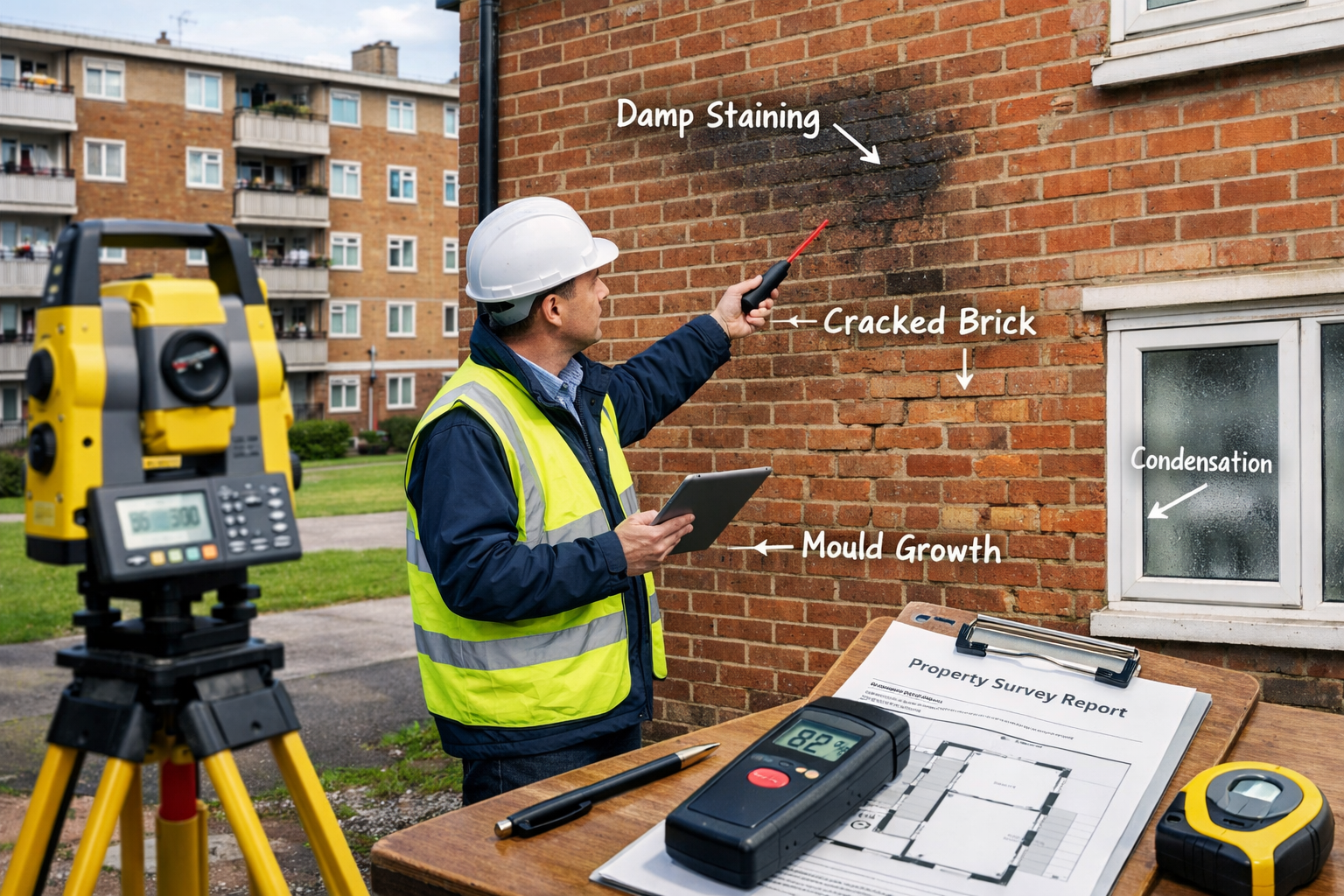
- Identifying structural defects, damp issues, and safety hazards
- Assessing building components and predicting replacement cycles
- Preparing detailed reports with photographic evidence
Planned Maintenance Programs
- Developing long-term maintenance strategies for housing stock
- Calculating lifecycle costs for building components
- Prioritizing repair and replacement schedules
- Managing capital investment programs worth millions of pounds
Disrepair and Compliance
- Investigating tenant disrepair claims and complaints
- Ensuring properties meet Decent Homes Standards
- Conducting inspections for Housing Health and Safety Rating System (HHSRS)
- Advising on legal compliance and regulatory requirements
Valuation and Asset Management
- Performing property valuations for right-to-buy applications
- Assessing properties for disposal or acquisition
- Contributing to strategic asset management decisions
- Supporting development and regeneration projects
The work of a surveyor social housing expert directly impacts the quality of life for thousands of residents, making it both challenging and rewarding.
Why Social Housing Surveying Is Different from Private Sector Work
Social housing surveying presents unique challenges that distinguish it from private residential or commercial building surveys. Understanding these differences is essential for anyone considering this career path.
Unique Sector Characteristics
| Aspect | Social Housing | Private Sector |
|---|---|---|
| Client Base | Local authorities, housing associations | Individual homeowners, investors |
| Property Types | Council estates, tower blocks, sheltered housing | Houses, flats, luxury properties |
| Regulatory Framework | Decent Homes Standards, HHSRS, Regulator of Social Housing | Building regulations, general property law |
| Funding | Public funds, social housing grants | Private capital, mortgages |
| Tenant Relationships | Vulnerable residents, legal obligations | Commercial transactions |
| Volume | Large-scale stock (hundreds/thousands of units) | Individual properties |
Legislative Knowledge Requirements
Social housing surveyors must navigate complex legislation including:
- Housing Act 2004 – Establishing HHSRS and licensing requirements
- Landlord and Tenant Act 1985 – Defining repair obligations
- Homes (Fitness for Human Habitation) Act 2018 – Setting minimum standards
- Building Safety Act 2022 – Introducing new safety requirements post-Grenfell
- Equality Act 2010 – Ensuring accessibility and adaptations
This specialized knowledge makes the surveyor social housing role highly specialized and valuable to employers.
Working with Vulnerable Populations
Unlike private sector work, social housing surveyors frequently encounter:
✅ Tenants with disabilities requiring property adaptations
✅ Families living in poverty or experiencing housing stress
✅ Elderly residents in sheltered accommodation
✅ Properties with severe disrepair affecting health
✅ Complex social situations requiring sensitivity and professionalism
The ability to communicate effectively with diverse populations while maintaining professional standards is essential.
Essential Qualifications and Skills for Surveyor Social Housing Roles
Breaking into social housing surveying requires specific educational credentials and professional development. The pathway is well-defined but demands commitment and continuous learning.
Academic Requirements
Undergraduate Education
Most social housing surveyors hold degrees in:
- Building Surveying (BSc/BEng)
- Quantity Surveying
- Construction Management
- Civil Engineering
- Architecture
RICS-accredited programs provide the most direct route to professional qualification. Universities across the UK offer specialized courses that combine technical knowledge with practical experience.
Postgraduate Options
For career changers or those seeking advancement:
- MSc Building Surveying
- Postgraduate Diploma in Building Surveying
- Conversion courses for non-cognate graduates
Professional Qualifications
RICS Chartered Status 🎓
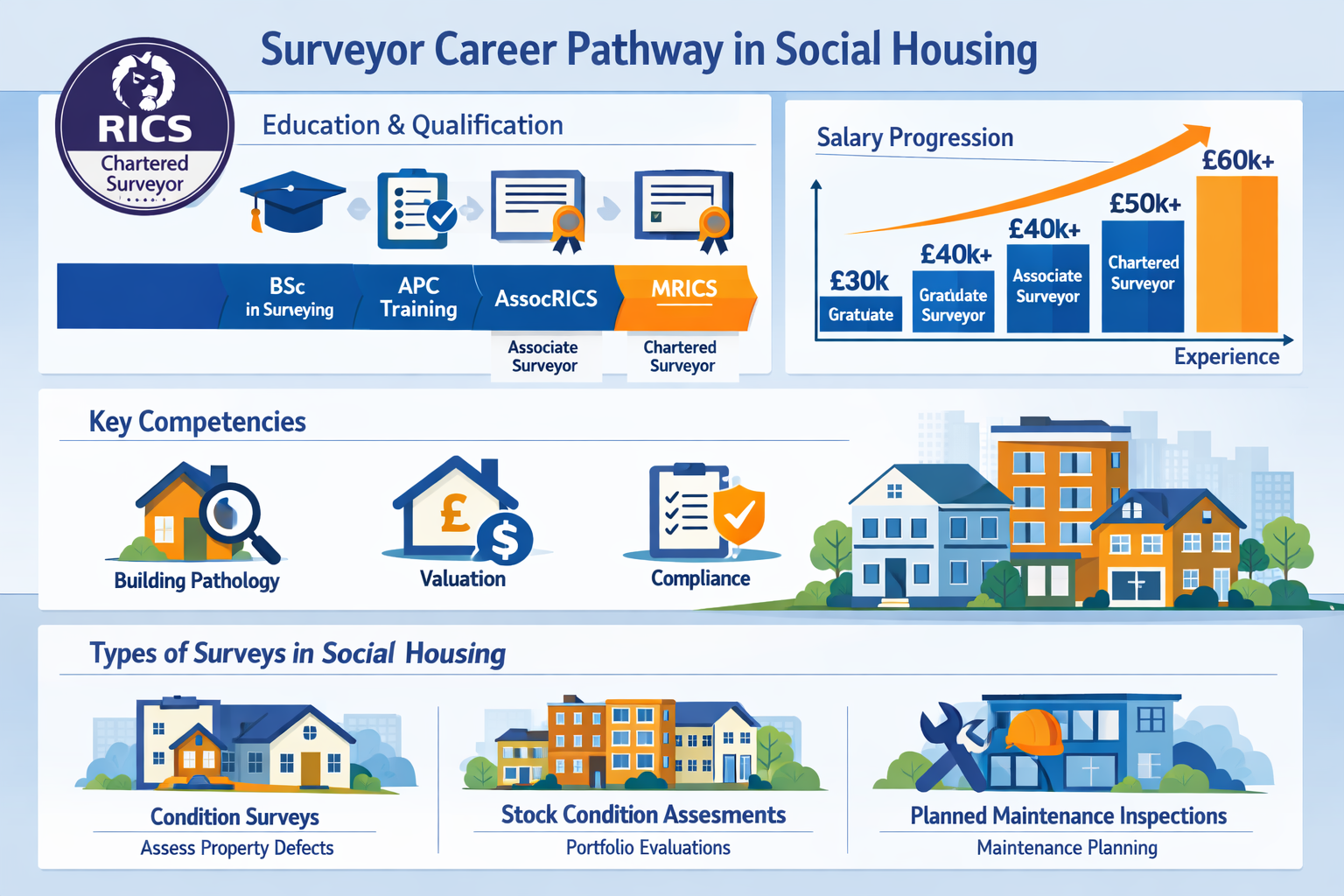
Becoming a Member of the Royal Institution of Chartered Surveyors (MRICS) is the gold standard for surveyor social housing professionals. The pathway includes:
- Academic qualification – RICS-accredited degree or conversion course
- Assessment of Professional Competence (APC) – Minimum 24 months structured training
- Final assessment – Professional interview demonstrating competence
- Continuing Professional Development (CPD) – Ongoing learning requirements
Alternative Routes
- AssocRICS – For technician-level professionals
- Chartered Institute of Building (CIOB) membership
- Association of Building Engineers (ABE) qualifications
Technical Skills
Successful social housing surveyors develop expertise in:
Building Pathology
- Identifying structural defects and deterioration
- Understanding damp causes and remediation
- Recognizing fire safety issues
- Assessing building component failures
Survey Technology
- Using moisture meters and thermal imaging cameras
- Operating drone technology for roof inspections
- Implementing digital survey software and mobile apps
- Creating 3D building models and BIM integration
Regulatory Compliance
- Applying HHSRS assessment methodology
- Understanding building regulations and codes
- Interpreting fire safety legislation
- Implementing accessibility standards
Financial Acumen
- Preparing cost estimates and budgets
- Managing capital programs
- Conducting lifecycle costing analysis
- Understanding procurement processes
For those interested in broader property expertise, exploring resources like the best London property valuation guide can provide additional context.
Soft Skills That Matter
Beyond technical knowledge, employers value:
💼 Communication – Explaining complex technical issues to non-technical audiences
💼 Empathy – Understanding tenant perspectives and vulnerabilities
💼 Time Management – Juggling multiple inspections and deadlines
💼 Problem-Solving – Finding practical solutions within budget constraints
💼 Negotiation – Working with contractors and resolving disputes
Career Pathways and Salary Expectations in Social Housing Surveying
The surveyor social housing career offers excellent progression opportunities and competitive remuneration. Understanding the typical career trajectory helps professionals plan their development.
Entry-Level Positions
Assistant Surveyor / Graduate Surveyor
- Salary Range: £24,000 – £32,000
- Responsibilities: Supporting senior surveyors, conducting basic inspections, preparing reports
- Experience Required: Recent graduate or APC candidate
- Typical Employers: Local councils, housing associations, property consultancies
New graduates typically begin by shadowing experienced professionals, learning inspection techniques, and building knowledge of housing stock and systems.
Mid-Career Roles
Surveyor / Building Surveyor
- Salary Range: £32,000 – £45,000
- Responsibilities: Independent inspections, managing small projects, handling disrepair claims
- Experience Required: 2-5 years post-qualification
- Qualifications: MRICS or equivalent
At this level, professionals take full responsibility for survey work, make recommendations on major repairs, and contribute to strategic planning.
Senior Surveyor
- Salary Range: £42,000 – £55,000
- Responsibilities: Managing teams, overseeing large capital programs, complex technical issues
- Experience Required: 5-10 years
- Additional Skills: Leadership, project management, budget control
Senior surveyors often specialize in areas such as planned maintenance, major works programs, or disrepair litigation support.
Senior Management
Principal Surveyor / Head of Property Services
- Salary Range: £55,000 – £75,000+
- Responsibilities: Strategic asset management, policy development, departmental leadership
- Experience Required: 10+ years with proven management track record
- Scope: Overseeing entire property portfolios worth hundreds of millions
Director of Asset Management
- Salary Range: £70,000 – £100,000+
- Responsibilities: Executive-level strategy, board reporting, organizational transformation
- Experience Required: Extensive senior leadership experience
- Impact: Shaping organizational direction and investment priorities
Alternative Career Paths
Experienced social housing surveyors can transition into:
- Consultancy – Providing specialist advice to multiple housing providers
- Expert Witness – Supporting legal cases involving property disrepair
- Academia – Teaching and research in building surveying programs
- Regulatory Bodies – Working for the Regulator of Social Housing or local government
- Development – Managing new build and regeneration programs
The versatility of surveying skills means professionals can explore diverse opportunities throughout their careers. Those interested in related fields might also explore party wall matters or leasehold valuation specializations.
Day-to-Day Work of a Surveyor Social Housing Professional
Understanding what a typical day looks like provides insight into the practical realities of this career. While no two days are identical, certain patterns emerge.
Morning: Planning and Site Visits
7:30 AM – Office Preparation
The day begins with reviewing the schedule, checking emails for urgent disrepair reports, and gathering equipment:
- Clipboard and survey forms
- Moisture meter and thermal imaging camera
- Personal protective equipment (PPE)
- Tablet or laptop with survey software
- Camera for photographic evidence
9:00 AM – Stock Condition Survey
First appointment involves inspecting a three-bedroom maisonette as part of a planned stock condition survey. The surveyor social housing specialist:
✓ Introduces themselves to the tenant and explains the inspection purpose
✓ Systematically examines all rooms, noting condition of walls, ceilings, floors
✓ Checks windows, doors, heating systems, and electrical installations
✓ Tests for damp using moisture meters
✓ Photographs defects and areas requiring attention
✓ Records findings on digital survey forms
✓ Discusses any immediate concerns with the tenant
11:00 AM – Emergency Inspection
Called to investigate a reported ceiling collapse in a ground-floor flat. This requires:
- Assessing structural safety and determining if the property is habitable
- Identifying the cause (water leak from above, structural failure, etc.)
- Arranging emergency repairs and temporary accommodation if needed
- Coordinating with contractors and housing management
- Documenting everything for insurance and legal purposes
Afternoon: Office Work and Meetings
1:00 PM – Report Writing
Back at the office, time is dedicated to:
- Completing detailed survey reports from morning inspections
- Uploading photographs and creating annotated diagrams
- Calculating repair costs and prioritizing works
- Updating asset management databases
- Reviewing contractor quotes for planned works
3:00 PM – Team Meeting
Weekly meeting with the property services team to discuss:
- Progress on capital investment program
- Challenging disrepair cases requiring specialist input
- Budget performance and forecasting
- Policy changes and regulatory updates
- Coordination between different departments
4:30 PM – Tenant Consultation
Meeting with a disabled tenant to discuss proposed adaptations:
- Assessing requirements for level access shower installation
- Explaining the process and timescales
- Coordinating with occupational therapists
- Arranging contractor access and minimizing disruption
Additional Responsibilities
Throughout the week, social housing surveyors also:
📋 Attend site meetings with contractors during major works projects
📋 Provide technical advice to housing officers and maintenance teams
📋 Review building plans for new developments or refurbishments
📋 Conduct fire risk assessments and safety inspections
📋 Prepare committee reports on asset management strategy
📋 Manage procurement processes for professional services
📋 Respond to freedom of information requests and legal inquiries
The variety keeps the role engaging, though it can be demanding when balancing urgent issues with long-term strategic work.
Challenges and Rewards of Being a Surveyor Social Housing Expert
Like any career, social housing surveying presents both difficulties and satisfactions. Understanding these helps set realistic expectations.
Common Challenges
Budget Constraints 💰
Social housing providers operate with limited resources, meaning:
- Difficult decisions about prioritizing repairs
- Pressure to find cost-effective solutions
- Balancing immediate needs against long-term planning
- Working within strict financial controls
Difficult Working Conditions
Properties may present:
- Severe disrepair with health hazards
- Hoarding situations requiring sensitive handling
- Aggressive or distressed tenants
- Properties in high-crime areas
- Exposure to asbestos, pests, or contamination
Emotional Demands
Witnessing poor living conditions and vulnerable residents can be:
- Emotionally draining and stressful
- Frustrating when solutions are delayed
- Challenging to maintain professional boundaries
- Difficult when resources don’t match needs
Workload Pressures
High caseloads mean:
- Tight deadlines for inspections and reports
- Balancing reactive and planned work
- Managing stakeholder expectations
- Long hours during peak periods
“The hardest part is seeing families living in conditions that aren’t acceptable, knowing there’s a long waiting list for repairs. You have to prioritize based on risk, but every case matters to someone.” – Senior Surveyor, London Housing Association
Professional Rewards
Making a Real Difference 🏆
The surveyor social housing role offers:
- Direct positive impact on people’s living conditions
- Satisfaction of solving complex building problems
- Contributing to community wellbeing
- Ensuring vulnerable residents have safe homes
Job Security and Stability
The sector provides:
- Consistent demand for qualified professionals
- Recession-resistant employment
- Public sector pension schemes
- Generous annual leave and benefits
Continuous Learning
The field offers:
- Exposure to diverse building types and ages
- Evolving technology and survey methods
- Changing legislation and standards
- Professional development opportunities
Career Progression
Clear pathways include:
- Structured progression from graduate to senior roles
- Opportunities to specialize in areas of interest
- Management and leadership positions
- Transferable skills for broader property careers
Many professionals find the combination of technical challenge and social purpose uniquely fulfilling, making it a rewarding long-term career choice.
How to Get Started as a Surveyor Social Housing Professional
For those inspired to pursue this career, taking the right first steps is crucial. Here’s a practical roadmap for entering the field.
For Students and Recent Graduates
Step 1: Choose the Right Education
- Research RICS-accredited building surveying programs at universities
- Consider location, course content, and industry links
- Look for programs offering placement years in social housing
- Attend open days and speak with current students
Step 2: Gain Relevant Experience
While studying:
- Apply for summer internships with housing associations or councils
- Seek part-time work with property maintenance companies
- Volunteer with housing charities or advice services
- Join professional societies and attend networking events
Step 3: Complete Your APC
After graduation:
- Secure a graduate position offering structured APC training
- Find an experienced counselor and supervisor
- Maintain detailed records of competency development
- Attend APC workshops and preparation courses
- Schedule your final assessment when ready
For Career Changers
Assess Your Transferable Skills
Professionals from construction, architecture, engineering, or property management already possess valuable knowledge. Identify gaps and address them through:
- Postgraduate conversion courses
- Distance learning programs
- Apprenticeship routes (available for mature learners)
- On-the-job training with supportive employers
Network Strategically
- Attend housing sector conferences and events
- Join LinkedIn groups focused on social housing
- Connect with surveyors working in the field
- Seek informational interviews to learn about opportunities
Consider Entry Points
Alternative routes include:
- Technical surveyor or assistant roles while gaining qualifications
- Moving from private sector surveying into social housing
- Transitioning from housing management into technical roles
- Freelance or consultancy work building sector experience
Finding Employment Opportunities
Where to Look
- Housing Association Websites – Most advertise vacancies directly
- Local Council Job Boards – Regular surveyor positions posted
- Specialist Recruiters – Agencies focusing on housing and construction
- Professional Networks – RICS job board and sector publications
- LinkedIn – Many roles advertised on professional networks
Preparing Applications
Strong applications demonstrate:
- Understanding of social housing challenges and context
- Relevant technical knowledge and qualifications
- Commitment to public service and social impact
- Examples of problem-solving and communication skills
- Awareness of current sector issues (building safety, decarbonization, etc.)
Interview Preparation
Expect questions about:
- Technical scenarios requiring practical solutions
- Handling difficult situations with tenants or contractors
- Understanding of relevant legislation and standards
- Approach to prioritization and decision-making
- Commitment to equality, diversity, and inclusion
For those based in specific areas, exploring opportunities with chartered surveyors in London or chartered surveyors in Surrey can provide localized options.
The Future of Surveyor Social Housing Careers in 2026 and Beyond
The social housing sector faces significant challenges and opportunities that will shape surveying careers in coming years. Understanding these trends helps professionals prepare for the future.
Building Safety Revolution
Following the Grenfell Tower tragedy, building safety has become paramount. The Building Safety Act 2022 introduces:
New Responsibilities
- Enhanced inspection regimes for high-rise buildings
- Mandatory competence requirements for professionals
- Stricter accountability for building safety
- Regular safety case reporting
Career Implications
- Growing demand for fire safety specialists
- Higher professional standards and qualifications
- Increased scrutiny and professional liability
- Opportunities in remediation and retrofit programs
Decarbonization and Sustainability
Social housing providers must achieve net-zero carbon by 2050, creating massive demand for:
🌱 Retrofit Expertise – Surveying properties for energy efficiency improvements
🌱 Sustainable Materials – Specifying low-carbon building solutions
🌱 Performance Assessment – Evaluating thermal performance and energy use
🌱 Green Technology – Understanding heat pumps, solar panels, and ventilation systems
This transition represents one of the largest investment programs in social housing history, offering extensive career opportunities for surveyors with sustainability expertise.
Digital Transformation
Technology is revolutionizing how surveyor social housing professionals work:
Emerging Technologies
- Artificial Intelligence – Predictive maintenance algorithms identifying failures before they occur
- Drones and Robotics – Automated inspections of difficult-to-access areas
- Building Information Modeling (BIM) – Digital twins of entire housing portfolios
- Mobile Technology – Real-time data capture and reporting
- Big Data Analytics – Strategic asset management based on comprehensive datasets
Required Skills
Future surveyors need:
- Digital literacy and comfort with new technologies
- Data analysis and interpretation capabilities
- Adaptability to changing tools and methods
- Understanding of cybersecurity and data protection
Regulatory Landscape
Expect continued evolution in:
- Consumer standards and tenant rights
- Professional competence frameworks
- Building regulations and safety requirements
- Environmental performance standards
- Accessibility and adaptability requirements
Staying current through CPD and professional engagement will be essential for career success.
Demographic Changes
The UK’s aging population and changing household structures mean:
- Increased demand for adapted and accessible housing
- Growing need for sheltered and supported housing expertise
- Focus on lifetime homes and inclusive design
- Specialization opportunities in older persons’ housing
Sector Consolidation and Growth
Housing associations are merging to create larger organizations, resulting in:
- More sophisticated asset management approaches
- Greater investment in professional development
- Opportunities to work across diverse geographical areas
- Potential for specialization within larger teams
The outlook for surveyor social housing careers remains extremely positive, with strong demand, good salaries, and meaningful work ensuring this remains an attractive profession.
Conclusion
The role of a surveyor social housing professional combines technical expertise, social purpose, and career stability in a uniquely rewarding way. These specialists ensure that millions of UK residents have safe, decent, and well-maintained homes, making their work essential to community wellbeing.
From conducting detailed building inspections to managing multi-million-pound capital programs, social housing surveyors tackle diverse challenges daily. The career demands strong technical knowledge, professional qualifications like RICS accreditation, and the soft skills to work effectively with vulnerable populations and diverse stakeholders.
Key Points to Remember
✅ Social housing surveying is a specialized field distinct from private sector work, requiring knowledge of specific legislation and regulatory frameworks
✅ Career pathways are clear and well-defined, from graduate positions through to senior management roles with salaries ranging from £24,000 to £100,000+
✅ The sector faces exciting challenges including building safety improvements, decarbonization programs, and digital transformation, creating abundant opportunities
✅ Professional qualifications, particularly RICS chartered status, are essential for career progression and credibility
✅ The work offers genuine social impact, helping ensure vulnerable residents have safe and decent homes
Next Steps for Aspiring Social Housing Surveyors
If you’re a student or recent graduate:
- Research RICS-accredited building surveying programs and apply to universities
- Seek internships or work experience with housing associations or local councils
- Join student chapters of professional bodies and attend industry events
- Begin building your professional network through LinkedIn and sector conferences
If you’re considering a career change:
- Assess your transferable skills and identify qualification gaps
- Explore postgraduate conversion courses or apprenticeship routes
- Connect with professionals in the field for informational interviews
- Apply for entry-level or technical positions while pursuing qualifications
For current professionals seeking advancement:
- Complete your RICS APC if not yet chartered
- Develop specialist expertise in areas like building safety, sustainability, or major works
- Pursue management training and leadership development
- Consider consultancy or expert witness work to diversify your experience
The social housing sector needs talented, committed professionals now more than ever. With aging housing stock, increasing regulatory requirements, and ambitious sustainability targets, demand for qualified surveyors will only grow. For those seeking a career that combines technical challenge, continuous learning, and genuine social impact, becoming a surveyor social housing specialist offers an excellent choice.
Whether you’re just starting your career journey or looking to transition into this rewarding field, the opportunities are extensive and the need is urgent. Take the first step today toward a profession that truly makes a difference in people’s lives while building your own successful and fulfilling career.
For more information about surveying careers and property expertise, visit Kingston Surveyors or explore their comprehensive blog covering various aspects of property surveying and valuation.