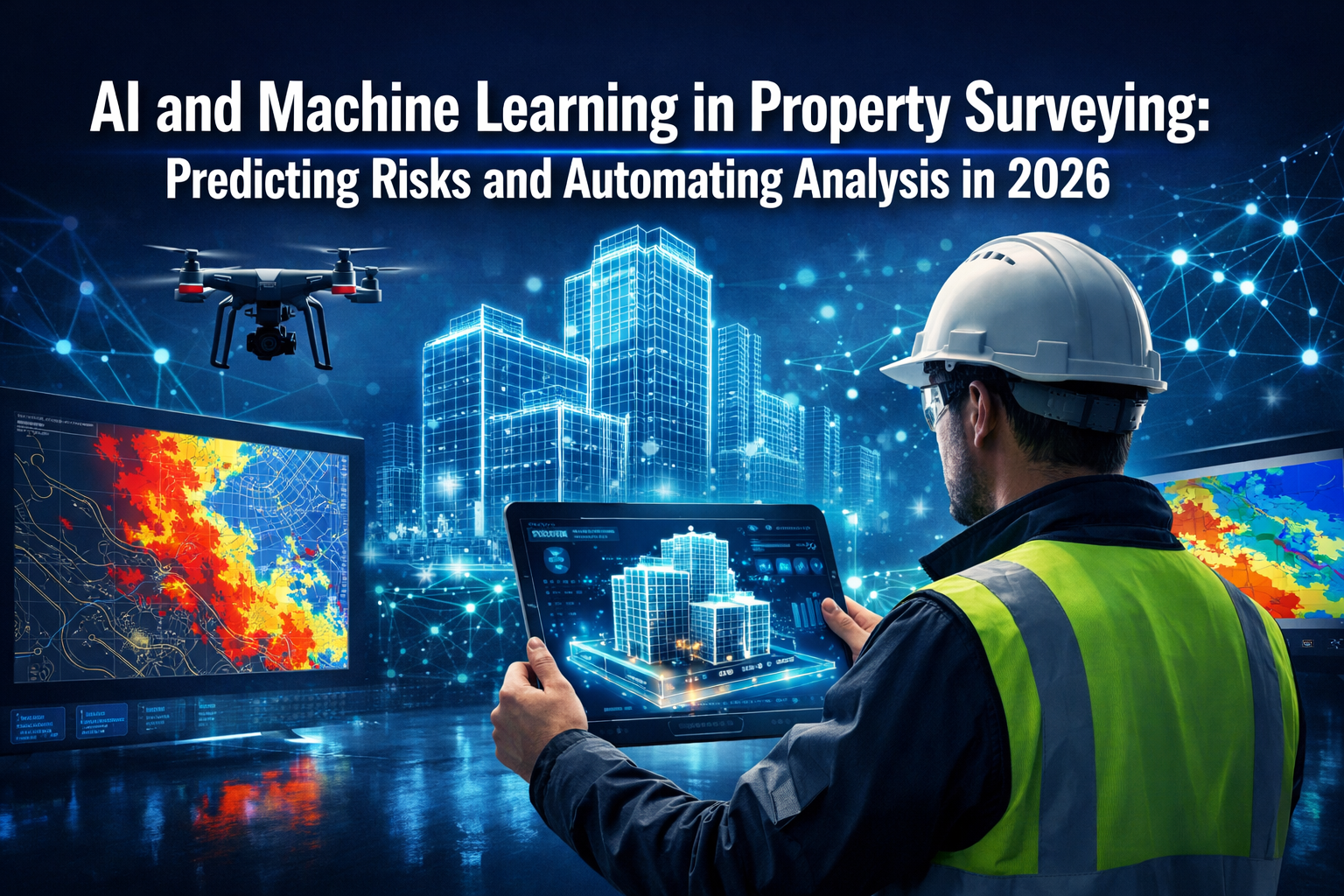

The property surveying profession stands at a transformative crossroads in 2026. Imagine a surveyor who can predict a building's structural risks before setting foot on site, detect hidden defects invisible to the human eye, and generate comprehensive analysis reports in minutes rather than days. This isn't science fiction—it's the reality of AI and Machine Learning in Property Surveying: Predicting Risks and Automating Analysis in 2026. As digital transformation accelerates across the architecture, engineering, and construction (AEC) sector, artificial intelligence is processing massive datasets to detect subtle changes, predict natural disasters like floods and landslides, and streamline workflows that once consumed countless hours of manual labor.
The surveying industry is experiencing what experts call "accelerating digital transformation" driven by mounting pressure to deliver faster, more accurate results in an increasingly complex property market.[6] While adoption has been gradual—only 27% of AEC sector professionals currently use AI tools—the trajectory is unmistakable: 94% of current adopters plan to increase their usage in 2026.[5] This surge signals a fundamental shift in how property professionals assess risk, value assets, and serve clients.
Key Takeaways
-
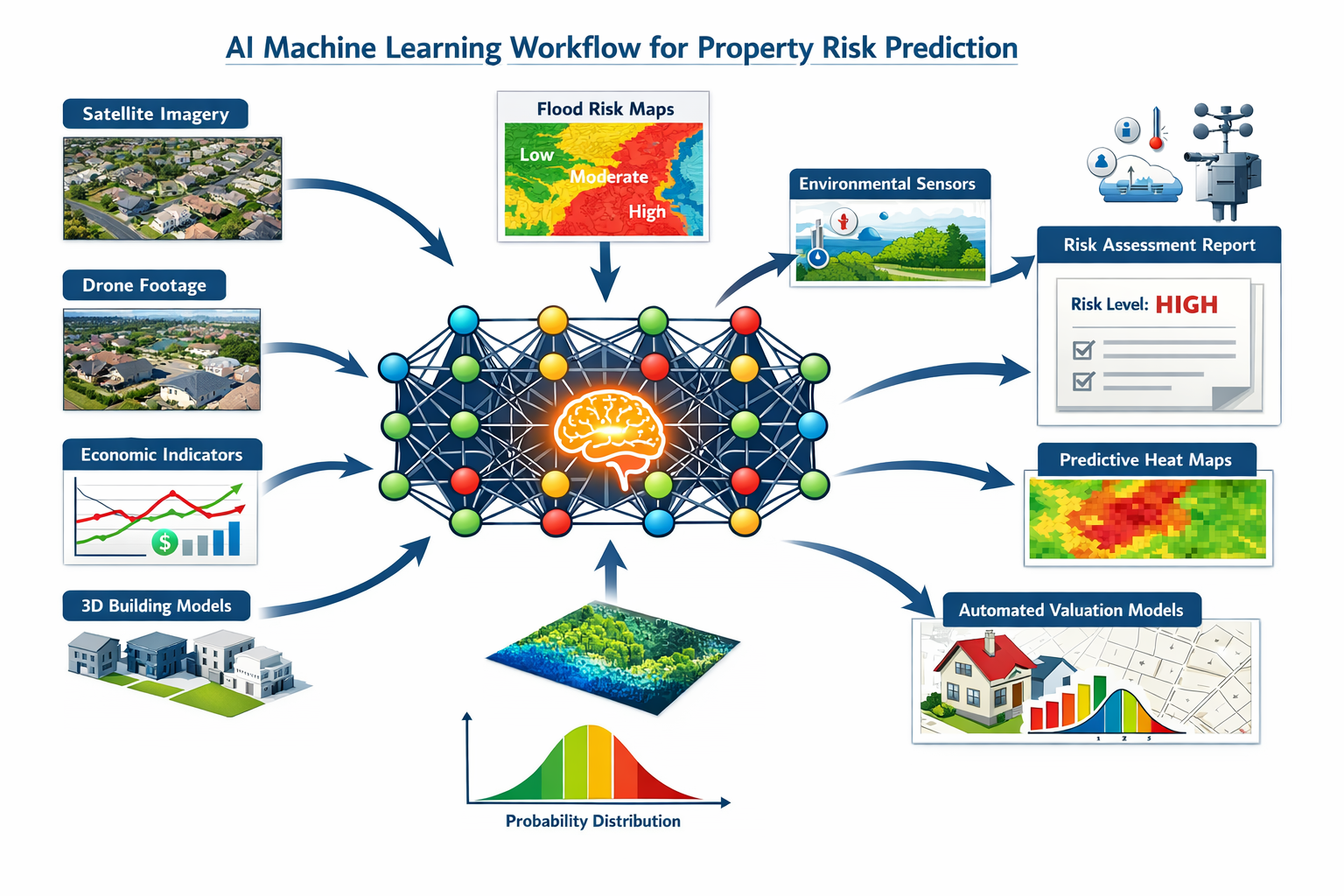
AI processes multiple data streams simultaneously: Machine learning models now synthesize economic indicators, environmental factors, neighborhood metrics, satellite imagery, and textual descriptions to provide comprehensive property analysis that would take humans weeks to compile.[1]
-
Predictive risk modeling transforms decision-making: AI-powered systems can forecast property-specific risks including flood probability, structural deterioration, and market value fluctuations under different economic scenarios, enabling proactive rather than reactive strategies.[1]
-
Human-AI collaboration is the new standard: Rather than replacing professional judgment, AI augments surveyor expertise by automating routine tasks, flagging potential issues, and providing data-driven insights that enhance traditional building survey methodologies.[1]
-
Drone-AI integration extends surveyor capabilities: Unmanned aerial vehicles combined with machine vision can inspect rooftops, large estates, and hazardous areas while AI interprets imagery to identify defects, measure dimensions, and assess conditions at unprecedented scale.[3]
-
Real-time dynamic analysis replaces static snapshots: AI-driven valuations and risk assessments continuously update as market conditions shift, functioning as living documents rather than point-in-time reports.[1]
How AI Processes Massive Datasets for Property Analysis in 2026
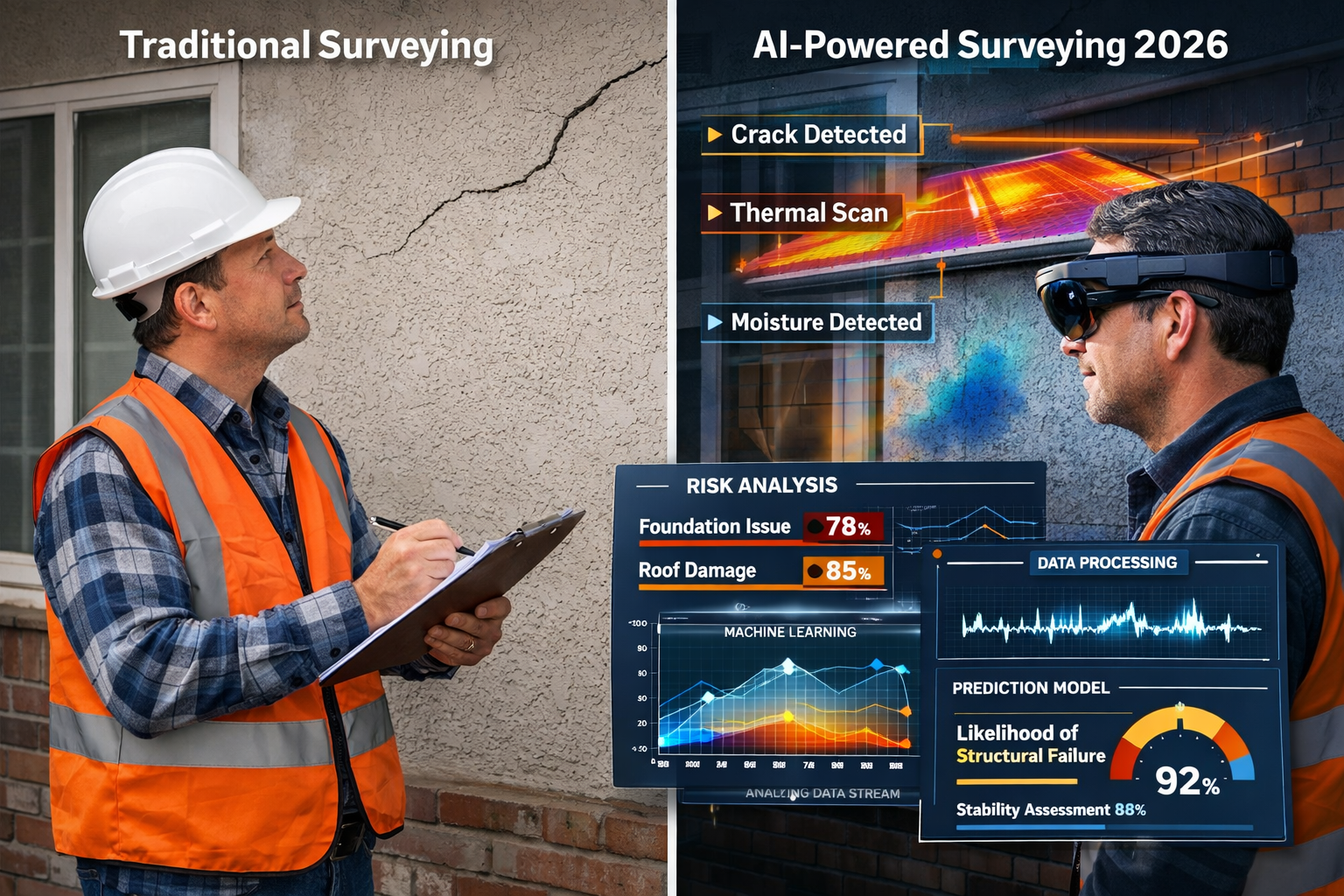
The Data Revolution in Property Surveying
The foundation of AI and Machine Learning in Property Surveying: Predicting Risks and Automating Analysis in 2026 lies in the technology's remarkable ability to process and synthesize vast quantities of disparate data. Modern machine learning models can simultaneously analyze:
📊 Economic Indicators: Interest rates, employment statistics, inflation trends, mortgage availability, and local economic development patterns
🌍 Environmental Factors: Flood risk zones, soil composition, seismic activity, climate change projections, urban development plans, and proximity to environmental hazards
🏘️ Neighborhood Metrics: School ratings, crime statistics, transportation access, amenity proximity, demographic trends, and community development initiatives
📸 Visual Data: Property photographs, satellite imagery, drone footage, thermal imaging, and historical building records
📝 Textual Information: Property descriptions, planning applications, historical maintenance records, local authority reports, and market commentary
This multi-modal data integration represents a quantum leap beyond traditional surveying methods. Where a conventional structural survey relies primarily on physical inspection and professional judgment, AI-enhanced surveys incorporate layers of contextual intelligence that reveal patterns invisible to individual analysis.[1]
Machine Vision Breakthroughs Transform Site Analysis
One of the most significant advances in 2026 is the application of sophisticated machine vision models to property surveying. Technologies like Meta's Segment Anything and similar platforms can classify building form and land use even in areas lacking structured data—a capability described as "enormously valuable in early-stage site analysis."[3]
These systems can:
- Identify building materials from aerial imagery with accuracy approaching 95%
- Detect structural anomalies such as roof sagging, wall bulging, or foundation settlement through subtle visual cues
- Measure dimensions and calculate floor areas without manual measurement
- Track changes over time by comparing historical imagery to identify deterioration patterns
- Assess maintenance condition by analyzing surface textures, discoloration, and vegetation encroachment
The practical implications are profound. A surveyor preparing a roof survey can now leverage AI to pre-identify potential problem areas before the site visit, making inspections more targeted and efficient. The technology doesn't replace the surveyor's expertise but rather directs it toward the most critical issues.
Automated Routine Task Processing
AI excels at automating repetitive, data-heavy processes that traditionally consumed significant professional time. In 2026, machine learning systems routinely handle:
✅ Lease abstraction: Extracting key terms, dates, and obligations from lengthy lease documents
✅ Rent roll analysis: Comparing rental income across portfolios and identifying anomalies or optimization opportunities
✅ Comparable evidence collation: Gathering and organizing recent sales data for valuation purposes
✅ Initial valuation modeling: Generating preliminary property valuations based on multiple valuation methodologies
✅ Report generation: Creating standardized sections of survey reports from structured data inputs
✅ Compliance checking: Verifying that properties meet regulatory requirements and building codes
This automation delivers dual benefits: it reduces human error inherent in manual data processing while freeing surveyors to focus on higher-value activities requiring professional judgment, client interaction, and complex problem-solving.[3] The time savings can be substantial—tasks that once required hours now complete in minutes.
3D Modeling and Cadastre Development
The demand for 3D cadastres is growing as urban environments become increasingly vertical.[2] Mobile mapping technologies combined with AI processing now enable creation of accurate three-dimensional property models that capture:
- Building footprints and heights with centimeter-level precision
- Internal floor layouts derived from multiple data sources
- Underground utilities and infrastructure mapped through integrated sensor data
- Property boundaries in three dimensions, essential for complex developments
- Volumetric measurements for valuation and planning purposes
These 3D models serve multiple purposes beyond visualization. They become digital twins that can simulate various scenarios—how will shadows from a proposed development affect neighboring properties? What flood depth would reach critical building systems? How would structural modifications impact load distribution?
For professionals conducting commercial building surveys, these digital representations provide unprecedented analytical capabilities, enabling virtual inspections, precise measurements, and detailed planning before physical intervention.
Predicting Risks: From Floods to Structural Failures
Environmental Risk Prediction and Climate Modeling
Perhaps the most impactful application of AI and Machine Learning in Property Surveying: Predicting Risks and Automating Analysis in 2026 lies in predictive risk assessment. Machine learning models can now forecast property-specific environmental hazards with remarkable accuracy by synthesizing:
🌊 Flood Risk Analysis: AI systems process topographical data, historical rainfall patterns, drainage capacity, climate projections, and real-time weather forecasts to generate probabilistic flood risk assessments. These aren't simple binary classifications but nuanced predictions that estimate flood depth, duration, and probability under various climate scenarios.
⛰️ Landslide and Subsidence Prediction: By analyzing soil composition, slope angles, vegetation coverage, rainfall patterns, and historical ground movement data, machine learning models identify properties at elevated risk of ground instability—critical information for areas with clay soils or mining history.
🔥 Fire Risk Assessment: In areas prone to wildfires, AI evaluates vegetation proximity, building materials, access routes, historical fire patterns, and climate conditions to quantify fire risk and inform mitigation strategies.
These predictive capabilities transform how surveyors approach specific defect reports and risk assessments. Rather than relying solely on historical data and general risk zones, professionals can provide clients with property-specific risk profiles that account for unique characteristics and projected future conditions.[1]
Structural Deterioration Forecasting
AI's pattern recognition capabilities excel at predicting structural deterioration before failures become critical. Machine learning models trained on thousands of building lifecycles can:
- Estimate remaining service life of building components (roofs, foundations, mechanical systems)
- Predict maintenance requirements based on building age, materials, climate exposure, and usage patterns
- Identify early warning signs of structural issues through subtle indicators in thermal imaging, moisture readings, and visual inspection data
- Forecast repair costs with greater accuracy by analyzing historical maintenance data and current market conditions
- Prioritize interventions based on risk severity and cost-benefit analysis
For properties requiring dilapidation surveys, AI-enhanced analysis provides more defensible assessments of deterioration patterns and causation, supporting both landlord and tenant positions with data-driven evidence.
Probabilistic Scenario Modeling
One of the most sophisticated applications involves probabilistic scenario modeling—the ability to simulate how property values and risks evolve under different future conditions.[1] These models can answer complex questions:
- How would a 2% interest rate increase affect property values in different neighborhoods?
- What impact would a major infrastructure project have on surrounding property risks and values?
- How do different climate scenarios affect long-term property viability?
- What is the probability distribution of repair costs over the next decade?
This capability transforms strategic decision-making for investors, lenders, and property owners. Rather than single-point estimates, stakeholders receive probability distributions that quantify uncertainty and support more informed risk management.
Enhanced Risk Assessment for Lenders and Investors
Financial institutions are among the primary beneficiaries of AI-enhanced risk prediction. Machine learning models provide more robust risk assessments including:
💰 Default probability estimation: Evaluating likelihood of mortgage default based on projected property values, borrower characteristics, and economic scenarios
📈 Market timing optimization: Identifying emerging markets before they fully mature, enabling early investment in appreciating areas
🏗️ Development feasibility analysis: Assessing viability of development projects by modeling construction costs, market absorption, and risk factors
🔍 Portfolio risk management: Analyzing concentration risk, correlation patterns, and stress scenarios across property portfolios
This enhanced analytical capability supports more accurate pricing of risk, better capital allocation, and improved returns for institutional investors while providing borrowers with more competitive financing terms based on comprehensive risk profiles.[1]
Streamlining Workflows: Implementation and Emerging Tools
The Human-AI Collaboration Model
A critical insight emerging in 2026 is that AI augments rather than replaces professional judgment. The most successful implementations follow a human-AI collaboration model where:
👤 Surveyors provide: Professional expertise, contextual understanding, client relationship management, ethical judgment, and final decision authority
🤖 AI provides: Data processing, pattern recognition, routine task automation, consistency checking, and analytical support
This combined approach is becoming the industry standard, particularly in markets where speed and precision matter most.[1] The surveyor remains the trusted professional advisor, but now equipped with analytical tools that enhance accuracy and efficiency.
Drone-AI Integration for Extended Reach
The integration of unmanned aerial vehicles (UAVs) with AI interpretation represents one of the most practical workflow enhancements in 2026. Drones extend surveyor reach to:
- Rooftops and elevated structures without scaffolding or access equipment
- Large estates and portfolios covering extensive areas efficiently
- Hazardous or inaccessible locations reducing safety risks
- Remote or difficult terrain where traditional access is challenging
When drone-captured imagery feeds into AI analysis systems, the combination delivers unprecedented efficiency. A comprehensive roof inspection that might have required a full day of access arrangements, physical inspection, and manual documentation can now be completed in hours—with the AI flagging potential defects for surveyor review and validation.[3]
For professionals conducting boundary surveys, drone-based mapping combined with AI processing provides accurate measurements and documentation while minimizing time on site.
Emerging AI Tools for Surveyors in 2026
The market for AI-powered surveying tools has matured significantly, with several categories of solutions now available:
1. Automated Valuation Models (AVMs)
These systems analyze millions of data points from historical sales trends and real-time market conditions to generate near-instant property valuations. Companies like iBuyers leverage these tools to make cash offers within hours.[1] While not replacing professional valuations for complex properties, AVMs provide useful benchmarks and support high-volume valuation work.
2. Defect Detection Systems
Specialized AI models trained on thousands of building defects can identify:
- Structural cracks and their severity
- Moisture intrusion and damp patterns
- Insulation deficiencies through thermal analysis
- Roof damage and deterioration
- Foundation settlement indicators
3. Document Intelligence Platforms
Natural language processing tools extract relevant information from:
- Title documents and legal descriptions
- Planning permissions and building regulations
- Historical survey reports
- Maintenance records and warranties
- Lease agreements and tenancy documentation
4. Predictive Maintenance Systems
These platforms forecast when building components will require maintenance or replacement, supporting:
- Reinstatement cost assessments
- Lifecycle costing for developments
- Maintenance budget planning
- Asset management optimization
5. Market Analysis and Forecasting Tools
AI-driven platforms provide real-time market intelligence including:
- Price trend analysis and forecasting
- Rental yield predictions
- Supply-demand dynamics
- Neighborhood evolution tracking
- Investment opportunity identification
Implementation Tips for Surveying Practices
For practices looking to integrate AI and Machine Learning in Property Surveying: Predicting Risks and Automating Analysis in 2026, consider these implementation strategies:
Start with High-Volume, Routine Tasks 🎯
Begin automation with repetitive processes that consume significant time but require limited professional judgment—comparable data collection, initial report drafting, or document review. This delivers quick wins and builds confidence in AI capabilities.
Invest in Data Quality and Organization 📁
AI systems are only as good as the data they process. Establish robust data management practices including:
- Standardized data capture protocols
- Consistent naming conventions and file structures
- Regular data quality audits
- Integration between different data sources
- Secure storage with appropriate backup
Maintain Professional Skepticism 🔍
Always validate AI outputs, particularly for critical decisions. Use AI as a decision support tool, not a decision-making replacement. Establish review protocols where experienced surveyors verify AI-generated insights before client delivery.
Provide Team Training and Support 📚
Successful implementation requires team buy-in and capability development. Invest in:
- Training on AI tool functionality and limitations
- Workshops on interpreting AI outputs
- Clear protocols for when to rely on AI versus traditional methods
- Ongoing skill development as tools evolve
Consider Client Communication 💬
Be transparent with clients about AI usage in your services. Explain how technology enhances accuracy and efficiency while emphasizing that professional judgment remains central to your work. Many clients view AI adoption as evidence of forward-thinking practice.
Stay Current with Regulatory Developments ⚖️
As AI adoption grows, regulatory frameworks are evolving. Monitor guidance from professional bodies like RICS regarding acceptable AI use in different surveying contexts, particularly for RICS valuations and formal reports.
Integration with Traditional Surveying Workflows
The most effective implementations seamlessly blend AI capabilities with established surveying methodologies. For example, a comprehensive homebuyer report might incorporate:
- Pre-inspection AI analysis: Desktop review using satellite imagery, historical data, and environmental risk modeling to identify potential issues
- Targeted physical inspection: Surveyor focuses on AI-flagged areas plus standard inspection protocols
- AI-assisted documentation: Automated report generation for standard sections, with surveyor customization for property-specific findings
- Enhanced risk profiling: AI-generated probabilistic risk assessments supplement professional recommendations
- Client presentation: Interactive digital reports with AI-powered visualizations and scenario modeling
This hybrid approach delivers efficiency gains without compromising the professional judgment that clients value and regulations require.
Addressing Common Implementation Challenges
Practices adopting AI tools often encounter predictable challenges:
Challenge: Initial Cost and ROI Uncertainty 💰
Solution: Start with limited pilot projects targeting specific workflows. Measure time savings and accuracy improvements to build business case for broader adoption. Many AI platforms offer tiered pricing allowing gradual scaling.
Challenge: Team Resistance to Change 👥
Solution: Involve team members in tool selection and implementation. Emphasize how AI handles tedious tasks, allowing more time for interesting professional work. Celebrate early wins and share success stories.
Challenge: Data Privacy and Security Concerns 🔒
Solution: Select AI vendors with robust security credentials and clear data handling policies. Ensure compliance with GDPR and other relevant regulations. Implement access controls and audit trails.
Challenge: Integration with Existing Systems 🔧
Solution: Prioritize AI tools offering APIs and integration capabilities with your current practice management, reporting, and data storage systems. Consider professional IT support for complex integrations.
Challenge: Keeping Pace with Rapid Evolution ⚡
Solution: Allocate time for ongoing learning and tool evaluation. Join professional networks sharing AI implementation experiences. Maintain flexibility to adopt new capabilities as they emerge.
Real-Time Dynamic Analysis and Market Intelligence
From Static Snapshots to Continuous Insights
Traditional property valuations and risk assessments function as point-in-time snapshots—accurate when prepared but rapidly outdated as market conditions shift. In contrast, AI-driven systems provide continuously updated analysis that adjusts in real-time to changing market forces.[1]
This dynamic capability transforms how stakeholders use property intelligence:
- Lenders can monitor loan-to-value ratios continuously, triggering reviews when thresholds are breached
- Investors receive alerts when properties meet acquisition criteria or market conditions warrant disposition
- Developers track feasibility metrics as construction costs, interest rates, and market absorption evolve
- Property owners monitor asset values and optimize timing for refinancing or sale decisions
The shift from periodic to continuous analysis represents a fundamental change in property risk management and investment strategy.
Instant Valuation Models and Automated Pricing
The rise of iBuyer companies demonstrates AI's capability to generate near-instant property valuations by analyzing millions of data points.[1] While these automated valuations serve specific purposes—particularly in residential markets with abundant comparable data—they also illustrate the technology's potential.
For professional surveyors, instant valuation models serve as:
- Initial screening tools for portfolio acquisitions
- Benchmarks for validating detailed valuations
- Market pulse indicators tracking price movements in real-time
- Client self-service options for preliminary estimates before commissioning formal valuations
The key is understanding when automated valuations suffice versus when professional judgment is essential. Complex properties, unusual characteristics, or high-value transactions typically require traditional chartered surveyor expertise, while standard residential properties in data-rich markets may be adequately served by AI-generated estimates.
Enhanced Market Forecasting
Machine learning models excel at identifying subtle market patterns that indicate emerging trends:
- Neighborhood gentrification indicators: Tracking business openings, demographic shifts, property improvements, and investment activity that signal appreciation potential
- Supply-demand imbalances: Analyzing construction pipelines, absorption rates, and demographic trends to forecast market tightening or softening
- Price momentum shifts: Detecting when market trends are accelerating, plateauing, or reversing
- Correlation breakdowns: Identifying when historical relationships between property types or locations are changing
These insights support more informed investment decisions and better client advice regarding market timing and risk exposure.
The Future Trajectory: What's Next for AI in Property Surveying

Accelerating Adoption Through 2026 and Beyond
While current adoption rates remain modest—27% of AEC professionals using AI tools—the trajectory is clear. With 94% of current adopters planning to increase usage in 2026, the industry is approaching an inflection point.[5] Several factors are driving this acceleration:
Client Expectations: Property buyers, investors, and lenders increasingly expect fast turnaround times and data-driven insights that manual processes struggle to deliver
Competitive Pressure: Early adopters gain efficiency advantages that translate to better pricing, faster service, and enhanced capabilities
Technology Maturation: AI tools are becoming more reliable, easier to use, and better integrated with existing workflows
Cost Reduction: Cloud-based AI services are increasingly affordable, with subscription models accessible to practices of all sizes
Professional Body Support: Organizations like RICS are developing guidance frameworks that clarify appropriate AI use, reducing implementation uncertainty
Emerging Capabilities on the Horizon
Looking beyond 2026, several emerging capabilities promise to further transform property surveying:
🔮 Augmented Reality (AR) Site Inspections
Surveyors will use AR glasses overlaying AI-generated insights directly onto physical properties during inspections—highlighting defects, displaying historical data, and providing real-time analysis guidance.
🌐 Blockchain-Verified Property Intelligence
Integration of AI analysis with blockchain-based property records will create tamper-proof audit trails and enable instant verification of property characteristics and history.
🗣️ Natural Language Interfaces
Conversational AI will allow surveyors to query property databases, request analyses, and generate reports using natural language commands rather than complex software interfaces.
🤝 Collaborative AI Assistants
Rather than standalone tools, AI will function as persistent assistants that learn individual surveyor preferences, maintain project context, and proactively suggest relevant analyses.
🌍 Global Comparative Analysis
AI systems will enable meaningful comparisons across international markets, adjusting for regulatory differences, currency fluctuations, and market maturity to support global investment decisions.
Balancing Innovation with Professional Standards
As AI capabilities expand, the surveying profession faces important questions about maintaining professional standards and ethical practice:
- Transparency: When and how should AI usage be disclosed to clients?
- Accountability: Who bears responsibility when AI-assisted analysis proves incorrect?
- Competence: What training and understanding of AI systems should surveyors possess?
- Bias: How can practices ensure AI tools don't perpetuate historical biases in property valuation or risk assessment?
- Professional judgment: Where is the boundary between acceptable AI assistance and inappropriate delegation of professional responsibility?
Professional bodies and regulatory frameworks are evolving to address these questions, with emphasis on AI as a tool that enhances rather than replaces professional expertise. The consensus emerging in 2026 is that surveyors remain accountable for all work product, regardless of technological assistance employed.
Conclusion: Embracing AI While Preserving Professional Value
AI and Machine Learning in Property Surveying: Predicting Risks and Automating Analysis in 2026 represents more than technological advancement—it's a fundamental evolution in how property professionals deliver value to clients. The technology's ability to process massive datasets, predict risks with unprecedented accuracy, and automate routine workflows creates opportunities for practices that embrace change while maintaining the professional judgment that distinguishes expert surveyors from algorithmic analysis.
The evidence is compelling: AI can detect structural risks before they become failures, forecast environmental hazards with property-specific precision, and generate comprehensive analysis in fractions of the time required by manual methods. Machine vision identifies defects invisible to casual inspection. Predictive models simulate scenarios that inform better decisions. Drone-AI integration extends surveyor capabilities to previously inaccessible areas.
Yet the human element remains irreplaceable. Professional experience, contextual understanding, client relationship management, and ethical judgment cannot be automated. The most successful practitioners in 2026 are those who leverage AI to handle data processing and routine tasks while focusing their expertise on complex problem-solving, professional advice, and client service.
Actionable Next Steps for Surveying Practices
For practices ready to integrate AI capabilities, consider these concrete actions:
-
Conduct a workflow audit identifying tasks consuming significant time but requiring limited professional judgment—these are prime automation candidates
-
Research available tools specific to your practice areas, whether residential surveys, commercial valuations, or specialist work like party wall matters
-
Start with a pilot project testing AI tools on a limited scope to build experience and measure results before broader implementation
-
Invest in team development ensuring staff understand AI capabilities, limitations, and appropriate use cases
-
Establish quality control protocols for validating AI outputs before client delivery
-
Communicate value to clients explaining how AI adoption enhances service quality, accuracy, and efficiency
-
Stay informed about regulatory guidance, emerging tools, and industry best practices through professional networks and continuing education
-
Plan for continuous evolution recognizing that AI capabilities will continue advancing, requiring ongoing adaptation and learning
The surveying profession's digital transformation is accelerating, driven by client demands, competitive pressures, and technological maturation. Practices that thoughtfully integrate AI capabilities while preserving professional standards will thrive in this evolving landscape. Those that resist change risk obsolescence as clients increasingly expect the speed, accuracy, and insights that AI-enhanced surveying delivers.
The future of property surveying isn't human versus machine—it's human and machine working in concert, each contributing unique strengths to deliver superior outcomes. That future has arrived in 2026, and the opportunity belongs to those ready to embrace it.
References
[1] How Ai And Machine Learning Are Reshaping Property Valuations In 2026 – https://www.thepaintedhinge.com/how-ai-and-machine-learning-are-reshaping-property-valuations-in-2026/
[2] Land Surveying Propelled Into The Future With Ai And Drones – https://resource-erectors.com/land-surveying-propelled-into-the-future-with-ai-and-drones/
[3] What Surveyors Think Ai – https://ww3.rics.org/uk/en/modus/technology-and-data/surveying-tools/what-surveyors-think-ai.html
[4] Ai And Machine Learning In Property Surveying Predicting Risks And Automating Analysis – https://nottinghillsurveyors.com/blog/ai-and-machine-learning-in-property-surveying-predicting-risks-and-automating-analysis
[5] Architecture Engineering Construction Sector Slow To Adapt Ai Survey Shows – https://www.asce.org/publications-and-news/civil-engineering-source/article/2025/12/18/architecture-engineering-construction-sector-slow-to-adapt-ai-survey-shows
[6] Doubling Down On Digital – https://amerisurv.com/2026/02/01/doubling-down-on-digital/
[7] How Is Ai And Machine Learning Transforming Data Collection Operations In 2026 – https://flyguys.com/how-is-ai-and-machine-learning-transforming-data-collection-operations-in-2026/
[8] Ai For Real Estate 2026 – https://avenuehq.com/blog/ai-for-real-estate-2026