

'

London's property market is experiencing a remarkable resurgence in 2026, with construction cranes once again dominating the skyline and homeowners rushing to capitalize on rising property values through extensions, conversions, and renovations. This construction boom has triggered an unprecedented surge in party wall notifications, creating a complex landscape for property owners, surveyors, and developers navigating the intricacies of shared boundaries. Understanding Party Wall Agreements in London's 2026 Boom: Navigating Disputes as Construction Activity Rises has never been more critical for anyone embarking on building work that affects neighbouring properties.
As investment pours back into London's residential sector and homeowners seek to maximize their property's potential, the Party Wall etc. Act 1996 has become the cornerstone of neighbourly relations and legal compliance. With construction activity reaching levels not seen since before the pandemic, disputes over party walls, boundary excavations, and structural alterations are testing relationships between neighbours and demanding professional surveyor intervention at record rates. 🏗️
This comprehensive guide examines the current state of party wall matters in London's booming construction environment, providing practical steps for property owners, chartered surveyors, and developers to navigate notices, surveys, and dispute resolution effectively under the Party Wall Act.
Key Takeaways
- Construction boom triggers surge: London's 2026 property recovery has created unprecedented demand for party wall agreements, particularly for loft conversions, basement excavations, and boundary extensions
- Legal compliance is mandatory: The Party Wall etc. Act 1996 requires formal notices and agreements for specific building works—ignoring these requirements can result in court injunctions, work stoppages, and significant legal costs
- Surveyor involvement protects all parties: Professional party wall surveyors create binding Party Wall Awards that document construction specifics, prevent disputes, and establish clear responsibilities when neighbours dissent or fail to respond
- Costs and timelines matter: Party wall surveyor fees typically start at £1,200 (plus £1,000 per additional neighbour), while notice periods require two months for structural work and one month for excavations
- Documentation prevents future disputes: Comprehensive Schedules of Condition documenting neighbouring properties before work begins are essential for attributing any damage correctly and avoiding costly legal battles
Understanding the Party Wall etc. Act 1996 in London's Current Construction Climate
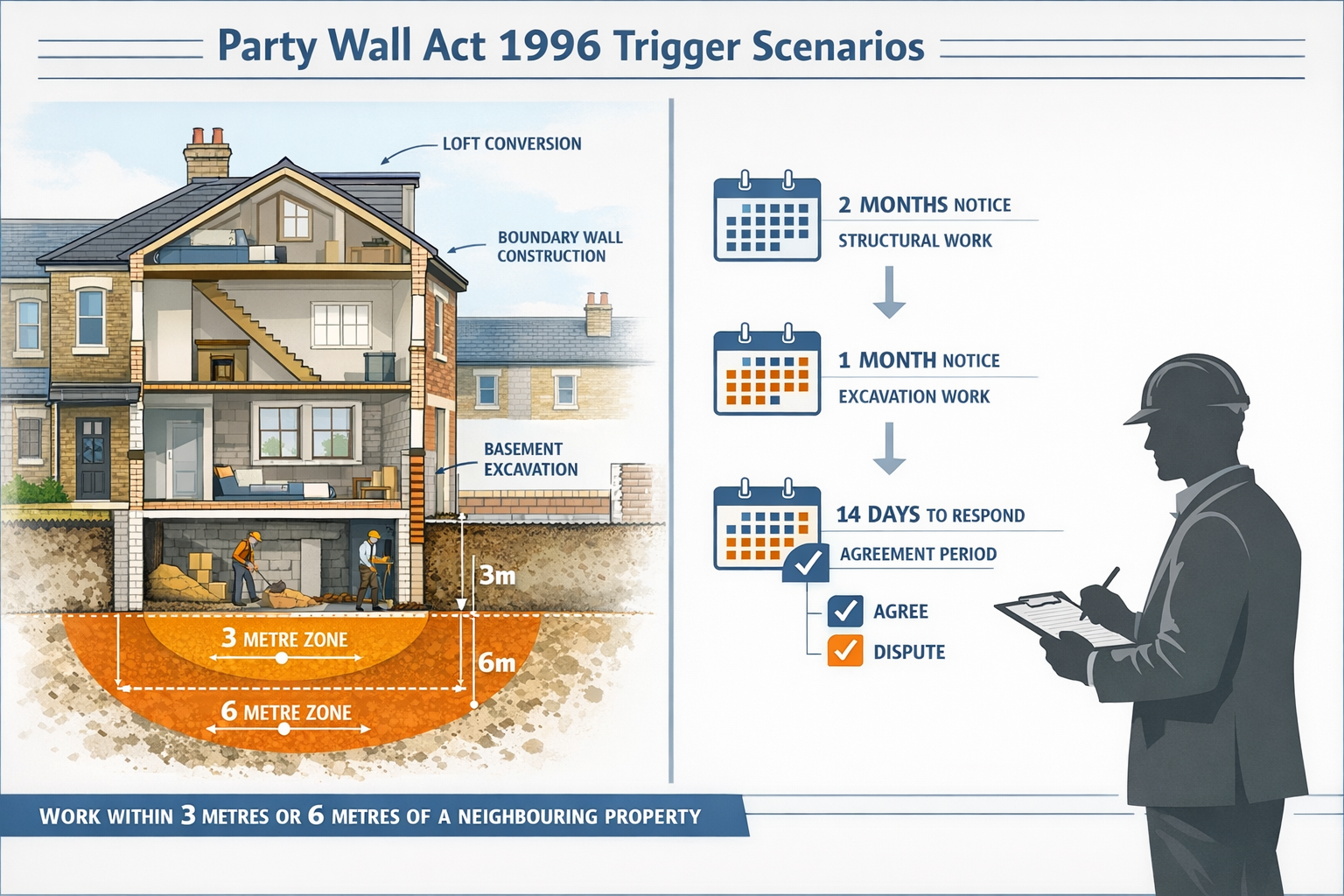
The Party Wall etc. Act 1996 provides the legal framework governing building work on or near shared boundaries between properties in England and Wales[1][4]. As London experiences its strongest construction activity in years during 2026, understanding this legislation has become essential for property owners, developers, and construction professionals operating in the capital's dense urban environment.
What Qualifies as a Party Wall?
A party wall is a shared wall or structure that stands on the boundary between two properties, typically found in:
- Terraced houses (the most common scenario in London)
- Semi-detached properties
- Flats with shared floors or ceilings
- Garden walls built along property boundaries
- Structures separating buildings in different ownership[1][4]
The Act applies specifically to England and Wales—property owners in Scotland or Northern Ireland operate under different legal frameworks[1][4]. This jurisdictional distinction becomes particularly important for surveyors working across the UK who must understand regional variations in party wall legislation.
When Is a Party Wall Agreement Required?
Understanding Party Wall Agreements in London's 2026 Boom: Navigating Disputes as Construction Activity Rises begins with recognizing the specific scenarios that trigger legal requirements. The Act mandates formal procedures for several common construction activities:
Structural Work on Existing Party Walls 🔨
- Cutting into a party wall to insert beams or joists
- Removing chimney breasts that form part of the party structure
- Increasing the height of a party wall
- Underpinning a party wall's foundations
- Installing damp proof courses in shared walls[1][3][4]
Building New Walls on Boundary Lines
- Constructing a new wall directly on the property boundary
- Building a wall astride the boundary line (straddling both properties)
- Erecting garden walls or boundary structures[4]
Excavation Near Neighbouring Properties
- Digging within three metres of a neighbouring building where the new foundations will be deeper than the neighbour's existing foundations
- Excavating within six metres of a neighbouring structure where the depth extends significantly below the neighbour's foundation level[1][3][4]
This "3-metre rule" and its 6-metre extension represent critical thresholds that frequently apply to basement conversions—one of London's most popular property enhancement projects in 2026. For detailed guidance on excavation requirements, property owners should consult information about the Party Wall Act 3-metre rule.
Common Applications in London's 2026 Construction Boom
The current surge in London construction activity has created specific patterns in party wall work. The most frequent applications include:
| Project Type | Party Wall Requirement | Typical Notice Period |
|---|---|---|
| Loft conversions | Structural work to party walls for steel beams | 2 months |
| Rear extensions | New walls on boundary lines | 2 months |
| Basement conversions | Excavation within 3-6 metres of neighbours | 1 month |
| Side extensions | Building on boundary lines | 2 months |
| Damp proofing | Insertion of DPC in party walls | 2 months |
Loft conversions represent the single most common trigger for party wall procedures in London and Essex, particularly as homeowners seek to add valuable living space without the expense of moving[4].
Party Wall Agreement vs. Party Wall Award: Understanding the Terminology
A crucial distinction often confuses property owners: the formal legal document created under the Party Wall etc. Act 1996 is technically called a Party Wall Award, not a "Party Wall Agreement"[1][4].
Party Wall Agreement refers to the informal consent process—when a neighbour receives notice and simply agrees to the proposed work in writing, no formal Award is necessary[1].
Party Wall Award is the binding legal document prepared by appointed surveyors when:
- A neighbour dissents (refuses consent)
- A neighbour fails to respond within 14 days
- Either party requests formal documentation regardless of consent[1][3]
The Award outlines construction specifics, establishes responsibilities, details protective measures, and creates legally enforceable obligations for all parties[1]. Understanding this distinction is essential for navigating party wall disputes effectively.
The Legal Consequences of Non-Compliance
Ignoring party wall requirements in London's competitive construction environment carries serious risks:
⚠️ Court injunctions stopping work immediately
⚠️ Legal costs for both parties mounting rapidly
⚠️ Claims for property damage without protective documentation
⚠️ Significant project delays while compliance is established retroactively
⚠️ Damaged neighbour relations that complicate future projects[1]
With construction activity surging in 2026, local authorities and neighbours have become increasingly vigilant about party wall compliance. The cost of proper compliance—typically £1,200 to £2,200 for surveyor involvement[6]—represents a fraction of the potential expenses from non-compliance litigation.
Separate from Planning Permission and Building Regulations
A common misconception among London property owners is that party wall procedures replace or incorporate planning permission and Building Regulations approval. In reality, these represent three distinct legal requirements[1]:
- Planning Permission: Required for certain alterations, extensions, and changes of use (local authority approval)
- Building Regulations: Ensures construction meets safety and performance standards (local authority inspection)
- Party Wall Procedures: Protects neighbours' rights during construction affecting shared boundaries (private agreement between owners)
Most significant London construction projects in 2026 require compliance with all three frameworks. Property owners should engage chartered surveyors in London who understand these intersecting requirements and can coordinate the various approval processes efficiently.
The Party Wall Notice Process: Practical Steps for London Property Owners in 2026
Successfully navigating Party Wall Agreements in London's 2026 Boom: Navigating Disputes as Construction Activity Rises requires understanding the formal notice procedures that protect both building owners and their neighbours. The process follows a structured timeline with specific legal requirements at each stage.
Step 1: Determine Whether Party Wall Notice Is Required
Before commencing any construction work, property owners must assess whether their project triggers Party Wall Act requirements. This assessment should occur during the planning stage, ideally before submitting planning applications or finalizing architectural designs.
Key questions to ask:
- Does the work involve cutting into, building on, or altering a shared wall?
- Will excavation occur within 3 metres of a neighbouring building with deeper foundations?
- Will excavation within 6 metres go significantly below neighbouring foundations?
- Does the project involve building a new wall on or astride the boundary line?[1][3][4]
Professional surveyors can provide definitive assessments during initial consultations, preventing costly mistakes later in the construction process.
Step 2: Serve Formal Party Wall Notices
Once party wall work is confirmed, the building owner (the person undertaking the construction) must serve formal written notice to all adjoining owners (neighbours whose properties are affected)[1][3].
Critical notice requirements:
📋 For structural work on party walls: Minimum two months' notice before work commences
📋 For excavation work: Minimum one month's notice before starting excavation
📋 For new walls on boundary lines: Minimum one month's notice[1]
The notice must include specific details:
- Description of the proposed work
- Date when work will commence
- Drawings or plans showing the extent of work
- Details of any underpinning or foundation work
- Information about the building owner and their surveyor (if appointed)[3][8]
Notices must be served to all adjoining owners, which in dense London terraced housing may include multiple neighbours. For example, a mid-terrace loft conversion might require notices to properties on both sides, potentially affecting four or more adjoining owners.
Step 3: The 14-Day Response Window
After receiving a party wall notice, adjoining owners have 14 days to respond in one of three ways[1][3]:
Option 1: Consent ✅
The neighbour provides written consent to the proposed work. If all neighbours consent, no formal Party Wall Award is required, and work can proceed after the notice period expires (though creating a Schedule of Condition is still strongly recommended)[1].
Option 2: Dissent ❌
The neighbour objects to the work or requests modifications. This triggers the formal surveyor appointment process and creation of a Party Wall Award[1][3].
Option 3: No Response ⏰
If a neighbour fails to respond within 14 days, they are deemed to have dissented, automatically triggering the surveyor appointment process[1][3].
This deemed dissent provision protects building owners from indefinite delays caused by unresponsive neighbours—a particularly valuable safeguard in London's 2026 construction boom where project timelines are critical.
Step 4: Appointing Party Wall Surveyors
When dissent occurs (actual or deemed), the Party Wall Act requires surveyor appointment to create a binding Party Wall Award. Three surveyor appointment options exist[1][3]:
Option A: Agreed Surveyor 🤝
Both parties jointly appoint a single surveyor who acts impartially for both building owner and adjoining owner. This represents the most cost-effective approach, typically costing around £1,200 for straightforward cases[6].
Understanding the role of an agreed surveyor can help property owners determine whether this option suits their circumstances.
Option B: Two Surveyors
Each party appoints their own surveyor. The two surveyors work together to create the Party Wall Award, with costs typically increasing to £1,200 base rate plus £1,000 per additional property involved[6].
Option C: Two Surveyors Plus Third Surveyor
In complex or contentious cases, the two appointed surveyors may select a third surveyor to resolve disagreements. This option significantly increases costs but ensures disputes are resolved without court intervention[1][3].
Step 5: Creating the Schedule of Condition
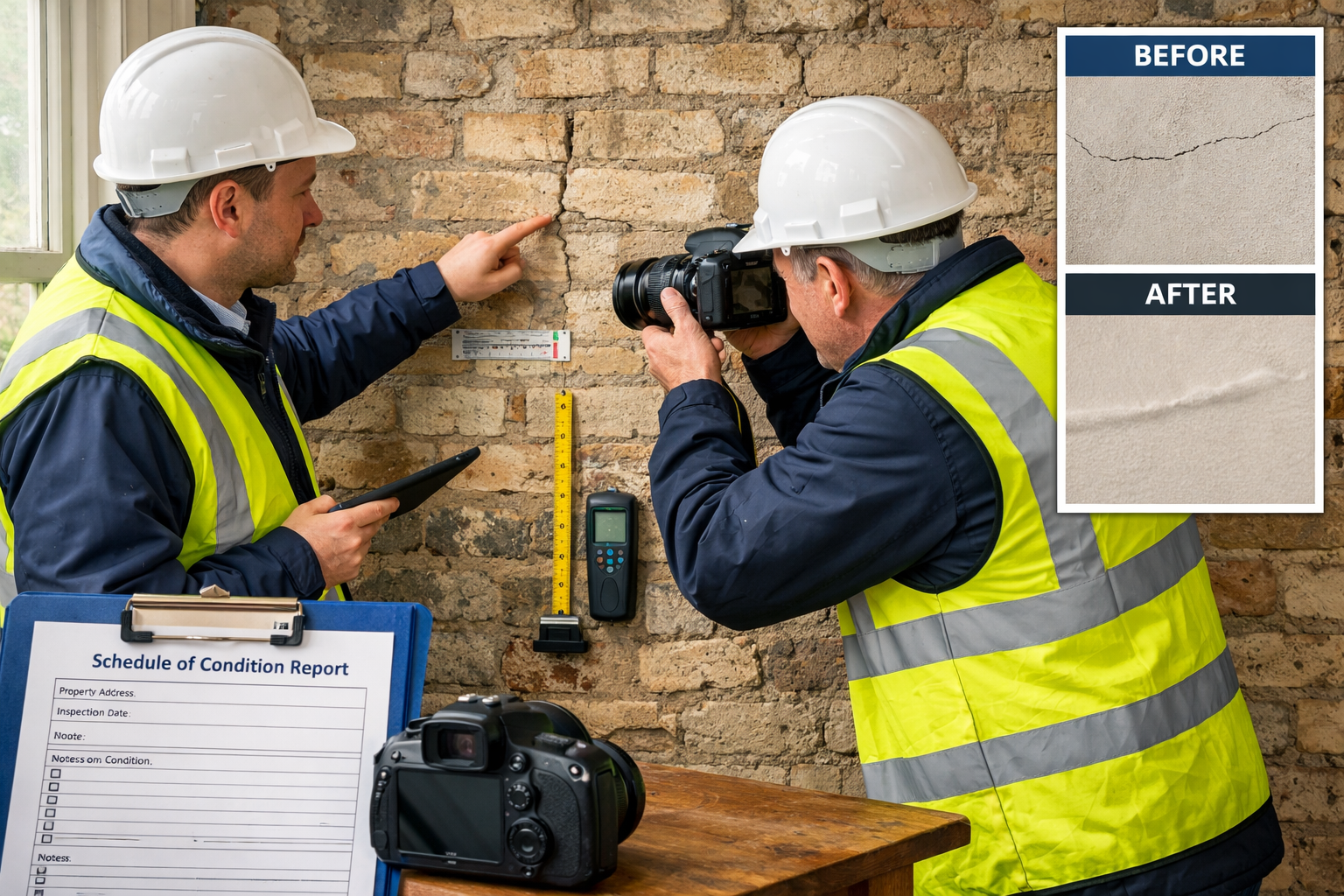
Before any construction work begins, surveyors prepare a comprehensive Schedule of Condition—a detailed photographic and written record of the adjoining property's current state[1][4].
This document serves as critical evidence if disputes arise about whether construction work caused specific damage. The Schedule typically includes:
- Detailed photographs of all rooms, focusing on walls, ceilings, and floors
- Written descriptions of existing cracks, defects, or damage
- Measurements of significant cracks or structural issues
- External photographs of the property's condition
- Documentation of shared structures like chimneys, walls, and boundaries[1][4]
For properties with shared chimneys, particular attention must be paid to documenting the chimney structure's condition before any work affecting it commences.
Step 6: The Party Wall Award Document
The surveyors prepare a formal Party Wall Award that becomes legally binding on both parties. This document typically includes[1][4]:
- Detailed description of the proposed work
- Start date and estimated completion timeline
- Working hours and days permitted
- Access arrangements for the building owner
- Protective measures required during construction
- Monitoring procedures for the adjoining property
- Responsibility for costs (usually the building owner)
- Dispute resolution procedures
- Rights of inspection for the adjoining owner
The Award must be served to both parties, who have 14 days to appeal to the County Court if they disagree with any provisions[3]. Once this appeal period expires without challenge, the Award becomes fully enforceable.
Property owners can review examples and detailed information about Party Wall Awards in London and Surrey to understand typical Award contents and provisions.
Step 7: Construction Phase Compliance
Once the Party Wall Award is in place, construction can proceed according to its terms. During this phase:
Building owner responsibilities:
- Adhere strictly to working hours specified in the Award
- Implement all protective measures outlined
- Allow surveyor inspections as required
- Minimize disruption to adjoining owners
- Maintain insurance coverage for party wall work[1][4]
Adjoining owner rights:
- Request surveyor inspections if concerns arise
- Expect compliance with Award terms
- Receive compensation for proven damage
- Access dispute resolution if terms are violated[1]
Step 8: Post-Construction Inspection and Resolution
After construction completes, a final inspection compares the adjoining property's condition against the original Schedule of Condition. Any damage attributable to the construction work must be repaired or compensated according to the Award's provisions[1][4].
This final step closes the party wall process and provides both parties with certainty about their rights and obligations. Proper documentation throughout the process—from initial notice through final inspection—protects everyone involved and prevents costly disputes.
Navigating Party Wall Disputes in London's 2026 Construction Boom
Despite best intentions and careful planning, Party Wall Agreements in London's 2026 Boom: Navigating Disputes as Construction Activity Rises frequently encounter challenges that require professional dispute resolution. Understanding common dispute scenarios and resolution strategies helps property owners, surveyors, and developers manage conflicts effectively.
Common Sources of Party Wall Disputes in 2026
London's intense construction activity has revealed recurring dispute patterns that chartered surveyors encounter regularly:
1. Damage Attribution Disputes 🏚️
The most frequent conflicts arise when adjoining owners claim that construction work has damaged their property. Common damage allegations include:
- Cracks in walls, ceilings, or plasterwork
- Subsidence or settlement issues
- Damage to decorative finishes
- Structural movement or distortion
- Water ingress or damp problems[5]
Without a comprehensive Schedule of Condition documenting pre-existing conditions, these disputes become extremely difficult to resolve. Property owners should ensure surveyors conduct thorough dilapidation surveys before work commences.
2. Access Disputes
Construction work sometimes requires temporary access to neighbouring properties for:
- Scaffolding installation
- Overhanging equipment
- Inspection of shared structures
- Repair work on party walls[5]
Adjoining owners may refuse access or impose unreasonable conditions, delaying projects and increasing costs. Party Wall Awards should specify access rights clearly to prevent these conflicts.
3. Working Hours and Disruption Conflicts
Neighbours frequently complain about:
- Construction noise exceeding reasonable levels
- Work occurring outside agreed hours
- Dust, debris, or materials affecting their property
- Vibration from excavation or demolition
- Extended project timelines beyond original estimates[5]
Clear Award provisions about working hours, noise mitigation, and project timelines help manage expectations and reduce friction.
4. Scope of Work Disputes
Conflicts arise when building owners:
- Exceed the work described in the original notice
- Make significant changes to approved plans
- Undertake additional party wall work without new notices
- Implement different construction methods than specified[5]
Any material changes to proposed work should trigger amended notices and updated Awards to maintain legal compliance.
5. Cost Disputes
Financial conflicts frequently involve:
- Surveyor fee allocations between parties
- Responsibility for repair costs
- Compensation for temporary loss of amenity
- Professional fees for additional inspections or reports[5][6]
The Party Wall Act establishes that building owners typically bear all reasonable costs, but disputes about what constitutes "reasonable" remain common.
Professional Dispute Resolution Strategies
When conflicts arise, several resolution pathways exist beyond expensive court litigation:
Early Surveyor Intervention 🔍
Appointed party wall surveyors serve as the first line of dispute resolution. Their responsibilities include:
- Mediating disagreements about Award provisions
- Conducting additional inspections when concerns arise
- Providing technical opinions on damage causation
- Recommending remedial measures or compensation
- Facilitating communication between parties[5]
Engaging experienced chartered surveyors in central London ensures access to professionals familiar with the capital's unique construction challenges and dispute patterns.
Third Surveyor Determination
When the two appointed surveyors cannot agree on specific issues, the pre-selected third surveyor provides binding determinations. This mechanism prevents deadlock without requiring court involvement[1][3].
Award Amendments
If circumstances change or disputes reveal Award inadequacies, surveyors can prepare amended Awards addressing new issues or modifying provisions. This flexibility helps maintain project momentum while protecting all parties' interests[3].
Formal Complaints and Appeals
Parties dissatisfied with surveyor decisions or Award provisions can:
- Appeal to the County Court within 14 days of Award service
- Request surveyor replacement in cases of bias or incompetence
- Seek judicial review of procedural irregularities[3]
However, court proceedings should represent a last resort given the significant costs and delays involved.
Preventing Disputes: Best Practices for 2026
Prevention remains far more cost-effective than resolution. Property owners and surveyors should implement these protective strategies:
Comprehensive Pre-Construction Documentation 📸
- Detailed Schedules of Condition with extensive photography
- Video walkthroughs of adjoining properties
- Professional structural assessments of existing defects
- Documentation of pre-existing cracks with measurements
- Moisture readings and damp surveys[1][4]
Clear Communication Throughout the Process
- Regular updates to adjoining owners about project progress
- Advance notice of particularly disruptive work phases
- Prompt responses to neighbour concerns or complaints
- Transparent sharing of inspection reports and findings
- Professional, courteous interactions at all stages[5]
Experienced Professional Engagement
- Appointment of qualified, RICS-registered party wall surveyors
- Use of reputable contractors familiar with party wall requirements
- Engagement of structural surveyors for complex projects
- Professional project management maintaining compliance
- Insurance coverage adequate for party wall risks[1]
Realistic Timelines and Budgets
- Adequate contingency for party wall procedures (8-12 weeks minimum)
- Budget allocation for surveyor fees (£1,200-£2,200 typically)[6]
- Allowance for potential remedial work or compensation
- Buffer time for dispute resolution if needed
- Realistic completion dates in Awards and notices[6]
Case Study: Typical London Loft Conversion Dispute Resolution
Consider a common 2026 scenario illustrating effective dispute navigation:
Situation: A homeowner in a Victorian terrace undertakes a loft conversion requiring steel beams inserted into party walls on both sides. Proper notices are served, and an agreed surveyor is appointed. A comprehensive Schedule of Condition documents both neighbouring properties.
Dispute: Midway through construction, one neighbour reports new cracks in their bedroom ceiling and demands work stoppage.
Resolution Process:
- The agreed surveyor conducts an immediate inspection
- Comparison with the Schedule of Condition reveals the cracks existed pre-construction but were hairline and barely visible
- Monitoring confirms the cracks have not widened during construction
- The surveyor determines construction is not responsible for the damage
- Work continues with enhanced monitoring protocols
- The neighbour accepts the technical determination, avoiding litigation
Outcome: The Schedule of Condition proved essential in resolving the dispute quickly and fairly, preventing a potentially costly legal battle and project delay.
The Role of Technology in Modern Party Wall Dispute Prevention
London's 2026 construction boom has seen increased adoption of technology for party wall management:
Digital Documentation Systems
- Cloud-based photograph and report storage
- Timestamped digital evidence of property conditions
- Shared access for all parties to inspection records
- Automated comparison of before/after conditions[5]
Monitoring Technology
- Crack monitoring gauges providing objective measurements
- Vibration monitoring during excavation work
- Noise level recording for working hours compliance
- Structural movement sensors for sensitive properties[5]
Communication Platforms
- Dedicated project portals for all stakeholders
- Automated notice delivery with proof of service
- Digital signature collection for consents and Awards
- Real-time progress updates for adjoining owners[5]
These technological solutions enhance transparency, provide objective evidence, and facilitate smoother party wall processes in London's dense urban environment.
When to Seek Legal Advice
While party wall surveyors handle most technical and procedural matters, certain situations warrant solicitor involvement:
- Neighbours threatening or pursuing litigation
- Allegations of negligence or professional misconduct
- Complex title or ownership disputes
- Enforcement of Award provisions through court orders
- Appeals against surveyor determinations[5]
Property law specialists familiar with party wall legislation can provide valuable guidance when disputes escalate beyond technical surveyor resolution.
The Financial Reality of Party Wall Disputes in 2026
Understanding the cost implications helps property owners make informed decisions about dispute resolution:
| Dispute Resolution Method | Typical Cost Range | Timeline |
|---|---|---|
| Surveyor mediation | £500-£1,500 | 2-4 weeks |
| Third surveyor determination | £1,000-£3,000 | 4-8 weeks |
| Award amendment | £800-£2,000 | 3-6 weeks |
| County Court appeal | £5,000-£25,000+ | 6-18 months |
| High Court litigation | £25,000-£100,000+ | 12-36 months |
These figures demonstrate why early, professional dispute resolution through qualified surveyors represents the most cost-effective approach for all parties.
Conclusion: Thriving in London's 2026 Construction Boom Through Proper Party Wall Management
The unprecedented construction activity sweeping through London in 2026 presents tremendous opportunities for property owners to enhance their homes, increase values, and capitalize on the recovering market. However, this boom also creates complex challenges around shared boundaries, neighbour relations, and legal compliance that demand professional expertise and careful management.
Party Wall Agreements in London's 2026 Boom: Navigating Disputes as Construction Activity Rises requires understanding that party wall procedures represent far more than bureaucratic obstacles—they provide essential protections for all property owners, establish clear responsibilities, and prevent costly disputes that can derail projects and damage neighbour relationships permanently.
Key Success Factors for 2026 and Beyond
Property owners, developers, and surveyors who thrive in London's competitive construction environment share common approaches:
1. Early Professional Engagement 🎯
Consulting qualified party wall surveyors during project planning—before finalizing designs or submitting planning applications—prevents costly redesigns and ensures compliance from the outset. The relatively modest investment in professional surveyor fees (typically £1,200-£2,200)[6] represents exceptional value compared to the potential costs of non-compliance, disputes, or litigation.
2. Comprehensive Documentation
Detailed Schedules of Condition, thorough photographic records, and professional assessments create objective evidence that protects all parties and facilitates fair dispute resolution. This documentation proves invaluable when questions arise about damage attribution or pre-existing conditions.
3. Transparent Communication
Maintaining open, professional dialogue with neighbours throughout the construction process reduces friction, manages expectations, and often prevents minor concerns from escalating into formal disputes. Regular updates and prompt responses to questions demonstrate respect and consideration.
4. Realistic Planning and Budgeting
Allocating adequate time (8-12 weeks minimum for party wall procedures) and budget (including surveyor fees, potential remedial work, and contingencies) ensures projects proceed smoothly without financial or scheduling pressures that tempt shortcuts or non-compliance.
5. Quality Professional Selection
Engaging RICS-registered chartered surveyors with specific party wall expertise and local London experience ensures access to professionals who understand the capital's unique construction challenges, property types, and dispute patterns.
Actionable Next Steps for Property Owners
For those planning construction work in London during 2026 and beyond:
Immediate Actions ✅
- Assess your project against Party Wall Act trigger scenarios (structural work, boundary walls, excavations within 3-6 metres)
- Identify all adjoining owners who may be affected by your proposed work
- Consult a qualified party wall surveyor for preliminary advice about notice requirements and timelines
- Review your project timeline to incorporate party wall procedures (minimum 8-12 weeks before construction start)
- Budget appropriately for surveyor fees, Schedule of Condition preparation, and potential contingencies
During the Process 🔄
- Serve proper notices with all required details and adequate notice periods (1-2 months depending on work type)
- Respond professionally to neighbour questions or concerns
- Cooperate fully with appointed surveyors during inspections and Schedule of Condition preparation
- Review the Party Wall Award carefully before signing to ensure understanding of all obligations
- Maintain communication with neighbours and surveyors throughout construction
Post-Construction 🏁
- Facilitate final inspections comparing property conditions against original Schedules
- Address any legitimate damage claims promptly and professionally
- Obtain completion documentation from surveyors confirming Award compliance
- Maintain records of all party wall documentation for future reference or property sales
- Learn from the experience to inform future construction projects
The Broader Context: Party Walls and London's Urban Development
As London continues its evolution as a global property investment hub, party wall procedures will remain central to the capital's development landscape. The dense Victorian and Edwardian terraced housing that characterizes much of London creates unique challenges and opportunities that require specialized knowledge and professional expertise.
The 2026 construction boom demonstrates that property owners increasingly recognize the value of professional party wall management. Rather than viewing these procedures as obstacles, successful developers and homeowners understand they provide essential frameworks for responsible urban development that protects property rights, maintains neighbourhood harmony, and ensures construction quality.
Resources and Professional Support
Property owners navigating party wall matters in London's 2026 construction boom should leverage available professional resources:
- RICS-registered party wall surveyors provide expert guidance on all aspects of party wall procedures
- Specialist solicitors offer legal advice for complex disputes or litigation scenarios
- Professional bodies like the Pyramus and Thisbe Club provide surveyor directories and educational resources
- Local authority building control departments can clarify how party wall requirements intersect with Building Regulations
- Planning consultants help coordinate party wall procedures with planning permission applications
For comprehensive party wall services throughout London, property owners can explore specialized party wall matters support from qualified chartered surveyors familiar with the capital's unique requirements.
Final Thoughts
London's 2026 construction boom presents extraordinary opportunities for property enhancement, value creation, and urban regeneration. Successfully navigating this dynamic environment requires understanding that party wall procedures represent not burdens but essential protections that enable responsible development while safeguarding property rights.
By engaging qualified professionals early, maintaining transparent communication with neighbours, documenting conditions comprehensively, and approaching party wall requirements as integral project components rather than afterthoughts, property owners can execute construction projects smoothly, legally, and harmoniously.
The investment in proper party wall management—both financial and temporal—pays dividends through avoided disputes, protected legal positions, maintained neighbour relationships, and successful project completion. As construction activity continues rising throughout 2026 and beyond, those who master party wall procedures will find themselves best positioned to capitalize on London's remarkable property market opportunities while contributing to the capital's sustainable urban development.
Whether planning a modest loft conversion or an extensive basement excavation, understanding and properly implementing party wall procedures ensures projects proceed efficiently, legally, and with minimal conflict—transforming potential obstacles into manageable processes that protect all stakeholders and enable London's continued architectural evolution.
References

[1] Party Wall Agreements Uk Complete Guide London And Essex Property Owners – https://ngconstructionltd.co.uk/advice/party-wall-agreements-uk-complete-guide-london-and-essex-property-owners
[2] Buying Property Party Wall Award – https://osborneslaw.com/blog/buying-property-party-wall-award/
[3] Party Wall Agreements What London Homeowners Need To Know – https://simplyconstructiongroup.co.uk/party-wall-agreements-what-london-homeowners-need-to-know/
[4] Party Wall Agreement – https://hoa.org.uk/advice/guides-for-homeowners/i-am-improving/party-wall-agreement/
[5] Neighbour Disputes And Party Walls Legal Insights From The Experts – https://www.adamjoseph.co.uk/neighbour-disputes-and-party-walls-legal-insights-from-the-experts
[6] Everything You Need To Know About Party Wall Agreements – https://aurahomes.co.uk/blog/everything-you-need-to-know-about-party-wall-agreements/
[7] Party Wall Agreements – https://www.tcl-surveyors.co.uk/party-wall-agreements/
[8] Step By Step Guide To The Party Wall Act – https://toynbeeassociates.com/step-by-step-guide-to-the-party-wall-act/