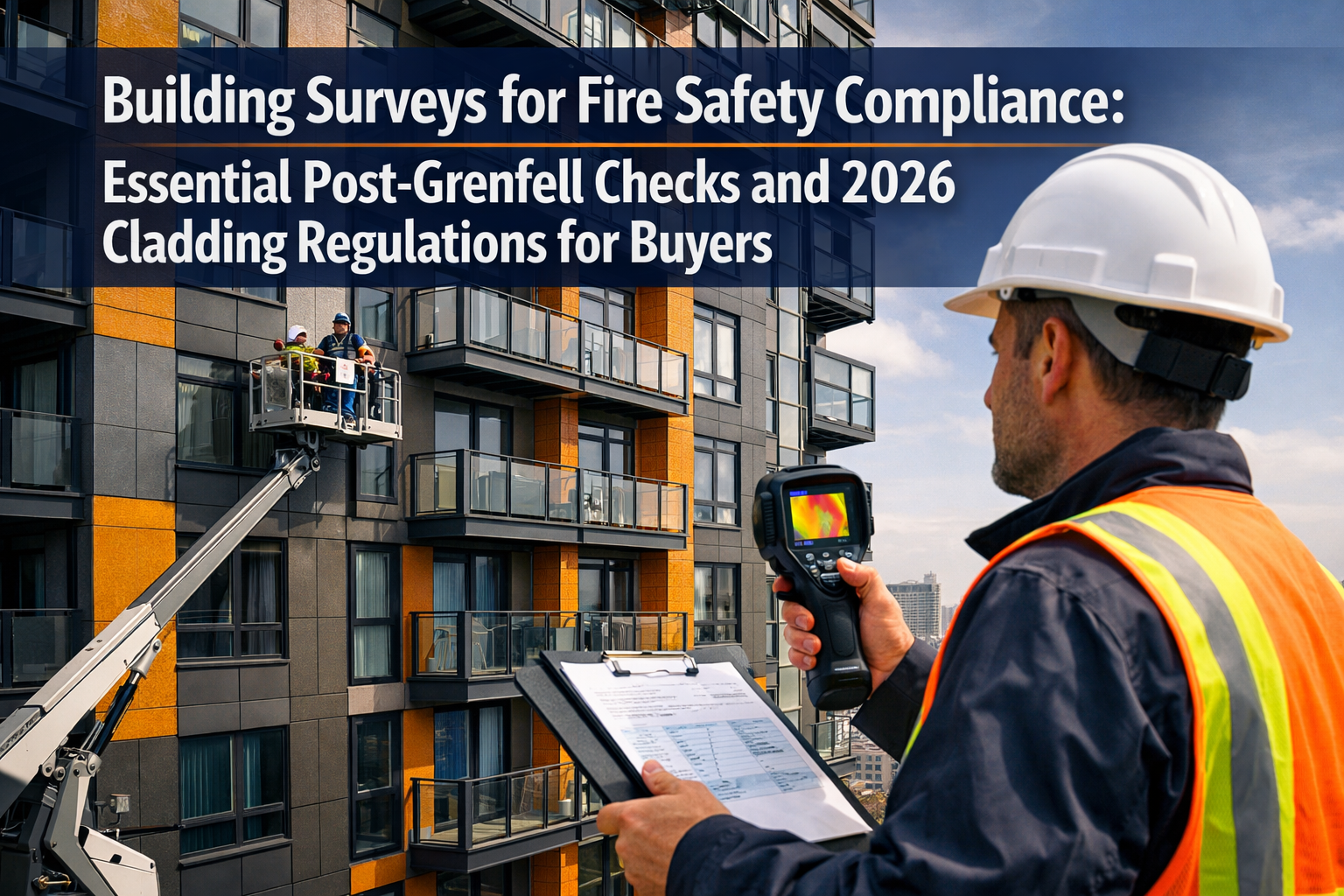

The tragic Grenfell Tower fire in 2017 fundamentally changed how the UK approaches building safety. Today, in 2026, property buyers face a complex landscape of fire safety regulations, cladding requirements, and compliance checks that can significantly impact both property values and personal safety. Understanding Building Surveys for Fire Safety Compliance: Essential Post-Grenfell Checks and 2026 Cladding Regulations for Buyers has become crucial for anyone considering purchasing a residential property, particularly in multi-story developments.
The regulatory environment has evolved dramatically, with new requirements for sprinkler systems, second staircases, enhanced detection standards, and rigorous cladding audits now forming the backbone of building safety legislation. For buyers, navigating these requirements without professional guidance can lead to costly surprises and potentially unsafe living conditions.
Key Takeaways
- 🔥 Mandatory sprinkler systems are now required in all new residential buildings with ceilings over 11 meters (approximately 4 stories), with care homes requiring sprinklers regardless of height[1][4]
- 🏢 Second staircase requirements came into effect in 2026 for new residential buildings exceeding 18 meters, fundamentally changing building design and safety evacuation protocols[4]
- 📊 Fire risk increases dramatically with height: buildings above 30 meters experience 366 fires per 1,000 buildings compared to just 9 fires per 1,000 across all apartment block heights[4]
- 💰 The Building Safety Levy launched October 1, 2026, raising £3.4 billion for building safety improvements and affecting new residential construction costs[7]
- ✅ Comprehensive building surveys now require specialized fire safety assessments, including cladding audits, balcony inspections, and verification of evacuation procedures to protect buyers from hidden liabilities
Understanding the Post-Grenfell Regulatory Landscape
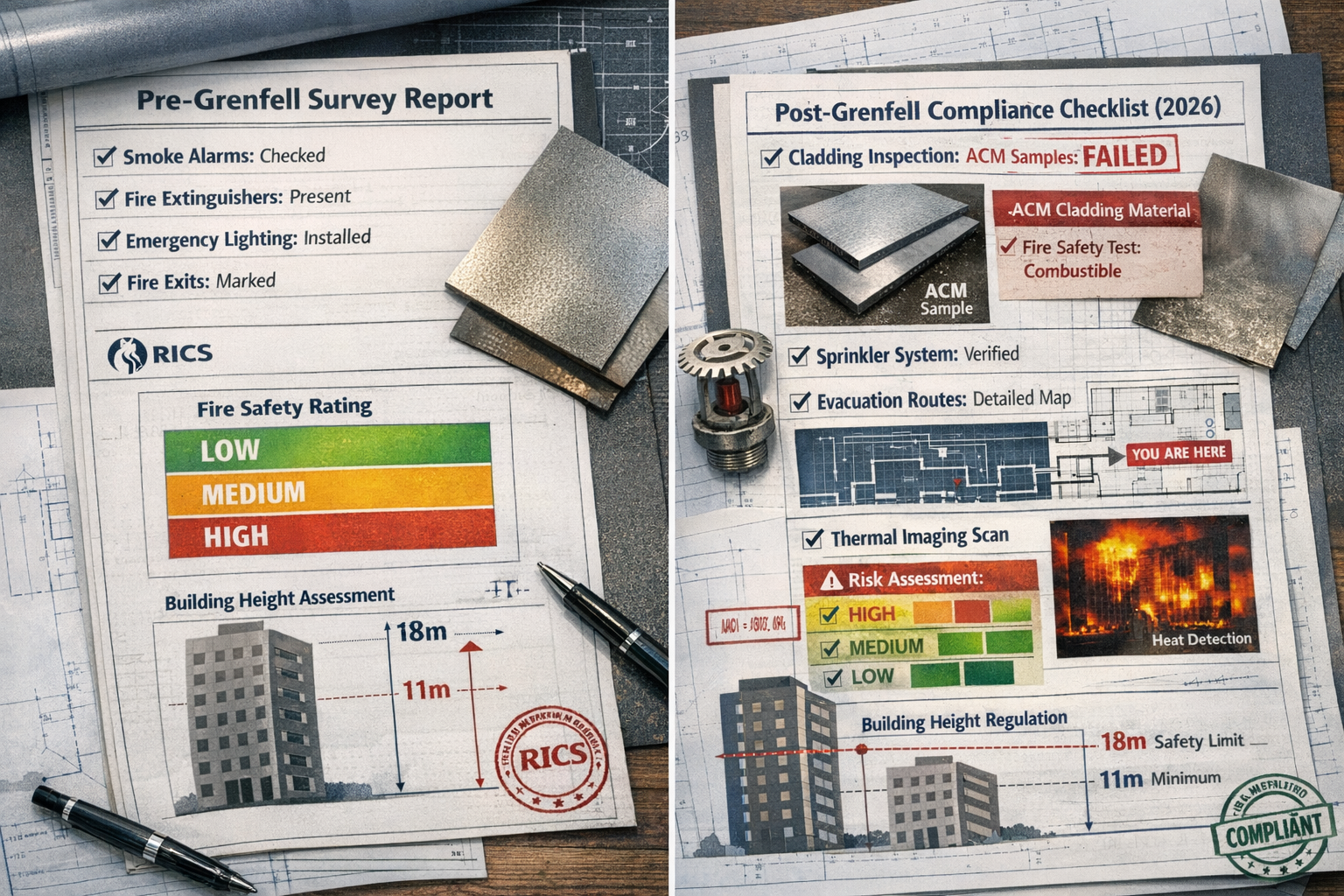
The Grenfell Tower tragedy exposed critical failures in building safety oversight, construction practices, and regulatory enforcement. The subsequent inquiry revealed that significant discrepancies existed between designed and built fire safety measures, prompting a complete overhaul of the UK's approach to building safety[6].
The Evolution of Building Safety Legislation
Since 2017, the UK government has implemented sweeping changes to building regulations, creating what many industry experts consider the most comprehensive building safety regime in the world. These changes affect not only new construction but also existing buildings, particularly those identified as "higher-risk buildings."
Higher-risk buildings are defined as residential buildings of at least 18 meters in height or with at least seven storeys. The government's 2026 review confirmed that this threshold remains appropriate based on current fire and fatality risk data[4]. However, the regulations extend beyond just tall buildings, with specific requirements now applying to buildings of various heights.
Key Regulatory Milestones in 2026
The regulatory landscape in 2026 includes several critical components:
Building Safety Act Implementation: The Building Safety Act has fundamentally restructured how building safety is managed throughout a building's lifecycle, from design and construction through to occupation and maintenance[3].
Approved Document B Updates: The latest revisions to Approved Document B have introduced stricter fire safety standards, including the 11-meter sprinkler mandate and enhanced detection requirements[1][4].
Building Control Approval Challenges: As of August 2025, only 31% of Building Control Approval Applications and 22% of Building Assessment Certificate applications had been approved under the higher-risk building regime, indicating significant compliance challenges across the industry[4].
These stringent approval rates demonstrate the heightened scrutiny now applied to building safety, making thorough fire safety compliance checks essential for property buyers. When considering a property purchase, engaging chartered surveyors in London who understand these complex regulations becomes invaluable.
Essential Fire Safety Components in Building Surveys for Fire Safety Compliance
Modern building surveys must go far beyond traditional structural assessments to encompass comprehensive fire safety evaluations. Understanding what surveyors should examine helps buyers make informed decisions and identify potential liabilities before completing a purchase.
Cladding Systems and External Wall Construction
Cladding inspection has become the most critical component of fire safety surveys following Grenfell. Surveyors must assess:
- Material composition: Identifying whether cladding contains combustible materials, particularly Aluminium Composite Material (ACM) with polyethylene cores
- Installation quality: Examining how cladding systems are attached and whether fire barriers are properly installed
- Cavity barriers: Verifying that fire stops are present within external wall cavities to prevent vertical fire spread
- Balcony construction: Assessing balcony materials and their fire resistance ratings, as balconies can provide pathways for fire spread
The regulatory oversight of construction practices has intensified following findings that revealed significant discrepancies between designed and built fire safety measures[6]. This means even relatively new buildings may have hidden defects requiring costly remediation.
Fire Suppression and Detection Systems
The 2026 regulations have expanded mandatory fire suppression requirements significantly:
Sprinkler System Requirements:
- Mandatory in all new residential blocks with ceilings over 11 meters (approximately 4 stories)[1][4]
- Required in all new care homes regardless of height[4]
- Must meet enhanced performance standards with regular testing and maintenance documentation
Detection System Standards:
- Smoke and heat detectors must meet higher sensitivity requirements[3]
- Interlinked alarms are now mandatory in certain building types to ensure immediate alerting across all floors[3]
- Systems must be integrated with building management systems in higher-risk buildings
For existing buildings, surveyors should verify that detection systems meet current standards, even if they were compliant when originally installed. A comprehensive structural survey in London should include detailed assessment of these critical safety systems.
Means of Escape and Evacuation Planning
Second Staircase Requirements: New residential buildings exceeding 18 meters must now include second staircases, a requirement that became effective in 2026[4]. For buyers considering new-build properties, verification that this requirement has been met is essential.
Evacuation Route Assessment should examine:
| Element | Assessment Criteria |
|---|---|
| Stairwell Protection | Fire-resistant construction, proper ventilation, emergency lighting |
| Corridor Width | Adequate width for simultaneous evacuation, clear of obstructions |
| Fire Doors | Self-closing mechanisms, proper seals, regular maintenance records |
| Signage | Clear, illuminated exit signs, evacuation route maps |
| Refuge Areas | Designated safe areas for mobility-impaired residents |
Building managers must now maintain detailed evacuation procedures and conduct regular drills, with staff training mandatory to ensure everyone understands their emergency roles[3]. Buyers should request documentation of these procedures and training records.
Documentation and Compliance Records
Mandatory documentation requirements have expanded significantly. Building owners must maintain detailed records of:
- Inspection schedules: Regular fire safety inspections with documented findings
- Maintenance logs: Service records for all fire safety equipment
- Staff training records: Evidence of fire safety training for building management staff
- Audit results: Reports from regulatory body audits and any remedial actions taken
Regulatory bodies are increasingly conducting audits and levying penalties for non-compliance[3]. Buyers should request access to these records as part of their due diligence process, as missing or inadequate documentation may indicate broader compliance issues.
Comprehensive Checklist for Building Surveys for Fire Safety Compliance: Essential Post-Grenfell Checks
Professional surveyors conducting fire safety compliance assessments in 2026 should follow a systematic approach that addresses all regulatory requirements and identifies potential risks to buyers.
Pre-Survey Documentation Review
Before conducting the physical inspection, surveyors should obtain and review:
✅ Building Control Approval certificates (noting the 31% approval rate for higher-risk buildings)[4]
✅ EWS1 forms (External Wall System forms) if applicable
✅ Fire Risk Assessments conducted within the past 12 months
✅ Building Safety Case for higher-risk buildings
✅ Cladding remediation plans and completion certificates
✅ Sprinkler system commissioning certificates and maintenance records
✅ Fire door inspection reports
✅ Emergency evacuation procedures and drill records
External Envelope Inspection
The external building envelope requires particularly careful scrutiny:
Cladding Material Assessment:
- Visual identification of cladding type and manufacturer
- Thermal imaging to identify potential cavity issues or insulation defects
- Assessment of cladding fixings and support systems
- Identification of any previous remediation work
Balcony and External Feature Audit:
- Material composition of balcony structures
- Fire resistance ratings of balcony dividers
- Assessment of combustible materials (furniture, planters, decorative elements)
- Verification of fire spread prevention measures between balconies
Window and Opening Assessment:
- Fire-resistant glazing where required
- Spandrel panel construction and fire resistance
- Window frame materials and fire performance
For properties requiring detailed roof assessments, specialized drone roof surveys in London can provide comprehensive visual documentation of external conditions without requiring expensive scaffolding access.
Internal Fire Safety Systems Verification
Sprinkler System Inspection:
- Verification of system installation in buildings over 11 meters[1][4]
- Inspection of sprinkler heads, pipes, and control valves
- Review of hydraulic calculations and system design
- Verification of water supply adequacy
- Assessment of system monitoring and alarm integration
Detection and Alarm System Assessment:
- Testing of smoke and heat detector sensitivity[3]
- Verification of interlinked alarm functionality
- Assessment of alarm audibility throughout the building
- Review of system maintenance and testing schedules
- Verification of integration with emergency services notification systems
Fire Suppression Equipment:
- Location and type of fire extinguishers
- Inspection dates and maintenance records
- Accessibility and appropriate placement
- Staff training on equipment use
Means of Escape Evaluation
Stairwell and Corridor Assessment:
- Measurement of corridor widths and stairwell dimensions
- Verification of second staircase in buildings over 18 meters[4]
- Assessment of fire-resistant construction materials
- Inspection of emergency lighting systems
- Evaluation of ventilation systems and smoke control measures
Fire Door Inspection:
- Verification of fire resistance ratings (FD30, FD60, etc.)
- Testing of self-closing mechanisms
- Inspection of intumescent seals and smoke seals
- Assessment of door gaps and fit
- Verification that fire doors haven't been modified or compromised
Signage and Wayfinding:
- Clarity and visibility of exit signage
- Illumination of emergency signs
- Evacuation route mapping
- Accessibility information for mobility-impaired residents
Building-Specific Risk Factors
Different building types present unique fire safety challenges:
High-Rise Buildings (Above 18 Meters):
- Enhanced scrutiny of cladding systems
- Verification of second staircase compliance[4]
- Assessment of fire service access and firefighting equipment
- Review of evacuation strategies (stay-put vs. simultaneous evacuation)
- Evaluation of smoke control systems in common areas
Mid-Rise Buildings (11-18 Meters):
- Sprinkler system verification[1][4]
- Assessment of single staircase adequacy
- Risk-based mitigation measures where fire safety concerns exist[4]
- Evaluation of fire detection and alarm systems
Converted Buildings:
- Assessment of original construction and fire resistance
- Verification that conversions meet current standards
- Identification of compromised fire compartmentation
- Evaluation of retrofitted fire safety systems
Understanding the differences between survey types helps buyers choose appropriate levels of inspection. Our guide on homebuyer report vs building survey explains when comprehensive fire safety assessments become essential.
Understanding 2026 Cladding Regulations for Property Buyers
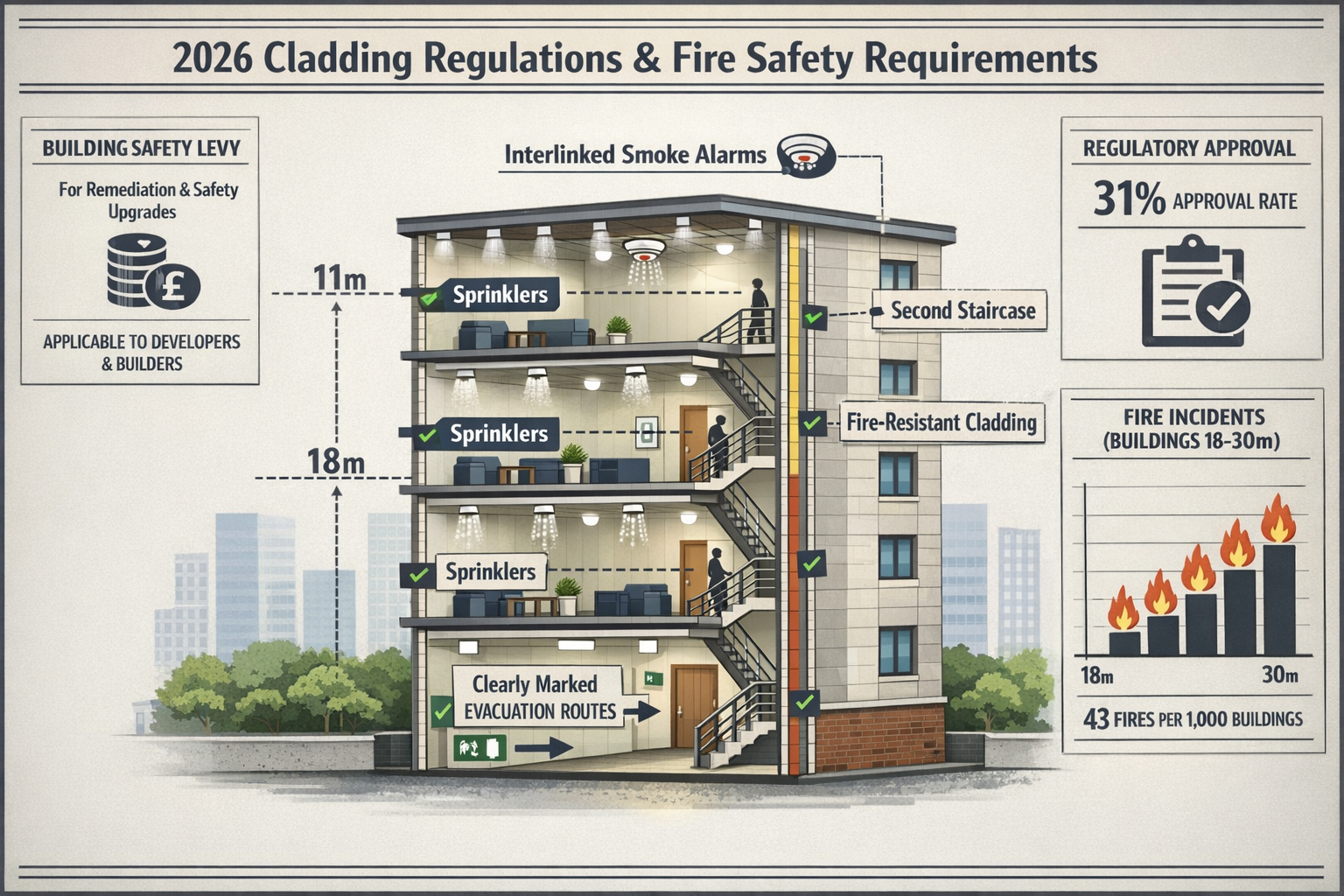
The cladding crisis has created significant financial and safety concerns for property owners and buyers. Understanding the current regulatory framework and its implications is essential for making informed purchase decisions in 2026.
The Building Safety Levy and Its Impact
The Building Safety Levy came into force on October 1, 2026, and is expected to raise £3.4 billion for building safety improvements[7]. This levy applies to:
- New residential buildings
- Purpose-built student accommodation
- Certain commercial developments with residential components
For buyers, the levy has several implications:
💰 Increased new-build costs: Developers pass levy costs to buyers through higher purchase prices
📈 Market dynamics: The levy may make existing properties more attractive relative to new builds
🏗️ Remediation funding: The levy funds cladding remediation for buildings without responsible developers
⚖️ Developer accountability: The levy creates financial pressure on developers to build safely from the outset
Height-Based Requirements and Risk Thresholds
The government's 2026 review confirmed that existing height thresholds remain appropriate based on fire risk data[4]:
Critical Height Thresholds:
| Height | Key Requirements | Fire Risk Data |
|---|---|---|
| Above 11m | Mandatory sprinkler systems[1][4] | Elevated fire risk compared to low-rise |
| Above 18m | Second staircase required[4]; Higher-risk building regime applies | 43 fires per 1,000 buildings (18-30m)[4] |
| Above 30m | Enhanced regulatory scrutiny; Comprehensive building safety case required | 366 fires per 1,000 buildings[4] |
These statistics demonstrate why regulatory requirements intensify with building height. Buyers considering properties in taller buildings should expect more extensive fire safety measures and associated service charge costs.
Risk-Based Mitigation Strategies
For buildings below 18 meters where fire safety risks are identified (such as combustible cladding), cost-effective risk mitigations can achieve adequate safety levels[4]:
Effective Mitigation Measures:
- Enhanced smoke and fire detection systems
- Improved alarm systems with building-wide coverage
- Adequate means of escape improvements
- Targeted sprinkler installation in high-risk areas
- Waking watch services during remediation periods
Understanding these mitigation options helps buyers assess whether buildings with identified issues can be made safe without complete cladding replacement, potentially saving hundreds of thousands of pounds in remediation costs.
Cladding Remediation: Costs and Timelines
Typical Remediation Scenarios:
🔴 Complete ACM Cladding Replacement:
- Cost: £20,000-£100,000+ per flat (depending on building size)
- Timeline: 18-36 months
- Interim measures: Waking watch, enhanced detection systems
- Funding: Developer responsibility, Building Safety Fund, or leaseholder liability
🟡 Partial Remediation with Risk Mitigation:
- Cost: £5,000-£25,000 per flat
- Timeline: 6-18 months
- Measures: Targeted cladding removal, enhanced fire safety systems, compartmentation improvements
- Funding: Mixed sources, often more accessible
🟢 Non-ACM Compliance Upgrades:
- Cost: £2,000-£10,000 per flat
- Timeline: 3-12 months
- Measures: Fire door upgrades, detection system improvements, documentation updates
- Funding: Service charge, sinking fund
Buyer Due Diligence Questions:
- Has an EWS1 form been completed, and what was the outcome?
- What remediation work is planned, and who will pay for it?
- Are there any ongoing legal proceedings against developers or contractors?
- What interim safety measures are in place?
- How will remediation costs be allocated among leaseholders?
- What impact will remediation have on property values and saleability?
For properties with identified defects, obtaining a specific defect report can provide detailed analysis of the issues and potential remediation approaches.
Financial Implications and Buyer Protection Strategies
The financial consequences of fire safety compliance issues can be substantial, making thorough due diligence essential for protecting buyers from unexpected costs.
Service Charge Implications
Fire safety compliance has significantly increased service charges in many buildings:
Typical Annual Service Charge Increases:
- Waking watch services: £100-£500 per month per flat during remediation
- Enhanced fire safety systems: £500-£2,000 annually for maintenance and monitoring
- Insurance premium increases: 200-500% increases for buildings with identified fire safety issues
- Professional building safety manager: £50-£200 per flat monthly in higher-risk buildings
Buyers should request at least three years of service charge accounts and budgets to identify trends and upcoming major works.
Mortgage and Valuation Challenges
Fire safety issues can severely impact property financing:
Mortgage Lending Restrictions:
- Many lenders refuse mortgages on properties without satisfactory EWS1 forms
- Buildings with ACM cladding may be unmortgageable until remediation completes
- Lenders may require retention of funds pending remediation completion
- Reduced loan-to-value ratios for properties with identified issues
Valuation Impacts:
- Properties with fire safety concerns may be valued at 20-50% below similar compliant properties
- Some properties become effectively unsaleable until remediation completes
- Remediation costs may exceed property values in extreme cases
Professional RICS registered valuers in London can provide accurate assessments that account for fire safety compliance issues and their market impact.
Legal Protections for Buyers
Contractual Protections:
✅ Specific warranties: Require sellers to warrant fire safety compliance
✅ Retention clauses: Hold back purchase funds pending remediation completion
✅ Indemnities: Obtain indemnities for known or potential fire safety costs
✅ Conditional contracts: Make completion conditional on satisfactory fire safety certification
Statutory Protections:
The Building Safety Act provides some protections for leaseholders, including:
- Caps on remediation costs for qualifying leaseholders
- Extended limitation periods for building defect claims
- Enhanced rights to information about building safety
However, these protections have limitations, and buyers should not rely solely on statutory rights without thorough pre-purchase investigation.
Insurance Considerations
Building Insurance Challenges:
- Buildings with fire safety issues face dramatically increased premiums
- Some buildings become uninsurable without remediation
- Waking watch requirements may be insurance conditions
- Buyers should verify current insurance arrangements and future renewals
Personal Contents Insurance:
- Individual flat insurance may be affected by building-wide fire safety issues
- Buyers should disclose known fire safety concerns to insurers
- Premium increases may be substantial even for contents-only policies
Working with Chartered Surveyors for Fire Safety Assessments
Given the complexity of fire safety regulations and the substantial financial risks involved, engaging qualified professionals has become essential for property buyers in 2026.
Qualifications and Expertise Required
Essential Professional Credentials:
🎓 RICS Chartered Surveyor status with building surveying specialism
🔥 Fire safety training and continuing professional development
📋 Building regulations expertise including Approved Document B
🏗️ Construction technology knowledge particularly cladding systems
⚖️ Legal framework understanding of Building Safety Act and related legislation
Not all surveyors possess the specialized knowledge required for comprehensive fire safety assessments. Buyers should specifically request surveyors with fire safety expertise and recent experience with post-Grenfell regulatory requirements.
Scope of Fire Safety Survey Services
Comprehensive Fire Safety Survey Components:
- Desktop Review: Analysis of all available documentation, certificates, and compliance records
- Visual Inspection: Detailed examination of external and internal fire safety features
- Testing and Verification: Where appropriate, testing of detection systems and fire doors
- Risk Assessment: Evaluation of identified issues and their severity
- Cost Estimation: Realistic estimates of remediation costs for identified defects
- Recommendations: Prioritized action plan for addressing fire safety concerns
- Compliance Verification: Assessment against current 2026 regulatory requirements
Survey Report Interpretation
Key Report Sections to Review:
Executive Summary: High-level overview of critical fire safety issues requiring immediate attention
Detailed Findings: Comprehensive documentation of all fire safety observations, typically categorized by:
- Category 1 (Urgent): Immediate safety risks requiring attention before purchase
- Category 2 (Significant): Important issues requiring remediation within 1-2 years
- Category 3 (Minor): Maintenance items and minor improvements
Cost Implications: Estimated costs for addressing identified issues, including:
- Immediate remediation requirements
- Medium-term compliance upgrades
- Ongoing maintenance and monitoring costs
- Potential service charge increases
Regulatory Compliance Assessment: Evaluation of compliance with current regulations and identification of any non-compliant features
Recommendations: Specific advice on whether to proceed with purchase, negotiate price reductions, or withdraw from the transaction
For commercial property buyers, specialized commercial property surveyors in London can provide tailored assessments for mixed-use and commercial buildings with residential components.
When to Commission Additional Specialist Reports
Some situations require specialist expertise beyond general building surveys:
Thermal Imaging Surveys: Identify hidden defects in external wall construction and insulation systems
Fire Engineering Assessments: Evaluate complex fire safety scenarios and alternative compliance strategies
Cladding Material Testing: Laboratory analysis of cladding samples to determine exact composition and fire performance
Structural Assessments: Evaluate whether buildings can support additional fire safety measures like sprinkler systems
Legal Reviews: Assess lease terms, building ownership structures, and liability allocation for remediation costs
Practical Guidance for Buyers Navigating Fire Safety Compliance
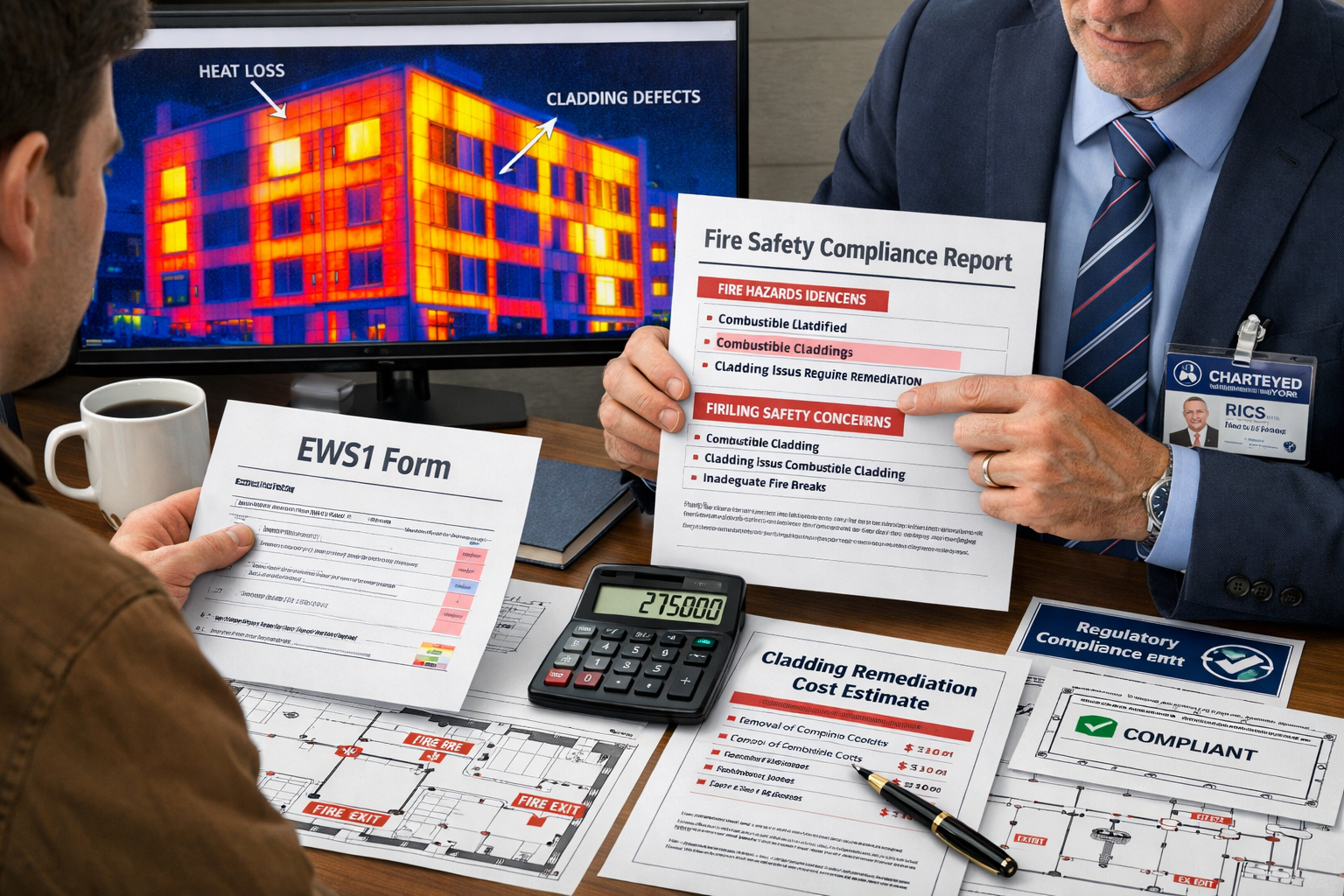
Armed with understanding of the regulations and assessment processes, buyers can take practical steps to protect themselves when purchasing properties in 2026.
Pre-Purchase Investigation Checklist
Essential Questions for Sellers/Managing Agents:
📋 Has a fire risk assessment been completed in the past 12 months?
🏢 What type of cladding is installed on the building?
📄 Has an EWS1 form been completed? If so, what rating was assigned?
💰 Are there any planned or ongoing remediation works?
👷 Who is responsible for remediation costs (developer, freeholder, leaseholders)?
🚨 What interim fire safety measures are currently in place?
📊 What are the current and projected service charges related to fire safety?
🔥 When were fire doors last inspected and upgraded if necessary?
💧 Is there a sprinkler system, and when was it last serviced?
📞 What evacuation procedures are in place, and when were they last tested?
Red Flags That Should Concern Buyers
Immediate Deal-Breakers:
🚫 ACM cladding with no funded remediation plan
🚫 Unmortgageable properties due to fire safety concerns
🚫 Ongoing waking watch with no end date or funding plan
🚫 Litigation against developers with uncertain outcomes
🚫 Missing or expired fire safety certificates
🚫 Non-compliant means of escape in higher-risk buildings
Serious Concerns Requiring Expert Assessment:
⚠️ Service charges that have doubled or tripled due to fire safety costs
⚠️ Buildings where freeholders or developers cannot be located
⚠️ Incomplete or missing building documentation
⚠️ Recent fire incidents in the building
⚠️ Non-functional or absent fire safety systems required by regulations
⚠️ Buildings where insurance has been cancelled or non-renewed
Negotiation Strategies
Price Reduction Calculations:
When fire safety issues are identified, buyers can negotiate based on:
- Direct remediation costs: Full estimated cost of required works
- Interim costs: Waking watch, enhanced insurance, and temporary measures until remediation completes
- Financing impact: Reduced mortgage availability requiring larger deposits
- Time value: Delays to remediation and uncertainty about completion
- Market impact: Reduced saleability and longer marketing periods
Example Negotiation Scenario:
Property asking price: £400,000
Estimated cladding remediation cost per flat: £40,000
Interim waking watch costs (18 months): £9,000
Increased insurance (3 years): £3,000
Market impact/risk premium: £20,000
Total negotiation basis: £72,000 (18% reduction)
Alternative Negotiation Approaches:
- Retention agreements: Seller retains funds in escrow pending remediation completion
- Indemnity insurance: Seller purchases insurance covering future remediation costs
- Conditional completion: Purchase completes only after specific fire safety works are finished
- Shared cost agreements: Negotiated split of remediation costs between buyer and seller
New Build vs. Existing Property Considerations
New Build Properties in 2026:
✅ Advantages:
- Built to latest fire safety standards including 11-meter sprinkler rule[1][4]
- Second staircases in buildings over 18 meters[4]
- Enhanced detection systems as standard[3]
- Building Safety Levy contributions toward future safety improvements[7]
- Comprehensive documentation and certification
❌ Disadvantages:
- Higher purchase prices reflecting levy costs and enhanced safety features
- Limited track record of building performance
- Potential for construction defects not yet apparent
- Developer insolvency risks during defects liability period
Existing Properties:
✅ Advantages:
- Established building performance and management track record
- Fire safety issues often already identified and potentially remediated
- Lower purchase prices where fire safety concerns exist
- Potential for negotiation based on known issues
❌ Disadvantages:
- May require costly retrofitting to meet current standards
- Uncertainty about hidden fire safety defects
- Potential for unmortgageability due to cladding issues
- Higher service charges for ongoing compliance and remediation
Long-Term Ownership Considerations
Fire safety compliance isn't just a purchase concern—it affects long-term ownership:
Ongoing Compliance Obligations:
- Regular fire safety assessments and updates
- Maintenance of fire safety systems and equipment
- Participation in building safety management for higher-risk buildings
- Potential for future regulatory changes requiring additional upgrades
Resale Implications:
- Properties with excellent fire safety compliance command premium prices
- Comprehensive fire safety documentation improves saleability
- Future buyers will conduct similar due diligence
- Market preferences increasingly favor buildings with exemplary safety records
Community Responsibilities:
- Active participation in residents' associations and building safety committees
- Cooperation with building safety managers and fire services
- Prompt reporting of fire safety concerns
- Support for necessary safety improvements even when costly
Future Regulatory Developments and Preparedness
The regulatory landscape continues to evolve, and buyers should consider potential future changes when making purchase decisions in 2026.
Anticipated Regulatory Changes Beyond 2026
Potential Future Requirements:
🔮 Retrofitting mandates: Existing buildings may face requirements to install sprinklers or second staircases
🔮 Enhanced detection standards: Further improvements to smoke and heat detection sensitivity and coverage
🔮 Balcony regulations: Specific requirements for balcony materials and fire resistance may be introduced
🔮 Digital building passports: Comprehensive digital records of all building safety features and modifications
🔮 Resident engagement requirements: Mandatory fire safety training and evacuation drills for all residents
Industry Best Practices Emerging in 2026
Leading property developers and managers are implementing practices that exceed current regulatory minimums:
Gold Standard Fire Safety Features:
- Sprinkler systems in all buildings regardless of height
- Enhanced fire-resistant cladding materials with testing certifications
- Multiple evacuation routes even in buildings below 18 meters
- Advanced smoke control and ventilation systems
- Real-time fire safety monitoring with 24/7 response capabilities
- Comprehensive resident fire safety education programs
Buildings incorporating these features may command premium prices but offer superior long-term value and safety.
Staying Informed About Regulatory Changes
Resources for Buyers and Owners:
📰 Government Building Safety Newsletter: Regular updates on regulatory changes and implementation guidance[7]
🏛️ RICS Guidance Notes: Professional standards and best practice recommendations
🔥 Fire Safety Event: Annual industry conference covering latest developments[5]
📚 Building Safety Regulator: Official guidance and compliance resources
👥 Residents' Associations: Collective knowledge and shared experiences
Buyers should consider properties in buildings with management teams that demonstrate proactive engagement with regulatory developments and commitment to exceeding minimum standards.
Conclusion: Making Informed Decisions About Building Surveys for Fire Safety Compliance
The landscape of Building Surveys for Fire Safety Compliance: Essential Post-Grenfell Checks and 2026 Cladding Regulations for Buyers represents one of the most significant changes in UK property ownership in decades. The regulatory framework has evolved from basic fire safety requirements to comprehensive building safety management systems that affect every aspect of property ownership, from initial purchase through long-term occupation.
Key principles for buyers in 2026:
✅ Never compromise on fire safety due diligence: The financial and personal safety risks are too significant to cut corners on professional assessments
✅ Engage qualified specialists: General building surveys must be supplemented with specific fire safety expertise, particularly for buildings over 11 meters
✅ Understand the complete cost picture: Purchase price is just the beginning—service charges, remediation costs, and insurance premiums can dramatically affect affordability
✅ Verify compliance documentation: Request and review all fire safety certificates, risk assessments, and remediation plans before committing to purchase
✅ Consider long-term implications: Fire safety compliance affects not just immediate safety but also future saleability, financing options, and ongoing costs
✅ Stay informed about regulatory developments: The regulatory landscape continues to evolve, and buyers should choose properties positioned to adapt to future requirements
Actionable Next Steps for Property Buyers
Immediate Actions:
-
Commission a comprehensive building survey from chartered surveyors with fire safety expertise before making any purchase commitments
-
Request all fire safety documentation including EWS1 forms, fire risk assessments, remediation plans, and service charge projections
-
Verify regulatory compliance against 2026 requirements including sprinkler systems (buildings over 11m), second staircases (buildings over 18m), and enhanced detection systems
-
Assess financial implications including remediation costs, service charge increases, insurance premiums, and potential mortgage restrictions
-
Obtain specialist advice on any identified issues, including legal review of liability allocation and financial planning for potential costs
Before Exchange of Contracts:
-
Negotiate appropriate protections including price reductions, retentions, indemnities, or conditional completion clauses based on fire safety findings
-
Confirm insurance availability and costs for both building insurance and personal contents coverage
-
Review management arrangements to ensure competent building safety management is in place
-
Understand evacuation procedures and verify that adequate means of escape exist and are properly maintained
-
Make informed go/no-go decision based on comprehensive understanding of fire safety compliance status and associated risks
Final Thoughts
The Grenfell tragedy fundamentally changed how the UK approaches building safety, creating a regulatory environment that prioritizes resident safety above all else. While this has created complexity and cost for property buyers, it has also created a framework that, when properly implemented, ensures that residential buildings meet the highest safety standards in the world.
For buyers willing to invest in proper due diligence and professional advice, the 2026 regulatory landscape provides clarity about what constitutes safe building design and management. Properties that fully comply with current regulations and demonstrate commitment to exceeding minimum standards represent sound long-term investments that protect both personal safety and financial interests.
The investment in comprehensive fire safety surveys and specialist advice is modest compared to the potential costs of purchasing a property with hidden fire safety defects. In 2026, informed buyers who prioritize fire safety compliance in their purchase decisions can navigate the market with confidence, knowing they have protected themselves and their families from both safety risks and financial liabilities.
References
[1] Fire Sprinkler Systems 2026 Guide – https://cafireprotection.co.uk/fire-sprinkler-systems-2026-guide/
[2] Fire Safety In Construction – https://www.ajg.com/uk/news-and-insights/fire-safety-in-construction/
[3] Fire Safety Regulations Whats New In 2026 – https://www.jensengroup.co.uk/fire-safety-regulations-whats-new-in-2026/
[4] Definition Of Higher Risk Buildings Initial Review And Plans For Ongoing Review – https://www.gov.uk/government/publications/review-of-the-definition-of-higher-risk-buildings/definition-of-higher-risk-buildings-initial-review-and-plans-for-ongoing-review
[5] buildingsafetyevent.co.uk – https://buildingsafetyevent.co.uk
[6] Navigating Change Uk Fire Testing And Safety Construction Companies – https://www.ul.com/insights/navigating-change-uk-fire-testing-and-safety-construction-companies
[7] January 2026 Welcome To Our New Building Safety Newsletter – https://assets.publishing.service.gov.uk/media/696f638c5b6060ca6736a085/January_2026_-_Welcome_to_our_new_Building_Safety_Newsletter.pdf
[8] Are You 2026 Ready Fire Security Compliance Checks Every Building Needs – https://shieldservicesgroup.com/are-you-2026-ready-fire-security-compliance-checks-every-building-needs/
[9] Preparing For 2026 The Future Of Fire Safety Legislation And What It Means For You – https://www.totalfiregroup.org/preparing-for-2026-the-future-of-fire-safety-legislation-and-what-it-means-for-you/