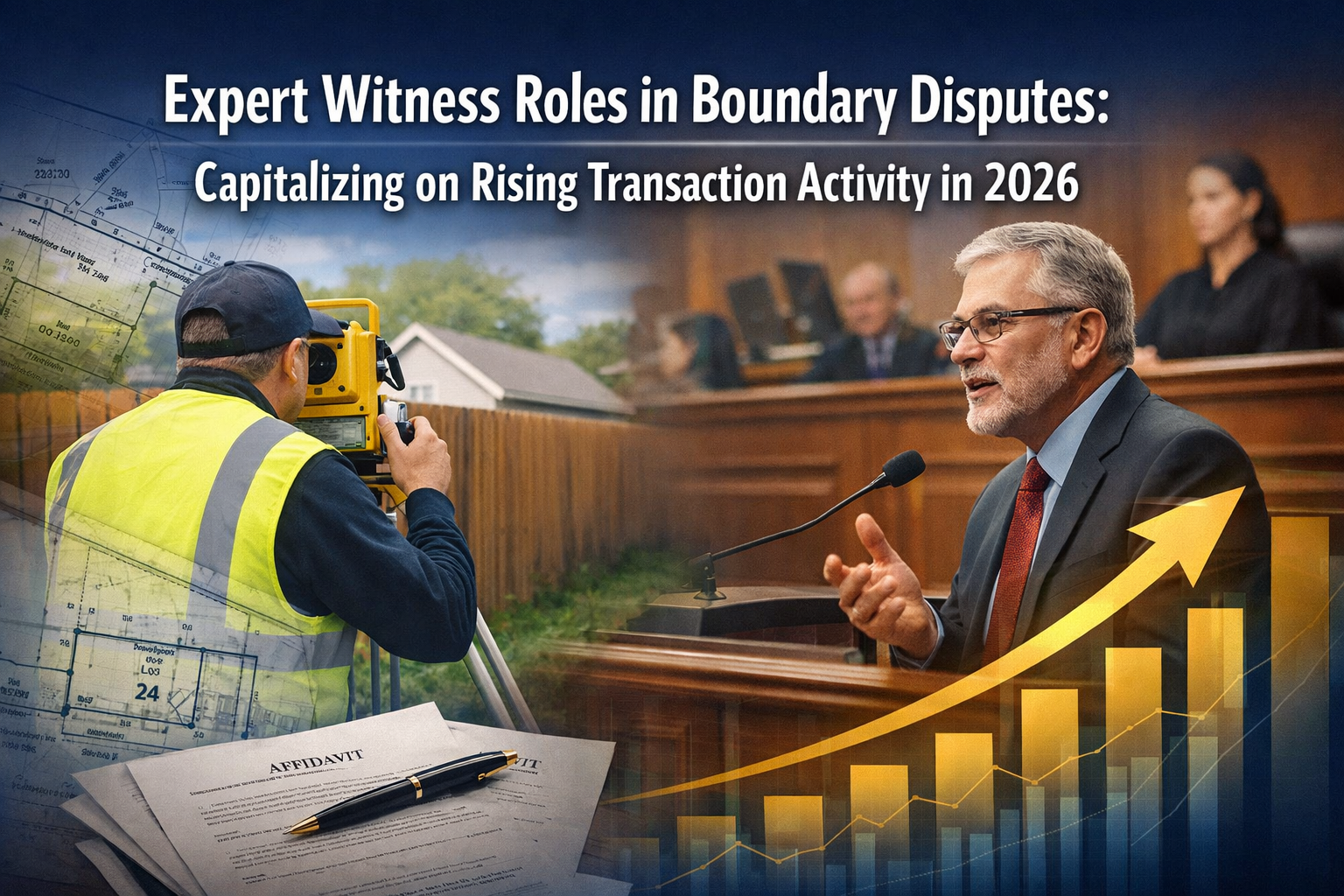

The property market is heating up in 2026, and with it comes an inevitable surge in boundary disputes. As buyer enquiries climb and sales activity gains momentum—with net balances of -15% and -9% respectively in January 2026—property transactions are creating fertile ground for conflicts over property lines, encroachments, and territorial rights. In this dynamic environment, expert witness roles in boundary disputes: capitalizing on rising transaction activity in 2026 has become more critical than ever for property professionals, legal practitioners, and property owners navigating complex territorial conflicts.
When properties change hands at accelerated rates, dormant boundary issues suddenly surface. A fence that has stood for decades becomes contentious. A shared driveway arrangement faces scrutiny. An overhanging tree or encroaching extension triggers legal action. These disputes require more than legal arguments—they demand technical expertise, precise measurements, and authoritative testimony that can withstand courtroom scrutiny.
Expert witnesses specializing in boundary disputes serve as the crucial bridge between complex surveying data and legal resolution. Their role extends far beyond simply measuring property lines; they interpret historical records, analyze cadastral data, apply legal precedents to physical evidence, and communicate technical findings in accessible language that judges, juries, and arbitrators can understand and rely upon.
Key Takeaways
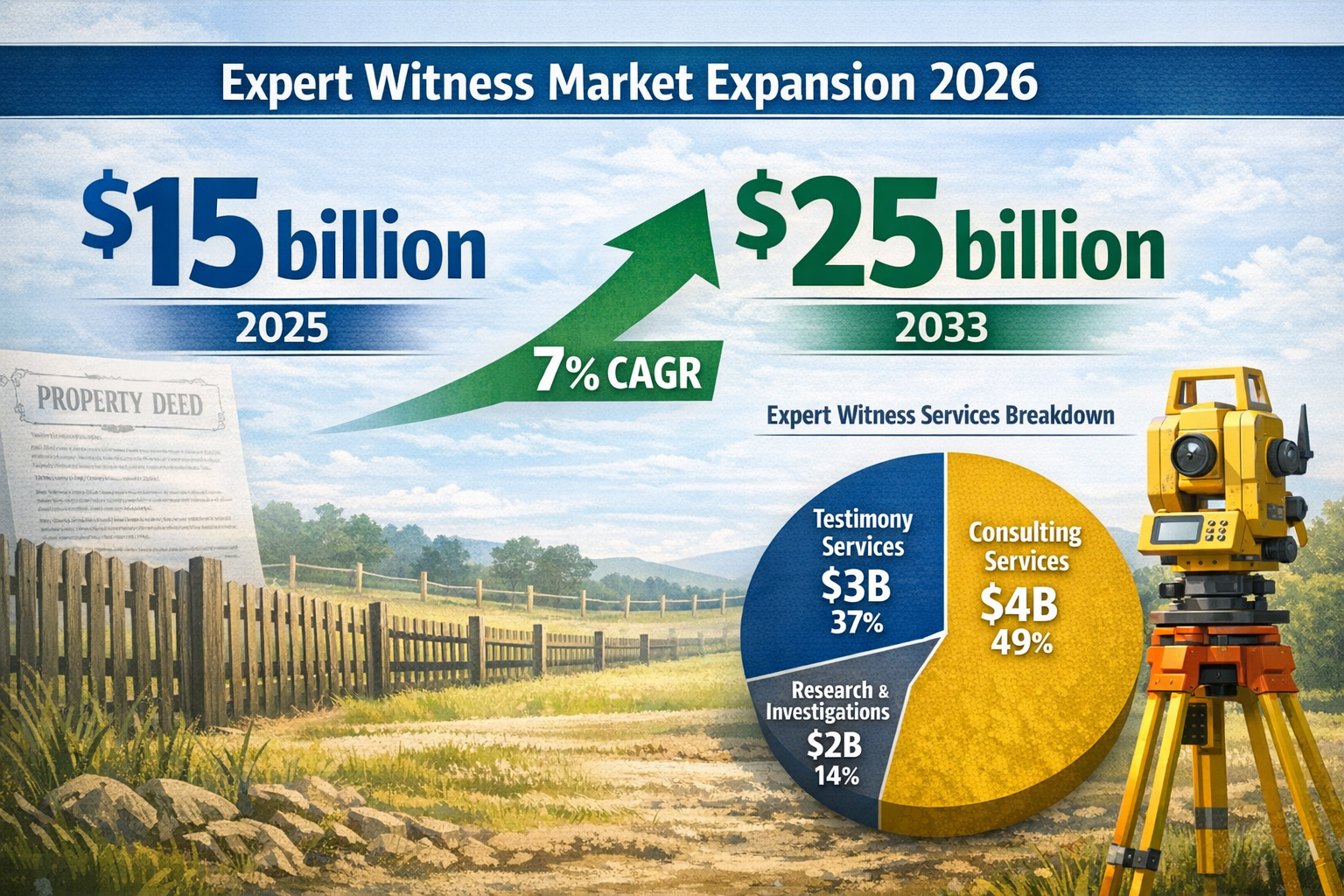
- 📈 Market Growth: The global expert witness services market is projected to reach $25 billion by 2033, growing at 7% CAGR, with boundary dispute expertise in high demand[3]
- 🏘️ Transaction-Driven Disputes: Rising property sales activity in 2026 correlates directly with increased boundary conflicts requiring expert resolution
- ⚖️ Multi-Faceted Role: Expert witnesses provide testimony services ($3B annually), consulting ($4B), and research investigations ($2B) across boundary dispute cases[3]
- 🌍 Cross-Border Recognition: International arbitral institutions increasingly recognize overseas expert credentials, expanding opportunities for qualified professionals[1]
- 🔮 Future Complexity: AI/ML systems, climate impacts, and autonomous surveying technologies are reshaping expert witness requirements and methodologies in 2026[2]
Understanding Expert Witness Roles in Boundary Disputes: Capitalizing on Rising Transaction Activity in 2026
The foundation of effective expert witnessing in boundary disputes rests on understanding the multifaceted nature of this specialized role. Expert witnesses must balance technical precision with legal requirements, maintaining independence while advocating for factual accuracy.
The Core Functions of Boundary Dispute Expert Witnesses
Expert witnesses in boundary disputes perform several essential functions that distinguish them from standard surveying professionals. Their responsibilities extend across investigation, analysis, reporting, and testimony phases of dispute resolution.
Investigation and Evidence Gathering forms the bedrock of expert witness work. This involves:
- Conducting comprehensive site surveys using modern equipment (total stations, GPS receivers, laser scanners)
- Researching historical property records, deeds, and conveyance documents
- Analyzing previous surveys and comparing methodologies
- Interviewing property owners and long-term residents about historical boundary usage
- Photographing and documenting current boundary conditions
- Identifying physical boundary markers, monuments, and natural features
Technical Analysis and Opinion Formation requires experts to synthesize complex data into defensible conclusions. Boundary dispute experts must:
- Apply legal principles such as adverse possession, prescription, and boundary acquiescence
- Interpret ambiguous deed descriptions and reconcile conflicting historical records
- Determine the most probable original boundary location based on available evidence
- Assess the accuracy and reliability of previous surveys
- Identify encroachments, easements, and rights of way
- Calculate areas of disputed land and potential financial implications
The expert witness report represents the culmination of this analytical work, providing a structured, transparent account of methodology, findings, and professional opinions.
Market Dynamics Driving Expert Witness Demand in 2026
The convergence of several market forces in 2026 has created unprecedented demand for expert witness services in boundary disputes. Rising transaction activity directly correlates with increased boundary conflict frequency, as property transfers expose previously unnoticed or tolerated boundary issues.
Transaction Volume Impact: When properties change ownership, several dispute triggers emerge:
| Transaction Phase | Common Boundary Issues |
|---|---|
| Pre-Purchase Survey | Discovery of encroachments, easement violations, or boundary discrepancies |
| Title Search | Conflicting property descriptions in historical deeds |
| Mortgage Valuation | Lender concerns about boundary uncertainty affecting property value |
| Completion | Neighbour disputes arising from new ownership |
| Post-Purchase Development | Planning applications revealing boundary conflicts |
The expert witness services market, valued at $15 billion in 2025, is projected to reach $25 billion by 2033, representing significant growth opportunities for qualified professionals[3]. Within this expanding market, testimony services account for approximately $3 billion annually, while consulting services represent $4 billion and research investigations contribute $2 billion[3].
Regional market dynamics also influence expert witness opportunities. North America currently holds the largest market share due to high litigation rates and mature legal systems, while Asia-Pacific is experiencing significant growth driven by rapid economic development and increasing multinational corporate activity[3]. For UK-based professionals, this presents opportunities to expand services internationally while capitalizing on domestic market growth.
The Professional Standards Framework
Expert witnesses operate within a rigorous professional standards framework that governs their conduct, methodology, and reporting. Understanding and adhering to these standards is essential for credibility and effectiveness.
Independence and Objectivity represent the cornerstone of expert witness credibility. The IBA Rules on Expert Evidence require experts to provide independence declarations affirming their primary duty to the court or tribunal rather than to the instructing party[1]. This independence must be maintained throughout the engagement, from initial instruction through final testimony.
Structured Reporting Requirements ensure transparency and reproducibility. Expert witnesses must provide structured written reports that include:
- Clear statement of qualifications and relevant experience
- Scope of instructions and questions to be addressed
- Methodology employed and reasons for selecting specific approaches
- All assumptions made and their justification
- Data sources, documents reviewed, and site investigations conducted
- Analysis process and intermediate findings
- Final opinions with supporting reasoning
- Acknowledgment of limitations or uncertainties
- Statement of independence and compliance with professional standards
Professional organizations such as RICS (Royal Institution of Chartered Surveyors) provide detailed guidance on expert witness practice, including ethical requirements, continuing professional development obligations, and quality assurance protocols.
Capitalizing on Rising Transaction Activity: Strategic Opportunities for Expert Witnesses in 2026
The surge in property transactions during 2026 creates multiple strategic opportunities for expert witnesses to expand their practices, diversify service offerings, and establish market leadership in boundary dispute resolution.
Positioning Services for Market Growth
Proactive market positioning enables expert witnesses to capture increased demand as transaction volumes rise. Several strategic approaches prove particularly effective in the current market environment.
Developing Specialized Niche Expertise allows professionals to command premium fees and attract high-value instructions. Potential specialization areas include:
- Heritage and Conservation Properties: Boundary disputes involving listed buildings, conservation areas, and properties with historical significance require specialized knowledge of historical surveying methods, archival research, and heritage law
- High-Value Residential Developments: Premium properties often involve complex boundary arrangements, including shared amenities, private roads, and restrictive covenants
- Commercial and Industrial Boundaries: Business property disputes involve different legal considerations, including access rights, loading areas, and commercial easements
- Rural and Agricultural Land: Large-scale boundary disputes require expertise in agricultural law, common land, and traditional boundary markers
- Leasehold and Commonhold Properties: Multi-unit developments present unique boundary challenges involving vertical boundaries, airspace rights, and common areas
Building Strategic Referral Networks ensures consistent instruction flow. Key referral sources include:
- Solicitors specializing in property litigation and boundary disputes resolution
- Estate agents and property transaction professionals
- Mortgage lenders and valuation firms
- Planning consultants and architects
- Other chartered surveyors requiring specialist expertise
Expanding Service Offerings Beyond Traditional Testimony
While courtroom testimony represents the most visible aspect of expert witness work, consulting and advisory services offer substantial revenue opportunities and help prevent disputes from reaching litigation.
Pre-Litigation Consulting Services include:
- Boundary Risk Assessments: Evaluating properties before purchase to identify potential boundary issues
- Negotiation Support: Providing technical expertise during boundary dispute negotiations between neighbours
- Alternative Dispute Resolution: Serving as technical advisors in mediation and arbitration proceedings
- Expert Determination: Acting as appointed expert to make binding determinations on boundary questions
- Second Opinions: Reviewing other surveyors' work to assess reliability and identify weaknesses
These consulting engagements often prove more profitable than litigation work, as they involve shorter timeframes, less formal reporting requirements, and reduced exposure to cross-examination stress. Additionally, they build long-term client relationships that generate repeat instructions.
Research and Investigation Services represent another growth area, accounting for approximately $2 billion annually in the expert witness services market[3]. These services include:
- Historical boundary research for complex estates
- Title defect investigation and resolution
- Cadastral mapping and GIS analysis
- Boundary evidence preservation and documentation
- Expert opinions on boundary law and surveying practice
The expert surveyor advice provided through these research services often prevents disputes from escalating to formal litigation, creating value for clients while establishing the expert's reputation for problem-solving.
Leveraging Technology for Competitive Advantage
Technological advancement represents both an opportunity and a challenge for expert witnesses in 2026. ForensisGroup forecasts that expert witness demand will be increasingly driven by AI/ML systems, autonomous functions, and algorithmic decision-making[2], requiring experts to develop new competencies while leveraging technology to enhance traditional services.
Modern Surveying Technology enhances accuracy, efficiency, and persuasiveness:
- 3D Laser Scanning: Creates detailed point clouds of boundary features, providing irrefutable evidence of current conditions
- Drone Surveying: Captures aerial imagery and topographic data for large properties or inaccessible areas
- GPS/GNSS Systems: Delivers centimeter-level accuracy for boundary positioning and monument location
- Ground Penetrating Radar: Locates buried boundary markers, foundations, and historical features
- Photogrammetry: Reconstructs three-dimensional models from photographs for historical analysis
Digital Presentation Tools improve communication effectiveness in courtroom and arbitration settings:
- Interactive 3D models that judges and juries can explore
- Animated sequences showing boundary evolution over time
- Overlay comparisons of historical maps and current conditions
- Virtual site visits for remote hearings
- Augmented reality boundary visualization
Data Management Systems ensure compliance with disclosure requirements and professional standards:
- Cloud-based document management for secure evidence storage
- Audit trails demonstrating methodology transparency
- Collaborative platforms for instructing solicitor communication
- Automated report generation with standardized formatting
- Quality assurance protocols ensuring consistency across cases
Understanding how technology intersects with traditional boundary principles becomes essential as climate impacts and critical infrastructure claims create new categories of boundary disputes[2]. Rising sea levels, coastal erosion, flooding, and subsidence all affect property boundaries in ways that require both technical expertise and legal interpretation.
Navigating Cross-Border Opportunities
International arbitral institutions and national courts are increasingly recognizing overseas expert credentials, with the ICC and UNCITRAL establishing codified procedures for cross-border expert testimony[1]. This creates opportunities for UK-based experts to expand their practices internationally while maintaining domestic market focus.
Cross-border expert witnessing requires understanding:
- Jurisdictional differences in boundary law and surveying practice
- International arbitration procedures and rules of evidence
- Cultural considerations in expert communication and presentation
- Professional indemnity insurance for international work
- Remote testimony protocols and technology requirements
The expansion of virtual hearings during recent years has accelerated acceptance of remote expert testimony, reducing travel requirements and making international work more accessible to specialists based in the UK.
Practical Implementation: Building and Scaling an Expert Witness Practice in Boundary Disputes
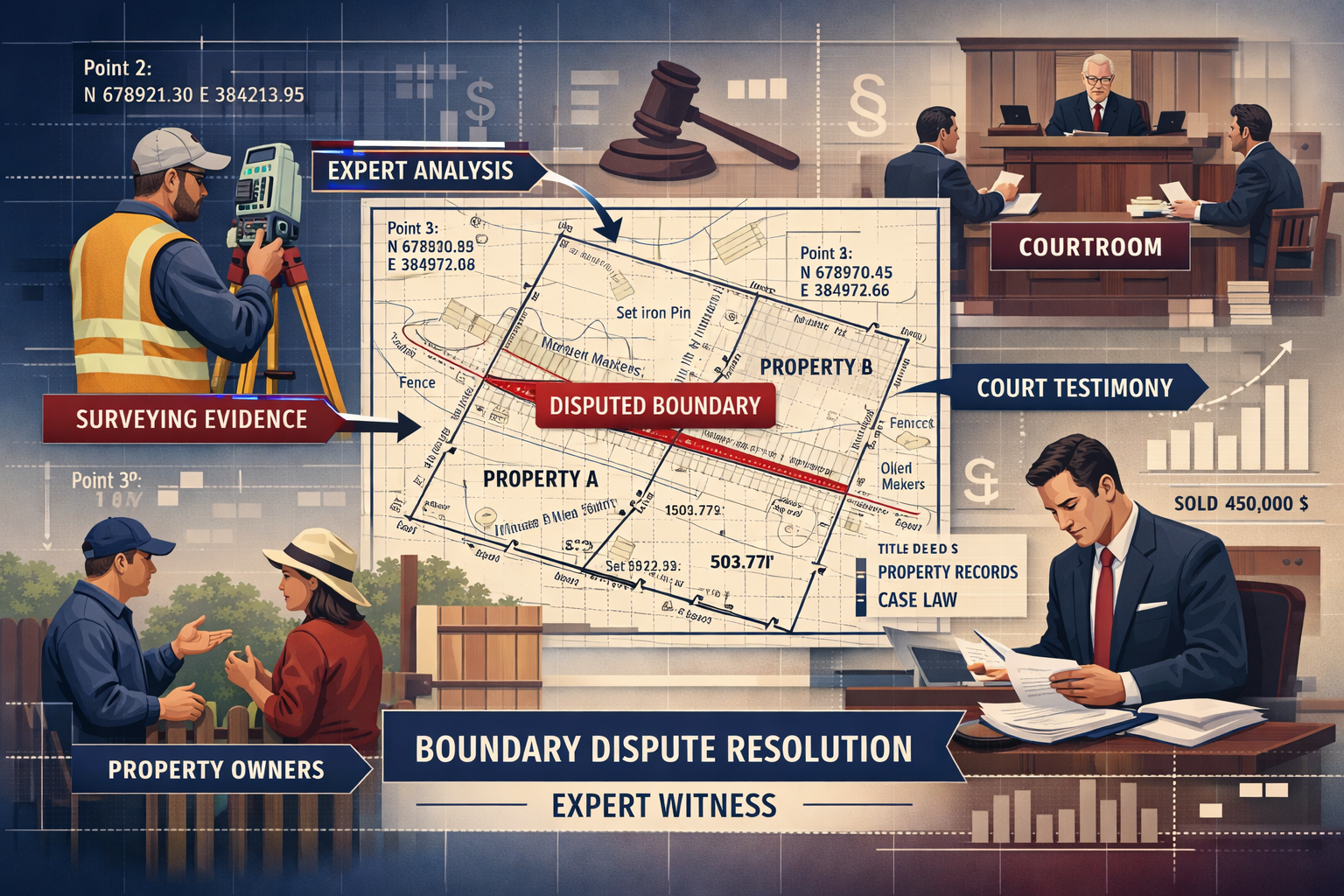
Translating strategic opportunities into sustainable practice growth requires systematic implementation of business development, technical excellence, and professional reputation management.
Establishing Credibility and Professional Recognition
Professional qualifications and certifications form the foundation of expert witness credibility. Essential credentials include:
Core Qualifications:
- MRICS or FRICS designation (Member or Fellow of Royal Institution of Chartered Surveyors)
- Specialist qualifications in land surveying, geomatics, or property law
- Expert witness training and certification
- Continuing professional development in boundary law and surveying technology
Reputation Building Activities:
- Publishing articles and papers on boundary dispute resolution
- Speaking at professional conferences and legal education events
- Contributing to industry guidance and best practice development
- Serving on professional committees and working groups
- Maintaining active membership in relevant professional organizations
Case Portfolio Development demonstrates expertise and builds confidence among potential instructing parties. Maintaining a portfolio of successfully resolved cases (with appropriate confidentiality protections) provides tangible evidence of capability and experience.
Fee Structures and Financial Management
Pricing strategy significantly impacts practice sustainability and growth. Expert witnesses typically employ several fee structures depending on engagement type and client preferences:
Hourly Billing: The most common approach, with rates varying based on:
- Expert's experience and reputation (£150-£500+ per hour)
- Complexity of the dispute
- Geographic location and market conditions
- Type of service (investigation vs. testimony)
- Urgency and time constraints
Fixed Fee Arrangements: Appropriate for defined scope work such as:
- Initial boundary assessments
- Desktop reviews and opinions
- Standard expert reports
- Mediation support
Retainer Agreements: For ongoing relationships with solicitors or corporate clients requiring regular access to expert advice
Contingency Arrangements: Generally prohibited for expert witnesses due to independence requirements, though consulting services may occasionally use success-based elements
Financial management considerations include:
- Professional indemnity insurance (essential, typically £1-5 million coverage)
- Time recording systems for accurate billing and productivity analysis
- Payment terms and credit control procedures
- Reserve funds for gaps between instructions
- Tax planning for self-employed or partnership structures
Managing the Expert Witness Workflow
Effective case management ensures quality delivery while maintaining profitability. A typical boundary dispute expert witness engagement follows this workflow:
1. Initial Instruction and Conflict Check (1-2 days)
- Review instruction letter and case documents
- Conduct conflict of interest check
- Assess competence for specific dispute issues
- Provide fee estimate and terms of engagement
- Confirm acceptance or decline instruction
2. Evidence Gathering and Site Investigation (3-10 days)
- Request and review all relevant documents
- Conduct site inspection and measurements
- Research historical records and title documents
- Interview relevant parties (where appropriate)
- Photograph and document current conditions
3. Analysis and Opinion Formation (5-15 days)
- Analyze all evidence systematically
- Apply relevant legal principles and surveying standards
- Consider alternative interpretations
- Formulate preliminary opinions
- Identify areas requiring additional investigation
4. Report Preparation (5-10 days)
- Draft structured report following professional standards
- Include all required elements (methodology, assumptions, data sources, etc.)
- Prepare supporting exhibits, plans, and photographs
- Internal quality review
- Finalize and submit report
5. Pre-Trial Preparation (2-5 days)
- Review opposing expert's report
- Prepare rebuttal analysis
- Attend expert meetings (if ordered)
- Prepare for cross-examination
- Coordinate with instructing solicitors
6. Testimony and Post-Trial (1-3 days)
- Provide evidence in court or arbitration
- Respond to cross-examination
- Clarify technical points as required
- Post-hearing submissions (if requested)
Understanding how boundary disputes intersect with party wall disputes and related property conflicts helps experts identify additional service opportunities and provide comprehensive guidance to clients.
Quality Assurance and Risk Management
Professional standards compliance protects both expert reputation and client interests. Implementing robust quality assurance processes includes:
Methodology Documentation: Maintaining detailed records of all investigation steps, measurements, calculations, and analytical processes ensures transparency and reproducibility.
Peer Review Processes: Having complex cases reviewed by other qualified professionals before finalizing reports identifies potential weaknesses and strengthens conclusions.
Continuing Education: Staying current with legal developments, surveying technology, and professional standards through regular training and professional development.
Insurance and Indemnity: Maintaining adequate professional indemnity insurance coverage protects against claims arising from professional negligence or errors.
Ethical Compliance: Adhering strictly to independence requirements, avoiding conflicts of interest, and maintaining confidentiality of client information.
When boundary disputes involve construction work or structural changes, understanding damage to property in party wall scenarios enhances the expert's ability to provide comprehensive opinions on causation and remediation.
Marketing and Business Development Strategies
Strategic marketing drives sustainable practice growth in competitive markets. Effective approaches for expert witness services include:
Content Marketing: Publishing authoritative content on boundary dispute topics establishes thought leadership and improves search visibility. Topics might include:
- Common boundary dispute scenarios and resolution approaches
- Recent case law affecting boundary determinations
- Technology applications in boundary surveying
- Guidance for property owners facing boundary conflicts
Professional Networking: Building relationships with solicitors, barristers, and other legal professionals generates referral instructions. Effective networking activities include:
- Attending legal sector events and conferences
- Joining relevant professional associations
- Hosting educational seminars for legal professionals
- Participating in alternative dispute resolution panels
Digital Presence: Maintaining a professional website with detailed information about qualifications, experience, and services helps potential clients evaluate expertise. Key elements include:
- Clear description of boundary dispute expertise
- Case studies and examples (with confidentiality protections)
- Professional credentials and affiliations
- Publications and speaking engagements
- Contact information and instruction procedures
Relationship Management: Maintaining ongoing communication with previous instructing parties ensures repeat instructions and referrals. Simple relationship management practices include:
- Periodic updates on relevant legal or technical developments
- Sharing published articles or presentations
- Acknowledging successful case outcomes
- Requesting testimonials and references
Understanding the broader context of property disputes, including issues like what to do if the neighbour is carrying out party wall work, helps experts position their services comprehensively.
Future Trends and Emerging Challenges in Expert Witness Roles for Boundary Disputes
The landscape of expert witnessing continues to evolve rapidly in 2026, driven by technological advancement, regulatory changes, and emerging dispute categories. Understanding these trends enables forward-thinking professionals to position their practices for sustained success.
Technology-Driven Transformation
Artificial intelligence and machine learning are reshaping expert witness requirements in fundamental ways. ForensisGroup identifies AI/ML systems, autonomous functions, and algorithmic decision-making as key drivers of expert witness demand in 2026[2]. For boundary dispute experts, this manifests in several ways:
Automated Boundary Determination Systems: AI-powered platforms increasingly analyze property records, historical surveys, and cadastral data to suggest boundary locations. Expert witnesses must:
- Evaluate the accuracy and reliability of AI-generated boundary determinations
- Explain algorithmic decision-making processes to courts
- Identify limitations and potential biases in automated systems
- Provide independent verification of AI-assisted surveys
Autonomous Surveying Technologies: Drones, robotic total stations, and autonomous scanning systems collect boundary data with minimal human intervention. Experts need expertise in:
- Validating data quality from autonomous systems
- Understanding sensor limitations and error sources
- Integrating autonomous survey data with traditional evidence
- Explaining autonomous surveying methodology to non-technical audiences
Digital Twin Technology: Three-dimensional digital representations of properties and boundaries enable virtual dispute analysis. This technology allows:
- Remote site inspection and evidence gathering
- Historical boundary reconstruction and visualization
- Scenario modeling for alternative boundary interpretations
- Enhanced courtroom presentation and communication
Blockchain and Distributed Ledger Systems: Some jurisdictions are exploring blockchain-based land registries, which may fundamentally change how boundary evidence is recorded and verified. Expert witnesses may need to understand:
- Cryptographic verification of property records
- Smart contract implications for boundary agreements
- Immutability and audit trail analysis
- Integration of traditional and blockchain-based evidence
Climate Change and Environmental Impacts
Climate impacts represent an emerging category of boundary disputes requiring specialized expertise[2]. Rising sea levels, coastal erosion, flooding, and land subsidence create unique challenges:
Ambulatory Boundaries: Boundaries defined by natural features (rivers, coastlines, vegetation lines) shift over time due to climate impacts. Experts must understand:
- Legal principles governing ambulatory vs. fixed boundaries
- Erosion and accretion analysis
- Historical shoreline reconstruction
- Climate modeling and future boundary projection
Subsidence and Ground Movement: Climate-related ground instability affects boundary monuments and property extent. Expert analysis includes:
- Differential settlement measurement and analysis
- Boundary monument displacement calculation
- Causation analysis (natural vs. human-induced movement)
- Remediation and boundary re-establishment
Flood Risk and Riparian Rights: Changing flood patterns affect riparian boundaries and water rights. Expertise requirements include:
- Hydrological analysis and flood modeling
- Riparian boundary law and water rights
- Historical flood extent research
- Future risk assessment and boundary implications
Regulatory and Legal Evolution
Cross-border expert witnessing continues to expand as international arbitral institutions refine procedures for overseas expert testimony[1]. Key developments include:
Standardized Expert Procedures: Organizations like the ICC and UNCITRAL have established codified procedures for cross-border expert testimony, creating consistency across jurisdictions while respecting local variations.
Virtual Hearing Protocols: Remote testimony has evolved from emergency measure to standard practice in many jurisdictions, requiring experts to develop skills in:
- Virtual presentation techniques
- Remote exhibit management
- Technology troubleshooting
- Maintaining authority and credibility through digital platforms
Enhanced Disclosure Requirements: Courts increasingly demand comprehensive disclosure of expert methodology, data sources, and alternative analyses. Experts must:
- Document all investigative steps thoroughly
- Preserve all data and working papers
- Explain rejected alternative hypotheses
- Disclose limitations and uncertainties explicitly
Expert Immunity Limitations: Some jurisdictions are reconsidering traditional expert witness immunity from negligence claims, potentially exposing experts to greater liability. This trend emphasizes the importance of:
- Rigorous quality assurance processes
- Comprehensive professional indemnity insurance
- Detailed engagement letters defining scope and limitations
- Peer review for complex or high-value cases
Emerging Dispute Categories
Supply chain disruptions and critical infrastructure claims create new boundary dispute contexts[2]. Examples include:
Infrastructure Development Disputes: Large-scale infrastructure projects (railways, highways, utilities) generate boundary conflicts involving:
- Compulsory purchase and land acquisition
- Temporary possession and access rights
- Permanent easement establishment
- Compensation assessment for partial takings
Telecommunications and Utility Easements: 5G deployment, fiber optic networks, and renewable energy infrastructure create new easement and access disputes requiring expert analysis of:
- Historical easement extent and scope
- Modern technology compatibility with historic rights
- Reasonable use principles for evolving technology
- Valuation of new easement grants
Urban Densification Conflicts: Increasing development pressure in urban areas generates boundary disputes involving:
- Airspace rights and vertical boundaries
- Basement extensions and subterranean development
- Party wall interactions with boundary issues
- Access rights for high-density development
Understanding these emerging categories positions expert witnesses to capture new market opportunities while developing specialized expertise that commands premium fees.
Conclusion: Seizing the Opportunity in Expert Witness Roles for Boundary Disputes in 2026
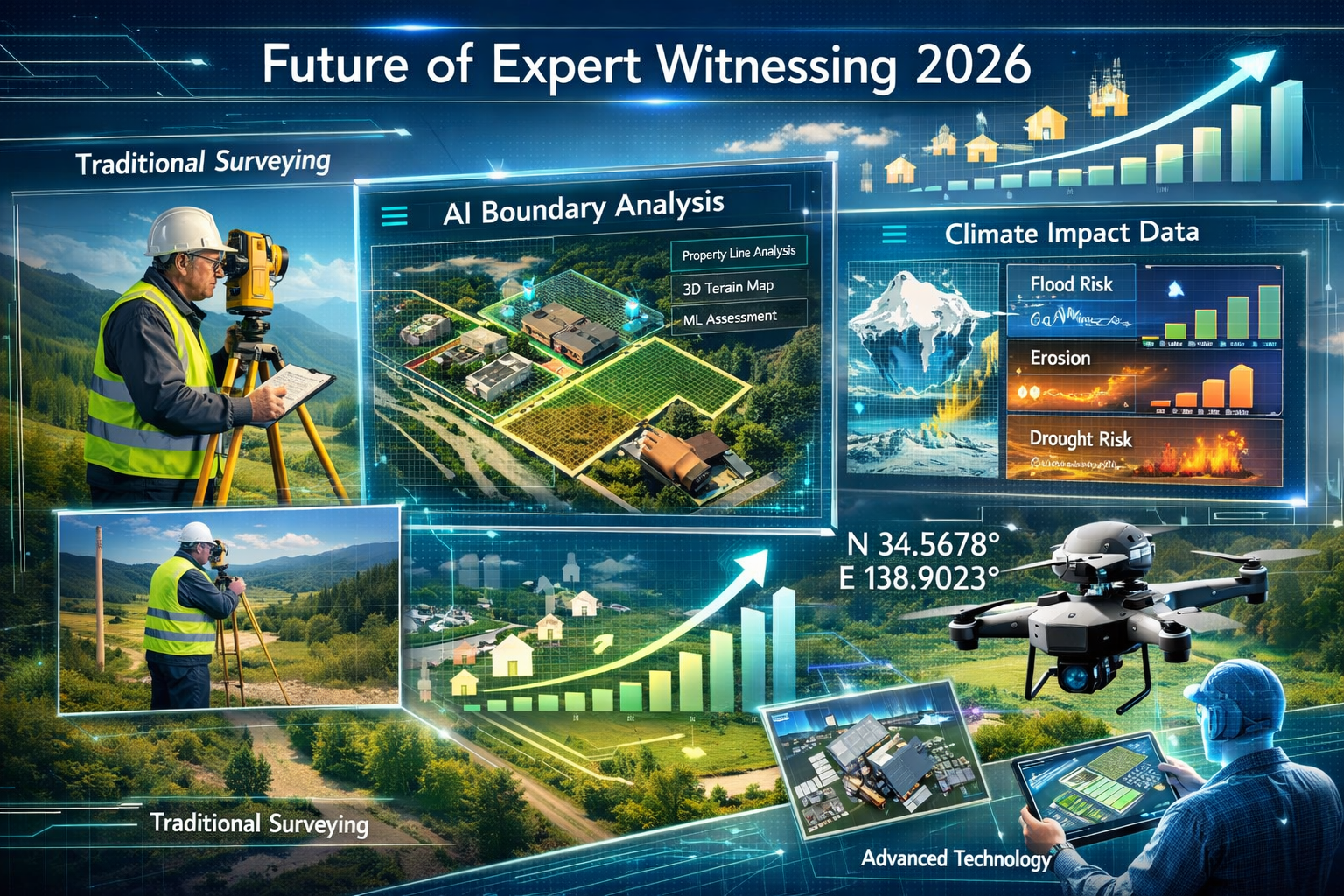
The convergence of rising transaction activity, technological advancement, and evolving dispute complexity creates an unprecedented opportunity landscape for expert witnesses specializing in boundary disputes in 2026. With the expert witness services market projected to reach $25 billion by 2033 and transaction volumes climbing steadily, demand for qualified boundary dispute experts will continue to grow across multiple sectors and jurisdictions.
Success in this expanding market requires a strategic approach that balances traditional surveying excellence with modern technological capabilities, combines technical precision with effective communication, and maintains unwavering commitment to professional independence and ethical standards.
Actionable Next Steps for Expert Witnesses
For Established Practitioners:
✅ Diversify Service Offerings: Expand beyond traditional testimony to include consulting, pre-litigation advisory, and alternative dispute resolution services that capitalize on the full $9 billion market for consulting and research services[3]
✅ Invest in Technology: Acquire modern surveying equipment (3D scanners, drones, GPS systems) and develop proficiency in digital presentation tools that enhance courtroom effectiveness and competitive positioning
✅ Develop Niche Specializations: Identify emerging dispute categories (climate impacts, infrastructure, technology easements) where specialized expertise commands premium fees and reduces competition
✅ Expand Geographic Reach: Explore cross-border opportunities through international arbitration, leveraging virtual hearing capabilities and standardized expert procedures[1]
✅ Build Strategic Partnerships: Develop referral networks with solicitors, estate agents, and other property professionals who encounter boundary disputes regularly
For Aspiring Expert Witnesses:
✅ Obtain Core Qualifications: Pursue RICS membership, specialist surveying qualifications, and expert witness training to establish credibility and meet professional standards
✅ Gain Diverse Experience: Seek exposure to various boundary dispute types, legal frameworks, and resolution mechanisms before specializing
✅ Study Case Law: Develop deep understanding of boundary law principles, precedent cases, and evolving legal standards that govern expert opinions
✅ Develop Communication Skills: Practice translating technical concepts into accessible language, as courtroom effectiveness depends on clear communication as much as technical accuracy
✅ Build Professional Network: Join relevant professional associations, attend legal sector events, and establish relationships with potential instructing parties
For Property Professionals and Legal Practitioners:
✅ Engage Experts Early: Involve boundary dispute experts during transaction due diligence and pre-litigation assessment to prevent disputes from escalating
✅ Verify Expert Credentials: Ensure instructed experts possess appropriate qualifications, relevant experience, and professional indemnity insurance
✅ Provide Comprehensive Instructions: Supply experts with all relevant documents, clear questions to address, and adequate time for thorough investigation
✅ Understand Expert Limitations: Recognize that experts provide opinions on technical matters within their expertise, not legal conclusions or advocacy
✅ Facilitate Expert Collaboration: When disputes involve multiple technical disciplines, coordinate expert interactions to ensure comprehensive analysis
The Path Forward
The property market's momentum in 2026 creates both challenges and opportunities. As transaction activity rises and boundary disputes multiply, the demand for qualified expert witnesses will intensify. Those who combine technical excellence with strategic positioning, embrace technological advancement while maintaining professional standards, and develop specialized expertise in emerging dispute categories will thrive in this expanding market.
The role of expert witnesses in boundary disputes resolution extends far beyond courtroom testimony—it encompasses prevention, negotiation, education, and problem-solving across the entire property transaction lifecycle. By capitalizing on rising transaction activity through strategic service development, technological investment, and professional excellence, expert witnesses can build sustainable, rewarding practices while contributing to fair and efficient dispute resolution.
The opportunity is clear. The market is growing. The time to act is now. Whether establishing a new expert witness practice, expanding existing services, or engaging experts to resolve boundary conflicts, understanding the dynamics of expert witness roles in boundary disputes amid rising transaction activity in 2026 provides the foundation for informed decision-making and successful outcomes.
References
[1] Trends In Expert Witnessing Cross Border Experts – https://www.roundtablegroup.com/the-experienced-expert/trends-in-expert-witnessing-cross-border-experts/
[2] Forensisgroup Discusses 2026 Trends Affecting Expert Witness Testimony – https://natlawreview.com/press-releases/forensisgroup-discusses-2026-trends-affecting-expert-witness-testimony
[3] Expert Witness Services 54217 – https://www.archivemarketresearch.com/reports/expert-witness-services-54217
[4] Boundary Dispute Surveys – https://www.highlandsurveying.com/boundary-dispute-surveys/
[5] Predictions 2026 Disputes And Investigations – https://www.simmons-simmons.com/en/publications/cmj28qvjt00eouj4gwocfl0mg/predictions-2026-disputes-and-investigations