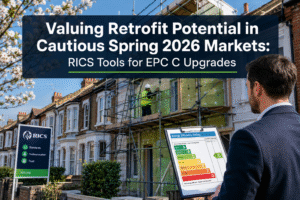
The property market in 2026 presents a unique challenge that hasn't been seen in decades: stark regional divergence that makes national averages nearly meaningless for accurate property valuations. According to the RICS January 2026 survey, Scotland and Northern Ireland are experiencing robust growth while London and the South East remain stubbornly stagnant—a pattern that demands fundamental shifts in how chartered surveyors approach Valuation Accuracy During Market Recovery: Navigating Regional Price Divergence in 2026. For professionals tasked with determining property values in this fragmented landscape, the traditional reliance on national trends and standard comparable sales methodologies simply won't suffice.
This divergence isn't merely academic—it has immediate practical implications for mortgage lending, investment decisions, tax assessments, and legal proceedings. When one region shows 5% annual growth while another barely moves, valuators must develop sophisticated regional analysis frameworks that account for local economic conditions, migration patterns, inventory levels, and buyer demographics. The recovery from pandemic-era disruptions has created a patchwork market where location matters more than ever before.
Key Takeaways
- Regional price divergence in 2026 is unprecedented, with Scotland and Northern Ireland showing strong growth while London and the South East experience near-zero appreciation, requiring location-specific valuation approaches
- National averages mask critical local variations—J.P. Morgan projects 0% national growth while individual regions vary from price declines to 5%+ appreciation[4]
- Comparable sales selection must prioritize recent, hyper-local transactions within the same micro-market rather than relying on broader regional data
- Commercial and residential markets are moving in opposite directions, with commercial investment forecast to surge 16% while residential sales grow only 3-14%[1][5]
- Mortgage rates averaging 6.3% in 2026 create affordability constraints that vary significantly by regional income levels, requiring adjusted capitalization rate models[5]
Understanding the 2026 Market Recovery Landscape
The National Picture: Stagnation Masks Regional Extremes
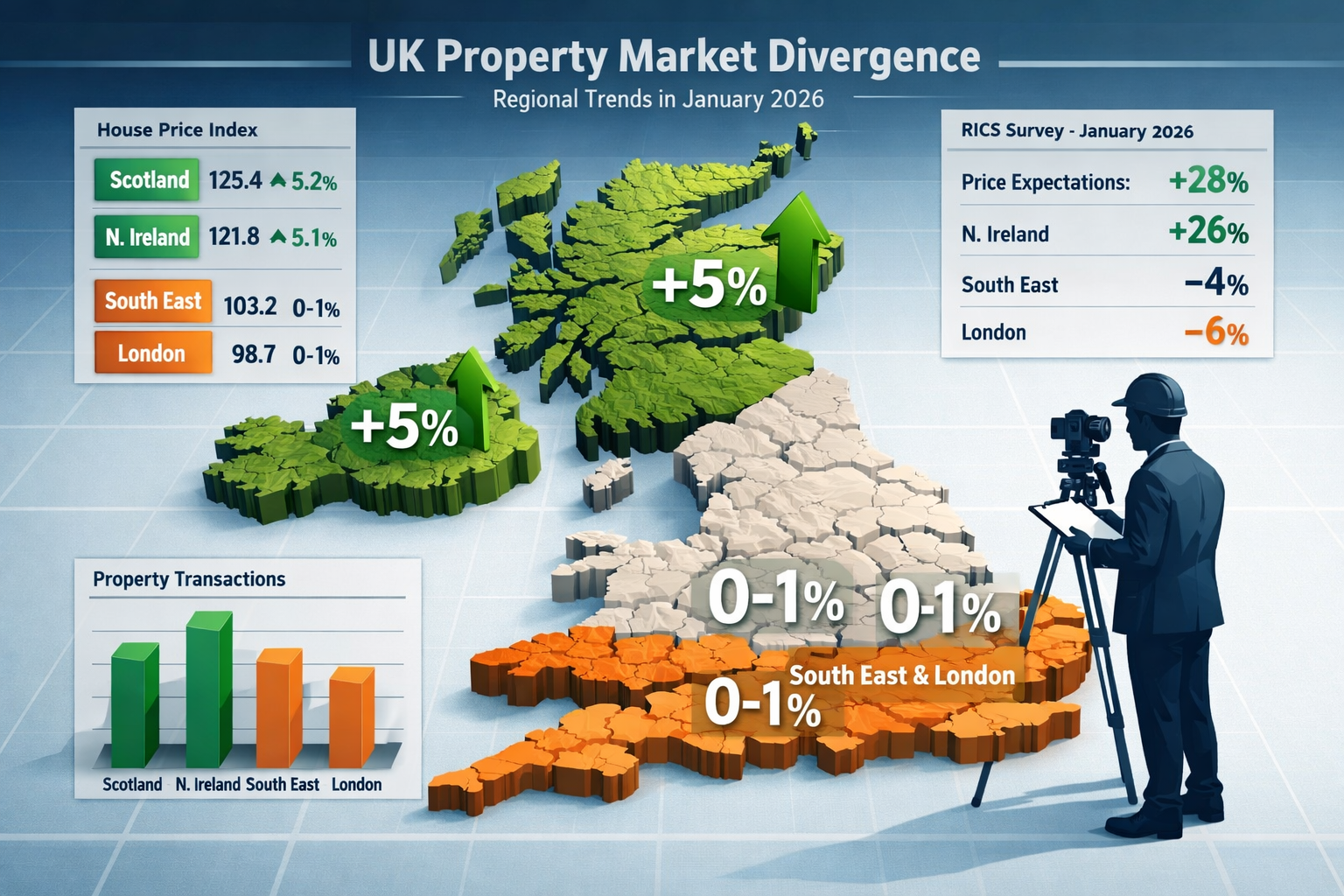
At first glance, the 2026 property market appears relatively calm. National home price growth is projected to stall at approximately 0-1% year-over-year[4][5]. This represents a dramatic reversal from the pandemic-era price surge when annual appreciation regularly exceeded 10-15% in many markets. However, this national average conceals extraordinary regional variations that make it nearly useless for practical valuation work.
J.P. Morgan's research indicates that house prices will effectively flatline at 0% nationally in 2026[4], while Redfin's more optimistic forecast suggests 1% appreciation[5]. The wide range in existing home sales growth estimates—from 3% (Redfin) to 7% (Cotality) to 14% (NAR)—further illustrates the uncertainty surrounding recovery timing[2][3][5]. This variation reflects fundamentally different market conditions across regions, property types, and price segments.
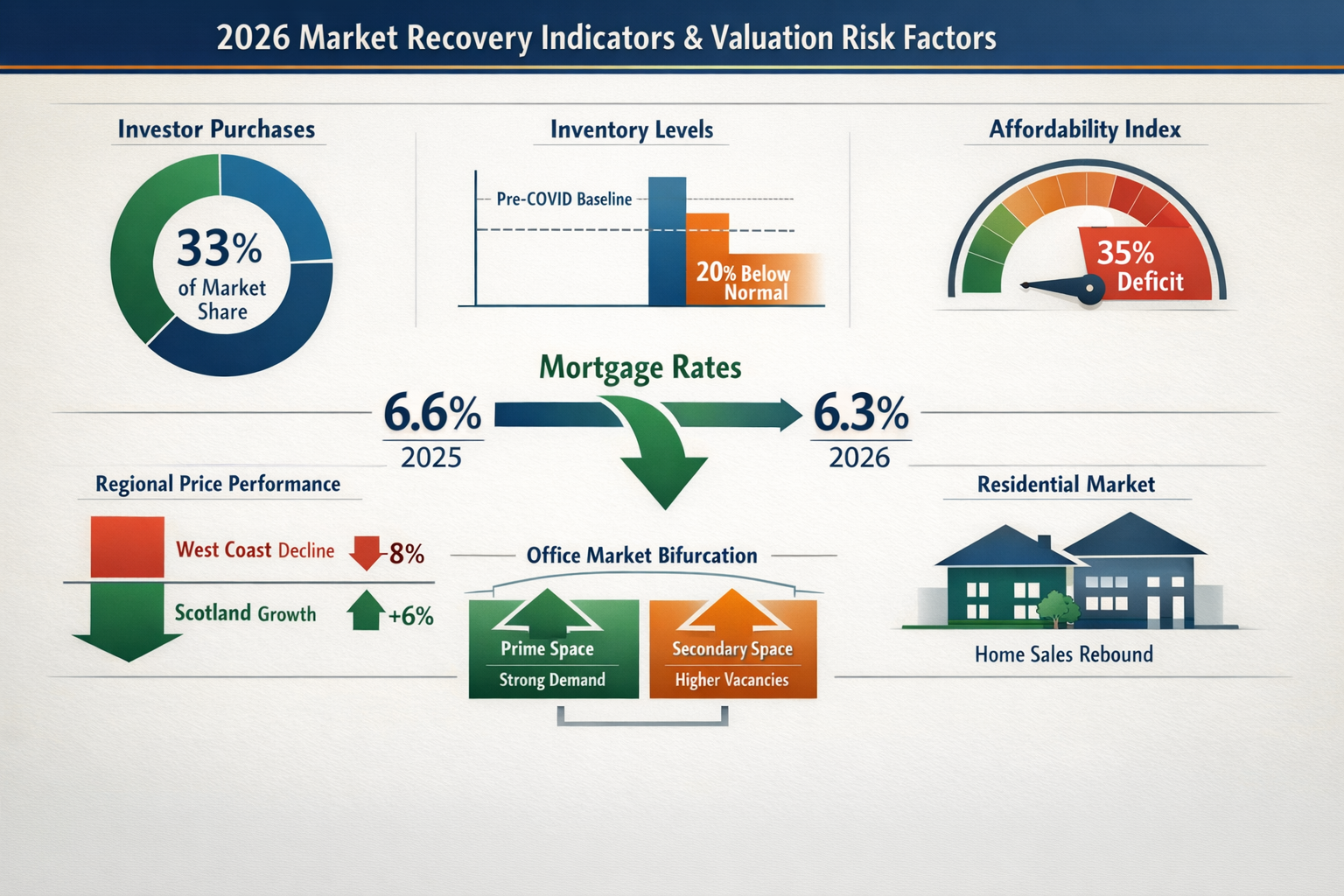
The affordability crisis continues to constrain demand nationwide. As of November 2025, the affordability index remained approximately 35% below pre-COVID levels[4], meaning the typical household has significantly less purchasing power than before the pandemic. This persistent challenge affects different regions unequally based on local income levels and price appreciation histories.
Regional Divergence: The RICS January 2026 Survey Findings
The RICS survey from January 2026 reveals the extent of regional market fragmentation. Scotland and Northern Ireland are experiencing robust price growth, with surveyors reporting strong buyer demand, limited inventory, and upward price pressure. These regions benefit from:
- Relatively affordable price points compared to southern England
- Strong local economies with diversified employment bases
- Limited new construction during the pandemic period
- In-migration from higher-cost regions seeking better value
In stark contrast, London and the South East show minimal price movement despite being the UK's largest property markets. These regions face:
- Persistently high prices relative to local incomes
- Abundant inventory from pandemic-era sellers
- Reduced international buyer activity
- Work-from-home trends reducing demand for expensive urban locations
The West Coast and Sun Belt regions in the United States present even more extreme examples of regional divergence, with active price depreciation due to oversupply from the pandemic-era construction boom[4]. These markets require fundamentally different valuation approaches than appreciating regions, including careful consideration of absorption rates and competitive new inventory.
Commercial vs. Residential: Diverging Asset Classes
While residential markets struggle with affordability and stagnant prices, commercial real estate shows surprising strength. Commercial real estate investment is forecast to increase 16% to $562 billion in 2026[1], representing a substantial recovery from recent years. This divergence suggests that valuators must carefully consider property type when assessing market conditions and selecting comparable sales.
The office market specifically shows deep bifurcation between asset quality tiers. Prime, newer office space with modern amenities, efficient layouts, and sustainable features is becoming increasingly scarce, with further scarcity expected by year-end 2026[1]. Meanwhile, older secondary office space faces ongoing pressure from hybrid work arrangements and tenant flight to quality. This makes comparable sales analysis particularly critical for accurate commercial property valuations.
Valuation Accuracy During Market Recovery: Navigating Regional Price Divergence in 2026—Methodological Challenges
The Comparable Sales Dilemma in Fragmented Markets
Traditional comparable sales analysis relies on identifying recently sold properties with similar characteristics in the same market area. However, when regional markets diverge significantly, determining what constitutes "the same market area" becomes problematic. A property in central London may have more in common with other global gateway cities than with properties just 50 miles away in terms of buyer demographics, price trends, and market dynamics.
Key challenges for comparable sales selection in 2026 include:
| Challenge | Impact on Valuation | Mitigation Strategy |
|---|---|---|
| Limited recent sales | Outdated comparables don't reflect current market | Expand search radius cautiously; weight recent sales heavily |
| Rapid regional divergence | 6-month-old sales may be irrelevant | Use monthly price indices to adjust older comparables |
| Property type variations | Commercial and residential moving opposite directions | Strictly limit comparables to same property type and quality tier |
| Buyer pool changes | Investor purchases now 33% of market[3] | Identify buyer type and adjust for different motivations |
| Inventory imbalances | Some regions 20% below normal inventory[2] | Consider days-on-market and absorption rates |
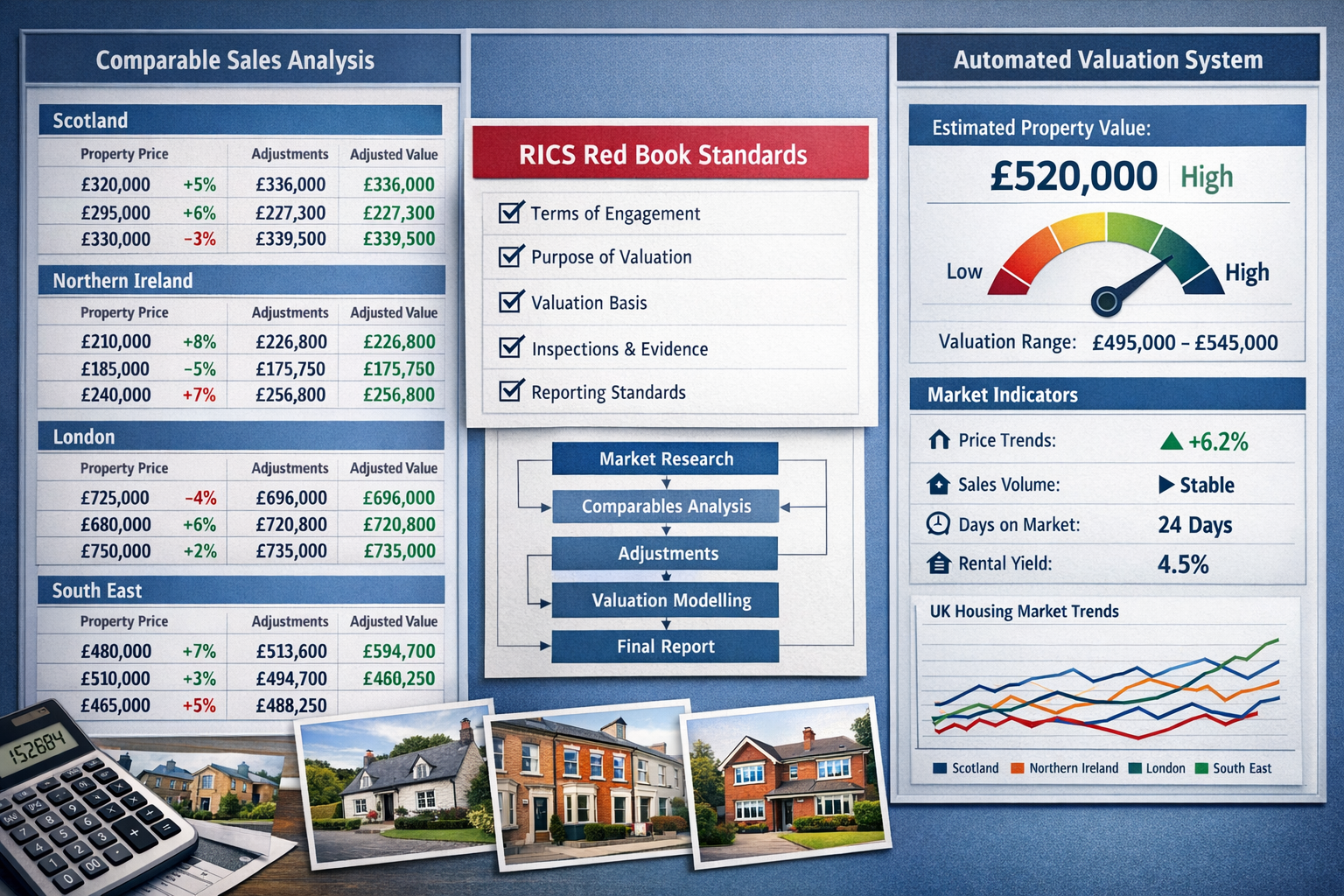
The inventory situation in 2026 adds complexity. Current inventory levels are approximately 20% above the prior year but still remain about 20% below pre-COVID normal levels[2]. This gradual rebalancing affects comparable sales availability and valuation confidence throughout the year. In tight inventory markets like Scotland, limited sales data may force valuators to rely more heavily on income approaches or automated valuation models (AVMs) with appropriate adjustments.
Adjusting for Regional Economic Fundamentals
Accurate valuation during regional price divergence requires deep understanding of local economic drivers. The migration patterns that fueled pandemic-era growth in Sun Belt states have largely stalled. In-migration to Florida, Texas, and similar destinations has plateaued following the initial surge[3], fundamentally changing demand projections in these markets.
Valuators must assess:
- Local employment trends and major employer stability
- Population growth or decline based on recent census and migration data
- Income levels and wage growth relative to property prices
- New construction pipeline and expected inventory additions
- Infrastructure investments that may enhance location desirability
For professional RICS valuations, these economic fundamentals must be explicitly documented and incorporated into the valuation reasoning. The Red Book standards require valuators to consider market conditions and trends that may affect value, making regional economic analysis not just best practice but a professional requirement.
The Mortgage Rate Environment and Capitalization Rates
The mortgage rate environment in 2026 significantly impacts both residential and commercial valuations. The 30-year fixed rate is projected to average 6.3% throughout the year, down from 6.6% in 2025[5]. While this represents improvement, rates remain elevated compared to the 3-4% range that prevailed during the pandemic period.
This rate environment affects valuations through several mechanisms:
For residential properties:
- Reduced buyer purchasing power limits price appreciation potential
- Higher rates support rental demand, potentially increasing investment property values
- Refinance activity surge (expected 30%+ increase to $670 billion annually[5]) may reduce distressed sales risk
- 20% of mortgaged homeowners holding rates above 6% creates "rate lock" limiting inventory[5]
For commercial properties:
- Capitalization rates must adjust upward to remain competitive with debt costs
- Income-producing properties require higher yields to justify acquisition
- Value compression occurs when cap rates rise without corresponding rent increases
- Quality properties in strong markets maintain value better than secondary assets
When conducting commercial property surveys or rent reviews, valuators must carefully calibrate capitalization rates to reflect both the general interest rate environment and specific regional market conditions.
Practical Approaches to Valuation Accuracy During Market Recovery: Navigating Regional Price Divergence in 2026
Developing Regional Market Intelligence Systems
Accurate valuation in a fragmented market requires systematic regional market intelligence. Chartered surveyors should develop structured approaches to gathering and analyzing local market data:
📊 Essential Data Sources:
- Local estate agent reports and asking price trends
- Regional RICS survey results and member sentiment
- Land Registry transaction data with monthly granularity
- Planning authority data on approved developments
- Local economic development reports and employment statistics
- Regional mortgage lending data and approval rates
Creating a regional market dashboard allows valuators to track key indicators over time and identify emerging trends before they appear in national statistics. This proactive approach is particularly valuable for probate valuations, matrimonial valuations, and other situations where accuracy is critical and disputes are likely.
Micro-Market Analysis: Drilling Down Beyond Regional Averages
Even within regions showing overall stagnation or growth, micro-market variations can be substantial. A prestigious neighborhood in London may appreciate while surrounding areas decline. A specific suburb in Scotland may outperform regional averages due to new transport links or school improvements.
Effective micro-market analysis involves:
- Defining appropriate market boundaries based on buyer behavior rather than administrative boundaries
- Identifying comparable properties within the same micro-market (typically within 0.5-1 mile radius for residential)
- Analyzing price per square foot trends at the postcode or neighborhood level
- Assessing inventory levels and absorption rates for the specific property type and price segment
- Evaluating local amenities, schools, transport, and development plans that affect desirability
For lease extension valuations and shared ownership valuations, micro-market analysis becomes even more critical because these specialized property types have limited comparable sales and require precise understanding of local market dynamics.
Hybrid Valuation Methodologies for Uncertain Markets
When traditional comparable sales analysis produces uncertain results due to limited data or rapid market changes, hybrid methodologies combining multiple approaches can improve accuracy:
The Three-Method Reconciliation Approach:
- Sales Comparison Approach – Traditional comparable sales with regional and temporal adjustments
- Income Approach – Capitalization of rental income or potential rental value
- Cost Approach – Replacement cost less depreciation, particularly relevant for unique properties
By triangulating value estimates from multiple methodologies, valuators can identify outliers and develop more robust conclusions. This approach is particularly valuable for capital gains tax valuations and retrospective valuations where accuracy affects significant financial consequences.
Automated Valuation Models (AVMs) as Supplementary Tools:
While AVMs should never replace professional judgment, they can provide useful supplementary data points, particularly in markets with limited recent comparable sales. Modern AVMs incorporate:
- Machine learning algorithms analyzing thousands of transactions
- Real-time market trend adjustments
- Regional economic indicators and demographic data
- Confidence intervals indicating reliability of estimates
Professional valuators should use AVMs as one input among many, not as definitive value conclusions. The RICS guidance on AVMs emphasizes their limitations and the continued necessity of human expertise in interpreting results.
Adjusting Comparables for Regional Market Conditions
When comparable sales must be drawn from different regional markets or time periods, systematic adjustment methodologies ensure consistency and defensibility:
Temporal Adjustments:
- Apply regional price indices (not national averages) to adjust for time differences
- Weight recent sales more heavily than older transactions
- Consider market direction (improving vs. declining) when extrapolating trends
- Document adjustment rationale with specific index sources
Location Adjustments:
- Quantify location premium/discount based on price per square foot differentials
- Consider accessibility, amenity proximity, and neighborhood prestige
- Adjust for regional economic fundamentals (employment, income levels)
- Account for micro-market characteristics affecting desirability
Property Characteristic Adjustments:
- Size, condition, age, and features require careful calibration
- Quality tier matching is critical in bifurcated markets
- Modern amenities command varying premiums across regions
- Energy efficiency and sustainability features increasingly affect value
For Right to Buy valuations and Charities Act valuations, systematic adjustment documentation is essential for regulatory compliance and potential appeals.
Sector-Specific Considerations for 2026 Valuations
Residential Property Valuation in Divergent Markets
The residential market in 2026 requires careful segmentation by price tier, property type, and regional location. Key considerations include:
First-Time Buyer Segment:
- Most affected by affordability constraints (35% below pre-COVID levels[4])
- Highly sensitive to mortgage rate changes
- Regional variations in Help to Buy and shared ownership availability
- Starter homes in affordable regions (Scotland, Northern Ireland) showing strongest demand
Mid-Market Family Homes:
- School catchment areas creating micro-market premiums
- Suburban locations benefiting from work-from-home trends
- Regional variations in space-per-pound value driving migration
- Inventory levels affecting negotiating power and price stability
Premium and Luxury Segment:
- Less sensitive to mortgage rates (higher cash buyer proportion)
- International buyer activity varying significantly by region
- London luxury market affected by tax policies and political uncertainty
- Quality and unique features commanding larger premiums in strong markets
Investment Properties:
- Investor purchases representing 33% of single-family transactions[3] fundamentally changes market dynamics
- Rental yield calculations must reflect regional rent trends and tenant demand
- Build-to-rent developments competing with individual landlords in some markets
- Tax treatment variations affecting investor appetite across regions
Commercial Property Valuation Complexities
The commercial sector's 16% investment growth forecast[1] masks significant variations by property type and quality tier:
Office Market Bifurcation:
- Prime office space with ESG credentials commanding premium rents and low cap rates
- Secondary office facing structural obsolescence and tenant flight
- Hybrid work patterns affecting space requirements and valuations
- Location within cities matters more than ever (transit access, amenity proximity)
Retail and Hospitality:
- E-commerce permanently reducing demand for traditional retail space
- Experiential retail and food & beverage showing resilience
- Regional tourism patterns affecting hospitality valuations
- Repurposing potential affecting secondary retail asset values
Industrial and Logistics:
- E-commerce growth supporting warehouse demand
- Last-mile logistics facilities commanding premiums near population centers
- Regional variations in industrial land availability
- Obsolescence risk for older facilities lacking modern specifications
Alternative Assets:
- Student housing, healthcare, data centers showing growth
- Limited comparable sales requiring income-based valuation approaches
- Regional demographic trends affecting demand projections
- Specialized knowledge required for accurate valuations
Professional commercial valuation services must account for these sector-specific dynamics while also incorporating broader regional market trends.
New Construction and Development Valuations
New construction is projected to grow approximately 1% in 2026[2], representing modest supply recovery that will influence valuation trajectories in markets with significant new inventory. Valuation considerations include:
- Absorption rate analysis for developments entering oversupplied markets
- Construction cost trends affecting replacement value calculations
- Buyer preferences for new vs. existing properties varying by region
- Warranty and defect-free premium quantification
- Energy efficiency and building regulation compliance value impact
For development sites and projects under construction, valuators must carefully assess:
- Planning permission status and conditions
- Regional demand for the proposed property type
- Construction timeline and market condition projections
- Comparable sales of similar new developments in the micro-market
- Development profit margins and risk adjustments
Risk Management and Professional Standards
RICS Red Book Compliance in Uncertain Markets
The RICS Valuation – Global Standards (Red Book) provides essential guidance for maintaining professional standards during market uncertainty. Key requirements particularly relevant to regional price divergence include:
Terms of Engagement:
- Clearly define valuation purpose and basis
- Specify assumptions regarding market conditions
- Identify any departures from standard assumptions
- Establish scope of investigation and information sources
Market Context and Uncertainty:
- Document regional market conditions affecting the valuation
- Identify material uncertainty if market evidence is limited
- Explain any unusual market characteristics or trends
- Provide appropriate caveats regarding valuation confidence
Comparable Evidence:
- Demonstrate reasonable efforts to identify relevant comparables
- Explain adjustments made for location, time, and property differences
- Document sources of market data and transaction information
- Justify any reliance on older comparables or broader market data
Reporting Requirements:
- Provide clear reasoning supporting value conclusions
- Explain regional and micro-market factors affecting value
- Identify any assumptions or special assumptions made
- Include appropriate qualifications regarding market uncertainty
For specialized valuations like non-domicile tax valuations or divorce property valuations, Red Book compliance ensures defensibility in potential disputes or regulatory reviews.
Managing Valuation Uncertainty and Client Expectations
Transparent communication about valuation uncertainty is essential in fragmented markets. Valuators should:
✅ Clearly explain limitations of available market data
✅ Provide value ranges when point estimates are unreliable
✅ Document assumptions that could materially affect conclusions
✅ Update clients on changing market conditions affecting previous valuations
✅ Recommend re-valuations when market conditions shift significantly
Professional indemnity insurance considerations become more important during market uncertainty. Valuators should:
- Ensure adequate coverage limits for the value of properties being assessed
- Document thorough investigation and reasonable methodology
- Retain comprehensive working papers supporting conclusions
- Avoid overconfidence in uncertain markets
- Seek peer review for complex or high-value assignments
Quality Assurance and Peer Review Processes
Implementing systematic quality assurance improves accuracy and reduces risk:
Internal Review Procedures:
- Checklist-based review of all valuation reports
- Peer review of complex or high-value assignments
- Regular calibration meetings to discuss market trends
- Database of comparable sales with quality ratings
- Feedback loops from subsequent sales or disputes
External Validation:
- Comparison with automated valuation model outputs
- Review of regional price indices and market reports
- Participation in RICS regional market surveys
- Networking with local estate agents and valuators
- Continuing professional development on regional markets
Technology and Data Management:
- Valuation software with built-in regional market data
- Geographic information systems (GIS) for micro-market analysis
- Automated comparable sales identification and adjustment
- Database management for tracking local transactions
- Analytics tools for identifying trends and outliers
Future Outlook and Emerging Trends
Market Trajectory for Late 2026 and Beyond
While predictions remain uncertain, several trends are likely to shape the property market through late 2026 and into 2027:
Mortgage Rate Trajectory:
- Gradual decline toward 6% by year-end if inflation remains controlled
- Potential for more significant drops if economic conditions weaken
- Refinance wave continuing as rate-locked homeowners gain opportunities
- Improved affordability slowly expanding buyer pool
Regional Convergence or Continued Divergence:
- Strong growth regions may moderate as affordability constraints emerge
- Stagnant regions may benefit from improved mortgage rates and pent-up demand
- Migration patterns could shift again based on remote work policies
- Infrastructure investments potentially creating new growth regions
Inventory Normalization:
- Continued gradual increase toward pre-COVID levels
- Regional variations in inventory recovery affecting price dynamics
- New construction slowly adding supply in high-demand markets
- Rate-locked homeowners gradually entering market as rates decline
Structural Market Changes:
- Investor share of purchases likely to remain elevated
- Build-to-rent sector continuing to expand
- Climate considerations increasingly affecting valuations
- Technology adoption accelerating in valuation practices
Technology and Innovation in Valuation Practice
Emerging technologies are transforming how valuators gather data and perform analysis:
Artificial Intelligence and Machine Learning:
- Enhanced AVMs with improved accuracy and regional calibration
- Natural language processing of market reports and property descriptions
- Predictive analytics for market trend forecasting
- Automated comparable sales identification and adjustment suggestions
Geospatial Analysis:
- Advanced GIS mapping of micro-market boundaries
- Heat mapping of price trends and market activity
- Accessibility analysis using transport network data
- Environmental risk assessment (flooding, subsidence, pollution)
Data Aggregation and Analytics:
- Real-time market data from multiple listing services
- Automated tracking of regional price indices
- Social media sentiment analysis for neighborhood trends
- Economic indicator integration for demand forecasting
Remote Inspection Technologies:
- High-resolution photography and 360-degree tours
- Drone surveys for roof and site assessment
- Virtual reality property inspections
- Thermal imaging and building diagnostics
While technology enhances efficiency and data availability, professional judgment remains essential. Valuators must interpret data in context, assess property-specific factors, and apply appropriate methodologies for each unique situation.
Preparing for Continued Market Volatility
The lessons of 2026's regional price divergence suggest that market fragmentation may be the new normal rather than a temporary phenomenon. Valuators should prepare for continued volatility by:
🎯 Building regional expertise through focused market study and local networking
🎯 Developing flexible methodologies that adapt to varying data availability
🎯 Investing in technology and data to improve market intelligence
🎯 Maintaining conservative approaches when uncertainty is high
🎯 Communicating clearly with clients about limitations and assumptions
🎯 Continuing professional development on emerging trends and methodologies
The property market's complexity in 2026 creates both challenges and opportunities for valuation professionals. Those who develop sophisticated regional analysis capabilities and embrace technology while maintaining rigorous professional standards will be best positioned to deliver accurate valuations in any market environment.
Conclusion
Valuation Accuracy During Market Recovery: Navigating Regional Price Divergence in 2026 requires fundamental shifts in how property professionals approach their work. The stark divergence revealed by the RICS January 2026 survey—with Scotland and Northern Ireland showing robust growth while London and the South East stagnate—demonstrates that national averages and traditional methodologies are insufficient in today's fragmented market.
The key to accurate valuations lies in hyper-local market intelligence, systematic comparable sales analysis with appropriate regional adjustments, and transparent communication about uncertainty. Whether conducting RICS valuations for mortgage purposes, probate valuations for estate administration, or commercial property assessments for investment decisions, professionals must account for regional economic fundamentals, micro-market dynamics, and property-specific factors.
The mortgage rate environment averaging 6.3%[5], persistent affordability challenges 35% below pre-COVID levels[4], and structural market changes like investor purchases representing 33% of transactions[3] all create complexity that demands sophisticated analysis. The commercial sector's 16% investment growth[1] contrasting with residential stagnation further illustrates the importance of property type and regional considerations.
Actionable Next Steps
For property professionals seeking to improve valuation accuracy in 2026's divergent market:
- Develop systematic regional market intelligence by creating data dashboards tracking local price trends, inventory levels, and economic indicators
- Refine comparable sales selection to prioritize recent, hyper-local transactions within the same micro-market rather than relying on broader regional data
- Implement hybrid valuation methodologies combining sales comparison, income, and cost approaches to triangulate value in uncertain markets
- Invest in technology and data sources including GIS mapping, automated valuation models, and real-time market analytics
- Enhance professional standards through peer review, continuing education on regional markets, and rigorous RICS Red Book compliance
- Communicate transparently with clients about market uncertainty, valuation limitations, and assumptions affecting conclusions
The property market's regional fragmentation in 2026 represents a fundamental shift that will likely persist beyond the current recovery period. Valuation professionals who adapt their methodologies, embrace technology, and develop deep regional expertise will be best positioned to deliver accurate, defensible valuations regardless of market conditions. The complexity creates challenges, but also opportunities for those willing to invest in developing sophisticated analytical capabilities and maintaining the highest professional standards.
References
[1] Us Real Estate Market Outlook 2026 – https://www.cbre.com/insights/books/us-real-estate-market-outlook-2026
[2] 2026 Real Estate Outlook What Leading Housing Economists Are Watching – https://www.nar.realtor/magazine/real-estate-news/2026-real-estate-outlook-what-leading-housing-economists-are-watching
[3] 2026 Property Market Trends – https://www.cotality.com/insights/articles/2026-property-market-trends
[4] Us Housing Market Outlook – https://www.jpmorgan.com/insights/global-research/real-estate/us-housing-market-outlook
[5] Housing Market Predictions 2026 – https://www.redfin.com/news/housing-market-predictions-2026/