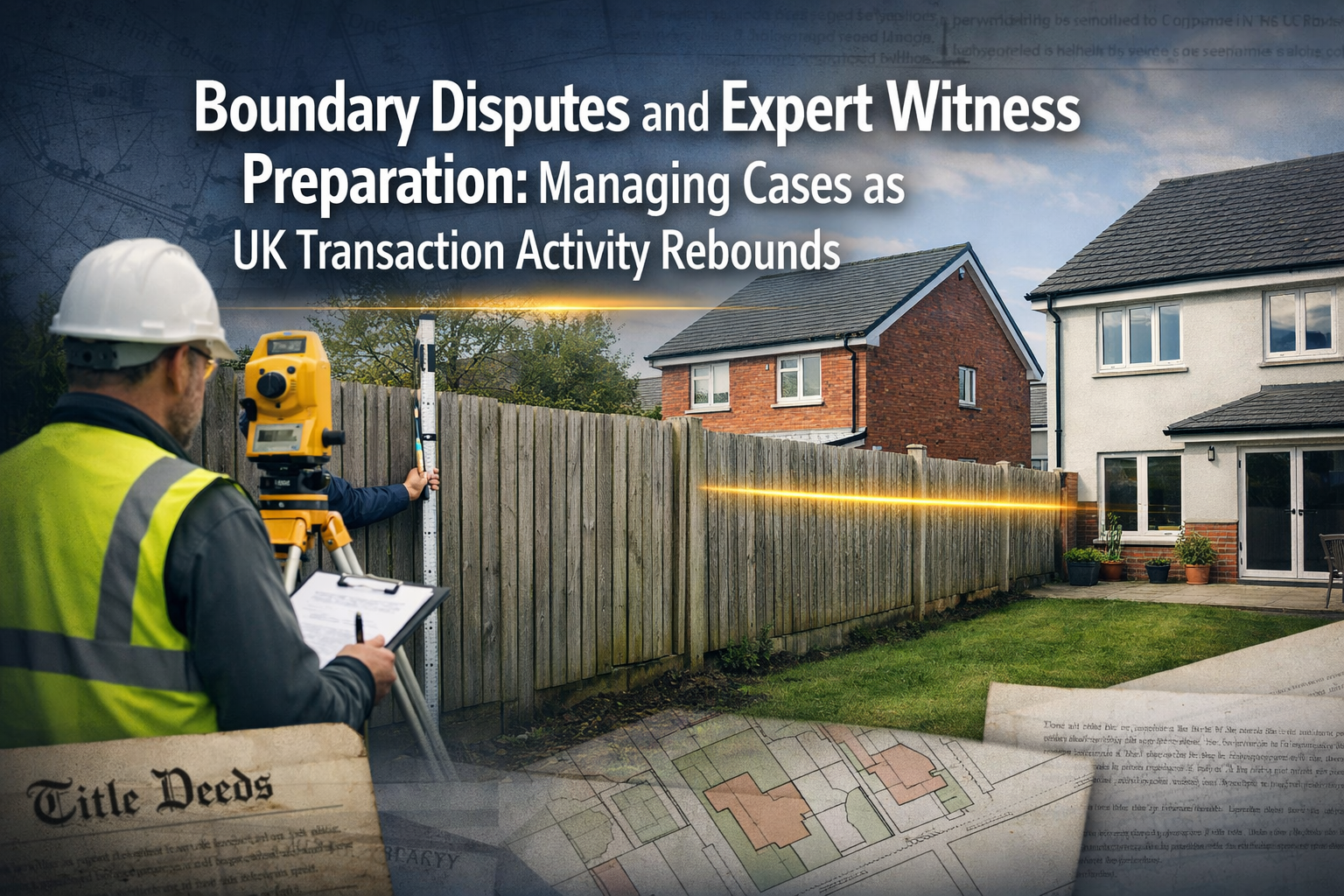
As the UK property market experiences renewed vigour in 2026, a familiar challenge resurfaces with increased intensity: boundary disputes. When transaction volumes rise and properties change hands more frequently, disagreements over property lines, fence positions, and land ownership become significantly more common. For surveyors and property professionals, understanding Boundary Disputes and Expert Witness Preparation: Managing Cases as UK Transaction Activity Rebounds has never been more critical to protecting clients' interests and maintaining professional standards.
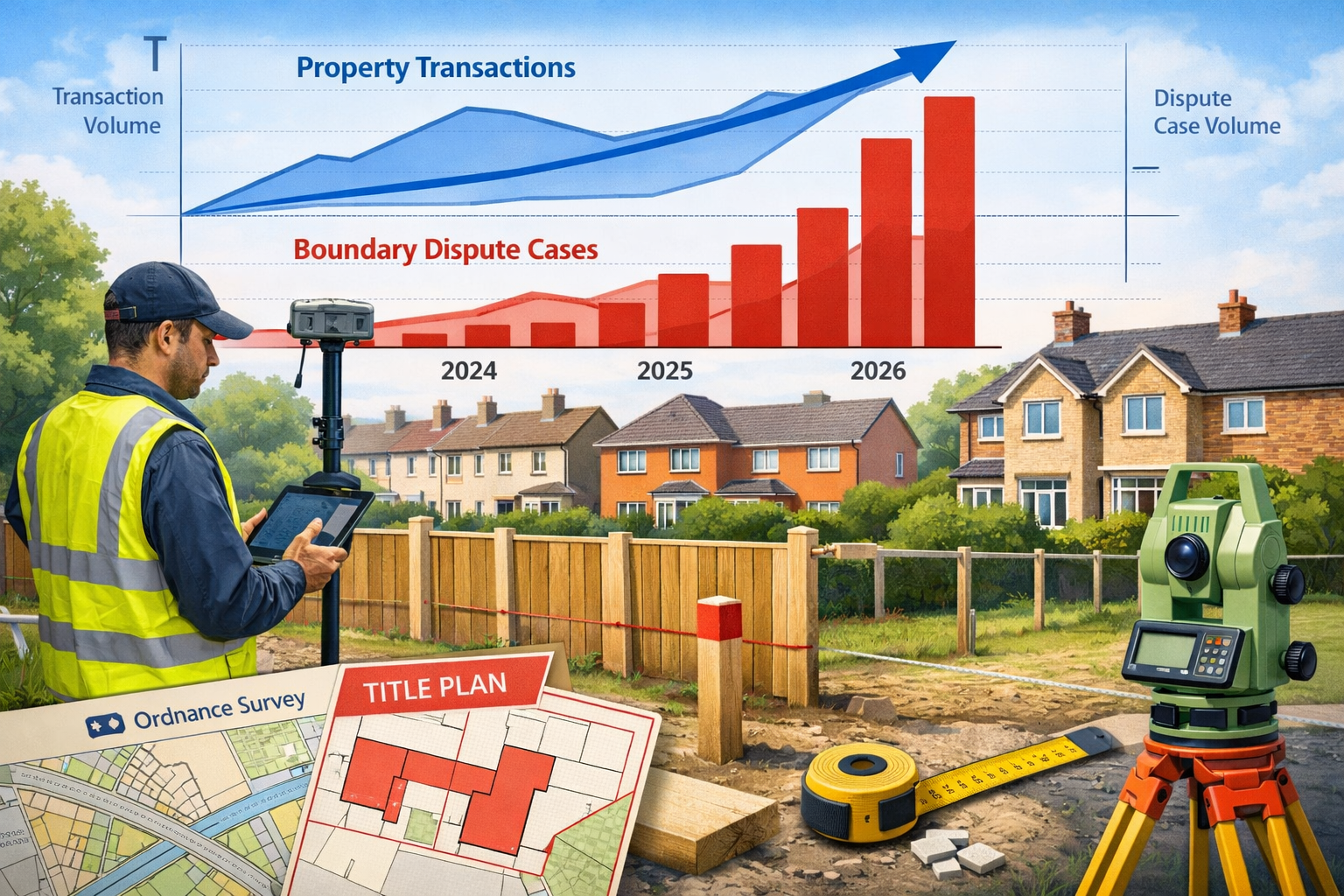
The correlation between market activity and boundary conflicts is well-established. As more buyers enter the market, pre-purchase surveys uncover previously unnoticed discrepancies, and new owners seek to clarify their property boundaries. This surge in disputes demands that surveyors acting as expert witnesses maintain rigorous documentation standards, stay current with RICS guidance, and prepare comprehensive evidence packages that can withstand judicial scrutiny.
Key Takeaways
- 📈 Rising transaction volumes in 2026 correlate directly with increased boundary dispute cases, requiring surveyors to prepare for higher caseloads and more complex evidence requirements
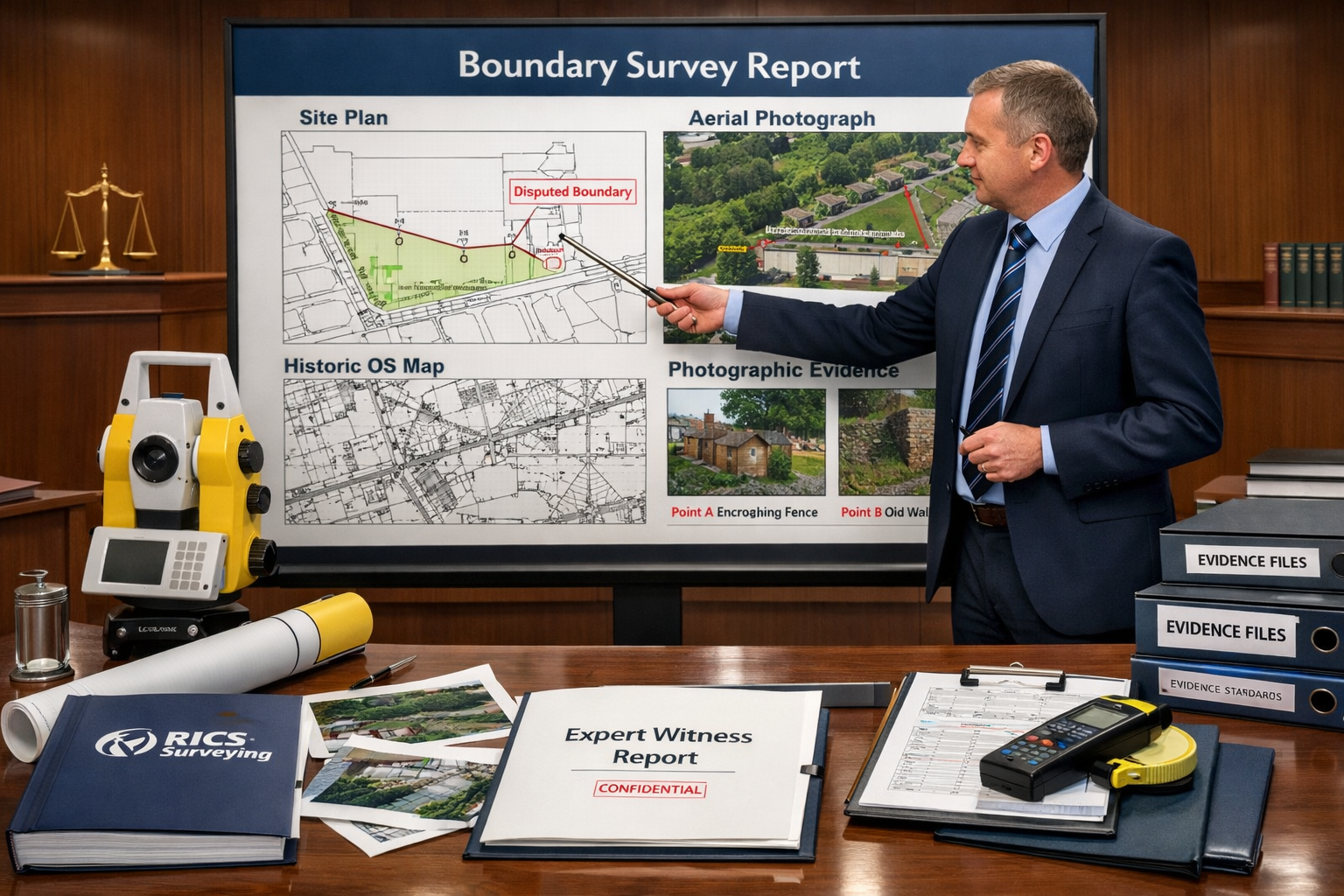
- 🏛️ Recent case law (Charlton v Forrest [2024]) confirms courts prioritize factual evidence including Ordnance Survey plans, aerial photographs, and historical records over expert consensus alone
- 📋 Expert witnesses must adhere to strict RICS standards and provide comprehensive documentation including boundary surveys, title analysis, and photographic evidence
- ⚖️ Effective case management requires systematic evidence gathering, early engagement with legal teams, and clear communication of technical findings to non-specialist audiences
- 💰 Cost-benefit analysis is essential before proceeding with boundary disputes, as legal expenses can quickly exceed property value gains
Understanding the Link Between UK Transaction Activity and Boundary Disputes
The 2026 Property Market Rebound
The UK property market in 2026 shows clear signs of recovery following several years of uncertainty. Increased buyer confidence, stabilizing interest rates, and pent-up demand have combined to create a more active transaction environment. This rebound brings welcome news for estate agents, conveyancers, and property professionals—but it also sets the stage for a predictable increase in boundary-related conflicts.
Why do more transactions mean more disputes? The answer lies in several interconnected factors:
- New ownership scrutiny: Fresh buyers conduct detailed boundary surveys that may reveal discrepancies previous owners ignored or accepted
- Pre-purchase investigations: Mortgage lenders require comprehensive surveys, uncovering boundary issues that might otherwise remain dormant
- Changing property use: New owners often have different plans for gardens, extensions, or outbuildings, bringing boundary positions into sharp focus
- Neighbour relationships: Established informal arrangements between long-term neighbours may not transfer to new owners
Historical Patterns and Current Trends
Historical data consistently demonstrates that boundary disputes spike during periods of increased property transactions. When the market is sluggish, neighbours often maintain informal arrangements and avoid costly legal confrontations. However, when properties change hands and market values rise, the financial stakes of gaining even a few feet of land increase substantially.
The financial implications can be significant. In urban areas like London, even a small strip of land can represent thousands of pounds in property value. This economic reality drives many disputes forward, despite the substantial legal costs involved.[4]
The Legal Framework: Recent Case Law and Evidentiary Standards
Charlton v Forrest [2024]: A Landmark Decision
The Charlton v Forrest [2024] EWHC 1014 case provides crucial guidance for surveyors preparing expert witness evidence in boundary disputes. This High Court decision fundamentally clarified what evidence courts will prioritize when determining precise boundary positions.[1]
Key principles established:
| Principle | Implication for Expert Witnesses |
|---|---|
| Boundary position is a question of fact for the court | Experts must present objective evidence, not just professional opinions |
| Courts can determine boundaries without original conveyances | Historical photographic evidence and OS maps carry significant weight |
| Ordnance Survey plans are admissible primary evidence | Surveyors should obtain and analyze all available OS historical editions |
| Aerial photographs constitute valuable evidence | Time-series aerial imagery can demonstrate long-standing boundary positions |
| Expert consensus is not determinative | Courts will independently assess factual evidence regardless of expert agreement |
This decision represents a significant shift in how surveyors should approach evidence preparation. Rather than relying primarily on professional interpretation of title documents, expert witnesses must now compile comprehensive factual evidence packages that courts can evaluate independently.[1]
What Evidence Establishes Boundaries in 2026?
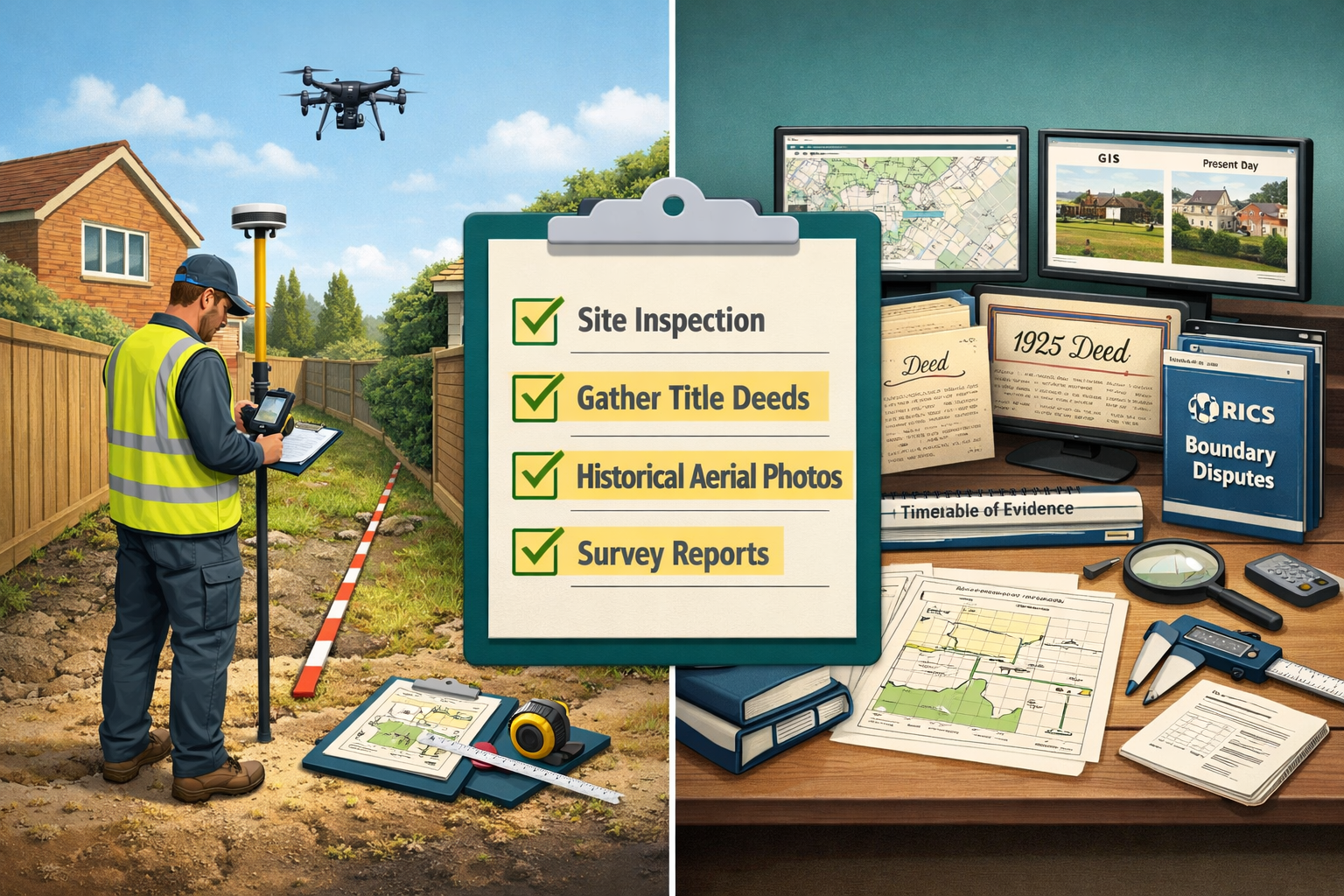
Based on current case law and professional guidance, surveyors acting as expert witnesses should gather and analyze the following evidence types:[2]
Primary Documentary Evidence:
- ✅ Title deeds and registered title plans
- ✅ Original conveyance documents (where available)
- ✅ Historical Ordnance Survey maps (all available editions)
- ✅ Sale particulars and estate agent materials
- ✅ Planning applications and approved drawings
Physical and Photographic Evidence:
- ✅ Current site photographs (comprehensive, dated, and annotated)
- ✅ Historical photographs showing boundary features
- ✅ Aerial photographs (historical and current)
- ✅ Satellite imagery time-series
- ✅ Physical boundary markers and features
Technical Survey Evidence:
- ✅ Professional boundary survey reports with GPS coordinates
- ✅ Measured site plans showing disputed areas
- ✅ Topographical surveys
- ✅ Comparative analysis of title plan vs. physical features
Supporting Documentation:
- ✅ Witness statements from long-term residents
- ✅ Recorded agreements or correspondence
- ✅ Maintenance records for boundary features
- ✅ Photographic evidence of adverse possession (if relevant)
For comprehensive guidance on conducting thorough boundary investigations, refer to our guide to boundary dispute and party wall surveyors.
Expert Witness Preparation: Best Practices for Surveyors in 2026
Understanding Your Role and Responsibilities
Surveyors acting as expert witnesses occupy a unique position. Unlike advocates who represent one party's interests, expert witnesses have an overriding duty to the court to provide independent, objective evidence. This fundamental principle governs all aspects of expert witness work.
Core responsibilities include:
- Independence: Providing opinions based solely on professional expertise, not client preferences
- Completeness: Disclosing all relevant facts, including those that may not support your client's position
- Clarity: Explaining technical matters in language accessible to non-specialists
- Accuracy: Ensuring all measurements, calculations, and interpretations are verifiable and correct
- Compliance: Adhering to RICS Practice Statements and CPR Part 35 requirements
"The expert witness must remember that their duty is to help the court, not to act as an advocate for the party who has instructed them. This independence is the cornerstone of credible expert evidence."
Systematic Evidence Collection and Documentation
Phase 1: Initial Assessment (Weeks 1-2)
Begin with a comprehensive desk-based review before site investigation:
- Request and review all available title documents
- Obtain Land Registry title plans and filed documents
- Acquire historical Ordnance Survey maps (ideally 3+ editions)
- Search for aerial photographs and satellite imagery
- Review planning history for both properties
- Analyze any previous survey reports
Phase 2: Site Investigation (Weeks 2-3)
Conduct thorough site investigations with proper documentation:
- Perform detailed measured survey using professional equipment
- Photograph all boundary features from multiple angles
- Record GPS coordinates of key boundary points
- Document physical evidence (fence posts, walls, hedges, markers)
- Note any evidence of maintenance or alterations
- Interview property owners and long-term neighbours (if appropriate)
Phase 3: Analysis and Report Preparation (Weeks 3-6)
Synthesize evidence into a comprehensive expert report:
- Compare physical boundaries with title plan depictions
- Analyze historical evidence for boundary evolution
- Calculate precise measurements and discrepancies
- Identify areas of certainty and uncertainty
- Prepare scaled plans showing disputed areas
- Draft clear, well-structured expert report
Understanding party wall disputes can also provide valuable context, as these often intersect with boundary issues.
Report Structure and Content Requirements
A professional expert witness report for boundary disputes should follow this structure:
1. Introduction and Instructions
- Expert's qualifications and experience
- Summary of instructions received
- Confirmation of CPR Part 35 compliance
- Statement of independence
2. Executive Summary
- Brief overview of dispute
- Key findings and opinions
- Main conclusions
3. Background and Context
- Property descriptions
- History of dispute
- Relevant title information
4. Methodology
- Survey techniques employed
- Equipment specifications
- Standards and guidance followed
- Limitations of investigation
5. Evidence Analysis
- Documentary evidence review
- Site investigation findings
- Historical evidence evaluation
- Comparative analysis
6. Technical Findings
- Precise measurements and calculations
- Boundary position determination
- Areas of certainty and uncertainty
- Alternative interpretations (if any)
7. Opinions and Conclusions
- Professional opinion on boundary position
- Reasoning and justification
- Response to opposing expert views (if applicable)
8. Appendices
- Site photographs (annotated)
- Survey plans and drawings
- Historical maps and documents
- Calculations and technical data
Managing Increased Caseloads in a Rebounding Market
Resource Planning and Capacity Management
As UK transaction activity rebounds in 2026, surveyors must anticipate increased demand for expert witness services. Effective capacity management ensures quality standards are maintained despite higher volumes.
Strategic approaches include:
- Early engagement protocols: Establish clear timelines with instructing solicitors at the outset
- Template systems: Develop standardized evidence checklists and report frameworks while maintaining case-specific customization
- Technology integration: Utilize GIS software, drone surveys, and digital documentation systems to improve efficiency
- Collaborative networks: Build relationships with specialist colleagues for complex cases or overflow capacity
- Continuing professional development: Stay current with case law, RICS updates, and technical advances
The future of geospatial technology is transforming how surveyors approach boundary investigations, with advanced mapping and analysis tools becoming increasingly accessible.[6]
Cost Management and Client Communication
Boundary disputes can become financially burdensome quickly. Expert witnesses have a professional responsibility to help clients understand cost implications and make informed decisions about proceeding.[4]
Key cost considerations:
| Cost Category | Typical Range | Factors Affecting Cost |
|---|---|---|
| Initial expert assessment | £1,500-£3,000 | Complexity, property size, evidence availability |
| Comprehensive boundary survey | £2,500-£6,000 | Site access, equipment requirements, historical research |
| Expert witness report | £3,000-£8,000 | Evidence volume, technical complexity, urgency |
| Court attendance | £2,000-£5,000 per day | Expert's experience level, case complexity |
| Additional consultations | £200-£400 per hour | Ongoing case developments |
Total expert costs for a contested boundary dispute typically range from £10,000 to £25,000, before considering legal fees, court costs, and potential adverse costs orders.[4]
When to Advise Against Proceeding
Professional integrity sometimes requires advising clients that pursuing a boundary dispute may not be worthwhile. Consider recommending alternative resolution when:
- 🚫 The disputed land area has minimal financial value compared to likely legal costs
- 🚫 Evidence is ambiguous or contradictory, creating significant uncertainty
- 🚫 The client's position lacks strong evidentiary support
- 🚫 Negotiated settlement options remain unexplored
- 🚫 The dispute stems primarily from personal conflict rather than substantive boundary issues
For situations involving party wall work on boundary walls, alternative resolution mechanisms may be more appropriate and cost-effective.
Alternative Dispute Resolution and Early Settlement Strategies
The Role of Mediation in Boundary Disputes
Before cases reach court, expert witnesses can play a valuable role in facilitating settlement through mediation or negotiation. Early expert involvement often identifies common ground and clarifies technical issues that may be obscuring potential agreement.
Benefits of mediation in boundary disputes:
- ⚡ Speed: Resolution in weeks rather than months or years
- 💷 Cost: Typically 70-80% less expensive than full litigation
- 🤝 Relationships: Preserves neighbour relationships where possible
- 🎯 Control: Parties retain control over outcome rather than court imposition
- 🔒 Confidentiality: Proceedings remain private
Expert witness contributions to mediation:
- Providing joint expert reports that identify areas of agreement
- Clarifying technical issues for mediators and parties
- Offering range of possible boundary positions with associated certainty levels
- Suggesting practical solutions that accommodate both parties' concerns
- Explaining implications of different settlement options
Without Prejudice Discussions and Joint Expert Appointments
The Civil Procedure Rules encourage experts from opposing parties to communicate directly to narrow issues and, where possible, reach agreement. This collaborative approach can significantly reduce litigation costs and court time.
Joint expert appointments involve both parties agreeing to instruct a single expert. While less common in boundary disputes than other areas, this approach offers:
- Substantial cost savings (single expert fee shared)
- Faster resolution timeline
- Reduced adversarial tension
- Court preference and potential costs protection
However, joint appointments require both parties to have confidence in the expert's independence and to accept that the findings will be binding on both sides.
Technology and Innovation in Boundary Dispute Evidence
Modern Surveying Technology
The tools available to surveyors in 2026 far exceed those of even a decade ago. Expert witnesses who leverage modern technology can provide more accurate, comprehensive, and persuasive evidence.
GPS and GNSS Technology:
- Centimeter-level accuracy for boundary point determination
- Coordinate systems compatible with Ordnance Survey National Grid
- Repeatable measurements for verification
- Integration with GIS mapping systems
Drone and Aerial Survey:
- High-resolution aerial photography from multiple angles
- 3D modeling of properties and boundary features
- Historical comparison with archived aerial imagery
- Cost-effective coverage of large or difficult-to-access sites
3D Laser Scanning:
- Precise measurement of complex boundary features
- Creation of detailed point clouds for analysis
- Permanent digital record of site conditions
- Ability to generate multiple views and cross-sections
GIS and Mapping Software:
- Overlay of historical maps with current surveys
- Spatial analysis of boundary evolution
- Professional presentation graphics for reports and court
- Integration of multiple evidence sources in single platform
Digital Evidence Management
Effective organization and presentation of evidence distinguishes exceptional expert witnesses from adequate ones. Digital evidence management systems enable:
- Chronological organization: Timeline views showing boundary evolution
- Spatial indexing: Geographic organization of photographs and documents
- Metadata tracking: Automated recording of dates, locations, and sources
- Version control: Tracking of document revisions and updates
- Secure sharing: Controlled access for legal teams and opposing experts
Preparing for Cross-Examination and Court Testimony
Understanding the Court Process
Many surveyors find court testimony the most challenging aspect of expert witness work. Thorough preparation and understanding of courtroom dynamics are essential for effective testimony.
Typical court process for boundary disputes:
- Statements of case: Parties set out their positions
- Expert reports: Exchange of expert evidence
- Joint statement: Experts meet to identify agreements/disagreements
- Pre-trial review: Court manages case progression
- Trial: Evidence presented, experts cross-examined
- Judgment: Court determines boundary position
Preparation strategies:
- Review all evidence multiple times before testimony
- Anticipate challenges to methodology and conclusions
- Prepare clear explanations of technical concepts
- Practice responding to hostile questioning
- Coordinate with instructing solicitors on likely cross-examination themes
- Prepare visual aids to illustrate key points
Effective Communication in the Witness Box
Do's and Don'ts of Expert Testimony:
✅ DO:
- Answer only the question asked
- Speak clearly and at moderate pace
- Address answers to the judge
- Admit limitations of knowledge or uncertainty
- Refer to your report and evidence
- Maintain professional composure
- Request clarification if questions are unclear
❌ DON'T:
- Argue with opposing counsel
- Volunteer information beyond the question
- Show frustration or defensiveness
- Use excessive jargon without explanation
- Speculate beyond your expertise
- Appear biased toward your instructing party
- Exaggerate certainty of opinions
"The most effective expert witnesses are those who demonstrate unshakeable integrity and independence. Courts value experts who acknowledge limitations and uncertainties more highly than those who claim absolute certainty on every point."
Regulatory Compliance and Professional Standards
RICS Requirements for Expert Witnesses
The Royal Institution of Chartered Surveyors maintains specific standards for members acting as expert witnesses. Compliance with these requirements is mandatory and subject to disciplinary proceedings for violations.
Key RICS guidance documents:
- Surveyors Acting as Expert Witnesses (4th edition): Comprehensive practice statement covering all aspects of expert witness work
- RICS Valuation – Global Standards (Red Book): Applicable when valuation evidence is required
- Boundary Disputes and Party Wall Procedures: Technical guidance on boundary investigations
Fundamental requirements include:
- Maintaining professional indemnity insurance with expert witness coverage
- Declaring any conflicts of interest before accepting instructions
- Providing services only within areas of competence
- Maintaining independence from instructing parties
- Complying with court rules and directions
- Keeping detailed records of all work performed
- Engaging in relevant continuing professional development
Insurance and Risk Management
Expert witness work carries specific professional risks that require appropriate insurance coverage and risk management protocols.
Key insurance considerations:
- Standard professional indemnity policies may exclude or limit expert witness work
- Specialist expert witness insurance may be required
- Coverage should extend to both negligence and breach of duty to court
- Retroactive coverage is essential given long-tail nature of claims
- Policy limits should reflect potential claim values in property disputes
Risk mitigation strategies:
- Maintain meticulous documentation of all instructions and communications
- Use written engagement letters specifying scope and limitations
- Implement quality review processes for all reports
- Decline instructions outside areas of genuine expertise
- Maintain appropriate CPD in expert witness procedures
- Seek legal advice when uncertain about procedural requirements
Regional Considerations Across the UK
London and Urban Boundary Disputes
Boundary disputes in London and other major urban centers present unique challenges due to high property values, limited space, and complex development histories.
Urban-specific considerations:
- Higher financial stakes: Even small boundary adjustments can represent significant value
- Historical complexity: Victorian and earlier developments often have incomplete or ambiguous records
- Dense development: Boundary features may be shared walls or structures rather than open boundaries
- Planning constraints: Conservation areas and listed buildings add complexity
- Access limitations: Surveying may require coordination with multiple properties
Surveyors working in urban environments should familiarize themselves with local historical development patterns and archival resources. For those practicing in specific areas, understanding local contexts is valuable—whether working as chartered surveyors in London or in surrounding regions.
Rural and Semi-Rural Boundary Issues
Rural boundary disputes often involve different evidence types and challenges compared to urban cases.
Rural-specific factors:
- Natural boundaries: Hedgerows, streams, and topographical features
- Agricultural land: Historical field patterns and farming practices
- Larger areas: Disputes may involve substantial acreage
- Historical records: Tithe maps, enclosure awards, and estate records
- Adverse possession: Longer periods of informal occupation more common
Regional Variations in Practice
Different regions of the UK may have varying approaches to boundary evidence and dispute resolution:
- Wales: Welsh language documents may require translation; different historical administrative boundaries
- Scotland: Distinct legal system with different property law principles
- Northern Ireland: Separate Land Registry system and historical records
The 2026 Outlook: Predictions and Preparations
Anticipated Trends in Boundary Dispute Resolution
Looking ahead through 2026 and beyond, several trends are likely to shape boundary dispute practice:
Technological advancement: Continued improvement in surveying technology will enable more precise boundary determination, potentially reducing areas of uncertainty but also raising expectations for expert precision.[6]
Procedural reforms: The Arbitration Act 2025 and ongoing civil justice reforms may influence dispute resolution procedures, potentially encouraging more cases toward alternative resolution mechanisms.[3][7]
Environmental considerations: Climate change impacts on boundary features (erosion, flooding, subsidence) may create new categories of disputes requiring specialist expertise.
Digital property records: Ongoing Land Registry digitization may improve evidence availability but also reveal previously unnoticed discrepancies.
Economic pressures: Continued property value appreciation in many areas will maintain financial incentives for pursuing boundary disputes despite costs.
Preparing Your Practice for Increased Demand
Surveyors should take proactive steps to position their practices for the anticipated increase in boundary dispute work:
Professional development priorities:
- Advanced training in expert witness procedures
- Technology skills in GIS, drone survey, and 3D modeling
- Understanding of recent case law and evidentiary developments
- Cross-examination and court testimony preparation
- Alternative dispute resolution techniques
Business development strategies:
- Building relationships with property litigation solicitors
- Developing marketing materials highlighting expert witness credentials
- Creating case studies demonstrating successful outcomes
- Establishing clear fee structures and engagement processes
- Investing in technology and software infrastructure
Quality assurance systems:
- Implementing peer review processes for expert reports
- Maintaining comprehensive evidence checklists
- Developing standardized but customizable report templates
- Creating secure document management systems
- Regular review of compliance with RICS standards
Practical Case Management: A Step-by-Step Approach
From Initial Instruction to Case Conclusion
Week 1: Initial Engagement
- Receive and review initial instructions from solicitor
- Conduct conflict check and independence assessment
- Provide fee estimate and engagement letter
- Request initial documentation package
- Schedule preliminary site visit
Weeks 2-3: Evidence Gathering
- Conduct desk-based research (title documents, historical maps, aerial photos)
- Perform detailed site survey and photography
- Interview relevant parties (if appropriate)
- Obtain specialist reports (e.g., historical research, aerial survey)
- Begin evidence analysis
Weeks 4-6: Report Preparation
- Synthesize evidence into coherent analysis
- Prepare technical drawings and plans
- Draft expert report following CPR Part 35 requirements
- Internal quality review
- Submit report to instructing solicitors
Weeks 7-8: Expert Discussion
- Review opposing expert's report
- Prepare for without prejudice discussion
- Meet with opposing expert to identify areas of agreement/disagreement
- Prepare joint statement
- Advise on settlement prospects
Weeks 9-12: Pre-Trial Preparation
- Respond to questions or requests for clarification
- Update report if new evidence emerges
- Prepare for cross-examination
- Coordinate with legal team on trial strategy
- Prepare visual aids and demonstrative evidence
Trial and Beyond:
- Attend court and provide testimony
- Remain available for recall if required
- Assist with post-trial matters if necessary
- Document lessons learned for future cases
Common Pitfalls and How to Avoid Them
Pitfall 1: Inadequate Initial Instructions
❌ Problem: Vague or incomplete instructions lead to scope creep and fee disputes
✅ Solution: Insist on detailed written instructions specifying exact questions to be addressed
Pitfall 2: Insufficient Evidence Gathering
❌ Problem: Missing key evidence that later undermines your opinion
✅ Solution: Use comprehensive evidence checklists and conduct thorough desk research before site work
Pitfall 3: Overstepping Expertise
❌ Problem: Offering opinions on legal or non-surveying matters
✅ Solution: Clearly delineate technical findings from legal conclusions; defer legal interpretation to counsel
Pitfall 4: Poor Communication
❌ Problem: Technical reports that judges and lay parties cannot understand
✅ Solution: Use clear language, visual aids, and progressive disclosure (summary → detail)
Pitfall 5: Advocacy Rather Than Independence
❌ Problem: Appearing biased toward instructing party
✅ Solution: Acknowledge weaknesses in your client's case; present balanced analysis
Conclusion: Excellence in Expert Witness Practice as Markets Evolve
As Boundary Disputes and Expert Witness Preparation: Managing Cases as UK Transaction Activity Rebounds in 2026, surveyors face both challenges and opportunities. The correlation between increased property transactions and boundary disputes is well-established, and the current market rebound suggests a sustained period of heightened demand for expert witness services.
Success in this environment requires more than technical surveying competence. Expert witnesses must combine rigorous evidence-gathering methodologies, comprehensive understanding of current case law, effective communication skills, and unwavering professional independence. The lessons from Charlton v Forrest [2024] emphasize that courts will independently assess factual evidence, placing greater responsibility on experts to compile comprehensive, objective evidence packages rather than relying on professional consensus alone.[1]
The financial and emotional costs of boundary disputes mean that expert witnesses also serve an important gatekeeping function—helping clients understand when disputes are worth pursuing and when alternative resolution or acceptance may be more prudent.[4] This advisory role, combined with technical expertise, positions surveyors as trusted professionals rather than mere hired guns.
Actionable Next Steps
For surveyors seeking to excel in expert witness work during this period of market growth:
- Invest in continuing professional development focused on expert witness procedures, recent case law, and cross-examination skills
- Upgrade technology capabilities including GPS equipment, drone survey, and GIS software to meet modern evidentiary standards
- Review and update professional indemnity insurance to ensure adequate expert witness coverage
- Develop systematic evidence-gathering protocols incorporating lessons from recent case law
- Build relationships with property litigation solicitors to establish referral networks
- Create template systems that maintain quality while improving efficiency for increased caseloads
- Engage with RICS guidance and ensure full compliance with professional standards
- Consider mediation and ADR training to offer clients full-spectrum dispute resolution support
The rebound in UK transaction activity presents a significant opportunity for surveyors with the expertise, systems, and professional standards to deliver exceptional expert witness services. Those who prepare thoroughly, maintain rigorous independence, and communicate effectively will find themselves well-positioned to serve clients and support the administration of justice in boundary disputes throughout 2026 and beyond.
For surveyors seeking to develop their boundary dispute expertise, exploring comprehensive resources on chartered surveying services and staying current with professional developments will be essential to maintaining competitive advantage in this growing market segment.
References
[1] Qa What Evidence Can Establish Boundaries – https://www.charlesrussellspeechlys.com/en/insights/expert-insights/real-estate/2024/qa-what-evidence-can-establish-boundaries/
[2] How To Resolve Boundary Disputes – https://srb.co.uk/how-to-resolve-boundary-disputes/
[3] 2025 Year In Review Commercial Disputes – https://www.hausfeld.com/what-we-think/perspectives-blogs/2025-year-in-review-commercial-disputes
[4] Are Boundary Disputes Worth It – https://www.stephensons.co.uk/site/blog/consumer-law-blog/are-boundary-disputes-worth-it
[5] Paul Wilmshursts Article On Winning Boundary Disputes – https://newsquarechambers.co.uk/paul-wilmshursts-article-on-winning-boundary-disputes/
[6] The Future Of Geospatial Analysis In Infrastructure Planning – https://castlesurveys.co.uk/the-future-of-geospatial-analysis-in-infrastructure-planning/
[7] Predictions 2026 Disputes And Investigations – https://www.simmons-simmons.com/en/publications/cmj28qvjt00eouj4gwocfl0mg/predictions-2026-disputes-and-investigations
[8] Forearmed A Guide To Likely Trends In 6677206 – https://www.jdsupra.com/legalnews/forearmed-a-guide-to-likely-trends-in-6677206/