

Scotland's property market has emerged as a standout performer in the UK real estate landscape, delivering exceptional growth that significantly outpaces national averages. As chartered surveyors and valuation professionals navigate 2026, understanding Scotland's unique market dynamics and implementing targeted strategies has become essential for accurate property assessments and client advisory services. The Scotland Valuation Outperformance 2026: Surveyor Strategies to Leverage Stronger-Than-National Growth phenomenon represents both an opportunity and a challenge for RICS professionals seeking to deliver precise, market-responsive valuations in this rapidly evolving environment.
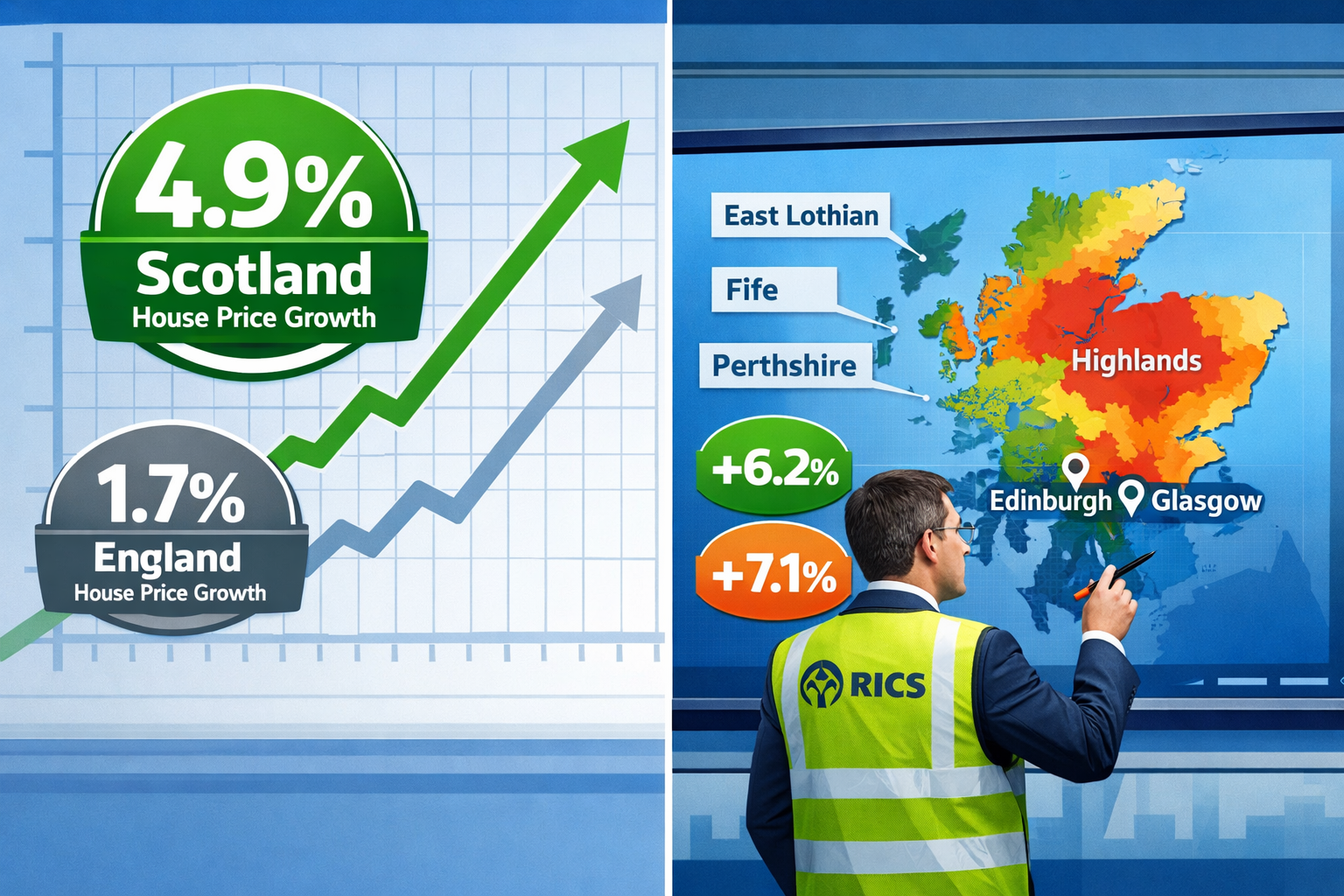
Recent data confirms Scotland's house prices increased 4.9% in the twelve months to December 2025, dramatically exceeding England's modest 1.7% growth and surpassing the UK average of 2.4%[5]. This outperformance, coupled with acute stock shortages in key metropolitan areas and resilient demand across lifestyle-driven regions, requires surveyors to recalibrate their valuation models and adopt Scotland-specific methodologies that accurately reflect local market conditions.
Key Takeaways
✅ Scotland delivered 4.9% annual house price growth through December 2025, outperforming England (1.7%) and the UK average (2.4%), positioning the market for continued strength in 2026[5].
✅ Regional variation demands localized valuation approaches, with acute stock shortages in Edinburgh and Glasgow contrasting with lifestyle-driven demand in East Lothian, Fife, Perthshire, and the Highlands[1].
✅ RICS surveyors must integrate Scotland-specific data sources and adjust Red Book methodologies to account for unique supply constraints, rental market dynamics, and commercial sector tightness[1].
✅ Projected 3-5% appreciation in 2026 requires surveyors to balance conservative forecasting with recognition of Scotland's stronger late-cycle momentum compared to broader UK markets[2][6].
✅ Commercial opportunities exist in Grade A office and industrial sectors, where Edinburgh faces one of the UK's tightest supply environments and Central Belt industrial vacancy remains exceptionally low[1].
Understanding Scotland's Market Outperformance in 2026
The Data Behind Scotland's Exceptional Growth
Scotland's property market delivered results in 2025 that exceeded even optimistic forecasts, establishing a foundation for continued outperformance in 2026. The 4.9% annual house price increase through December 2025 represents not just a statistical anomaly but a fundamental shift in regional market dynamics[5]. This growth trajectory surpassed earlier predictions that anticipated modest appreciation, with the market delivering approximately 5% sales growth throughout 2025—demonstrating stronger transactional momentum than industry experts anticipated[2].
For surveyors conducting RICS registered valuations, this outperformance necessitates careful consideration of comparable evidence and market adjustment factors. While England's 1.7% growth reflects ongoing affordability constraints and economic uncertainty in southern markets, Scotland's resilience stems from distinct supply-demand imbalances that create localized pricing power.
The rental market provides additional context for valuation professionals. Average monthly rent in Scotland reached £1,021 in January 2026, representing a 2.6% annual increase—the lowest annual rise in over four years[5]. This moderation from the 11.7% peak observed in August 2023 indicates market stabilization rather than weakness, as chronic undersupply continues to support rental values despite slower growth rates.
Regional Variation: Where Growth Concentrates
Scotland's market performance cannot be understood through aggregate statistics alone. Regional variation represents perhaps the most critical factor for surveyors developing accurate valuations in 2026. The market exhibits distinct characteristics across geographic segments:
| Region | Primary Growth Drivers | Valuation Considerations |
|---|---|---|
| Edinburgh | Acute stock shortages, Grade A office scarcity, strong employment base | Premium adjustments for quality stock, limited comparable evidence |
| Glasgow | Deep buyer pools, family home demand, commercial resilience | Supply constraints supporting price floors, transactional velocity |
| East Lothian | Lifestyle migration, coastal appeal, commuter accessibility | Demand-driven appreciation, limited new build supply |
| Fife | Affordability relative to Edinburgh, quality of life factors | Value positioning attracting Edinburgh relocators |
| Perthshire | Rural lifestyle demand, second home market, natural amenity premium | Discretionary buyer segment, seasonal transaction patterns |
| Highlands | Tourism-linked demand, remote working enablement, scarcity value | Limited comparable evidence, unique property characteristics |
For surveyors, these regional distinctions require localized comparable analysis rather than reliance on national or even Scotland-wide indices. A property in Edinburgh's New Town faces fundamentally different market dynamics than a comparable property in rural Perthshire, despite both benefiting from Scotland's overall outperformance trend.
Commercial Sector Dynamics Supporting Valuation Growth
Beyond residential markets, Scotland's commercial property sector exhibits characteristics that support the broader Scotland Valuation Outperformance 2026: Surveyor Strategies to Leverage Stronger-Than-National Growth narrative. Edinburgh's Grade A office market faces one of the tightest supply environments across the entire UK, creating upward pressure on rents for prime assets[1]. For surveyors conducting commercial property valuations, this scarcity premium must be quantified and justified within valuation reports.
The industrial and logistics sector demonstrates similar supply constraints, with vacancy rates remaining exceptionally low across the Central Belt[1]. This tightness reflects Scotland's strategic position in UK distribution networks and ongoing demand for modern warehouse facilities serving e-commerce and logistics operations.
"Scotland's commercial real estate fundamentals remain robust, with supply constraints in key sectors supporting above-trend rental growth and capital value resilience throughout 2026." — Market Analysis[1]
These commercial dynamics create cross-sector valuation implications. Strong commercial markets support employment growth, which in turn drives residential demand and rental market strength—creating a reinforcing cycle that surveyors must recognize when assessing market sustainability.
Scotland Valuation Outperformance 2026: RICS Methodologies and Adjustment Factors
Adapting Red Book Standards for Scottish Markets
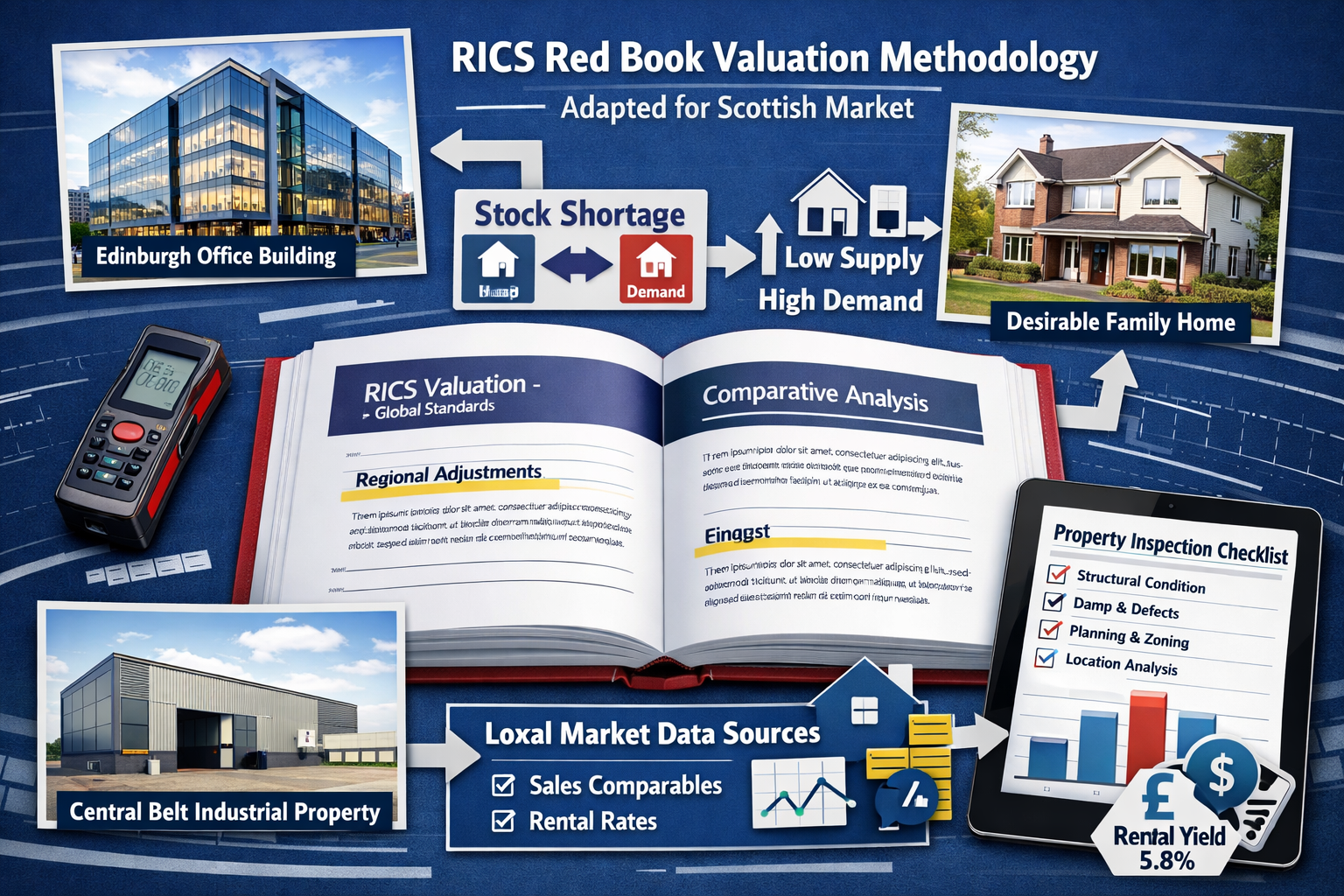
RICS professionals conducting valuations in Scotland during 2026 must balance adherence to Red Book valuation standards with recognition of market-specific factors that distinguish Scottish performance from broader UK trends. The Scotland Valuation Outperformance 2026: Surveyor Strategies to Leverage Stronger-Than-National Growth framework requires methodological adjustments across several dimensions:
Comparable Evidence Selection: Traditional comparable analysis relies on transactions within defined geographic and temporal parameters. In Scotland's supply-constrained markets, particularly Edinburgh and Glasgow, limited transaction volumes can create challenges for identifying truly comparable evidence. Surveyors must:
- Expand geographic search parameters while maintaining relevance to subject property characteristics
- Weight recent transactions more heavily given accelerating market conditions
- Adjust for time using Scotland-specific rather than UK-wide indices
- Consider off-market transactions and withdrawn listings as additional market indicators
- Incorporate rental evidence to triangulate capital value assessments
Market Adjustment Factors: Scotland's 4.9% growth versus England's 1.7% demonstrates the inadequacy of applying uniform adjustment factors across UK regions[5]. Surveyors must develop Scotland-specific adjustment matrices that account for:
- Supply scarcity premiums in high-demand, low-stock locations
- Quality differentials reflecting acute shortages of family homes in sought-after areas[1]
- Locational premiums for properties in established school catchments or commuter corridors
- Condition adjustments recognizing premium values for move-in-ready properties in tight markets
Integrating Scotland-Specific Data Sources
Accurate valuations in outperforming markets require access to granular, localized data that captures market nuances invisible in national statistics. RICS surveyors should integrate multiple Scotland-specific data sources:
Local Authority Planning Data: Planning application volumes and approval rates provide leading indicators of supply pipeline constraints. Areas with limited planning approvals face greater supply pressure, supporting price resilience.
Registers of Scotland Transaction Data: Detailed transaction records offer property-level insights into sale prices, buyer profiles, and transaction timelines—essential for understanding local market velocity.
Scottish Government Housing Statistics: Official statistics on housing completions, affordable housing delivery, and tenure patterns inform supply-side analysis.
Regional Estate Agent Sentiment Surveys: Qualitative intelligence from active market participants provides context for quantitative data, particularly regarding buyer motivation and bidding dynamics.
Commercial Property Market Reports: Sector-specific intelligence on office, industrial, and retail markets informs cross-sector valuation considerations and economic base analysis.
For surveyors accustomed to relying primarily on national indices and automated valuation models (AVMs), this data-intensive approach represents a significant methodological shift. However, in markets exhibiting Scotland Valuation Outperformance 2026: Surveyor Strategies to Leverage Stronger-Than-National Growth characteristics, such rigor distinguishes professional valuations from algorithmic estimates.
Valuation Approach Selection for Different Property Types
Scotland's diverse property market requires thoughtful valuation approach selection based on property type, location, and intended use. The three primary valuation methodologies—comparison, investment, and residual—each offer distinct advantages in different contexts:
Comparison Approach (Market Approach):
- Best for: Residential properties, standard commercial units with active markets
- Scotland 2026 considerations: Adjust comparables for market momentum, apply location-specific growth rates
- Challenges: Limited stock creating sparse comparable evidence in prime locations
- Solutions: Expand temporal search parameters, weight quality adjustments more heavily
Investment Approach (Income Approach):
- Best for: Rental properties, commercial investments, multi-unit residential
- Scotland 2026 considerations: Apply Scotland-specific yield compression factors, recognize rental growth moderating from 11.7% peak to 2.6%[5]
- Challenges: Rental market stabilization creating yield uncertainty
- Solutions: Scenario analysis with conservative, base, and optimistic yield assumptions
Residual Approach (Development Approach):
- Best for: Development sites, properties with redevelopment potential
- Scotland 2026 considerations: Account for planning constraints limiting supply, adjust profit margins for market strength
- Challenges: Construction cost inflation, planning approval timelines
- Solutions: Sensitivity analysis on key variables, conservative profit margin assumptions
Many valuations benefit from multiple approach triangulation, where two or more methodologies provide cross-validation of value conclusions. In Scotland's outperforming market, this triangulation offers particular value by testing whether capital value assessments align with investment fundamentals and development economics.
Accounting for Mortgage Market Changes
The Financial Conduct Authority's revised guidance allowing greater mortgage flexibility represents a significant market variable for 2026 valuations[1]. Analysts project this regulatory shift could support a 22% UK-wide price uplift over five years, with Scotland well-positioned to benefit as sentiment improves and access to finance expands.
For surveyors, these mortgage market dynamics influence valuation in several ways:
Buyer Pool Expansion: Increased mortgage flexibility expands the pool of qualified buyers, particularly for properties at higher price points where loan-to-value ratios previously constrained demand.
Pent-Up Demand Release: As mortgage rates ease from recent peaks, pent-up demand is expected to re-emerge across Scottish markets, particularly for family homes in prime locations[1]. This demand release supports price resilience and reduces downside risk in valuation scenarios.
Affordability Assessments: Surveyors conducting valuation reports must consider how changing mortgage affordability affects market sustainability. Scotland's lower absolute price points compared to southern England create greater affordability headroom, supporting continued demand even as interest rates normalize.
Market Velocity Implications: Improved mortgage access typically accelerates transaction velocity, reducing time-on-market and supporting asking price achievement rates—factors that influence comparable evidence analysis and market adjustment factors.
Surveyor Strategies to Leverage Scotland's Stronger-Than-National Growth
Strategy 1: Develop Regional Market Expertise
The Scotland Valuation Outperformance 2026: Surveyor Strategies to Leverage Stronger-Than-National Growth opportunity rewards specialists over generalists. Surveyors should develop deep expertise in specific Scottish regions rather than attempting comprehensive national coverage.
Geographic Specialization Benefits:
- 🎯 Enhanced comparable knowledge: Intimate familiarity with local transaction history and property characteristics
- 🎯 Relationship networks: Connections with local estate agents, solicitors, and property professionals providing market intelligence
- 🎯 Planning insight: Understanding of local authority planning policies and development constraints
- 🎯 Buyer profile knowledge: Recognition of typical buyer demographics and motivation in specific markets
Implementation Approach:
- Select 2-3 core geographic markets aligned with transaction volume and growth potential
- Establish local market monitoring protocols including regular estate agent contact and planning portal reviews
- Build comparable evidence databases with property-level detail exceeding standard industry data
- Develop local authority relationships to access planning and development pipeline intelligence
- Create market commentary templates documenting regional trends and valuation implications
Surveyors serving clients across multiple regions should consider partnership arrangements or referral networks with regional specialists, ensuring clients receive valuations informed by genuine local expertise rather than generic national analysis.
Strategy 2: Implement Dynamic Valuation Modeling
Static valuation approaches prove inadequate in markets exhibiting the volatility and momentum characteristic of Scotland's 2026 performance. Dynamic valuation modeling incorporates multiple scenarios and sensitivity analysis to provide clients with comprehensive value assessments.
Core Components of Dynamic Models:
Scenario Analysis Framework:
- Conservative scenario: Assumes growth moderation to 2% annually, reflecting potential economic headwinds
- Base scenario: Projects 3-4% growth aligned with analyst consensus forecasts[2]
- Optimistic scenario: Incorporates 5% growth reflecting continued supply constraints and demand resilience[6]
Sensitivity Variables:
- Interest rate trajectories (±0.5% impact assessment)
- Supply pipeline changes (new planning approvals impact)
- Employment market shifts (major employer relocations or expansions)
- Regulatory changes (planning policy, taxation adjustments)
Temporal Value Ranges:
Rather than single-point valuations, dynamic models provide value ranges reflecting market uncertainty:
- 90-day value range: Narrow band reflecting immediate market conditions
- 12-month value projection: Wider band incorporating anticipated market evolution
- 3-year value trajectory: Scenario-based projections for long-term investment analysis
This approach proves particularly valuable for clients making investment decisions, refinancing considerations, or portfolio management choices where understanding value evolution matters as much as current market value.
Strategy 3: Enhance Commercial Sector Capabilities
Scotland's Grade A office scarcity and industrial vacancy resilience create significant opportunities for surveyors with commercial valuation expertise[1]. Many residential-focused practices overlook these higher-value, less commoditized opportunities.
Commercial Capability Development:
Office Sector Focus:
- Understand Edinburgh's Grade A supply constraints and rental growth drivers
- Develop expertise in lease analysis and rental tone assessment
- Build relationships with commercial letting agents and occupier advisors
- Track major occupier requirements and relocation decisions
Industrial and Logistics Expertise:
- Monitor Central Belt vacancy rates and rental trends
- Understand e-commerce and distribution network requirements
- Assess modern specification standards and obsolescence factors
- Track development pipeline and planning allocations
Mixed-Use and Conversion Opportunities:
- Identify properties with alternative use potential
- Understand permitted development rights and planning policy
- Assess residential conversion feasibility for commercial assets
- Evaluate highest and best use across property types
Commercial valuations typically command higher fee levels than residential work while facing less commoditization pressure from automated valuation models. Surveyors building commercial expertise position themselves for premium work in Scotland's outperforming market.
Strategy 4: Leverage Technology for Market Intelligence
Modern valuation practice increasingly relies on technology-enabled market intelligence that provides real-time insights into market dynamics. Surveyors embracing these tools gain competitive advantages in accuracy and efficiency.
Technology Integration Opportunities:
Automated Data Aggregation:
- Property portal scraping tools capturing listing data, price changes, and time-on-market metrics
- Registers of Scotland API integration for automated transaction data retrieval
- Planning portal monitoring systems alerting to new applications and approvals
- Rental market platforms tracking advertised rents and tenant demand indicators
Geospatial Analysis Tools:
- GIS mapping of transaction patterns and price heat maps
- Proximity analysis for amenities, transport links, and employment centers
- School catchment mapping and performance correlation analysis
- Environmental risk assessment (flood zones, contamination, conservation areas)
Predictive Analytics:
- Machine learning models identifying emerging price trends before visible in aggregate data
- Natural language processing of estate agent commentary and market reports
- Sentiment analysis of buyer and seller behavior indicators
- Time-series forecasting incorporating multiple market variables
Client Communication Platforms:
- Interactive valuation reports with embedded market data visualizations
- Client portals providing ongoing market updates for valued properties
- Automated market commentary generation for regular client communications
- Video presentation capabilities for complex valuation explanations
Technology should augment rather than replace professional judgment. The most effective surveyors use technology to gather and analyze data more efficiently, freeing time for interpretive analysis and client advisory services that differentiate professional valuations from algorithmic estimates.
Strategy 5: Develop Specialized Valuation Services
Beyond standard market value assessments, Scotland's outperforming market creates demand for specialized valuation services addressing specific client needs. Surveyors developing these capabilities access higher-margin work with less competition.
High-Value Specializations:
Tax-Related Valuations:
- Capital gains tax valuations for property disposals in appreciating markets
- Probate valuations where estate values have increased significantly
- Inheritance tax planning valuations for wealth transfer strategies
- Non-domicile tax valuations for international clients with Scottish property holdings
Matrimonial and Dispute Resolution:
- Divorce valuations where property represents significant marital assets
- Partnership dissolution valuations for jointly-held investment properties
- Expert witness services for valuation disputes and litigation support
- Mediation support valuations facilitating settlement negotiations
Development and Investment Advisory:
- Residual land valuations for development site acquisitions
- Investment portfolio valuations for institutional and private investors
- Reinstatement cost valuations for insurance purposes in high-value markets
- Viability assessments for planning applications and affordable housing negotiations
Leasehold and Freehold Matters:
- Lease extension valuations for Scottish long leasehold properties
- Freehold acquisition valuations for collective enfranchisement
- Ground rent capitalization assessments
- Leasehold reform impact analysis
Each specialization requires additional training, professional development, and often specific RICS qualifications. However, the investment yields returns through premium fee structures and client relationships extending beyond single-transaction engagements.
Strategy 6: Build Strategic Partnership Networks
No surveyor possesses expertise across all property types, locations, and valuation contexts. Strategic partnerships enable practices to offer comprehensive services while maintaining quality standards through specialist collaboration.
Partnership Network Components:
Geographic Partnerships: Reciprocal referral arrangements with surveyors in complementary Scottish regions, enabling comprehensive national coverage through trusted specialist networks.
Discipline Partnerships: Relationships with structural engineers, planning consultants, environmental specialists, and quantity surveyors providing integrated advisory services for complex instructions.
Professional Services Networks: Connections with solicitors, accountants, wealth managers, and financial advisors generating referral opportunities and collaborative client service.
Technology Partnerships: Relationships with PropTech providers, data analytics firms, and software developers enabling access to cutting-edge tools without internal development costs.
Academic and Research Partnerships: Connections with university real estate departments and research institutions providing access to market research, emerging trends analysis, and thought leadership opportunities.
Effective partnerships require formalization through clear referral protocols, quality assurance standards, and mutual benefit structures. The most successful surveying practices view partnerships as strategic assets requiring ongoing investment and relationship management.
Market Outlook and Risk Considerations for 2026
Projected Growth Trajectories and Analyst Consensus
While Scotland demonstrated exceptional 4.9% growth through December 2025[5], surveyor strategies for 2026 must account for more moderate projections reflecting market maturation and economic uncertainties. The Scotland Valuation Outperformance 2026: Surveyor Strategies to Leverage Stronger-Than-National Growth narrative incorporates realistic growth expectations:
Conservative Analyst Forecasts:
- Rettie projects 3-4% house price growth for Scotland in 2026[2]
- Savills anticipates Scotland will exceed its downgraded 2% UK-wide forecast due to stronger late-cycle momentum[1][4]
- Industry consensus centers on 3-5% appreciation across Scottish markets[6]
These projections reflect several moderating factors:
📊 Interest Rate Environment: While mortgage rates have eased from recent peaks, they remain elevated relative to the ultra-low rate environment of 2020-2021, constraining affordability for some buyer segments.
📊 Economic Uncertainty: Global economic headwinds, including persistent inflation concerns and geopolitical tensions, create caution among discretionary buyers and investors.
📊 Supply Pipeline Development: Increased planning approvals and new build completions in some markets may gradually ease acute supply shortages, moderating price pressure.
📊 Rental Market Stabilization: The deceleration from 11.7% peak rental growth to 2.6% indicates market normalization[5], potentially reducing investor demand for buy-to-let acquisitions.
For surveyors, these projections inform market adjustment factors and temporal value assessments. Valuations should reflect realistic growth expectations rather than extrapolating 2025's exceptional performance indefinitely forward.
Risk Factors Requiring Surveyor Attention
Professional valuations must acknowledge downside risks alongside growth opportunities. Several factors could undermine Scotland's outperformance trajectory:
Macroeconomic Risks:
- Recession scenarios: Economic contraction reducing employment security and buyer confidence
- Interest rate volatility: Unexpected rate increases constraining mortgage affordability
- Inflation persistence: Sustained high inflation eroding real income growth and discretionary spending capacity
Policy and Regulatory Risks:
- Planning policy changes: Liberalization of planning constraints increasing supply and moderating price pressure
- Taxation adjustments: Changes to stamp duty, capital gains tax, or council tax affecting transaction costs and holding costs
- Rental market regulation: Further tenant protections or rent controls potentially reducing investor demand
- Energy efficiency requirements: Increasing standards for rental properties creating compliance costs
Market-Specific Risks:
- Supply pipeline acceleration: Significant new build completions in key markets easing shortages
- Demand shift reversals: Changes in remote working patterns reducing lifestyle migration to rural areas
- Commercial market weakness: Office sector challenges from hybrid working reducing employment base in key cities
- Mortgage availability constraints: Lender risk appetite reduction limiting buyer pool expansion
Climate and Environmental Risks:
- Flood risk materialization: Increasing frequency of flooding events affecting property insurability and values
- Energy performance concerns: Poor EPC ratings reducing marketability and value of older properties
- Climate adaptation costs: Required retrofitting for climate resilience creating capital expenditure requirements
Surveyors should incorporate risk assessment into valuation reports, particularly for loan security purposes where lenders require understanding of value sustainability and downside scenarios. This risk-aware approach demonstrates professional rigor and protects both clients and surveyors from future disputes.
Opportunities Beyond Residential Markets
While residential property dominates valuation volume, Scotland's commercial sector dynamics create significant opportunities for surveyors willing to develop specialized expertise[1].
Grade A Office Opportunities:
Edinburgh's exceptionally tight Grade A office supply creates premium rental growth potential and capital appreciation for quality assets. Surveyors understanding this sector can provide valuable advisory services to:
- Institutional investors seeking Scottish commercial exposure
- Corporate occupiers evaluating lease versus purchase decisions
- Developers assessing office development viability
- Lenders providing acquisition or development finance
Industrial and Logistics Growth:
The Central Belt's low industrial vacancy rates reflect structural demand from e-commerce growth and distribution network evolution. Valuation opportunities include:
- Modern warehouse and distribution center assessments
- Last-mile logistics facility valuations supporting urban delivery networks
- Industrial estate portfolio valuations for investment funds
- Development land valuations for logistics site acquisitions
Alternative Sectors:
Scotland's tourism economy, renewable energy expansion, and lifestyle market create niche opportunities:
- Tourism and hospitality: Hotel, guest house, and short-term rental property valuations
- Student accommodation: Purpose-built student housing in university cities
- Healthcare and senior living: Care homes and retirement housing facilities
- Renewable energy: Land valuations for wind farm developments and solar installations
These specialized sectors typically face less competition from generalist surveyors and automated valuation tools, supporting premium fee structures and long-term client relationships.
Conclusion: Positioning for Success in Scotland's Outperforming Market

The Scotland Valuation Outperformance 2026: Surveyor Strategies to Leverage Stronger-Than-National Growth phenomenon represents a defining opportunity for RICS professionals willing to adapt methodologies, develop regional expertise, and embrace specialized service delivery. Scotland's exceptional 4.9% growth through December 2025, significantly exceeding England's 1.7% and the UK average of 2.4%[5], establishes momentum that analysts project will continue through 2026, albeit at more moderate 3-5% appreciation rates[2][6].
Success in this environment requires surveyors to move beyond generic national approaches and develop Scotland-specific capabilities across multiple dimensions:
✅ Regional specialization providing deep market knowledge in high-performing areas like Edinburgh, Glasgow, East Lothian, and Fife
✅ Dynamic valuation modeling incorporating scenario analysis and sensitivity testing to reflect market uncertainty and momentum
✅ Commercial sector expertise capitalizing on Grade A office scarcity and industrial market tightness[1]
✅ Technology integration enabling real-time market intelligence and enhanced analytical capabilities
✅ Specialized service development addressing tax, matrimonial, investment, and development valuation needs
✅ Strategic partnerships extending service capabilities through trusted specialist networks
The market's supply-demand fundamentals—acute stock shortages in metropolitan areas, resilient lifestyle-driven demand in rural regions, and chronic rental market undersupply—create structural support for continued outperformance. However, professional valuations must balance recognition of these strengths with realistic assessment of moderating factors, including interest rate environments, economic uncertainties, and supply pipeline developments.
Actionable Next Steps for Surveyors
Immediate Actions (Next 30 Days):
- Audit current comparable evidence databases to ensure Scotland-specific data adequacy and currency
- Establish relationships with 3-5 local estate agents in target Scottish markets for ongoing market intelligence
- Review recent valuations for consistency with Scotland's outperformance trajectory and adjustment factor adequacy
- Identify technology gaps in current practice systems and evaluate solutions for market data aggregation and analysis
- Assess specialization opportunities aligned with practice strengths and market demand
Medium-Term Development (Next 90 Days):
- Develop regional market expertise through dedicated research, site visits, and professional network building in 1-2 priority Scottish markets
- Implement dynamic valuation modeling frameworks incorporating scenario analysis and sensitivity testing
- Build commercial sector capabilities through training, mentorship, or partnership arrangements
- Create specialized service offerings in at least one high-value niche (tax, matrimonial, investment, development)
- Establish partnership networks with complementary specialists enabling comprehensive service delivery
Long-Term Strategic Positioning (Next 12 Months):
- Achieve recognized specialist status in priority Scottish markets through consistent quality delivery and thought leadership
- Develop proprietary market intelligence systems providing competitive advantages in data access and analysis
- Build institutional client relationships for recurring commercial and portfolio valuation work
- Establish expert witness credentials through case work, professional development, and industry recognition
- Create scalable service delivery models enabling practice growth while maintaining quality standards
The Scotland Valuation Outperformance 2026: Surveyor Strategies to Leverage Stronger-Than-National Growth opportunity rewards those who act decisively to develop relevant capabilities and market positioning. As mortgage flexibility expands[1], pent-up demand re-emerges, and Scotland's structural advantages continue supporting above-national growth, surveyors with deep regional expertise and sophisticated analytical capabilities will capture disproportionate value from this exceptional market environment.
For RICS professionals seeking to understand broader valuation best practices and standards, resources on valuation factors and RICS valuation costs provide valuable context for professional service delivery across all markets.
The Scottish property market's 2026 trajectory offers a compelling case study in regional market dynamics, supply-demand fundamentals, and the critical role of professional valuation expertise in accurately assessing value in exceptional market conditions. Surveyors who embrace the strategies outlined above position themselves not merely to participate in Scotland's growth, but to leverage it for sustained professional success and client value delivery.
References
[1] Savills Scotland Poised For Renewed Real Estate Momentum In 2026 – https://www.scottishconstructionnow.com/articles/savills-scotland-poised-for-renewed-real-estate-momentum-in-2026
[2] Looking Ahead To 2026 With Dr John Boyle – https://www.rettie.co.uk/blog/looking-ahead-to-2026-with-dr-john-boyle
[4] House Prices – https://moneyweek.com/investments/house-prices/house-prices
[5] February2026 – https://www.ons.gov.uk/economy/inflationandpriceindices/bulletins/privaterentandhousepricesuk/february2026
[6] Valuation Strategies For Northern Uk Price Surge Surveyor Tactics In Scotland Northern Ireland And North England 2026 – https://nottinghillsurveyors.com/blog/valuation-strategies-for-northern-uk-price-surge-surveyor-tactics-in-scotland-northern-ireland-and-north-england-2026