}

London's commercial property landscape is experiencing a remarkable transformation in 2026, with 55% of investors now viewing office spaces as the most undervalued asset class in the capital's property market [6]. This significant shift in perception has triggered a wave of office retrofit projects across the city, creating unprecedented demand for party wall agreements and professional surveying services. As building owners rush to modernize aging office stock to meet contemporary workspace standards and sustainability requirements, understanding the intricacies of Party Wall Agreements for Office Retrofits: Surveys in London's Underpriced Market Recovery 2026 has become essential for successful project delivery.
The convergence of market recovery and retrofit activity presents unique challenges for property developers, building owners, and investors. Unlike residential conversions, office retrofits often involve complex structural modifications to shared walls, foundations, and building envelopes—all of which trigger requirements under the Party Wall etc. Act 1996. With construction costs rising and regulatory compliance becoming increasingly stringent, proper party wall procedures can mean the difference between a smooth retrofit project and costly delays or disputes.
Key Takeaways
- 55% of investors consider London offices the most undervalued asset class in 2026, driving significant retrofit investment across the capital [6]
- Party wall surveys are legally required for most office retrofit projects involving structural alterations to shared walls, foundations, or boundaries
- Proper notice procedures (typically 2 months for structural work) must be followed to avoid disputes and project delays that can cost thousands in lost time
- Appointed surveyors play a crucial role in documenting pre-construction conditions, agreeing on work specifications, and resolving disputes between building owners
- Early engagement with party wall procedures can reduce retrofit project timelines by 4-6 weeks and prevent costly legal challenges
Understanding Party Wall Requirements for Commercial Retrofits
What Triggers Party Wall Procedures in Office Buildings
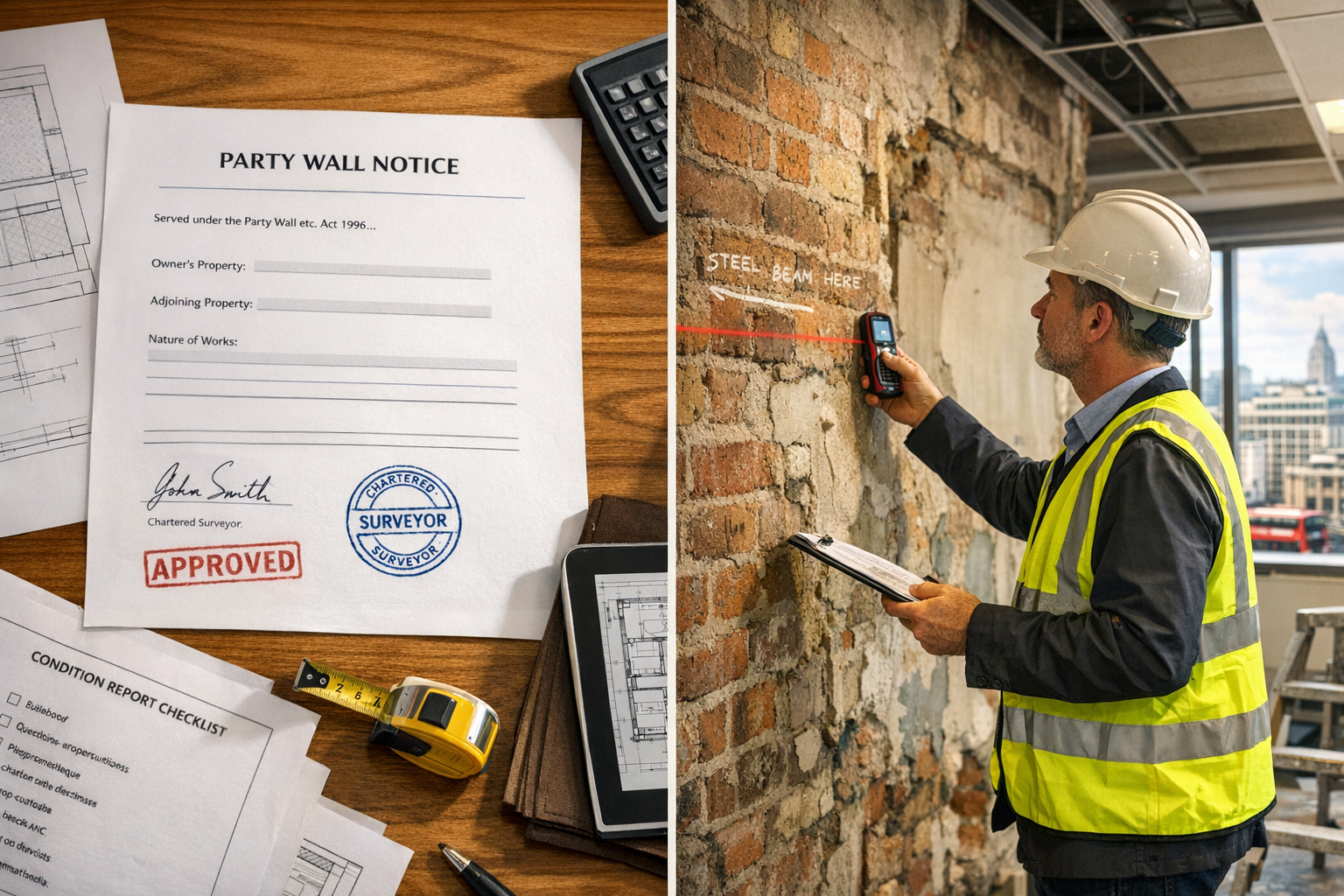
Office retrofit projects in London frequently involve work that falls under the Party Wall etc. Act 1996. Understanding what triggers these legal requirements is the first step toward compliance and successful project delivery.
Structural alterations to party walls—the shared walls between adjoining properties—represent the most common trigger for party wall procedures. In office buildings, this typically includes:
- 🏗️ Removing or inserting beams into shared walls for open-plan conversions
- 🔨 Cutting into party walls for new service runs or ventilation systems
- 🧱 Underpinning foundations that support both properties
- 📐 Raising party walls to accommodate additional floors or mezzanines
- ⚡ Installing damp-proof courses or insulation within shared structures
The Party Wall Act 1996 framework also covers excavation work within three meters of adjoining buildings if the work goes deeper than the neighbor's foundations, or within six meters if the excavation will cut a line drawn at 45 degrees from the bottom of the neighbor's foundations. For office retrofits in densely built areas of London, this often applies to basement extensions or underground parking modifications.
"The retrofit boom in London's office sector has created unprecedented demand for party wall expertise. Projects that once seemed straightforward now require careful navigation of shared structural elements and neighboring property rights." – Industry surveyor observation
The Legal Framework Governing Office Retrofits
The Party Wall etc. Act 1996 provides the legal framework that governs how building owners must proceed when planning work that affects shared structures. Unlike residential projects, commercial retrofits often involve multiple adjoining owners, complex lease arrangements, and institutional property holders—all of which add layers of complexity to the party wall process.
Key legal principles include:
- Notice requirements: Building owners must serve formal party wall notices to all affected adjoining owners
- Consent or dissent: Adjoining owners have 14 days to consent or dissent to the proposed works
- Surveyor appointment: If consent is not given, surveyors must be appointed to create a party wall award
- Right of access: Building owners gain legal right to access adjoining properties for necessary work
- Protection of interests: The Act protects both building owners' rights to develop and adjoining owners' rights to prevent damage
For office retrofits in 2026, compliance with these procedures has become more critical as property values recover and owners become more protective of their assets. The financial stakes are higher, making professional surveying and proper documentation essential.
Party Wall Agreements for Office Retrofits: Surveys in London's Underpriced Market Recovery 2026 – Market Context
London's Office Market Recovery and Investment Trends
The London office market in 2026 represents a compelling opportunity for investors and developers, with fundamental shifts in how commercial space is valued and utilized. The perception that offices are undervalued by a majority of investors reflects several converging factors that make retrofit projects particularly attractive [6].
Market dynamics driving the recovery include:
- 📊 Vacancy rates declining as companies commit to quality office space over quantity
- 💼 Flight to quality with tenants preferring modern, sustainable buildings
- 🌱 ESG requirements pushing landlords to retrofit rather than demolish
- 💰 Valuation gaps between prime and secondary stock creating retrofit opportunities
- 🏙️ Planning policies favoring retention and improvement of existing buildings
The shift toward retrofit rather than new construction has been particularly pronounced in 2026. With construction costs remaining elevated and sustainability concerns paramount, improving existing office stock has become the preferred strategy for many investors [1]. This trend directly impacts party wall procedures, as retrofit projects typically involve more complex work to shared structures than new builds on cleared sites.
Why Retrofit Projects Are Accelerating in 2026
Several factors have converged to accelerate office retrofit activity across London in 2026, creating a perfect storm of demand for party wall surveying services and structural survey expertise.
Primary drivers include:
Regulatory pressure: Stricter energy performance requirements and building safety regulations have made retrofitting older office stock a necessity rather than an option. Buildings that fail to meet minimum energy efficiency standards face restricted letting opportunities and reduced valuations [2].
Sustainability mandates: Corporate tenants increasingly demand BREEAM or LEED certified spaces, driving landlords to undertake comprehensive retrofits that often involve structural modifications to party walls for improved insulation, ventilation, and energy systems [1].
Technological integration: Modern office tenants expect advanced building management systems, high-speed connectivity infrastructure, and smart building features—all of which may require modifications to shared walls and structures [4].
Workplace evolution: The post-pandemic shift toward hybrid working has created demand for flexible, collaborative spaces that require reconfiguration of existing floor plates, often involving work to party walls [6].
Economic viability: With offices perceived as undervalued, the return on investment for retrofit projects has become increasingly attractive compared to the higher costs of new construction [6].
These factors have created an environment where understanding Party Wall Agreements for Office Retrofits: Surveys in London's Underpriced Market Recovery 2026 is essential for any stakeholder in the commercial property sector.
The Party Wall Survey Process for Office Retrofit Projects
Initial Assessment and Notice Requirements
The party wall process for office retrofits begins long before construction crews arrive on site. Early planning is crucial for avoiding delays and ensuring smooth project delivery.
Step 1: Identify Affected Parties
The first task involves identifying all adjoining owners who will be affected by the proposed retrofit work. In commercial buildings, this can be more complex than residential projects:
- 🏢 Multiple tenancies within adjoining buildings
- 🏛️ Institutional owners with complex decision-making processes
- 📋 Leasehold arrangements requiring landlord and tenant coordination
- 🗂️ Mixed-use buildings with different owners for commercial and residential portions
Step 2: Prepare Detailed Work Specifications
Before serving notices, building owners should prepare comprehensive specifications of the proposed work. This should include:
- Architectural drawings showing party wall locations
- Structural engineering reports detailing proposed modifications
- Method statements for how work will be executed
- Timeline for construction activities
- Proposed measures to minimize disruption
Step 3: Serve Formal Notices
The Party Wall etc. Act 1996 requires specific notice periods depending on the type of work:
| Work Type | Notice Period | Notice Form |
|---|---|---|
| Party Structure Notice (structural work to party walls) | 2 months | Detailed specification required |
| Party Wall Notice (new wall on boundary) | 1 month | Line of junction details |
| Adjacent Excavation Notice (foundation work) | 1 month | Depth and proximity details |
For office retrofits, the Party Structure Notice is most commonly required. This notice must include sufficient detail for adjoining owners to understand the scope and impact of the proposed work. Inadequate notices can be challenged, causing significant project delays.
Appointing Surveyors and Creating Party Wall Awards
When an adjoining owner dissents to proposed work—or simply fails to respond within 14 days—the Act requires the appointment of surveyors to resolve the matter through a party wall agreement.
Surveyor Appointment Options
The Act provides three pathways for surveyor appointment:
- Agreed Surveyor: Both parties appoint a single surveyor to act impartially
- Two Surveyors: Each party appoints their own surveyor, who then select a third surveyor
- Three Surveyors: Each party appoints a surveyor, and those two appoint a third to resolve disputes
For commercial retrofits in 2026, the agreed surveyor approach has become increasingly popular due to cost efficiency and faster resolution times. However, complex projects or contentious relationships may necessitate separate surveyors for each party.
The Party Wall Award Document
The appointed surveyor(s) must prepare a Party Wall Award—a legally binding document that sets out:
- ✅ Detailed description of the work to be undertaken
- ✅ Timing and method of construction activities
- ✅ Access arrangements for the building owner's contractors
- ✅ Condition schedule documenting the current state of adjoining properties
- ✅ Dispute resolution procedures if issues arise during construction
- ✅ Cost allocation for surveyor fees and any necessary remedial work
The condition schedule is particularly important for office retrofits, as it provides baseline documentation of the adjoining property's state before work commences. This protects both parties by establishing clear evidence of pre-existing conditions versus construction-related damage.
Conducting Pre-Construction Condition Surveys
Pre-construction condition surveys form a critical component of party wall procedures for office retrofits. These surveys document the current state of adjoining properties before any work begins, providing essential evidence if disputes arise about construction damage.
Survey Methodology
Professional surveyors conducting pre-construction assessments typically:
- 📸 Photograph all rooms and external elevations of adjoining properties
- 📝 Document existing defects including cracks, settlement, water damage
- 📏 Measure significant cracks to establish baseline dimensions
- 🎥 Video record complex areas or existing damage patterns
- 🔍 Inspect structural elements near the party wall location
- 📊 Prepare detailed schedules describing conditions in each area
For office buildings, this process often involves coordination with tenants and facility managers to access multiple floors, common areas, and service spaces. The survey must be sufficiently comprehensive to withstand potential legal scrutiny if damage claims emerge during or after construction.
Documentation Standards
High-quality condition surveys for office retrofits in 2026 typically include:
- High-resolution photographs with date/time stamps
- Detailed written descriptions of existing conditions
- Floor plans annotated with defect locations
- Crack width measurements using precision gauges
- Structural element condition assessments
- Services and finishes documentation
This documentation becomes part of the Party Wall Award and serves as the reference point for assessing any construction-related damage claims. Given the high values involved in commercial property, investing in thorough condition surveys provides essential protection for all parties.
Navigating Common Challenges in Office Retrofit Party Wall Procedures
Managing Multiple Adjoining Owners
Office retrofits in London's dense urban environment frequently involve work that affects multiple adjoining properties, each with different owners, occupiers, and interests. This complexity requires careful coordination and communication.
Challenges with Multiple Parties
- ⚖️ Conflicting interests between different adjoining owners
- ⏰ Varied response times to notices and surveyor appointments
- 💷 Cost allocation disputes when multiple properties are affected
- 📅 Scheduling conflicts for access and condition surveys
- 🏛️ Institutional decision-making processes that slow approvals
Best Practice Strategies
Successful navigation of multi-party scenarios requires:
- Early engagement: Contact all potentially affected owners well before formal notice periods
- Clear communication: Provide comprehensive information about proposed work and timelines
- Coordinated surveying: Where possible, use agreed surveyors to streamline the process
- Flexible scheduling: Accommodate different parties' availability for surveys and access
- Professional representation: Engage experienced chartered surveyors familiar with commercial party wall matters
For office retrofits in 2026, the trend toward institutional ownership of commercial property has added complexity to party wall procedures. Large property companies and REITs often have established protocols and legal teams that must review all party wall matters, potentially extending timelines beyond the statutory minimums.
Addressing Structural Concerns and Building Safety
The heightened focus on building safety following regulatory changes has made structural assessments during party wall procedures more rigorous in 2026. Surveyors and building owners must demonstrate that proposed retrofit work will not compromise structural integrity or fire safety.
Key Structural Considerations
Office retrofit projects commonly involve:
- 🏗️ Load-bearing wall modifications for open-plan layouts
- 🔥 Fire compartmentation changes affecting party walls
- 🌊 Waterproofing and damp-proofing shared structures
- ⚡ Service penetrations through party walls
- 🏋️ Floor loading changes affecting shared structural elements
Each of these elements requires careful assessment by qualified structural engineers and documentation within the party wall process. The surveyor's role includes ensuring that proposed work complies with current building regulations and does not adversely affect the structural performance of adjoining properties.
Integration with Building Control
Party wall procedures in 2026 increasingly overlap with Building Control approval processes. Surveyors must ensure that:
- Structural calculations are prepared by qualified engineers
- Fire safety measures comply with current regulations
- Proposed work aligns with approved building control submissions
- Method statements address structural protection during construction
- Temporary works designs account for party wall constraints
This integration helps prevent situations where party wall awards permit work that subsequently fails to gain building control approval, avoiding costly delays and redesign.
Preventing and Resolving Disputes
Despite best efforts, party wall disputes can arise during office retrofit projects. Understanding common flashpoints and resolution mechanisms is essential for keeping projects on track.
Common Dispute Triggers
- ⏱️ Noise and disruption exceeding anticipated levels
- 🏚️ Construction damage to adjoining properties
- 🚧 Access issues and contractor behavior
- 📋 Scope creep with work exceeding awarded specifications
- 💰 Cost disputes over surveyor fees or remedial work
Resolution Mechanisms
The Party Wall etc. Act 1996 provides a framework for dispute resolution:
- Surveyor mediation: Appointed surveyors attempt to resolve disagreements
- Third surveyor determination: If two surveyors cannot agree, the third surveyor decides
- Award amendments: Surveyors can issue supplemental awards to address new issues
- Appeal to County Court: As a last resort, parties can appeal surveyor decisions
For office retrofits in 2026, the emphasis has shifted toward early dispute prevention rather than resolution. This includes:
- Regular communication between building owners and adjoining owners
- Proactive monitoring for construction damage
- Swift response to complaints or concerns
- Transparent documentation of all work activities
- Professional contractor management to minimize disruption
When disputes do arise, engaging experienced surveyors who understand commercial property dynamics can prevent escalation to costly legal proceedings.
Cost Implications and Timeline Planning for Party Wall Surveys
Understanding Party Wall Surveyor Costs
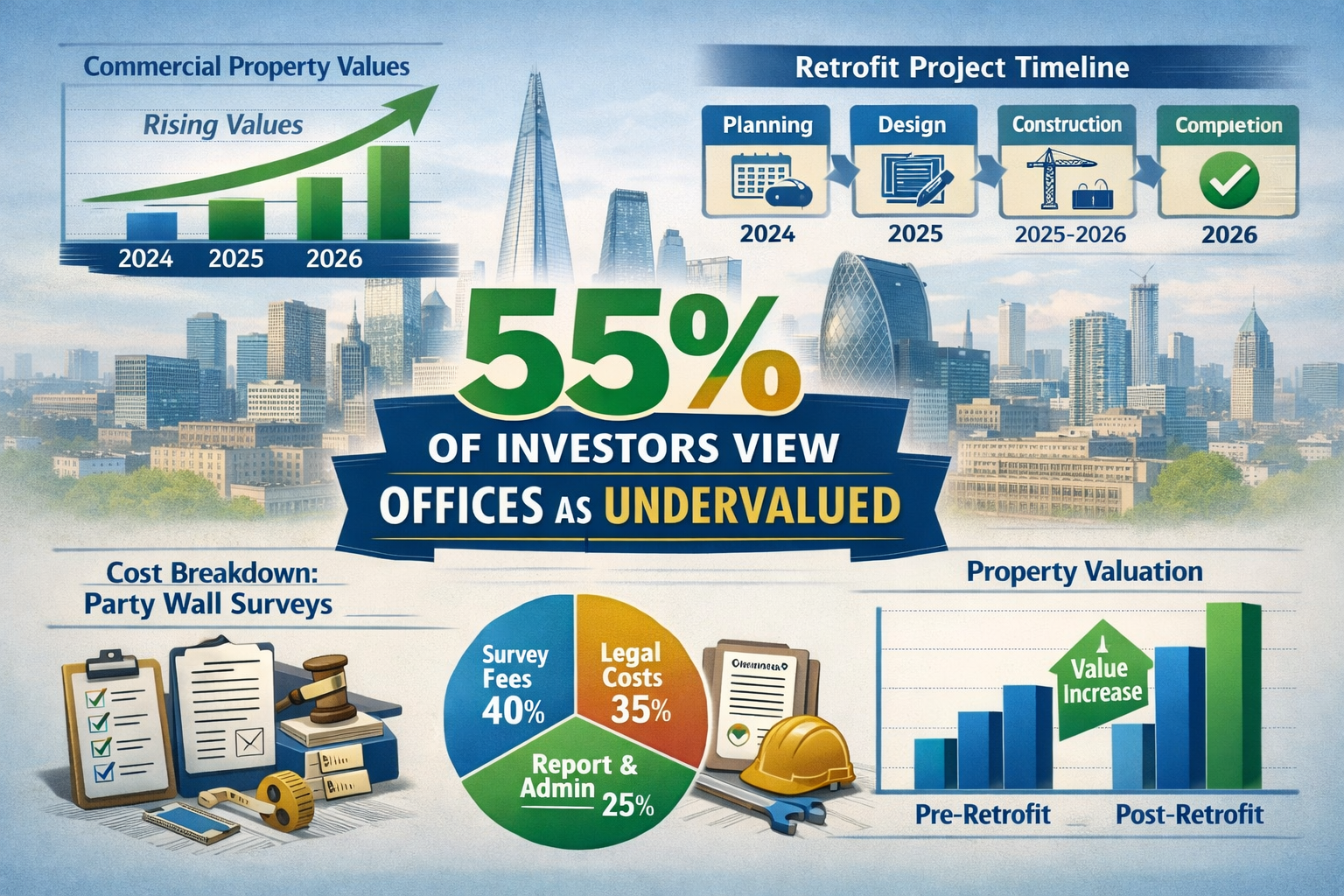
The financial aspects of party wall procedures represent a significant consideration for office retrofit budgets in 2026. Understanding typical party wall surveyor costs helps developers and building owners plan appropriately.
Typical Fee Structures
Party wall surveyors typically charge using one of several models:
| Fee Structure | Description | Typical Range (2026) |
|---|---|---|
| Hourly Rate | Time-based charging | £150-£300 per hour |
| Fixed Fee | Agreed price for straightforward cases | £800-£2,500 per property |
| Percentage | Based on construction value | 0.5-1.5% of works cost |
| Hybrid | Fixed fee plus hourly for additional work | Varies by project |
For office retrofit projects, costs tend toward the higher end of these ranges due to:
- Greater complexity of commercial structures
- Multiple affected properties requiring coordination
- Higher professional indemnity insurance requirements
- More extensive condition survey requirements
- Institutional owner expectations for detailed documentation
Cost Allocation
Under the Party Wall etc. Act 1996, the building owner (the party undertaking the work) typically bears the cost of:
- Their own surveyor's fees
- The adjoining owner's surveyor's fees (if separate surveyors are appointed)
- The third surveyor's fees (if appointed)
- All reasonable costs associated with the party wall process
For large office retrofits affecting multiple adjoining properties, total party wall surveyor costs can range from £10,000 to £50,000 or more, depending on project complexity and the number of affected parties. While significant, these costs represent a small fraction of typical retrofit budgets and provide essential legal protection.
Timeline Considerations for Retrofit Projects
Proper timeline planning for party wall procedures is essential to avoid costly construction delays. Office retrofit projects in 2026 must account for both statutory notice periods and practical surveying timelines.
Typical Party Wall Timeline
| Phase | Duration | Key Activities |
|---|---|---|
| Initial Assessment | 2-4 weeks | Identify affected parties, prepare specifications |
| Notice Period | 2 months | Statutory notice period for structural work |
| Surveyor Appointment | 2-4 weeks | Adjoining owners appoint surveyors or agree to single surveyor |
| Condition Surveys | 2-6 weeks | Schedule and conduct pre-construction surveys |
| Award Preparation | 4-8 weeks | Surveyors negotiate terms and prepare award document |
| Total Typical Timeline | 4-6 months | From initial planning to award completion |
Critical Path Considerations
For office retrofit projects, party wall procedures often sit on the critical path for project delivery. Delays in the party wall process directly impact construction start dates and overall project timelines.
Strategies to minimize timeline impact:
- 🚀 Early engagement: Begin party wall procedures during design development, not after planning approval
- 📋 Comprehensive notices: Provide detailed specifications to avoid challenges and re-serving
- 🤝 Proactive communication: Engage adjoining owners informally before formal notices
- 👥 Agreed surveyors: Where relationships allow, use single surveyors to streamline the process
- ⚡ Parallel processing: Conduct multiple property surveys simultaneously rather than sequentially
The construction sector in 2026 faces significant workforce and material challenges [2], making efficient project delivery more critical than ever. Proper party wall planning prevents delays that compound other project pressures.
Budgeting for Contingencies and Remedial Work
Beyond surveyor fees, office retrofit budgets must account for potential remedial work and contingencies related to party wall matters.
Potential Additional Costs
- 🔧 Remedial repairs: Fixing any construction damage to adjoining properties
- 🏗️ Temporary works: Additional structural support required by party wall awards
- 🔍 Monitoring: Vibration or movement monitoring during construction
- 📸 Additional surveys: Post-construction condition surveys to verify no damage
- ⚖️ Dispute resolution: Legal costs if disputes escalate beyond surveyor resolution
Recommended Contingency Allowances
Experienced developers typically include the following contingencies in office retrofit budgets:
- Party wall surveyor fees: 1-2% of construction costs
- Remedial work contingency: 2-3% of construction costs
- Delay contingency: 4-6 weeks in project timeline
These allowances provide buffer for unexpected complications while ensuring that party wall matters don't derail project economics. Given the perception of London offices as undervalued in 2026 [6], maintaining project budgets and timelines is essential to realizing anticipated returns on retrofit investments.
Best Practices for Party Wall Agreements in Office Retrofits
Selecting Qualified Party Wall Surveyors
The choice of party wall surveyor significantly impacts the success of office retrofit projects. In 2026, the complexity of commercial party wall matters demands surveyors with specific expertise and qualifications.
Essential Qualifications and Experience
When selecting a party wall surveyor for office retrofits, building owners should look for:
- ✅ RICS membership: Chartered status with the Royal Institution of Chartered Surveyors
- ✅ Commercial experience: Specific background in office and commercial properties
- ✅ Local knowledge: Familiarity with London building types and construction methods
- ✅ Technical expertise: Understanding of structural engineering and building pathology
- ✅ Professional indemnity insurance: Adequate coverage for commercial project values
- ✅ Dispute resolution skills: Proven ability to navigate contentious situations
Specialist vs. Generalist Surveyors
While many surveyors offer party wall services, office retrofits benefit from specialists who understand:
- Complex commercial lease arrangements
- Institutional property owner requirements
- Modern building systems integration
- Sustainability retrofit considerations
- Building safety and structural regulations
Engaging experienced party wall surveyors with commercial expertise can reduce project risks and ensure smoother navigation of the party wall process.
Documentation and Record-Keeping Strategies
Meticulous documentation throughout the party wall process provides essential protection for all parties and facilitates smooth project delivery.
Essential Documentation
Comprehensive party wall records for office retrofits should include:
📋 Pre-Construction Phase:
- Original party wall notices with proof of service
- Correspondence with adjoining owners
- Surveyor appointment letters
- Detailed work specifications and drawings
- Condition survey reports and photographs
- Party wall award documents
🏗️ Construction Phase:
- Daily site diaries noting party wall-related activities
- Photographic records of work progress
- Monitoring data (vibration, movement, noise)
- Incident reports for any issues or complaints
- Correspondence addressing adjoining owner concerns
✅ Post-Construction Phase:
- Post-construction condition surveys
- Comparison reports (pre vs. post condition)
- Remedial work specifications and completion certificates
- Final correspondence confirming satisfactory completion
- Archive of all party wall documentation
Digital Documentation Systems
In 2026, best practice increasingly involves digital documentation platforms that:
- Provide cloud-based access for all parties
- Timestamp all documents and photographs
- Enable real-time sharing of progress updates
- Integrate with project management systems
- Ensure secure long-term archiving
These systems improve transparency, reduce disputes, and provide robust evidence if disagreements arise during or after construction.
Communication and Stakeholder Management
Effective communication represents perhaps the most important factor in successful party wall procedures for office retrofits. The complexity of commercial projects demands proactive stakeholder engagement.
Key Stakeholder Groups
Office retrofit projects typically involve:
- 🏢 Building owners: The party undertaking the retrofit
- 🏛️ Adjoining property owners: Neighboring building owners affected by work
- 👔 Tenants: Occupiers of both the building being retrofitted and adjoining properties
- 👷 Contractors: Construction teams executing the work
- 📐 Design team: Architects and engineers specifying the retrofit
- ⚖️ Party wall surveyors: Professionals managing the party wall process
- 🏗️ Project managers: Coordinating overall project delivery
Communication Best Practices
Successful projects in 2026 typically implement:
- Pre-notice engagement: Informal discussions with adjoining owners before formal notices
- Regular updates: Scheduled communications about project progress and upcoming activities
- Responsive communication: Swift responses to questions or concerns
- Accessible contacts: Clear points of contact for different stakeholder groups
- Transparent processes: Open sharing of information within legal and commercial constraints
- Proactive problem-solving: Addressing issues before they escalate to formal disputes
"The most successful office retrofit projects in London's 2026 market recovery are those where party wall procedures are treated as stakeholder engagement opportunities rather than legal obstacles. Early, transparent communication prevents the vast majority of disputes." – Commercial property surveyor
For projects involving work on boundary walls, this communication becomes even more critical as the work directly affects the interface between properties.
Sustainability and Modern Building Standards in Office Retrofits
ESG Requirements and Party Wall Implications
The environmental, social, and governance (ESG) agenda has become a dominant force in commercial property in 2026, with direct implications for office retrofit party wall procedures [1].
Sustainability-Driven Retrofit Work
Modern office retrofits increasingly focus on:
- 🌱 Energy efficiency improvements: Enhanced insulation of party walls and external envelopes
- ♻️ Carbon reduction: Replacement of building systems requiring service runs through party walls
- 💧 Water management: Improved drainage and waterproofing of shared structures
- 🌡️ Thermal performance: Addressing thermal bridging at party wall junctions
- 🔋 Renewable energy: Roof and facade modifications for solar installations
Each of these sustainability measures may trigger party wall requirements when they involve work to shared structures. For example, adding external wall insulation often requires work to party walls at building junctions, necessitating proper notices and awards.
Balancing Sustainability and Party Wall Compliance
The challenge for building owners in 2026 is achieving ambitious sustainability targets while navigating party wall procedures. This requires:
- Early integration of party wall considerations into sustainability planning
- Surveyor involvement in design development to identify potential issues
- Specification of methods that minimize party wall impacts where possible
- Clear communication with adjoining owners about sustainability benefits
- Coordination between sustainability consultants and party wall surveyors
The perception of offices as undervalued [6] creates opportunities for value creation through sustainability retrofits, but only if party wall procedures are properly managed to avoid delays and cost overruns.
Integrating Modern Building Systems
Technology integration in office retrofits frequently involves modifications to party walls and shared structures, requiring careful party wall management.
Common System Integration Challenges
Modern office buildings in 2026 require sophisticated systems that may impact party walls:
- 📡 Connectivity infrastructure: Fiber optic and 5G systems requiring penetrations
- 🌬️ Advanced HVAC: Modern ventilation systems with different ductwork routing
- 🔌 Electrical capacity: Upgraded power distribution requiring new risers
- 💻 Smart building systems: Sensors and controls throughout the building
- 🚨 Enhanced fire safety: Upgraded compartmentation and detection systems
Party Wall Considerations for System Integration
When integrating modern systems, party wall awards must address:
- Locations and sizes of penetrations through party walls
- Fire-stopping requirements for all penetrations
- Acoustic performance maintenance
- Structural implications of chasing or cutting into walls
- Access requirements for installation and future maintenance
- Coordination with adjoining building systems
Professional party wall surveyors with technical knowledge can help design teams specify system integration methods that comply with party wall requirements while meeting modern building standards.
Regulatory Landscape and Compliance in 2026
Current Building Regulations and Party Wall Interaction
The regulatory environment for office retrofits in 2026 involves complex interactions between party wall legislation and broader building regulations.
Key Regulatory Frameworks
Office retrofit projects must navigate:
- 🏛️ Party Wall etc. Act 1996: Governs work affecting shared structures
- 🏗️ Building Regulations: Sets technical standards for construction work
- 🔥 Building Safety Act: Enhanced requirements for structural and fire safety
- 🌍 Energy Performance Regulations: Minimum efficiency standards for commercial buildings
- 🏙️ Planning regulations: Development control and conservation requirements
Coordination Challenges
The interaction between these frameworks creates several challenges:
- Timing conflicts: Different approval processes with varying timelines
- Specification conflicts: Requirements that may conflict between regimes
- Documentation overlap: Multiple submissions requiring similar information
- Inspection coordination: Different authorities requiring site access
- Compliance demonstration: Proving adherence to multiple standards
Best Practice Approach
Successful office retrofits in 2026 typically adopt an integrated compliance strategy:
- Appoint a compliance coordinator to manage all regulatory interactions
- Develop unified documentation serving multiple regulatory purposes
- Engage party wall surveyors early in building control discussions
- Ensure design specifications satisfy all applicable requirements
- Coordinate inspection schedules to minimize disruption
This integrated approach prevents situations where party wall awards permit work that subsequently fails other regulatory tests, avoiding costly redesign and delays.
Professional Standards and Industry Guidance
The Royal Institution of Chartered Surveyors (RICS) provides professional guidance that shapes party wall practice in 2026, ensuring consistent standards across the industry.
RICS Guidance Notes
Key professional standards include:
- Party Wall Legislation and Procedure guidance note
- Building Surveying Practice standards
- Conflicts of Interest professional requirements
- Professional Indemnity Insurance minimum coverage standards
- Continuing Professional Development requirements for surveyors
These standards ensure that party wall surveyors maintain competence and act professionally, providing confidence to building owners and adjoining owners alike.
Industry Best Practice Evolution
Party wall practice for office retrofits continues to evolve in 2026, with emerging best practices including:
- Greater use of building information modeling (BIM) for party wall documentation
- Integration of digital monitoring systems for construction impact assessment
- Enhanced pre-construction engagement protocols
- Standardized award templates for common retrofit scenarios
- Collaborative approaches to multi-party situations
Staying current with these evolving practices helps ensure efficient, compliant party wall procedures that support successful office retrofit delivery.
Case Study Insights: Office Retrofits in London's Recovery
Lessons from Recent London Office Retrofit Projects
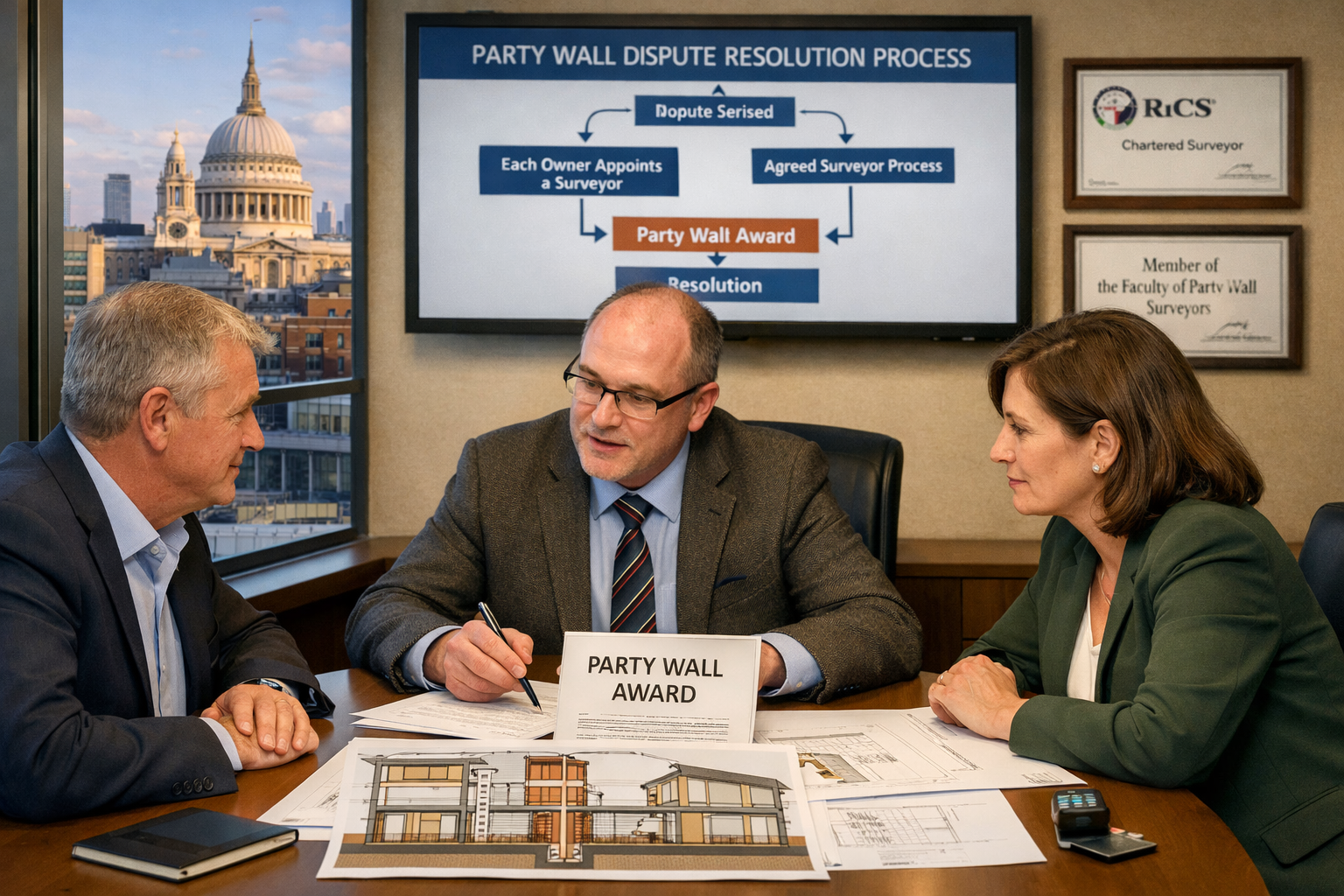
While specific project details often remain confidential, general lessons from office retrofit projects in London's 2026 market recovery provide valuable insights for party wall planning.
Common Success Factors
Successful office retrofits with complex party wall situations typically share:
- ✅ Early surveyor engagement: Involving party wall surveyors during design development
- ✅ Comprehensive notices: Providing detailed specifications that minimize later variations
- ✅ Proactive communication: Regular dialogue with adjoining owners throughout the process
- ✅ Quality contractors: Experienced builders who understand party wall sensitivities
- ✅ Adequate budgets: Realistic allowances for surveyor fees and potential remedial work
- ✅ Flexible timelines: Project programs that accommodate party wall procedures
Common Pitfalls
Conversely, problematic projects often feature:
- ❌ Late party wall consideration: Treating party wall matters as an afterthought
- ❌ Inadequate notices: Vague specifications leading to disputes and re-serving
- ❌ Poor communication: Failing to engage adjoining owners proactively
- ❌ Inexperienced contractors: Builders unfamiliar with party wall constraints
- ❌ Insufficient budgets: Underestimating party wall costs and contingencies
- ❌ Aggressive timelines: Unrealistic programs that don't accommodate proper procedures
Adapting to Market-Specific Challenges
London's unique property market characteristics create specific challenges for party wall procedures in office retrofits.
Market-Specific Factors
- 🏙️ Dense urban fabric: Properties in close proximity with complex shared structures
- 🏛️ Historic buildings: Older construction requiring specialist knowledge and careful handling
- 🌍 International ownership: Overseas investors with different expectations and processes
- 💼 Institutional holdings: Large property companies with established protocols
- 📈 Value sensitivity: High property values making damage claims particularly significant
Adaptation Strategies
Successful navigation of London's market in 2026 requires:
- Local expertise: Engaging surveyors with specific London experience
- Cultural sensitivity: Understanding different owner expectations and communication styles
- Historic building knowledge: Specialist expertise for period properties
- Institutional protocols: Familiarity with major property owner requirements
- Value protection: Robust condition surveys and monitoring for high-value properties
The recognition of offices as undervalued [6] has attracted diverse investor types to the London market, each with different approaches to party wall matters. Flexibility and professional expertise help navigate this diversity successfully.
Future Outlook: Party Wall Agreements and London's Office Market
Emerging Trends in Office Retrofit Development
The office retrofit market in London shows several emerging trends that will shape party wall requirements in the coming years.
Predicted Developments
Industry forecasts for 2026 and beyond suggest:
- 📊 Continued retrofit acceleration: Sustained investment in existing office stock over new construction [1]
- 🌱 Net-zero retrofits: Increasing focus on deep energy retrofits with complex party wall implications
- 🏗️ Adaptive reuse: Conversion of secondary offices to alternative uses requiring structural modifications
- 🤖 Technology integration: Smart building systems requiring extensive service installations
- 👥 Flexible workspace: Continued reconfiguration for hybrid working models
Each of these trends suggests ongoing demand for party wall surveying expertise as office retrofits remain central to London's commercial property strategy.
Technology and Innovation in Party Wall Procedures
Digital innovation is beginning to transform party wall procedures, with implications for office retrofit projects.
Emerging Technologies
- 📱 Digital notice serving: Electronic delivery and tracking of party wall notices
- 🏗️ BIM integration: 3D modeling of party wall locations and proposed works
- 📊 Automated monitoring: Real-time vibration and movement tracking during construction
- 🤖 AI-assisted surveys: Machine learning for condition assessment and damage detection
- 📸 Photogrammetry: 3D scanning for comprehensive condition documentation
These technologies promise to make party wall procedures more efficient, accurate, and transparent—particularly valuable for complex office retrofit projects with multiple stakeholders.
Regulatory Technology (RegTech)
The convergence of party wall requirements with broader regulatory compliance is driving development of integrated platforms that:
- Manage multiple regulatory approval processes simultaneously
- Provide unified documentation repositories
- Track compliance across different frameworks
- Generate required reports and submissions
- Facilitate communication between all stakeholders
As these platforms mature, they will reduce administrative burden and help prevent the compliance conflicts that can delay office retrofit projects.
Skills and Workforce Considerations
The retrofit boom in London's office market has created significant demand for qualified party wall surveyors, raising questions about workforce capacity [5].
Skills Gap Challenges
The industry faces several workforce challenges:
- 👨🎓 Limited training pipelines: Insufficient new surveyors entering the profession
- 🏗️ Commercial expertise shortage: Particular scarcity of surveyors with office retrofit experience
- 📚 Technical complexity: Increasing sophistication of retrofit projects requiring advanced knowledge
- 🌍 London-specific knowledge: Need for surveyors familiar with capital's unique building stock
- ⚖️ Dispute resolution skills: Growing importance of mediation and negotiation capabilities
Industry Responses
To address these challenges, the surveying profession is:
- Developing enhanced training programs for party wall specialists
- Creating mentorship schemes pairing experienced and emerging surveyors
- Producing technical guidance specifically for commercial retrofits
- Promoting party wall surveying as a career specialization
- Leveraging technology to improve surveyor productivity
For building owners planning office retrofits in 2026 and beyond, early engagement with qualified surveyors becomes even more critical given capacity constraints across the industry.
Conclusion: Navigating Party Wall Agreements for Successful Office Retrofits
The convergence of London's office market recovery and the retrofit imperative has created unprecedented opportunity for building owners and investors in 2026. With 55% of investors viewing offices as the most undervalued asset class [6], the potential for value creation through strategic retrofits is substantial. However, realizing this potential requires expert navigation of party wall procedures that can make or break project success.
Party Wall Agreements for Office Retrofits: Surveys in London's Underpriced Market Recovery 2026 represent far more than a legal compliance exercise—they are a critical risk management tool that protects investments, maintains stakeholder relationships, and ensures smooth project delivery. The complexity of commercial retrofits, combined with London's dense urban fabric and diverse ownership landscape, demands professional expertise and careful planning.
Key Success Factors
Successful office retrofit projects in 2026's market recovery share several characteristics:
- 🎯 Early planning: Integrating party wall considerations from project inception
- 👥 Expert advisors: Engaging qualified, experienced party wall surveyors
- 📋 Comprehensive documentation: Maintaining detailed records throughout the process
- 🤝 Proactive communication: Building positive relationships with adjoining owners
- 💰 Realistic budgeting: Allocating adequate resources for surveyor fees and contingencies
- ⏰ Appropriate timelines: Building party wall procedures into project programs
- 🔧 Quality execution: Using experienced contractors who understand party wall sensitivities
Actionable Next Steps
For building owners, developers, and investors planning office retrofits in London:
Immediate Actions:
- Assess party wall implications early in project planning—don't wait until design is finalized
- Engage qualified surveyors with specific commercial retrofit experience in London
- Identify all affected parties and begin informal engagement before formal notices
- Develop comprehensive work specifications to support detailed party wall notices
- Allocate adequate budget for surveyor fees, monitoring, and potential remedial work
Medium-Term Strategies:
- Build party wall timelines into overall project programs from the outset
- Establish communication protocols for engaging with adjoining owners throughout construction
- Implement robust documentation systems for condition surveys and ongoing monitoring
- Coordinate party wall procedures with other regulatory approvals to avoid conflicts
- Review contractor experience with party wall requirements before appointment
Long-Term Considerations:
- Develop relationships with trusted party wall surveyors for future projects
- Build institutional knowledge about party wall procedures within your organization
- Monitor regulatory developments that may affect future retrofit projects
- Participate in industry forums to stay current with best practices
- Consider technology investments that streamline party wall documentation and compliance
The Path Forward
As London's office market continues its recovery and retrofit activity accelerates, the importance of professional party wall management will only increase. The buildings being retrofitted today will serve the capital's economy for decades to come, making it essential that work is executed properly, legally, and with proper regard for all stakeholders' interests.
The Party Wall etc. Act 1996 provides a robust framework for balancing building owners' development rights with adjoining owners' property protection. When approached professionally and proactively, party wall procedures facilitate rather than hinder successful office retrofits. The key is treating these requirements as an integral part of project planning rather than an administrative burden.
For those navigating Party Wall Agreements for Office Retrofits: Surveys in London's Underpriced Market Recovery 2026, the message is clear: invest in expertise, plan comprehensively, communicate proactively, and document thoroughly. These principles, combined with the professional guidance available through experienced party wall surveyors, provide the foundation for successful retrofit projects that capture the value opportunity in London's recovering office market.
The retrofit boom presents a generational opportunity to modernize London's office stock, improve sustainability performance, and create value in underpriced assets. Proper party wall management ensures this opportunity can be realized efficiently, legally, and with minimal disruption—benefiting building owners, adjoining owners, and the broader commercial property market alike.
References
[1] How Retrofit And Quality Are Shaping – https://www.constructionmagazine.uk/2025/10/how-retrofit-and-quality-are-shaping.html
[2] What Challenges Are Being Forecast For The Commercial Construction Industry In 2026 And Beyond – https://virtus-contracts.co.uk/blog/what-challenges-are-being-forecast-for-the-commercial-construction-industry-in-2026-and-beyond/
[3] London Commercial Property Market – https://removalsandstoragex.com/blog/london-commercial-property-market/
[4] Retrofit At Scale Investible Urban Development – https://www.gensler.com/blog/retrofit-at-scale-investible-urban-development
[5] Are Retrofit Skills And Workforce Growth On Track Heading Into 2026 – https://elementallondon.show/features/are-retrofit-skills-and-workforce-growth-on-track-heading-into-2026/
[6] The Shifting Landscape Of Uk Offices – https://www.jll.com/en-uk/insights/the-shifting-landscape-of-uk-offices