
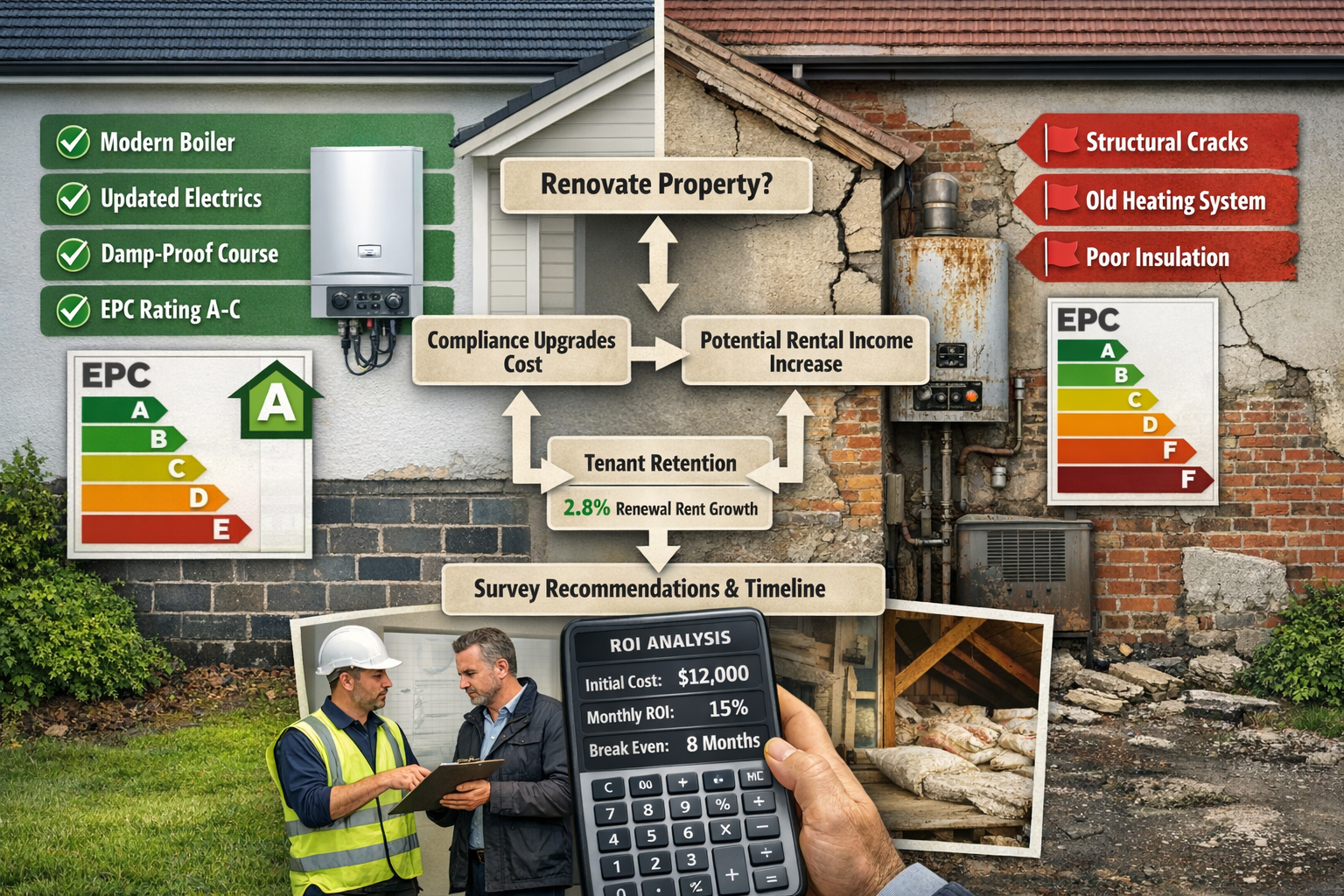
{"cover":"Professional landscape format (1536x1024) hero image featuring bold text overlay 'Lettings Market Building Surveys: Assessing Rental Viability in 2026 Tenant Demand Surge' in extra large 72pt white sans-serif font with dark shadow effect, centered in upper third. Background shows modern UK residential property facade with surveyor conducting inspection using tablet and laser measuring device, overlaid with subtle transparent data graphics showing upward tenant demand arrows and rental yield percentages. Color scheme: deep navy blue, crisp white, gold accents. High contrast professional composition with rule of thirds layout, magazine cover quality, editorial style photography with sharp focus on property details and survey equipment.","content":["Detailed landscape format (1536x1024) image showing professional chartered surveyor in high-visibility vest conducting comprehensive building survey inspection inside rental property, examining structural elements with moisture meter and thermal imaging camera. Foreground displays clipboard with detailed survey checklist highlighting compliance items, damp readings, and safety certificates. Background shows cross-section view of property revealing hidden defects like roof issues, plumbing concerns, and electrical systems. Overlay includes semi-transparent data boxes showing 8% tenant demand increase statistics, 12-day letting speed metrics, and regional rent variation percentages. Clean professional aesthetic with blue and white color scheme, technical documentation visible, RICS standards reference materials.","Detailed landscape format (1536x1024) infographic-style image displaying UK rental market heat map with color-coded regions showing rent growth variations: North East in deep red (8.0% growth), London in cool blue (1.1% growth), Wales in orange (5.8% growth). Central focus on detailed property condition assessment matrix with columns for structural integrity, energy efficiency ratings (EPC certificates), safety compliance checkboxes, and rental yield calculations. Includes visual representations of £1,367 average monthly rent figure, supply constraint indicators showing declining property listings graph, and landlord exit rate statistics. Professional financial aesthetic with charts, percentages, and property condition rating scales clearly visible.","Detailed landscape format (1536x1024) image showing split-screen comparison of two rental properties: left side displays well-maintained property with green checkmarks for passed survey items including modern boiler, updated electrical systems, damp-proof course, and EPC rating A-C certificate prominently displayed. Right side shows property with survey red flags including structural cracks, outdated heating system, poor insulation, and lower EPC rating. Center overlay features decision-making flowchart for landlords with arrows pointing to renovation recommendations, compliance upgrade costs versus potential rental income increases, and tenant retention statistics showing 2.8% renewal rent growth. Includes calculator displaying ROI projections and timeline for survey-recommended improvements with professional surveyor consultation imagery."]}
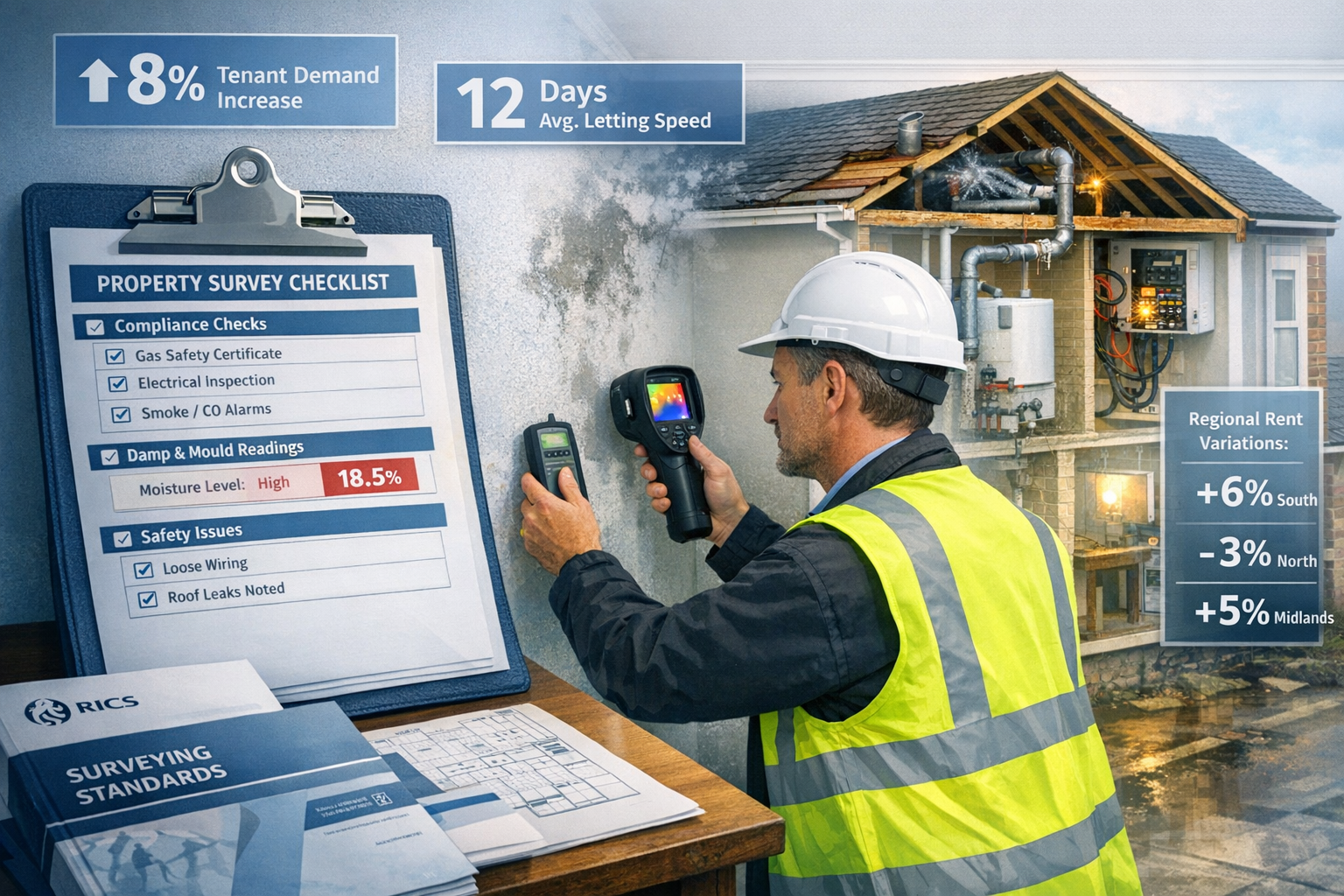
The UK lettings market is experiencing a remarkable transformation in 2026. Tenant demand has surged by 8% month-on-month, while properties are letting in just 12 days—the fastest pace since the market rebalanced in late 2025[5]. For landlords navigating this dynamic landscape, understanding Lettings Market Building Surveys: Assessing Rental Viability in 2026 Tenant Demand Surge has become essential to capitalize on opportunities while managing risks. With rental supply at record lows and tenant competition intensifying, comprehensive building surveys now serve as critical tools for assessing property condition, ensuring compliance, and maximizing rental yields in an increasingly competitive market.
This surge in tenant activity comes against a backdrop of constrained supply and evolving rental dynamics. Average UK monthly private rent stands at £1,367, with significant regional variations creating both challenges and opportunities for property investors[2]. As landlords face mounting pressure from regulatory changes and market volatility, professional building surveys provide the data-driven insights needed to make informed decisions about rental viability and property investments.
Key Takeaways
- Tenant demand increased 8% in January 2026, with properties letting in just 12 days, creating urgent need for landlords to assess rental property condition and compliance
- Regional rent variations are extreme: North East shows 8.0% growth while London records only 1.1%, making location-specific building surveys essential for yield optimization
- Comprehensive building surveys identify structural issues, compliance gaps, and improvement opportunities that directly impact rental income potential and tenant retention
- Supply constraints favor well-maintained properties with strong survey reports, commanding premium rents and faster letting times in competitive markets
- Professional surveys protect landlord investments by uncovering hidden defects that could lead to costly repairs, void periods, or regulatory penalties
Understanding the 2026 Rental Market Landscape
Current Market Dynamics and Tenant Behavior
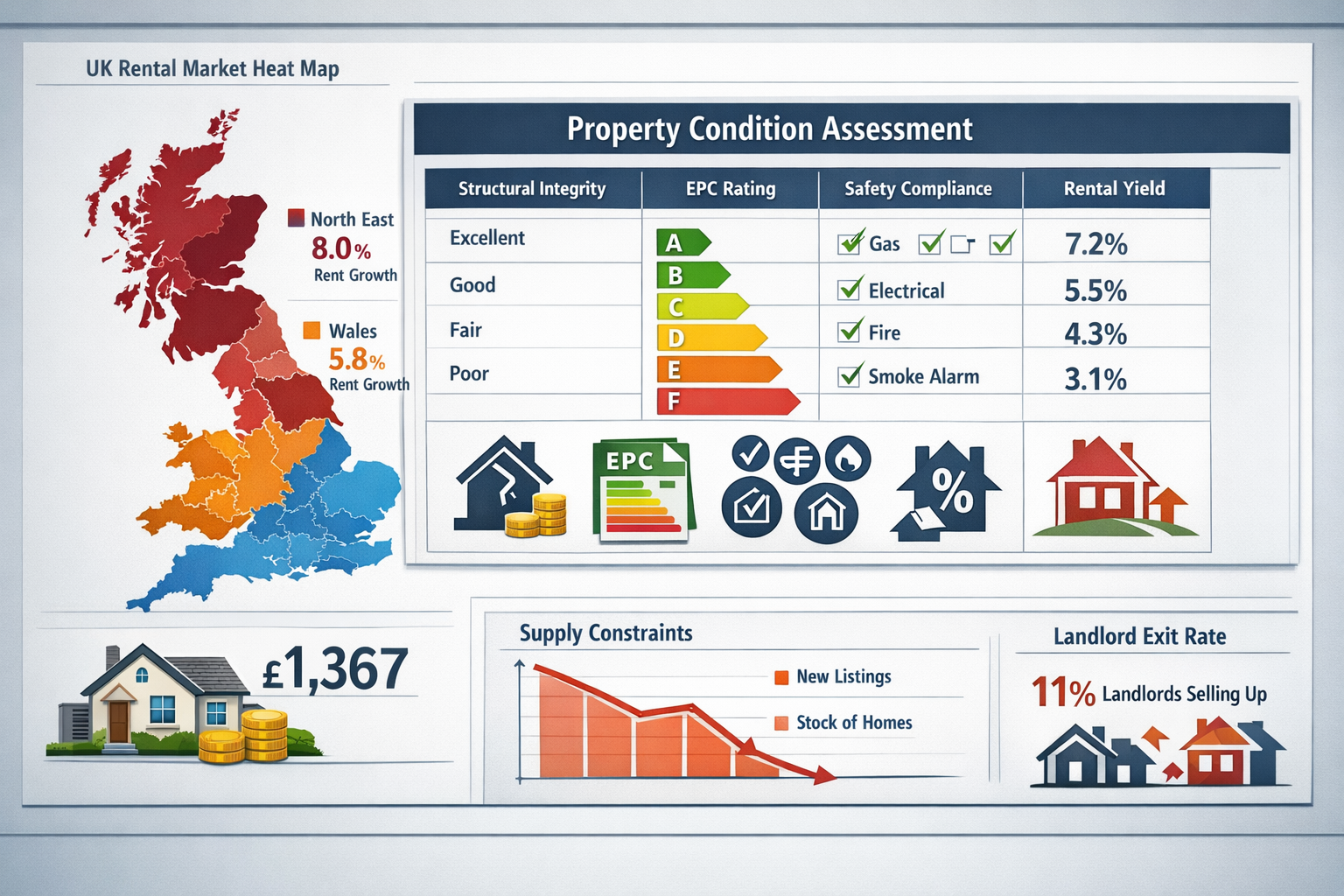
The rental market in 2026 presents a complex picture of moderating growth alongside sustained demand. Annual rent growth has cooled to 3.5% for the 12 months to January 2026, down from 4.0% the previous month, marking the lowest annual inflation rate since March 2022[2]. However, this moderation masks significant regional disparities and evolving tenant behaviors that directly impact rental viability assessments.
Regional performance varies dramatically across the UK:
| Region | Annual Rent Growth | Average Monthly Rent |
|---|---|---|
| North East | 8.0% | Not specified |
| Wales | 5.8% | £826 |
| Northern Ireland | 5.6% | £875 |
| London | 1.1% | Higher than average |
| UK Average | 3.5% | £1,367 |
These variations highlight why Lettings Market Building Surveys: Assessing Rental Viability in 2026 Tenant Demand Surge must incorporate location-specific analysis. A property survey in the North East requires different yield expectations and improvement priorities compared to London properties experiencing rental stagnation.
Supply Constraints Driving Market Pressure
The fundamental challenge facing the 2026 lettings market is severe supply shortage. Rental listings have hit record low levels, with a growing number of landlords exiting the market due to regulatory pressures, tax changes, and increased operational costs[3]. This supply crisis creates a paradox: while some areas experience rental growth moderation, tenant competition for quality properties remains fierce.
Working with chartered surveyors in London helps landlords understand how property condition directly impacts competitiveness in supply-constrained markets. Properties with comprehensive survey reports demonstrating excellent condition and compliance can command premium rents and achieve faster letting times—critical advantages when tenant demand is high but quality stock is limited.
The Renewal vs. New Tenancy Divide
An important trend emerging in 2026 is the divergence between renewal and new tenancy rents. While newly let homes saw rents decline 0.2% year-on-year to January 2026, renewal rents increased 2.8% annually, rising to £1,305 per month[4]. Outside London, renewed rents climbed even more substantially at 5.2% to £1,070[4].
This split reveals changing tenant priorities:
- 🏠 Existing tenants value stability and are willing to accept moderate increases to avoid moving costs and uncertainty
- 📉 New tenants negotiate harder in markets with increased choice, particularly in London and the South East
- ✅ Well-maintained properties retain tenants longer, reducing void periods and turnover costs
- 🔍 Building surveys identify improvements that justify renewal rent increases while maintaining tenant satisfaction
How Building Surveys Support Lettings Market Building Surveys: Assessing Rental Viability in 2026 Tenant Demand Surge
Comprehensive Property Condition Assessment
Professional building surveys provide landlords with detailed intelligence about property condition, structural integrity, and maintenance requirements—all critical factors when assessing rental viability in competitive markets. A thorough survey examines:
Structural Elements:
- Foundation stability and subsidence risks
- Roof condition, drainage, and weatherproofing
- Wall integrity, damp penetration, and insulation quality
- Floor structure and load-bearing capacity
Building Services:
- Heating system efficiency and compliance
- Electrical installation safety and certification
- Plumbing condition and water pressure
- Ventilation adequacy and condensation risks
Compliance and Safety:
- Fire safety measures and escape routes
- Gas safety certification requirements
- Energy Performance Certificate (EPC) ratings
- Electrical Installation Condition Reports (EICR)
For landlords considering properties for rental investment, understanding what survey you need ensures the appropriate level of investigation matches the property type and rental market positioning.
Identifying Hidden Defects Before They Impact Rental Income
One of the most valuable aspects of Lettings Market Building Surveys: Assessing Rental Viability in 2026 Tenant Demand Surge is the early identification of defects that could derail rental plans. Hidden issues such as:
- 🔴 Structural movement or subsidence requiring expensive remediation
- 💧 Damp and moisture penetration leading to health hazards and tenant complaints
- ⚡ Outdated electrical systems failing to meet current safety standards
- 🏚️ Roof deterioration risking water damage and emergency repairs
These problems, if undetected, can result in extended void periods, emergency repair costs, and potential legal liabilities. In a market where properties are letting in just 12 days[5], any delay caused by unexpected defects represents significant lost rental income.
Specialized surveys like subsidence surveys or roof surveys provide targeted investigation of high-risk areas, giving landlords confidence in their rental viability assessments.
Calculating Improvement ROI and Rental Yield Optimization
Building surveys don't just identify problems—they highlight improvement opportunities that can significantly enhance rental yields. In the current market, where tenant demand is strong but discerning, strategic improvements guided by survey findings can:
Increase Rental Income:
- Upgrading EPC ratings from D to C or higher can justify 5-10% rent premiums
- Modern kitchens and bathrooms attract quality tenants willing to pay more
- Enhanced security features appeal to safety-conscious renters
- Energy-efficient heating reduces tenant utility costs, making properties more attractive
Reduce Operational Costs:
- Preventative maintenance identified in surveys prevents expensive emergency repairs
- Improved insulation and heating efficiency reduce landlord-paid utilities in HMOs
- Addressing minor issues before they escalate saves thousands in remediation costs
Accelerate Letting Times:
- Properties in excellent condition let faster, reducing void periods
- Survey-backed condition reports build tenant confidence
- Compliance documentation streamlines tenant onboarding
For commercial or mixed-use properties, commercial building surveys provide specialized assessment of rental viability factors specific to business tenancies.
Strategic Applications of Lettings Market Building Surveys: Assessing Rental Viability in 2026 Tenant Demand Surge
Pre-Purchase Investment Analysis
For investors considering rental property acquisitions in 2026's competitive market, building surveys form the foundation of due diligence and investment analysis. With tenant demand up 8%[5] but supply constrained, identifying properties with strong rental potential requires detailed condition assessment.
A comprehensive pre-purchase survey reveals:
Immediate Costs:
- Essential repairs needed before first letting
- Compliance upgrades required by law
- Safety certification expenses
- Cosmetic improvements to achieve target rent
Long-Term Capital Expenditure:
- Major component replacement timelines (roof, boiler, windows)
- Structural work requirements over 5-10 year horizon
- Energy efficiency improvement opportunities
- Accessibility modifications for broader tenant appeal
Rental Income Projections:
- Achievable rent based on condition and location
- Premium potential after survey-recommended improvements
- Void period risks associated with deferred maintenance
- Tenant retention likelihood based on property quality
This analysis enables investors to calculate true net rental yields accounting for all survey-identified costs, avoiding the common mistake of overestimating returns based on headline rent figures alone.
Portfolio Management and Strategic Disposals
For landlords managing multiple properties, regular building surveys provide portfolio-level intelligence supporting strategic decisions about retention, improvement, or disposal. In 2026's evolving market, where some landlords are exiting due to regulatory pressures[3], survey data helps identify which properties justify continued investment.
Survey-Driven Portfolio Decisions:
✅ Retain and Improve: Properties in strong rental areas with minor defects offering high ROI on improvements
⚠️ Retain with Caution: Properties with adequate condition but in declining rental markets requiring monitoring
❌ Strategic Disposal: Properties with major structural issues in low-growth areas where repair costs exceed rental viability
📈 Acquisition Targets: Gap analysis revealing property types and locations underrepresented in portfolio
For properties being prepared for sale, a schedule of condition report documents current state, protecting landlords from future disputes while supporting asking price justification.
Compliance and Risk Mitigation
The regulatory landscape for landlords continues to evolve in 2026, making compliance verification through building surveys increasingly important. Surveys identify gaps in:
Mandatory Safety Requirements:
- Gas Safety Record renewals
- Electrical Installation Condition Reports (5-year cycle)
- Energy Performance Certificates (valid for 10 years)
- Fire safety measures in HMOs and multi-occupancy buildings
- Carbon monoxide and smoke detector installations
Emerging Regulatory Standards:
- Minimum EPC rating requirements (currently E, potentially rising to C)
- Selective licensing scheme conditions in specific local authorities
- Accessibility standards for new conversions
- Retrofit requirements for older properties
Tenant Health and Safety:
- Damp and mold risks requiring remediation
- Structural hazards posing injury risks
- Inadequate heating or insulation affecting habitability
- Water quality and legionella prevention
Non-compliance can result in substantial fines, prohibition orders, and reputational damage. In competitive rental markets where tenant demand is high, properties with comprehensive compliance documentation attract better quality tenants and command premium rents.
Landlords dealing with property condition disputes may also benefit from specific defect reports that provide detailed analysis of particular issues raised by tenants or identified during routine inspections.
Rent Review and Lease Renewal Negotiations
With renewal rents increasing 2.8% annually while new tenancy rents decline 0.2%[4], survey-backed evidence of property improvements strengthens landlords' positions during rent review negotiations. Tenants are more likely to accept increases when presented with:
- 📊 Documented improvements made since last review
- 🔧 Preventative maintenance protecting property value
- 📈 Comparative market analysis showing below-market current rent
- ✅ Compliance investments benefiting tenant safety and comfort
Professional rent review services combine building survey data with market analysis to establish fair rental values that balance landlord returns with tenant retention.
Regional Considerations for Lettings Market Building Surveys: Assessing Rental Viability in 2026 Tenant Demand Surge
London Market Dynamics
London presents unique challenges in 2026, with Inner London rents falling for 13 consecutive months annually and Outer London recording 8 months of annual declines[4]. Despite this, London remains the UK's most expensive rental market, with areas like Kensington and Chelsea averaging £3,640 monthly[2].
Survey Priorities for London Properties:
- Space optimization: Surveys identifying conversion or reconfiguration opportunities to maximize rental income per square foot
- Transport connectivity: Properties near transport links command premiums despite broader market softness
- Energy efficiency: High utility costs make EPC improvements particularly valuable to London tenants
- Period property challenges: Older London stock requires specialized surveys addressing heritage building issues
The London market's complexity makes working with experienced chartered surveyors essential for accurate rental viability assessment.
High-Growth Regional Markets
In contrast to London, regions like the North East (8.0% growth), Wales (5.8%), and Northern Ireland (5.6%) offer stronger rental yield potential[2]. Building surveys in these markets focus on:
Value-Add Opportunities:
- Lower property prices allow more extensive improvements
- Tenant expectations may differ from premium London market
- Local compliance requirements and building standards
- Regional property types (terraced houses, ex-council properties)
Market-Specific Risks:
- Economic dependency on local industries
- Population migration patterns
- Future infrastructure development
- Local authority licensing schemes
Emerging Rental Hotspots
Outside London, Oxford leads with average rents of £1,923[2], reflecting strong rental demand in university cities and economic hubs. Building surveys in these emerging hotspots should assess:
- 🎓 Student market potential: HMO conversion viability and licensing requirements
- 💼 Professional tenant appeal: Quality standards expected by higher-income renters
- 🏗️ Development pipeline: New supply potentially affecting rental growth
- 📍 Micro-location factors: Proximity to universities, business parks, and amenities
Maximizing Returns Through Survey-Informed Improvements
Prioritizing High-Impact Upgrades
Not all survey-identified improvements offer equal return on investment. In 2026's tenant demand surge, landlords should prioritize upgrades that:
Immediately Impact Rental Income:
-
EPC Rating Improvements (C or above)
- Insulation upgrades
- Efficient heating system replacement
- Double/triple glazing installation
- LED lighting and energy-efficient appliances
-
Kitchen and Bathroom Modernization
- Contemporary fixtures and fittings
- Improved storage solutions
- Quality finishes appealing to target demographic
-
Cosmetic Enhancements
- Neutral decoration throughout
- Quality flooring (laminate, carpet, tiles)
- External curb appeal improvements
Protect Long-Term Asset Value:
-
Structural Integrity
- Roof repairs and replacement
- Damp-proofing and drainage
- Foundation and subsidence remediation
-
Building Services
- Boiler and heating system upgrades
- Electrical rewiring and consumer unit replacement
- Plumbing system modernization
-
Preventative Maintenance
- External decoration and weatherproofing
- Gutter and drainage clearance
- Window and door maintenance
Timing Improvements for Market Conditions
With properties letting in just 12 days[5], timing improvements strategically maximizes returns:
Pre-Letting Preparation:
- Complete all survey-identified essential repairs before marketing
- Ensure all compliance certificates are current
- Address cosmetic issues that appear in property photos
Between Tenancies:
- Use void periods for more extensive improvements
- Coordinate multiple trades efficiently to minimize downtime
- Upgrade specifications to justify rent increases for new tenancies
During Tenancies:
- Schedule preventative maintenance to avoid emergency repairs
- Communicate improvements to existing tenants supporting renewal negotiations
- Plan major works for natural tenancy break points
Future-Proofing Rental Properties
Anticipating Regulatory Changes
The rental sector faces ongoing regulatory evolution. Building surveys help landlords anticipate and prepare for future requirements:
Energy Efficiency Standards:
- Current minimum EPC rating: E
- Potential future requirement: C (widely anticipated)
- Survey-identified pathway to achieve higher ratings
- Cost-benefit analysis of improvement options
Safety Legislation:
- Electrical safety inspection frequency
- Fire safety requirements for different property types
- Carbon monoxide detector specifications
- Water quality and legionella prevention
Licensing Expansion:
- Additional and selective licensing schemes spreading across local authorities
- HMO definition changes affecting licensing requirements
- Property condition standards for licensed properties
Sustainable Investment Strategies
With growing tenant awareness of environmental issues and rising energy costs, sustainable property features increasingly influence rental decisions:
- ♻️ Renewable energy: Solar panels, heat pumps, and green energy tariffs
- 💧 Water efficiency: Low-flow fixtures and rainwater harvesting
- 🌡️ Smart heating: Programmable thermostats and zone control
- 🔋 EV charging: Future-proofing for electric vehicle adoption
Building surveys identify opportunities to incorporate these features, differentiating properties in competitive markets and attracting environmentally conscious tenants willing to pay premium rents.
Working with Professional Surveyors
Selecting the Right Survey Type
Different rental scenarios require different survey approaches:
Level 2 Survey (HomeBuyer Report):
- Standard properties in reasonable condition
- Typical buy-to-let investments
- Properties built post-1900 using conventional construction
Level 3 Survey (Building Survey):
- Older properties (pre-1900)
- Properties with visible defects or alterations
- Unusual construction types
- Properties requiring significant investment decisions
Specialist Surveys:
Interpreting Survey Reports for Rental Decisions
Professional survey reports categorize issues by urgency and severity:
Category 1 (Urgent):
- Immediate action required
- Serious safety risks
- May prevent property letting until resolved
Category 2 (Significant):
- Repairs needed but not immediately urgent
- Could worsen if neglected
- Should be addressed within 12-24 months
Category 3 (Minor):
- Routine maintenance items
- No immediate impact on rental viability
- Address during normal maintenance cycles
Understanding these categories helps landlords prioritize expenditure and develop realistic timelines for achieving optimal rental condition.
Conclusion
Lettings Market Building Surveys: Assessing Rental Viability in 2026 Tenant Demand Surge represents a critical strategy for landlords navigating today's complex rental landscape. With tenant demand up 8% month-on-month and properties letting in just 12 days[5], the market rewards well-maintained, compliant properties that can be brought to market quickly and command premium rents.
The data is clear: while average UK rents stand at £1,367 with 3.5% annual growth[2], regional variations create distinct opportunities and challenges. Building surveys provide the detailed intelligence needed to assess rental viability accurately, identify improvement opportunities, and protect investments against hidden defects and compliance risks.
Actionable Next Steps
For landlords seeking to capitalize on 2026's tenant demand surge:
-
Commission comprehensive building surveys for all rental properties, prioritizing those approaching tenancy renewals or experiencing void periods
-
Develop improvement roadmaps based on survey findings, focusing on high-ROI upgrades that enhance rental income and tenant retention
-
Ensure full compliance with current safety and energy efficiency regulations, anticipating future requirement increases
-
Work with experienced chartered surveyors who understand local rental markets and can provide rental viability assessments alongside condition reports
-
Review portfolios strategically, using survey data to identify properties warranting continued investment versus those suitable for disposal
-
Monitor regional market dynamics, recognizing that rental viability varies significantly across the UK and requires location-specific analysis
The rental market's evolution in 2026 favors informed, proactive landlords who use professional building surveys to make data-driven decisions. As supply constraints persist and tenant demand remains strong, properties backed by comprehensive condition assessments and strategic improvements will continue commanding premium rents and achieving superior investment returns.
References
[1] Uk Rents Stall As Tenants Act More Cautiously – https://landlordknowledge.co.uk/uk-rents-stall-as-tenants-act-more-cautiously/
[2] February2026 – https://www.ons.gov.uk/economy/inflationandpriceindices/bulletins/privaterentandhousepricesuk/february2026
[3] Landlord Press Review February 2026 – https://www.rentila.co.uk/blog/landlord-press-review-february-2026/
[4] Rental Market Update – https://www.buyassociationgroup.com/en-us/news/rental-market-update/
[5] Rental Pulse February 2026 – https://www.lettingaproperty.com/landlord/blog/rental-pulse-february-2026/