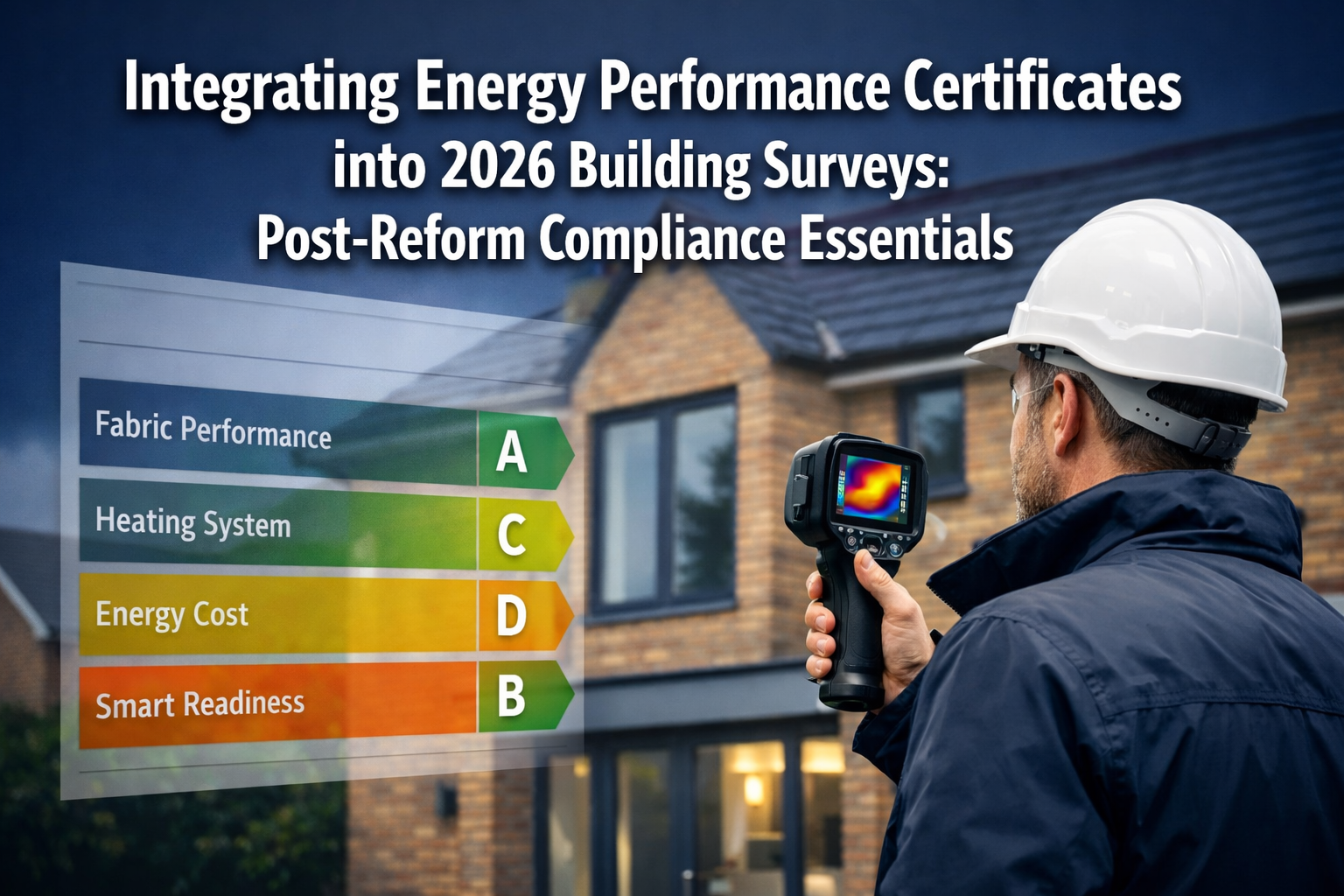

{"cover":"Professional landscape format (1536x1024) hero image featuring bold text overlay 'Integrating Energy Performance Certificates into 2026 Building Surveys: Post-Reform Compliance Essentials' in extra large 70pt white sans-serif font with dark shadow effect, positioned in upper third with perfect center alignment. Background shows modern UK property surveyor examining building exterior with thermal imaging camera, overlaid with semi-transparent EPC rating certificate showing new four-metric framework (Fabric Performance, Heating System, Energy Cost, Smart Readiness). Color scheme: deep navy blue, white, green energy efficiency accents. High contrast professional composition with rule of thirds layout, magazine cover quality, editorial style suitable for property professional publication in 2026.","content":["Detailed landscape format (1536x1024) infographic illustration showing the four new EPC metrics launching October 2026: Fabric Performance gauge with building envelope cross-section, Heating System efficiency chart with heat pump icon, Energy Cost calculator with pound sterling symbols, and Smart Readiness indicator with connected home technology symbols. Clean professional layout with color-coded sections in green, blue, orange, and purple. Include comparison panel showing old single-rating system versus new four-metric framework with A-G scale bands. Modern technical illustration style with clear typography, data visualization elements, and professional surveying aesthetic suitable for building industry professionals.","Comprehensive landscape format (1536x1024) visual diagram depicting building survey workflow integration process for 2026 EPC compliance. Show flowchart with key stages: property marketing trigger point, mandatory EPC provision, surveyor inspection with tablet device, Home Energy Model calculation methodology, four-metric assessment output, and retrofit recommendation pathway. Include visual representations of different property types (listed buildings, HMOs, short-term rentals) with checkmarks showing new compliance requirements. Professional color scheme with blue workflow arrows, green compliance indicators, and red non-compliance warnings. Clean infographic style with icons, text labels, and clear hierarchical information structure.","Detailed landscape format (1536x1024) comparative timeline visualization showing EPC compliance milestones from 2026 to 2030. Horizontal timeline with major markers: January 2026 partial government response, October 2026 four-metric framework launch, 2027-2029 transition period with legacy EER retention, October 2030 minimum C rating requirement for rental properties. Include visual elements like calendar icons, property silhouettes, energy rating badges transitioning from current system to new standards, and surveyor professional conducting assessments. Color-coded phases with green (current), amber (transition), blue (future compliance). Professional business infographic style with clear date markers, milestone descriptions, and regulatory impact indicators."]}
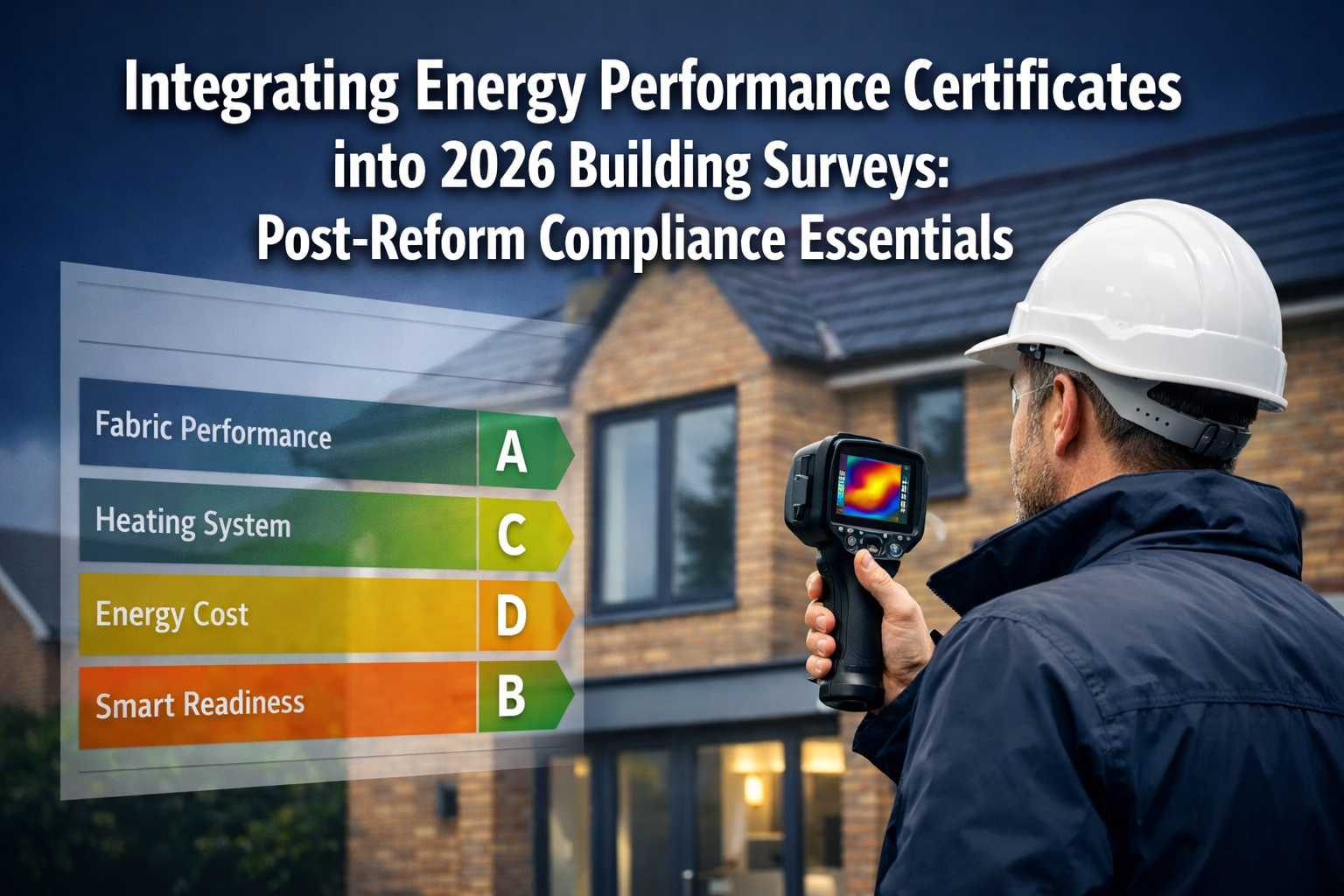
The landscape of property transactions in the United Kingdom is undergoing a fundamental transformation in 2026. With sweeping reforms to Energy Performance Certificates (EPCs) taking effect this October, building surveyors face unprecedented challenges in integrating energy performance assessments into their standard inspection protocols. These changes aren't merely administrative updates—they represent a paradigm shift in how property energy efficiency is measured, reported, and valued. For professionals conducting commercial building surveys or residential assessments, understanding the intricacies of integrating Energy Performance Certificates into 2026 building surveys: post-reform compliance essentials has become mission-critical.
The stakes are particularly high as proposed homebuying reforms advocate for mandatory upfront condition assessments, elevating EPCs from afterthought documents to central components of the property evaluation process. Surveyors who master the integration methods, anticipate common pitfalls, and accurately assess valuation impacts will position themselves as indispensable advisors in recovering property markets. 🏘️
Key Takeaways
- Four-metric framework replaces single ratings: October 2026 introduces separate assessments for Fabric Performance, Heating System, Energy Cost, and Smart Readiness, fundamentally changing how surveyors evaluate building energy efficiency
- Marketing trigger tightens compliance: Valid EPCs must now be available at the point of marketing rather than completion, requiring earlier coordination between surveyors and energy assessors
- Expanded property coverage eliminates exemptions: Listed buildings, HMOs, and short-term rentals now require EPCs, significantly broadening the surveyor's compliance responsibilities
- 2030 minimum C rating deadline approaches: The escalating MEES requirements to EPC C by October 2030 create urgent retrofit assessment opportunities for building surveyors
- Home Energy Model improves accuracy: The transition from SAP methodology promises more reliable performance predictions, requiring surveyors to understand new calculation frameworks
Understanding the 2026 EPC Reform Framework
The Four-Metric Revolution
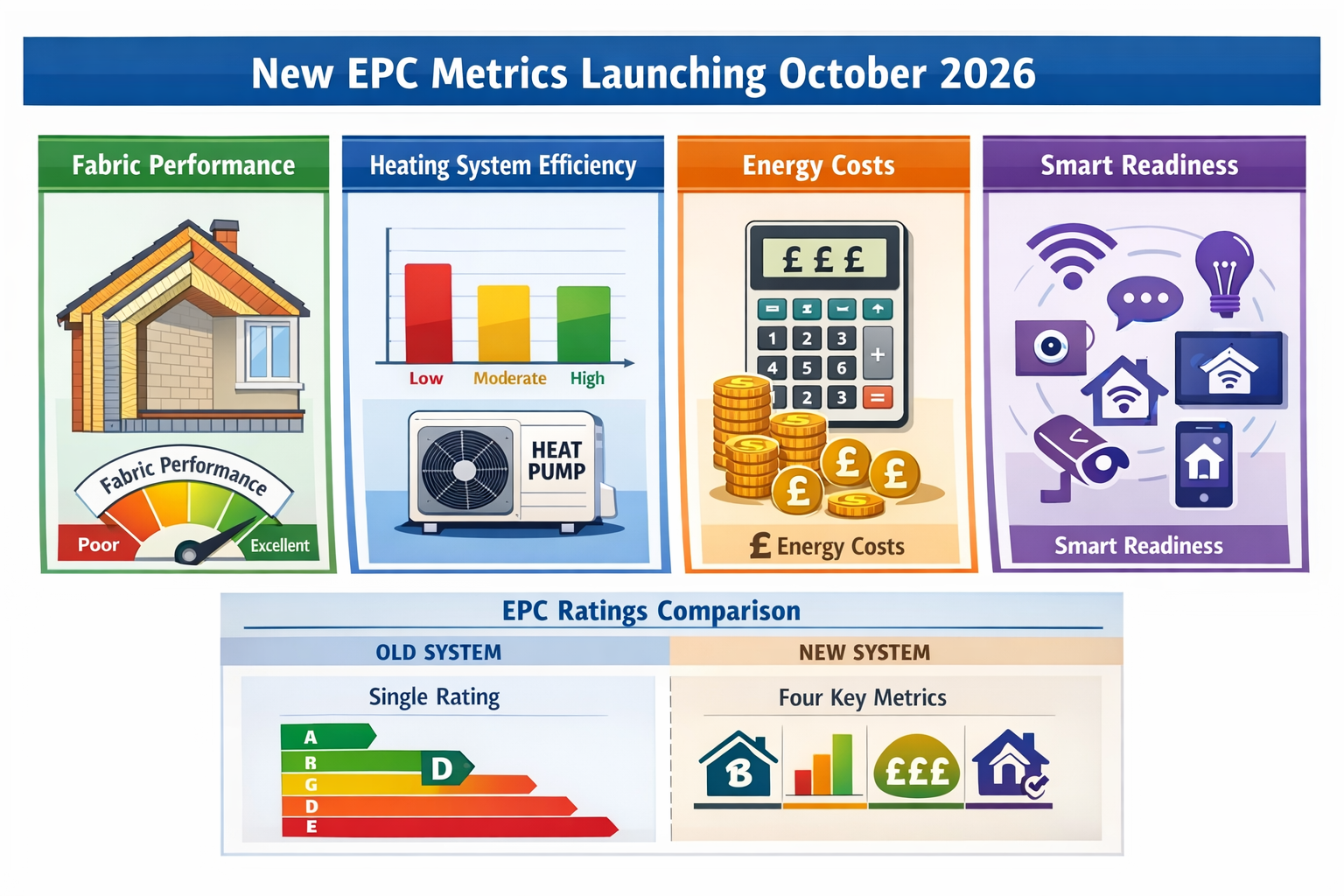
The most significant change in integrating Energy Performance Certificates into 2026 building surveys: post-reform compliance essentials is the replacement of the familiar single A-G rating with a four-metric assessment framework launching in October 2026. This transformation fundamentally alters how building surveyors must approach energy performance evaluation.[1]
The new framework comprises:
| Metric | Assessment Focus | Surveyor Implications |
|---|---|---|
| Fabric Performance | Building envelope efficiency, insulation quality, thermal bridging | Requires detailed inspection of walls, roofs, windows, and construction methods |
| Heating System | Heat source efficiency and carbon intensity | Demands technical knowledge of heating technologies, heat pumps, and renewable systems |
| Energy Cost | Estimated running costs for occupants | Necessitates understanding of tariff structures and consumption patterns |
| Smart Readiness | Capacity for smart meter integration and flexible tariffs | Involves assessment of building management systems and connectivity infrastructure |
This granular approach provides significantly more actionable information than the previous single rating. When conducting a structural survey, surveyors can now identify specific performance weaknesses—perhaps a property has excellent fabric performance but an outdated heating system—enabling targeted retrofit recommendations rather than generic improvement suggestions.
Home Energy Model Replaces SAP Methodology
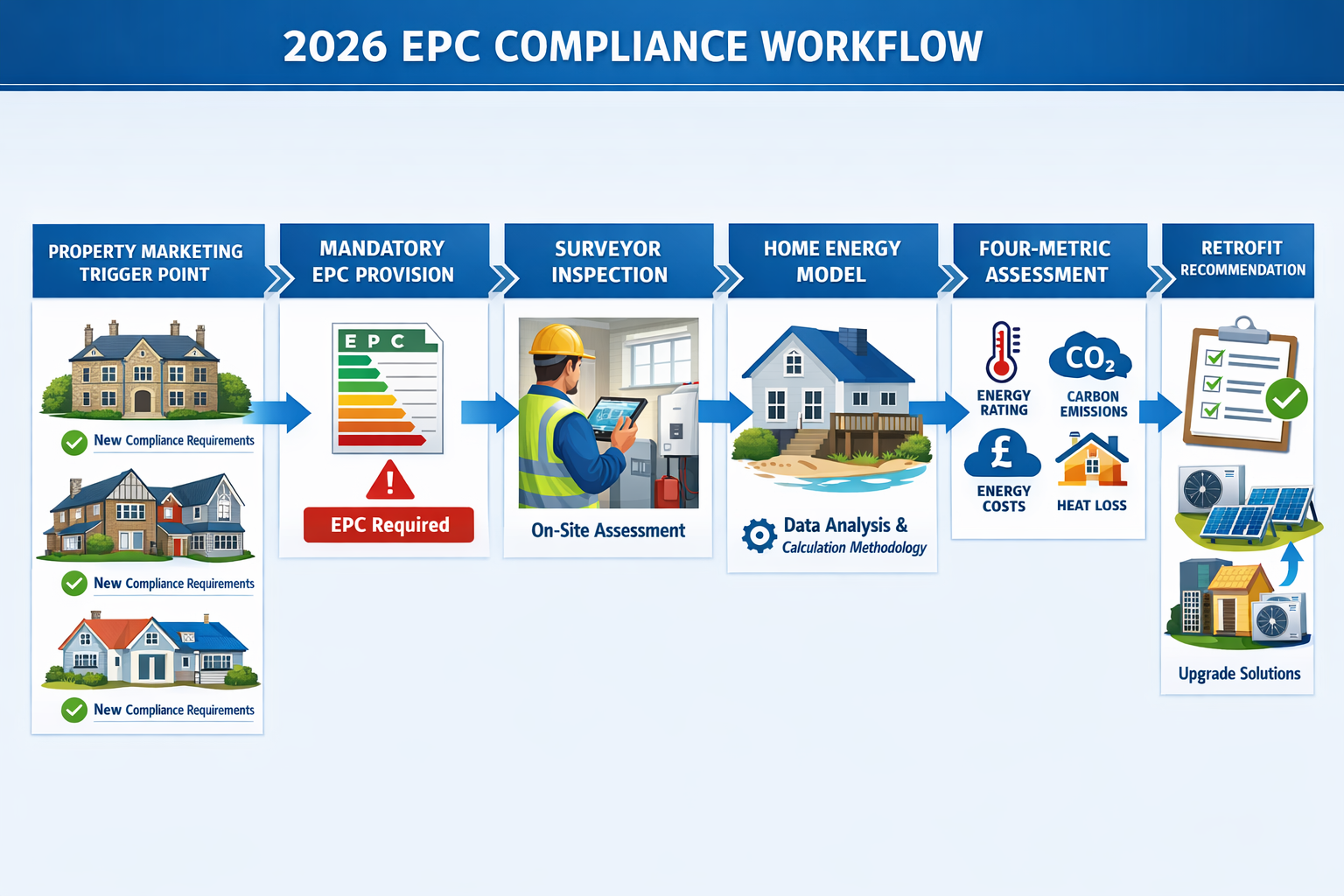
Underpinning these new metrics is a fundamental change in calculation methodology. The Standard Assessment Procedure (SAP) that has governed EPC calculations for years is being replaced by the Home Energy Model (HEM).[2] This transition promises improved accuracy and reliability in building performance measurements, but it also requires surveyors to familiarize themselves with new assessment protocols.
The Home Energy Model incorporates:
- More sophisticated thermal modeling capabilities
- Enhanced consideration of actual occupancy patterns
- Improved treatment of renewable energy technologies
- Better integration with smart home systems
For building surveyors, this means the data collected during site inspections will be processed through more nuanced algorithms. The measurements and observations recorded must be more precise, as the HEM is designed to catch discrepancies that the older SAP methodology might have overlooked.
Legacy EER Metric Temporary Retention
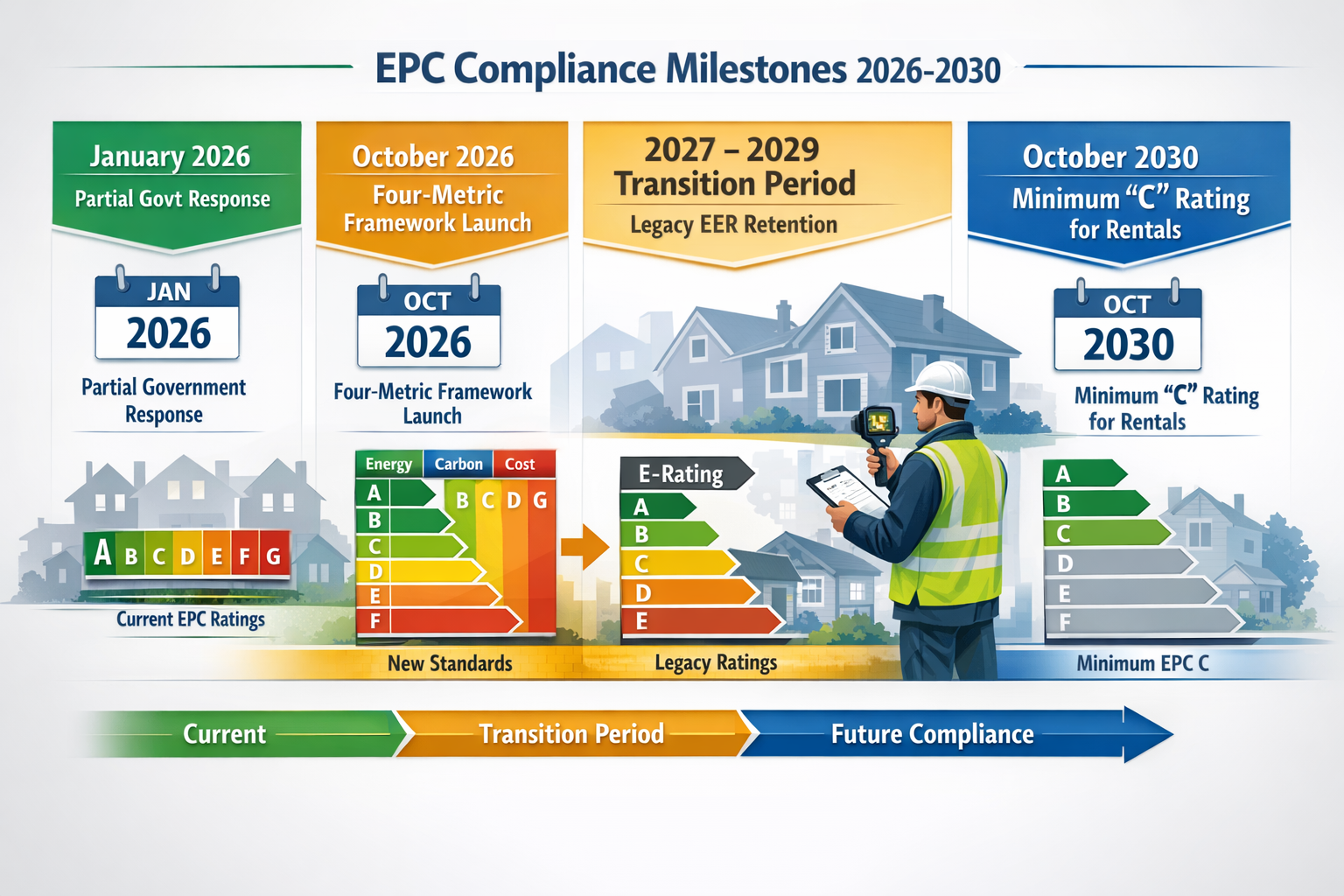
To facilitate the transition period, the government has wisely decided to temporarily retain the legacy Energy Efficiency Rating (EER) metric alongside the new four-metric framework.[3] This parallel system serves multiple purposes:
✅ Allows comparison with historical EPC data
✅ Supports existing regulatory compliance frameworks
✅ Provides continuity for mortgage lenders and valuers
✅ Enables gradual market adjustment to new metrics
When preparing reports for clients, surveyors should reference both the legacy rating and the new metrics, explaining how they relate and what each indicates about the property's performance. This dual-reporting approach will be particularly important for homebuyer reports where buyers may be comparing properties assessed under different systems.
Expanded Compliance Requirements and Trigger Points
Marketing Trigger Replaces Pre-Completion Requirement
One of the most consequential changes for building surveyors is the shift in EPC trigger points. Previously, EPCs were required before completion of a sale or letting. Under the 2026 reforms, a valid EPC must be available strictly at the point of marketing.[1][2]
This seemingly minor timing adjustment has major practical implications:
For Sellers and Landlords:
- EPCs must be commissioned earlier in the sales process
- Properties cannot be advertised without valid certificates
- Non-compliance results in immediate marketing prohibition
For Building Surveyors:
- Earlier coordination with energy assessors is essential
- Survey scheduling must account for EPC availability
- Recommendations may influence EPC commissioning decisions
When advising clients on what survey they need, surveyors should now routinely inquire about EPC status and recommend simultaneous commissioning of both assessments to streamline the transaction process.
Listed Buildings Lose Exemption Status
A particularly significant policy shift eliminates the previous exemption for heritage and listed buildings. Landlords and sellers of listed properties must now produce valid EPCs when properties are marketed, sold, or let.[1]
This change presents unique challenges for surveyors working with historic properties:
🏛️ Balancing preservation and performance: Retrofit recommendations must respect conservation requirements while improving energy efficiency
🏛️ Specialized assessment skills: Understanding traditional construction methods and appropriate intervention strategies becomes essential
🏛️ Coordination with conservation officers: Energy improvements may require listed building consent, adding complexity to the survey process
Surveyors conducting inspections of listed properties should work closely with energy assessors who have experience with traditional buildings and understand the limitations imposed by conservation requirements. The schedule of condition report becomes particularly important for documenting existing fabric before any energy efficiency interventions.
HMO Whole-Building Requirements
The 2026 reforms introduce stringent requirements for Houses in Multiple Occupation (HMOs). When any single room in an HMO is rented out, a valid EPC for the entire building becomes mandatory—not just for the individual unit.[1][3]
This whole-building approach creates several compliance considerations:
- Shared services assessment: Common heating systems, insulation, and building fabric must be evaluated comprehensively
- Multiple occupancy patterns: Energy consumption modeling becomes more complex with varied usage across units
- Landlord coordination: Building-wide improvements may require cooperation among multiple property owners in converted buildings
For surveyors inspecting HMO properties, understanding the building's overall energy performance becomes essential, not just the condition of individual units. Recommendations should address both unit-specific and building-wide improvements.
Short-Term and Holiday Lets Inclusion
Another expansion of EPC requirements brings short-term rental properties into the compliance framework. All short-term rental properties must now have valid EPCs regardless of whether guests are responsible for paying energy bills.[1]
This inclusion affects:
- Airbnb and holiday cottage operators: Properties previously exempt now require certification
- Seasonal rental markets: Even properties rented for limited periods annually must comply
- Investment property assessments: Surveyors evaluating short-term rental investments must factor in EPC compliance costs
The growing short-term rental market means surveyors will increasingly encounter these properties during inspections and should be prepared to advise clients on compliance requirements and potential improvement costs.
Integrating Energy Performance Certificates into 2026 Building Surveys: Practical Implementation Strategies
Pre-Survey Coordination and Planning
Successful integration of EPCs into building surveys requires strategic coordination before site visits. Surveyors should establish clear protocols:
1. Client Briefing Phase
- Confirm EPC status during initial engagement
- Explain the four-metric framework and its implications
- Discuss whether simultaneous EPC assessment is advisable
- Clarify roles and responsibilities between surveyor and energy assessor
2. Document Review
- Obtain and review any existing EPCs (valid for 10 years)[3]
- Identify known building characteristics affecting energy performance
- Research property history for previous improvements
- Check planning records for conservation constraints
3. Assessment Coordination
- Schedule survey to align with or follow EPC assessment when possible
- Establish communication channels with energy assessors
- Agree on data sharing protocols
- Coordinate access arrangements
This preparatory work ensures that the building survey and energy performance assessment complement rather than duplicate each other, providing clients with comprehensive property intelligence.
On-Site Assessment Integration
During the physical inspection, surveyors should systematically gather information relevant to the four new EPC metrics while conducting their standard condition assessment:
Fabric Performance Observations:
- Wall construction type and insulation indicators
- Window glazing specifications and condition
- Roof insulation presence and estimated thickness
- Thermal bridging at junctions and penetrations
- Air tightness indicators (gaps, cracks, ventilation systems)
- Damp issues affecting insulation performance
Heating System Documentation:
- Boiler type, age, and efficiency rating
- Heating controls sophistication
- Radiator or underfloor heating distribution
- Renewable technology presence (heat pumps, solar thermal)
- Fuel source and storage arrangements
Smart Readiness Indicators:
- Smart meter installation status
- Building management system presence
- Programmable thermostats and zoning controls
- Home automation integration potential
- Connectivity infrastructure
When conducting drone roof surveys, surveyors can capture valuable thermal imaging data that supports both structural assessment and energy performance evaluation, providing visual evidence of heat loss patterns and insulation deficiencies.
Reporting and Recommendations
The survey report should seamlessly integrate energy performance considerations with traditional condition assessments. Best practices include:
Structured Energy Performance Section:
- Summary of current EPC rating (if available) and four-metric scores
- Comparison with typical properties of similar age and type
- Identification of primary energy efficiency deficiencies
- Estimated improvement costs for each metric
Retrofit Recommendations Hierarchy:
| Priority Level | Intervention Type | Typical Impact | Cost Range |
|---|---|---|---|
| High Priority | Heating system upgrade, critical insulation gaps | Significant energy cost reduction, MEES compliance | £5,000-£15,000 |
| Medium Priority | Secondary glazing, loft insulation enhancement | Moderate performance improvement | £2,000-£8,000 |
| Low Priority | Smart controls, draught-proofing | Incremental efficiency gains | £500-£3,000 |
Valuation Impact Commentary:
- Effect of current EPC rating on marketability
- Potential value uplift from improvements
- MEES compliance timeline and implications
- Comparison with local market energy performance standards
This integrated approach transforms the building survey from a pure condition assessment into a strategic planning document that guides both immediate purchase decisions and long-term property improvement strategies.
Common Integration Pitfalls to Avoid
Even experienced surveyors face challenges when integrating Energy Performance Certificates into 2026 building surveys: post-reform compliance essentials. Awareness of common pitfalls helps prevent costly mistakes:
⚠️ Scope Confusion: Clearly delineate between the surveyor's structural/condition assessment and the energy assessor's EPC certification—avoid overstepping professional boundaries while ensuring complementary coverage
⚠️ Data Inconsistency: Ensure measurements and observations align with those recorded by energy assessors—discrepancies undermine credibility and confuse clients
⚠️ Retrofit Recommendations Without Context: Generic improvement suggestions ignore practical constraints like listed building status, budget limitations, or occupancy patterns—tailor advice to specific client circumstances
⚠️ Outdated Methodology References: Continuing to reference SAP calculations instead of the new Home Energy Model creates confusion—update professional knowledge and terminology
⚠️ Underestimating Compliance Timelines: Failing to emphasize the October 2030 MEES deadline for C-rated properties leaves clients unprepared for mandatory improvements—clearly communicate regulatory timelines
Working with residential structural engineers when complex retrofit interventions are contemplated ensures that energy efficiency improvements don't compromise structural integrity—a particularly important consideration in older properties.
Valuation Impacts and Market Dynamics in 2026
Energy Performance as a Value Driver
The reformed EPC framework significantly amplifies energy performance as a property value determinant. Research consistently demonstrates that properties with superior energy ratings command price premiums, while poor performers face discounts and extended marketing periods.
In the 2026 market context, several factors intensify this relationship:
📈 Rising Energy Costs: Continued volatility in energy markets makes running cost estimates (one of the four new metrics) increasingly relevant to buyers
📈 MEES Compliance Pressure: The approaching 2030 deadline for C-rated rental properties creates urgency for landlord investors
📈 Mortgage Lender Requirements: Growing numbers of lenders offer preferential rates for energy-efficient properties while scrutinizing poor performers
📈 Environmental Awareness: Buyer demographics increasingly prioritize sustainability and carbon footprint reduction
When preparing RICS valuations, surveyors must quantify these impacts with market-specific evidence. A property with a D rating in a market where most comparables achieve C or better faces measurable value suppression, while a B-rated property may justify a premium.
Retrofit Investment Analysis
A critical service surveyors can provide is retrofit investment analysis—helping clients understand whether energy efficiency improvements represent sound financial decisions. This analysis should consider:
Cost-Benefit Calculation:
- Upfront improvement costs
- Annual energy savings (using the new Energy Cost metric)
- Potential property value increase
- Payback period and return on investment
Regulatory Compliance Value:
- Avoiding MEES non-compliance penalties
- Maintaining rental property marketability
- Future-proofing against tightening standards
Practical Implementation Factors:
- Disruption during improvement works
- Alternative accommodation requirements
- Phasing options for budget management
- Grant and incentive availability
"The 2026 EPC reforms transform energy performance from a compliance checkbox into a strategic asset management consideration. Surveyors who help clients navigate this complexity add tremendous value beyond traditional condition reporting." — Industry Expert Commentary
For clients considering significant improvements, coordination with commercial property surveyors experienced in development and refurbishment projects ensures realistic cost estimates and practical implementation strategies.
Market Segmentation by Energy Performance
The reformed EPC framework is accelerating market segmentation based on energy performance. Properties increasingly fall into distinct categories:
Premium Segment (A-B Ratings):
- Modern construction or comprehensively retrofitted properties
- Renewable heating systems, superior insulation
- Smart home integration, low running costs
- Commands price premiums, shorter marketing periods
Mainstream Segment (C Rating):
- Meets current and 2030 MEES requirements
- Adequate energy performance for most buyers
- Moderate improvement potential
- Represents the compliance baseline for rental properties
Improvement Segment (D-E Ratings):
- Requires investment to meet future standards
- Attracts value-conscious buyers or investors
- Significant retrofit opportunities
- Price discounts reflect improvement costs
Distressed Segment (F-G Ratings):
- Non-compliant for rental purposes (current MEES)
- Substantial improvement costs required
- Limited buyer pool, extended marketing
- May face mortgage lending challenges
Surveyors should explicitly position properties within this segmentation framework, helping clients understand market positioning and competitive dynamics. This context makes energy performance data actionable rather than merely informational.
Preparing for the October 2026 Launch and Beyond
Industry Preparation Timeline
The government's partial response published in January 2026 provided crucial clarity on the reformed EPC framework, but additional guidance on outstanding technical questions—including Air Conditioning Inspection Reports and data management protocols—is expected throughout 2026.[1][5]
Key Milestones for Surveyors:
Q1-Q2 2026 (Current Period):
- ✓ Complete professional development on four-metric framework
- ✓ Update survey templates and reporting formats
- ✓ Establish relationships with qualified energy assessors
- ✓ Review client communication materials
Q3 2026 (Pre-Launch):
- ✓ Finalize integration protocols and workflows
- ✓ Train staff on Home Energy Model principles
- ✓ Develop retrofit recommendation frameworks
- ✓ Prepare for increased EPC-related inquiries
Q4 2026 (Post-Launch):
- ✓ Monitor implementation challenges and adjust processes
- ✓ Gather client feedback on integrated reporting
- ✓ Build case studies demonstrating value-added services
- ✓ Refine valuation impact methodologies
2027-2030 (Transition Period):
- ✓ Track market response to reformed EPCs
- ✓ Monitor MEES compliance preparations
- ✓ Develop expertise in complex retrofit assessments
- ✓ Position for 2030 C-rating deadline advisory services
This systematic preparation ensures surveyors are ready to provide authoritative guidance when the reforms take effect, rather than scrambling to understand new requirements while serving clients.
Professional Development Priorities
Mastering integrating Energy Performance Certificates into 2026 building surveys: post-reform compliance essentials requires targeted professional development:
Technical Knowledge:
- Home Energy Model calculation principles
- Four-metric framework interpretation
- Renewable heating technology assessment
- Smart home and building management systems
- Thermal imaging and energy assessment tools
Regulatory Understanding:
- MEES evolution and compliance timelines
- Listed building energy efficiency constraints
- HMO and short-term rental requirements
- EU Energy Performance of Buildings Directive implications[4]
Market Intelligence:
- Energy performance valuation impacts
- Retrofit cost benchmarking
- Financing and incentive programs
- Buyer and tenant preferences regarding energy efficiency
Communication Skills:
- Explaining complex energy data to lay clients
- Translating technical metrics into actionable recommendations
- Presenting cost-benefit analyses effectively
- Managing client expectations regarding improvement timelines
Many professional bodies and industry organizations offer specialized training programs addressing these competencies. Surveyors should prioritize continuing professional development that directly supports the reformed EPC integration requirements.
Technology and Tools Integration
Effective integration of energy performance assessment into building surveys increasingly relies on specialized technology and digital tools:
Mobile Data Capture:
- Tablet-based survey applications with EPC data fields
- Photograph annotation for energy-related observations
- Voice recording for detailed performance notes
- GPS tagging for renewable technology locations
Thermal Imaging:
- Infrared cameras identifying heat loss patterns
- Thermal bridging visualization
- Insulation deficiency detection
- Air leakage identification
Reporting Software:
- Templates incorporating four-metric framework
- Automated retrofit recommendation generators
- Cost-benefit calculation modules
- Comparative market analysis for energy ratings
Data Integration Platforms:
- EPC register connectivity for historical data
- Building information modeling (BIM) integration
- Energy modeling software compatibility
- Client portal access for ongoing performance monitoring
Investment in appropriate technology enhances both efficiency and quality of integrated assessments, positioning surveyors as modern, tech-enabled professionals rather than traditional clipboard-and-paper inspectors.
Conclusion: Positioning for Success in the Reformed EPC Landscape
The 2026 reforms to Energy Performance Certificates represent the most significant transformation in building energy assessment since the original EPC framework was introduced. For building surveyors, these changes are not merely regulatory compliance burdens—they represent tremendous opportunities to expand service offerings, demonstrate enhanced expertise, and provide greater value to clients navigating increasingly complex property markets.
Successfully integrating Energy Performance Certificates into 2026 building surveys: post-reform compliance essentials requires a multifaceted approach:
Strategic Integration: Embedding energy performance assessment throughout the survey process rather than treating it as a separate compliance requirement creates comprehensive property intelligence that informs better decisions.
Technical Competence: Understanding the four-metric framework, Home Energy Model methodology, and practical implications of different energy performance levels establishes professional authority and client confidence.
Market Awareness: Recognizing how energy ratings affect property values, marketability, and investment returns enables surveyors to provide strategic advisory services beyond traditional condition reporting.
Regulatory Foresight: Anticipating the October 2030 MEES deadline and helping clients prepare for escalating standards positions surveyors as forward-thinking advisors rather than reactive reporters.
Client Communication: Translating complex energy performance data into clear, actionable recommendations that align with client objectives and constraints demonstrates practical value and builds lasting relationships.
Actionable Next Steps
For building surveyors preparing to navigate the reformed EPC landscape, immediate actions include:
-
Audit Current Practices: Review existing survey processes to identify where energy performance considerations should be enhanced or integrated more systematically
-
Invest in Professional Development: Complete training on the four-metric framework, Home Energy Model, and retrofit assessment methodologies before the October 2026 launch
-
Establish Assessor Networks: Build relationships with qualified energy assessors to enable coordinated service delivery and knowledge sharing
-
Update Templates and Tools: Revise survey report formats, inspection checklists, and client communication materials to reflect the reformed EPC framework
-
Develop Retrofit Expertise: Build knowledge of improvement costs, implementation processes, and available financing to provide comprehensive client guidance
-
Monitor Market Dynamics: Track how energy performance affects property values and transaction timelines in your local markets to provide evidence-based advice
-
Communicate Value Proposition: Clearly articulate to clients how integrated energy performance assessment enhances the traditional building survey and supports better property decisions
The surveyors who embrace these reforms as opportunities rather than obstacles will distinguish themselves in competitive markets, build stronger client relationships, and contribute meaningfully to the UK's building stock energy efficiency improvement. The October 2026 launch is not the end of this transformation—it's the beginning of a new era in property assessment where energy performance stands alongside structural condition as a fundamental determinant of building quality and value.
By mastering the integration of energy performance certificates into building surveys, professionals position themselves at the forefront of an evolving industry, prepared to guide clients through both immediate compliance requirements and long-term strategic property decisions in an increasingly energy-conscious marketplace. 🏗️
References
[1] 2026 Epc Reform Technical Update – https://buildingenergyexperts.co.uk/resources/2026-epc-reform-technical-update/
[2] Epc Reform What We Know – https://energy-trust.co.uk/epc-reform-what-we-know/
[3] Government Reforms Energy Performance Buildings Regime And Raises Minimum Energy – https://www.osborneclarke.com/insights/government-reforms-energy-performance-buildings-regime-and-raises-minimum-energy
[4] Energy Performance Certificate New Calculation 2024 – https://www.engelvoelkers.com/de/en/commercial/insights/regional/hamburg/energy-performance-certificate-new-calculation-2024
[5] Reforms To The Energy Performance Of Buildings Regime Partial Government Response – https://www.gov.uk/government/consultations/reforms-to-the-energy-performance-of-buildings-regime/outcome/reforms-to-the-energy-performance-of-buildings-regime-partial-government-response