
The build-to-rent sector is experiencing unprecedented growth in 2026, creating a perfect storm of opportunity and complexity for property developers and surveyors alike. As institutional investors rush to meet housing demand before new legislation reshapes the market, party wall agreements have become critical compliance checkpoints that can make or break development timelines. Understanding Party Wall Agreements for Living Sector Developments: Surveyor Essentials in 2026's High-Demand Build-to-Rent Surge is no longer optional—it's essential for navigating today's competitive rental housing landscape.
With the Senate's 21st Century ROAD to Housing Act requiring large institutional investors to sell build-to-rent homes within seven years of ownership[2], developers are accelerating construction schedules while grappling with complex party wall requirements across multi-unit developments. This regulatory pressure, combined with persistent housing shortages, has elevated the role of surveyors from administrative facilitators to strategic advisors who can prevent costly delays and disputes.
Key Takeaways
- 🏗️ Build-to-rent developments require specialized party wall strategies due to multiple adjoining properties and institutional ownership structures
- ⏰ Timing is critical: Standard party wall works require 2-month notice periods, while excavation work needs 1-month notice[1]
- 📋 Schedule of condition documentation is mandatory and protects both developers and neighboring property owners from liability disputes
- 💼 Institutional investors face new constraints with the 7-year ownership requirement affecting long-term build-to-rent strategies[2]
- 🎯 Surveyor expertise in multi-unit party wall coordination has become a competitive advantage in 2026's accelerated development environment
Understanding Party Wall Agreements for Living Sector Developments in 2026
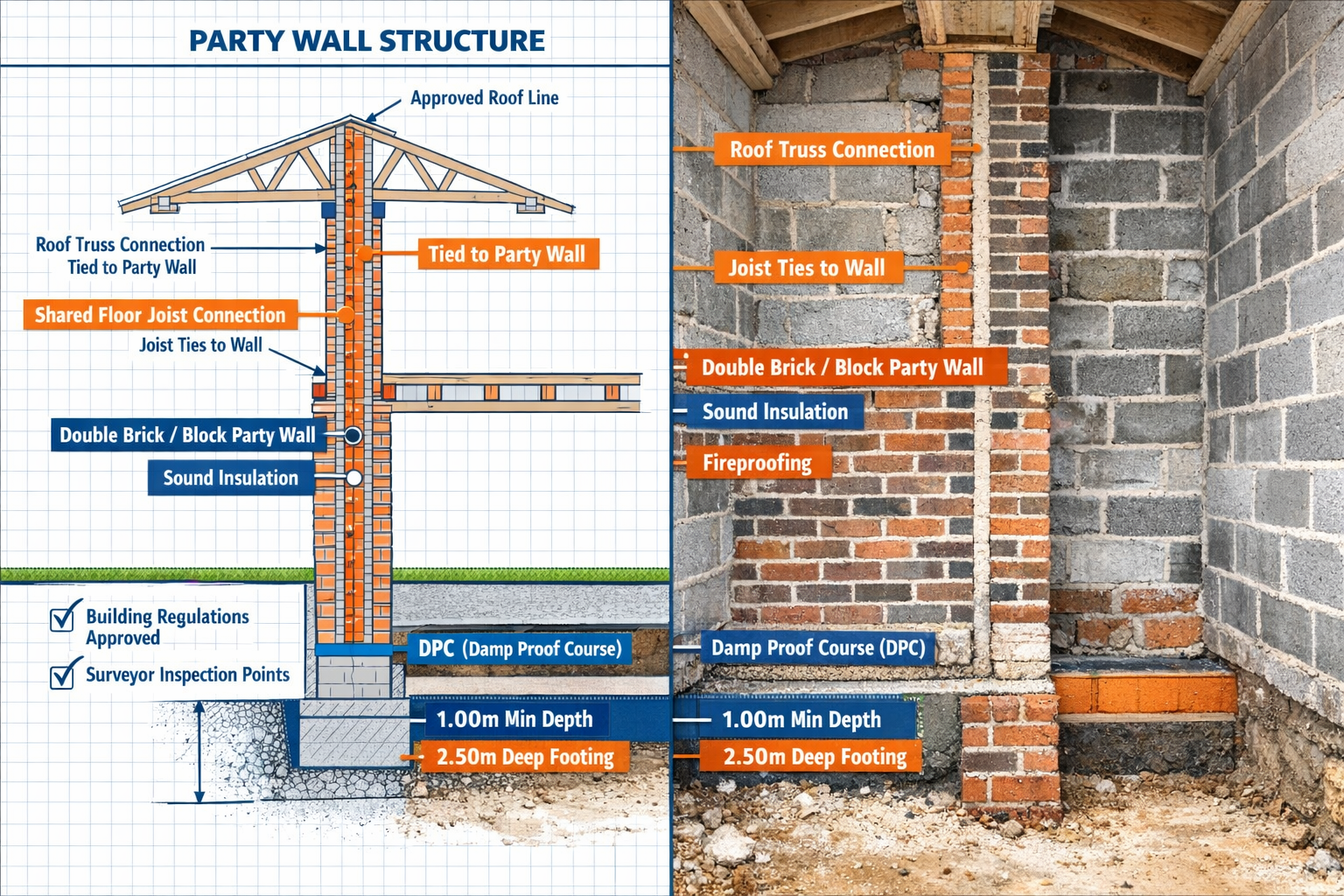
What Makes Build-to-Rent Party Wall Agreements Different?
Build-to-rent developments present unique challenges that distinguish them from traditional residential party wall scenarios. Unlike single-family home extensions or loft conversions, purpose-built rental housing typically involves:
- Multiple simultaneous party walls across connected townhouses or apartment blocks
- Institutional ownership structures rather than individual homeowners
- Accelerated construction timelines driven by investor return expectations
- Higher density configurations with shared walls on multiple sides
These factors require surveyors to adopt a more strategic, project-management approach to party wall matters rather than treating each wall as an isolated agreement.
The Legislative Landscape Reshaping Development Strategies
The 21st Century ROAD to Housing Act, which passed Senate cloture 89-9 on March 11, 2026, has fundamentally altered institutional investment strategies in the living sector. The legislation defines large investors as entities owning at least 350 single-family homes and mandates divestment within seven years[2][3].
This regulatory shift has created urgency among developers to:
✅ Maximize construction efficiency to achieve rental income before mandatory sale periods
✅ Streamline compliance processes including party wall agreements
✅ Build portfolio value quickly through rapid, high-quality development
✅ Minimize construction delays that could compress profitable rental periods
For surveyors, this means clients are increasingly intolerant of preventable delays caused by party wall complications. The party wall agreed surveyor role has evolved from neutral facilitator to efficiency optimizer.
Common Party Wall Triggers in Build-to-Rent Projects
Build-to-rent developments typically trigger party wall requirements through several construction activities:
| Construction Activity | Party Wall Act Section | Notice Period | Common in BTR? |
|---|---|---|---|
| New walls on boundary lines | Section 1 | 2 months | ✅ Very Common |
| Work to existing party walls | Section 2 | 2 months | ✅ Very Common |
| Excavation within 3-6 metres | Section 6 | 1 month | ✅ Very Common |
| Foundation work for extensions | Section 2 & 6 | 1-2 months | ⚠️ Moderate |
| Damp proof course installation | Section 2 | 2 months | ⚠️ Moderate |
| Loft conversions (multi-unit) | Section 2 | 2 months | ❌ Less Common |
Understanding the Party Wall Act 3 metre rule is particularly crucial for build-to-rent projects, where excavation work often affects multiple neighboring properties simultaneously.
The Critical Role of Schedule of Condition Reports
Every party wall agreement must include a schedule of condition documenting the pre-work state of adjoining properties[1]. For build-to-rent developments, this documentation serves multiple purposes:
📸 Photographic evidence of existing conditions across multiple units
📝 Detailed written descriptions of structural elements, finishes, and defects
🛡️ Legal protection for developers against unfounded damage claims
💰 Insurance documentation supporting coverage claims if damage occurs
Professional surveyors understand that comprehensive party wall schedule of condition reports are investment protection tools, not administrative burdens. In multi-unit developments, these reports can prevent disputes that might otherwise halt construction across entire phases.
Surveyor Essentials: Navigating Complex Multi-Unit Agreements

Strategic Notice Timing for Development Phases
The standard 2-month notice period for party wall works and 1-month for excavation work[1] can create significant timeline challenges when multiplied across dozens or hundreds of units. Expert surveyors employ phased notification strategies:
Phase 1: Pre-Development Mapping (Months 1-2)
- Identify all party wall interfaces across the development
- Map ownership structures of adjoining properties
- Assess potential dispute risks based on property conditions
- Prepare standardized party wall notice templates
Phase 2: Coordinated Notification (Months 3-4)
- Issue notices in strategic sequence aligned with construction phases
- Coordinate with multiple adjoining owners simultaneously
- Track response deadlines across all notices
- Engage agreed surveyors early for complex scenarios
Phase 3: Documentation and Agreement (Months 5-6)
- Complete schedule of condition surveys before construction begins
- Finalize party wall awards with protective provisions
- Establish monitoring protocols for ongoing construction
- Set up communication channels for damage to property concerns
This systematic approach prevents the common mistake of sequential processing that can add months to development timelines.
Managing Institutional Client Expectations
Institutional investors entering the build-to-rent market often lack experience with UK party wall legislation. Surveyors must educate clients on:
💡 Non-negotiable legal requirements that cannot be bypassed regardless of budget
💡 Realistic timeline expectations incorporating notice periods and potential disputes
💡 Cost implications including party wall surveyor costs across multiple units
💡 Risk mitigation strategies that protect investment value
Experienced surveyors position party wall compliance as risk management rather than regulatory overhead. When developers understand that proper party wall procedures prevent construction stoppages and litigation, they typically allocate appropriate resources.
Handling Multi-Party Disputes in High-Density Developments
Party wall disputes become exponentially more complex when multiple adjoining owners are involved. Common dispute triggers in build-to-rent projects include:
⚠️ Noise and vibration concerns during construction
⚠️ Access requirements for survey and monitoring
⚠️ Structural integrity fears from neighboring property owners
⚠️ Property value impact perceptions
Effective dispute resolution requires:
- Proactive communication: Regular updates to all affected parties before issues escalate
- Technical expertise: Clear explanations of construction methods and safety measures
- Independent verification: Third-party monitoring when trust is lacking
- Documented procedures: Written protocols for addressing concerns promptly
Surveyors who excel at boundary dispute resolution understand that preventing disputes is more valuable than resolving them.
Technology Integration for Large-Scale Projects
Modern build-to-rent developments demand technological sophistication in party wall management:
Digital Documentation Systems
- Cloud-based schedule of condition databases
- Photographic evidence with GPS tagging and timestamps
- Version-controlled party wall awards and amendments
- Automated notice tracking and deadline management
Communication Platforms
- Stakeholder portals for real-time updates
- Digital consent and approval workflows
- Automated notification systems for milestone events
- Issue tracking and resolution documentation
Monitoring Technologies
- Vibration sensors for real-time construction impact assessment
- Structural movement monitoring equipment
- Photographic comparison tools for damage assessment
- Digital inspection reports with annotated imagery
Surveyors who leverage these technologies deliver faster, more transparent, and better-documented party wall services that align with institutional client expectations.
Cost Management Across Portfolio Developments
Understanding and communicating party wall costs is essential for build-to-rent feasibility. Typical cost components include:
| Cost Category | Single Unit | 10-Unit Development | 50-Unit Development |
|---|---|---|---|
| Surveyor fees | £700-£1,500 | £5,000-£10,000 | £20,000-£40,000 |
| Schedule of condition | £300-£600 | £2,500-£5,000 | £10,000-£20,000 |
| Monitoring visits | £200-£400 each | £1,500-£3,000 | £6,000-£12,000 |
| Dispute resolution | £1,000-£5,000+ | £8,000-£30,000+ | £30,000-£100,000+ |
These figures demonstrate why dispute prevention through expert surveyor engagement is cost-effective compared to reactive problem-solving.
Obtaining Party Wall Consent in Complex Scenarios
Party wall consent becomes more challenging when dealing with:
- Absentee landlords of adjoining properties
- Multiple freeholders in mixed-use developments
- Commercial tenants with different concerns than residential owners
- Historic properties requiring special consideration
Successful surveyors maintain databases of local property ownership patterns and establish relationships with property management companies serving the area. This network approach accelerates the consent process across multiple properties.
Future-Proofing Party Wall Practices for 2026 and Beyond

Adapting to Evolving Build-to-Rent Market Dynamics
The 7-year ownership requirement is reshaping how institutional investors approach build-to-rent portfolios[2][3]. Surveyors must anticipate:
📊 Increased development velocity as investors maximize rental periods
📊 Higher quality standards to support premium valuations at mandatory sale
📊 Portfolio-wide compliance systems replacing property-by-property approaches
📊 Exit strategy considerations influencing construction decisions
This environment rewards surveyors who think strategically about how party wall decisions today affect property marketability five to seven years forward.
Sustainability and Party Wall Considerations
Modern build-to-rent developments increasingly incorporate sustainability features that intersect with party wall requirements:
🌱 Enhanced insulation requiring party wall modifications
🌱 Renewable energy systems with structural implications
🌱 Water efficiency measures affecting drainage and foundations
🌱 Acoustic performance exceeding minimum standards
Surveyors knowledgeable about sustainable construction methods can guide developers through party wall implications of green building features, ensuring compliance while supporting environmental objectives.
Professional Development for Surveyors
The specialized demands of Party Wall Agreements for Living Sector Developments: Surveyor Essentials in 2026's High-Demand Build-to-Rent Surge require continuous learning:
✏️ Legislative updates as housing policy continues evolving
✏️ Construction technology understanding for modern building methods
✏️ Project management skills for multi-unit coordination
✏️ Client relationship management for institutional investors
✏️ Dispute resolution techniques specific to high-density developments
Surveyors who invest in these competencies position themselves as indispensable partners in build-to-rent development success.
Regional Considerations and Market Variations
Party wall requirements remain consistent under the Act, but market dynamics vary significantly:
Urban Core Markets (London, Manchester, Birmingham)
- Higher density developments with complex party wall scenarios
- More experienced institutional investors
- Competitive surveyor markets with specialized expertise
- Higher property values increasing dispute stakes
Emerging Build-to-Rent Markets (Regional cities)
- Growing institutional interest but less local expertise
- Opportunities for surveyors to establish market leadership
- Educational role with less experienced developers
- Lower property values but higher volume opportunities
Understanding these regional dynamics helps surveyors tailor their services and communication approaches effectively.
Building Long-Term Client Relationships
Institutional build-to-rent investors typically develop multiple projects over time. Surveyors who deliver exceptional service on initial projects position themselves for ongoing relationships:
🤝 Consistent quality across all engagements
🤝 Proactive problem identification before issues escalate
🤝 Clear communication in language clients understand
🤝 Value demonstration through time and cost savings
🤝 Strategic advice beyond minimum compliance requirements
These relationships create stable revenue streams and professional satisfaction as surveyors become trusted advisors rather than transactional service providers.
Conclusion
Party Wall Agreements for Living Sector Developments: Surveyor Essentials in 2026's High-Demand Build-to-Rent Surge represents both a challenge and an opportunity for property professionals. The convergence of legislative pressure from the 21st Century ROAD to Housing Act, persistent housing shortages, and institutional investment acceleration has created an environment where expert party wall management is a competitive differentiator.
Surveyors who master the specialized requirements of multi-unit developments—from strategic notice timing and comprehensive schedule of condition documentation to technology-enabled project coordination—deliver measurable value to clients racing to maximize returns within new regulatory constraints. The 2-month notice period for standard works and 1-month for excavation work[1] may seem straightforward for single properties, but multiplying these requirements across dozens of units while maintaining construction momentum demands sophisticated project management skills.
The 7-year ownership requirement for large institutional investors[2][3] has fundamentally altered development economics, making every month of construction delay increasingly costly. Surveyors who prevent party wall disputes through proactive communication, thorough documentation, and strategic planning protect their clients' investment timelines and profitability.
Next Steps for Property Professionals
For Surveyors:
- Invest in technology systems that scale party wall management across large developments
- Develop institutional client communication skills and project management capabilities
- Build regional networks to accelerate consent processes
- Stay current on evolving build-to-rent legislation and market dynamics
For Developers:
- Engage experienced party wall surveyors during project planning phases, not after construction begins
- Budget appropriately for comprehensive party wall services across entire developments
- Recognize party wall compliance as risk management that protects investment value
- Establish systematic approaches to multi-unit party wall coordination
For Institutional Investors:
- Incorporate party wall timeline requirements into development feasibility analyses
- Select development partners with proven party wall management capabilities
- Understand that compliance shortcuts create risks far exceeding cost savings
- Build relationships with chartered surveyors who understand institutional investment objectives
The build-to-rent surge of 2026 has elevated party wall agreements from administrative formalities to strategic project components. Professionals who recognize this shift and adapt their practices accordingly will thrive in this dynamic, high-stakes market environment.
References
[1] Party Wall Agreement – https://hoa.org.uk/advice/guides-for-homeowners/i-am-improving/party-wall-agreement/
[2] Housing Bill Force Sales Of Build For Rent Homes – https://www.realtor.com/news/real-estate-news/housing-bill-force-sales-of-build-for-rent-homes/
[3] Limits On Build For Rent Homes In Housing Bill Draws Industry Pushback 21st Century Road To Housing Act Institutional Investors Housing Supply Home Affordability – https://news3lv.com/news/nation-world/limits-on-build-for-rent-homes-in-housing-bill-draws-industry-pushback-21st-century-road-to-housing-act-institutional-investors-housing-supply-home-affordability