
The landscape of urban development transformed dramatically on March 5, 2026, when sweeping changes to permitted development rights removed longstanding barriers to office-to-residential conversions. For property investors, developers, and surveyors, these reforms represent both unprecedented opportunity and complex valuation challenges. Understanding how to accurately assess Valuing Office-to-Residential Conversions Post-2026 Planning Reforms: Surveyor Risk Assessments for Permitted Development has become essential as commercial property owners rush to capitalize on relaxed regulations while occupiers increasingly concentrate in core urban locations.
The removal of the 1,500 square meter floor space cap and vacancy requirements has unlocked previously ineligible buildings across the UK, but successful conversions demand rigorous surveyor assessments that account for structural feasibility, regulatory compliance, and market positioning. As the commercial property market continues its post-pandemic evolution, chartered surveyors must navigate an intricate web of building safety regulations, local authority considerations, and valuation methodologies to accurately price these conversion opportunities.
Key Takeaways
- Expanded Eligibility: The March 2026 reforms eliminated the 1,500 sqm cap and vacancy requirements, allowing commercial buildings of any size to convert to residential use under Class MA permitted development rights [1]
- Enhanced Due Diligence: Surveyors must conduct comprehensive structural assessments, regulatory compliance checks, and market analysis to accurately value conversion opportunities and identify hidden risks
- Regulatory Complexity: Buildings over 18 meters or 7 storeys face extended Building Safety Regulator approval timelines (potentially 40+ weeks), significantly impacting project feasibility and valuation [3]
- Location-Dependent Value: Conversion viability varies dramatically based on local Article 4 Directions, protected land designations, and occupier demand shifts toward core urban locations
- Risk-Adjusted Valuations: Professional surveyor assessments must factor in compliance costs, approval delays, structural modification expenses, and residual value calculations to determine true conversion potential
Understanding the 2026 Planning Reform Landscape
The planning reforms implemented in March 2026 fundamentally altered the economic calculus for office-to-residential conversions across England. These changes represent the most significant expansion of permitted development rights since their introduction, creating new opportunities for asset repositioning while introducing complex valuation considerations.
Key Regulatory Changes Under Class MA
The cornerstone of the 2026 reforms centers on Class MA permitted development rights, which now allow conversions without full planning permission. The removal of the 1,500 square meter floor space limitation means that large office blocks, corporate headquarters, and multi-story commercial buildings previously excluded from permitted development can now proceed through the streamlined prior approval process [1].
Equally significant, the elimination of vacancy requirements allows property owners to obtain prior approval before buildings become vacant, reducing holding costs and enabling more strategic asset management decisions. This change addresses a critical pain point where developers previously faced extended periods of lost rental income while waiting to satisfy vacancy conditions.
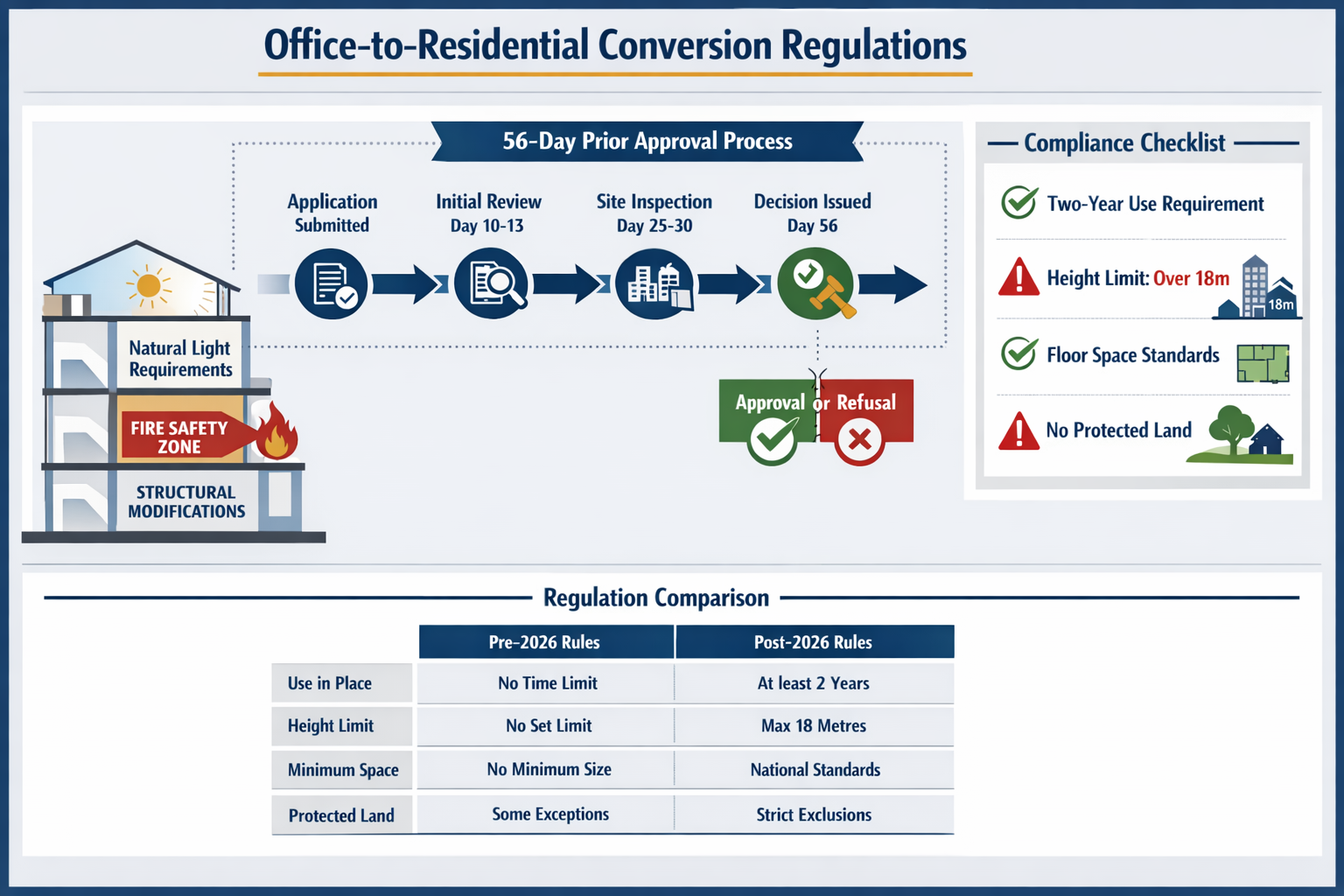
However, buildings must still demonstrate two years of continuous Class E use (including former B1(a) office designation) to qualify for conversion rights [3]. This requirement prevents speculative land banking and ensures conversions target genuinely redundant commercial space rather than artificially created opportunities.
Prior Approval Process and Timeline
Unlike full planning applications, the prior approval route operates on a 56-day determination timeline with specific assessment criteria. Local planning authorities evaluate applications based on:
- 🏗️ Transport and highways impact
- 🧪 Contamination risks and remediation needs
- 💧 Flood risk assessment
- 🔊 Noise impacts on future residents
- ☀️ Natural light provision in habitable rooms
Importantly, if these conditions are satisfied, councils must grant approval – this is not a discretionary policy balancing exercise like traditional planning permission [3]. This quasi-automatic approval mechanism provides greater certainty for developers and investors, though it shifts risk assessment responsibility heavily onto professional surveyors during pre-acquisition due diligence.
Chartered surveyors across London have reported increased demand for pre-application technical assessments as clients seek to de-risk investments before committing capital.
Protected Areas and Exclusions
Not all locations qualify for Class MA conversions. Protected designations that exclude permitted development rights include:
| Protected Designation | Conversion Eligibility | Additional Considerations |
|---|---|---|
| National Parks | ❌ Excluded | Full planning required |
| Areas of Outstanding Natural Beauty (AONB) | ❌ Excluded | Full planning required |
| World Heritage Sites | ❌ Excluded | Heritage assessment mandatory |
| Listed Buildings | ❌ Excluded | Listed building consent required |
| Conservation Areas | ⚠️ Restricted | Enhanced natural light and character scrutiny [3] |
| Scheduled Monuments | ❌ Excluded | Archaeological considerations |
Additionally, local authorities retain power to implement Article 4 Directions that remove Class MA rights entirely within specific areas, typically where councils wish to protect employment land or maintain commercial vitality in town centers [3]. Surveyors must verify the absence of Article 4 restrictions during initial feasibility assessments, as these can completely eliminate the permitted development route.
Professional surveyors in areas like Camden and Central London frequently encounter these restrictions in employment protection zones.
Surveyor Risk Assessments for Valuing Office-to-Residential Conversions Post-2026 Planning Reforms

Accurate valuation of conversion opportunities requires surveyors to conduct multi-layered risk assessments that extend far beyond traditional commercial property appraisals. The 2026 reforms have created a complex landscape where regulatory compliance, structural feasibility, and market positioning intersect to determine true asset value.
Structural and Technical Feasibility Analysis
The foundation of any conversion valuation begins with a comprehensive structural survey that identifies both obvious defects and latent conditions that could derail projects or inflate costs. Key assessment areas include:
Building Envelope and Services: Office buildings typically feature deep floor plates optimized for open-plan layouts, which create challenges for residential conversion where Building Regulations require natural light in habitable rooms. Surveyors must evaluate whether existing window configurations can serve residential units or whether costly facade modifications are necessary [3].
Structural Capacity: Converting office loading (typically 2.5-4.0 kN/m²) to residential use (1.5 kN/m²) generally reduces structural demands, but adding kitchens, bathrooms, and partition walls in new locations may require localized strengthening. Structural surveys must identify any existing defects, subsidence, or structural movement that could complicate conversion work.
Building Services Infrastructure: Office buildings designed for daytime occupancy require significant mechanical and electrical upgrades to support 24/7 residential use. Surveyors should assess:
- Heating and hot water capacity for individual units
- Electrical distribution and meter infrastructure
- Water pressure and supply capacity
- Drainage and sewage systems
- Ventilation and air quality systems
- Telecommunications and broadband infrastructure
Fire Safety and Means of Escape: Residential fire safety requirements differ substantially from commercial standards. Conversions must provide compliant escape routes, fire-resistant compartmentation, and detection/alarm systems appropriate for sleeping accommodation. These modifications can represent 15-25% of total conversion costs in complex buildings.
Building Safety Regime Compliance for Taller Buildings
A critical risk factor that many preliminary valuations overlook involves the Higher-Risk Building Regime introduced under the Building Safety Act. Buildings meeting specific criteria face substantially extended approval timelines and enhanced regulatory scrutiny:
Higher-Risk Building Thresholds:
- 18 meters or more in height, OR
- 7 storeys or more, AND
- Contains at least two residential units
Buildings meeting these criteria must obtain Building Safety Regulator approval before construction commences and cannot be occupied until completion gateway sign-off is secured [3]. While official targets suggest 8-12 week determination periods, parliamentary scrutiny has revealed that many applicants face waits exceeding 40 weeks for decisions [3].
"The Building Safety Regulator approval process has become a critical path item that can add 6-12 months to conversion timelines for taller buildings, fundamentally altering project viability and financing costs." – Building Safety Parliamentary Review
This extended timeline creates significant holding cost implications that surveyors must factor into residual valuations. A project delayed by 40 weeks incurs additional:
- Finance costs on acquisition debt
- Extended professional team fees
- Opportunity costs on capital deployment
- Market risk exposure to price fluctuations
For buildings in locations like Hammersmith or Guildford, where taller office blocks are common, this regulatory pathway requires careful modeling in feasibility studies.
Building Regulations Compliance Assessment
Beyond the prior approval process, all conversions must achieve full Building Regulations compliance across multiple technical areas [4]:
Part B (Fire Safety): Adequate means of escape, fire-resistant construction, and detection systems appropriate for residential use.
Part C (Site Preparation and Resistance to Contaminants): Ground contamination assessment and remediation where necessary, particularly for buildings on former industrial sites.
Part E (Resistance to Sound): Acoustic separation between units and from external noise sources to meet residential standards.
Part F (Ventilation): Adequate ventilation for habitable rooms, kitchens, and bathrooms, often requiring new mechanical ventilation systems.
Part L (Conservation of Fuel and Power): Energy efficiency standards including insulation upgrades, efficient heating systems, and renewable energy considerations.
Part M (Access and Use): Accessibility requirements including wheelchair-accessible units (typically 10% of total units in larger developments).
Surveyors conducting building survey services must identify compliance gaps early in the valuation process, as remediation costs can vary dramatically based on existing building conditions.
Local Authority and Article 4 Direction Risk
Even with national permitted development rights in place, local authorities retain mechanisms to restrict conversions. Surveyors must investigate:
Article 4 Direction Mapping: Comprehensive review of local authority Article 4 Directions that may remove Class MA rights entirely in specific areas. These are typically implemented to protect employment land in strategic locations [3].
Employment Land Protection Policies: Some authorities restrict conversions where areas are designated for industrial or employment uses, requiring demonstration that conversion won't harm employment objectives [3].
Special Use Considerations: Additional tests apply if conversion would result in loss of nursery or health centre facilities, requiring alternative provision or justification [3].
Conservation Area Restrictions: While not entirely excluded, conservation area conversions face enhanced scrutiny on natural light adequacy and impact on area character, potentially leading to prior approval refusals [3].
Professional surveyors in areas like Richmond and Hampstead frequently navigate conservation area considerations that affect conversion feasibility.
Valuation Methodologies for Office-to-Residential Conversions Post-2026 Planning Reforms
Determining accurate market value for conversion opportunities requires surveyors to employ specialized valuation approaches that account for transformation costs, regulatory risks, and market positioning. The 2026 reforms have created a dynamic environment where traditional valuation methods require significant adaptation.
Residual Valuation Method
The residual method remains the primary approach for conversion opportunity valuation, calculating the maximum price a developer can pay for an asset while achieving target profit margins. The formula works backwards from completed residential value:
Residual Land Value = Gross Development Value – (Construction Costs + Professional Fees + Finance Costs + Contingency + Developer's Profit)
For office-to-residential conversions, this calculation requires careful consideration of:
Gross Development Value (GDV): The completed value of residential units based on comparable sales evidence for similar converted properties in the local market. Surveyors must adjust comparables for:
- Unit size and configuration
- Natural light quality and aspect
- Building amenities and common areas
- Parking provision
- Location and accessibility
- Building heritage and character features
Construction Costs: Conversion costs typically range from £1,200-£2,500 per square meter depending on building condition and specification level, though complex projects with significant structural work or facade modifications can exceed £3,000 per square meter. Detailed cost planning should include:
- Structural modifications and reinforcement
- New building services installation
- Fire safety and compartmentation works
- External envelope repairs and upgrades
- Internal fit-out and finishes
- Accessibility modifications
- External works and landscaping
Professional Fees: Typically 10-15% of construction costs, covering architects, structural engineers, M&E consultants, planning consultants, and project management.
Finance Costs: Interest on acquisition debt and development finance throughout the project period, typically 18-30 months for conversions (extending to 36+ months for higher-risk buildings requiring Building Safety Regulator approval).
Contingency: 10-15% of construction costs to account for unforeseen conditions, particularly important in older buildings where hidden defects may emerge during works.
Developer's Profit: Target returns of 15-20% on GDV for conversion projects, with higher margins required for projects with elevated regulatory or market risk.
Comparative Method Adjustments
Where conversion precedents exist in the local market, surveyors can employ the comparative method with appropriate adjustments. This approach analyzes recent sales of similar converted properties to establish market value, adjusting for:
Conversion Complexity: Buildings requiring minimal structural intervention command premiums over those needing extensive modifications.
Regulatory Pathway: Properties that successfully navigated prior approval without complications achieve higher values than those with protracted approval histories or building safety delays.
Location Premium: Conversions in core urban locations with strong occupier demand (particularly areas benefiting from post-pandemic occupier concentration) achieve higher per-unit values than peripheral locations.
Building Character: Conversions that retain attractive period features or architectural interest command premiums over generic office blocks.
Surveyors operating in markets like South East London or West London can often identify relevant conversion comparables to inform valuations.
Investment Method for Phased Conversions
For larger buildings where phased conversion and occupation is planned, the investment method may be appropriate, capitalizing projected rental income streams at appropriate yields. This approach considers:
Rental Value Assessment: Market rents for converted residential units based on local demand, typically requiring research into:
- Build-to-rent comparable evidence
- Purpose-built apartment rental levels
- Tenant preferences and amenity expectations
- Parking and storage premiums
Yield Analysis: Appropriate capitalization rates for converted residential investment property, typically 4.5-6.5% depending on location, building quality, and tenant covenant strength.
Void Periods: Anticipated letting periods between unit completion and full occupation, typically 3-6 months for high-quality conversions in strong markets.
Management Costs: Ongoing building management, maintenance, and service charge administration costs that reduce net operating income.
Risk-Adjusted Valuation Considerations
Given the regulatory complexity introduced by the 2026 reforms, surveyors must incorporate explicit risk adjustments into conversion valuations:
Regulatory Approval Risk: Probability-weighted scenarios for prior approval outcomes, particularly for buildings in conservation areas or where natural light compliance is marginal. A 10-20% probability of prior approval refusal may justify a 15-30% valuation discount.
Building Safety Delay Risk: For higher-risk buildings, modeling extended approval timelines (30-50 weeks rather than target 8-12 weeks) with associated holding cost increases. This can reduce residual values by 10-25% depending on project leverage.
Market Timing Risk: Exposure to residential market fluctuations during extended conversion periods, particularly relevant for projects with 24-36 month timelines. Sensitivity analysis should model 10-15% GDV variations.
Cost Escalation Risk: Construction cost inflation during project delivery, particularly for complex conversions where unforeseen conditions may emerge. Enhanced contingency provisions (15-20%) may be appropriate for older buildings with limited technical information.
Article 4 Direction Risk: Potential for local authorities to implement Article 4 Directions during project planning phases, eliminating the permitted development route. While relatively low probability, the impact is binary (project becomes unviable), justifying risk premiums in sensitive locations.
Professional RICS registered valuers employ sophisticated risk modeling to account for these factors in formal valuation reports.
Market Demand and Occupier Shift Analysis
A critical but often underweighted factor in conversion valuations involves occupier demand dynamics and the post-pandemic shift toward core urban locations. Surveyors must assess:
Local Housing Demand: Detailed research into residential demand drivers including:
- Population growth and household formation trends
- Employment concentrations and commuting patterns
- Affordability relative to existing housing stock
- Competitive supply from new-build developments
Unit Mix Optimization: Analysis of optimal unit sizes and configurations based on local demand profiles. Markets with strong professional employment may favor larger one and two-bedroom units, while areas near universities may support studio and small one-bedroom configurations.
Occupier Preferences: Understanding target occupier preferences for:
- Natural light quality and ceiling heights
- Building character and heritage features
- Amenity provision (gyms, co-working, outdoor space)
- Parking and storage requirements
- Proximity to transport and services
Core Location Premium: Recognition that occupier concentration in core urban areas post-pandemic has created demand disparities. Conversions in prime locations like Central London may achieve 20-40% premiums over peripheral locations, fundamentally altering project viability.
Surveyors should conduct detailed market research or commission specialist residential market reports to inform demand assumptions underpinning GDV calculations.
Practical Implementation: Surveyor Due Diligence Checklist
For surveyors conducting comprehensive risk assessments on conversion opportunities, a systematic due diligence approach ensures all material factors are identified and quantified:
Pre-Acquisition Phase
✅ Title and Legal Review
- Confirm Class E use for minimum two continuous years
- Identify any restrictive covenants limiting residential use
- Review lease terms if property is leasehold
- Check for Article 4 Directions or employment land protections
✅ Planning and Regulatory Desktop Review
- Verify building is not in excluded protected designation
- Review local authority prior approval precedents
- Identify any conservation area restrictions
- Assess Building Safety Regulator jurisdiction (height/storeys)
✅ Initial Building Assessment
- Commission structural survey identifying major defects
- Assess facade condition and window configuration
- Review building services capacity and condition
- Identify asbestos, contamination, or hazardous materials risks
✅ Market Feasibility Analysis
- Research local residential values and rental levels
- Identify comparable conversion precedents
- Assess optimal unit mix and specification level
- Evaluate competitive supply and demand balance
Detailed Due Diligence Phase
✅ Comprehensive Technical Surveys
- Full measured survey and floor plan preparation
- Structural engineer's assessment of conversion feasibility
- M&E consultant's services upgrade specification
- Fire engineer's compliance strategy and cost estimate
- Acoustic consultant's sound insulation requirements
- Drone roof survey for roof condition assessment
✅ Regulatory Compliance Planning
- Prior approval application document preparation
- Natural light assessment for all proposed habitable rooms
- Transport and highways impact statement
- Contamination risk assessment and remediation strategy
- Flood risk evaluation and mitigation measures
- Building Regulations compliance gap analysis
✅ Cost Planning and Valuation
- Detailed quantity surveyor's cost estimate
- Professional fees and statutory costs schedule
- Finance cost modeling across realistic timeline scenarios
- Contingency provision based on building condition
- Residual valuation with risk-adjusted inputs
- Sensitivity analysis for key variables
✅ Legal and Contractual Framework
- Contractor selection and capability assessment
- Construction contract drafting with clear responsibilities
- Professional indemnity insurance verification
- Warranty and latent defects insurance arrangements
- Building control and certification pathway confirmation
Experienced surveyors in locations like Kingston and Twickenham emphasize the importance of this systematic approach to de-risk conversion investments.
Case Study Considerations: Regional Variations
The viability of Valuing Office-to-Residential Conversions Post-2026 Planning Reforms: Surveyor Risk Assessments for Permitted Development varies significantly across different regional markets, requiring surveyors to adapt valuation approaches to local conditions.
London and Core Urban Markets
In prime London locations and major city centers, conversion opportunities benefit from:
- Strong residential demand from occupiers prioritizing core locations
- High GDV potential supporting more extensive conversion costs
- Established conversion precedents providing valuation comparables
- Professional service infrastructure enabling complex projects
However, these markets also face:
- Frequent Article 4 Directions in employment protection zones
- Conservation area restrictions requiring enhanced natural light justification
- Higher land values requiring premium residential specifications to justify residual values
- Building Safety Regulator pressures with extended timelines for taller buildings
Surveyors operating in areas like Chiswick, Putney, and Ealing must carefully navigate these competing factors.
Home Counties and Commuter Locations
Markets in the Home Counties including Hertfordshire, Buckinghamshire, and Oxfordshire present different dynamics:
- Lower GDV potential requiring careful cost control
- Fewer Article 4 restrictions providing more straightforward regulatory pathways
- Car parking requirements adding cost but meeting occupier expectations
- Family housing demand favoring larger unit configurations
Towns like St Albans, Hemel Hempstead, and Watford offer conversion opportunities where lower acquisition costs offset reduced residential values.
Suburban and Secondary Markets
In suburban locations like Epsom, Esher, and Weybridge, conversion viability depends heavily on:
- Transport connectivity to employment centers
- Local amenity provision supporting residential communities
- Competition from new-build suburban housing developments
- Parking and outdoor space expectations from target occupiers
Surveyors must conduct particularly thorough market demand analysis in these locations, as conversion viability is more marginal and sensitive to market timing.
Conclusion
The 2026 planning reforms have fundamentally transformed the office-to-residential conversion landscape, creating substantial opportunities for asset repositioning while introducing complex valuation and risk assessment challenges. The removal of floor space caps and vacancy requirements has unlocked previously ineligible buildings across the UK, but successful conversion projects demand rigorous professional surveyor input throughout the investment lifecycle.
Valuing Office-to-Residential Conversions Post-2026 Planning Reforms: Surveyor Risk Assessments for Permitted Development requires surveyors to master multiple technical disciplines—from structural engineering and building regulations compliance to market analysis and financial modeling. The regulatory framework, while streamlined through the prior approval process, contains critical complexity around Building Safety Regulator requirements, local authority restrictions, and technical compliance standards that can dramatically impact project viability.
Surveyors must employ sophisticated residual valuation methodologies that explicitly account for regulatory approval risks, building safety timeline uncertainties, and market demand variations. The shift toward core urban locations post-pandemic has created divergent conversion economics across different regional markets, requiring careful location-specific analysis rather than generic valuation assumptions.
Actionable Next Steps
For property investors and developers considering conversion opportunities:
- Commission comprehensive pre-acquisition surveys from experienced chartered surveyors covering structural, regulatory, and market feasibility
- Verify regulatory status early including Article 4 Direction checks, protected designation reviews, and two-year use requirement confirmation
- Model Building Safety Regulator timelines conservatively for buildings over 18 meters or 7 storeys, assuming 30-50 week approval periods rather than official targets
- Conduct detailed market demand research to validate unit mix assumptions and GDV projections, particularly in secondary locations
- Engage specialist consultants for natural light assessments, fire safety strategies, and building regulations compliance planning before committing capital
- Build enhanced contingencies (15-20%) into cost plans to account for unforeseen conditions in older office buildings
- Secure experienced contractors with proven conversion delivery track records and appropriate professional indemnity insurance
For professional surveyors conducting conversion valuations:
- Develop specialized technical knowledge across building regulations, fire safety, and Building Safety Act requirements
- Build databases of conversion comparables and cost benchmarks to inform residual valuations
- Establish relationships with specialist consultants for technical due diligence support
- Implement systematic risk assessment frameworks that explicitly quantify regulatory, technical, and market uncertainties
- Stay current on local authority Article 4 implementation and employment land protection policies
- Provide clients with scenario-based valuations showing sensitivity to key variables rather than single-point estimates
The 2026 reforms have created a dynamic market where professional surveyor expertise has never been more valuable. Those who invest in developing comprehensive risk assessment capabilities and sophisticated valuation methodologies will be best positioned to guide clients through this complex but opportunity-rich landscape.
References
[1] Unlocking New Opportunities – https://www.cushmanwakefield.com/en/united-kingdom/insights/unlocking-new-opportunities
[2] Watch – https://www.youtube.com/watch?v=ZMbkBSCNBhs
[3] How To Convert Offices Into Homes Without Planning Permission – https://urbanistarchitecture.co.uk/how-to-convert-offices-into-homes-without-planning-permission/
[4] Can You Convert Your Commercial Property Into Residential Use – https://palmerslaw.co.uk/can-you-convert-your-commercial-property-into-residential-use/