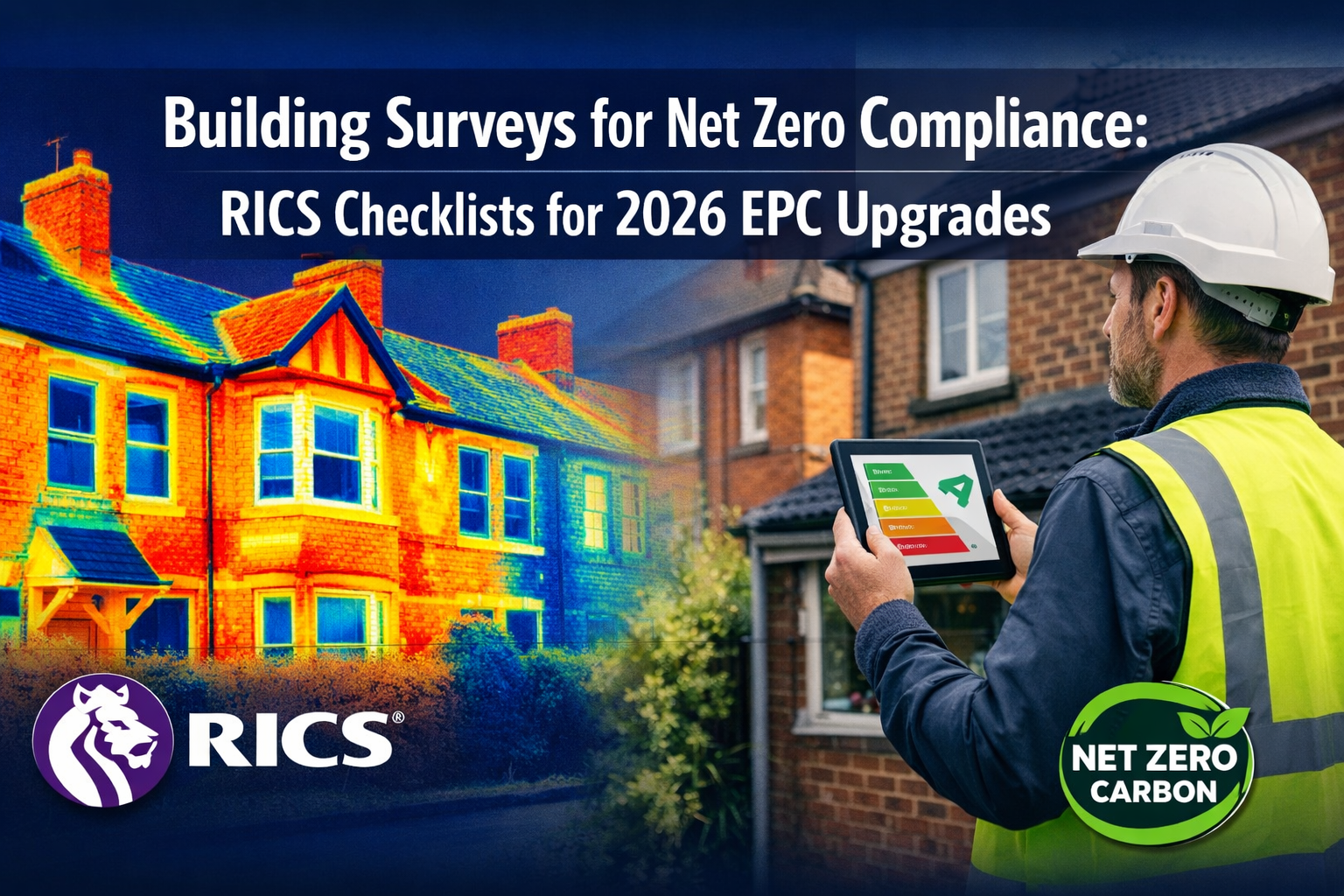

The race to net zero is transforming how building surveyors approach property assessments in 2026. With the UK Net Zero Carbon Buildings Standard now formally launched and certification verification beginning this quarter, property professionals face mounting pressure to integrate energy performance considerations into every survey. Building Surveys for Net Zero Compliance: RICS Checklists for 2026 EPC Upgrades and Retrofit Assessments have become essential tools for identifying retrofit opportunities, ensuring regulatory compliance, and future-proofing property investments against evolving environmental legislation.
For chartered surveyors, this shift represents more than just additional paperwork—it's a fundamental change in how building condition assessments are conducted and reported. The convergence of traditional structural surveys with energy efficiency evaluations means that every inspection now carries implications for carbon reduction targets, property valuations, and long-term operational costs.
Key Takeaways
- 🏗️ The UK Net Zero Carbon Buildings Standard launched in 2026 with formal certification verification beginning Q2 2026, establishing unified methodology for measuring operational and embodied emissions across building lifecycles
- 📋 RICS-aligned checklists now integrate EPC upgrade pathways into Level 3 building surveys, enabling surveyors to identify retrofit opportunities during standard property assessments
- 🔍 Annual verification requirements demand detailed evidence including metered energy data, carbon calculations, and lifecycle assessments, creating ongoing compliance obligations for property owners
- 🏘️ Sector-specific criteria cover residential, commercial, healthcare, education, and heritage properties, with differentiated pathways for new builds, major retrofits, and existing building upgrades
- ⚡ EPC system reforms and MEES regulations continue evolving, making proactive retrofit assessments critical for maintaining property marketability and avoiding future compliance penalties
Understanding the UK Net Zero Carbon Buildings Standard Framework
The UK Net Zero Carbon Buildings Standard represents a watershed moment for the property sector. Developed by over 350 industry experts from organizations including UKGBC, RICS, CIBSE, and BRE, this consensus-driven framework replaces ambiguous net zero claims with standardized, verifiable methodology [1].
What Makes This Standard Different?
Unlike previous voluntary initiatives, this standard establishes rigorous verification requirements that prevent premature net zero claims. Buildings can only receive certification once they are completed, occupied, and operating—with actual performance data demonstrating compliance [2].
The framework measures both:
- Operational emissions: Energy use intensity during building occupation
- Embodied carbon: Full lifecycle impacts from raw material extraction through demolition
This dual focus aligns with ISO and European standards, ensuring international compatibility while addressing the complete carbon footprint of buildings [1].
Testing and Validation
The standard underwent extensive real-world testing before launch. A pilot programme initiated in September 2024 evaluated 205 building projects across diverse property types, with participant feedback directly shaping the final version released in 2026 [1]. This evidence-based approach ensures the standard remains practical and achievable while maintaining rigorous environmental credentials.
Building Surveys for Net Zero Compliance: Integrating RICS Checklists into Survey Practice
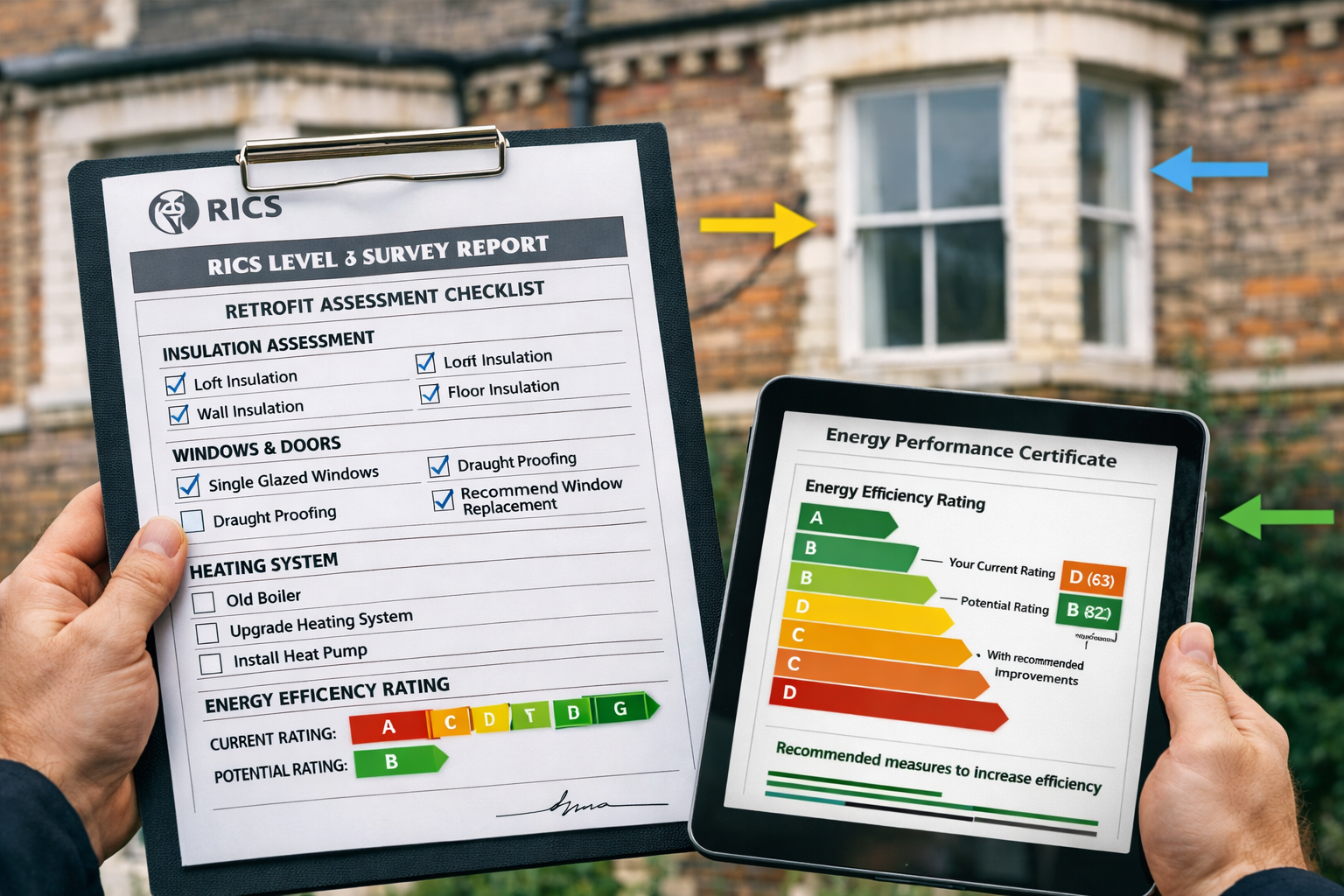
Traditional building surveys focused primarily on structural integrity, defects, and maintenance requirements. The integration of Building Surveys for Net Zero Compliance: RICS Checklists for 2026 EPC Upgrades and Retrofit Assessments fundamentally expands this scope, requiring surveyors to evaluate energy performance alongside conventional building pathology.
Enhanced Level 3 Survey Components
Modern building surveys now incorporate:
| Assessment Area | Traditional Focus | Net Zero Enhancement |
|---|---|---|
| External Walls | Structural cracks, damp penetration | Thermal performance, insulation opportunities, thermal bridging |
| Windows & Doors | Condition, operation, weatherproofing | U-values, air leakage, upgrade potential to triple glazing |
| Roofing | Covering condition, structural integrity | Insulation depth, solar panel suitability, ventilation strategy |
| Heating Systems | Age, operation, maintenance needs | Efficiency ratings, heat pump compatibility, zoning potential |
| Ventilation | Adequacy, condensation risk | Heat recovery systems, air quality, moisture management |
RICS Guidance on Retrofit Assessments
RICS has published comprehensive guidance on Whole Life Carbon Assessment, providing surveyors with methodologies for evaluating embodied and operational carbon across building lifecycles [7]. This guidance enables surveyors to:
- Calculate baseline carbon performance
- Identify high-impact retrofit interventions
- Assess cost-benefit ratios for upgrade pathways
- Prioritize improvements based on carbon reduction potential
For heritage properties and conservation areas, specialized specific defect reports can address the unique challenges of improving energy performance while preserving architectural character.
Practical Checklist Integration
Building Surveys for Net Zero Compliance: RICS Checklists for 2026 EPC Upgrades and Retrofit Assessments should include:
✅ Thermal Envelope Assessment
- Wall construction identification and insulation status
- Thermal imaging to identify heat loss patterns
- Air tightness evaluation and draft proofing opportunities
- Window and door performance ratings
✅ Building Services Evaluation
- Current heating system efficiency and upgrade options
- Hot water generation and distribution efficiency
- Renewable energy integration potential (solar PV, heat pumps)
- Smart controls and zoning capabilities
✅ EPC Upgrade Pathway Analysis
- Current EPC rating with supporting evidence
- Costed improvement recommendations ranked by impact
- Projected rating improvements for each intervention
- Regulatory compliance timeline (MEES requirements)
✅ Heritage and Planning Considerations
- Conservation area restrictions affecting retrofit options
- Listed building consent requirements for improvements
- Sympathetic upgrade solutions maintaining character
- Planning policy alignment for external alterations
✅ Embodied Carbon Considerations
- Material selection recommendations for retrofit works
- Lifecycle assessment of proposed interventions
- Demolition vs. refurbishment carbon calculations
- Circular economy opportunities (material reuse)
Sector-Specific Verification Routes and Certification Pathways
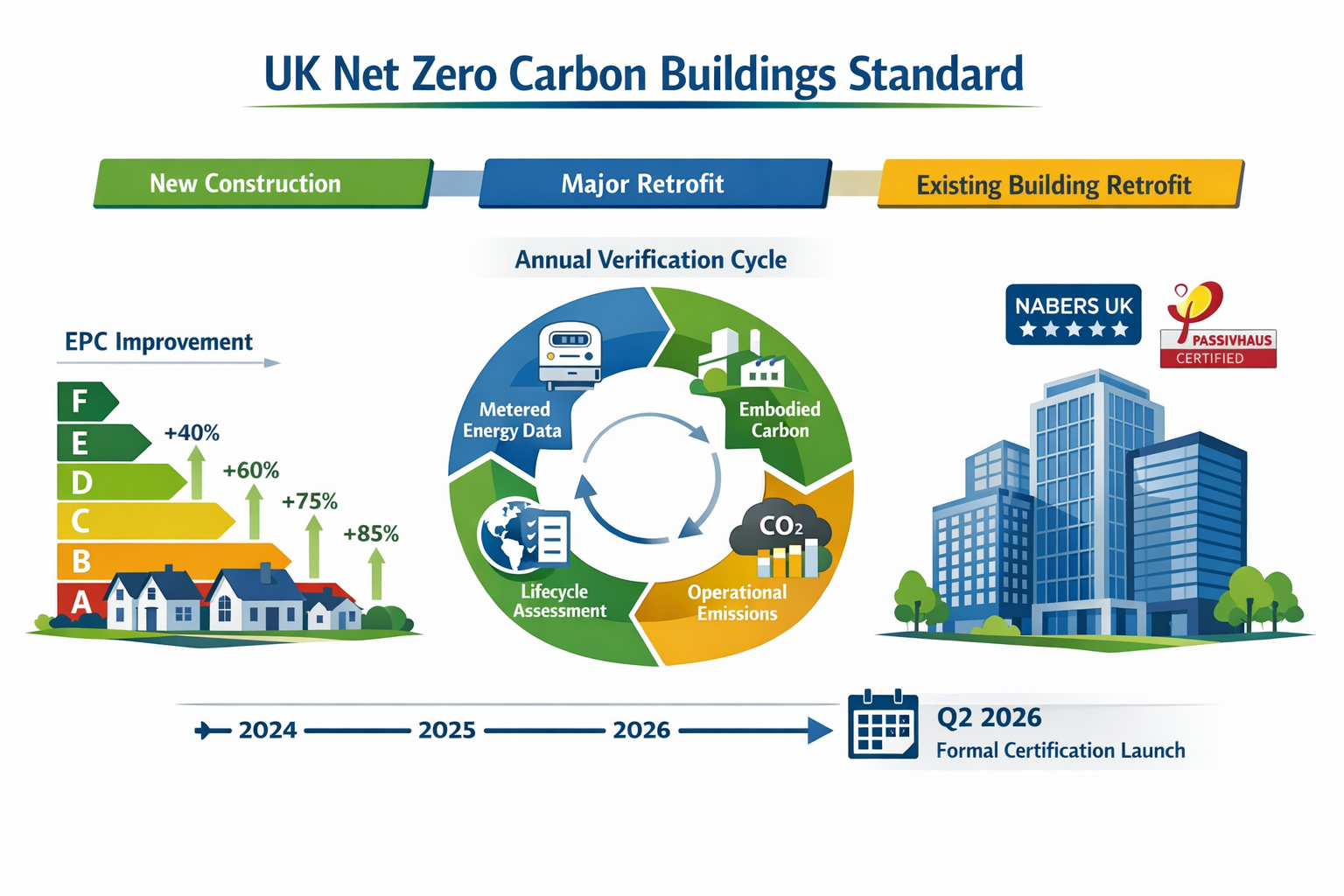
The UK Net Zero Carbon Buildings Standard establishes differentiated pathways recognizing that new construction, major retrofits, and existing building upgrades face distinct challenges and opportunities [1].
Residential Property Pathways
For residential properties, the standard provides clear criteria for:
New Build Homes: Must demonstrate both design-stage carbon calculations and post-occupancy performance verification through metered data. The standard requires evidence of:
- Space heating demand below sector-specific thresholds
- Renewable energy integration or procurement
- Low-carbon material specifications with Environmental Product Declarations
- Operational energy monitoring systems installed from completion
Existing Home Retrofits: Recognize the practical constraints of improving older housing stock while maintaining achievable targets:
- Baseline energy assessment establishing pre-retrofit performance
- Prioritized intervention packages addressing fabric-first principles
- Post-retrofit verification demonstrating measurable improvements
- Annual monitoring confirming sustained performance
Commercial and Non-Domestic Buildings
Commercial properties face additional complexity due to tenant-landlord splits and diverse occupancy patterns. The standard introduces innovative verification routes allowing:
- Whole-building certification where single occupancy enables comprehensive control
- Landlord-controlled areas certification for base building services and fabric
- Tenant fit-out certification for demised spaces with separate metering
This flexibility addresses practical scenarios where commercial property valuations must account for split incentives between building owners and occupiers [1].
Heritage and Conservation Properties
Recognizing the unique challenges of historic buildings, the standard provides adapted criteria that:
- Balance carbon reduction with heritage preservation
- Acknowledge constraints on external insulation and window replacement
- Emphasize internal improvements and building services upgrades
- Accept longer payback periods for sympathetic interventions
Schedule of condition reports become particularly valuable for heritage properties, documenting baseline conditions before retrofit works commence.
2026 EPC Upgrades: Regulatory Landscape and Compliance Requirements
The regulatory environment surrounding energy performance continues evolving throughout 2026, creating both challenges and opportunities for property owners and professionals.
Current MEES Requirements
Minimum Energy Efficiency Standards (MEES) currently prohibit letting non-domestic properties with EPC ratings below E. The government is finalizing enhanced MEES requirements that will progressively raise these thresholds [2]:
- 2027 Target: Minimum EPC rating of D for existing tenancies
- 2030 Target: Minimum EPC rating of C for all non-domestic rentals
- Residential Sector: Similar trajectory expected with consultation ongoing
EPC System Reforms
The government released a partial response to EPC system reforms in March 2026, acknowledging widespread criticism of current assessment methodology [1]. Proposed improvements include:
- More accurate modeling of actual energy consumption
- Better recognition of renewable energy systems
- Improved treatment of heritage property constraints
- Integration with smart meter data for performance validation
These reforms will fundamentally change how RICS registered valuers assess property values, with energy performance becoming increasingly material to market pricing.
Future Homes and Future Buildings Standards
The long-awaited Future Homes Standard and Future Buildings Standard are expected to be finalized in 2026, establishing:
- Carbon emission targets for new residential construction
- Enhanced fabric performance requirements
- Renewable heating system mandates
- Preparation for zero carbon-ready infrastructure
These standards will influence retrofit strategies for existing buildings, as improvement works increasingly adopt new-build specifications where practical.
Annual Verification and Ongoing Compliance Management
Unlike one-time assessments, the UK Net Zero Carbon Buildings Standard requires annual verification to maintain certification status [1]. This ongoing obligation transforms building management practices and creates new opportunities for surveying professionals.
Evidence Requirements for Annual Verification
Property owners seeking certification must submit comprehensive documentation including:
📊 Metered Energy Data
- Electricity consumption (grid and on-site generation)
- Gas or other fossil fuel usage
- District heating/cooling energy supplied
- Tenant sub-metering data where applicable
📊 Carbon Calculations
- Operational emissions using current grid carbon intensity factors
- Embodied carbon updates for any building modifications
- Offset arrangements for residual emissions (if applicable)
- Renewable energy generation and export calculations
📊 Lifecycle Assessment Updates
- Material additions or replacements during reporting period
- End-of-life planning for building components
- Circular economy initiatives and material reuse
- Waste management and demolition planning
"On Track" Verification for New Developments
The standard introduces optional "on track" verification checks available at practical completion for new buildings [1]. This interim assessment allows developers to:
- Verify design-stage calculations against as-built conditions
- Identify potential performance gaps before occupancy
- Adjust commissioning and handover procedures
- Provide purchasers with confidence in projected performance
However, full certification remains contingent on demonstrating actual operational performance once buildings are occupied and metered data becomes available.
Compatibility with Existing Certification Schemes
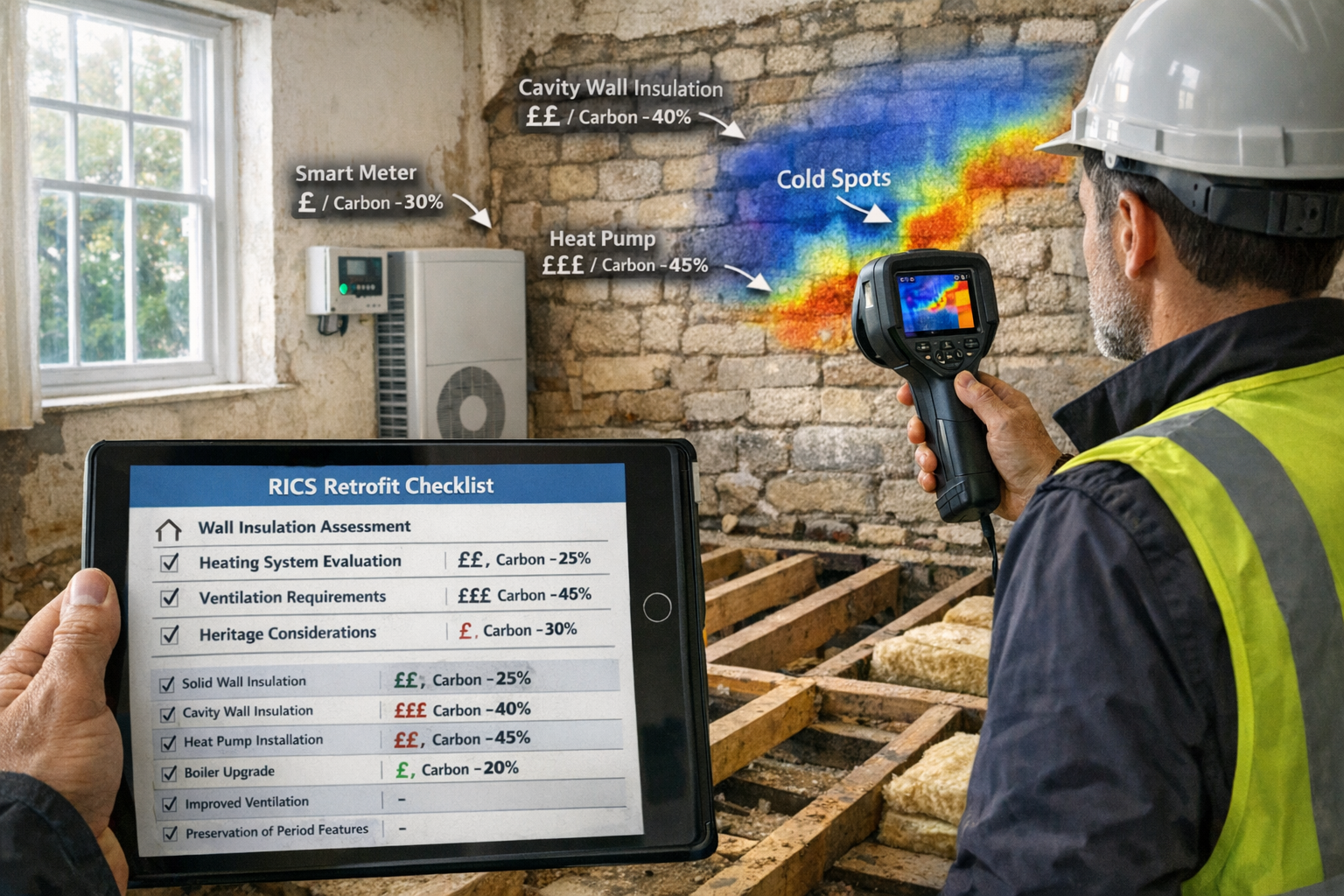
The UK Net Zero Carbon Buildings Standard includes updated guidance ensuring compatibility with established certification schemes including NABERS UK and Passivhaus [1]. This integration reduces duplicate reporting requirements and enables buildings to pursue multiple credentials without redundant assessments.
NABERS UK Integration
NABERS UK (National Australian Built Environment Rating System) focuses on operational energy performance based on actual metered data. The net zero standard aligns by:
- Accepting NABERS UK energy ratings as evidence for operational emissions
- Using consistent measurement boundaries and calculation methodologies
- Recognizing NABERS UK verification processes for annual compliance
- Enabling single data collection serving both frameworks
Passivhaus Alignment
Passivhaus certification emphasizes fabric performance and design-stage energy modeling. The net zero standard complements this by:
- Recognizing Passivhaus design calculations for embodied carbon assessment
- Accepting Passivhaus air tightness testing as verification evidence
- Aligning space heating demand thresholds with Passivhaus criteria
- Enabling Passivhaus buildings to achieve net zero certification with minimal additional assessment
This interoperability benefits developers and owners pursuing multiple certifications, streamlining compliance processes while maintaining rigorous standards.
Practical Implementation: Retrofit Assessment Workflow
Implementing Building Surveys for Net Zero Compliance: RICS Checklists for 2026 EPC Upgrades and Retrofit Assessments requires structured workflows integrating traditional surveying expertise with energy performance analysis.
Stage 1: Baseline Assessment
The initial survey establishes comprehensive baseline conditions:
- Desktop Review: Gather existing documentation including current EPC, planning history, building control records, and previous survey reports
- Site Inspection: Conduct thorough building survey documenting construction methods, materials, building services, and defects
- Thermal Imaging: Use infrared thermography to identify heat loss patterns, thermal bridging, and insulation deficiencies
- Performance Testing: Conduct air leakage testing where appropriate to quantify infiltration rates
- Services Evaluation: Assess heating, ventilation, hot water, and electrical systems for efficiency and upgrade potential
Stage 2: Retrofit Opportunity Identification
Analysis of baseline data identifies improvement opportunities:
- Fabric Improvements: Wall, roof, and floor insulation upgrades; window and door replacements; draft proofing
- Building Services: Heating system replacements (heat pumps, biomass); ventilation with heat recovery; hot water efficiency
- Renewable Energy: Solar PV potential; solar thermal; ground or air source heat pumps
- Smart Controls: Heating controls and zoning; smart meters; building management systems
Stage 3: Cost-Benefit Analysis
Each intervention requires evaluation of:
- Capital Cost: Materials, labor, professional fees, VAT considerations
- Carbon Reduction: Annual operational emissions savings; embodied carbon of materials
- Energy Savings: Reduced fuel consumption and cost savings over lifecycle
- EPC Impact: Projected rating improvement and MEES compliance
- Payback Period: Simple and discounted payback calculations
- Grant Funding: Available support schemes and incentives
Stage 4: Prioritized Recommendations
Survey reports should present findings as prioritized action plans:
Priority 1 – Immediate Actions (MEES compliance, critical defects affecting energy performance)
Priority 2 – Medium-term Improvements (cost-effective interventions with <10 year payback)
Priority 3 – Long-term Enhancements (comprehensive retrofits aligned with major maintenance cycles)
This structured approach enables property owners to plan phased improvements aligned with budgets and regulatory timelines.
The Role of Technology in Net Zero Surveys
Modern surveying technology enhances the accuracy and efficiency of Building Surveys for Net Zero Compliance: RICS Checklists for 2026 EPC Upgrades and Retrofit Assessments.
Thermal Imaging and Diagnostic Tools
Infrared thermography provides visual evidence of:
- Missing or inadequate insulation
- Thermal bridging at structural junctions
- Air leakage paths around windows and doors
- Moisture ingress affecting thermal performance
Advanced drone roof surveys enable safe, comprehensive assessment of roof conditions and solar panel installation potential without scaffolding access.
Digital Survey Platforms
Cloud-based survey software facilitates:
- Structured data collection using standardized RICS checklists
- Photographic evidence linked to specific building elements
- Automatic report generation with consistent formatting
- Client portals for transparent communication and progress tracking
Energy Modeling Software
Specialized tools enable surveyors to:
- Model current building performance based on survey findings
- Simulate improvement scenarios and predict outcomes
- Generate accurate EPC projections for retrofit options
- Calculate embodied carbon for material selections
Common Challenges and Solutions in Net Zero Compliance Surveys
Property professionals implementing net zero compliance assessments encounter recurring challenges requiring practical solutions.
Challenge 1: Heritage Property Constraints
Issue: Listed buildings and conservation areas restrict external insulation, window replacement, and renewable energy installations.
Solution: Focus on internal improvements including:
- Secondary glazing maintaining original windows
- Internal wall insulation using breathable materials
- Roof space insulation maximization
- High-efficiency heating systems with minimal visual impact
- Discreet solar PV on non-principal elevations
Challenge 2: Multi-Occupied Buildings
Issue: Landlord-tenant splits create misaligned incentives for energy improvements.
Solution: Utilize the standard's flexible verification routes allowing:
- Landlord certification for base building fabric and services
- Tenant certification for fit-out and operational practices
- Green lease provisions requiring energy performance collaboration
- Sub-metering enabling accurate attribution of consumption
Challenge 3: Cost Barriers
Issue: Comprehensive retrofits require substantial capital investment.
Solution: Develop phased improvement plans:
- Prioritize high-impact, cost-effective interventions
- Align major works with planned maintenance cycles
- Access available grant funding and incentive schemes
- Demonstrate lifecycle cost savings in RICS valuations
Challenge 4: Performance Gap
Issue: Actual operational performance often falls short of design predictions.
Solution: Implement robust verification processes:
- Post-occupancy monitoring and commissioning
- Building user guidance and training
- Annual performance reviews with corrective actions
- Smart controls optimizing system operation
Conclusion
Building Surveys for Net Zero Compliance: RICS Checklists for 2026 EPC Upgrades and Retrofit Assessments represent the evolution of professional surveying practice to meet the urgent demands of climate change mitigation. With the UK Net Zero Carbon Buildings Standard now operational and formal certification verification underway in Q2 2026, property professionals must integrate energy performance considerations into every assessment.
The convergence of traditional building pathology expertise with carbon reduction analysis creates both challenges and opportunities. Surveyors who develop competencies in thermal performance evaluation, retrofit assessment, and lifecycle carbon analysis will provide essential value to clients navigating increasingly complex regulatory landscapes.
Actionable Next Steps
For property owners and professionals seeking to implement net zero compliance strategies:
- Commission Comprehensive Assessments: Engage chartered surveyors with net zero expertise to conduct baseline evaluations using RICS-aligned checklists
- Develop Retrofit Roadmaps: Create prioritized improvement plans aligned with MEES timelines and certification requirements
- Access Professional Guidance: Consult RICS registered valuers to understand energy performance impacts on property values
- Monitor Regulatory Developments: Stay informed about evolving EPC reforms, MEES requirements, and Future Homes/Buildings Standards
- Implement Phased Improvements: Begin cost-effective interventions immediately while planning comprehensive retrofits aligned with maintenance cycles
- Establish Monitoring Systems: Install metering and monitoring infrastructure enabling annual verification and performance optimization
The transition to net zero buildings is not optional—it's an inevitable transformation reshaping property markets, valuations, and professional practice. Early adoption of comprehensive survey methodologies positions property owners and professionals advantageously, ensuring regulatory compliance while capturing the financial and environmental benefits of improved energy performance.
References
[1] Uk Launches Net Zero Carbon Buildings Standard To Define Credible Climate Claims Across Property Sector – https://esgcx.com/uk-launches-net-zero-carbon-buildings-standard-to-define-credible-climate-claims-across-property-sector/
[2] Uk Net Zero Carbon Buildings Standard Launches To Define Credible Net Zero Claims – https://energyadvicehub.org/uk-net-zero-carbon-buildings-standard-launches-to-define-credible-net-zero-claims/
[7] Whole Life Carbon Assessment – https://www.rics.org/profession-standards/rics-standards-and-guidance/sector-standards/construction-standards/whole-life-carbon-assessment