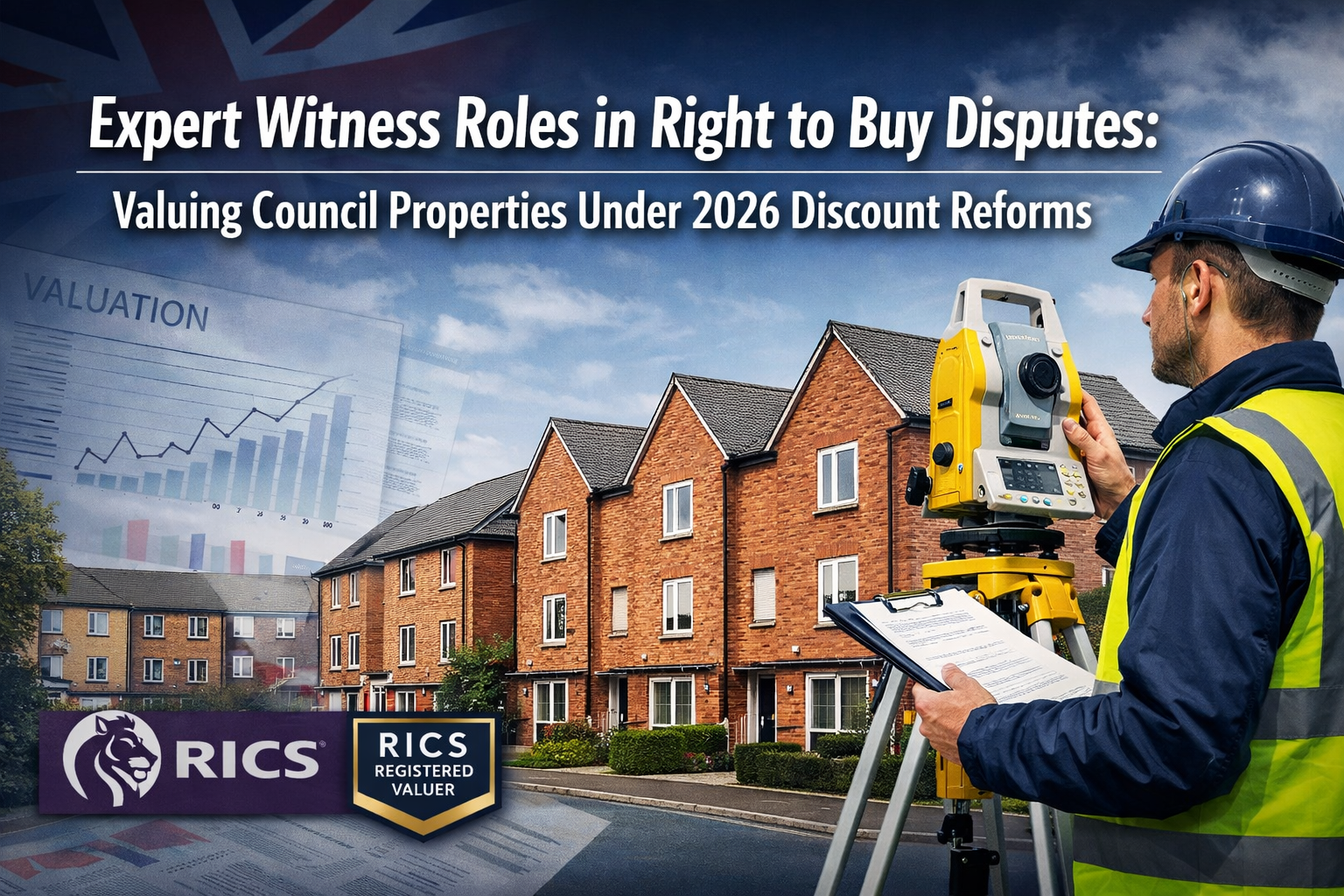

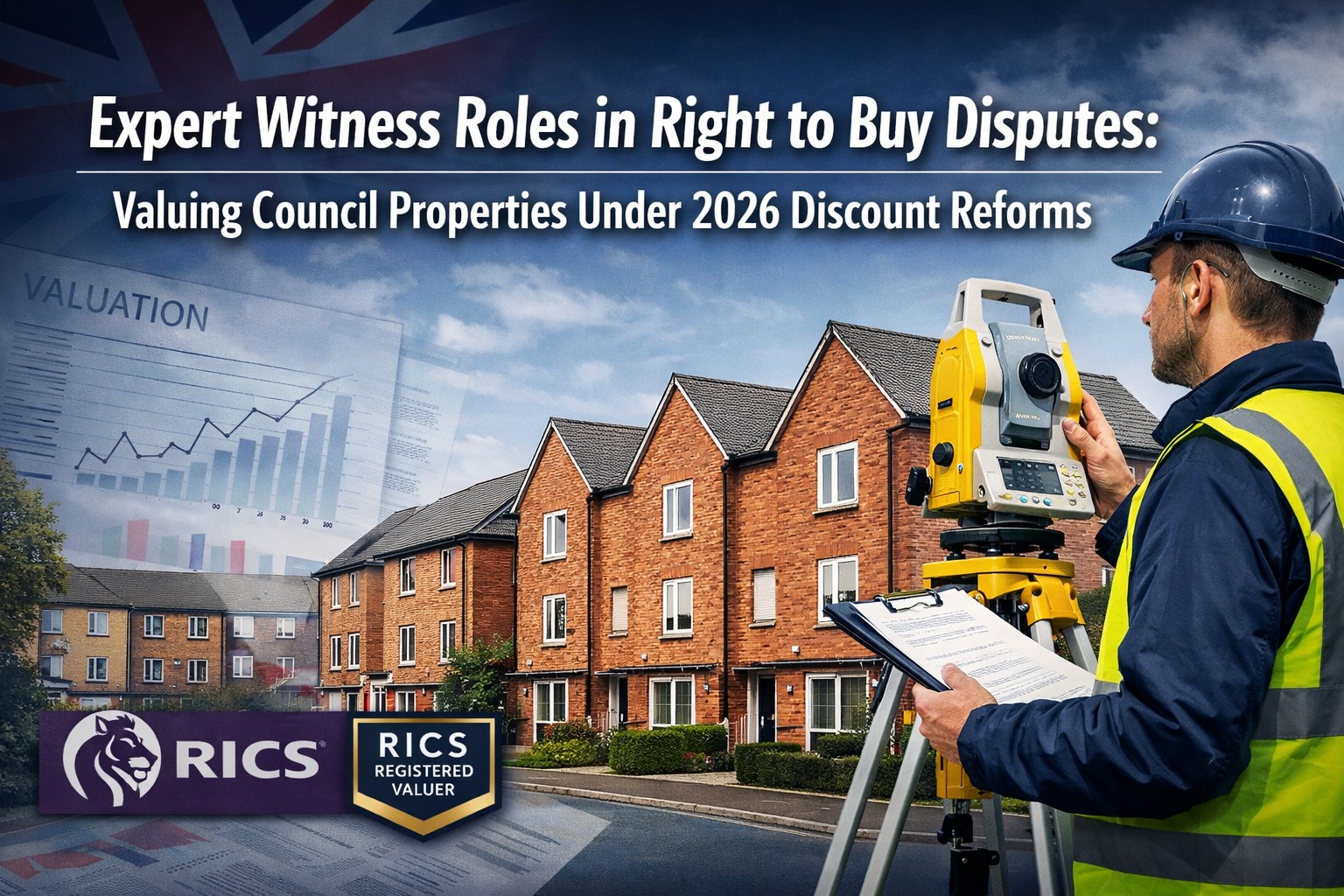
The landscape of Right to Buy property transactions has undergone significant transformation in 2026, creating unprecedented challenges for tenants, councils, and property professionals alike. As government reforms reshape discount structures and eligibility criteria, disputes over property valuations have surged to their highest levels in two decades. Expert Witness Roles in Right to Buy Disputes: Valuing Council Properties Under 2026 Discount Reforms have become critical to ensuring fair outcomes for all parties involved. Understanding how qualified surveyors leverage RICS data and methodologies to contest valuations can mean the difference between a successful purchase and a costly dispute. This comprehensive guide explores the evolving role of expert witnesses in navigating these complex valuation challenges under the new regulatory framework.
Key Takeaways
- 🏘️ 2026 reforms have extended qualifying periods to 5 years and reduced maximum discounts, triggering a surge in Right to Buy applications and subsequent valuation disputes
- 📊 Expert witnesses must apply RICS Red Book standards and demonstrate independence when challenging council property valuations in tribunal proceedings
- 💰 Valuation methodologies now require detailed comparable market analysis, adjustment for property condition, and specific consideration of discount reform impacts
- ⚖️ Dispute resolution increasingly relies on qualified chartered surveyors who can provide expert witness reports that withstand legal scrutiny
- 📈 Right to Buy applications reached 20-year highs in 2026 as tenants rushed to secure purchases before further reforms take effect [6]
Understanding the 2026 Right to Buy Discount Reforms
The Right to Buy scheme, which has enabled over 2 million council tenants to purchase their homes since its introduction in 1980 [5], has undergone substantial changes in 2026. These reforms fundamentally alter how properties are valued and what discounts tenants can claim.
Key Changes to Discount Structures
The 2026 reforms have introduced several critical modifications to the Right to Buy framework:
Extended Qualifying Periods: Tenants must now demonstrate 5 years of continuous tenancy before becoming eligible to purchase their council property [2]. This represents a significant increase from previous requirements and aims to reduce speculative purchases.
Reduced Maximum Discounts: The reforms have lowered maximum discount caps across England, with regional variations reflecting local housing market pressures [3]. In high-demand areas, maximum discounts have been reduced by up to 30%, substantially affecting the final purchase price tenants will pay.
New Build Exemptions: Newly constructed council homes are now exempt from Right to Buy for 35 years following completion [8]. This change aims to protect social housing stock and ensure long-term availability for future generations.
Impact on Valuation Disputes
These reforms have created a perfect storm for valuation disagreements. According to government data, Right to Buy applications surged to their highest level in 20 years as tenants rushed to complete purchases before the new discount structures took effect [6]. This unprecedented volume has strained council valuation departments and increased the likelihood of errors or disagreements.
The valuation process now requires more sophisticated analysis to account for:
- Market value assessments under tighter comparable property criteria
- Accurate calculation of reduced discount percentages
- Proper application of extended qualifying period requirements
- Consideration of property condition and necessary repairs
When councils and tenants disagree on property valuations, the need for independent expert surveyor advice becomes paramount.
The Critical Role of Expert Witnesses in Right to Buy Valuation Disputes
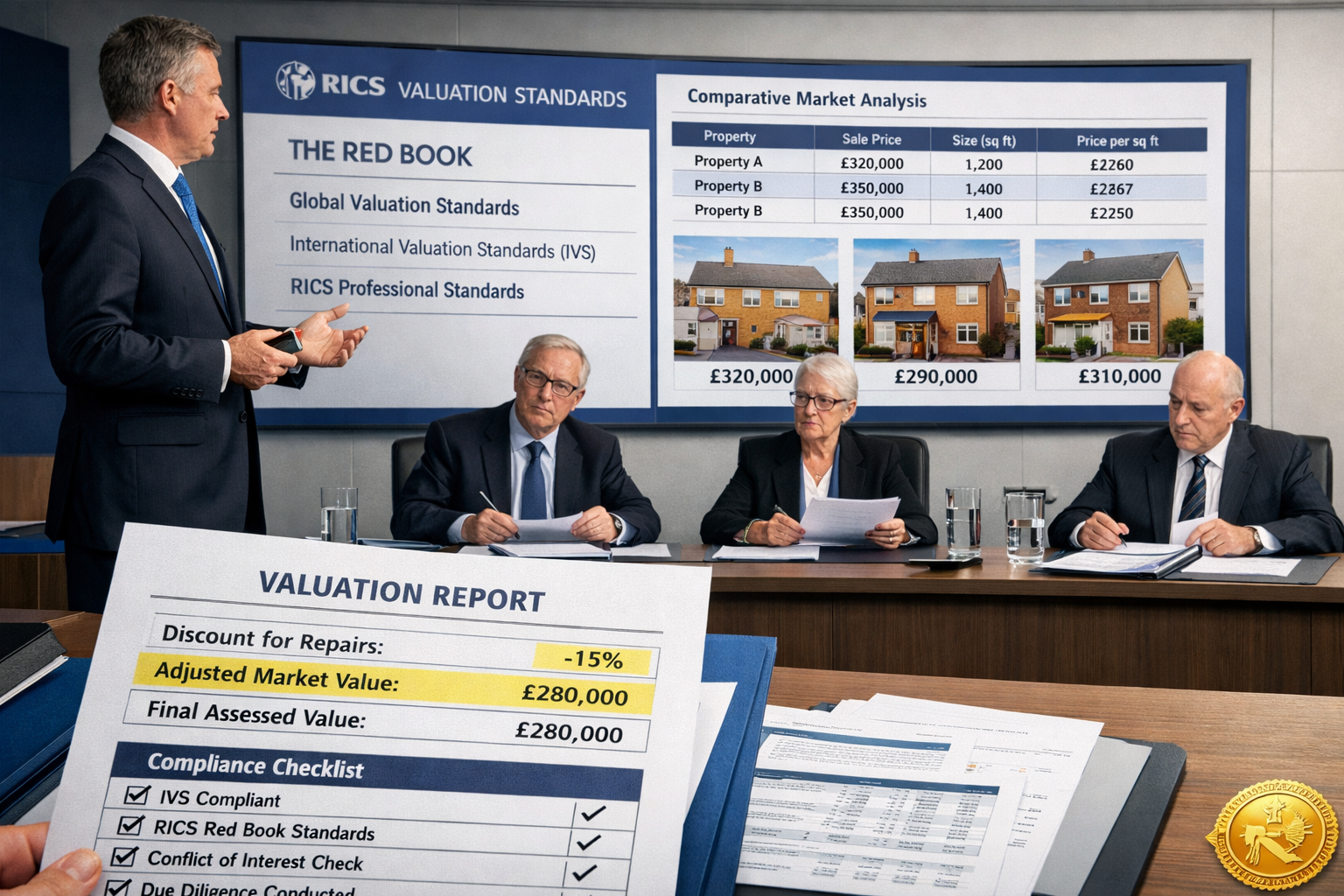
Expert witnesses serve as the cornerstone of fair dispute resolution in Right to Buy transactions. Their role extends far beyond simple property valuation—they must provide independent, evidence-based assessments that can withstand rigorous legal scrutiny.
Qualifications and Standards Required
To serve as an expert witness in Right to Buy disputes, professionals must meet stringent criteria:
RICS Membership: Expert witnesses must typically be chartered surveyors registered with the Royal Institution of Chartered Surveyors (RICS). This ensures they adhere to the RICS Red Book valuation standards, which provide the framework for professional property valuation in the UK.
Relevant Experience: Experts should demonstrate substantial experience in residential property valuation, particularly within the social housing sector. Understanding the nuances of council property stock, including common construction methods, maintenance standards, and local market dynamics, is essential.
Independence and Impartiality: Perhaps most critically, expert witnesses must maintain complete independence from both parties. Their duty is to the tribunal or court, not to the party instructing them. This principle ensures that valuation evidence remains objective and credible.
Core Responsibilities in Valuation Disputes
When engaged in Right to Buy disputes, expert witnesses undertake several key responsibilities:
Comprehensive Property Inspection: A thorough physical inspection of the council property forms the foundation of any expert valuation. This includes assessing structural condition, identifying defects, evaluating improvements made by the tenant, and documenting any factors that might affect market value.
Market Analysis and Comparables: Expert witnesses must conduct detailed research into comparable property sales within the locality. Under the 2026 reforms, this analysis requires particular attention to:
- Recent sales of similar council properties sold under Right to Buy
- Open market sales of equivalent properties in the same area
- Adjustments for differences in condition, location, and amenities
- Consideration of current market trends and economic factors
Discount Calculation Verification: Experts must verify that councils have correctly applied the new discount structures introduced in 2026. This involves confirming qualifying periods, calculating appropriate discount percentages, and ensuring maximum caps have been properly applied [2].
Report Preparation: The expert witness must prepare a comprehensive expert witness report that clearly articulates their methodology, findings, and conclusions. This document must be accessible to non-technical readers while maintaining professional rigor.
Common Grounds for Valuation Challenges
Expert witnesses frequently encounter several recurring issues in Right to Buy valuations:
| Dispute Type | Description | Expert's Role |
|---|---|---|
| Overvaluation | Council sets market value too high | Provide comparable evidence demonstrating lower market value |
| Discount Miscalculation | Incorrect application of 2026 discount rules | Verify qualifying period and recalculate correct discount |
| Condition Disputes | Disagreement over property condition impact | Document defects and quantify repair costs |
| Comparable Selection | Inappropriate comparables used | Identify more suitable comparable properties |
| Improvement Recognition | Tenant improvements not properly credited | Value tenant-funded improvements separately |
Valuation Methodologies for Council Properties Under 2026 Reforms
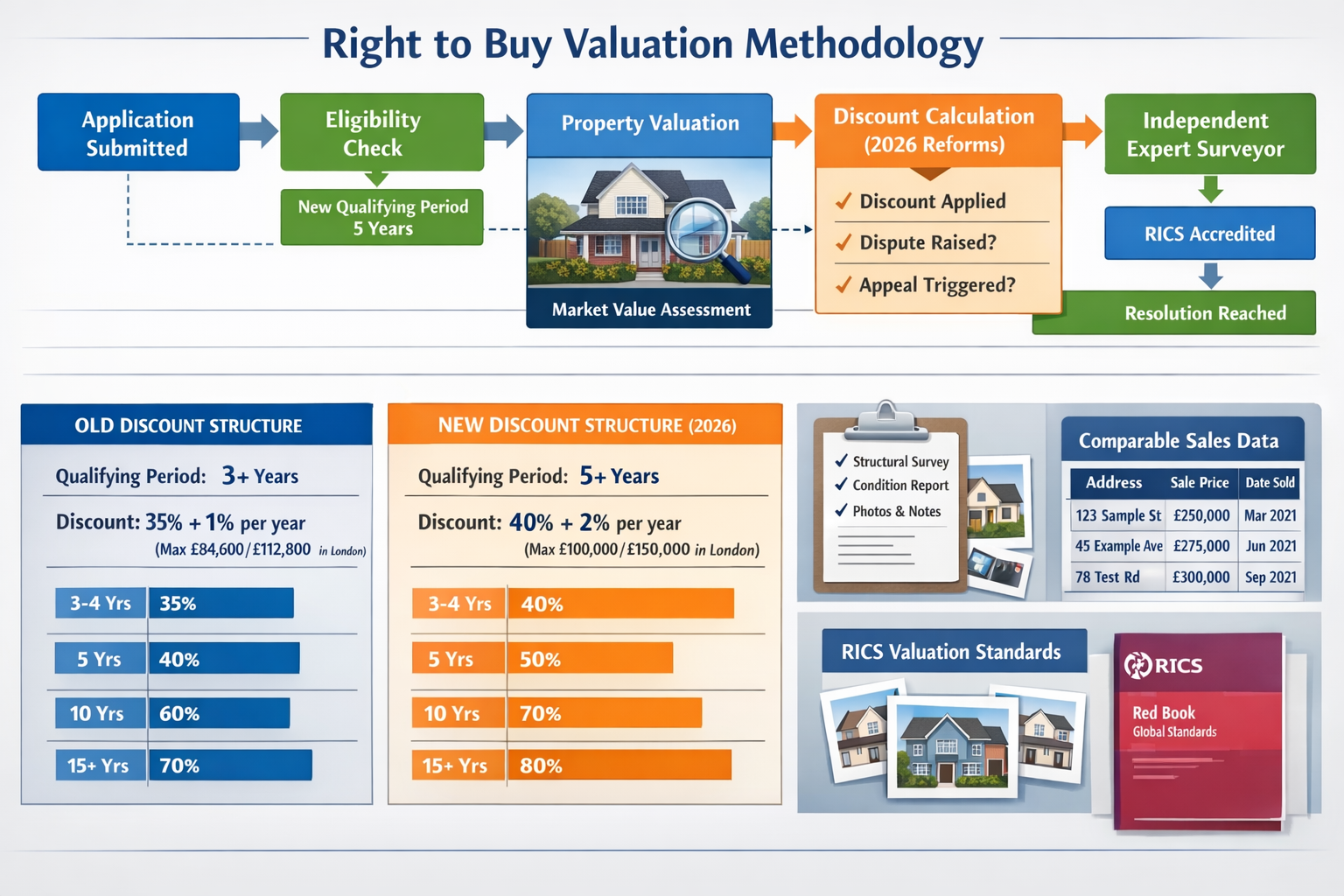
The Expert Witness Roles in Right to Buy Disputes: Valuing Council Properties Under 2026 Discount Reforms require application of specific valuation methodologies tailored to the unique characteristics of social housing transactions.
The RICS Red Book Framework
All professional valuations for Right to Buy purposes must comply with RICS Valuation – Global Standards (commonly known as the Red Book). This framework ensures consistency, transparency, and reliability in property valuations.
The Red Book requires expert witnesses to:
- Clearly define the purpose and intended use of the valuation
- Specify the basis of value (typically Market Value for Right to Buy)
- Disclose any assumptions or special assumptions made
- Provide sufficient detail for the valuation to be properly understood
- Maintain professional indemnity insurance
For those seeking professional valuation services, understanding RICS valuation costs and standards is essential to ensuring quality expert input.
Market Value Assessment Process
Determining the market value of a council property involves several critical steps:
Step 1: Property Inspection and Analysis
Expert witnesses conduct thorough inspections to assess:
- Overall condition and state of repair
- Age, construction type, and architectural style
- Accommodation layout and room sizes
- Heating, electrical, and plumbing systems
- External features including gardens and parking
- Location factors and local amenities
Step 2: Comparable Evidence Gathering
The expert must identify and analyze recent sales of similar properties. Under the 2026 reforms, this requires particular attention to:
- Properties of similar size, type, and condition
- Sales completed within the past 6-12 months
- Geographic proximity (typically within 1-2 miles)
- Adjustments for market movement since sale dates
Step 3: Adjustment and Reconciliation
No two properties are identical, so experts must make informed adjustments for differences between the subject property and comparables. Common adjustment factors include:
- Size differences: Adjusting per square foot or per room
- Condition variations: Accounting for superior or inferior maintenance
- Location premiums: Recognizing more or less desirable streets
- Amenity differences: Parking, gardens, modernization levels
Step 4: Market Value Conclusion
After analyzing all evidence and making appropriate adjustments, the expert arrives at a market value opinion. This figure represents what a willing buyer would pay a willing seller in an arm's-length transaction, assuming both parties are reasonably informed and acting without compulsion.
Applying the 2026 Discount Structure
Once market value is established, the expert must verify correct application of the reformed discount structure:
Calculating the Base Discount: Under 2026 rules, tenants receive a percentage discount based on their qualifying tenancy period. The reforms have adjusted these percentages downward compared to previous schemes [3].
Applying Maximum Caps: Regional maximum discount caps now limit the total discount available. Expert witnesses must ensure councils have applied the correct cap for the property's location [2].
Accounting for Previous Discounts: If the tenant previously purchased another property under Right to Buy, any discount received must be deducted from the current entitlement.
Final Purchase Price Calculation: The purchase price equals the market value minus the applicable discount (subject to the maximum cap).
Specialized Valuation Considerations
Council properties often present unique valuation challenges requiring expert analysis:
Non-Standard Construction: Many council properties were built using non-traditional construction methods that may affect mortgageability and value. Expert witnesses must identify these issues and quantify their impact.
Estate Factors: Properties on large council estates may be subject to estate-specific factors affecting value, including management quality, communal area maintenance, and local reputation.
Right to Buy Restrictions: Properties sold under Right to Buy are subject to certain restrictions, including repayment provisions if sold within 5 years [1]. These restrictions may affect market value and must be considered.
Tenant Improvements: Distinguishing between council-funded improvements and tenant-funded enhancements is crucial. Only the base property value (excluding tenant improvements) should be used for discount calculations.
Dispute Resolution Procedures and Expert Witness Testimony
When valuation disagreements cannot be resolved through negotiation, formal dispute resolution mechanisms come into play. Understanding these procedures is essential for expert witnesses involved in Right to Buy cases.
The Dispute Resolution Process
Initial Disagreement: Disputes typically arise when a tenant challenges the council's valuation, believing the market value has been set too high or the discount incorrectly calculated.
Independent Valuation: The tenant may commission an independent RICS registered valuer to provide a counter-valuation. This report should clearly identify areas of disagreement with the council's assessment.
Negotiation Phase: Before proceeding to formal proceedings, parties typically attempt to resolve differences through negotiation. Expert witnesses may participate in joint inspections or discussions to narrow areas of dispute.
Tribunal Proceedings: If negotiation fails, the matter may proceed to the First-tier Tribunal (Property Chamber). This is where expert witness testimony becomes crucial.
Preparing Expert Witness Reports
A robust expert witness report must include:
Executive Summary: A concise overview of the property, valuation conclusion, and key findings.
Property Description: Detailed description of the subject property, including location, accommodation, condition, and any notable features.
Inspection Details: Date of inspection, persons present, weather conditions, and any limitations on the inspection.
Methodology Statement: Clear explanation of the valuation approach used and why it is appropriate for this case.
Comparable Evidence: Detailed analysis of comparable properties, including:
- Full addresses and sale dates
- Sale prices and circumstances
- Similarities and differences to subject property
- Adjustments made and reasoning
Market Value Opinion: Clear statement of the expert's market value conclusion with supporting reasoning.
Discount Verification: Analysis of the discount calculation, identifying any errors or confirming correctness.
Conclusions: Summary of findings and final opinion on the appropriate purchase price.
Declaration: Statement of expert witness duties and confirmation of independence.
Giving Evidence at Tribunal
Expert witnesses may be called to give oral evidence at tribunal hearings. Effective testimony requires:
Clarity and Accessibility: Explaining technical valuation concepts in language accessible to non-experts while maintaining professional credibility.
Responsiveness: Answering questions directly and concisely, acknowledging limitations or uncertainties where appropriate.
Professional Demeanor: Maintaining composure, objectivity, and respect for all parties throughout proceedings.
Evidence-Based Reasoning: Supporting all opinions with clear reference to inspection findings, comparable evidence, and professional standards.
Common Pitfalls to Avoid
Expert witnesses should be aware of common errors that can undermine their credibility:
❌ Advocacy: Acting as an advocate for the instructing party rather than providing independent evidence
❌ Inadequate Comparables: Relying on insufficient or inappropriate comparable evidence
❌ Unsupported Adjustments: Making adjustments to comparables without clear justification
❌ Ignoring Contradictory Evidence: Failing to address evidence that contradicts the expert's opinion
❌ Exceeding Expertise: Offering opinions on matters outside the expert's area of competence
Case Studies: Expert Witness Roles in Right to Buy Disputes Under 2026 Reforms
Examining real-world scenarios illustrates how expert witnesses navigate the complexities of valuation disputes under the reformed framework.
Case Study 1: Overvaluation Challenge
Scenario: A tenant with 8 years' qualifying tenancy challenged a council valuation of £285,000 for a three-bedroom semi-detached house, arguing the market value should be £255,000.
Expert Witness Approach: The independent expert conducted a thorough inspection and identified five comparable sales within half a mile, all completed within the previous six months. These comparables ranged from £248,000 to £268,000, with appropriate adjustments for differences in condition and amenities.
Outcome: The expert's report demonstrated that the council had used comparables from a more desirable neighborhood and had failed to adjust for the subject property's inferior condition. The tribunal accepted the expert's valuation of £258,000, reducing the purchase price by approximately £15,000 after discount application.
Key Learning: The importance of truly comparable evidence cannot be overstated. Geographic proximity and timing are crucial factors in selecting appropriate comparables.
Case Study 2: Discount Calculation Error
Scenario: A council applied a 40% discount to a property with a market value of £180,000, but the tenant believed they were entitled to a higher discount under the 2026 reforms.
Expert Witness Approach: The expert reviewed the tenant's tenancy history and discovered a 6-month period that the council had not counted toward the qualifying period due to a brief change in tenancy status. The expert demonstrated that this period should have been included, extending the qualifying period by six months and increasing the discount percentage.
Outcome: The corrected discount calculation resulted in an additional 2% discount, saving the tenant approximately £3,600.
Key Learning: Meticulous review of tenancy records is essential. Small errors in qualifying period calculations can have significant financial implications.
Case Study 3: Tenant Improvement Recognition
Scenario: A tenant had invested £35,000 in a full kitchen and bathroom renovation, plus installation of central heating. The council's valuation appeared to include the value of these improvements, which should have been excluded from the base valuation for discount purposes.
Expert Witness Approach: The expert obtained evidence of the tenant's expenditure, including invoices and before/after photographs. They then valued the property in its pre-improvement condition by analyzing comparable properties without similar modernization.
Outcome: The expert determined that the market value should be reduced by £28,000 to reflect the property's condition before tenant improvements. This significantly reduced the purchase price after discount application.
Key Learning: Proper identification and valuation of tenant improvements requires documentary evidence and careful analysis. The distinction between normal maintenance and capital improvements must be clearly drawn.
Future Implications and Ongoing Reforms
The Expert Witness Roles in Right to Buy Disputes: Valuing Council Properties Under 2026 Discount Reforms continue to evolve as the government monitors the impact of recent changes.
Anticipated Further Reforms
According to the government's January 2026 progress update on delivering renewal for social and affordable housing, additional reforms are under consideration [7]:
Potential Further Discount Reductions: Some housing policy experts anticipate further reductions in maximum discounts, particularly in high-demand urban areas where social housing shortages are most acute.
Extended Exemption Periods: The current 35-year exemption for new builds may be extended or applied to substantially refurbished properties to further protect social housing stock [8].
Regional Variations: Greater regional differentiation in Right to Buy terms may be introduced, with more restrictive conditions in areas facing severe housing shortages.
Implications for Expert Witnesses
These ongoing reforms create both challenges and opportunities for expert witnesses:
Continuing Education: Expert witnesses must stay current with regulatory changes, attending professional development courses and monitoring government announcements.
Enhanced Documentation: As reforms increase complexity, the need for meticulous documentation and clear explanation in expert reports becomes even more critical.
Increased Demand: The surge in applications before reform implementation suggests sustained demand for expert witness services as disputes work through the system [6].
Technology and Valuation Practice
Emerging technologies are transforming how expert witnesses conduct valuations:
Data Analytics: Advanced property data platforms provide more comprehensive comparable evidence and market trend analysis.
Virtual Inspections: While physical inspections remain the gold standard, supplementary virtual inspection technologies can enhance evidence gathering.
Digital Reporting: Interactive digital reports with embedded photographs, maps, and comparable data improve clarity and accessibility.
Selecting the Right Expert Witness for Your Right to Buy Dispute
Whether you're a tenant challenging a valuation or a council seeking independent verification, selecting the appropriate expert witness is crucial to achieving a fair outcome.
Essential Qualifications to Verify
✅ RICS Chartered Surveyor Status: Confirm the expert holds MRICS or FRICS designation
✅ Relevant Experience: Verify specific experience with Right to Buy valuations and tribunal proceedings
✅ Local Market Knowledge: Ensure familiarity with the specific geographic area and property type
✅ Professional Indemnity Insurance: Confirm adequate coverage for expert witness work
✅ Availability: Ensure the expert can meet necessary timelines for report preparation and potential tribunal attendance
Questions to Ask Potential Experts
When interviewing potential expert witnesses, consider asking:
- How many Right to Buy valuation disputes have you been involved in?
- What is your experience with the 2026 discount reforms specifically?
- Have you previously given evidence at tribunal or court proceedings?
- What is your typical timeline for report preparation?
- What are your fees and payment terms?
- Can you provide references from previous clients or solicitors?
Understanding Fee Structures
Expert witness fees typically include:
- Inspection Fee: For site visit and property assessment
- Report Preparation: For research, analysis, and report writing
- Tribunal Attendance: Daily rates for giving evidence (if required)
- Travel Expenses: Mileage or public transport costs
Fees vary based on property complexity, geographic location, and expert experience. Obtaining a clear fee agreement upfront prevents misunderstandings and ensures budget certainty.
For those seeking professional assistance, exploring chartered surveyor services in your area is an excellent starting point.
Conclusion
The Expert Witness Roles in Right to Buy Disputes: Valuing Council Properties Under 2026 Discount Reforms have become increasingly complex and critical as government policy reshapes this important pathway to homeownership. The reforms introduced in 2026—including extended qualifying periods, reduced maximum discounts, and new build exemptions—have created unprecedented challenges in property valuation and dispute resolution.
Expert witnesses who understand RICS standards, maintain strict independence, and apply rigorous valuation methodologies are essential to ensuring fair outcomes for both tenants and councils. Their ability to provide evidence-based, professionally credible assessments helps tribunals make informed decisions that balance the legitimate interests of all parties.
Key Takeaways for Success
🔑 For Tenants: If you believe your council property has been overvalued or your discount miscalculated, commissioning an independent expert witness can provide the evidence needed to challenge the valuation effectively.
🔑 For Councils: Ensuring initial valuations are robust, well-documented, and compliant with RICS standards reduces the likelihood of successful challenges and demonstrates proper stewardship of public assets.
🔑 For Expert Witnesses: Maintaining independence, staying current with regulatory changes, and providing clear, accessible reports that withstand legal scrutiny are the cornerstones of effective expert witness practice.
Next Steps
If you're involved in a Right to Buy dispute or anticipate valuation challenges:
-
Act Quickly: Valuation disputes have strict timelines. Engage an expert witness early in the process.
-
Gather Documentation: Compile all relevant documents including tenancy records, council valuations, comparable evidence, and any improvement receipts.
-
Seek Professional Advice: Consult with a qualified expert witness who has specific experience with Right to Buy disputes under the 2026 reforms.
-
Consider Alternative Resolution: Before proceeding to tribunal, explore whether negotiation with expert input might resolve the dispute more efficiently.
-
Understand Your Rights: Familiarize yourself with the dispute resolution process and your entitlements under the reformed Right to Buy scheme.
The landscape of Right to Buy continues to evolve, but one constant remains: the need for professional, independent, and evidence-based valuation expertise. By understanding the critical role expert witnesses play in these disputes, all parties can work toward fair and equitable outcomes that respect both the rights of long-term tenants and the need to protect valuable social housing stock for future generations.
Whether you're navigating a current dispute or preparing for a future Right to Buy application, the expertise of qualified professionals remains your strongest asset in achieving a successful outcome under the 2026 reforms.
References
[1] Right To Buy Extension – https://www.samconveyancing.co.uk/news/conveyancing/right-to-buy-extension
[2] Right To Buy Reforms To Bring Longer Waits And Lower Discounts For Tenants – https://www.eleanorcharleshomes.co.uk/blog/right-to-buy-reforms-to-bring-longer-waits-and-lower-discounts-for-tenants/
[3] Reforming The Right To Buy – https://www.northern-consortium.org.uk/news/reforming-the-right-to-buy/
[5] Right To Buy – https://en.wikipedia.org/wiki/Right_to_Buy
[6] Right To Buy Applications Surge To 20 Year High As Tenants Rush For Lower Discounts – https://www.insidehousing.co.uk/news/right-to-buy-applications-surge-to-20-year-high-as-tenants-rush-for-lower-discounts-95907
[7] January 2026 Progress Update Delivering A Decade Of Renewal For Social And Affordable Housing – https://www.gov.uk/government/publications/delivering-a-decade-of-renewal-for-social-and-affordable-housing/january-2026-progress-update-delivering-a-decade-of-renewal-for-social-and-affordable-housing
[8] Newly Built Council Homes To Be Exempt From Right To Buy For 35 Years – https://www.housingtoday.co.uk/news/newly-built-council-homes-to-be-exempt-from-right-to-buy-for-35-years/5136844.article