
The UK property market is experiencing a remarkable resurgence in 2026. With agreed sales net balance improving to -9%—the strongest reading since June 2025—and new buyer enquiries surging across the country, chartered surveyors face an unprecedented challenge: scaling operations rapidly while maintaining the rigorous standards that underpin professional credibility. Building Survey Quality Assurance in High-Volume Recovery: Maintaining Standards as Transaction Activity Accelerates has become the defining operational imperative for surveying practices navigating this transformative period.
As transaction volumes climb and lenders forecast continued growth throughout 2026, the pressure to deliver timely, accurate, and comprehensive building surveys intensifies. Yet speed cannot compromise quality. The stakes are too high—for buyers making life-changing property decisions, for lenders managing risk portfolios, and for surveyors whose professional reputations rest on every report issued.
Key Takeaways
- 📈 Market recovery is accelerating: Agreed sales net balance has reached -9%, the best performance since mid-2025, signaling sustained transaction growth that will test surveying capacity throughout 2026
- ⚙️ Quality frameworks are essential: Implementing systematic quality assurance protocols, standardized checklists, and peer review processes ensures RICS compliance even during volume spikes
- 🔍 Technology enables scale: Digital survey tools, AI-assisted defect detection, and automated report generation help maintain thoroughness while increasing throughput
- 📋 Government reforms demand readiness: Proposed upfront property condition assessments could fundamentally reshape when and how surveys are conducted, requiring operational adaptability
- 🎯 Specialization matters: Focus on critical 2026 priorities including RAAC cladding identification, latent defects, and comprehensive risk assessment maintains professional standards
Understanding the 2026 Market Recovery and Its Impact on Survey Demand
The property market landscape in 2026 represents a dramatic shift from the cautious environment of recent years. Transaction activity is accelerating across residential and commercial sectors, driven by returning buyer confidence, improved mortgage availability, and stabilizing economic conditions. For surveying practices, this recovery translates directly into surging demand for building surveys and homebuyer reports.
The Volume Challenge Facing Surveyors
Many lenders are forecasting increased volumes and a strong start to the year, creating immediate capacity pressures for surveying firms.[1] This demand surge presents a double-edged sword: while increased workload drives revenue growth, it simultaneously threatens the quality standards that distinguish professional surveyors from less rigorous competitors.
The buy-to-let sector exemplifies this dynamic. Institutional and professional landlords continue investing actively, working with property professionals who understand the value of proper surveys.[1] These sophisticated clients demand comprehensive assessments that identify potential issues before purchase—they won't accept rushed or superficial inspections regardless of market pressures.
Government Reforms Reshaping the Surveying Landscape
Beyond market-driven demand, transformative government reforms are fundamentally changing how and when surveys occur. The UK government has proposed making property condition assessments a standard upfront requirement in the homebuying process.[1] This regulatory shift could significantly increase demand for surveys earlier in transactions, requiring surveyors to adapt operational workflows and quality assurance processes accordingly.
Earlier inspections are becoming part of the framework for 2026, meaning surveyors must be prepared to deliver comprehensive assessments before properties are formally marketed.[7] This timing change introduces new quality challenges: surveys conducted before active buyer interest may require updates if properties remain unsold for extended periods, creating additional quality control considerations.
Building Survey Quality Assurance in High-Volume Recovery: Framework Essentials
Maintaining standards as transaction activity accelerates requires systematic quality assurance frameworks that embed consistency into every stage of the survey process. Ad hoc quality checks are insufficient when volumes surge—only structured approaches prevent standards from eroding under pressure.
Core Components of Effective QA Systems
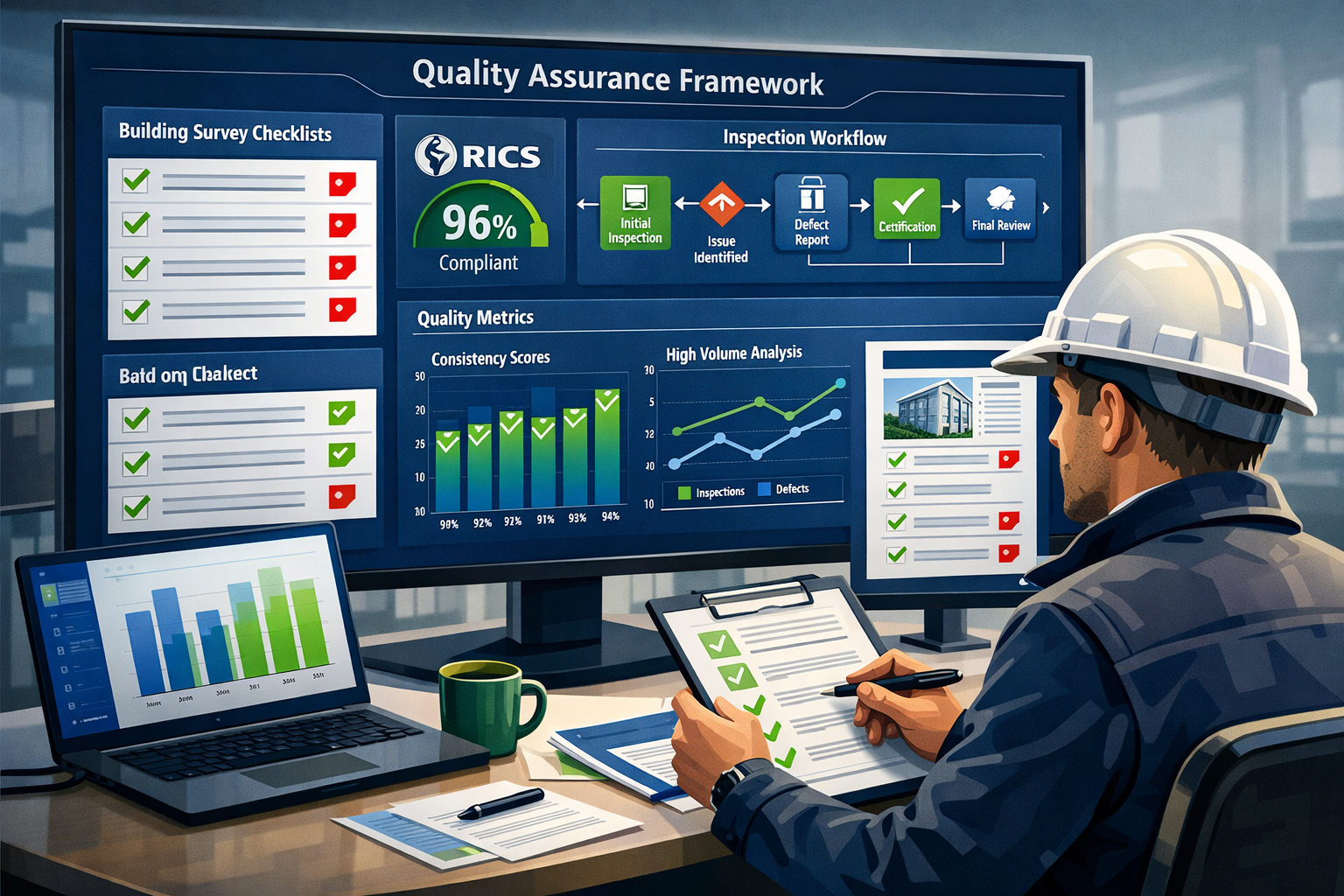
A robust quality assurance framework for building surveys encompasses several critical elements:
1. Standardized Inspection Protocols 📋
Comprehensive checklists ensure surveyors examine every critical building element regardless of time pressures. These protocols should cover:
- Structural integrity assessments (foundations, walls, roofs)
- Moisture and damp identification
- Building services evaluation (electrical, plumbing, heating)
- RAAC cladding and modern materials concerns
- Energy efficiency and insulation standards
- External envelope and weatherproofing
- Internal finishes and fixtures condition
2. Digital Survey Tools and Templates 💻
Technology enables consistency at scale. Digital survey platforms with pre-populated templates ensure:
- No critical inspection points are overlooked
- Data capture is standardized across all surveyors
- Photographs and measurements are systematically documented
- Reports follow consistent formatting and structure
- Quality metrics can be tracked and analyzed
3. Peer Review Processes 👥
Even experienced surveyors benefit from second opinions on complex cases. Implementing peer review protocols for:
- High-value properties above specified thresholds
- Properties with identified significant defects
- Unusual construction types or materials
- Cases involving RAAC, cladding, or structural concerns
- Random sampling of routine surveys (10-15% recommended)
4. Continuous Professional Development 📚
Quality standards evolve with building practices, materials, and regulations. Regular training ensures surveyors remain current on:
- Emerging defect patterns (RAAC identification, modern materials failures)
- Updated RICS guidance and professional standards
- New survey technologies and methodologies
- Legal and regulatory changes affecting surveys
- Case studies from quality issues and lessons learned
Quality Metrics and Performance Monitoring
What gets measured gets managed. Effective quality assurance requires quantifiable metrics that track performance:
| Quality Metric | Target Standard | Monitoring Frequency |
|---|---|---|
| Report completion time | Within 5 working days | Weekly |
| Client satisfaction score | ≥4.5/5.0 average | Monthly |
| Peer review pass rate | ≥95% first-time approval | Monthly |
| Defect identification accuracy | ≥98% (verified post-purchase) | Quarterly |
| RICS compliance audit score | 100% compliance | Annually |
| Report amendment requests | <5% of total surveys | Monthly |
These metrics provide early warning signals when volume pressures begin compromising quality, enabling proactive intervention before standards deteriorate significantly.
Building Survey Quality Assurance in High-Volume Recovery: Technology and Process Innovation
Technology represents the critical enabler for maintaining quality while scaling operations. Manual processes that sufficed at lower volumes become bottlenecks during recovery periods—digital transformation isn't optional for surveyors navigating 2026's market conditions.
AI-Assisted Defect Detection and Analysis
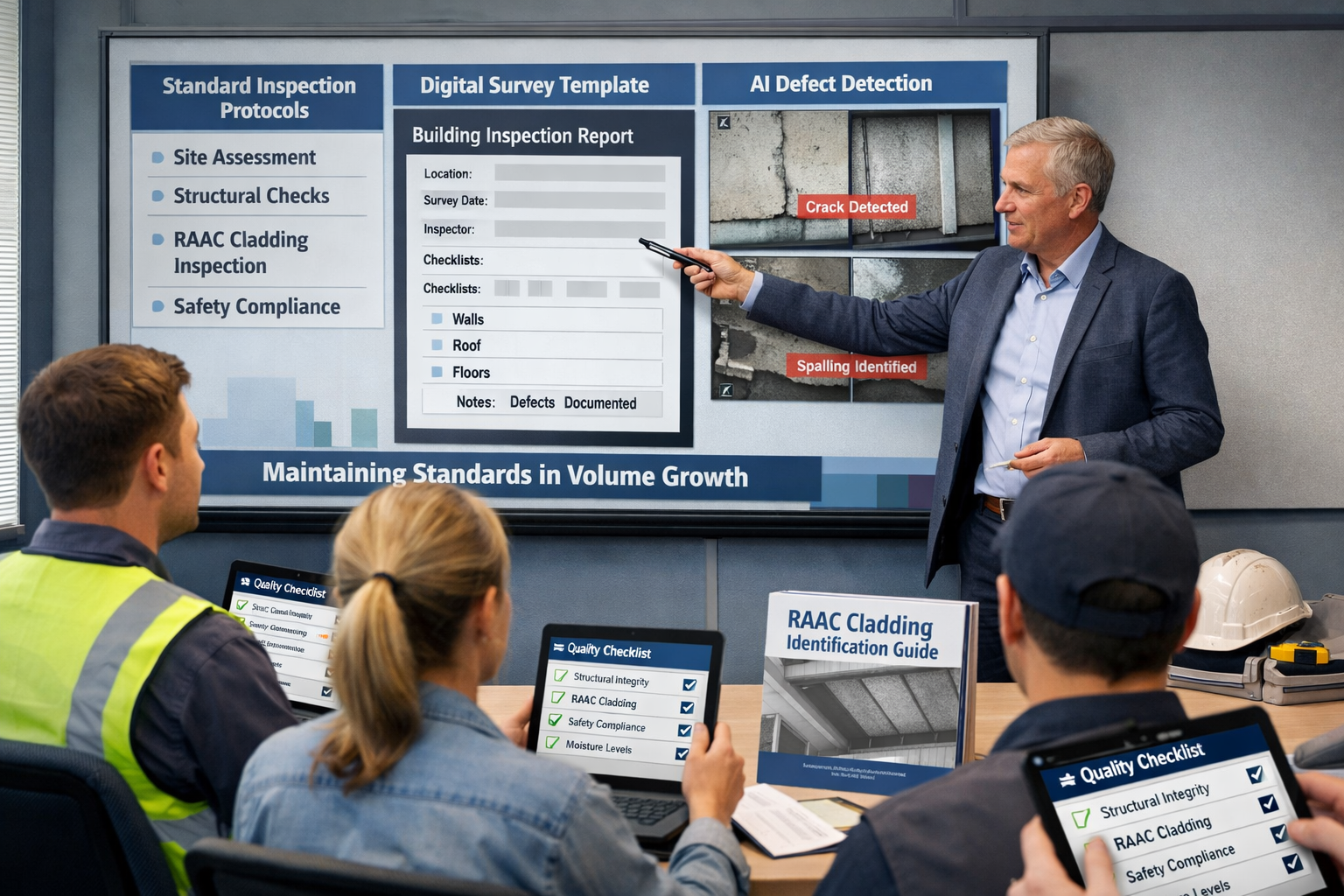
Artificial intelligence is revolutionizing building surveys by augmenting surveyor expertise with pattern recognition capabilities that identify potential issues more consistently:
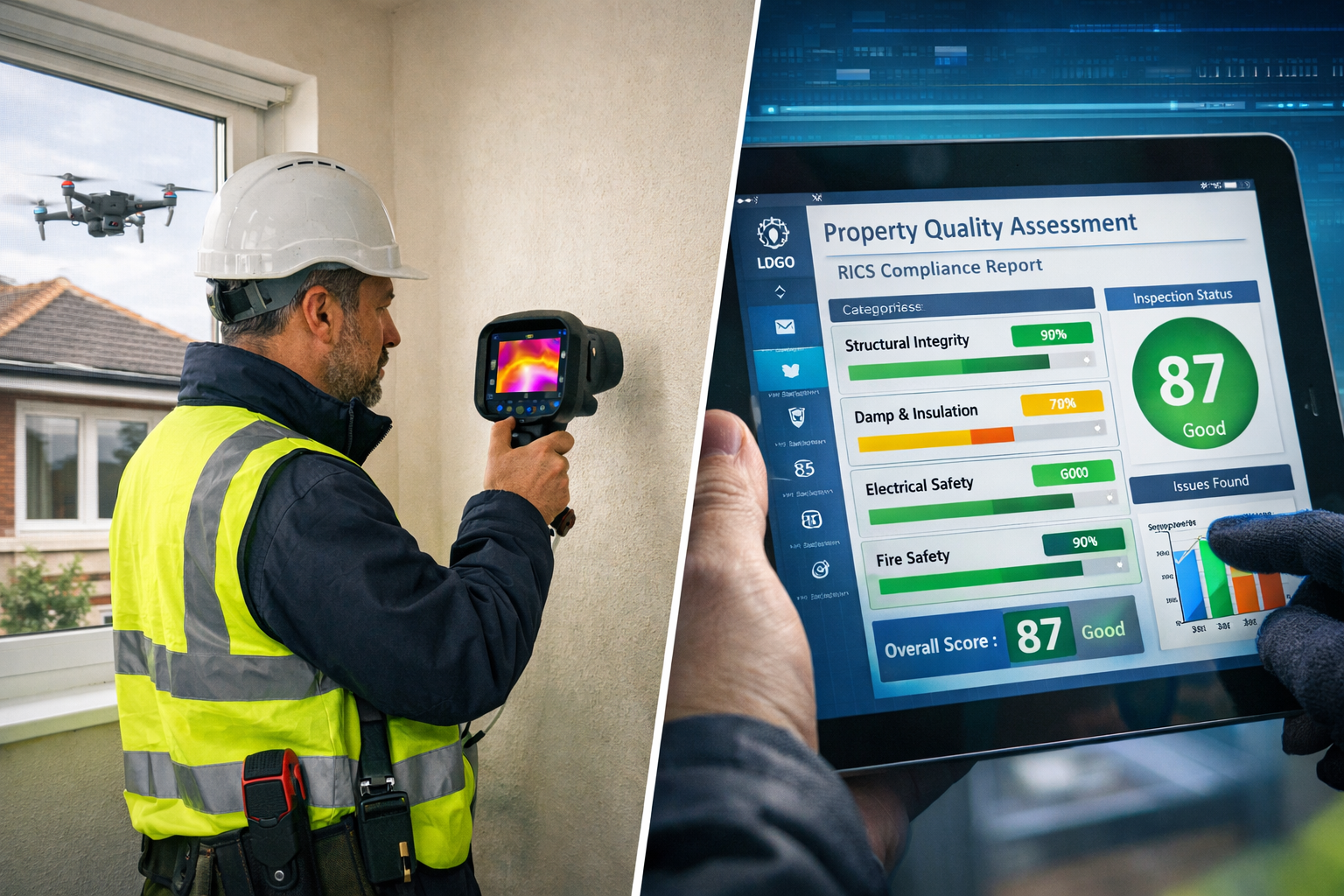
- Thermal imaging analysis: AI algorithms analyze thermal camera data to identify moisture ingress, insulation deficiencies, and thermal bridging more reliably than manual interpretation
- Photograph-based defect recognition: Machine learning models trained on thousands of defect images can flag potential structural issues, damp patterns, and material deterioration for surveyor review
- Comparative analysis: AI systems compare current property conditions against databases of similar properties, highlighting anomalies that warrant closer inspection
"Technology doesn't replace professional judgment—it enhances consistency. AI flags potential issues, but experienced surveyors make the final assessment and recommendations."
Drone Surveys for Comprehensive Roof Inspections
Drone roof surveys have become essential tools for maintaining thoroughness while managing time constraints. Benefits include:
- Safety improvements: Eliminates dangerous roof access for initial assessments
- Comprehensive coverage: Captures detailed imagery of entire roof surfaces including difficult-to-access areas
- Time efficiency: Completes roof inspection in 15-20 minutes versus hours for traditional access
- Documentation quality: High-resolution photographs provide superior evidence for reports and client discussions
For chartered surveyors operating across London and surrounding regions, drone technology enables consistent roof assessment quality regardless of property height or complexity.
Automated Report Generation Systems
Modern survey software with automated report generation capabilities significantly reduces administrative burden while improving consistency:
- Pre-populated sections based on property type and construction era
- Automatic insertion of standardized defect descriptions and risk ratings
- Integrated photograph placement with automatic captioning
- Consistent formatting and RICS-compliant structure
- Built-in quality checks for completeness and logical consistency
These systems free surveyors to focus on inspection quality and professional judgment rather than report formatting and administrative tasks.
Maintaining Standards During Volume Spikes: Operational Strategies
Even with robust frameworks and technology, operational discipline determines whether quality standards hold during sustained volume increases. Successful surveying practices implement specific strategies to manage capacity without compromising thoroughness.
Strategic Capacity Management
Workforce planning must anticipate demand fluctuations:
- Flexible staffing models: Maintain relationships with qualified associate surveyors who can supplement capacity during peaks
- Workload distribution: Implement systems that balance assignments across team members, preventing individual overload
- Realistic scheduling: Build buffer time into appointment calendars for complex properties or unexpected complications
- Selective client acceptance: During extreme volume periods, prioritize clients who value quality over speed
Specialization and Triage Approaches
Not all surveys require identical depth. Risk-based triage allocates resources appropriately:
Level 1 – Standard Surveys: Modern properties (post-2000), good condition, no obvious concerns
- Streamlined inspection protocols
- Junior surveyors with senior oversight
- Technology-heavy approach
Level 2 – Enhanced Surveys: Pre-2000 properties, visible defects, specific client concerns
- Comprehensive inspection protocols
- Experienced surveyors
- Detailed defect analysis
Level 3 – Specialist Surveys: Historic properties, significant structural concerns, RAAC/cladding issues
- Extended inspection time allocation
- Senior surveyors or specialists only
- Additional specialist reports when required
- Mandatory peer review
This stratification ensures appropriate resource allocation without applying unnecessary rigor to straightforward cases or insufficient scrutiny to complex properties.
Quality Assurance Checkpoints
Implementing staged quality reviews catches issues before reports reach clients:
- Field Inspection Checklist Completion: Digital systems verify all required inspection points were documented
- Photograph Quality Review: Automated checks ensure sufficient images captured with adequate lighting and clarity
- Draft Report Review: Senior surveyor reviews draft before finalization
- Pre-Issue Quality Check: Administrative review confirms formatting, completeness, and logical consistency
- Post-Issue Client Feedback: Systematic collection of client satisfaction data
Each checkpoint represents an opportunity to identify and correct quality issues, creating multiple safety nets that protect standards even when individual steps face time pressures.
Critical Building Survey Priorities for 2026 Market Conditions
The specific challenges facing property markets in 2026 require surveyors to prioritize certain inspection areas that carry heightened significance for buyers, lenders, and long-term property values.
RAAC Cladding and Modern Materials Concerns
Reinforced Autoclaved Aerated Concrete (RAAC) identification has become a critical survey priority following widespread recognition of structural risks in buildings constructed between the 1950s and 1990s.[5] Surveyors must:
- Recognize visual indicators of RAAC construction
- Recommend specialist structural assessment when RAAC is suspected
- Understand implications for property value and mortgage availability
- Document findings with appropriate urgency and clarity
Similarly, modern cladding systems require enhanced scrutiny following fire safety concerns. Comprehensive building surveys must evaluate external wall systems, particularly in multi-story buildings, and advise clients on potential remediation costs and regulatory compliance issues.
Latent Defects and Long-Term Stability
As property prices stabilize in 2026, latent defects that might compromise long-term value demand careful attention:[5]
- Foundation movement: Subtle cracking patterns indicating ongoing settlement or subsidence
- Moisture ingress: Hidden damp issues that may worsen over time
- Structural alterations: Undocumented modifications that may not comply with building regulations
- Building services deterioration: Aging electrical, plumbing, or heating systems approaching end-of-life
For properties showing concerning signs, recommending specialist subsidence surveys or structural engineering assessments protects clients and maintains professional standards.
Energy Efficiency and Future-Proofing
With increasing regulatory focus on energy performance, surveys should evaluate:
- Insulation adequacy in roofs, walls, and floors
- Window and door thermal efficiency
- Heating system efficiency and age
- Renewable energy potential (solar, heat pumps)
- Likely EPC rating and improvement opportunities
These assessments help buyers understand not just current condition but future regulatory compliance costs and energy expenditure implications.
Professional Standards and RICS Compliance Under Pressure
The Royal Institution of Chartered Surveyors (RICS) sets professional standards that govern survey practice in the UK. During high-volume periods, maintaining RICS compliance requires conscious effort and organizational commitment.
RICS Survey Standards and Inspection Levels
RICS defines three survey levels with specific scope requirements:
- RICS Level 1 (Condition Report): Basic visual inspection, suitable for conventional properties in reasonable condition
- RICS Level 2 (HomeBuyer Report): More detailed inspection including accessible areas, suitable for most residential properties
- RICS Level 3 (Building Survey): Comprehensive inspection of all accessible areas, suitable for older, unusual, or significantly altered properties
Quality assurance frameworks must ensure surveyors deliver the appropriate inspection depth for the service level commissioned. Volume pressures must never result in Level 3 surveys being conducted with Level 2 thoroughness.
Professional Indemnity and Risk Management
Maintaining quality standards directly impacts professional indemnity insurance and liability exposure. Insurers increasingly scrutinize quality assurance processes when underwriting surveying practices, with premium implications for firms demonstrating weak quality controls.
Risk management during high-volume periods requires:
- Clear scope documentation: Written confirmation of survey level and limitations
- Appropriate disclaimers: Transparent communication about inaccessible areas and inspection constraints
- Recommendation clarity: Unambiguous advice about further investigations when defects are identified
- Record retention: Comprehensive documentation of inspection processes and decision-making
Continuing Professional Development Requirements
RICS mandates ongoing professional development for chartered surveyors. During busy periods, CPD activities often receive reduced priority—yet this is precisely when current knowledge matters most. Effective practices:
- Schedule regular CPD sessions regardless of workload
- Focus CPD on emerging issues (RAAC, cladding, new regulations)
- Share learning across teams through internal knowledge sessions
- Maintain CPD records systematically to demonstrate compliance
Regional Considerations and Market Variations
Building survey quality assurance must adapt to regional market characteristics and property types prevalent in different areas. Surveyors operating across diverse geographies face additional complexity in maintaining consistent standards.
London and Urban Market Dynamics
Chartered surveyors in London and major urban centers encounter specific challenges:
- Property age diversity: Victorian terraces, post-war flats, and modern developments require different inspection approaches
- Leasehold complexities: Shared structures, service charges, and building management issues
- Space constraints: Limited access for inspections in dense urban environments
- High property values: Greater liability exposure and client expectations
Urban practices often require specialized expertise in period properties, leasehold matters, and high-value residential assets. Quality assurance frameworks must ensure appropriate surveyor allocation based on property characteristics and complexity.
Regional Market Characteristics
Surveyors operating in Surrey, Sussex, Hampshire, and Buckinghamshire face different property profiles:
- Rural properties: Larger plots, outbuildings, septic systems, private water supplies
- Period properties: Historic buildings requiring conservation expertise
- Modern estates: Volume-built homes with specific defect patterns
- Mixed construction: Greater variety in building methods and materials
Quality assurance systems must accommodate this diversity while maintaining consistent professional standards regardless of property type or location.
Client Communication and Managing Expectations
Quality assurance extends beyond technical inspection standards to encompass client communication and expectation management. During high-volume periods, communication quality often deteriorates—yet clear, timely client interaction is essential for professional service delivery.
Setting Realistic Timelines
Transparency about realistic completion timelines prevents client dissatisfaction and reduces pressure to rush inspections:
- Communicate current workload and expected report delivery timeframes upfront
- Build contingency time for complex properties or unexpected findings
- Provide regular status updates for surveys requiring extended investigation
- Manage expectations about additional time needed for specialist assessments
Clients who understand realistic timelines from the outset are more satisfied than those promised unrealistic delivery dates that are subsequently missed.
Explaining Survey Scope and Limitations
Many client complaints stem from misunderstood survey scope. Quality client service requires:
- Clear written explanations of what each survey level includes and excludes
- Specific discussion of inaccessible areas and inspection limitations
- Transparent communication about when specialist reports are advisable
- Post-survey discussions to explain findings and recommendations
Understanding what survey you need prevents scope mismatches and subsequent dissatisfaction.
Handling Defect Findings Professionally
When surveys identify significant defects, professional communication is critical:
- Present findings objectively without unnecessary alarm
- Explain implications clearly in non-technical language
- Provide realistic cost estimates for remediation when possible
- Recommend appropriate specialists for further investigation
- Support clients in understanding negotiation options with sellers
This balanced approach maintains client confidence while ensuring they understand property condition issues fully.
Future-Proofing Quality Assurance for Ongoing Market Evolution
The property market recovery of 2026 represents not a temporary spike but likely the beginning of sustained higher transaction volumes. Forward-thinking surveying practices are building quality assurance systems designed for long-term scalability rather than short-term volume management.
Investing in Technology Infrastructure
Sustainable quality at scale requires technology investment:
- Cloud-based survey platforms enabling remote collaboration and review
- Mobile inspection applications with offline functionality
- Integrated photograph management and report generation systems
- Client portals for transparent communication and document delivery
- Data analytics platforms for quality metric tracking and trend analysis
These investments pay dividends through improved efficiency, consistency, and quality oversight capabilities.
Building Organizational Quality Culture
Technology alone doesn't ensure quality—organizational culture determines whether standards are genuinely prioritized:
- Leadership commitment to quality over short-term revenue maximization
- Recognition and reward systems that value thoroughness and accuracy
- Open discussion of quality issues without blame culture
- Continuous improvement mindset that learns from mistakes
- Client feedback integration into quality improvement processes
Practices that embed quality into their cultural DNA maintain standards even under extreme volume pressures.
Preparing for Regulatory Changes
With government reforms potentially mandating upfront property condition assessments, surveyors must prepare for fundamental process changes:[1]
- Earlier survey timing in transaction processes
- Potential standardization of survey formats and content
- Integration with digital property information platforms
- Possible regulatory oversight of survey quality and standards
Proactive engagement with these evolving requirements positions practices to adapt smoothly rather than scrambling when regulations are implemented.
Conclusion
Building Survey Quality Assurance in High-Volume Recovery: Maintaining Standards as Transaction Activity Accelerates represents the defining challenge for chartered surveyors navigating 2026's property market resurgence. With agreed sales net balance reaching -9%—the strongest performance since mid-2025—and buyer enquiries surging, the pressure to scale operations while maintaining RICS standards has never been more acute.
Success requires a multifaceted approach combining systematic quality assurance frameworks, strategic technology adoption, disciplined operational management, and unwavering commitment to professional standards. Surveyors who implement robust quality controls, leverage digital tools effectively, and maintain focus on critical 2026 priorities—including RAAC identification, latent defects, and comprehensive risk assessment—will thrive during this recovery period while protecting their professional reputations.
The stakes extend beyond individual practices. The credibility of the entire surveying profession rests on delivering consistently high-quality assessments that protect property buyers and support informed decision-making. As government reforms potentially reshape when and how surveys are conducted, the industry's collective commitment to quality will influence regulatory outcomes and public confidence in professional surveying services.
Actionable Next Steps
For surveying practices seeking to strengthen quality assurance during this high-volume recovery period:
- Audit current quality processes against the framework elements outlined in this article, identifying gaps and improvement opportunities
- Invest in digital survey technology that enables consistency, efficiency, and comprehensive documentation at scale
- Implement staged quality checkpoints throughout the survey process, creating multiple opportunities to identify and correct issues
- Develop capacity management strategies including flexible staffing models and risk-based triage approaches
- Prioritize continuous professional development focused on 2026's critical issues: RAAC, cladding, energy efficiency, and emerging defect patterns
- Establish quantifiable quality metrics and monitoring systems that provide early warning of standard deterioration
- Engage proactively with regulatory developments to prepare for potential upfront assessment requirements
The property market recovery of 2026 presents tremendous opportunity for surveying practices—but only those who successfully balance growth with unwavering quality standards will build sustainable success and lasting professional credibility.
References
[1] Surveying In 2026 Reform Recovery And Renewed Demand – https://www.lrg.co.uk/news-and-insights/surveying-in-2026-reform-recovery-and-renewed-demand/
[5] Building Survey Priorities In 2026 Market Recovery Raac Cladding And Latent Defects For Stabilising Prices – https://nottinghillsurveyors.com/blog/building-survey-priorities-in-2026-market-recovery-raac-cladding-and-latent-defects-for-stabilising-prices
[7] Building Surveys Under New Homebuying Rules Earlier Inspections And Risk Mitigation In 2026 – https://nottinghillsurveyors.com/blog/building-surveys-under-new-homebuying-rules-earlier-inspections-and-risk-mitigation-in-2026