
As property markets across the UK show tentative signs of recovery in 2026, East Anglia remains stubbornly behind the curve. While mortgage rates have dropped to four-year lows and buyer sentiment gradually improves, this region continues to lag alongside London and the South East in affordability and price performance. For savvy investors and homebuyers, this creates a unique window: properties in underperforming areas often harbor hidden value that comprehensive building surveys can reveal. Understanding how to deploy Building Survey Checklists for East Anglia Lagging Markets: Spotting Opportunities in 2026 Recovery Lags becomes essential for identifying defects that create negotiation leverage and spotting renovation potential before the market fully rebounds.
The data tells a compelling story. East Anglia recorded buyer demand at -9% in recent months—a significant improvement from -43% earlier but still deeply negative[1]. Meanwhile, surveyors report -26% downward pressure on prices, third-highest in the nation[5]. Yet house prices have risen for three consecutive months, reaching £299,331 and sitting 2.2% higher year-over-year[1]. This contradiction—improving prices amid weak demand and negative sentiment—signals a market in transition, where thorough due diligence separates profitable opportunities from value traps.

Key Takeaways
- 📊 East Anglia shows contradictory signals: Prices rising 2.2% annually while surveyors report -26% downward pressure, creating negotiation opportunities for informed buyers
- 🔍 Level 3 surveys are critical: Comprehensive building surveys reveal defects in older East Anglia housing stock that create 15-25% negotiation leverage in lagging markets
- 🏘️ Location-specific performance varies significantly: Chelmsford and Ipswich outperform while coastal and rural areas lag, requiring tailored survey protocols
- 💰 Record price reductions signal opportunity: 809,000 price cuts in 2025 (up 7.8%) indicate sellers adjusting to reality, perfect timing for survey-backed offers
- 📈 12-month outlook remains positive: Despite current weakness, surveyors predict +33% price growth ahead as rates fall and inflation eases[5]
Understanding East Anglia's Unique Position in the 2026 Recovery
East Anglia's property landscape presents a fascinating paradox in 2026. The region encompasses diverse markets—from the commuter-friendly towns of Hertfordshire to the coastal communities of Norfolk and Suffolk, from the university city of Cambridge to agricultural areas facing economic headwinds. This diversity means Building Survey Checklists for East Anglia Lagging Markets: Spotting Opportunities in 2026 Recovery Lags must account for vastly different property types, construction methods, and local economic conditions.
The Data Behind the Lag
According to the Royal Institution of Chartered Surveyors (RICS), East Anglia continues to face "ongoing affordability challenges" that place it among the nation's most difficult markets[2]. Several factors contribute to this persistent underperformance:
Economic pressures remain elevated despite national improvements. While mortgage rates have reached their lowest point in four years[4], the cost of living crisis has disproportionately affected East Anglia's rural communities and lower-income households. Agricultural sector challenges ripple through the regional economy, affecting employment and wage growth.
Housing supply has increased substantially—a 10% rise in available homes compared to last year[1]. While this benefits buyers with greater choice, it creates downward pressure on prices and extends time-on-market. Properties linger unsold, and motivated sellers become increasingly willing to negotiate, especially when building surveyor services identify significant defects.
The prime market shows particular weakness. Average asking prices in the East of England prime sector stand at £1,066,779, down 3.6% year-over-year[1]. This high-value segment often features period properties with complex maintenance requirements—exactly where comprehensive surveys deliver maximum value.
Regional Performance Variations
Not all East Anglia markets perform equally. Chelmsford and Ipswich currently lead regional recovery efforts[1], benefiting from strong transport links to London and diverse employment bases. These areas show resilient demand and faster price stabilization.
Conversely, coastal communities and deeply rural areas face steeper challenges. Properties in these locations often feature:
- Older construction with heritage considerations
- Exposure to coastal weather and erosion concerns
- Limited local employment driving out-migration
- Seasonal tourism dependency
- Agricultural building conversions with unique defects
Each of these characteristics demands specialized survey attention. A Georgian townhouse in Ipswich requires different scrutiny than a converted barn in rural Suffolk or a Victorian seaside property in Great Yarmouth.
Building Survey Checklists for East Anglia Lagging Markets: Essential Components
Deploying effective Building Survey Checklists for East Anglia Lagging Markets: Spotting Opportunities in 2026 Recovery Lags requires understanding both standard survey protocols and region-specific considerations. Level 3 Building Surveys (formerly Full Structural Surveys) provide the comprehensive analysis necessary for older properties and those in transitional markets.
Foundation and Structural Assessment
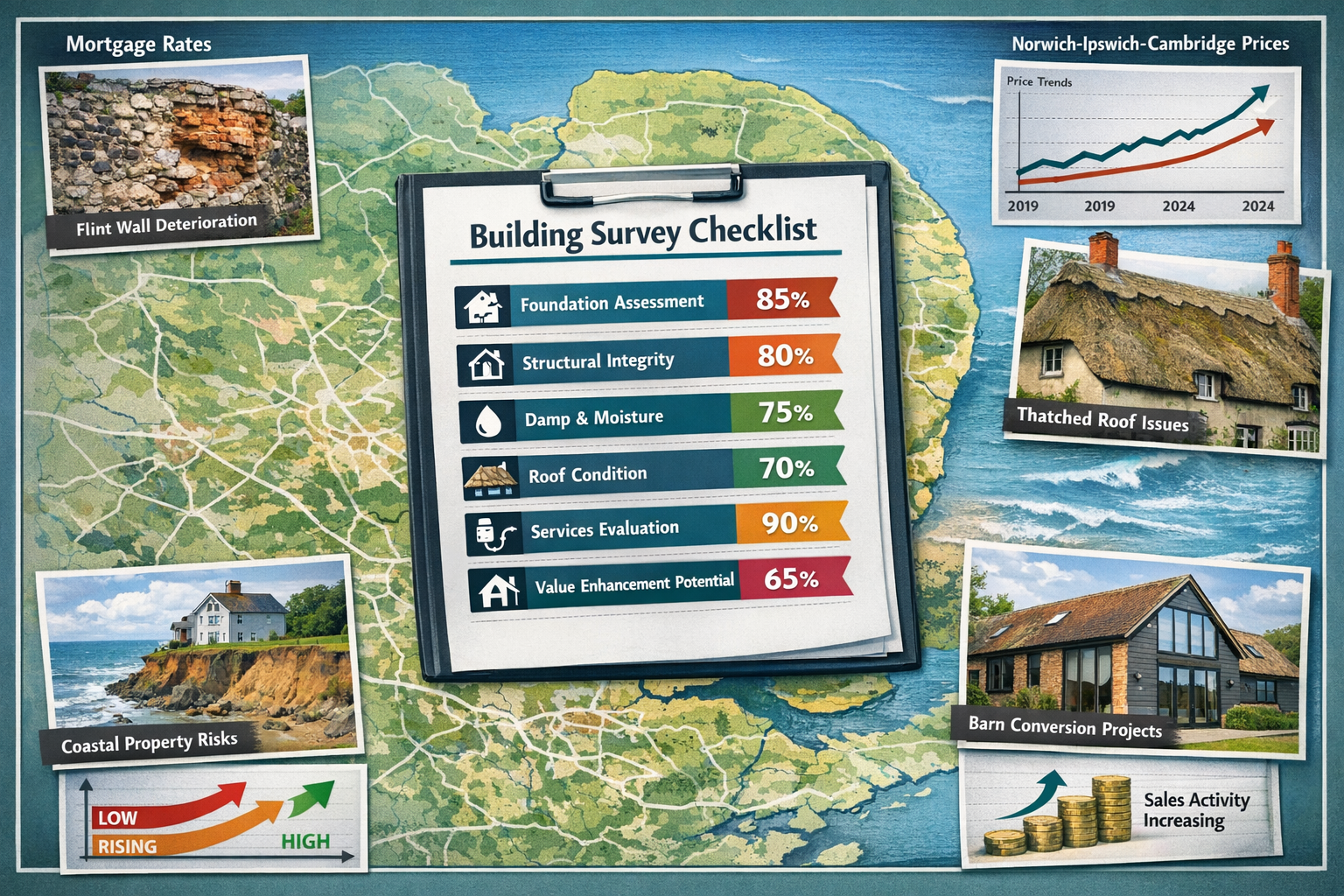
East Anglia's geology presents unique challenges. Much of the region sits on clay substrata prone to movement, while coastal areas feature sandy soils with different load-bearing characteristics. Your checklist should prioritize:
Subsidence and settlement indicators deserve particular attention. Look for:
- Stepped cracking in brickwork (especially near corners and openings)
- Doors and windows that stick or show gaps
- Sloping floors or visible deflection in floor joists
- Cracks wider than 3mm requiring monitoring
- Previous underpinning work and its adequacy
Professional subsidence surveys can quantify movement and determine whether issues are historic, stabilized, or ongoing. In lagging markets, even minor subsidence concerns create significant negotiation leverage—often 10-20% of asking price for remediation costs and risk premium.
Traditional construction methods dominate East Anglia's housing stock:
- Flint and brick construction: Common in Norfolk and Suffolk, requiring inspection for pointing deterioration and water ingress
- Timber-framed buildings: Medieval and Tudor properties need specialist assessment for structural timber condition
- Clay lump construction: Unique to East Anglia, this earth-based material demands moisture management expertise
- Victorian solid wall construction: Prone to damp penetration without cavity protection
Damp, Moisture, and Water Ingress
East Anglia's climate—with coastal humidity and agricultural land drainage patterns—makes moisture management critical. Your survey checklist must include:
Rising damp assessment using electronic moisture meters at multiple wall heights. Many older properties lack damp-proof courses or feature failed Victorian slate DPCs requiring replacement.
Penetrating damp sources to investigate:
- Failed or inadequate guttering and downpipes
- Porous brickwork and deteriorated mortar joints
- Defective roof coverings allowing water ingress
- Ground levels above DPC height
- Bridged cavities (where present)
Condensation and ventilation issues often plague older properties with modern double glazing installed without adequate ventilation upgrades. Check for:
- Mold growth patterns indicating poor air circulation
- Single-glazed windows in need of replacement
- Inadequate heating systems
- Blocked or insufficient airbricks
- Bathroom and kitchen extraction deficiencies
The 10% increase in housing supply means buyers can afford to be selective[1]. Properties with significant damp issues face extended marketing periods—creating opportunities for buyers who understand remediation costs and can negotiate accordingly.
Roof Condition and Weather Protection
East Anglia's exposure to North Sea weather systems places particular stress on roof coverings. Survey checklists should comprehensively assess:
Roof covering condition and remaining lifespan:
- Plain clay tiles (common in period properties): Check for slippage, frost damage, and delamination
- Concrete tiles (post-1950s properties): Assess for weathering and mechanical damage
- Slate roofs: Identify nail sickness, delamination, and missing/slipped slates
- Thatched roofs (Norfolk/Suffolk): Require specialist thatcher inspection for remaining life and fire safety
Roof structure and support elements:
- Rafter and purlin condition, especially for signs of woodworm or rot
- Adequate bracing and wind resistance in exposed locations
- Chimney stack stability and pointing condition
- Valley and flashing integrity at junctions
- Flat roof areas and their waterproofing systems
A roof requiring replacement within 3-5 years represents £8,000-£25,000+ in costs depending on property size and covering type. In a lagging market with -26% price pressure[5], this becomes powerful negotiation ammunition.
Services and Modern Compliance
Older East Anglia properties frequently feature outdated or inadequate services requiring substantial investment:
Electrical installations should be tested for:
- Age and compliance with current regulations (installations over 25 years typically need rewiring)
- Adequate circuit protection and earthing arrangements
- Sufficient socket provision for modern living
- Recent Electrical Installation Condition Report (EICR) availability
- Consumer unit type (modern RCD protection vs. old fuse boxes)
Heating systems require assessment of:
- Boiler age, efficiency rating, and remaining serviceable life
- Radiator coverage and system balancing
- Controls adequacy (room thermostats, TRVs, programmer)
- Pipe and tank condition in older systems
- Alternative heating (oil, LPG, solid fuel) in rural areas
Drainage and water supply:
- Mains connection vs. private supplies (common in rural East Anglia)
- Septic tanks or treatment plants requiring compliance upgrades
- Lead pipework requiring replacement
- Water pressure adequacy
- Surface water drainage and soakaway condition
Properties requiring complete service upgrades can demand £15,000-£40,000 investment—costs that sellers in lagging markets increasingly accept as legitimate price adjustments when supported by professional survey evidence.
Energy Efficiency and Improvement Potential
With energy costs remaining elevated in 2026, properties with poor thermal performance face buyer resistance. Your checklist should evaluate:
Current Energy Performance Certificate (EPC) rating and improvement pathway:
- Properties rated D or below increasingly difficult to market
- Solid wall insulation potential (internal or external)
- Loft insulation depth and effectiveness
- Floor insulation opportunities
- Glazing upgrade requirements
Renewable energy potential:
- Solar PV installation feasibility (roof orientation, structural capacity, planning constraints)
- Heat pump suitability (property insulation standards, radiator sizing, space availability)
- Battery storage integration possibilities
Properties with clear improvement pathways to EPC rating C or above offer genuine value uplift potential. In recovering markets, buyers who identify and execute these improvements capture appreciation as the market strengthens.
Spotting Value Opportunities Through Survey Intelligence
The real power of Building Survey Checklists for East Anglia Lagging Markets: Spotting Opportunities in 2026 Recovery Lags lies not just in identifying defects but in recognizing which issues create disproportionate negotiation leverage while requiring manageable remediation investment.
The Price Reduction Landscape
East Anglia's market dynamics in 2026 strongly favor informed buyers. With 809,000 price reductions logged nationally in 2025—7.8% higher than the previous year[1]—sellers increasingly recognize that properties must be realistically priced. When your survey identifies significant defects, vendors who have already reduced prices once prove far more willing to negotiate further.
Strategic survey timing maximizes leverage. Commission your survey after offer acceptance but structure your offer to reflect "subject to satisfactory survey." When defects emerge, you hold three negotiation positions:
- Price reduction equivalent to remediation costs plus risk premium (typically 15-25% above actual repair costs)
- Vendor remediation before completion (appropriate for urgent safety issues)
- Retention arrangements where funds are held back pending post-completion works
In lagging markets with weak demand (-9% in East Anglia[1]), vendors rarely want transactions to collapse over survey findings. Professional chartered surveyors provide the credible evidence necessary to support renegotiation.
Identifying Cosmetic vs. Structural Issues
Successful opportunity spotting requires distinguishing between:
Cosmetic deterioration that depresses asking prices but requires modest investment:
- Dated kitchens and bathrooms (£8,000-£25,000 replacement)
- Tired decoration throughout (£3,000-£8,000 for professional redecoration)
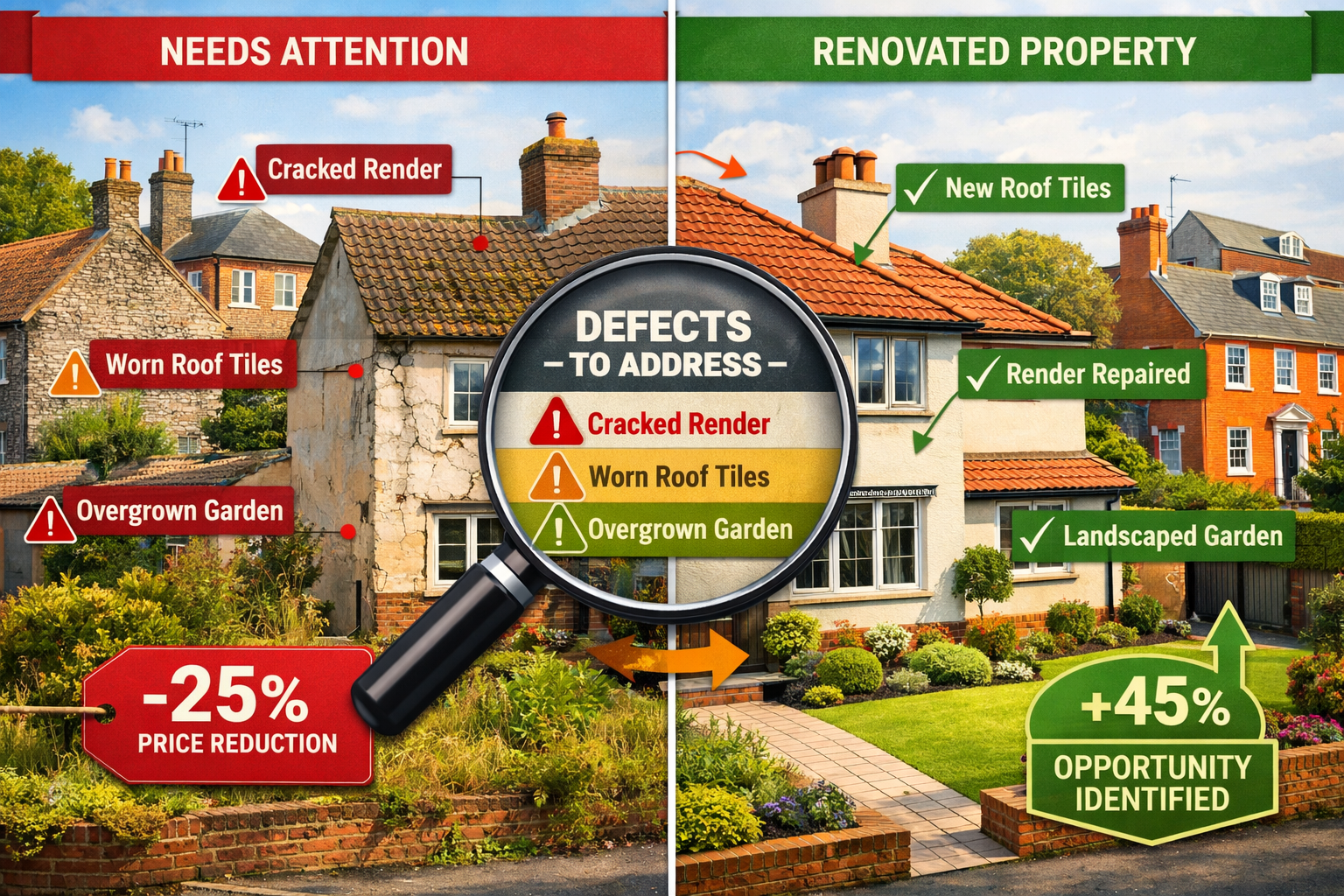
- Overgrown gardens and poor external presentation (£2,000-£5,000 landscaping)
- Worn carpets and flooring (£3,000-£8,000 replacement)
Structural and building fabric issues requiring substantial investment:
- Subsidence requiring underpinning (£15,000-£50,000+)
- Roof replacement (£8,000-£25,000+)
- Complete rewiring (£5,000-£12,000)
- Damp-proofing and replastering (£3,000-£15,000)
- Heating system replacement (£4,000-£12,000)
Properties suffering primarily from cosmetic neglect but with sound structure represent optimal opportunities. The visual impact depresses prices significantly, but remediation costs remain manageable. Conversely, properties with major structural defects may appear superficially acceptable but harbor expensive problems.
Location-Specific Opportunity Mapping
Given the performance variations across East Anglia, opportunity identification requires location-specific analysis:
Outperforming areas (Chelmsford, Ipswich) offer:
- Faster capital appreciation as recovery accelerates
- Stronger rental demand for buy-to-let investors
- Better liquidity when time to sell arrives
- Lower risk of further price deterioration
Properties in these locations with survey-identified defects offer the best risk-adjusted opportunities—you benefit from location strength while purchasing at a discount to market value.
Underperforming areas (coastal communities, deep rural locations) require:
- Longer investment horizons to capture appreciation
- Careful assessment of local employment and demographics
- Understanding of specific location challenges (coastal erosion, flood risk, agricultural economy dependency)
- Realistic expectations about resale timelines
These locations can offer deeper discounts but demand more thorough due diligence. Consider engaging specific defect reports for targeted investigation of particular concerns.
Renovation Potential and Value-Add Strategies
East Anglia's housing stock frequently offers conversion, extension, and reconfiguration opportunities that surveys should identify:
Permitted development potential:
- Loft conversions adding bedroom space (£25,000-£50,000 investment, often adding 15-20% value)
- Single-story rear extensions (£30,000-£60,000 investment)
- Garage conversions creating additional living space
- Outbuilding improvements and home office creation
Planning permission opportunities:
- Two-story extensions on suitable properties
- Annexe buildings for multi-generational living or rental income
- Change of use for agricultural buildings
- Garden plot subdivision in larger grounds
Your survey should assess structural feasibility for these improvements. Properties with clear value-add potential purchased in lagging markets position you to capture appreciation both from market recovery and from improvements executed.
Navigating the 2026 Recovery Timeline
Understanding market timing helps contextualize survey findings and opportunity assessment. The data suggests East Anglia's recovery will be gradual rather than sudden.
Current Market Indicators
Buyer demand improvement from -43% to -9%[1] represents significant progress but remains negative. This suggests:
- Continued buyer leverage in negotiations for 6-12 months
- Gradual absorption of excess inventory
- Sustained opportunity for survey-backed price reductions
- Time to be selective and thorough in due diligence
Mortgage rate improvements to four-year lows[4] are beginning to filter through to demand. However, the lag between rate reductions and transaction volumes typically spans 6-9 months, meaning:
- Current weak demand won't persist indefinitely
- Early movers capture best opportunities before competition intensifies
- Survey-identified defects provide maximum leverage now, less so as demand strengthens
12-month price expectations show surveyors predicting +33% net balance growth[5]. This forward-looking optimism contrasts sharply with current -26% price pressure[5], indicating professionals expect conditions to improve substantially. The implication: properties purchased now at survey-negotiated discounts should benefit from both the discount and subsequent market appreciation.
Sector-Specific Considerations
Different property types within East Anglia face varying recovery trajectories:
Period properties (pre-1919) with character features:
- Currently face buyer resistance due to energy efficiency concerns
- Require highest survey scrutiny for structural and services issues
- Offer greatest value uplift potential when improved
- Benefit most from EPC improvement investments
Interwar and post-war properties (1919-1970):
- More standardized construction simplifies survey assessment
- Common defects well-understood (concrete cancer, cavity wall tie failure, asbestos)
- Easier to improve energy efficiency
- Steady demand from families seeking move-in condition
Modern properties (post-1980):
- Lower survey risk but still require assessment
- Focus on build quality, snagging issues, and warranty coverage
- Less negotiation leverage from surveys unless significant defects present
- Consider snagging report services for new builds
Risk Management Through Comprehensive Surveys
In lagging markets, comprehensive surveys serve dual purposes: identifying negotiation opportunities and preventing catastrophic purchases.
False economy of limited surveys: Basic condition reports or mortgage valuations provide insufficient detail for older East Anglia properties. The £400-£600 saved by avoiding a full Level 3 survey pales against the £20,000+ costs of undiscovered defects.
Specialist investigations complement building surveys when specific concerns arise:
- Structural engineer reports for significant movement or alterations
- Timber and damp specialists for extensive rot or beetle infestation
- Drainage surveys using CCTV for older systems
- Asbestos surveys for properties built 1950-1999
- Electrical testing and gas safety inspections
Insurance and warranty considerations: Survey findings affect buildings insurance premiums and availability. Undisclosed subsidence, flooding history, or structural alterations can void coverage. Professional surveys provide the documentation insurers require and protect against non-disclosure claims.
Practical Implementation: Your Survey Action Plan
Translating Building Survey Checklists for East Anglia Lagging Markets: Spotting Opportunities in 2026 Recovery Lags into actionable strategy requires systematic implementation.
Step 1: Property Identification and Initial Assessment
Before commissioning surveys, conduct preliminary screening:
Location analysis: Focus on areas with:
- Strong fundamentals (employment, transport, amenities) but temporary price weakness
- Chelmsford and Ipswich for lower risk[1]
- Carefully selected rural and coastal areas for higher potential returns
- Proximity to chartered surveyor coverage areas for convenient inspection access
Property age and type matching to survey requirements:
- Pre-1919: Level 3 survey mandatory
- 1919-1970: Level 3 survey recommended
- Post-1970: Level 2 survey minimum, Level 3 if concerns exist
- Conversions, non-standard construction, or previous alterations: Level 3 survey essential
Vendor signals indicating negotiation potential:
- Extended time on market (90+ days)
- Previous price reductions
- Motivated sale circumstances (probate, divorce, relocation)
- Limited recent maintenance or improvement
- Dated presentation suggesting deferred maintenance
Step 2: Commissioning Comprehensive Surveys
Select appropriately qualified professionals:
RICS-qualified surveyors with local East Anglia experience understand regional construction methods, common defects, and local market conditions. Their reports carry weight in renegotiations because vendors' solicitors and agents recognize their credibility.
Specialist expertise for particular property types:
- Period property specialists for pre-1850 buildings
- Agricultural building conversion experts for barn conversions
- Coastal property specialists understanding salt exposure and erosion
- Thatched property specialists for Norfolk/Suffolk cottages
Survey scope clarity: Brief your surveyor on:
- Your renovation intentions and budget
- Specific concerns from viewing
- Intended use (owner-occupation, rental, development)
- Timeline for any planned works
Quality surveyors provide not just defect identification but also:
- Remediation cost estimates
- Prioritization of urgent vs. long-term issues
- Improvement recommendations
- Maintenance schedules
Step 3: Survey Analysis and Negotiation Strategy
When your survey report arrives, systematic analysis maximizes leverage:
Defect categorization by urgency and cost:
- Category 1 (Urgent): Immediate safety risks requiring action before occupation
- Category 2 (Significant): Defects requiring attention within 12-24 months
- Category 3 (Moderate): Issues requiring monitoring or longer-term attention
Cost quantification for all identified issues:
- Obtain contractor quotes for major works
- Add 15-20% contingency for unforeseen complications
- Include professional fees (architects, structural engineers, planning consultants)
- Factor in temporary accommodation costs if works require vacation
Negotiation positioning based on market conditions:
- In current weak demand environment, aim for 100-125% of remediation costs
- Present survey findings professionally with supporting quotes
- Offer vendor choice: price reduction or remediation before completion
- Be prepared to walk away if vendor unreasonable—other opportunities exist
Legal protection through:
- Survey findings incorporated into contract conditions
- Specific warranty exclusions if vendor won't negotiate
- Retention arrangements for disputed items
- Insurance policy review ensuring coverage for known issues
Step 4: Post-Purchase Value Realization
Successful opportunity capture requires disciplined execution after purchase:
Prioritized remediation addressing:
- Safety and compliance issues first (electrical, gas, structural)
- Weather protection second (roof, gutters, external walls)
- Internal improvements third (damp treatment, decoration, kitchens/bathrooms)
- Energy efficiency upgrades throughout
Value-add improvements timed for maximum return:
- Execute permitted development works within first 12 months
- Submit planning applications early if required
- Complete EPC improvements before next valuation
- Maintain comprehensive records of all works for future sale
Market monitoring to optimize exit timing:
- Track East Anglia demand indicators for recovery signals
- Monitor comparable sales in your specific location
- Reassess when buyer demand returns to positive territory
- Consider refinancing to extract equity if holding long-term
Regional Resources and Professional Support
Successfully implementing Building Survey Checklists for East Anglia Lagging Markets: Spotting Opportunities in 2026 Recovery Lags requires access to qualified professionals and local expertise.
Surveying and Technical Professionals
While East Anglia-specific surveyors provide optimal local knowledge, firms with regional coverage across the South East and surrounding areas offer valuable expertise. Professional chartered surveyors in London frequently extend services into East Anglia, bringing metropolitan standards and comprehensive experience.
For properties in specific locations, consider surveyors with proven track records in:
- Surrey for properties in western East Anglia
- Hertfordshire for properties in southwestern areas
- Essex specialists for properties in southeastern locations
Specialist Consultants
Complex projects may require additional expertise:
Structural engineers for:
- Significant movement or subsidence assessment
- Extension and conversion feasibility studies
- Beam calculations and structural alterations
- Foundation design for new works
Architectural services for:
- Planning application preparation
- Building regulation compliance
- Design optimization for value-add projects
- Listed building and conservation area expertise
Quantity surveyors for:
- Detailed cost estimation for major works
- Tender preparation and contractor selection
- Project cost management
- Valuation of completed improvements
Legal and Financial Advisors
Property transactions in lagging markets with survey complications require experienced support:
Conveyancing solicitors with:
- Experience handling survey-based renegotiations
- Understanding of retention arrangements
- Expertise in warranty and insurance implications
- Local authority search interpretation
Mortgage brokers who:
- Understand lender requirements for properties with defects
- Access specialist lenders for non-standard construction
- Structure finance to accommodate renovation costs
- Advise on bridging finance for uninhabitable properties
Tax advisors for:
- Capital Gains Tax planning on investment properties
- Stamp Duty Land Tax optimization
- VAT recovery on conversion projects
- Inheritance Tax implications of property portfolios
Conclusion
The 2026 property market presents a compelling opportunity for informed buyers in East Anglia. While the region continues to lag national recovery trends—with buyer demand at -9%, downward price pressure at -26%, and persistent affordability challenges[1][5]—these very weaknesses create the conditions for value capture through comprehensive due diligence.
Building Survey Checklists for East Anglia Lagging Markets: Spotting Opportunities in 2026 Recovery Lags provides the framework for identifying properties where defects create negotiation leverage, where remediation costs remain manageable relative to value uplift potential, and where location fundamentals support medium-term appreciation. The data suggests recovery is coming—surveyors predict +33% price growth over the next 12 months[5], mortgage rates have reached four-year lows[4], and buyer demand is improving from deeply negative levels[1].
The window for maximum opportunity remains open but won't last indefinitely. As demand continues recovering and inventory is absorbed, buyer leverage will diminish. Properties purchased now with comprehensive survey intelligence—identifying defects worth £20,000 in remediation but securing £30,000+ in price reductions—position investors to benefit from both the discount and subsequent market appreciation.
Actionable Next Steps
✅ Identify target locations within East Anglia, prioritizing Chelmsford and Ipswich for lower risk or carefully selected rural/coastal areas for higher potential returns
✅ Shortlist properties showing motivated vendor signals: extended marketing periods, price reductions, dated presentation, or deferred maintenance
✅ Commission Level 3 Building Surveys from RICS-qualified surveyors with regional expertise and appropriate specialist knowledge for your property type
✅ Analyze survey findings systematically, categorizing defects by urgency and cost, obtaining contractor quotes, and developing negotiation strategy
✅ Negotiate confidently using professional survey evidence, aiming for 100-125% of remediation costs in price reductions given current market weakness
✅ Execute improvements strategically, prioritizing safety and weather protection, then value-add works that enhance marketability and EPC ratings
✅ Monitor market indicators for recovery signals, positioning yourself to refinance or sell when East Anglia demand returns to positive territory
The combination of weak current demand, improving fundamentals, and positive forward outlook creates ideal conditions for survey-informed property acquisition. Those who act now with comprehensive due diligence will capture the greatest opportunities in East Anglia's 2026 recovery lag.
References
[1] East Of England Regional Market Report – https://www.fineandcountry.co.uk/insights/property-market-reports/east-of-england-regional-market-report
[2] Uk Resi Survey Jan 2026 Report Shows Early Signs Market Recovery Despite Caution – https://www.rics.org/news-insights/uk-resi-survey-jan-2026-report-shows-early-signs-market-recovery-despite-caution
[3] 2026 A Year Of Measured Recovery For Real Estate – https://mrgglobal.com/2026-a-year-of-measured-recovery-for-real-estate/
[4] Uk Property March 2026 – https://www.garrington.co.uk/market-review/uk-property-march-2026/
[5] House Prices – https://moneyweek.com/investments/house-prices/house-prices