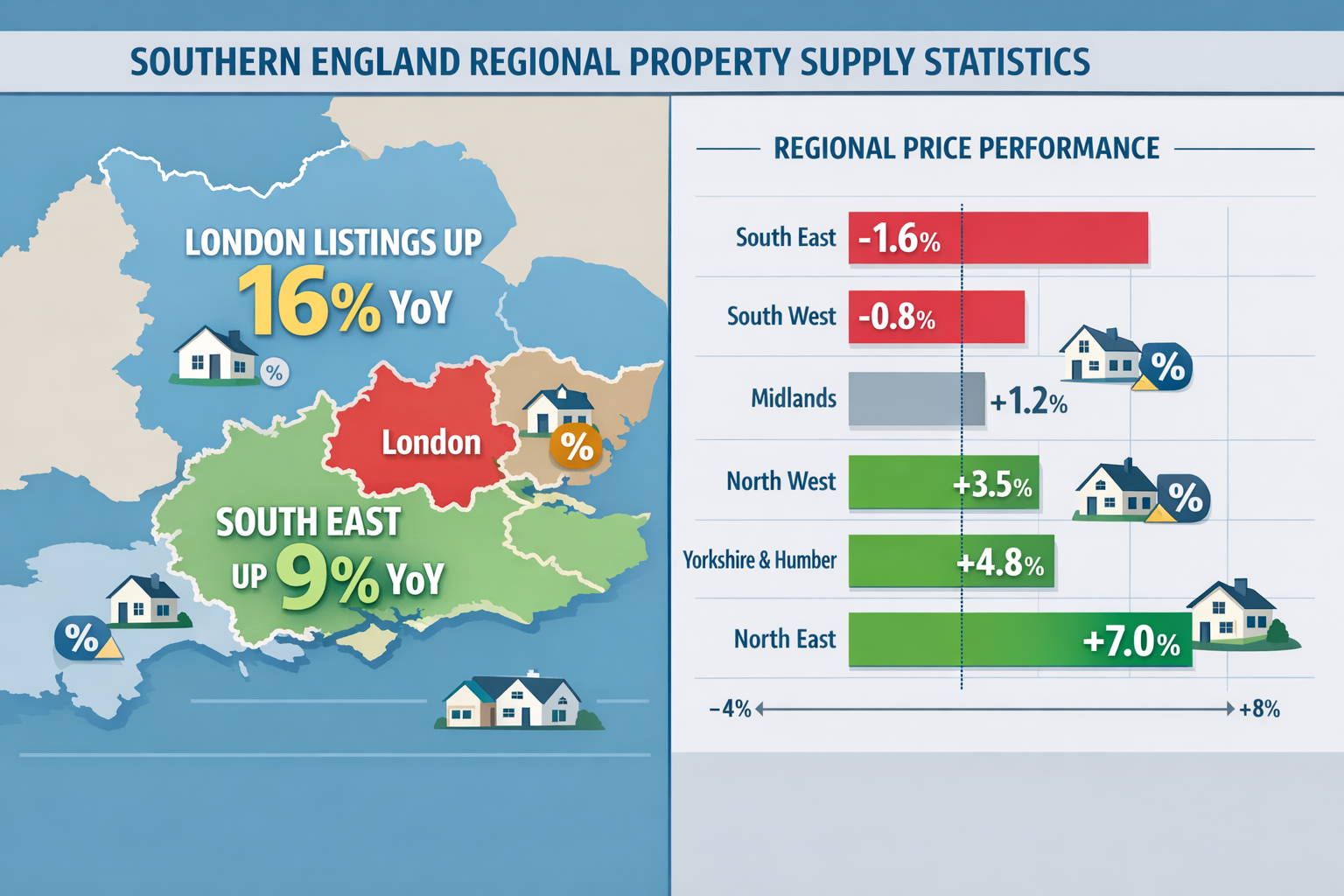
The southern England property market is experiencing a dramatic shift in 2026. Listings in London have surged 16% year-over-year, while the South East has seen a 9% increase, creating unprecedented challenges for property valuers navigating this supply-driven landscape. As Budget uncertainty continues to ripple through the market and buyers become increasingly price-sensitive, understanding the Valuation Risks in 2026 Southern England Supply Surge: Surveyor Strategies for Increased Listings has never been more critical for professionals conducting accurate property assessments.
This supply surge comes at a pivotal moment when southern England faces distinct regional headwinds. While property stock levels nationally have reached their highest point since 2014[2], the concentration of new listings in the South creates specific valuation complexities that surveyors must address with precision and strategic insight.
Key Takeaways
- 📊 Southern England listings have increased significantly with London up 16% and South East up 9% year-over-year, creating downward pressure on valuations
- 📉 The South East recorded a -1.6% annual price decline in early 2026, contrasting sharply with northern regions experiencing growth up to 7.0%[5]
- 🏘️ Property stock levels are at their highest since 2014, giving buyers greater negotiating power and requiring surveyors to adjust comparable analysis methods[2]
- 💰 Affordability constraints remain binding in higher-priced southern areas, where average London flat prices exceed £539,000—more than double prices in northern regions[4]
- 🎯 Strategic surveyor approaches including enhanced comparable analysis, supply-demand modeling, and risk-adjusted valuations are essential for accurate assessments in 2026
Understanding the 2026 Southern England Supply Surge Context
Regional Market Dynamics Driving Increased Listings
The 2026 supply surge in southern England represents a fundamental market recalibration. After years of constrained inventory, sellers are responding to improved mortgage conditions and renewed buyer confidence. Post-Christmas buyer demand increased by more than 50% nationally in early 2026, while new listings surged over 80%[2], indicating genuine transactional momentum rather than speculative activity.
However, this supply response is geographically uneven. Southern England's listing increases significantly outpace other regions, creating localized oversupply conditions in specific submarkets. For surveyors conducting property valuations in London, this means traditional comparable analysis requires more nuanced adjustment for current market velocity.
Budget Uncertainty and Buyer Behavior
Political and fiscal uncertainty following recent Budget announcements has made southern England buyers particularly cautious. Price sensitivity has intensified as purchasers recognize they have greater negotiating leverage with expanded choice. This behavioral shift directly impacts valuation methodology, as historical transaction data may not fully reflect current buyer willingness to pay.
The combination of increased supply and heightened caution creates what industry professionals term a "buyer's market"—a condition requiring surveyors to weight recent comparable sales more heavily than historical averages when determining current market value.
The North-South Divide in 2026
Perhaps the most striking feature of the 2026 market is the stark regional performance divergence. While the South East experienced a -1.6% annual price decline, the North East saw a remarkable 7.0% monthly price increase in January 2026[5]. This disparity reflects fundamental differences in affordability, with average London flat prices of approximately £539,000 more than double the average prices in Scotland, Wales, Northern Ireland, and northern England[4].
For surveyors working across regional boundaries, this divergence necessitates distinct valuation frameworks. Approaches suitable for assessing properties in Oxfordshire or Sussex may require significant modification compared to northern England methodologies.
Valuation Risks in 2026 Southern England Supply Surge: Key Challenges for Surveyors

Comparable Sales Analysis in High-Supply Environments
The primary valuation risk surveyors face in 2026's supply surge is the reliability of comparable sales data. Traditional valuation methodology relies on recent, similar property transactions to establish market value. However, when supply increases rapidly, the time-adjusted relevance of comparables deteriorates faster than in balanced markets.
Consider this practical challenge: A surveyor valuing a semi-detached property in Guildford in March 2026 might reference comparable sales from December 2025. But if local listings increased 25% during that three-month period, those December comparables may reflect a fundamentally different supply-demand balance, potentially overstating current market value by 3-7%.
Strategic solutions include:
- Shortening comparable timeframes from the standard 6 months to 3 months or less
- Applying supply-adjustment factors based on quantified listing increases
- Weighting recent transactions more heavily in valuation calculations
- Incorporating withdrawn listing data to understand failed pricing strategies
Price Expectation Gaps and Negotiation Dynamics
The supply surge has created significant gaps between seller expectations and buyer willingness to pay. Many sellers list properties based on peak 2021-2022 valuations or outdated comparable data, while buyers armed with extensive choice push for discounts.
For surveyors, this creates a critical question: Should valuations reflect asking prices, agreed prices, or completed transaction prices? Each metric tells a different story in high-supply markets:
| Metric | 2026 Southern England Trend | Valuation Implication |
|---|---|---|
| Average Asking Price | Declining slowly, lagging market reality | May overstate current market value |
| Agreed Sale Price | Declining faster, reflecting negotiations | Better indicator of buyer sentiment |
| Completed Price | Most accurate but 8-12 weeks delayed | Historical accuracy but timing lag |
Professional surveyors must clearly communicate which metric their valuation reflects and adjust methodology accordingly. For matrimonial valuations or probate valuations, this distinction carries significant legal and financial implications.
Property Type Performance Variations
Not all property types experience the supply surge equally. Semi-detached houses are leading appreciation at 2.4% annual growth, followed by detached houses at 2.2%[4], while flats in urban centers face greater pressure from increased supply.
This creates type-specific valuation risks:
- 🏢 Flats in London face oversupply in specific postcodes, particularly new-build developments
- 🏡 Family homes with gardens in commuter belt locations maintain stronger demand
- 🏘️ Period properties with character features show more resilient pricing
- 🏗️ New-build developments face particular pressure as builders increase supply
Surveyors must incorporate property type performance data into their analysis, recognizing that broad regional trends may not apply uniformly across housing categories.
Affordability Constraints and Mortgage Accessibility
Despite mortgage rates easing significantly from 2023-24 peaks and approaching pre-mini-Budget levels[2], affordability constraints remain binding in southern England. The combination of high absolute prices and elevated price-to-income ratios means many potential buyers remain priced out, even with improved lending conditions.
This affordability ceiling creates a valuation risk at the upper end of the market. Properties priced above £750,000 in southern England face a dramatically smaller buyer pool, potentially leading to extended marketing periods and eventual price reductions. Surveyors conducting Red Book valuations must factor this demand constraint into their market value assessments.
Surveyor Strategies for Increased Listings: Professional Best Practices
Enhanced Due Diligence and Market Intelligence
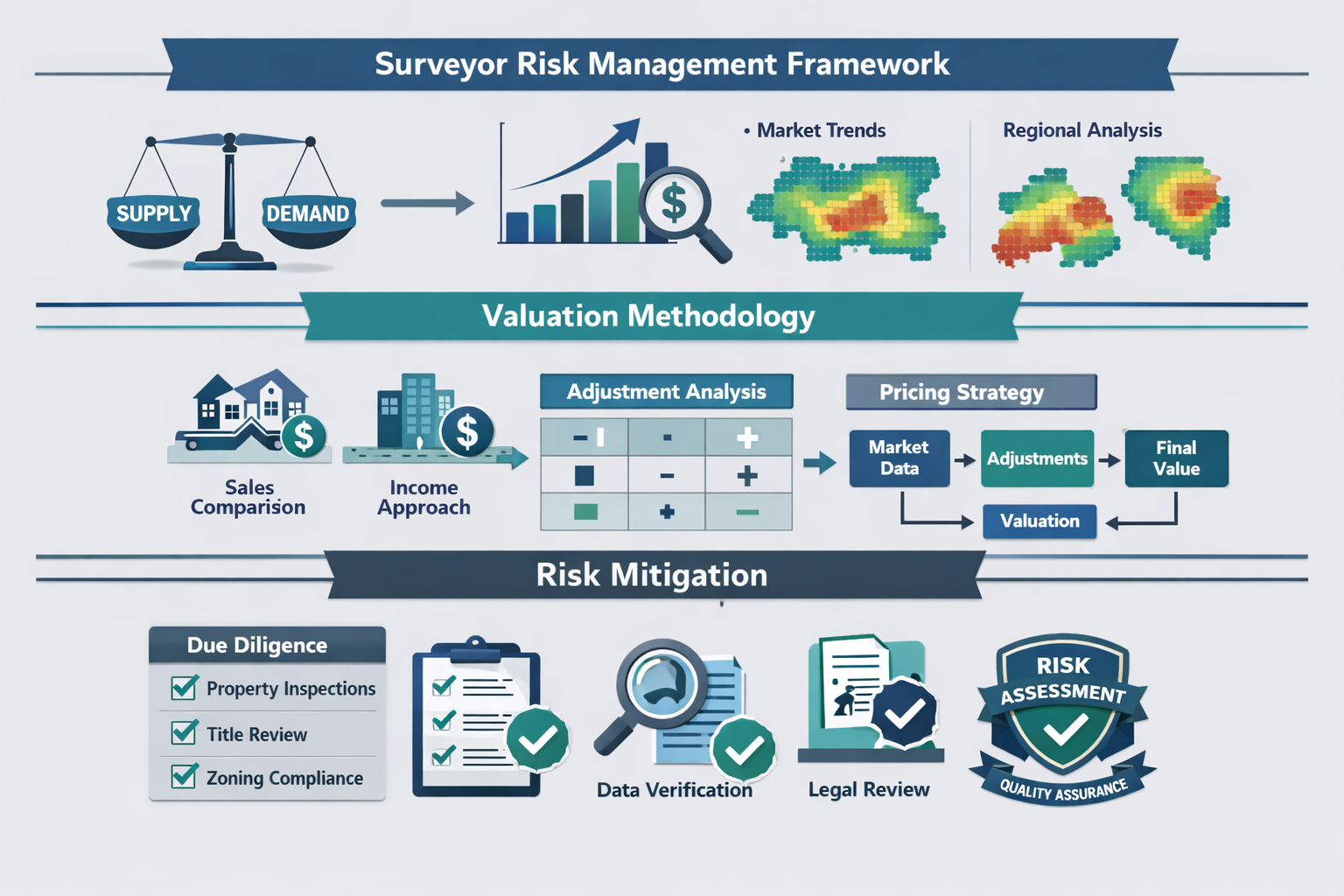
Successful navigation of the Valuation Risks in 2026 Southern England Supply Surge requires surveyors to expand their market intelligence gathering beyond traditional sources. Best practice approaches include:
Real-time listing monitoring 📱
Track active listings, new instructions, and price reductions in target postcodes using multiple property portals. Quantify supply changes month-over-month to establish trend direction.
Agent relationship development 🤝
Maintain regular contact with local estate agents to understand buyer sentiment, negotiation patterns, and typical discount levels from asking to agreed prices.
Submarket segmentation 🗺️
Recognize that broad regional data masks significant local variations. A West London postcode may perform entirely differently from a South West London location despite geographic proximity.
Transaction velocity analysis ⚡
Monitor days-on-market trends as a leading indicator of supply-demand balance shifts before they appear in price data.
Supply-Adjusted Valuation Methodology
Traditional valuation approaches require modification in high-supply environments. Professional surveyors are implementing supply-adjusted methodologies that explicitly account for listing increases:
Step 1: Establish Baseline Value
Begin with standard comparable sales analysis using the most recent transactions available, preferably within 8-12 weeks.
Step 2: Quantify Supply Change
Calculate the percentage increase in active listings for the specific property type and location over the past 3-6 months.
Step 3: Apply Adjustment Factor
Research suggests that a 10% increase in supply typically correlates with a 1-2% downward pressure on values in the short term, though this varies by location and property type.
Step 4: Validate with Market Evidence
Cross-reference the adjusted valuation against recent asking-to-agreed price ratios and withdrawn listings to ensure reasonableness.
This systematic approach provides defensible valuations that reflect current market realities rather than historical data that may no longer apply.
Risk Disclosure and Client Communication
Perhaps the most critical strategy for surveyors in 2026 is transparent risk communication. Valuation reports should explicitly address:
✅ Market condition context – Clearly state that valuations are conducted during a period of elevated supply and market adjustment
✅ Methodology limitations – Acknowledge the reduced reliability of historical comparables in rapidly changing markets
✅ Valuation range provision – Consider providing a valuation range (e.g., £475,000-£495,000) rather than a single point estimate when uncertainty is elevated
✅ Marketing period assumptions – Specify expected time-to-sale assumptions, which may be extended in high-supply conditions
✅ Scenario analysis – For commercial or high-value residential work, provide alternative valuations under different supply-demand scenarios
This transparency protects both the surveyor and the client, ensuring informed decision-making based on realistic market assessments.
Technology Integration and Data Analytics
Forward-thinking surveyors are leveraging technology solutions to enhance valuation accuracy in complex markets:
- Automated valuation models (AVMs) as supplementary data points, though not replacements for professional judgment
- Geographic information systems (GIS) to visualize supply concentrations and identify oversupply hotspots
- Predictive analytics tools that incorporate supply trends, economic indicators, and historical patterns
- Digital comparable databases enabling rapid analysis of larger transaction datasets
For firms offering commercial property surveying services, these technologies provide competitive advantages in delivering timely, data-driven valuations.
Continuous Professional Development
The 2026 market environment demands ongoing education and skill development. Professional surveyors should prioritize:
- 📚 RICS guidance updates on valuation in uncertain markets
- 📊 Economic forecasting training to better anticipate market movements
- 🏛️ Regional market specialization rather than generalist approaches
- 💼 Client advisory skills to effectively communicate complex market dynamics
Organizations like RICS provide specialized courses addressing valuation challenges in transitional markets, equipping surveyors with frameworks for navigating the current southern England environment.
Regional Opportunities Within the Southern England Market
Commuter Belt Resilience
While broad southern England trends show supply pressure, specific submarkets demonstrate resilience. London and the South East are expected to benefit from renewed confidence and falling mortgage rates, particularly within the commuter belt and prime suburban markets[2].
Areas offering reasonable train access to London while providing more space and affordability—such as St Albans, Watford, and Leatherhead—show stronger demand fundamentals that may offset general supply increases.
Surveyors should differentiate between urban core and commuter belt properties when assessing valuation risk, as these submarkets operate under different demand drivers.
Property Type Opportunities
The data clearly indicates that not all property types face equal risk. Semi-detached and detached houses continue to show positive growth trajectories[4], suggesting family homes with outdoor space maintain strong appeal despite supply increases.
For surveyors, this creates opportunities to provide nuanced, property-specific advice rather than applying blanket regional assumptions. A four-bedroom detached house in Buckinghamshire faces fundamentally different market dynamics than a one-bedroom flat in central London, even though both fall within the southern England region.
Long-term Structural Support
Despite near-term supply pressures, fundamental undersupply continues to support southern England values over the medium term. UK government housing supply targets of 370,000 new homes per year in England are not being met, with current rates requiring more than doubling[4].
This structural deficit means the 2026 supply surge represents a temporary rebalancing rather than oversupply, providing confidence that well-priced properties will find buyers and that valuations conducted with appropriate methodology will prove accurate over time.
Future Outlook: Preparing for Market Evolution
Projected Growth Trajectories
UK property price growth projections for 2026 center on 2-3% annually[2], with regional variations expected to favor the Midlands, North of England, Scotland, and Wales. This implies relatively weaker growth in southern England, though not necessarily price declines in most areas.
Zoopla forecasts subdued growth in southern England despite supply increases, with buyers remaining price-sensitive as greater housing availability comes to market[1]. This "slow growth" scenario requires surveyors to adopt conservative valuation approaches, avoiding optimistic assumptions about near-term appreciation.
Adaptive Strategies for Changing Conditions
The most successful surveyors in 2026 and beyond will demonstrate adaptive capacity—the ability to modify methodologies as market conditions evolve. This includes:
- 🔄 Regular methodology reviews (quarterly rather than annually)
- 📈 Scenario planning frameworks for different market trajectories
- 🎯 Submarket specialization to develop deep local expertise
- 🤝 Collaborative approaches sharing insights across professional networks
As the market continues to adjust throughout 2026, flexibility and responsiveness will distinguish exceptional surveyors from those applying outdated approaches.
Professional Standards and Regulatory Compliance
Maintaining rigorous adherence to RICS Valuation Standards remains paramount, particularly in challenging market conditions. The Red Book provides clear guidance on valuation uncertainty, market conditions disclosure, and professional judgment application—all directly relevant to the 2026 southern England context.
Surveyors must ensure their practices fully comply with these standards while adapting to market realities, documenting their reasoning and assumptions thoroughly to support their professional conclusions.
Conclusion
The Valuation Risks in 2026 Southern England Supply Surge present significant challenges for property surveyors, but also opportunities for professionals who adapt their methodologies and embrace strategic approaches. With London listings up 16% and South East listings up 9% year-over-year, the market has fundamentally shifted toward a buyer-favorable environment requiring careful, data-driven valuation practices.
Key strategic imperatives for surveyors include:
✅ Shortening comparable analysis timeframes and applying supply-adjustment factors
✅ Differentiating between property types and submarkets rather than applying broad regional assumptions
✅ Enhancing market intelligence gathering through technology and professional relationships
✅ Communicating valuation uncertainty transparently with clients
✅ Maintaining RICS compliance while adapting to evolving market conditions
The regional performance divergence between southern and northern England, combined with property type variations and affordability constraints, demands nuanced, sophisticated valuation approaches. Surveyors who invest in continuous professional development, leverage data analytics, and maintain flexibility in their methodologies will navigate this challenging environment successfully.
Next Steps for Property Professionals:
- Audit your current valuation methodology to ensure it adequately addresses supply surge impacts
- Develop submarket expertise in your primary service areas rather than relying on broad regional data
- Invest in technology tools that enhance market intelligence and comparable analysis
- Strengthen client communication around valuation uncertainty and market conditions
- Engage with professional development opportunities focused on valuation in transitional markets
The 2026 southern England market represents a pivotal moment requiring professional excellence, strategic thinking, and adaptive capacity. Surveyors who rise to this challenge will not only navigate current conditions successfully but position themselves as trusted advisors capable of guiding clients through complex market environments for years to come.
References
[1] Revealed The 10 Uk Locations Which Could See The Biggest House Price Growth In 2026 – https://moneyweek.com/investments/house-prices/revealed-the-10-uk-locations-which-could-see-the-biggest-house-price-growth-in-2026
[2] The Uk Property Market Enters 2026 With Renewed Confidence And Strong Momentum – https://www.aucklandestates.com/news/the-uk-property-market-enters-2026-with-renewed-confidence-and-strong-momentum/
[3] Watch – https://www.youtube.com/watch?v=QNEZeLc3THs
[4] Uk Price Forecasts – https://investropa.com/blogs/news/uk-price-forecasts
[5] Valuation Strategies For Northern Englands 2026 Price Surge Outpacing Southern Affordability Challenges – https://nottinghillsurveyors.com/blog/valuation-strategies-for-northern-englands-2026-price-surge-outpacing-southern-affordability-challenges