
The resurgence of property transaction volumes in 2026 has exposed a critical vulnerability in the UK conveyancing system: council search backlogs that delay completions by weeks or even months. When these delays trigger financial losses, disputes inevitably follow—and expert witnesses become essential to resolving them. Understanding Expert Witness Roles in 2026 Local Searches Backlog Disputes: Evidence Strategies for Delayed Completions is now crucial for surveyors, solicitors, and property professionals navigating this challenging landscape.
As transaction activity rebounds following years of market volatility, local authorities struggle to process search requests within reasonable timeframes. Buyers face extended mortgage offer expiries, sellers encounter chain collapses, and both parties suffer quantifiable financial harm. In these circumstances, expert witnesses—particularly RICS-qualified chartered surveyors—provide the evidential foundation for compensation claims, tribunal submissions, and litigation strategies.
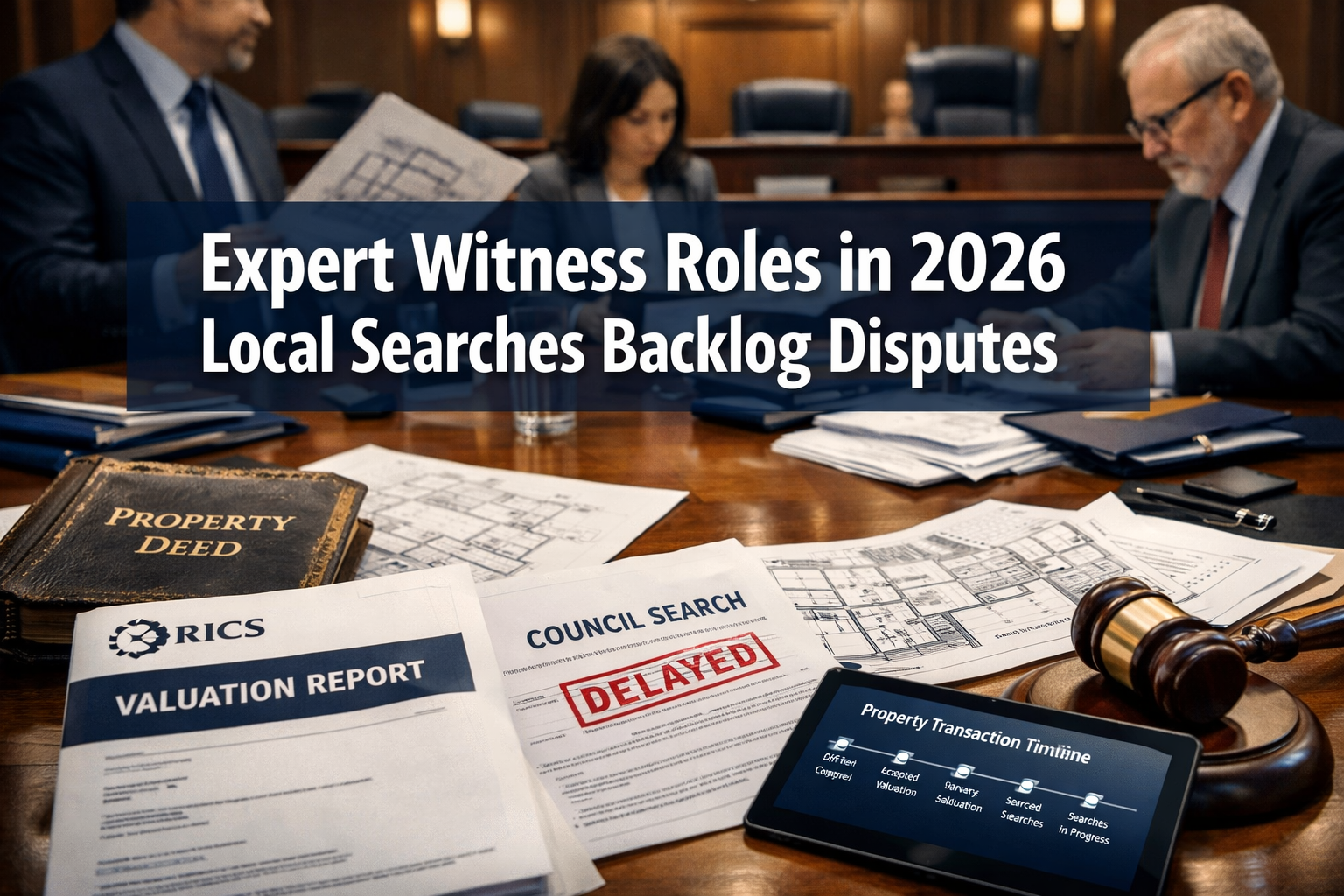
Key Takeaways
- Expert witnesses provide critical valuation evidence linking council search delays to quantifiable financial losses in property transactions during 2026's increased market activity
- RICS data and methodology form the backbone of credible tribunal submissions, establishing industry-standard timelines and demonstrating causation between delays and damages
- Admissibility standards have tightened following December 2023 amendments to Federal Rules of Evidence 702, requiring more rigorous documentation of expert qualifications and methodology
- Strategic evidence compilation must include council correspondence, comparative market analysis, and detailed financial impact calculations to withstand cross-examination
- Proactive engagement of expert witnesses early in dispute processes significantly improves claim success rates and settlement negotiations
Understanding the 2026 Local Searches Crisis
The Backlog Phenomenon
Local authority searches remain a fundamental component of UK property transactions, revealing planning permissions, building control approvals, environmental risks, and other critical information. However, 2026 has witnessed unprecedented delays as councils face:
- Staff shortages following years of budget constraints
- Technology infrastructure gaps preventing digital processing efficiency
- Surging demand as property markets recover from previous downturns
- Regulatory changes requiring additional verification steps
Standard search turnaround times of 10-15 working days have extended to 6-12 weeks in many jurisdictions, creating a cascade of problems throughout transaction chains. When mortgage offers expire, interest rates change, or buyers withdraw due to delays, the question becomes: who bears responsibility for resulting financial losses?
Financial Impact on Stakeholders
The consequences of search delays extend far beyond mere inconvenience:
For Buyers:
- Expired mortgage offers requiring reapplication at potentially higher rates
- Additional accommodation costs during extended waiting periods
- Lost deposit amounts when transactions collapse
- Opportunity costs from missing alternative properties
For Sellers:
- Continued property ownership expenses (mortgage, insurance, utilities)
- Lost sale proceeds preventing onward purchases
- Chain collapse triggering multiple transaction failures
- Market value deterioration during extended sale periods
For Professionals:
- Solicitor liability claims for inadequate delay management
- Estate agent commission disputes
- Surveyor negligence allegations regarding timing advice
These tangible losses require expert quantification to support compensation claims[5].
Expert Witness Roles in 2026 Local Searches Backlog Disputes: Evidence Strategies for Delayed Completions
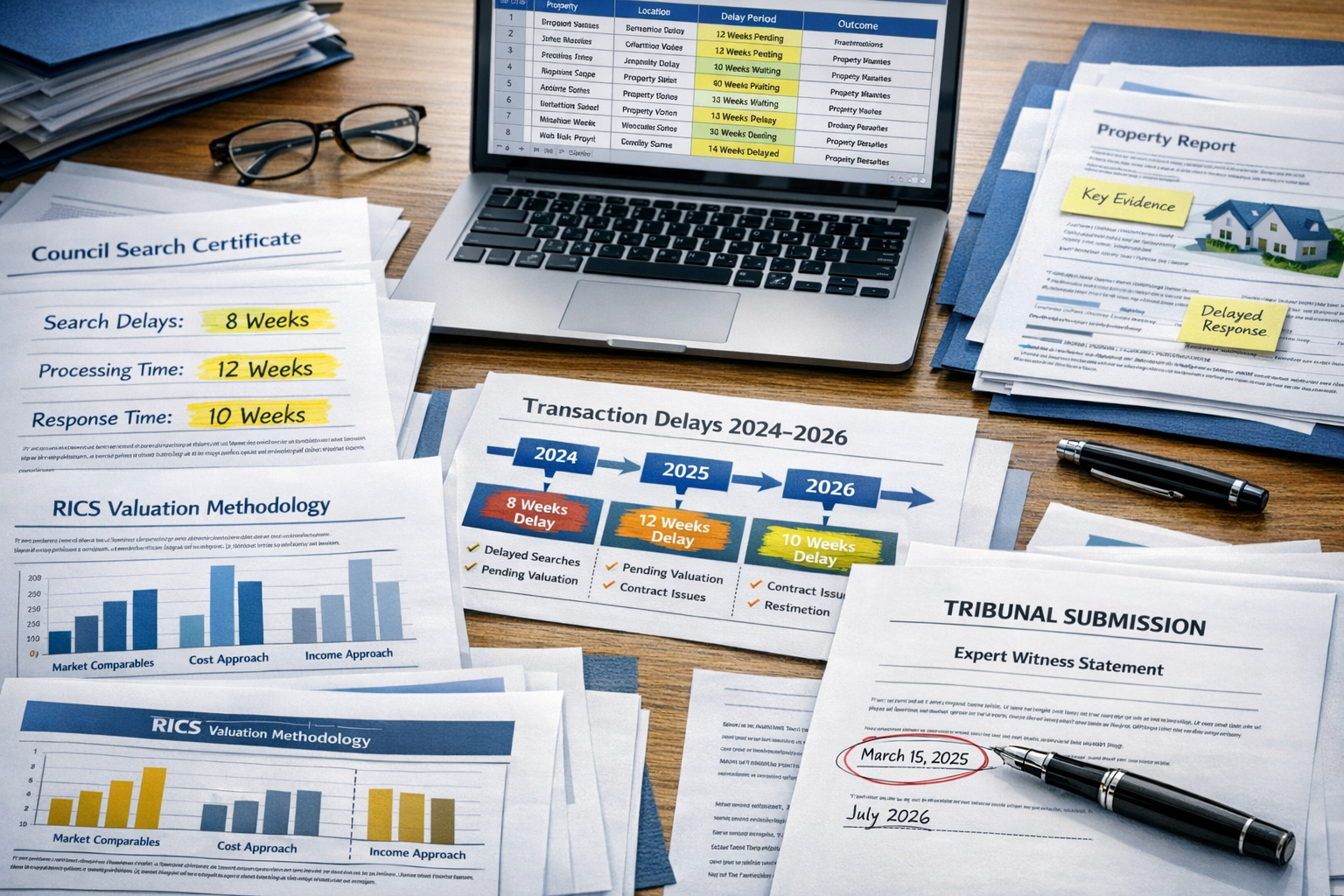
Defining the Expert Witness Function
In local searches backlog disputes, expert witnesses serve multiple critical functions that distinguish them from ordinary witnesses. Their role encompasses:
Independent Assessment: Expert witnesses must provide unbiased, objective analysis regardless of which party engages them. Their duty to the tribunal or court supersedes any obligation to the instructing party[5].
Technical Expertise: Qualified experts possess specialized knowledge in property valuation, conveyancing timelines, market conditions, and financial loss quantification that tribunal members typically lack.
Evidence Synthesis: Experts transform complex technical data—RICS benchmarks, market statistics, transaction records—into comprehensible evidence that supports legal arguments[3].
Credibility Enhancement: Properly qualified experts lend authority to claims, particularly when their methodology aligns with recognized professional standards.
Qualification Requirements
The December 2023 amendments to Federal Rules of Evidence 702 have heightened scrutiny of expert witness qualifications and methodology[6]. For local searches disputes, credible experts typically possess:
✅ RICS Chartered Surveyor status with relevant practice areas (residential valuation, commercial property)
✅ Demonstrable experience in property transaction processes and conveyancing timelines
✅ Expert witness training covering report writing, tribunal procedures, and cross-examination preparation
✅ Current market knowledge specific to 2026 conditions and regional variations
✅ Professional indemnity insurance covering expert witness activities
Instructing parties should verify these credentials thoroughly, as challenges to expert admissibility have increased significantly[6]. The expert's curriculum vitae, continuing professional development records, and previous tribunal experience all contribute to their credibility.
Strategic Engagement Timing
Early engagement of expert witnesses provides substantial advantages in local searches disputes[4]. Ideally, experts should be consulted:
- Immediately upon recognizing delay patterns that exceed reasonable expectations
- Before formal complaint submission to councils or professional bodies
- During initial loss quantification to ensure comprehensive damage documentation
- Prior to settlement negotiations to establish credible claim valuations
This proactive approach allows experts to guide evidence collection from the outset, ensuring critical documentation isn't overlooked. For guidance on related property disputes, see our resources on neighbour disputes and boundary disputes resolution.
Evidence Strategies for Building Robust Valuation Cases
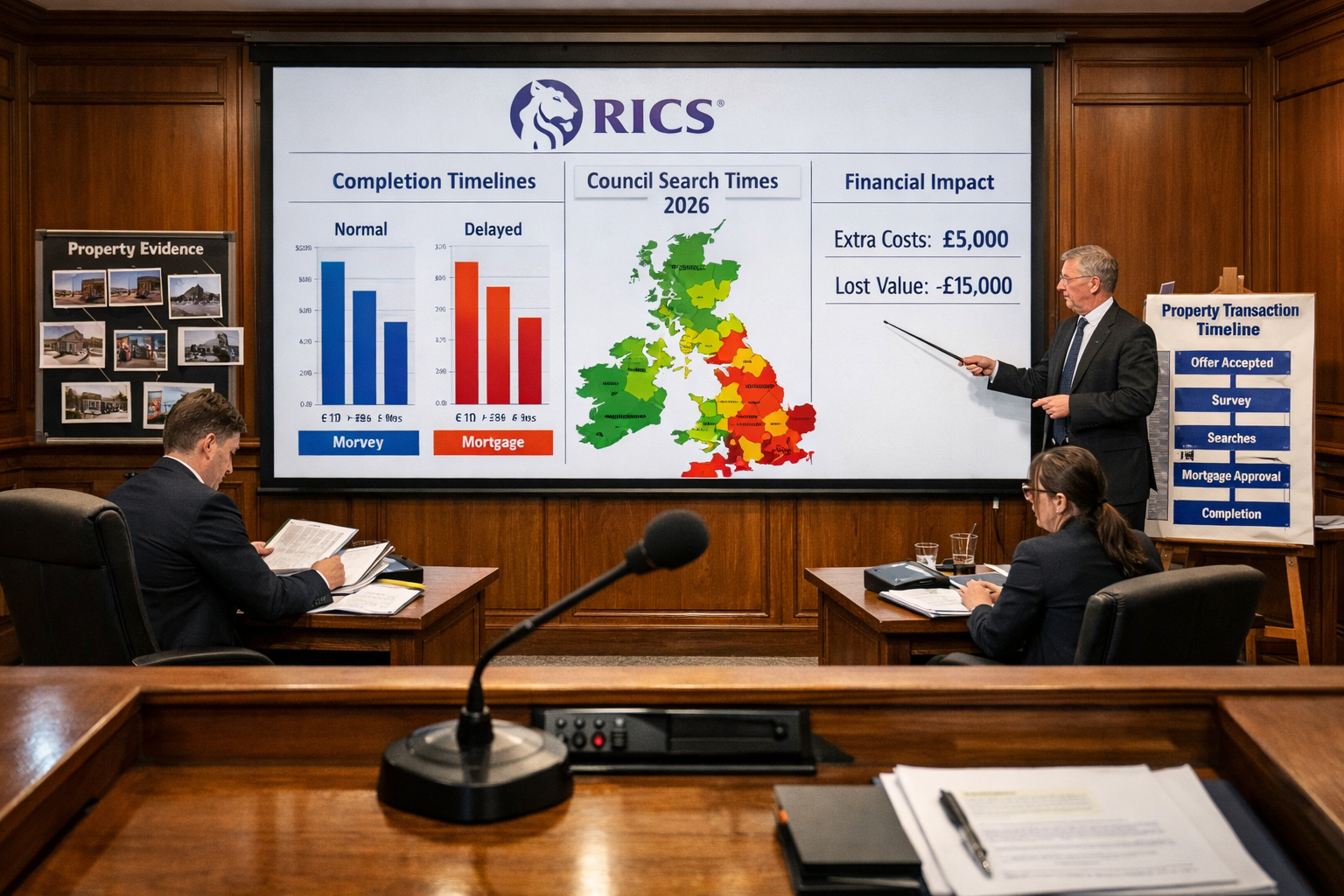
RICS Data as Evidential Foundation
The Royal Institution of Chartered Surveyors provides industry-standard benchmarks that form the backbone of credible expert evidence in 2026 disputes[3]. Expert witnesses should incorporate:
Market Transaction Timelines: RICS publishes average completion periods by region and property type. Demonstrating that a specific transaction exceeded these benchmarks by substantial margins establishes the abnormal nature of delays.
Valuation Methodology Standards: RICS Red Book guidelines ensure consistent, defensible valuation approaches. Expert reports should explicitly reference applicable sections demonstrating methodological compliance. Learn more about RICS registered valuers and their standards.
Professional Practice Standards: RICS guidance on reasonable search ordering timelines and solicitor obligations provides context for assessing whether delays resulted from council failures versus professional negligence.
Comparative Market Analysis: RICS data enables experts to demonstrate how property values or interest rates changed during delay periods, quantifying opportunity costs and direct financial losses.
Documenting Council Delay Causation
Establishing causation—that council delays specifically caused the claimed losses—requires meticulous evidence compilation:
| Evidence Category | Documentation Required | Purpose |
|---|---|---|
| Timeline Records | Search order dates, council acknowledgments, chase correspondence | Proves delay duration and council awareness |
| Council Communications | Email chains, phone logs, formal responses | Demonstrates council capacity issues vs. normal processing |
| Mortgage Documentation | Offer letters, expiry notices, reapplication records | Links delays to financing consequences |
| Alternative Transaction Evidence | Comparable property sales, lost opportunity documentation | Quantifies specific financial impacts |
| Professional Correspondence | Solicitor updates, surveyor reports, estate agent communications | Establishes transaction context and mitigation attempts |
Expert witnesses must analyze this documentation to construct a coherent narrative connecting council delays to specific, quantifiable losses. For complex property matters, expert surveyor advice proves invaluable.
Financial Loss Quantification Methods
Credible expert evidence requires precise, defensible calculations of financial harm:
Direct Costs:
- Mortgage reapplication fees
- Extended accommodation expenses (rental, hotel, storage)
- Additional survey or valuation fees
- Legal costs attributable to delay management
Interest Rate Differential:
When mortgage offers expire and rates increase, experts calculate the present value of additional interest payments over the loan term. For a £300,000 mortgage:
- Original offer: 4.5% over 25 years = £1,667 monthly payment
- Replacement offer: 5.2% over 25 years = £1,790 monthly payment
- Monthly differential: £123
- Present value of 300 months of differential: approximately £29,500
Property Value Changes:
If property values decline during delay periods, experts provide retrospective valuations demonstrating market value at the intended completion date versus actual completion date. Our retrospective valuation services address these specific needs.
Chain Collapse Losses:
When delays trigger chain failures, experts quantify:
- Deposit forfeitures
- Abortive transaction costs
- Replacement property premium (higher purchase price for alternative)
- Temporary accommodation necessitated by sale collapse
Methodology Transparency and Defensibility
Following the 2023 FRE 702 amendments, expert reports must demonstrate methodological rigor with unprecedented clarity[6]. Best practices include:
🔍 Explicit Assumption Statements: Clearly articulate all assumptions underlying calculations (e.g., "Assuming buyer would have secured original mortgage offer but for search delay…")
🔍 Alternative Scenario Analysis: Present calculations under various assumptions to demonstrate robustness (conservative, moderate, and liberal loss estimates)
🔍 Peer-Reviewed Methodology: Reference established valuation techniques from RICS guidance, academic literature, or tribunal precedents
🔍 Data Source Documentation: Provide complete citations for market data, interest rates, property values, and transaction statistics
🔍 Qualification of Opinions: Acknowledge limitations, uncertainties, and factors outside the expert's direct knowledge
This transparency not only satisfies admissibility standards but also enhances credibility during cross-examination.
Tribunal Submission Protocols and Best Practices
Report Structure and Content
Expert witness reports for local searches disputes should follow a standardized structure that facilitates tribunal comprehension:
1. Executive Summary
- Concise overview of instructions, methodology, and conclusions
- Key financial loss figures prominently stated
- Clear opinion on causation and liability
2. Expert Qualifications
- Detailed CV emphasizing relevant experience
- RICS membership evidence and specializations
- Previous expert witness experience summary
- Confirmation of independence and tribunal duty understanding
3. Instructions and Scope
- Precise statement of questions posed by instructing party
- Documents reviewed and site visits conducted
- Limitations or constraints on investigation
4. Factual Background
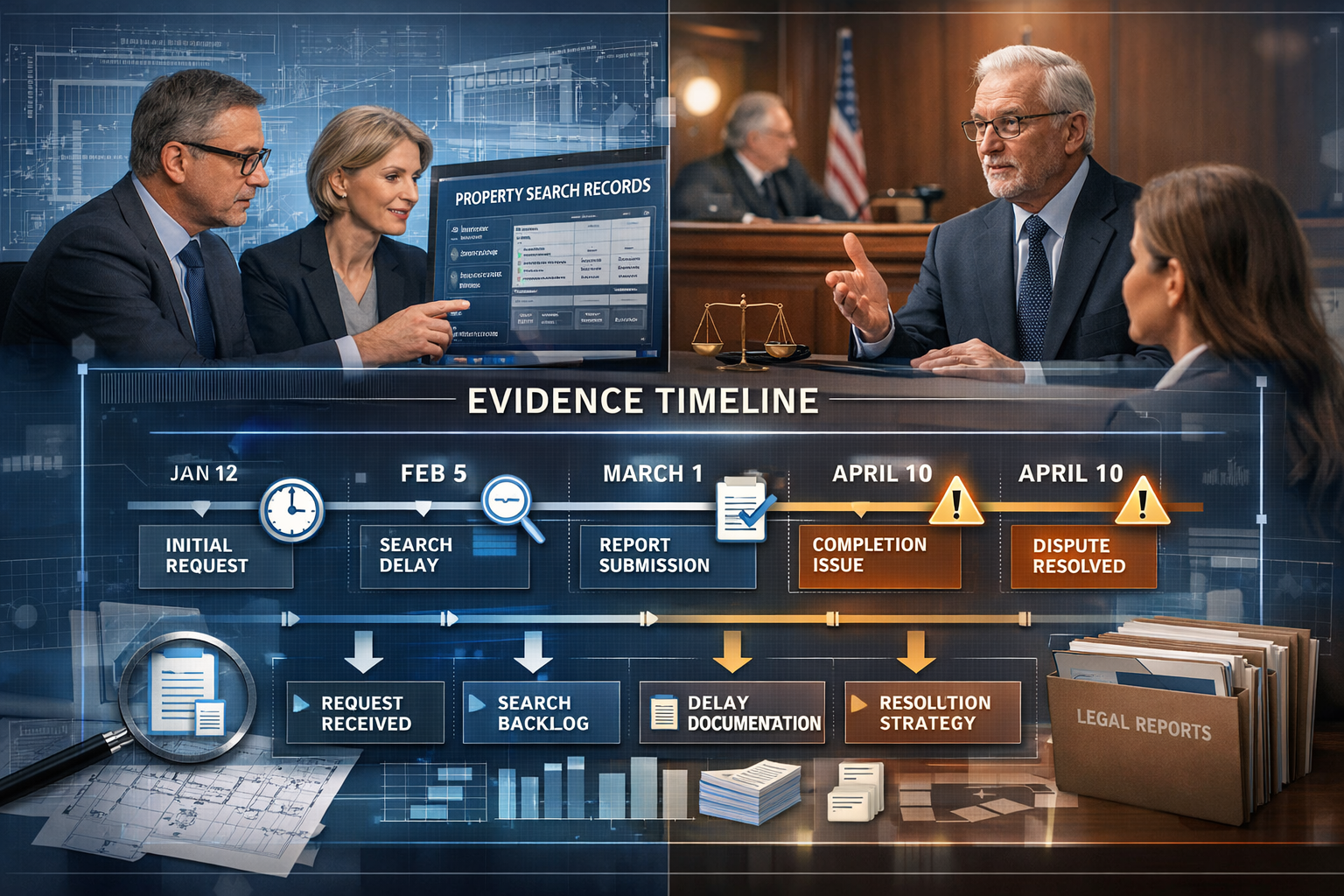
- Transaction timeline with key dates
- Council search process description
- Delay documentation summary
- Relevant market conditions during dispute period
5. Technical Analysis
- RICS benchmark comparisons
- Causation analysis linking delays to losses
- Financial quantification with supporting calculations
- Alternative scenarios and sensitivity analysis
6. Conclusions and Opinions
- Clear, unambiguous statements of expert opinion
- Confidence levels where appropriate
- Acknowledgment of uncertainties or alternative interpretations
7. Appendices
- Supporting documentation
- Calculation spreadsheets
- Relevant RICS guidance excerpts
- Comparable transaction data
Cross-Examination Preparation
Expert witnesses must anticipate challenges to their evidence during tribunal hearings[2]:
Common Challenge Areas:
- Qualification relevance to specific dispute aspects
- Methodology selection and application
- Assumption reasonableness
- Data source reliability
- Alternative interpretation possibilities
- Financial calculation accuracy
Preparation Strategies:
- Conduct mock cross-examinations with instructing solicitors
- Review opposing expert reports thoroughly
- Prepare concise explanations for technical concepts
- Organize supporting documentation for quick reference
- Maintain composure and objectivity under pressure
"The expert witness's credibility often determines case outcomes more than the underlying facts. Preparation, transparency, and unshakeable objectivity are non-negotiable."
Collaborative Expert Approaches
In complex disputes, tribunals may order joint expert meetings or concurrent evidence sessions. These processes require:
Pre-Meeting Preparation:
- Thorough review of opposing expert's report
- Identification of agreement and disagreement areas
- Preparation of questions for opposing expert
- Openness to methodology discussions
Joint Statement Production:
- Clear articulation of agreed facts and opinions
- Precise description of disagreement areas
- Explanation of reasons for divergent conclusions
- Avoidance of adversarial language
Concurrent Evidence Management:
- Respectful engagement with opposing expert
- Focus on technical issues rather than advocacy
- Willingness to acknowledge valid alternative viewpoints
- Assistance to tribunal in understanding technical disputes
This collaborative approach often narrows dispute scope and facilitates settlements. For related property matters involving multiple parties, understanding party wall disputes provides useful context.
Emerging Trends and 2026 Considerations
Technology-Enhanced Evidence Presentation
Expert witnesses increasingly leverage digital tools to enhance evidence clarity:
- Interactive timeline visualizations showing delay progression and key events
- Comparative market analysis dashboards with real-time data updates
- Financial modeling software demonstrating loss calculations under various scenarios
- Geographic information systems mapping regional search delay patterns
These technologies improve tribunal comprehension while demonstrating expert sophistication.
Regulatory Evolution Impact
The 2026 landscape includes several regulatory developments affecting expert witness roles:
Conveyancing Reforms: Proposed upfront information requirements may shift liability frameworks, requiring experts to assess compliance with new standards[1].
Consumer Protection Enhancements: Strengthened buyer protections may expand recoverable loss categories, requiring broader expert analysis.
Professional Indemnity Changes: Evolving insurance requirements affect which professionals bear ultimate liability for delay-related losses.
Expert witnesses must maintain current knowledge of these regulatory shifts to provide relevant, accurate evidence.
Preventative Advisory Roles
Beyond dispute resolution, expert witnesses increasingly provide preventative advice:
- Transaction timeline risk assessment identifying delay vulnerabilities
- Search ordering strategy optimization minimizing delay exposure
- Loss mitigation protocols reducing damages if delays occur
- Professional compliance auditing ensuring solicitors meet duty standards
This proactive engagement reduces dispute frequency while positioning experts as valuable transaction partners. For comprehensive property transaction support, explore our valuation services.
Conclusion
Expert Witness Roles in 2026 Local Searches Backlog Disputes: Evidence Strategies for Delayed Completions have become indispensable as property transaction volumes rebound and council capacity struggles to keep pace. The financial consequences of search delays—from mortgage offer expirations to chain collapses—demand rigorous, defensible quantification that only qualified expert witnesses can provide.
Success in these disputes requires strategic evidence compilation from transaction inception, leveraging RICS data and methodology to establish industry-standard benchmarks and demonstrate causation. The tightened admissibility standards following 2023 regulatory changes demand unprecedented methodological transparency and qualification documentation.
Actionable Next Steps
For property professionals navigating local searches disputes in 2026:
-
Engage expert witnesses early—ideally before formal complaints or litigation commence—to guide comprehensive evidence collection
-
Prioritize RICS-qualified chartered surveyors with demonstrable experience in property valuation, transaction timelines, and expert witness procedures
-
Compile meticulous documentation of council correspondence, transaction timelines, financial impacts, and mitigation attempts from the outset
-
Leverage RICS benchmarks as the evidential foundation for all timeline expectations and loss quantifications
-
Prepare for heightened scrutiny of expert qualifications and methodology under current admissibility standards
-
Consider collaborative expert approaches that may narrow dispute scope and facilitate favorable settlements
-
Maintain awareness of regulatory evolution affecting liability frameworks and recoverable loss categories
The complexity of local searches backlog disputes demands professional expertise that combines technical valuation skills, legal procedure knowledge, and effective communication abilities. By understanding these expert witness roles and evidence strategies, property professionals can better protect their clients' interests and navigate the challenging transaction landscape of 2026.
For additional guidance on property disputes and valuation matters, explore our comprehensive resources on party wall matters and valuation factors.
References
[1] Expert Witness Roles In 2026 Homebuying Reform Disputes Defending Survey Evidence Under New Upfront Standards – https://nottinghillsurveyors.com/blog/expert-witness-roles-in-2026-homebuying-reform-disputes-defending-survey-evidence-under-new-upfront-standards
[2] Damages Expert Witness Roles Selection Guide – https://capitalexpertservices.com/articles/damages-expert-witness-roles-selection-guide/
[3] Expert Witness Challenges In 2026 Interest Rate Volatility Disputes Rics Data Driven Preparation – https://nottinghillsurveyors.com/blog/expert-witness-challenges-in-2026-interest-rate-volatility-disputes-rics-data-driven-preparation
[4] Selecting Engaging With An Expert Witness – https://www.forvismazars.us/forsights/2025/09/selecting-engaging-with-an-expert-witness
[5] Role Of An Expert Witness In Real Estate Litigation – https://edringtonandassociates.com/real-estate/role-of-an-expert-witness-in-real-estate-litigation/
[6] What New Rules Mean For Expert Witness Admissibility – https://www.meadenmoore.com/blog/iag/what-new-rules-mean-for-expert-witness-admissibility