

The UK property market in early 2026 presents a puzzle that demands precision: buyer demand has plummeted, national prices hover in neutral territory, yet dramatic regional splits are reshaping how surveyors approach building inspections. The RICS February 2026 Insights: Building Survey Protocols for Regional Price Divergences and Flat Headline Balances reveal a market where London properties face -40% price pressure while northern regions hold steady—a divergence that fundamentally changes how Level 3 surveys must be conducted, documented, and delivered. [2]
For chartered surveyors navigating these fractured market conditions, the challenge extends beyond identifying structural defects. Survey protocols must now account for regional risk profiles, adjust investigation depth based on local price trajectories, and deliver reports that reflect the specific market dynamics affecting property values in each geographic area.

Key Takeaways
- 📉 Buyer demand collapsed to -26% in February 2026, down sharply from -15% in January, signaling significant market cooling that affects survey urgency and scope requirements
- 🗺️ Regional price divergence reached extreme levels, with London at -40% while Northern Ireland, Scotland, and North West England show resilience—requiring geography-specific survey protocols
- 🏗️ Building survey methodologies must adapt to flat headline balances and localized price pressures through enhanced structural investigation in declining markets and streamlined protocols in stable regions
- ⏱️ Transaction timelines face compression, with near-term sales expectations at -2% creating pressure for faster survey turnaround while maintaining RICS quality standards [4]
- 📊 Long-term price sentiment remains cautiously positive at +33% over 12 months, but short-term expectations dropped to -18%, requiring surveyors to balance immediate defect reporting with forward-looking value considerations [2]
Understanding the RICS February 2026 Market Context
The RICS February 2026 Insights: Building Survey Protocols for Regional Price Divergences and Flat Headline Balances emerge from a residential market experiencing unprecedented fragmentation. [2] National headline house prices registered a net balance of -12%, representing only marginal weakening from previous months—a deceptively stable figure that masks profound regional variations.
Buyer Demand Dynamics
New buyer enquiries plunged to -26% in February 2026, marking a substantial deterioration from January's -15% reading. This sharp decline reflects multiple pressures: mortgage rate uncertainty, economic headwinds, and regional affordability challenges that vary dramatically across the UK. [2]
The implications for building surveyors are immediate:
- Reduced transaction volumes mean each survey carries greater weight in buyer decision-making
- Extended marketing periods allow more thorough pre-inspection research and comparable analysis
- Price negotiation leverage shifts toward buyers, increasing demand for detailed defect quantification
- Survey cancellations may rise as transactions fall through, affecting scheduling and resource allocation
Agreed sales remained subdued at -12% in February 2026, confirming that properties reaching the survey stage face completion challenges. [2] This environment demands building surveyor services that deliver clear, actionable intelligence to support or challenge asking prices.
The Regional Divergence Reality
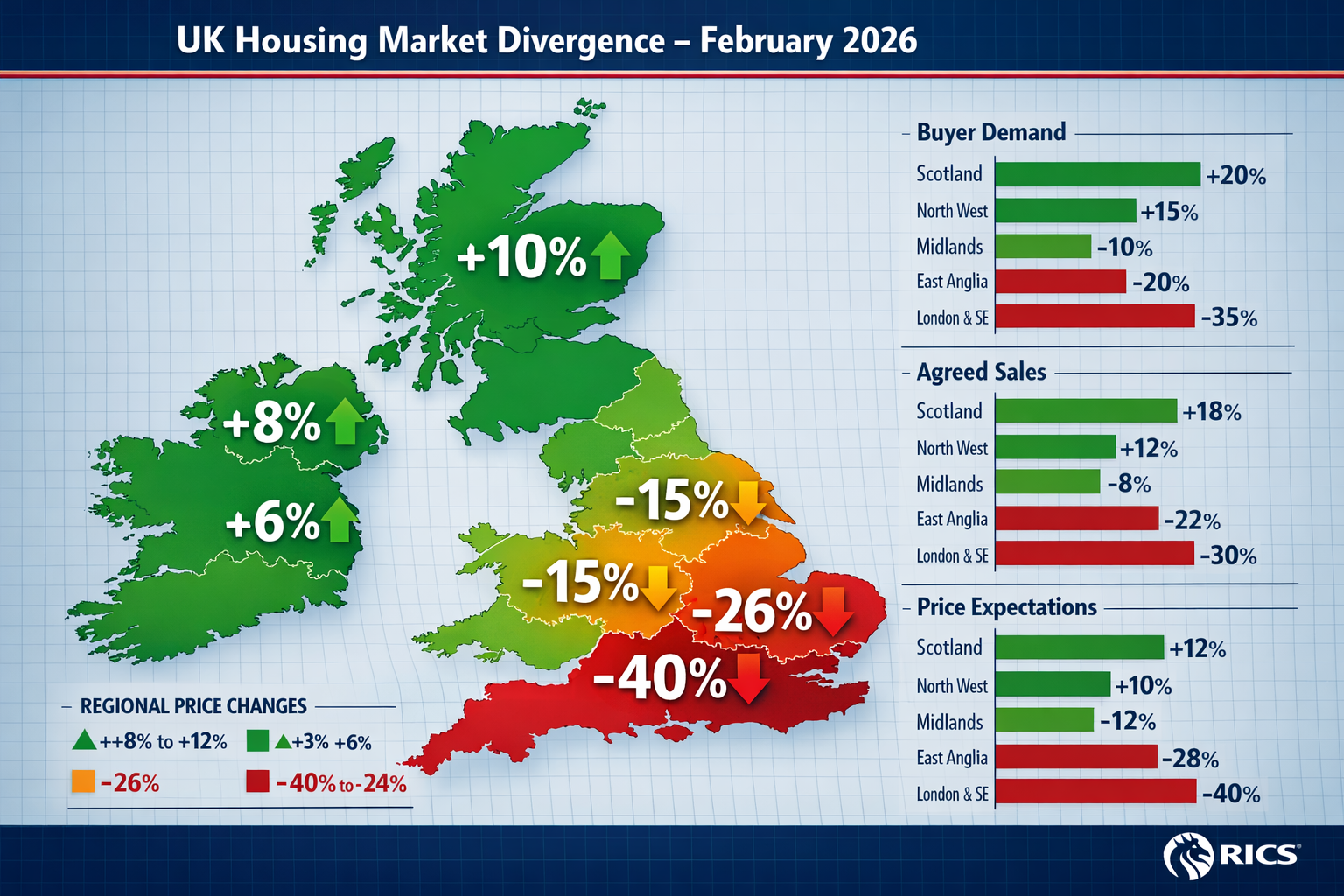
The most striking feature of the RICS February 2026 Insights: Building Survey Protocols for Regional Price Divergences and Flat Headline Balances is the pronounced geographic split in price trends:
| Region | Price Balance (%) | Market Characterization |
|---|---|---|
| London | -40% | Severe downward pressure |
| East Anglia | -26% | Significant weakness |
| South East | -24% | Substantial decline |
| Northern Ireland | Positive | Resilient performance |
| Scotland | Positive | Stable to firmer |
| North West England | Positive | Outperforming south |
This geographic fragmentation creates distinct survey contexts. Properties in Central London face fundamentally different market pressures than those in West London or northern regions, requiring tailored investigation protocols.
Short-Term vs. Long-Term Price Expectations
The sentiment split between near-term and longer-term outlooks adds complexity to survey reporting:
- Near-term price expectations fell to -18% in February 2026, down sharply from -6% in January—reflecting immediate market pessimism [2]
- 12-month price expectations remain positive at +33%, though more moderate than previous periods [2]
- London's 12-month outlook cooled dramatically from +56% to just +7%, signaling a fundamental reassessment of capital appreciation prospects [2]
For surveyors preparing homebuyer reports versus building surveys, this temporal divergence matters. Buyers purchasing in weakening markets need comprehensive structural intelligence to avoid overpaying for properties requiring significant remedial work, while those in stable regions may prioritize transaction speed over exhaustive investigation.
Adapting Building Survey Protocols for Regional Price Divergences
The RICS February 2026 Insights: Building Survey Protocols for Regional Price Divergences and Flat Headline Balances demand fundamental adjustments to how Level 3 building surveys are scoped, conducted, and reported across different UK regions. [1]
Enhanced Protocols for Declining Markets (London, South East, East Anglia)
In regions experiencing significant price pressure, survey protocols must intensify to protect buyers from overpaying in falling markets:
🔍 Structural Investigation Depth
Properties in London and surrounding areas warrant enhanced structural scrutiny:
- Extended foundation inspection including trial pits where ground conditions or visible settlement suggest subsidence risk
- Comprehensive damp and moisture testing across all elevations, not just symptomatic areas
- Detailed roof void inspection with particular attention to concealed structural alterations
- Thermal imaging surveys to identify hidden defects that could derail negotiations
- Specialist referral protocols for early engagement of structural engineers when concerns arise
The rationale is clear: in markets where prices decline -40%, buyers need absolute confidence that purchase prices reflect true structural condition, not inflated asking prices from stronger market periods.
📋 Defect Quantification and Cost Estimation
Survey reports in declining markets must provide granular repair cost estimates:
- Itemized defect schedules with individual cost ranges for each identified issue
- Priority categorization (immediate, short-term, long-term) linked to specific budget figures
- Alternative remediation options with comparative cost analysis
- Specialist quotation recommendations for complex issues requiring trade expertise
This level of detail empowers buyers to negotiate effectively and avoid properties where remedial costs would push total acquisition costs above market value.
🏘️ Comparable Analysis Integration
Building surveys in weakening markets should incorporate market context:
- Local transaction evidence showing recent sale prices for similar properties
- Days-on-market analysis indicating vendor motivation and negotiation potential
- Regional trend commentary explaining how local price movements affect value
- Forward-looking risk assessment based on short-term price expectations for the specific area
While surveyors must avoid formal valuation unless separately instructed, contextual market intelligence helps buyers understand whether identified defects justify price reductions in the current environment.
Streamlined Protocols for Stable Markets (Northern Ireland, Scotland, North West)
In regions showing price resilience, survey protocols can emphasize efficiency without compromising thoroughness:
⚡ Accelerated Inspection Methodologies
- Risk-based investigation focusing resources on property-specific concerns rather than exhaustive examination of every element
- Technology-enhanced surveys using drone roof surveys to reduce access time while maintaining coverage
- Standardized reporting templates for common property types, allowing faster report preparation
- Conditional specialist referrals only when specific concerns warrant additional investigation
The goal is reducing survey turnaround time to support faster transactions in markets where buyer demand remains healthier and competition for properties persists.
🎯 Focused Defect Reporting
In stable markets, reports can prioritize:
- Material defects requiring immediate attention or significant expenditure
- Safety-critical issues affecting habitability or structural integrity
- High-impact items likely to affect mortgage lending decisions
- Condensed commentary on minor maintenance items without extensive elaboration
This approach recognizes that buyers in competitive markets need clear guidance on deal-breakers while avoiding report paralysis from exhaustive documentation of trivial issues.
Cross-Regional Protocol Considerations
Regardless of regional market conditions, certain survey elements remain non-negotiable:
✅ RICS professional standards compliance including inspection methodology, reporting format, and professional indemnity coverage [1]
✅ Comprehensive photographic documentation supporting all findings and conclusions
✅ Clear limitation clauses explaining inspection constraints and areas not accessed
✅ Professional liability protection through appropriate insurance and disclaimer language
✅ Client communication protocols ensuring buyers understand survey scope and findings
For chartered surveyors in London and across the UK, maintaining these core standards while adapting to regional market dynamics represents the professional challenge of 2026.
Implementing Survey Adjustments in Response to Flat Headline Balances
The RICS February 2026 Insights: Building Survey Protocols for Regional Price Divergences and Flat Headline Balances reveal a national market hovering near equilibrium (-12% price balance) while regional extremes pull in opposite directions. [2] This creates specific operational challenges for surveying practices.
Scheduling and Resource Allocation Strategies
The -26% buyer demand reading combined with -12% agreed sales suggests reduced but unpredictable transaction flow: [2]
Flexible Capacity Management:
- Multi-region service areas allowing surveyors to shift resources from declining to stable markets
- Associate surveyor networks providing surge capacity when regional demand spikes
- Staggered appointment availability balancing quick-turnaround slots for urgent instructions with longer-lead comprehensive surveys
- Cancellation policies protecting revenue when transactions abort before survey completion
Practices serving both South West London and northern markets can optimize utilization by directing surveyors to regions with stronger transaction volumes.
Technology Integration for Efficiency
Meeting the RICS February 2026 Insights: Building Survey Protocols for Regional Price Divergences and Flat Headline Balances demands technology adoption:
📱 Digital Survey Tools
- Mobile inspection apps capturing findings, photos, and measurements in real-time
- Cloud-based report generation allowing collaborative editing and faster client delivery
- Template libraries with region-specific commentary reflecting local market conditions
- Automated cost databases providing current repair estimates for common defects
🤖 AI-Assisted Analysis
- Defect recognition software flagging potential issues in survey photographs
- Comparative analysis tools identifying similar properties and typical defect patterns
- Risk scoring algorithms prioritizing investigation areas based on property characteristics
- Report quality checking ensuring consistency and completeness before client delivery
These technologies support faster turnaround without sacrificing the thoroughness that RICS standards demand. [1]
Client Communication and Expectation Management
In markets characterized by flat headline balances but regional extremes, clear client communication becomes critical:
Pre-Instruction Consultations:
- Regional market briefings explaining local price trends and survey implications
- Scope discussions tailoring investigation depth to property type, age, and market context
- Timeline commitments reflecting realistic turnaround based on property complexity
- Fee transparency with clear explanations of how regional factors affect survey costs
Post-Survey Follow-Up:
- Findings presentations walking clients through key defects and cost implications
- Negotiation guidance (within professional boundaries) on how survey findings affect offer prices
- Specialist referral coordination when additional investigations are recommended
- Long-term maintenance planning helping buyers understand ongoing property care requirements
For buyers navigating uncertain markets, surveyors who provide clear, contextual guidance add value beyond the technical survey report itself.
Specialized Survey Products for Divergent Markets
The fragmented 2026 market creates demand for specialized survey services:
Market-Specific Offerings:
| Service Type | Target Market | Key Features |
|---|---|---|
| Rapid Assessment Survey | Stable northern markets | 48-hour turnaround, focused on material defects |
| Comprehensive Due Diligence | Declining southern markets | Enhanced investigation, detailed cost estimates |
| Investment Property Survey | All regions | Rental yield analysis, maintenance forecasting |
| New Build Snagging | All regions | Detailed defect identification for warranty claims |
| Pre-Purchase Structural | High-value properties | Full structural engineer involvement from outset |
Practices offering tiered survey products can serve diverse client needs across regional markets while optimizing resource deployment.
Rental Market Considerations
The RICS February 2026 Insights also highlight persistent rental market pressures, with landlord instructions at -27% and rent expectations at +20%. [2] This creates opportunities for survey services targeting:
- Buy-to-let investors requiring commercial building survey methodologies applied to residential portfolios
- Landlord compliance inspections ensuring properties meet evolving safety and energy standards
- Tenant dispute investigations providing specific defect reports for maintenance disagreements
- Portfolio condition assessments helping institutional landlords plan capital expenditure
With tenant demand stable at +2% but stock shortages persisting, rental property surveys represent a counter-cyclical revenue stream as sales market activity softens. [2]
Conclusion: Navigating 2026's Fragmented Property Landscape
The RICS February 2026 Insights: Building Survey Protocols for Regional Price Divergences and Flat Headline Balances paint a picture of a UK residential market in profound transition. With buyer demand at -26%, London prices under -40% pressure, yet northern regions holding firm, the one-size-fits-all approach to building surveys no longer serves clients effectively. [2]
Successful surveying practices in 2026 will:
✅ Customize investigation depth based on regional market dynamics—intensifying scrutiny in declining markets while streamlining protocols where prices remain stable
✅ Integrate market context into survey reports, helping buyers understand how identified defects interact with local price trends and negotiation leverage
✅ Leverage technology to deliver faster turnaround times without compromising the thoroughness that RICS standards and professional liability demand [1]
✅ Communicate proactively with clients about regional variations, setting realistic expectations for survey scope, timeline, and cost
✅ Maintain professional standards across all market conditions, recognizing that quality and consistency build long-term reputation regardless of short-term market fluctuations
Actionable Next Steps for Surveyors
📋 Review your current survey protocols against regional market data—are investigation depths appropriate for local price trends?
🗺️ Segment your service area by market performance, developing distinct survey offerings for declining versus stable regions
💻 Invest in efficiency technologies that reduce turnaround time while maintaining documentation quality
📞 Enhance client communication processes to explain regional market context and survey scope implications
🤝 Build specialist referral networks in each region you serve, enabling rapid engagement when enhanced investigation is warranted
📊 Track regional performance metrics for your practice—which areas generate consistent instructions, which face volume challenges?
The fragmented market revealed in the RICS February 2026 Insights challenges surveyors to think geographically, act strategically, and serve clients with unprecedented precision. Those who adapt their protocols to reflect regional divergences while maintaining core professional standards will thrive in this complex landscape.
For property buyers navigating 2026's uncertain market, partnering with surveyors who understand these regional dynamics and adjust their methodologies accordingly isn't just prudent—it's essential to making informed purchase decisions in a market where national headlines obscure dramatic local variations.
Whether you're purchasing in pressure-point London or resilient northern markets, ensure your surveyor's protocols reflect the specific market dynamics affecting your property's value and condition. The RICS February 2026 Insights make clear that geography matters more than ever—and your building survey should reflect that reality.
References
[1] Building Survey Standards Evolution How Rics Quality Strengthening Initiatives Impact Surveyor Practice In 2026 – https://nottinghillsurveyors.com/blog/building-survey-standards-evolution-how-rics-quality-strengthening-initiatives-impact-surveyor-practice-in-2026
[2] Uk Residential Survey February 2026 – https://www.rics.org/news-insights/uk-residential-survey-february-2026
[3] Rics Ceo Comments On The Publication Of The Future Homes And Building Standards – https://www.rics.org/news-insights/rics-ceo-comments-on-the-publication-of-the-future-homes-and-building-standards
[4] Transaction Speed Demands In 2026 Building Surveys And Valuations Under 6 Week Completion Pressure – https://nottinghillsurveyors.com/blog/transaction-speed-demands-in-2026-building-surveys-and-valuations-under-6-week-completion-pressure