

The London property market has entered uncharted territory in 2026. For the first time in over a decade, buyers hold unprecedented negotiating power while sellers confront the reality of price reductions and extended marketing periods. Valuing flats in London's cooling 2026 market requires surveyors to deploy rigorous Level 3 surveys that identify structural defects, leasehold complications, and valuation risks—essential tools when stagnant prices and heightened buyer caution define every transaction.
This shift represents more than a seasonal adjustment. With prime London transactions down 30% year-on-year and over half of properties experiencing at least one price reduction[3], the market dynamics have fundamentally changed. Surveyors must now equip buyers with comprehensive pre-purchase assessments that justify negotiation positions and protect against overpaying in an environment where asking prices no longer reflect achievable sale values.
Key Takeaways
- 📊 Prime London transactions fell 30% year-on-year in January 2026, with achieved prices down 5.6% and average discounts from asking price reaching 10.3%[3]
- 🏠 First-time buyers now represent 48.3% of London sales, the highest share nationally, signaling renewed confidence in the entry-level market despite overall caution[1]
- 📈 Supply has reached an 11-year high for March, with total stock up 8.3% compared to early 2025, creating substantial buyer choice and negotiating leverage[1]
- 🔍 Level 3 Building Surveys provide critical risk assessment for flats in a cooling market, identifying structural defects, leasehold issues, and valuation concerns that justify price negotiations
- 💷 Over 50% of prime properties sold underwent price reductions—the highest proportion since late 2018—making accurate pre-purchase valuations essential for informed buying decisions[3]
Understanding London's 2026 Market Cooling: The Data Behind Buyer Caution
The London property landscape has transformed dramatically as 2026 unfolds. Multiple indicators confirm that the capital's once-resilient market now faces significant headwinds that demand careful analysis from both buyers and surveyors.
Transaction Volume Decline and Market Weakness
Transaction volumes tell a stark story. January 2026 recorded 30% fewer property transactions than the previous year and 20% below the 2017-2019 pre-pandemic January average[1]. This structural weakness extends beyond seasonal fluctuations, indicating fundamental shifts in market confidence and affordability.
The Bank of England's mortgage approval data reinforces this trend. Net mortgage approvals for house purchases fell to 60,000 in January 2026, below the previous six-month average of approximately 64,100[2]. These figures suggest that affordability constraints continue to limit buyer activity despite improved choice and negotiating power.
Price Stagnation and Seller Adjustments
While asking prices increased modestly by 0.8% in March to £371,042, annual price growth remains muted at just 1.6%[2]. This tepid appreciation contrasts sharply with the double-digit growth rates experienced in previous years, signaling a market in equilibrium or slight decline.
Prime London has experienced particularly sharp corrections. Achieved prices fell 5.6% year-on-year, with buyers securing average discounts of 10.3% from initial asking prices[3]. More tellingly, over half of prime London properties that sold had undergone at least one price reduction—the highest proportion since late 2018[3].
This widespread seller capitulation creates opportunities for well-informed buyers but also raises critical questions about accurate valuation. When asking prices no longer reflect market reality, professional valuation services become indispensable for establishing defensible offers.
Regional Disparities and Time-to-Sale Variations
London's market cooling doesn't occur in isolation. Regional disparities have widened considerably, with time-to-sale metrics revealing significant variations. Rightmove data shows the average number of days to secure a buyer ranges from approximately 60 days in the North East to 80 days in London[2].
These extended marketing periods in the capital reflect both higher price points and increased buyer selectivity. When properties linger on the market, buyers gain leverage to conduct thorough due diligence, including comprehensive surveys that might previously have seemed excessive.
London rental growth has also cooled dramatically to just 1.1% annually as of January 2026, down from higher growth rates across other UK regions[2]. While London's average private rent of £2,253 remains the highest nationally, this deceleration suggests reduced investment demand and potential softening in capital values.
The Super-Prime Paradox
The super-prime market (properties valued at £5m+) presents paradoxical trends that warrant particular attention. New instructions hit a record January figure, up 12.5% year-on-year, while transactions fell 7.1% and available stock grew nearly 10%[3].
This surge in seller activity without matching buyer demand creates a significant imbalance. Wealthy sellers appear motivated to exit positions, possibly anticipating further cooling or responding to tax considerations, yet buyers remain cautious. For surveyors valuing high-end flats, this dynamic necessitates conservative approaches that reflect genuine market appetite rather than aspirational asking prices.
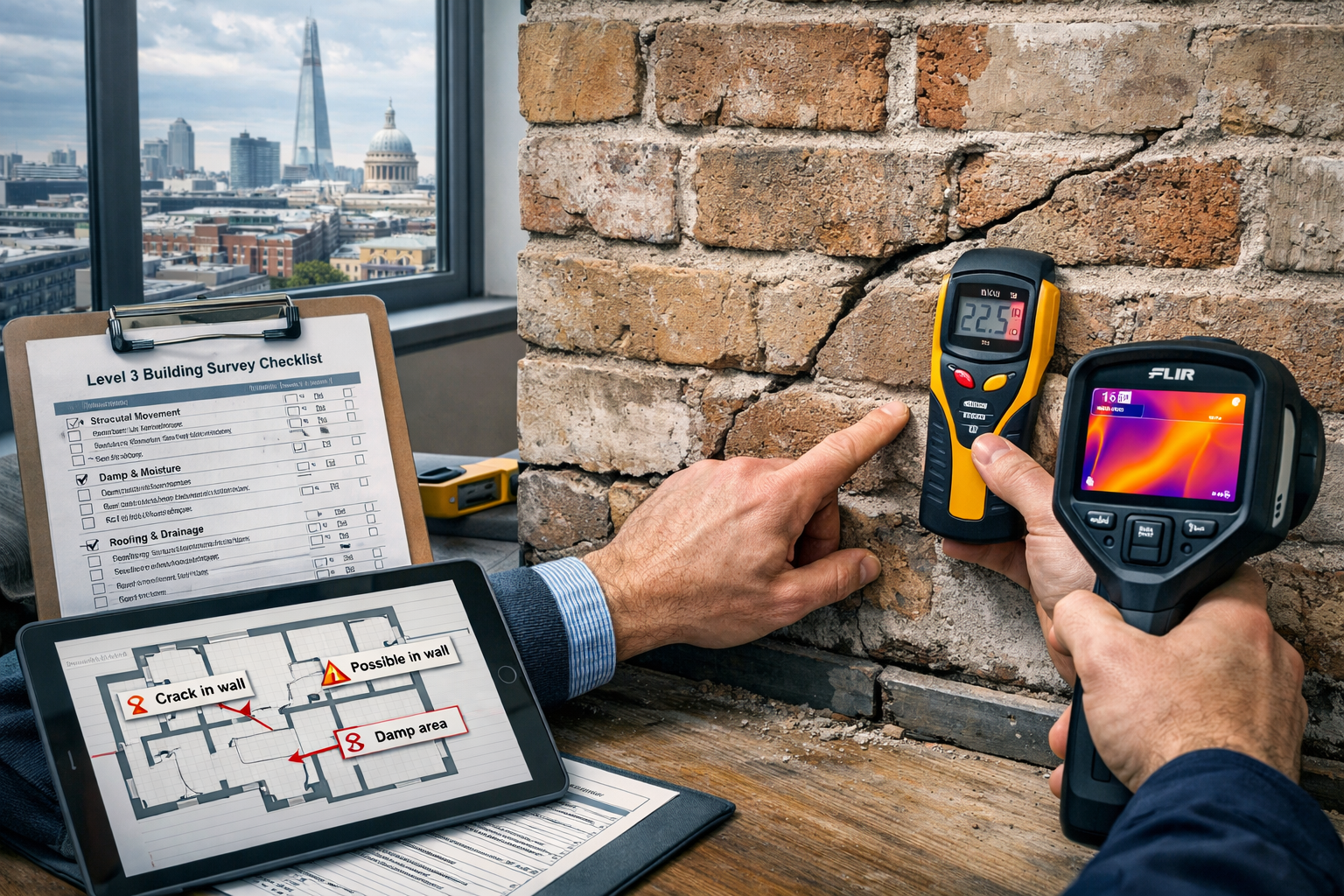
Level 3 Surveys: Essential Risk Identification for Valuing Flats in London's Cooling 2026 Market
When market conditions shift from seller to buyer dominance, the importance of comprehensive pre-purchase surveys escalates dramatically. Level 3 Building Surveys—formerly known as full structural surveys—provide the detailed risk assessment necessary for informed decision-making in London's cooling market.
What Level 3 Surveys Reveal About Flat Valuations
A Level 3 Building Survey represents the most comprehensive inspection available for residential properties. Unlike basic condition reports or Homebuyer Reports, Level 3 surveys involve:
- Detailed structural analysis of all accessible areas, including roof spaces, basements, and service installations
- Identification of defects with severity ratings and repair cost estimates
- Assessment of construction quality and materials used throughout the property
- Evaluation of alterations and their compliance with building regulations
- Recommendations for specialist investigations where concerns warrant further analysis
For flats specifically, Level 3 surveys must address unique considerations including leasehold complications, shared structure responsibilities, and common area maintenance obligations. These factors significantly impact valuation and future cost exposure.
Structural Defects That Justify Price Negotiations
In a cooling market where buyers hold negotiating power, documented defects become powerful bargaining tools. Level 3 surveys commonly identify issues that warrant price adjustments:
Foundation and structural movement: Subsidence surveys may reveal crack patterns indicating settlement or heave, particularly in Victorian and Edwardian conversions common across London. Repair costs can range from £5,000 for minor underpinning to £50,000+ for extensive structural stabilization.
Roof defects and water ingress: For top-floor flats, roof condition assessments identify deteriorating coverings, failed flashings, and inadequate drainage. Modern drone roof surveys provide comprehensive documentation of inaccessible areas without scaffolding costs.
Damp and condensation issues: Penetrating damp, rising damp, and condensation problems affect both property value and habitability. Surveyors use moisture meters and thermal imaging to quantify severity and identify underlying causes requiring remediation.
Building services deterioration: Aging electrical installations, obsolete heating systems, and deteriorating plumbing represent significant future expenditure. A Level 3 survey documents the condition and remaining serviceable life of all major systems.
Fire safety and cladding concerns: Post-Grenfell, external wall systems require careful assessment. Properties with combustible cladding face potential remediation costs and mortgage lending restrictions that dramatically impact value.
Leasehold Complications and Service Charge Risks
London's flat market is predominantly leasehold, introducing valuation complexities that freehold houses avoid. Level 3 surveys should trigger additional investigations into:
Lease length and extension costs: Flats with leases below 80 years face "marriage value" calculations that significantly increase lease extension costs. Surveyors must factor these future liabilities into current valuations.
Service charge obligations: Historical service charge accounts reveal management quality and cost trends. Escalating charges or substantial reserve fund deficits indicate future financial burdens that reduce net value.
Major works provisions: Section 20 notices for planned major works can impose costs of £20,000-£100,000+ per flat. Surveyors should review building maintenance plans and reserve fund adequacy.
Building insurance arrangements: Freeholder-arranged insurance often exceeds market rates. The capitalized value of excess premiums over the remaining lease term reduces the property's worth.
Integration with RICS Valuation Standards
Professional valuations must comply with RICS Valuation – Global Standards (the "Red Book"). RICS registered valuers combine Level 3 survey findings with market analysis to produce defensible valuations that reflect:
- Market Value: The estimated amount for which property should exchange on the valuation date between willing parties in an arm's-length transaction
- Comparable evidence: Recent sales of similar flats adjusted for condition, location, and specification differences
- Depreciated replacement cost: Where comparable evidence is limited, particularly for unique or specialized properties
- Investment value: For buy-to-let purchasers, incorporating rental yields and capital growth prospects
When chartered surveyors in London conduct valuations in the current cooling market, they must apply appropriate adjustments for market conditions. With over 50% of prime properties experiencing price reductions[3], historical comparable evidence requires careful interpretation and downward adjustment.
Specific Defect Reports for Targeted Investigations
Where Level 3 surveys identify particular concerns, specific defect reports provide focused investigations. These targeted assessments might involve:
- Structural engineers evaluating load-bearing capacity or movement severity
- Damp specialists conducting invasive investigations to determine water ingress sources
- Electrical contractors testing installation safety and capacity
- Asbestos surveyors sampling and analyzing suspect materials
The costs of these specialist reports (typically £300-£1,500 each) represent prudent investment when purchasing in a cooling market where buyer caution is justified.

Strategic Protocols for Surveyors: Accurate Pre-Purchase Valuations in a Buyer's Market
Valuing flats in London's cooling 2026 market demands methodological rigor and conservative assumptions. Surveyors must develop protocols that protect buyers from overpaying while providing lenders with defensible security valuations.
Establishing Market Value in Conditions of Price Uncertainty
The fundamental challenge facing valuers in 2026 is determining "market value" when recent transactions may not reflect current conditions. With prime London prices down 5.6% year-on-year and average discounts from asking price reaching 10.3%[3], historical comparables require careful adjustment.
Time-adjusted comparable analysis represents the cornerstone approach:
| Adjustment Factor | Typical Range | Application in 2026 Market |
|---|---|---|
| Time adjustment | -0.5% to -1.5% per month | Apply negative adjustments for comparables older than 3 months |
| Condition differential | -5% to -15% | Increase adjustments for properties requiring significant remediation |
| Lease length | -1% per year below 80 years | Apply enhanced discounts given reduced buyer appetite |
| Market conditions | -3% to -8% | General downward adjustment reflecting cooling sentiment |
Professional valuation reports must explicitly state the adjustments applied and the reasoning behind them. Transparency in methodology provides both buyers and lenders with confidence in the valuation conclusion.
Incorporating Supply-Demand Imbalances
With supply at an 11-year high and stock up 8.3% compared to early 2025[1], the supply-demand balance has shifted decisively in buyers' favor. Surveyors should incorporate this dynamic through:
Days-on-market analysis: Properties marketed for extended periods (80+ days in London)[2] signal weak demand at current asking prices. Valuations should reflect achievable prices rather than seller aspirations.
Inventory-to-sales ratios: High inventory relative to transaction volumes indicates oversupply. In such conditions, conservative valuations protect buyers from purchasing at peak inventory prices that may decline further.
Price reduction frequency: With over 50% of prime properties experiencing reductions[3], valuers should assume initial asking prices overstate market value by 5-10% until proven otherwise through actual transactions.
First-Time Buyer Market Dynamics
The surge in first-time buyers to 48.3% of London sales[1] introduces specific valuation considerations. These buyers typically:
- Maximize borrowing capacity at 4.5x income multiples, making them sensitive to valuation shortfalls
- Purchase smaller flats (one and two-bedroom units) in outer London boroughs
- Prioritize transport links and school quality over property condition
- Have limited capital reserves for post-purchase repairs
Surveyors valuing properties likely to attract first-time buyers should apply particular scrutiny to defects requiring immediate expenditure. A flat valued at £400,000 with £25,000 of necessary repairs may prove unmortgageable if the buyer lacks additional capital.
Negotiation Leverage Documentation
In the current buyer's market, Level 3 surveys serve dual purposes: risk identification and negotiation support. Surveyors should structure reports to facilitate price discussions:
Executive summary of value-impacting defects: A concise opening section quantifying major issues and their estimated remediation costs provides buyers with immediate negotiating ammunition.
Photographic evidence: Comprehensive documentation of defects with clear, annotated photographs strengthens buyers' positions when requesting price reductions.
Comparable condition analysis: Where possible, referencing how similar defects affected prices of comparable properties provides objective justification for adjustments.
Priority action matrix: Categorizing defects by urgency (immediate, short-term, long-term) helps buyers understand which issues require immediate capital allocation versus deferred maintenance.
Regional Variations Within London
London's property market comprises distinct sub-markets with varying cooling rates. Central London surveyors observe different conditions than those in West London or South West London.
Prime Central London (PCL): Experiencing the sharpest corrections, with international buyer absence and non-dom tax changes creating downward pressure. Valuations should reflect reduced investment demand.
Outer London boroughs: Benefiting from first-time buyer activity and relative affordability, these areas show more resilience. However, supply increases still favor buyers.
Transport-adjacent locations: Properties near Crossrail stations and other transport improvements may justify premium valuations despite broader market cooling.
Surveyors must calibrate their approaches to the specific sub-market dynamics affecting each property rather than applying uniform London-wide assumptions.
Red Book Compliance and Professional Standards
All RICS valuations must comply with Red Book standards, ensuring consistency and reliability. In cooling markets, particular attention must be paid to:
Assumptions and special assumptions: Clearly stating any assumptions about property condition, tenure, or market conditions that affect the valuation
Uncertainty and sensitivity analysis: Where market conditions create valuation uncertainty, providing a range or sensitivity analysis demonstrates professional judgment
Departure from standards: Any departure from Red Book requirements must be explicitly disclosed and justified
Conflicts of interest: Ensuring independence from parties with interests in the valuation outcome
Professional indemnity insurance requirements also escalate in volatile markets. Surveyors should ensure adequate coverage given increased litigation risk when valuations prove optimistic relative to subsequent market performance.
Specialized Valuation Scenarios
Beyond standard purchase valuations, London's cooling market creates demand for specialized assessments:
Matrimonial valuations: Divorce proceedings require valuations reflecting current market conditions rather than historical purchase prices
Probate valuations: Estate valuations must reflect open market value at date of death, requiring careful comparable analysis
Retrospective valuations: Tax purposes may require valuations at historical dates, necessitating reconstruction of market conditions
Each scenario demands specific methodological approaches while maintaining RICS compliance and professional standards.
Market Outlook and Strategic Implications for 2026
As 2026 progresses, market analysts project modest growth ahead. Nationwide expects UK house price growth in the 2-4% range for 2026[2], consistent with a steadily functioning market rather than rapid appreciation. For London specifically, several factors will shape the trajectory:
Interest rate environment: Any further Bank of England rate adjustments will directly impact mortgage affordability and buyer capacity
Economic confidence: Employment levels, wage growth, and consumer sentiment drive housing demand and transaction volumes
Supply dynamics: Whether the current 11-year high inventory level persists or normalizes will determine the duration of buyer-favorable conditions
Regulatory changes: Ongoing leasehold reform, building safety legislation, and tax policy adjustments continue to reshape market dynamics
For surveyors, this environment demands conservative, evidence-based valuations that protect buyers while maintaining professional credibility. The "best buyers' market in ten years"[2] creates opportunities for well-advised purchasers but also risks for those who overpay based on outdated assumptions.
Actionable Protocols for Surveying Professionals
Surveyors operating in London's cooling market should implement the following protocols:
✅ Conduct comprehensive Level 3 surveys for all flat purchases, regardless of apparent condition
✅ Apply time-adjusted comparable analysis with explicit negative adjustments for market cooling
✅ Document all defects photographically with clear annotations supporting valuation adjustments
✅ Investigate leasehold complications including service charges, major works provisions, and lease extension costs
✅ Provide sensitivity analysis showing valuation ranges under different market scenarios
✅ Maintain RICS Red Book compliance with particular attention to assumptions and uncertainty disclosures
✅ Recommend specialist investigations where initial surveys identify significant concerns
✅ Consider regional variations within London's diverse sub-markets rather than applying uniform assumptions
Conclusion
Valuing flats in London's cooling 2026 market represents both challenge and opportunity for surveying professionals. With transactions down 30% year-on-year, prices stagnant or declining, and over half of properties experiencing reductions, the market has fundamentally shifted to favor buyers[3]. This transformation demands rigorous Level 3 surveys that identify structural defects, leasehold complications, and valuation risks—providing buyers with the evidence needed to negotiate effectively and avoid overpaying.
The surge in first-time buyers to 48.3% of London sales[1] and record supply levels creating an 11-year high in available stock[1] confirm that 2026 offers unprecedented buyer leverage. However, this advantage only materializes when purchasers commission comprehensive pre-purchase assessments from qualified chartered surveyors who understand current market dynamics.
For surveying professionals, the cooling market necessitates conservative valuation approaches that incorporate negative time adjustments, condition differentials, and supply-demand imbalances. RICS Red Book compliance remains essential, with particular attention to assumptions, uncertainty disclosures, and professional independence. By implementing the protocols outlined in this article, surveyors can deliver valuations that protect buyers, satisfy lenders, and maintain professional standards during this period of market adjustment.
Next Steps for Buyers and Surveyors
For property buyers: Commission a Level 3 Building Survey before committing to any London flat purchase in 2026. Use survey findings to negotiate price reductions that reflect genuine market value rather than aspirational asking prices. Factor in all identified defects, leasehold obligations, and future expenditure when determining your maximum offer.
For surveying professionals: Review and update valuation methodologies to reflect current market cooling. Enhance comparable analysis with explicit time and condition adjustments. Strengthen report documentation to support buyer negotiations. Consider additional professional development in specialized areas such as leasehold valuation, building pathology, and RICS Red Book updates.
The London property market will eventually stabilize and return to growth, but 2026 represents a transitional period where caution, comprehensive due diligence, and accurate valuation protect all parties from the risks of price uncertainty. Those who adapt their approaches to current realities will navigate this cooling market successfully while building reputations for professional excellence that endure beyond the current cycle.
References
[1] March 2026 – https://www.black-brick.com/insights/market-update/march-2026/
[2] 199 March 2026 Uk Property Market Update – https://www.fraser-reeves.co.uk/blog/199-march-2026-uk-property-market-update
[3] Uk Property March 2026 – https://www.garrington.co.uk/market-review/uk-property-march-2026/