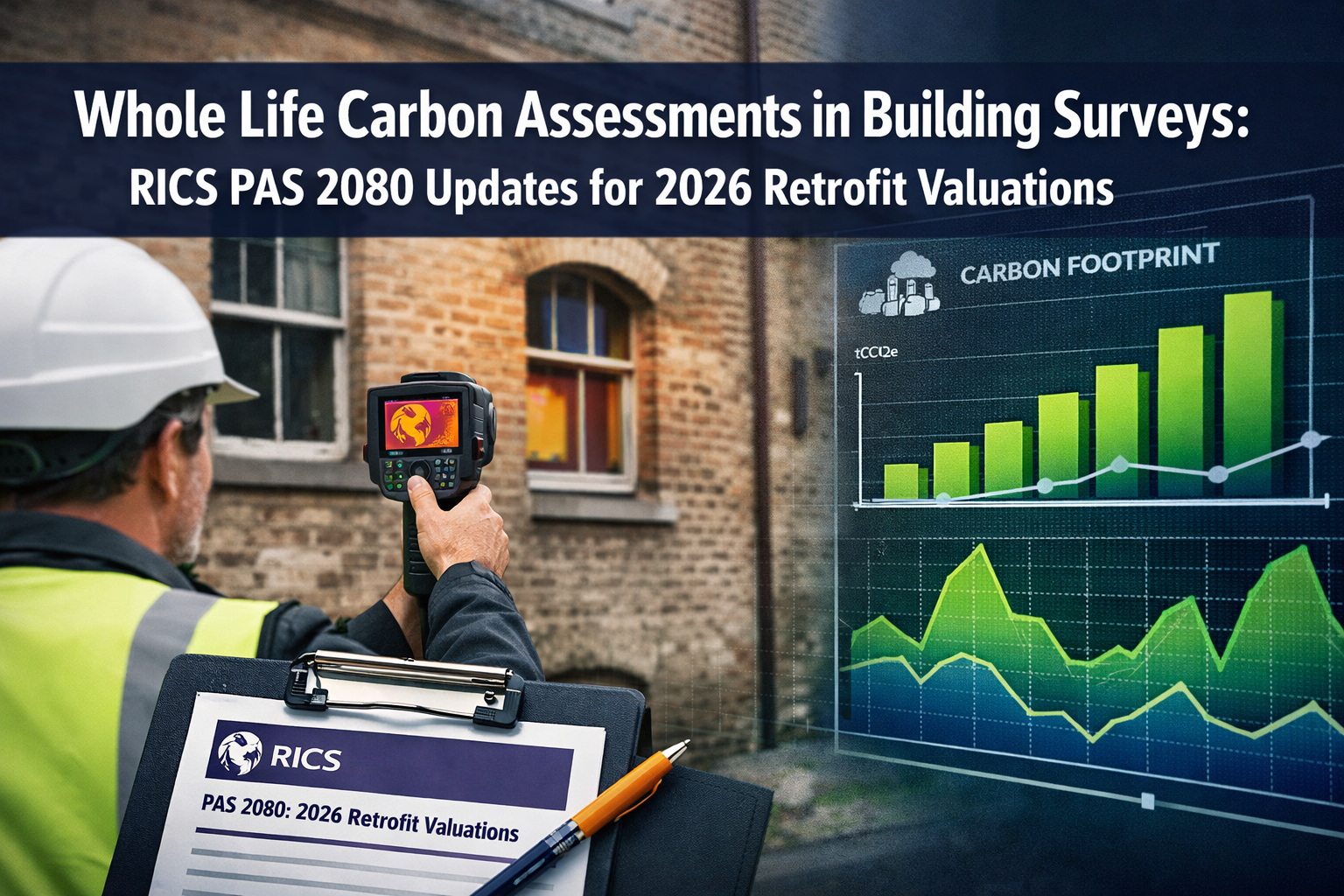

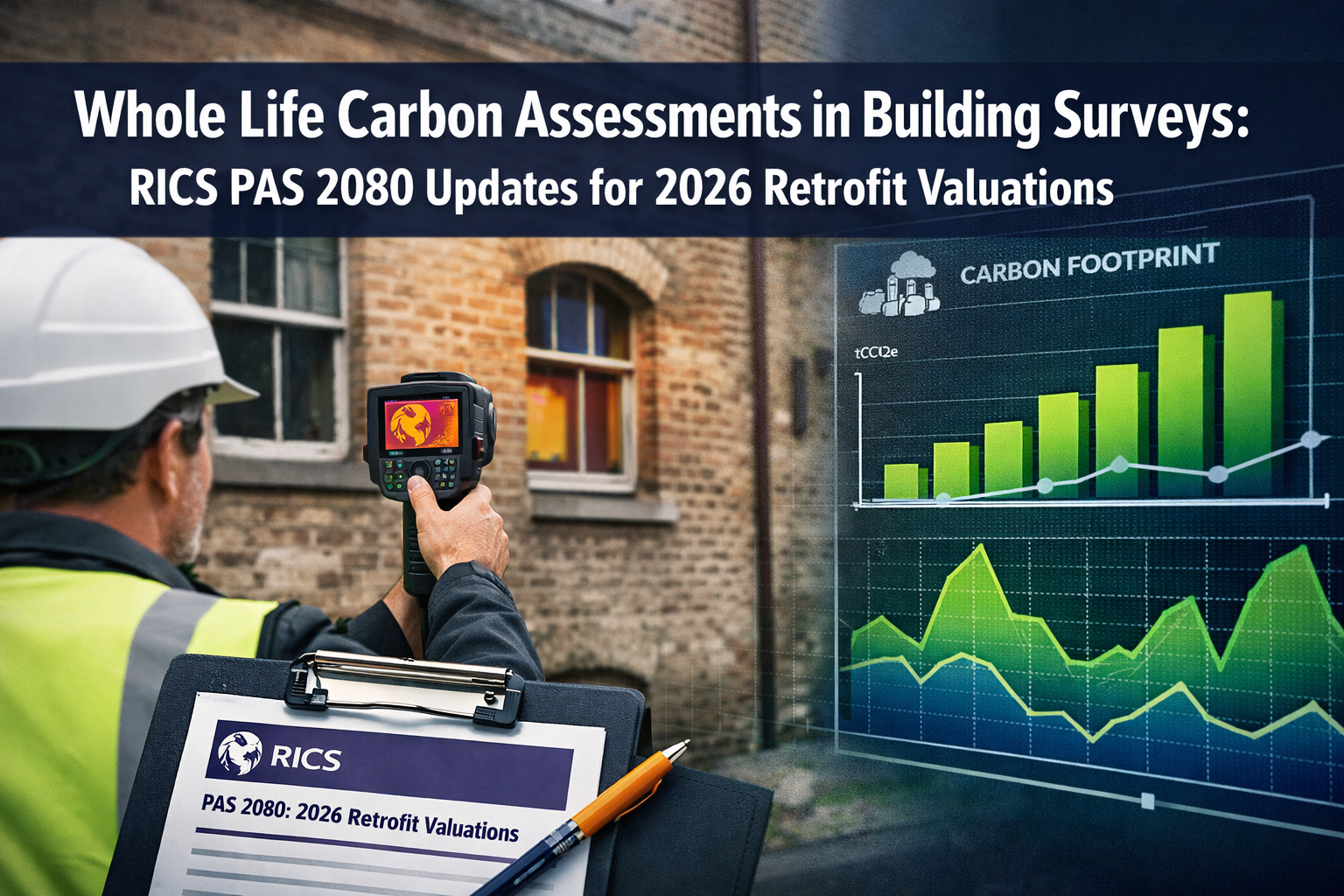
The built environment stands at a critical crossroads in 2026. With sustainability mandates tightening and carbon reduction targets becoming legally binding, property professionals face unprecedented pressure to quantify and manage the environmental impact of buildings throughout their entire lifecycle. Whole Life Carbon Assessments in Building Surveys: RICS PAS 2080 Updates for 2026 Retrofit Valuations represent a fundamental shift in how surveyors evaluate properties, moving beyond traditional structural and financial considerations to embrace comprehensive carbon accounting.
For surveyors conducting Level 3 building surveys and retrofit valuations, the integration of whole life carbon (WLC) assessments has transitioned from optional best practice to essential professional competency. The dual-standard framework—combining the RICS Professional Standard Whole Life Carbon Assessment for the Built Environment (2nd Edition) with PAS 2080:2023—now provides the definitive methodology for measuring and managing carbon emissions across new construction and existing building stock[5][6].
This comprehensive guide equips chartered surveyors with the knowledge and practical tools needed to apply these updated standards effectively, ensuring accurate property valuations that reflect the true environmental and financial implications of retrofit projects.
Key Takeaways
- 🏗️ Dual-standard framework: RICS WLCA 2nd Edition and PAS 2080:2023 work together—one measures carbon, the other manages the process across the building lifecycle[6]
- 📊 ESG valuation mandate: New RICS ESG standard effective April 30, 2026, requires all commercial property valuations to consider sustainability factors globally[2]
- 🔍 Surveyor role expansion: Whole-house assessments, stock condition surveys, and quality assurance for retrofit projects are now core surveyor responsibilities[1]
- 💰 Value impact: Capital and operational expenditure linked to carbon reduction can now be reflected in property valuations under specific guidance[2]
- 🌍 Global alignment: The framework aligns with International Cost Management Standards (ICMS) 3rd Edition, ensuring worldwide applicability[5]
Understanding the 2026 Whole Life Carbon Assessment Framework
The Dual-Standard Approach
The professional landscape for carbon assessment has evolved significantly with the publication of two complementary standards that together form the foundation for Whole Life Carbon Assessments in Building Surveys: RICS PAS 2080 Updates for 2026 Retrofit Valuations[5][6].
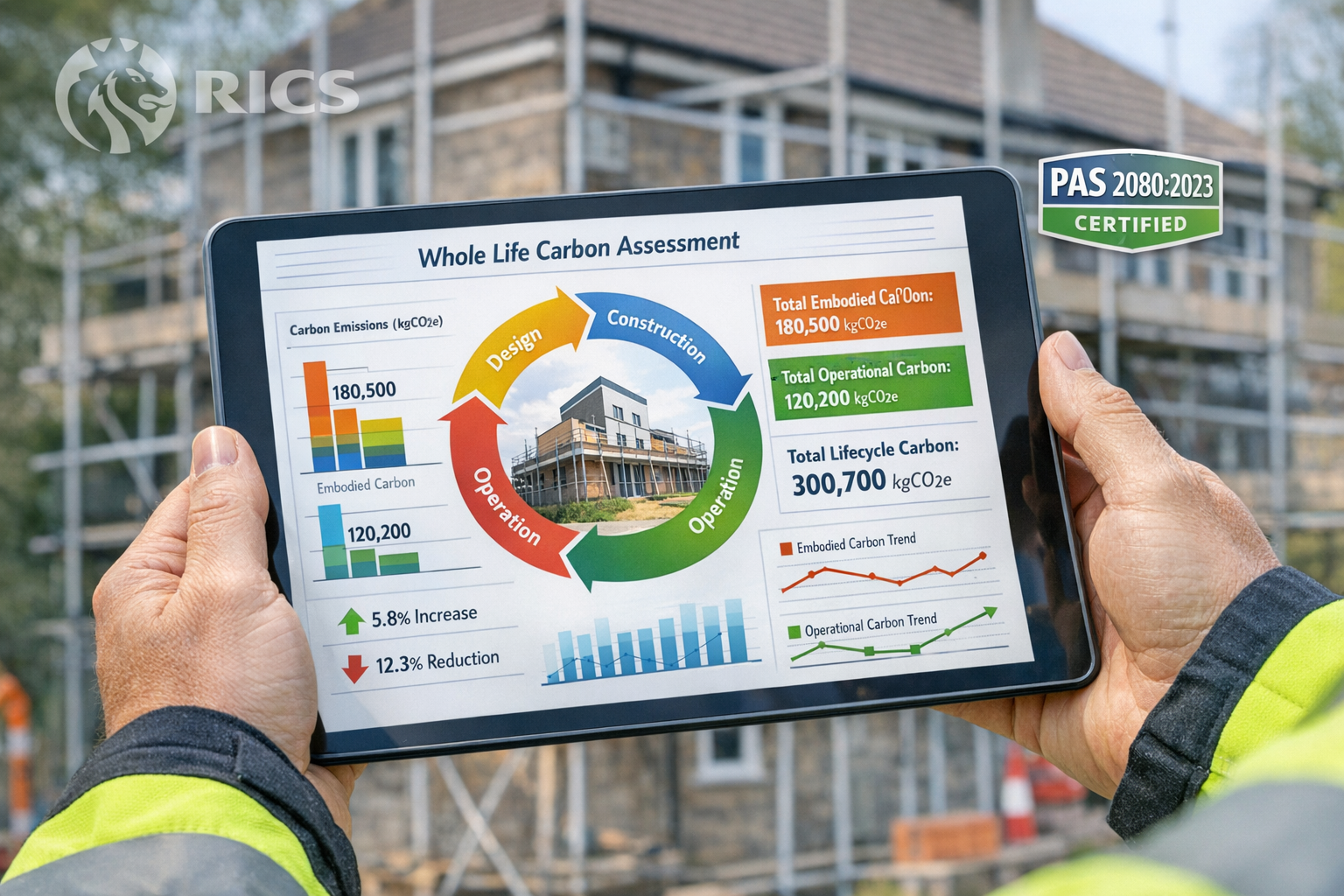
RICS Professional Standard WLCA (2nd Edition) establishes the technical methodology for measuring carbon emissions across all lifecycle stages:
- Embodied carbon: Materials extraction, manufacturing, transportation, construction, and end-of-life disposal
- Operational carbon: Energy consumption for heating, cooling, lighting, and building systems
- Sequestered carbon: Carbon storage in materials like timber
- Avoided emissions: Benefits from renewable energy generation or material reuse
PAS 2080:2023 complements this by providing the governance framework, outlining roles, responsibilities, and decision-making processes that enable effective carbon management throughout project delivery[6].
This division of labor is intentional and powerful. While the RICS standard answers "how much carbon?", PAS 2080 addresses "who manages it and how?"—creating a complete system for carbon accountability in the built environment.
Key Principles of PAS 2080:2023
The updated PAS 2080:2023 standard introduces several critical principles that surveyors must understand when conducting commercial building surveys:
| Principle | Application in Surveys | Impact on Valuations |
|---|---|---|
| Leadership | Senior surveyor accountability for carbon outcomes | Carbon targets influence project scope and recommendations |
| Systems thinking | Whole-building approach vs. component-level analysis | Holistic retrofit strategies valued higher than piecemeal improvements |
| Collaboration | Multi-disciplinary teams including engineers and energy assessors | Comprehensive assessments require coordinated expertise |
| Carbon budgets | Quantified limits for embodied and operational carbon | Budget compliance affects feasibility and value |
| Data transparency | Documented assumptions and calculation methodologies | Audit trails support valuation defensibility |
Implementing Whole Life Carbon Assessments in Building Surveys
Scope and Methodology for Level 3 Surveys
When conducting comprehensive building surveys, surveyors must now integrate WLC assessment at multiple stages of the inspection and reporting process.
Pre-inspection data gathering should include:
- Building age, construction type, and original materials specification
- Historical energy performance certificates (EPCs) and consumption data
- Previous retrofit interventions and their documented carbon impact
- Planned future works and their carbon implications
- Local planning authority sustainability requirements
During the physical inspection, surveyors should document:
✅ Structural elements: Foundation type, wall construction, roof structure (timber vs. concrete)
✅ Building envelope: Insulation levels, glazing specifications, air tightness indicators
✅ Building services: Heating systems, ventilation, lighting, renewable energy installations
✅ Material condition: Remaining service life affecting replacement timing and embodied carbon
✅ Retrofit opportunities: Spaces suitable for insulation upgrades, renewable installations, or fabric improvements
Calculation Boundaries and Data Quality
The RICS WLCA standard defines clear boundaries for carbon calculation, typically following the structure established in BS EN 15978:
- Modules A1-A5: Product and construction stages (embodied carbon)
- Modules B1-B7: Use stage including operational energy, maintenance, repair, replacement
- Modules C1-C4: End-of-life stage including deconstruction, transport, waste processing
- Module D: Benefits beyond the building lifecycle (reuse, recycling, energy recovery)
For retrofit valuations, Modules B become particularly significant. Surveyors must assess:
- Baseline operational carbon: Current annual emissions from energy consumption
- Retrofit embodied carbon: Additional materials and construction activities
- Post-retrofit operational savings: Reduced emissions from improved performance
- Payback period: Years required for operational savings to offset embodied carbon investment
"The framework aims to help surveyors decarbonise the built environment through the use of accurate, reliable data"[5]
Data quality significantly impacts assessment reliability. The RICS standard establishes a hierarchy:
Tier 1: Manufacturer-specific Environmental Product Declarations (EPDs)
Tier 2: Generic EPDs for product categories
Tier 3: Industry average data from databases like ICE or RICS WLCA guidance
For existing buildings undergoing retrofit assessment, surveyors often work with limited original construction data. In these cases, the standard permits reasonable assumptions based on building age, type, and typical construction practices of the period—provided these assumptions are clearly documented and justified.
Integration with Traditional Survey Reporting
Whole Life Carbon Assessments in Building Surveys: RICS PAS 2080 Updates for 2026 Retrofit Valuations require modified reporting structures that integrate carbon data alongside traditional defect identification and repair recommendations.
A comprehensive Level 3 survey report should now include:
Section 1: Executive Summary
- Property overview with carbon baseline (kgCO2e/m²/year)
- Critical defects and carbon-intensive repair recommendations
- Priority retrofit opportunities with carbon reduction potential
Section 2: Detailed Findings
- Element-by-element condition assessment
- Carbon implications of repair vs. replacement decisions
- Material specifications with embodied carbon data
Section 3: Whole Life Carbon Assessment
- Methodology and calculation boundaries
- Current carbon footprint breakdown (operational vs. embodied)
- Retrofit scenarios with carbon reduction projections
- Compliance with local and national carbon targets
Section 4: Recommendations and Costings
- Prioritized action plan balancing defect remediation and carbon reduction
- Capital cost estimates with carbon cost per tonne CO2e avoided
- Lifecycle cost analysis including energy savings
This integrated approach ensures that RICS registered valuers receive comprehensive information to support accurate property valuations that reflect both physical condition and environmental performance.
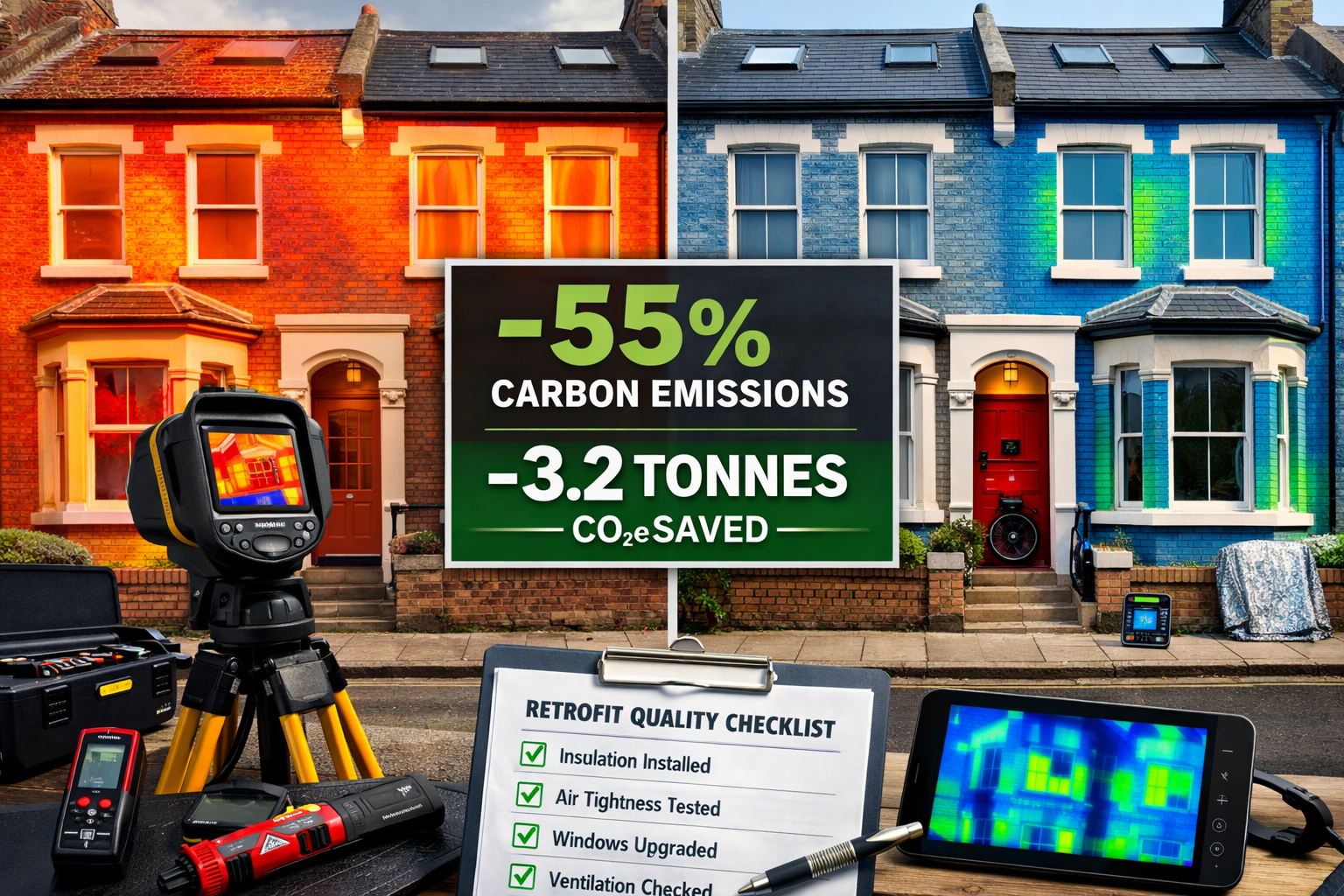
Retrofit Valuations Under the 2026 ESG Standards
The New ESG Valuation Framework
The fourth edition of the RICS global professional standard on ESG and sustainability in commercial property valuation, effective April 30, 2026, fundamentally changes how surveyors approach retrofit valuations[2]. This updated standard applies to all RICS members and firms undertaking commercial property valuations globally, creating a unified approach to sustainability considerations.
Key provisions affecting retrofit valuations:
Capital expenditure reflection: Valuers can now reflect carbon-reduction capital expenditure in valuations when:
- Works are planned with documented specifications and costs
- Carbon reduction is quantified using RICS WLCA methodology
- Financial benefit can be demonstrated through reduced operating costs or regulatory compliance
- Market evidence supports value recognition for similar improvements
Operational expenditure considerations: Ongoing costs related to ESG performance, including:
- Energy costs based on current and projected carbon pricing
- Maintenance requirements for retrofit installations
- Monitoring and reporting obligations
- Compliance costs for emerging regulations
Valuation limits and disclaimers: The standard clarifies that valuers:
- Should not conduct detailed carbon assessments themselves (this is a surveyor/specialist role)
- Must rely on competent third-party assessments for carbon data
- Should clearly state assumptions about future regulatory changes
- Must distinguish between current market value and potential value post-retrofit
Consolidated ESG KPIs for Property Assessment
The 2026 standard includes a consolidated global list of ESG-related key performance indicators that surveyors should document to support valuation[2]:
Environmental KPIs:
- Energy Performance Certificate (EPC) rating
- Whole life carbon (kgCO2e/m²/year)
- Operational energy intensity (kWh/m²/year)
- Renewable energy generation capacity
- Water consumption efficiency
- Waste diversion from landfill percentage
Social KPIs:
- Indoor air quality measurements
- Accessibility compliance
- Occupant wellbeing certifications (WELL, Fitwel)
- Community impact assessments
Governance KPIs:
- Sustainability certification status (BREEAM, LEED, NABERS)
- Climate risk disclosure compliance
- Green building certification validity periods
- Maintenance and monitoring protocols
For residential retrofit projects, surveyors should adapt these KPIs appropriately, focusing on energy performance, carbon reduction, and occupant health factors particularly relevant to housing stock.
Market Evidence and Comparable Analysis
One of the most challenging aspects of Whole Life Carbon Assessments in Building Surveys: RICS PAS 2080 Updates for 2026 Retrofit Valuations is establishing market evidence for the value premium associated with low-carbon properties.
Emerging market trends in 2026:
📈 Green premium: Studies increasingly show rental and capital value premiums for properties with superior environmental performance, typically ranging from 3-8% depending on location and property type
📉 Brown discount: Properties with poor energy efficiency face growing value discounts as regulatory pressure increases and operating costs rise
⚡ Stranded asset risk: Buildings unable to meet minimum energy performance standards face potential obsolescence, significantly impacting long-term value
When conducting commercial property valuations, surveyors should seek comparable evidence from:
- Recent transactions with disclosed EPC ratings and carbon performance data
- Rental evidence showing premium for certified green buildings
- Investment yields reflecting ESG risk factors
- Market reports from property consultancies tracking sustainability premiums
For properties where comparable evidence is limited, surveyors should apply sensitivity analysis, modeling value scenarios under different assumptions about future carbon pricing, regulatory requirements, and market recognition of environmental performance.
Practical Application: The 2026 Retrofit Quality Summit Framework
Surveyor Roles in Large-Scale Retrofit Programs
The Quality in Retrofit Summit held at RICS headquarters in January 2026 established clear expectations for surveyor involvement in the UK's accelerated housing retrofit program[1][4]. This framework directly informs how Whole Life Carbon Assessments in Building Surveys: RICS PAS 2080 Updates for 2026 Retrofit Valuations should be implemented in practice.
Surveyors are now expected to deliver:
1. Whole-house assessments
- Comprehensive evaluation of building fabric, services, and occupant needs
- Identification of retrofit measures appropriate to building type and construction
- Sequencing recommendations to avoid unintended consequences (e.g., moisture risk from insulation without ventilation improvements)
2. Stock condition surveys at neighborhood scale
- Systematic assessment of housing typologies across geographic areas
- Data collection to support strategic retrofit planning
- Identification of common defect patterns enabling standardized solutions
3. Quality assurance and compliance monitoring
- Pre-installation surveys establishing baseline condition
- Mid-work inspections ensuring specification compliance
- Post-completion verification of performance outcomes
- Documentation supporting warranty and insurance requirements
4. Awaab's Law compliance support
- Risk assessment for damp and mould in existing and post-retrofit conditions
- Specification of remedial measures addressing root causes
- Monitoring protocols ensuring ongoing compliance with minimum standards[1]
These expanded responsibilities require surveyors to work collaboratively with energy assessors, retrofit coordinators, and structural engineers to deliver comprehensive solutions.
Case Study Approach: Victorian Terraced Housing Retrofit
To illustrate practical application, consider a typical retrofit valuation scenario for a Victorian terraced house in London:
Property characteristics:
- Built 1890, solid brick walls (no cavity), suspended timber floors
- Single-glazed sash windows, gas central heating (15 years old)
- Current EPC rating: E (48)
- Annual energy consumption: 18,500 kWh
- Current operational carbon: 3,850 kgCO2e/year
Proposed retrofit package:
- Internal wall insulation (100mm)
- Loft insulation upgrade (300mm)
- Secondary glazing to retain sash windows
- Air source heat pump replacement of gas boiler
- Solar PV array (3.5 kWp)
Whole Life Carbon Assessment:
| Element | Embodied Carbon (kgCO2e) | Operational Saving (kgCO2e/year) | Payback Period (years) |
|---|---|---|---|
| Wall insulation | 2,400 | 850 | 2.8 |
| Loft insulation | 180 | 320 | 0.6 |
| Secondary glazing | 450 | 180 | 2.5 |
| Heat pump | 1,200 | 1,650 | 0.7 |
| Solar PV | 3,800 | 950 | 4.0 |
| Total | 8,030 | 3,950 | 2.0 |
Post-retrofit performance:
- Projected EPC rating: B (82)
- Annual energy consumption: 8,200 kWh
- Operational carbon: 420 kgCO2e/year (89% reduction)
- Carbon payback: 2.0 years
Valuation implications:
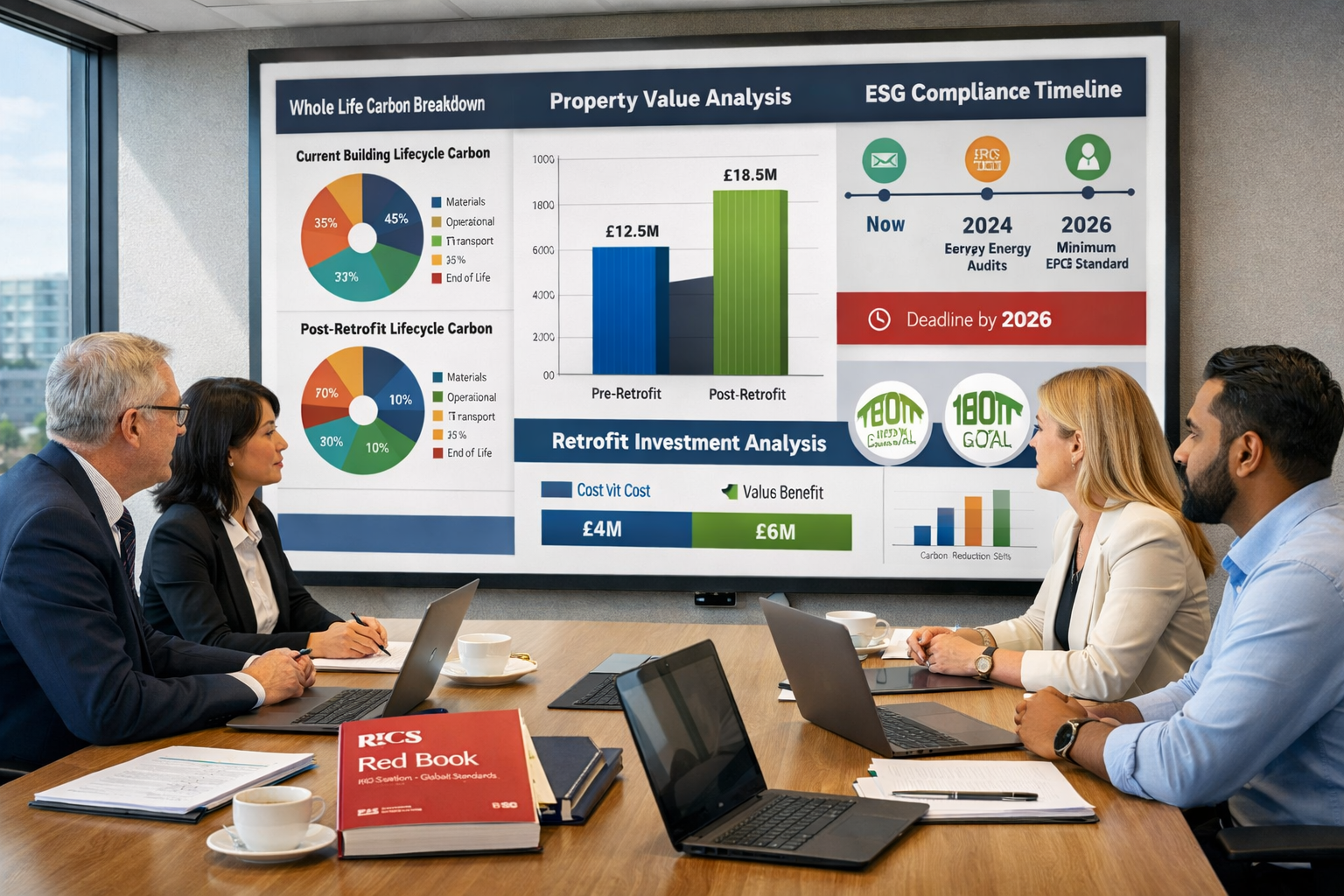
- Capital cost: £45,000
- Annual energy cost saving: £1,850 (at 2026 rates)
- Simple financial payback: 24.3 years
- Value enhancement: £18,000-£27,000 (4-6% premium based on local market evidence)
- Net position: Positive value creation of £3,000 after accounting for capital investment
This analysis demonstrates how surveyors can integrate technical carbon assessment with financial valuation to provide clients with comprehensive decision-making information.
Challenges and Solutions in Implementation
Data Availability and Accuracy
One of the most significant challenges in implementing Whole Life Carbon Assessments in Building Surveys: RICS PAS 2080 Updates for 2026 Retrofit Valuations is obtaining reliable data for existing buildings where original construction information is unavailable.
Common data gaps:
- Unknown material specifications for hidden elements
- Missing historical energy consumption records
- Uncertainty about previous modifications and their carbon impact
- Limited availability of EPDs for older building materials
Practical solutions:
🔍 Investigative techniques: Use of drone roof surveys, thermal imaging, and targeted opening-up works to verify construction details
📚 Historical research: Consultation of building control records, original architectural drawings, and period construction manuals to establish typical specifications
🤝 Industry databases: Utilization of standardized carbon factors from sources like the ICE Database, RICS WLCA guidance, and manufacturer databases
📝 Documented assumptions: Clear statement of assumptions with sensitivity analysis showing how variations affect outcomes
Competency and Training Requirements
The expanded scope of surveyor responsibilities requires enhanced competency in areas traditionally outside core surveying practice:
Essential knowledge areas:
- Building physics and thermodynamics
- Energy modeling fundamentals
- Carbon accounting methodologies
- Retrofit design principles
- Building pathology related to retrofit (particularly moisture management)
RICS has identified whole life carbon assessment as one of five hot topics for surveyor professional development in spring 2026[5], recognizing the need for widespread upskilling across the profession.
Recommended development pathway:
- Foundation: RICS WLCA Professional Standard training
- Governance: PAS 2080:2023 implementation workshops
- Technical: Building physics and retrofit design courses
- Practical: Mentored experience on retrofit assessment projects
- Specialist: Advanced certification in retrofit coordination or energy assessment
Integration with Existing Survey Workflows
Incorporating carbon assessment into established survey processes requires workflow adaptation without compromising efficiency or quality.
Recommended workflow integration:
Pre-appointment stage:
- Clarify scope including WLC assessment requirements
- Confirm fee structure reflecting additional analysis time
- Establish client expectations for data provision
Desktop review stage:
- Request EPC, energy bills, previous survey reports
- Research building age and typical construction methods
- Identify relevant local planning policies and carbon targets
Site inspection stage:
- Extended inspection time for detailed fabric assessment
- Photographic documentation of key carbon-relevant elements
- Notes on retrofit opportunities and constraints
Analysis and reporting stage:
- Carbon calculation using standardized tools
- Scenario modeling for retrofit options
- Integration of findings into comprehensive report
Quality assurance stage:
- Peer review of carbon calculations
- Verification of assumptions and data sources
- Compliance check against RICS and PAS 2080 requirements
This systematic approach ensures that carbon assessment becomes an integrated component of professional practice rather than an afterthought.
Regulatory Context and Future Developments
Current Regulatory Landscape in 2026
The implementation of Whole Life Carbon Assessments in Building Surveys: RICS PAS 2080 Updates for 2026 Retrofit Valuations occurs within a rapidly evolving regulatory environment:
UK regulations:
- Minimum Energy Efficiency Standards (MEES): Ongoing tightening of minimum EPC requirements for rental properties
- Future Homes Standard: New build requirements driving market expectations for existing stock
- Awaab's Law: Mandatory standards for social housing affecting retrofit specifications[1]
- UK Government Warm Homes Plan: Large-scale funding for low-income household retrofits[1]
Planning requirements:
- Many local authorities now require whole life carbon assessments for major developments
- Retrofit projects in conservation areas face additional constraints balancing heritage and carbon reduction
- Emerging requirements for carbon reduction statements in planning applications
Financial regulations:
- Climate-related financial disclosure requirements affecting institutional property investors
- Green finance standards requiring carbon performance verification
- Insurance industry increasing focus on climate resilience and energy efficiency
Global Alignment and International Standards
The RICS WLCA standard's alignment with the International Cost Management Standards (ICMS) 3rd Edition ensures that UK surveyors are applying methodologies consistent with global best practice[5]. This international harmonization is particularly important for:
- Cross-border investment and valuation
- Multinational property portfolios requiring consistent reporting
- International professional mobility and qualification recognition
- Global climate commitments and carbon accounting frameworks
The convergence between RICS and Institution of Civil Engineers (ICE) messaging on carbon assessment and management[6] further strengthens the professional consensus around these methodologies, reducing confusion and supporting consistent application across disciplines.
Emerging Technologies and Tools
Technology is rapidly evolving to support more efficient and accurate carbon assessment:
Digital tools for surveyors:
- BIM integration: Building Information Modeling platforms with embedded carbon calculation
- AI-powered analysis: Machine learning algorithms predicting retrofit performance based on building characteristics
- Mobile assessment apps: Field data collection tools with real-time carbon calculation
- Digital twins: Virtual building models enabling scenario testing before physical intervention
Data platforms:
- Centralized EPD libraries providing manufacturer-specific carbon data
- Energy consumption databases enabling benchmarking against similar buildings
- Market evidence platforms tracking sustainability premiums and discounts
Remote assessment technologies:
- Thermal imaging drones identifying heat loss without scaffolding access
- LiDAR scanning creating detailed building models for retrofit planning
- IoT sensors monitoring post-retrofit performance to validate predictions
These technological advances are making comprehensive carbon assessment increasingly practical and cost-effective, supporting wider adoption across the surveying profession.
Best Practices for Surveyors
Essential Checklist for WLC Assessment in Surveys
To ensure compliance with Whole Life Carbon Assessments in Building Surveys: RICS PAS 2080 Updates for 2026 Retrofit Valuations, surveyors should follow this comprehensive checklist:
✅ Scope definition
- Confirm WLC assessment boundaries (modules A-D)
- Establish assessment period (typically 60 years for buildings)
- Clarify reporting requirements and format
- Identify relevant local and national carbon targets
✅ Data collection
- Obtain existing EPCs and energy consumption records
- Document building age, type, and construction methods
- Photograph key elements affecting carbon performance
- Record existing retrofit measures and their specifications
- Identify material types for major building elements
✅ Calculation methodology
- Use RICS-compliant carbon calculation tools
- Apply appropriate carbon factors (Tier 1-3 hierarchy)
- Document all assumptions clearly
- Include sensitivity analysis for key variables
- Verify calculations through peer review
✅ Retrofit scenario development
- Identify technically feasible improvement measures
- Calculate embodied carbon of proposed interventions
- Project operational carbon savings
- Determine carbon payback periods
- Consider sequencing and phasing implications
✅ Valuation integration
- Quantify capital costs of retrofit measures
- Calculate lifecycle cost implications
- Research comparable evidence for value impact
- Apply appropriate valuation methodology
- Document limitations and uncertainties
✅ Reporting and communication
- Present findings in clear, accessible language
- Use visual aids (charts, graphs, thermal images)
- Provide executive summary with key metrics
- Include detailed technical appendices
- Offer clear recommendations with prioritization
Collaboration with Other Professionals
Effective implementation of whole life carbon assessments requires multidisciplinary collaboration. Surveyors should establish working relationships with:
Energy assessors: For detailed energy modeling and EPC production
Retrofit coordinators: For specification development and quality assurance
Structural engineers: For assessment of structural implications of retrofit measures
Building services engineers: For mechanical and electrical system design
Heritage consultants: For conservation area and listed building projects
Quantity surveyors: For detailed cost estimation and lifecycle costing
When conducting dilapidation surveys or schedule of condition reports, surveyors should consider how carbon assessment might inform the scope of required works, particularly where lease obligations include energy performance standards.
Quality Assurance and Professional Standards
Maintaining high standards in carbon assessment is essential for professional credibility and client protection:
Internal quality controls:
- Peer review of calculations and assumptions
- Standardized templates and checklists
- Regular calibration against actual performance data
- Continuous professional development in carbon assessment
External verification:
- Third-party review for high-value or complex projects
- Certification under recognized schemes (e.g., LEED, BREEAM)
- Compliance audits against RICS and PAS 2080 requirements
- Professional indemnity insurance covering carbon assessment advice
Documentation standards:
- Complete audit trail of data sources and calculations
- Version control for assessment updates
- Secure data storage complying with GDPR
- Clear statement of limitations and assumptions
Conclusion
Whole Life Carbon Assessments in Building Surveys: RICS PAS 2080 Updates for 2026 Retrofit Valuations represent a fundamental evolution in surveying practice, integrating environmental performance alongside traditional structural and financial considerations. The dual-standard framework of RICS WLCA 2nd Edition and PAS 2080:2023 provides surveyors with robust methodologies for measuring and managing carbon across the building lifecycle[5][6].
The new ESG valuation standard effective April 30, 2026, ensures that carbon performance directly influences property values, making accurate assessment essential for both buyers and sellers[2]. Surveyors who develop competency in these areas position themselves at the forefront of professional practice, meeting growing client demand and regulatory requirements.
The expanded role of surveyors in retrofit delivery—from whole-house assessments to quality assurance—creates significant opportunities for practice development while contributing meaningfully to national carbon reduction targets[1]. The Quality in Retrofit Summit framework demonstrates the profession's commitment to delivering large-scale environmental improvement with technical rigor and quality assurance.
Actionable Next Steps for Surveyors
Immediate actions (next 30 days):
- Review the standards: Download and study the RICS WLCA 2nd Edition and PAS 2080:2023
- Assess current competency: Identify knowledge gaps in carbon assessment and retrofit evaluation
- Update templates: Modify survey report templates to incorporate WLC assessment sections
- Engage with RICS registered valuers: Discuss how carbon data should be presented to support valuation
Short-term development (3-6 months):
- Complete training: Enroll in RICS-accredited WLC assessment courses
- Acquire tools: Invest in carbon calculation software and assessment equipment
- Build networks: Establish relationships with energy assessors, retrofit coordinators, and engineers
- Pilot projects: Conduct WLC assessments on selected projects to develop practical experience
Long-term strategy (6-12 months):
- Develop specialization: Consider advanced certification in retrofit assessment or energy efficiency
- Market expertise: Promote carbon assessment capabilities to existing and prospective clients
- Contribute to knowledge: Share case studies and lessons learned with the professional community
- Monitor developments: Stay current with evolving regulations and market evidence
The integration of whole life carbon assessment into building surveys is no longer optional—it is a professional imperative. Surveyors who embrace this evolution will not only enhance their professional value but contribute meaningfully to the urgent task of decarbonizing the built environment. The frameworks, methodologies, and best practices outlined in this guide provide a solid foundation for this essential work.
For surveyors seeking to expand their capabilities in this area, consider how carbon assessment integrates with existing services such as commercial building surveys, Red Book valuations, and specific defect reports. The comprehensive approach to property assessment that includes environmental performance alongside traditional factors represents the future of professional surveying practice.
References
[1] Retrofit Leaders Meet Rics Hq Discuss Importance Transformative Projects – https://www.rics.org/news-insights/retrofit-leaders-meet-rics-hq-discuss-importance-transformative-projects
[2] Rics Publishes Updated Global Standard Esg Sustainability Commercial Property Valuation – https://www.rics.org/news-insights/rics-publishes-updated-global-standard-esg-sustainability-commercial-property-valuation
[4] Quality In Retrofit Summit 2026 – https://retrofitacademy.org/quality-in-retrofit-summit-2026/
[5] pbctoday.co.uk – https://www.pbctoday.co.uk/news/planning-construction-news/five-hot-topics-for-surveyors-spring-2026/158511/
[6] Rics And Ice Harmonise Messaging On Carbon Assessment And Manage – https://www.rics.org/news-insights/rics-and-ice-harmonise-messaging-on-carbon-assessment-and-manage