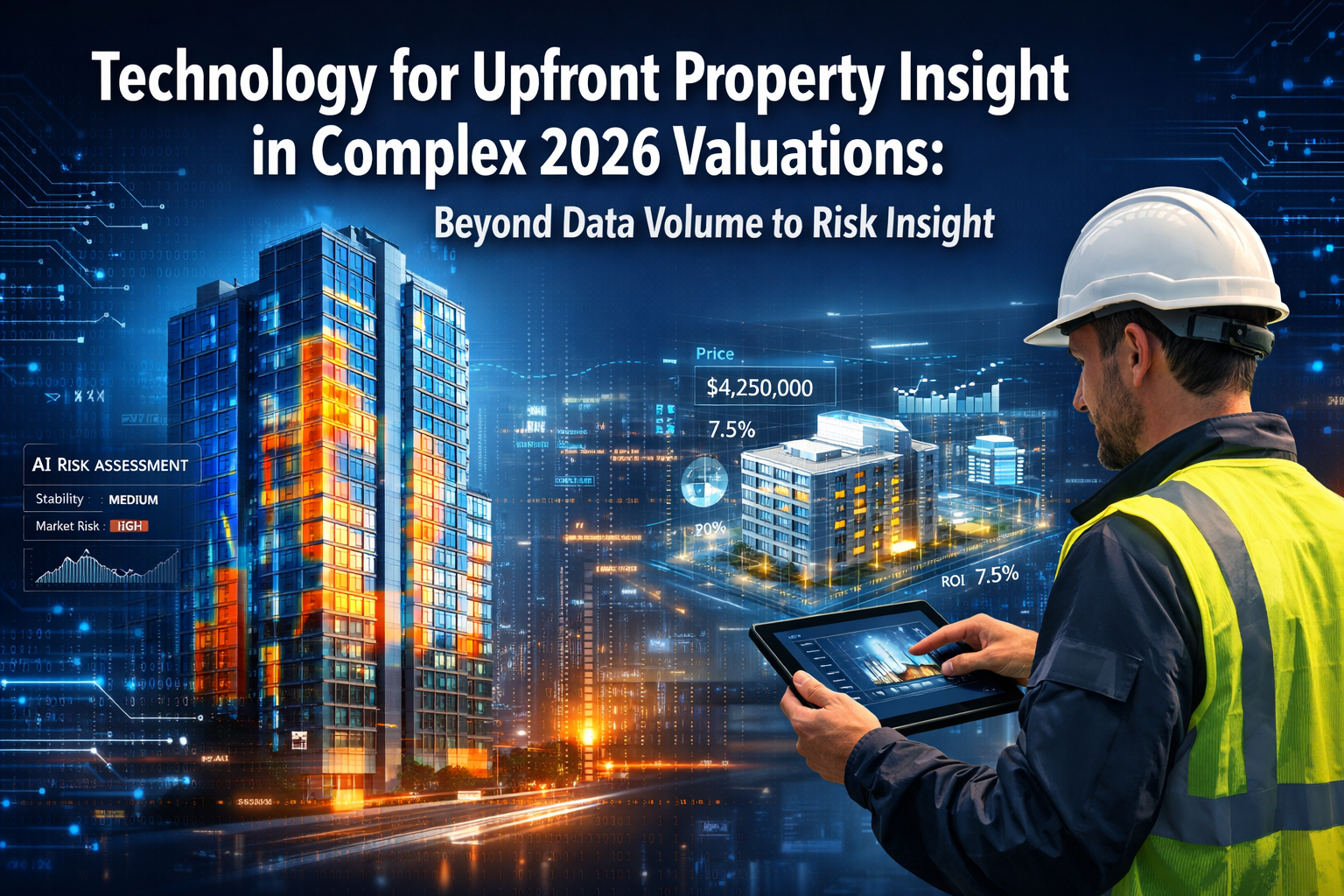
AI-powered automated valuation models now achieve 2.8% median error rates, representing a dramatic leap from the 10-15% margins that plagued traditional methods just five years ago[8]. This transformation matters most when valuing high-rise buildings, non-standard properties, and complex commercial assets—where traditional comparables fall short and lender queries can derail transactions for weeks. As 80% of property valuations in the U.S. will be powered by artificial intelligence by 2026[5], the question is no longer whether to adopt these technologies, but how to leverage them for upfront risk insight that prevents delays rather than merely processing data faster.
Key Takeaways
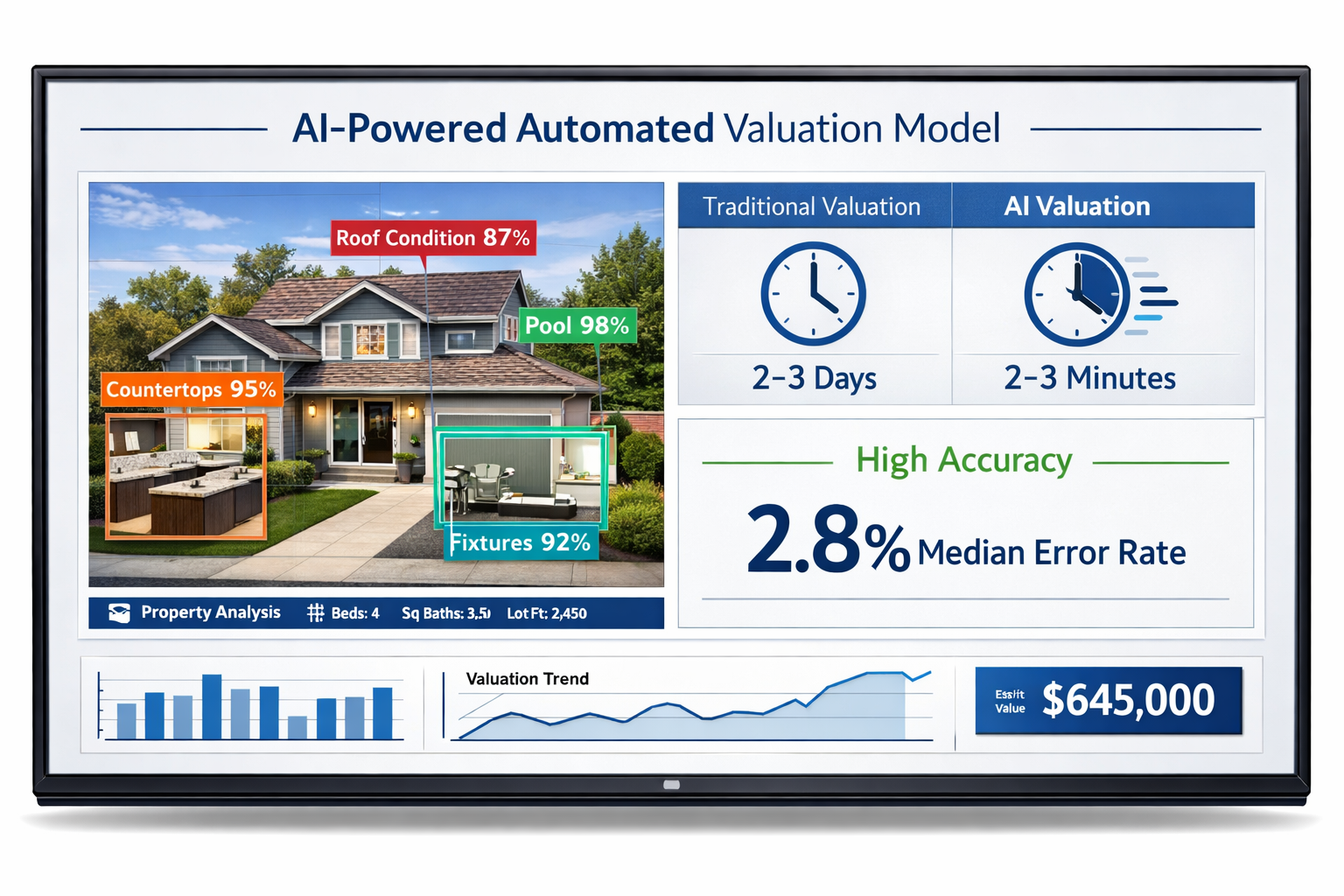
- AI-driven AVMs reduce valuation time from 2-3 days to 2-3 minutes while achieving 2.8% median error rates, enabling real-time property assessments for complex assets[4][8]
- Computer vision and digital twin technology extract risk insights from property features that traditional methods miss, particularly valuable for high-rise and non-standard buildings
- Agentic AI orchestrates multi-source data integration to provide comprehensive risk profiles rather than simple comparable sales analysis[7]
- Early-stage risk assessment tools reduce lender queries by 60-70% through predictive analytics that identify potential valuation challenges before formal appraisal
- Data quality and integration architecture matter more than technology selection for achieving competitive advantage in 2026 valuations[8]
The Evolution from Data Volume to Risk Intelligence in 2026 Valuations
The property valuation industry has moved through three distinct phases. First came digitization—converting paper records to electronic formats. Second arrived data aggregation—collecting massive volumes of comparable sales, tax records, and market statistics. Now in 2026, the industry enters its third phase: risk intelligence extraction.
Why Traditional Approaches Fail for Complex Properties
High-rise buildings, mixed-use developments, and properties with unique characteristics present challenges that expose the limitations of comparable market analysis. A 40-story residential tower with retail podium, underground parking, and shared amenities doesn't have perfect comparables. Traditional valuers spend days researching, adjusting, and justifying their conclusions—only to face lender queries about methodology, comparable selection, and adjustment factors.
The core problem isn't insufficient data. Most valuers have access to comprehensive databases. The challenge is extracting actionable risk insight from that data quickly enough to inform upfront decision-making. When a commercial property valuation takes three weeks and still generates 15 lender queries, the issue is analytical framework, not data availability.
The 2026 Technology Stack for Upfront Property Insight
Modern valuation technology integrates five core capabilities:
- AI-Powered Automated Valuation Models (AVMs) that process comparable sales with contextual understanding
- Computer Vision Systems that extract property characteristics from photographs and drone imagery
- Digital Twin Technology that creates virtual property replicas for scenario modeling
- Predictive Analytics Engines that identify emerging risks before they impact value
- Agentic AI Orchestration that coordinates data from multiple sources autonomously[7]
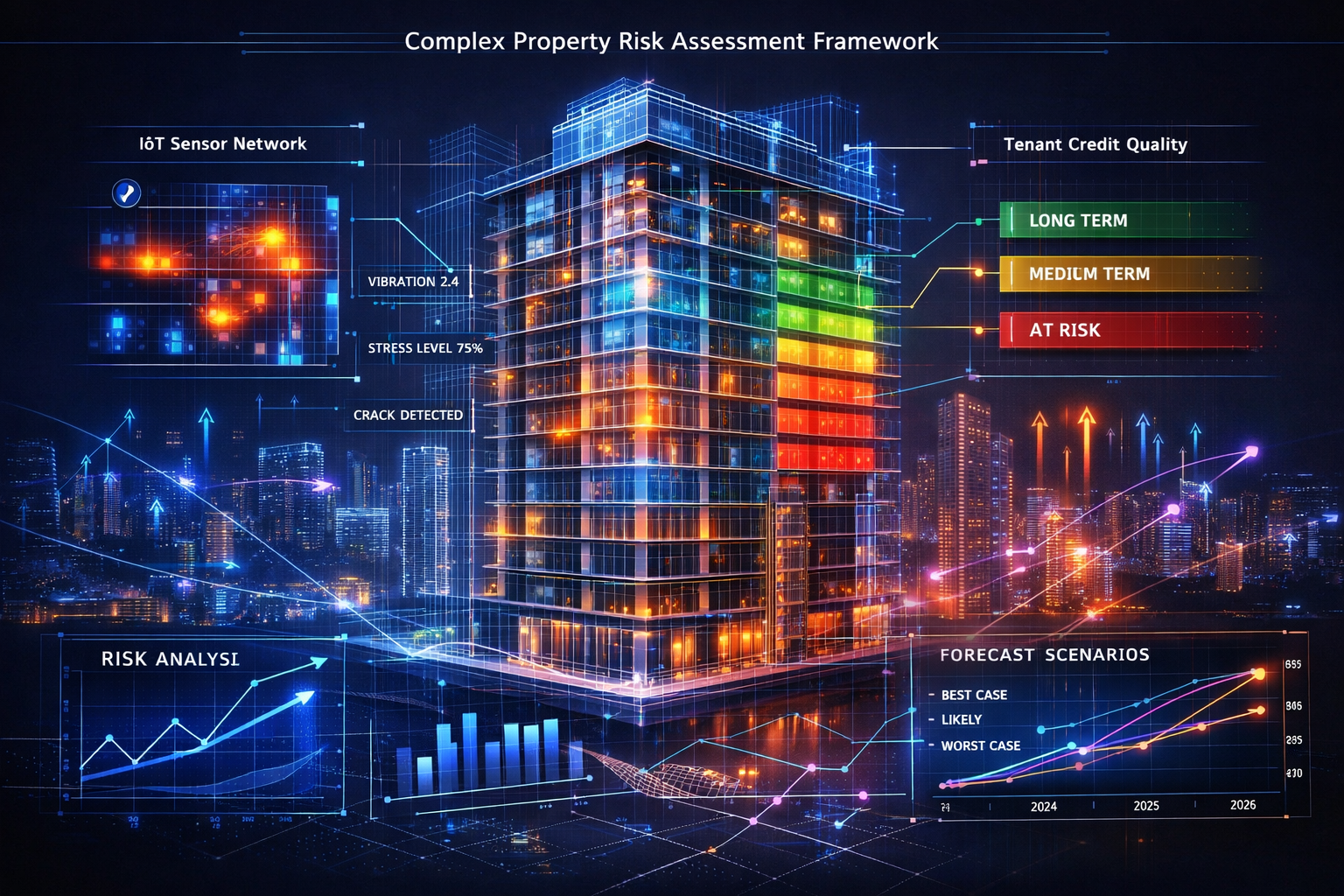
This technology stack enables what traditional methods cannot: simultaneous analysis of hundreds of value factors with risk weighting based on property-specific characteristics. For a high-rise building, the system evaluates structural integrity indicators from IoT sensors, tenant credit quality from financial databases, local demographic trends from census data, and comparable sales—all within minutes rather than days[4].
Technology for Upfront Property Insight in Complex 2026 Valuations: Core Capabilities
The global AI in real estate market reached $303 billion in 2025 and is projected to expand to $989 billion by 2029 at a 34.4% compound annual growth rate[8]. This investment reflects institutional recognition that competitive advantage comes from early risk identification, not faster processing of outdated methodologies.
Automated Valuation Models: From Simple Comps to Contextual Intelligence
Modern AVMs bear little resemblance to their predecessors. While early systems simply averaged comparable sales within geographic boundaries, 2026 AVMs employ machine learning algorithms that understand context, adjust for property-specific features, and quantify uncertainty.
Key capabilities include:
- Feature extraction from listing photographs identifying granite countertops, fixture quality, and finish levels without physical inspection[4]
- Lease term analysis that extracts key provisions from 90+ page documents instantaneously[4]
- Tenant credit assessment integrating financial data to evaluate income stability for commercial properties
- Market trend prediction identifying emerging value shifts before they appear in comparable sales data[6]
The compression of valuation time from 2-3 days to 2-3 minutes represents a 99% reduction in processing time[4]. More importantly, these systems achieve superior accuracy because they analyze factors human valuers cannot process at scale. When valuing a freehold property in London, an AVM can simultaneously evaluate 200+ comparable sales, weight them by similarity across 50+ characteristics, and adjust for market momentum—all before a traditional valuer completes their database search.
Computer Vision and Digital Twins: Seeing What Humans Miss
Computer vision technology transforms property photographs from marketing materials into quantifiable data sources. The system identifies:
- 🏗️ Structural elements and their condition
- 🎨 Finish quality and upgrade levels
- 📐 Space configuration and layout efficiency
- ⚠️ Visible defects or maintenance issues
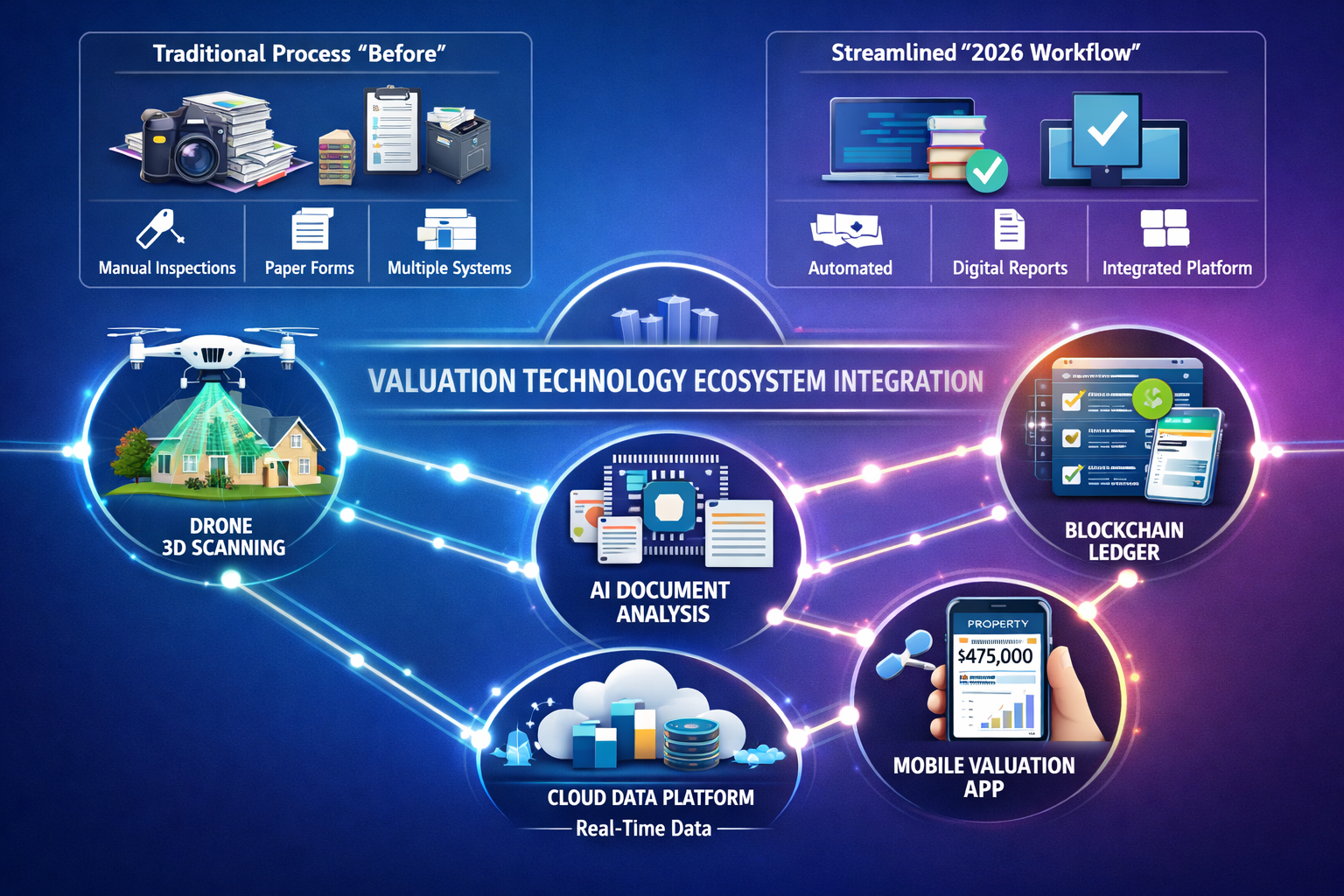
For high-rise buildings, drone-captured imagery combined with 3D scanning creates digital twins—virtual replicas that enable simulation of renovations, energy modeling, and maintenance planning without physical disruption[1][3]. These digital twins serve as permanent, auditable records of property condition at specific points in time, addressing a common source of lender queries: "What was the property's condition at valuation date?"
A valuation report in London supported by digital twin documentation reduces query cycles by providing visual evidence of property condition, eliminating the "he said, she said" debates that delay transactions.
Predictive Analytics: Identifying Risk Before It Materializes
Traditional valuations are inherently backward-looking, relying on historical comparable sales to estimate current value. Predictive analytics shifts the focus forward, identifying emerging trends that will impact value in the near term.
Applications for complex properties include:
| Risk Factor | Traditional Approach | Predictive Analytics Approach |
|---|---|---|
| Tenant Default | Review payment history | Analyze credit trends, industry health, local employment data |
| Market Softening | Compare recent sales | Identify leading indicators (permit activity, absorption rates, demographic shifts) |
| Structural Issues | Physical inspection | Monitor IoT sensor data for anomalies in building performance |
| Regulatory Changes | Review current zoning | Track legislative proposals, planning applications in area |
For a commercial building survey in London, predictive analytics might flag that a major tenant's industry is experiencing contraction, suggesting elevated re-letting risk even if current rent is paid on time. This upfront risk insight enables lenders to adjust loan terms proactively rather than discovering the issue during due diligence.
Implementing Technology for Upfront Property Insight in Complex 2026 Valuations
Technology adoption without strategic implementation delivers limited value. The most successful firms in 2026 recognize that data quality, integration architecture, and workforce readiness matter as much as the AI tools themselves[8].
Data Quality: The Foundation of Reliable Insight
AI systems are only as good as their training data. For property valuations, this means:
- Comprehensive comparable sales databases with verified transaction details
- Property characteristic data that goes beyond basic square footage and bedroom count
- Market context information including demographic trends, employment data, and infrastructure projects
- Historical performance data for income-producing properties
Many firms discover that their existing data requires significant cleansing and standardization before AI systems can extract reliable insights. A property listed as "3 bedroom" might be a 2-bedroom with converted dining room, affecting comparability. Address inconsistencies, duplicate records, and missing fields all degrade AI performance.
For specialized valuations like probate valuations in London or divorce valuations, data quality is particularly critical because these assignments often involve properties held for decades with limited recent comparable sales.
Integration Architecture: Connecting Disparate Data Sources
The power of 2026 valuation technology lies in synthesizing insights from multiple data sources. A comprehensive risk assessment for a high-rise building might integrate:
- 📊 Property databases for comparable sales
- 🏢 Building management systems for IoT sensor data
- 📄 Document repositories for lease agreements and tenant information
- 🗺️ Geographic information systems for location analysis
- 💰 Financial databases for tenant credit assessment
- 📈 Economic data feeds for market trend analysis
This requires robust API connections, data transformation pipelines, and real-time synchronization. Many firms partner with proptech platforms that provide pre-built integrations rather than developing custom solutions.
Agentic AI: Autonomous Risk Assessment Workflows
Agentic AI represents the next evolution in proptech, capable of orchestrating complex workflows with minimal human intervention[7]. Unlike traditional AI that responds to specific queries, agentic systems pursue objectives autonomously, making decisions about which data to gather, how to analyze it, and what actions to recommend.
For property valuations, an agentic AI system might:
- Receive a valuation request for a 35-story mixed-use building
- Identify the property type and select appropriate valuation methodologies
- Gather comparable sales data from multiple databases
- Request drone imagery if recent photographs are unavailable
- Extract lease terms from stored documents
- Assess tenant credit quality by querying financial databases
- Analyze local market trends using demographic and economic data
- Generate preliminary valuation with confidence intervals
- Identify risk factors that require human review
- Produce comprehensive report with supporting documentation
This autonomous workflow reduces valuation time while ensuring consistent application of methodology across all assignments. For firms handling high volumes of valuations, agentic AI enables scalability without proportional increases in staff.
Workforce Readiness: Augmentation, Not Replacement
Despite concerns about AI replacing valuers, the reality in 2026 is augmentation rather than replacement. Technology handles data processing, pattern recognition, and routine analysis, freeing human experts to focus on judgment, client communication, and complex problem-solving.
Successful implementation requires:
- Training programs that teach valuers to interpret AI outputs and understand model limitations
- Quality assurance processes that combine automated checks with human review
- Clear escalation protocols defining when AI recommendations require expert override
- Continuous feedback loops where human valuers improve AI models through corrections and refinements
The most valuable skill for valuers in 2026 is not traditional comparable analysis—AI excels at that. Instead, it's risk interpretation and stakeholder communication. When an AI system flags elevated risk for a property, the human valuer must explain what that means for lending decisions, recommend mitigation strategies, and defend the analysis to skeptical clients.
Reducing Lender Queries Through Early Risk Assessment
Lender queries represent one of the most significant sources of transaction delay in property finance. A query cycle typically adds 7-14 days to transaction timelines, and complex properties often generate multiple query rounds. Technology for upfront property insight in complex 2026 valuations addresses this challenge by identifying potential concerns before formal valuation.
Pre-Valuation Risk Screening
Before commissioning a full RICS valuation, lenders can use AI-powered screening tools to assess:
- Valuation complexity based on property characteristics
- Data availability for comparable analysis
- Known risk factors such as structural concerns or market volatility
- Likely valuation range with confidence intervals
This screening enables lenders to:
✅ Adjust loan terms proactively if risk assessment suggests challenges
✅ Request additional documentation upfront rather than after valuation
✅ Select appropriate valuation methodology based on property type
✅ Set realistic timelines for complex assignments
For properties requiring retrospective valuations, early risk screening is particularly valuable because historical data may be limited, requiring alternative valuation approaches.
Real-Time Valuation Monitoring
Rather than treating valuation as a point-in-time event, 2026 technology enables continuous monitoring of value-affecting factors. IoT sensors in smart buildings provide real-time data on:
- 🌡️ Energy consumption and efficiency
- 👥 Occupancy patterns and space utilization
- 🔧 Equipment performance and maintenance needs
- 🚨 Security incidents and building access
This continuous data stream enables early warning systems that alert lenders when property conditions deteriorate, triggering revaluation before problems escalate. For commercial properties with rent review provisions, real-time monitoring provides objective data supporting rental negotiations.
Automated Query Response Systems
When lender queries do arise, AI systems can generate responses automatically for routine questions:
- "How were comparables selected?" → System provides similarity scoring methodology and weighting factors
- "What adjustments were made?" → System shows adjustment calculations with supporting market data
- "What is the confidence level?" → System provides statistical confidence intervals based on data quality
This automation reduces query response time from days to hours, maintaining transaction momentum. For specialized assignments like insurance reinstatement valuations or matrimonial valuations, automated response systems ensure consistent documentation across all assignments.
Future-Proofing Valuation Practices for 2026 and Beyond
The rapid evolution of valuation technology shows no signs of slowing. Firms that view technology adoption as a one-time project will find themselves perpetually behind. Instead, successful organizations build continuous innovation capabilities into their operations.
Key Strategies for Staying Current
1. Modular Technology Architecture
Rather than monolithic systems, adopt modular platforms that allow component upgrades without complete replacement. This enables integration of new AI models, data sources, and analytical tools as they emerge.
2. Strategic Partnerships
Partner with proptech providers, data vendors, and technology firms rather than building everything in-house. The pace of innovation in AI and machine learning makes internal development impractical for most valuation firms.
3. Data Asset Development
Treat proprietary data as a strategic asset. Firms with extensive historical valuation data, property characteristic databases, and market intelligence have competitive advantages that AI amplifies rather than eliminates.
4. Regulatory Engagement
Participate in industry discussions about AI governance, valuation standards, and regulatory frameworks. Firms that help shape standards will be better positioned than those that merely comply with them.
5. Client Education
Educate clients about how technology enhances rather than replaces professional judgment. Transparency about AI capabilities and limitations builds trust and sets appropriate expectations.
Addressing Common Implementation Challenges
Organizations implementing advanced valuation technology frequently encounter these challenges:
| Challenge | Solution Approach |
|---|---|
| Legacy system integration | Use middleware platforms that bridge old and new systems |
| Staff resistance | Demonstrate how technology eliminates tedious tasks, not jobs |
| Data privacy concerns | Implement robust security protocols and compliance frameworks |
| Model transparency | Use explainable AI that shows reasoning behind recommendations |
| Cost justification | Start with pilot projects demonstrating ROI before full rollout |
For firms conducting best-practice London property valuations, demonstrating that technology enhances rather than compromises professional standards is essential for client acceptance.
Conclusion: From Data Processing to Strategic Insight
Technology for upfront property insight in complex 2026 valuations represents a fundamental shift from data processing to strategic risk intelligence. The compression of valuation time from days to minutes, the achievement of 2.8% median error rates, and the integration of predictive analytics create unprecedented opportunities for early risk identification and transaction acceleration.
For high-rise buildings, non-standard properties, and complex commercial assets, these technologies address the core challenge that traditional methods cannot: synthesizing insights from hundreds of value factors simultaneously while quantifying uncertainty and identifying emerging risks. The result is not just faster valuations, but better-informed lending decisions that reduce queries, prevent delays, and improve outcomes for all stakeholders.
Key actions for implementation:
🎯 Assess current data quality and invest in cleansing and standardization before deploying AI tools
🎯 Start with pilot projects focused on specific property types or transaction scenarios
🎯 Build integration architecture that connects disparate data sources into unified workflows
🎯 Train staff on AI interpretation and risk communication rather than traditional comparable analysis
🎯 Establish feedback loops where human expertise continuously improves AI performance
🎯 Engage with technology partners rather than attempting to build everything in-house
The firms that thrive in 2026 and beyond will be those that recognize technology as an enabler of professional judgment rather than a replacement for it. By combining AI-powered analytics with human expertise in risk interpretation and stakeholder communication, these organizations deliver the upfront property insight that modern property finance demands.
Understanding valuation factors in this technology-enhanced environment requires appreciation for both traditional valuation principles and emerging analytical capabilities. The goal is not to abandon professional judgment but to augment it with tools that process information at scales and speeds humans cannot match.
As the property valuation industry continues its evolution from art to science, the winners will be those who master the integration of technology and expertise—delivering not just numbers, but actionable risk insight that drives better decisions.
References
[1] Real Estate Tech Explained Tools Transforming Property – https://meduzzen.com/blog/real-estate-tech-explained-tools-transforming-property/
[3] How Technology Is Shaping The Future Of Property Valuations – https://www.portotheme.com/how-technology-is-shaping-the-future-of-property-valuations/
[4] Ai For Real Estate – https://www.growthfactor.ai/resources/blog/ai-for-real-estate
[5] Top 5 Real Estate Tech Tools To Watch In 2026 – https://swifttechco.com/blog/real-estate/top-5-real-estate-tech-tools-to-watch-in-2026
[6] Top 5 Real Estate Technology Trends For 2026 Future Proof Your Portfolio – https://www.redirectconsulting.com/blog/top-5-real-estate-technology-trends-for-2026-future-proof-your-portfolio
[7] Next Phase Of Proptech Agentic Ai In 2026 – https://www.icsc.com/news-and-views/icsc-exchange/next-phase-of-proptech-agentic-ai-in-2026
[8] Ai Use Cases In Real Estate – https://www.blott.com/reports/ai-use-cases-in-real-estate