
Construction activity across England and Wales continues to surge in 2026, yet invalid party wall notices remain the single most preventable cause of costly project injunctions. Recent case law demonstrates that even minor technical defects in notice drafting can halt multi-million pound developments, leaving building owners liable for substantial legal costs and neighbour surveyor fees. Understanding the precise requirements of Invalid Party Wall Notices in 2026: Surveyor Strategies to Prevent Injunctions and Project Delays has become essential for protecting both timelines and budgets.
The Party Wall etc. Act 1996 establishes strict procedural requirements that many building owners underestimate until facing enforcement action. Invalid notices trigger a cascade of consequences: expired timelines, dissenting neighbours, dual surveyor appointments, and in worst-case scenarios, court injunctions that bring construction to an immediate halt.
Key Takeaways
- Invalid party wall notices are the leading cause of construction injunctions in 2026, with incorrect addressing, insufficient notice periods, and unclear work descriptions representing the most common defects
- Two-month minimum notice periods are mandatory for all party wall works, with notices expiring after 12 months if work doesn't commence
- Professional surveyor involvement from the outset prevents costly rectification, reduces dispute risk, and protects against injunction applications
- Building owners bear full financial liability for both their own and adjoining owners' reasonable surveyor fees when neighbours dissent to notices
- Schedules of Condition provide critical legal protection by documenting pre-work property conditions and preventing unfounded damage claims
Understanding Invalid Party Wall Notices in 2026: Common Defects That Trigger Disputes
The Party Wall etc. Act 1996 requires specific notice formats depending on the type of work proposed. Yet many building owners and inexperienced practitioners make fundamental errors that invalidate the entire process [1].
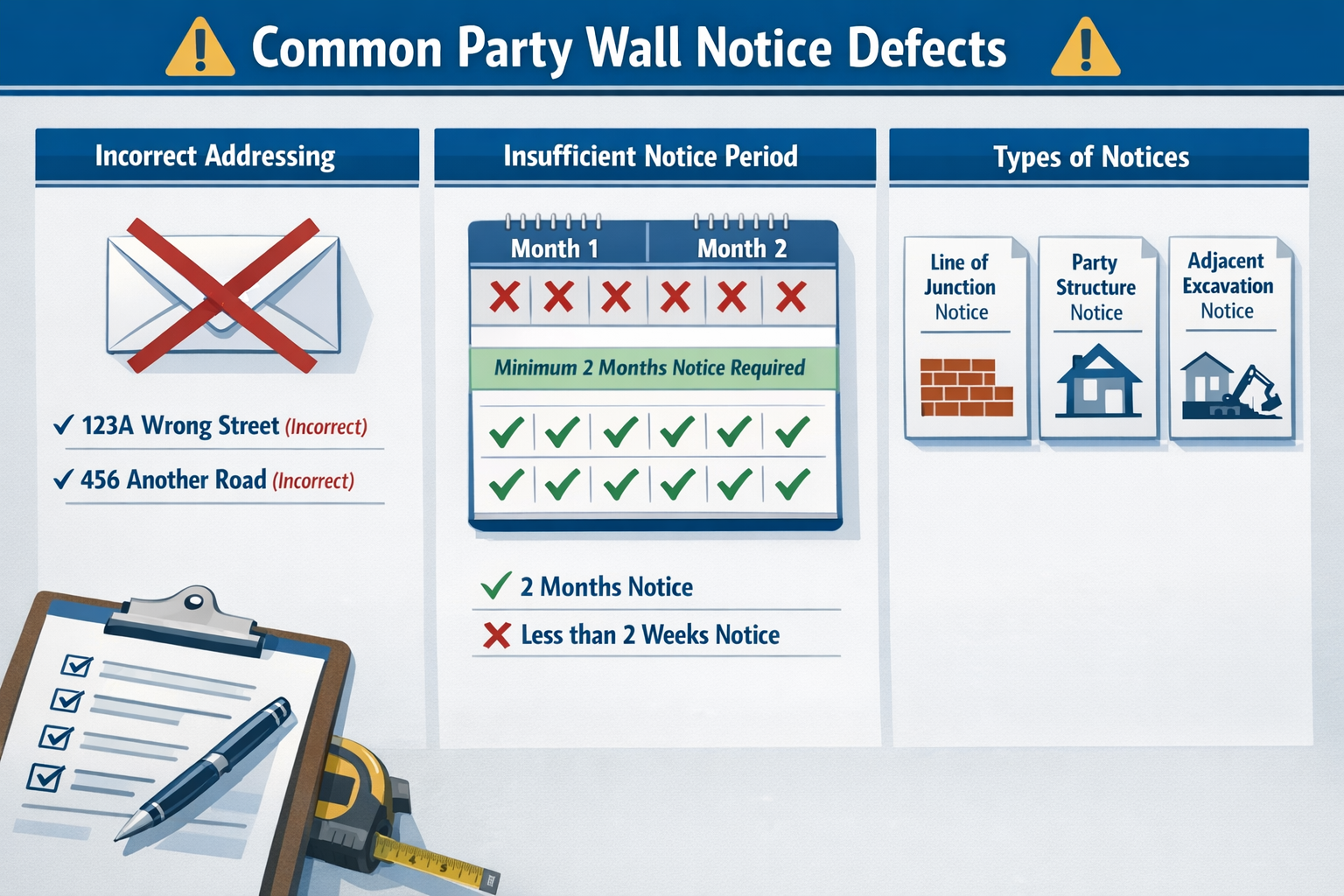
The Three Notice Types and Their Specific Requirements
Understanding which notice applies to your project is the first critical step:
📋 Party Structure Notice (Section 3)
- Required for works directly to an existing party wall or party structure
- Covers cutting into walls, inserting beams, raising walls, or demolition
- Must describe the exact nature and extent of proposed works
📋 Line of Junction Notice (Section 1)
- Required when building a new wall on or astride the boundary line
- Applies to new construction rather than alterations to existing structures
- Includes options for different construction types
📋 Adjacent Excavation Notice (Section 6)
- Required for excavations within 3 or 6 metres of neighbouring structures
- Depth and proximity thresholds determine applicability
- Must include detailed excavation specifications
Using a generic template that doesn't match your specific work category represents one of the most common reasons for notice invalidity [4]. Professional surveyors ensure the correct notice type is selected and properly completed before service.
Critical Information That Must Appear in Every Notice
Invalid notices typically fail due to missing or incorrect essential information [1]:
| Required Element | Common Defects | Consequence |
|---|---|---|
| Adjoining Owner Details | Wrong names, incomplete addresses, missing co-owners | Notice deemed invalid, must re-serve |
| Building Owner Details | Corporate entity errors, incomplete contact information | Prevents proper communication |
| Work Description | Vague language, incomplete scope, misleading details | Adjoining owner cannot properly assess impact |
| Proposed Start Date | Missing date, insufficient notice period | Automatic invalidity |
| Plans and Drawings | Missing, unclear, inconsistent with description | Prevents informed consent |
⚠️ Warning: Incorrect adjoining owner identification represents the single most frequent defect. Surveyors must verify ownership through Land Registry searches rather than relying on assumptions or outdated information.
For complex projects involving multiple properties, understanding legal requirements for party walls becomes even more critical.
The Two-Month Rule and Timeline Compliance for Valid Party Wall Notices
Time-based requirements under the Party Wall Act are absolute. Building owners cannot negotiate these periods or seek neighbour agreement to shorter timelines [1].
Mandatory Notice Periods That Cannot Be Waived
All party wall notices must be served at least two months before the proposed start date for works. This period allows adjoining owners adequate time to:
- Review the proposed works thoroughly
- Seek independent professional advice
- Appoint their own surveyor if they choose to dissent
- Arrange pre-work condition surveys
Even if your neighbour verbally agrees to shorter notice, the statutory period remains legally required. Commencing work before the two-month period expires (or before receiving consent/completing the award process) exposes building owners to injunction risk [5].
The 14-Day Response Window and Deemed Dissent
Once a valid notice is served, adjoining owners have 14 days to respond in one of three ways [3]:
- ✅ Consent in writing – Allows work to proceed without formal award
- ❌ Dissent in writing – Triggers surveyor appointment process
- 🔇 No response – Automatically treated as dissent after 14 days
Many building owners mistakenly interpret silence as acceptance. Under the Act, failure to respond constitutes deemed dissent, requiring the full surveyor appointment and award process [3].
One-Year Validity Period Creates Urgency
Party wall notices expire 12 months after service if works haven't commenced [1]. This creates particular challenges for:
- Projects with extended planning approval timelines
- Phased developments with staggered start dates
- Works delayed by financing or contractor availability
Expired notices must be completely re-served, restarting the two-month clock and potentially triggering new rounds of negotiation. Professional surveyors track validity periods and advise on optimal service timing to prevent expiration.
Understanding the party wall act 3 metre rule helps determine when excavation notices specifically require service.
Surveyor Strategies to Prevent Invalid Party Wall Notices in 2026
Professional party wall surveyors employ systematic approaches to ensure notice validity and prevent disputes before they arise.
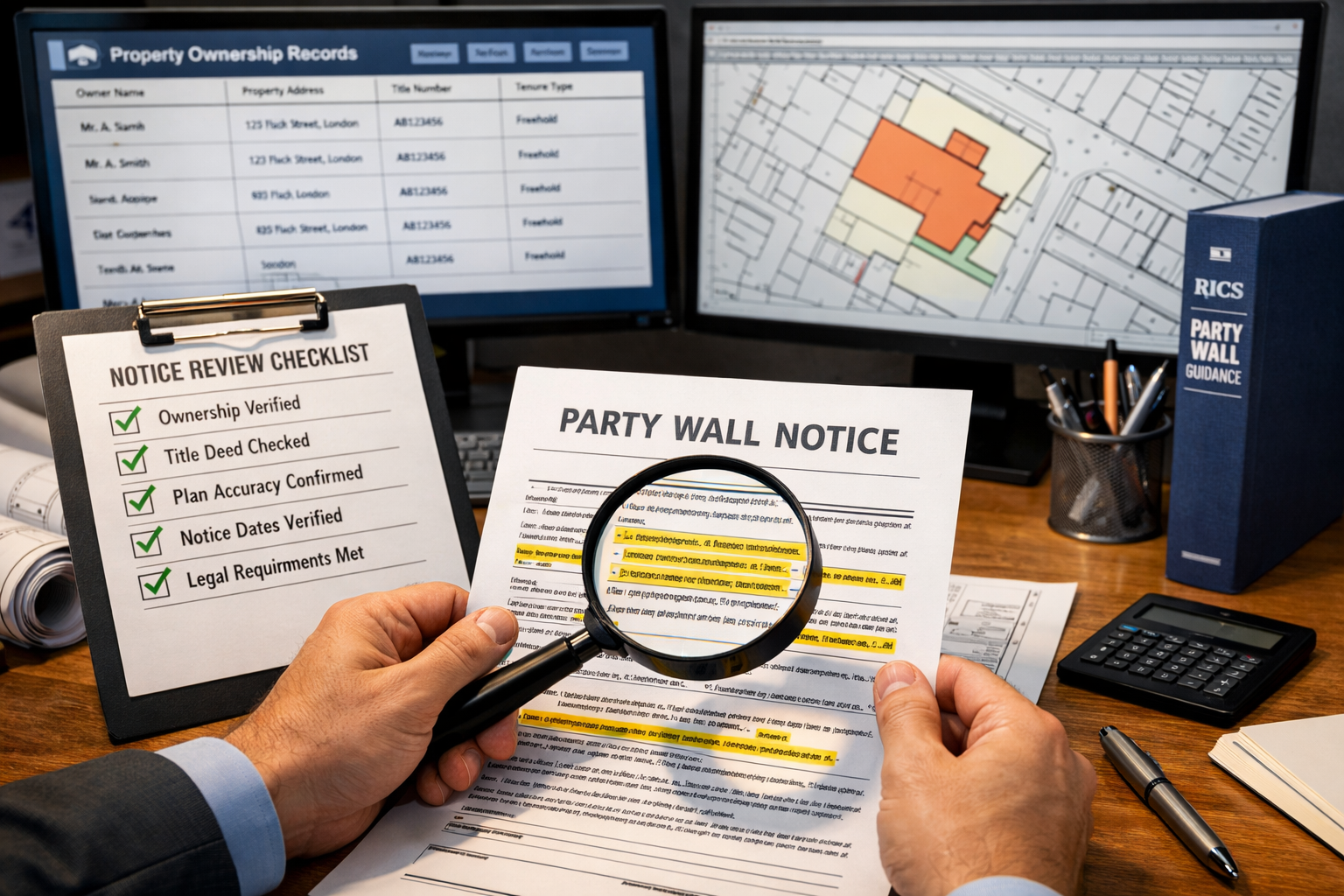
Pre-Service Verification Checklist
Before serving any party wall notice, experienced surveyors complete comprehensive verification:
🔍 Property Ownership Research
- Conduct Land Registry searches for all adjoining properties
- Identify all legal owners, including companies and trusts
- Verify current addresses for service
- Check for leasehold interests requiring separate notices
🔍 Work Scope Documentation
- Review architectural and structural drawings thoroughly
- Confirm which notice type(s) apply to the specific works
- Identify all properties potentially affected
- Document excavation depths and distances precisely
🔍 Timeline Planning
- Calculate minimum two-month notice period from intended start date
- Allow buffer time for potential disputes or delays
- Consider seasonal factors affecting construction scheduling
- Verify notice won't expire before realistic commencement
This methodical approach prevents the most common defects that invalidate notices and cause project delays [1].
Professional Notice Drafting That Withstands Scrutiny
Generic template notices downloaded from the internet frequently contain errors or omit critical information. Professional surveyors draft notices that include:
Precise Work Descriptions
- Specific structural elements to be affected
- Methods and techniques to be employed
- Extent and depth of any excavations
- Temporary works and support requirements
Clear Visual Documentation
- Scaled drawings showing party wall locations
- Cross-sections illustrating proposed alterations
- Excavation plans with measurements to boundaries
- Photographic context where helpful
Complete Contact Information
- Multiple contact methods for building owner
- Designated surveyor details if already appointed
- Clear instructions for response process
- Reference numbers for tracking
Investing in professional notice drafting prevents the need for costly rectification later [1]. The relatively modest cost of proper preparation far outweighs the expense of re-serving notices, managing disputes, or defending injunction applications.
The Agreed Surveyor Approach: Reducing Complexity and Cost
When adjoining owners dissent (or are deemed to dissent), the Act requires surveyor appointments. Building owners face a strategic choice that significantly impacts project costs [2]:
Option 1: Dual Surveyor Appointment
- Building owner appoints their surveyor
- Adjoining owner appoints separate surveyor
- Two surveyors jointly prepare the award
- Building owner pays both surveyors' reasonable fees
Option 2: Agreed Single Surveyor
- Both parties appoint one surveyor to act for both
- Single surveyor prepares award impartially
- Reduced total fees (only one surveyor)
- Faster process with fewer coordination requirements
The party wall agreed surveyor approach offers substantial advantages when neighbours are willing to cooperate. Professional surveyors can propose this option early in discussions, emphasizing cost savings for all parties.
Schedule of Condition: Essential Protection Against Future Claims
Even with valid notices and proper awards, building owners face potential liability for damage to adjoining properties during construction. Schedules of Condition provide crucial protection [6].
A comprehensive Schedule of Condition includes:
- Detailed written descriptions of existing property condition
- Extensive photography documenting every room and exterior elevation
- Identification of pre-existing defects that might otherwise be blamed on works
- Professional assessment of structural condition and vulnerabilities
These reports serve as definitive evidence if disputes arise about construction damage. Without them, building owners may face expensive claims for pre-existing conditions they didn't cause [6].
For projects involving party wall excavation, Schedules of Condition become particularly critical given the higher risk profile of groundworks.
Consequences of Invalid Notices: Injunctions, Delays, and Financial Liability
The consequences of serving invalid party wall notices extend far beyond simple administrative inconvenience. Building owners face serious legal and financial risks.
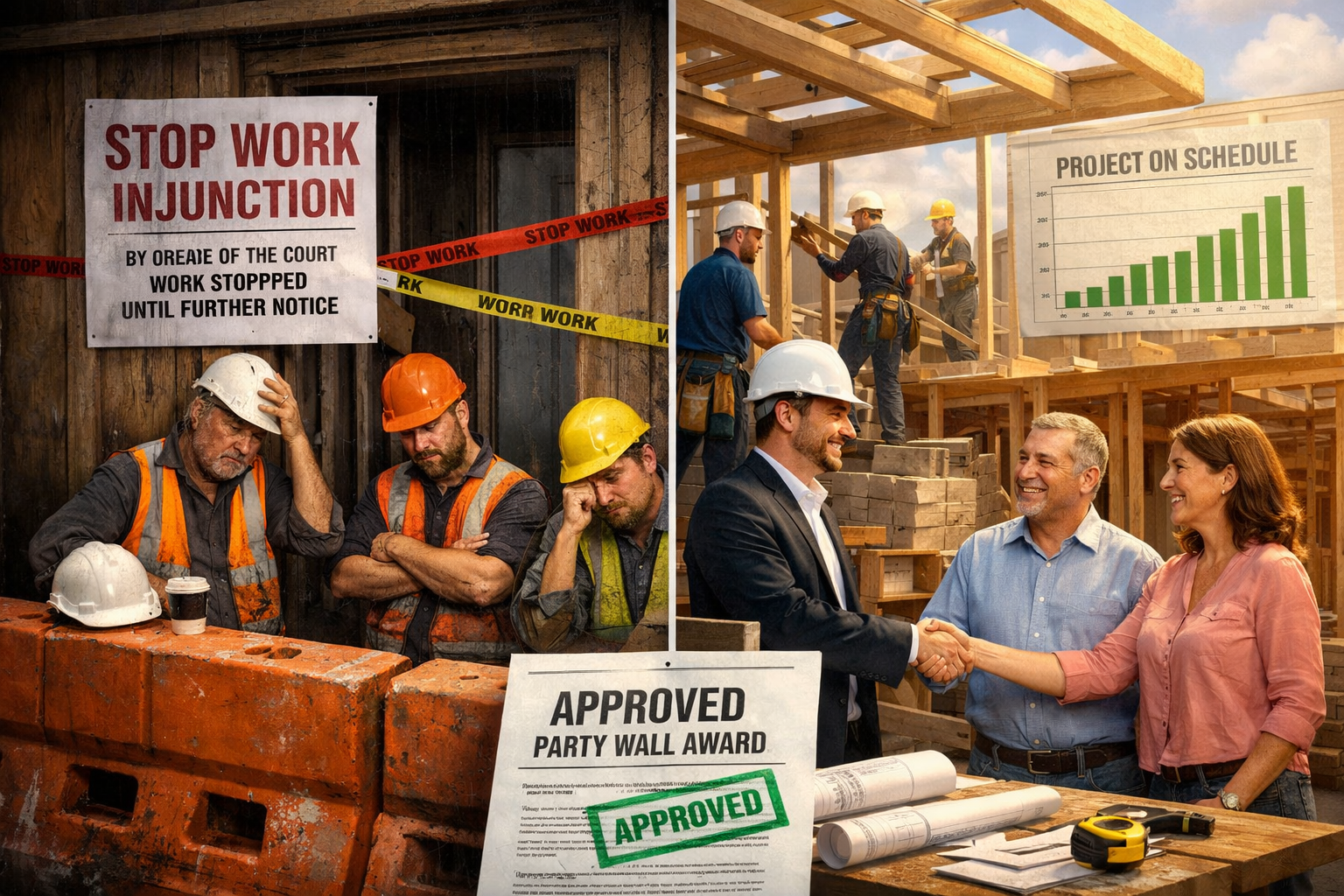
Court Injunctions That Halt Construction Immediately
When building owners proceed with party wall works without valid notices or proper awards, adjoining owners can seek court injunctions to stop the work [5]. These legal orders:
- Take effect immediately upon issuance
- Require complete cessation of all related construction activities
- Remain in force until proper party wall procedures are completed
- Expose building owners to contempt of court if violated
Recent case law confirms that courts readily grant injunctions for party wall violations, viewing the Act's procedural requirements as mandatory rather than advisory [5]. The disruption to project timelines can be catastrophic, particularly for:
- Commercial developments with tenant move-in dates
- Residential projects with exchange and completion deadlines
- Renovation works where owners are in temporary accommodation
- Contractor schedules affecting multiple sequential projects
Financial Liability for Surveyor Fees on Both Sides
The Party Wall Act places financial responsibility squarely on building owners. When adjoining owners dissent to notices, building owners must pay [2]:
Building Owner's Costs:
- Their own surveyor's fees for award preparation
- Schedule of Condition for their own property
- Legal advice if disputes escalate
Adjoining Owner's Costs (Building Owner Pays):
- Adjoining owner's surveyor fees (must be "reasonable")
- Adjoining owner's Schedule of Condition
- Adjoining owner's legal costs if disputes proceed to court
This financial structure creates significant incentive to get notices right initially. Invalid notices that require re-service double the surveyor involvement period and associated costs [1].
Understanding party wall surveyor costs helps building owners budget appropriately for professional involvement.
Project Delays and Contractor Standby Costs
Invalid notices create cascading delays that affect entire project schedules:
- Discovery of invalidity (often when adjoining owner raises objections)
- Re-drafting and re-service of corrected notices
- New two-month waiting period before work can commence
- Potential surveyor appointment process if relationships have deteriorated
- Award preparation taking additional weeks or months
During these delays, building owners face:
- Contractor standby charges or loss of contractor availability
- Extended financing costs on construction loans
- Opportunity costs from delayed project completion
- Relationship damage with neighbours that complicates future dealings
Professional surveyor involvement from the outset prevents these expensive consequences [7].
Damage Claims Without Protective Documentation
Building owners who proceed without proper Schedules of Condition face vulnerability to damage claims they cannot effectively defend [6]. Adjoining owners may allege:
- Structural cracks caused by vibration or settlement
- Cosmetic damage from construction activities
- Water ingress from disturbed party wall structures
- Loss of support from excavation works
Without baseline documentation, building owners struggle to prove whether damage existed before works commenced. This often results in:
- Expensive repair obligations for pre-existing conditions
- Extended legal disputes over causation
- Damage to professional reputation
- Difficulty obtaining insurance for future projects
For guidance on managing these situations, reviewing resources on what is a party wall dispute provides valuable context.
Best Practices for Surveyors: Ensuring Notice Validity in 2026
Professional surveyors in 2026 follow established protocols that align with RICS guidance and case law developments.
Early Engagement Before Design Finalization
The most effective surveyor involvement begins during project planning rather than after designs are complete. Early engagement allows:
Design Optimization
- Identifying works that trigger party wall requirements
- Suggesting design modifications that reduce neighbour impact
- Planning construction sequencing to minimize disruption
- Coordinating with architects and structural engineers
Relationship Management
- Opening communication channels with neighbours early
- Explaining proposed works before formal notices
- Building goodwill that facilitates smoother formal process
- Identifying potential concerns that can be addressed in design
Timeline Planning
- Calculating realistic notice periods into project schedules
- Allowing adequate time for award preparation if needed
- Coordinating party wall process with planning applications
- Preventing last-minute rushes that increase error risk
Comprehensive Neighbour Communication Strategy
Professional surveyors don't rely solely on formal notice service. They develop communication strategies that include [7]:
Pre-Notice Discussions
- Informal meetings to explain proposed works
- Answering questions about process and timelines
- Providing preliminary drawings and information
- Establishing rapport before formal procedures
Clear Written Communications
- Cover letters explaining notice purpose and requirements
- Plain-language summaries of technical content
- Contact information for questions
- Realistic timelines for response and work commencement
Ongoing Updates
- Progress reports during award preparation
- Advance notice of construction milestones
- Prompt response to concerns or questions
- Post-completion follow-up
This proactive approach reduces dissent rates and facilitates agreed surveyor appointments when dissent does occur [7].
Documentation Standards That Withstand Legal Scrutiny
Professional surveyors maintain meticulous records throughout the party wall process:
Service Documentation
- Proof of delivery for all notices (recorded delivery receipts)
- Photographic evidence of hand-delivery when used
- Detailed records of service dates and methods
- Copies of all documents as actually served
Communication Records
- Written logs of all telephone conversations
- Email correspondence with all parties
- Meeting notes with dates and attendees
- Response tracking for all formal communications
Technical Documentation
- Complete drawing sets referenced in notices
- Specifications for all proposed works
- Structural calculations where relevant
- Photographic surveys and condition reports
This documentation proves invaluable if disputes arise or legal proceedings become necessary.
Continuing Professional Development on Evolving Case Law
Party wall law continues to develop through court decisions that interpret the Act's requirements. Professional surveyors maintain current knowledge through:
- Regular review of reported party wall cases
- Attendance at professional development seminars
- Membership in specialist party wall organizations
- Consultation with solicitors on complex matters
Recent case law has clarified important issues including notice validity requirements, surveyor appointment procedures, and the scope of awards [5]. Surveyors who stay current with these developments provide better protection for their clients.
Resources on party wall legislation help professionals maintain up-to-date knowledge.
Practical Guidance for Building Owners: Protecting Your Project in 2026
Building owners planning construction work in 2026 should take proactive steps to prevent party wall notice problems.
When to Appoint a Party Wall Surveyor
Consider professional surveyor appointment if your project involves:
- Any work directly to a party wall (cutting, inserting beams, raising height)
- New construction on or near boundary lines
- Excavations within 3-6 metres of neighbouring structures
- Complex projects with multiple adjoining properties
- High-value developments where delay costs are substantial
- Previously strained neighbour relationships
The cost of professional surveyor involvement is modest compared to the risks of invalid notices [1]. Most surveyors offer fixed fees for notice preparation, providing budget certainty.
Red Flags That Indicate Notice Problems
Be alert for warning signs that notices may be invalid:
🚩 Generic template notices without project-specific details
🚩 Unclear work descriptions that don't match your actual plans
🚩 Missing or incomplete adjoining owner information
🚩 Insufficient notice period from service to proposed start date
🚩 Wrong notice type for the works being undertaken
🚩 No accompanying drawings or inadequate visual documentation
If you've received advice that seems to minimize party wall requirements or suggests shortcuts, seek a second opinion from an experienced professional.
Cost-Benefit Analysis of Professional Surveyor Involvement
Many building owners hesitate to engage surveyors due to perceived costs. Consider the comparative expenses:
Professional Surveyor Costs:
- Notice preparation: £500-£1,500
- Schedule of Condition: £500-£1,000
- Award preparation (if needed): £1,500-£3,000
- Total typical cost: £2,500-£5,500
Invalid Notice Consequences:
- Re-service and extended timelines: £2,000-£5,000
- Contractor delays and standby: £5,000-£20,000+
- Legal costs if disputes escalate: £10,000-£50,000+
- Injunction defense and compliance: £15,000-£100,000+
- Total potential cost: £32,000-£175,000+
The return on investment for professional involvement is compelling [6]. Even in best-case scenarios where invalid notices are caught early, rectification costs exceed the initial professional fees that would have prevented the problem.
Selecting the Right Party Wall Surveyor
Not all surveyors have equivalent party wall expertise. When selecting a professional, consider:
Qualifications and Experience
- RICS membership (Member or Fellow status)
- Specific party wall training and certification
- Years of experience with party wall matters
- Track record with projects similar to yours
Local Knowledge
- Familiarity with local property types and construction
- Established relationships with local surveyors
- Understanding of regional building practices
Communication Skills
- Clear explanations of process and requirements
- Responsiveness to questions and concerns
- Ability to manage neighbour relationships diplomatically
Fee Structure
- Transparent pricing with written fee agreements
- Clear scope of services included
- Provisions for additional work if disputes arise
For projects in specific areas, consider specialists such as chartered surveyors in London who understand local conditions.
The Role of Party Wall Agreements and Awards in Preventing Disputes
Understanding the distinction between informal agreements and formal awards helps building owners navigate the process effectively.
When Consent Eliminates the Need for Awards
If adjoining owners provide written consent to your party wall notice within 14 days, the formal award process becomes unnecessary [3]. Work can proceed after the two-month notice period expires, subject to any conditions in the consent.
Written consent should:
- Clearly reference the notice being consented to
- Be signed by all legal owners of the adjoining property
- Specify any conditions or requirements
- Be retained as proof of agreement
However, even with consent, building owners should still consider obtaining Schedules of Condition to protect against future damage claims [6].
Award Contents That Provide Legal Protection
When dissent occurs (express or deemed), surveyors prepare a Party Wall Award that becomes legally binding on all parties [2]. Comprehensive awards include:
Work Specifications
- Detailed description of permitted works
- Methods and techniques to be employed
- Hours of work and access requirements
- Duration and phasing of construction
Protection Measures
- Required temporary support or shoring
- Vibration or noise limitations
- Dust and debris control requirements
- Emergency contact procedures
Financial Provisions
- Surveyor fee allocations
- Security for expenses (if appropriate)
- Damage compensation procedures
Schedules of Condition
- Pre-work condition documentation
- Photographic records
- Identified vulnerabilities
Awards provide clear frameworks that prevent disputes during construction and establish procedures for resolving any issues that arise.
Resources on party wall agreements explain the formal documentation process in detail.
Enforcement Mechanisms and Dispute Resolution
Party Wall Awards are enforceable through county court proceedings if either party fails to comply [2]. The Act also provides an appeals process:
- Either party can appeal an award to county court
- Appeals must be filed within 14 days of award service
- Courts can confirm, vary, or set aside awards
- Legal costs typically follow the outcome
Professional surveyors draft awards that balance both parties' interests, reducing appeal risk and facilitating smooth project progression.
Conclusion
Invalid Party Wall Notices in 2026: Surveyor Strategies to Prevent Injunctions and Project Delays represents a critical concern for building owners undertaking construction work. The surge in construction activity across England and Wales has been matched by an increase in party wall disputes, many stemming from preventable notice defects.
The consequences of invalid notices extend far beyond administrative inconvenience. Building owners face potential injunctions that halt work immediately, financial liability for surveyor fees on both sides, extended project delays with associated contractor costs, and vulnerability to damage claims without protective documentation.
Professional surveyor involvement from project inception provides comprehensive protection against these risks. Experienced surveyors ensure correct notice type selection, verify adjoining owner details through proper research, draft precise work descriptions with supporting documentation, calculate appropriate notice periods and track validity, and prepare Schedules of Condition that protect against unfounded claims.
The cost-benefit analysis overwhelmingly favours professional involvement. Typical surveyor fees of £2,500-£5,500 prevent potential costs of £32,000-£175,000+ from invalid notices, disputes, and injunctions.
Actionable Next Steps
For Building Owners Planning Construction Work:
- Engage a qualified party wall surveyor during project planning, not after designs are finalized
- Allow adequate time for the two-month notice period in your project schedule
- Conduct Land Registry searches to identify all legal owners of adjoining properties
- Open communication channels with neighbours before serving formal notices
- Insist on Schedules of Condition even if neighbours consent to works
- Maintain comprehensive documentation of all party wall procedures and communications
For Property Professionals and Surveyors:
- Maintain current knowledge of party wall case law and RICS guidance
- Develop systematic verification checklists for notice preparation
- Build relationships with local party wall specialists for complex matters
- Educate clients early about party wall requirements and timelines
- Document everything with an eye toward potential future disputes
The Party Wall etc. Act 1996 provides a clear framework for managing construction work affecting shared structures and boundaries. When properly followed, it facilitates smooth project progression while protecting the interests of all parties. Invalid notices undermine this framework, creating unnecessary conflict, expense, and delay.
In 2026's active construction environment, professional surveyor strategies for preventing invalid party wall notices have never been more valuable. Building owners who invest in proper notice preparation and professional guidance protect their projects, their budgets, and their neighbour relationships.
References
[1] Invalid Party Wall Notices – https://timgreenwood-associates.co.uk/news/invalid-party-wall-notices/
[2] Invalid Party Wall Notices – https://stokemont.com/advice/invalid-party-wall-notices/
[3] Options For Responding To Party Wall Notices A Complete Guide For Homeowners – https://www.adamjoseph.co.uk/options-for-responding-to-party-wall-notices-a-complete-guide-for-homeowners
[4] 2026 Diy Party Wall Notice Validity Tips – https://www.simplesurvey.co.uk/uncategorised/2026-diy-party-wall-notice-validity-tips/
[5] Court Of Appeal Considers The Effect Of Failing To Serve A Party Wall Notice – https://www.blbsolicitors.co.uk/blog/court-of-appeal-considers-the-effect-of-failing-to-serve-a-party-wall-notice/
[6] Understanding Party Wall Issues And How Surveyors Save You Thousands – https://www.houricanassociates.com/party-wall-news/understanding-party-wall-issues-and-how-surveyors-save-you-thousands/
[7] How To Make The Party Wall Process Run Smoothly – https://urbanistarchitecture.co.uk/how-to-make-the-party-wall-process-run-smoothly/