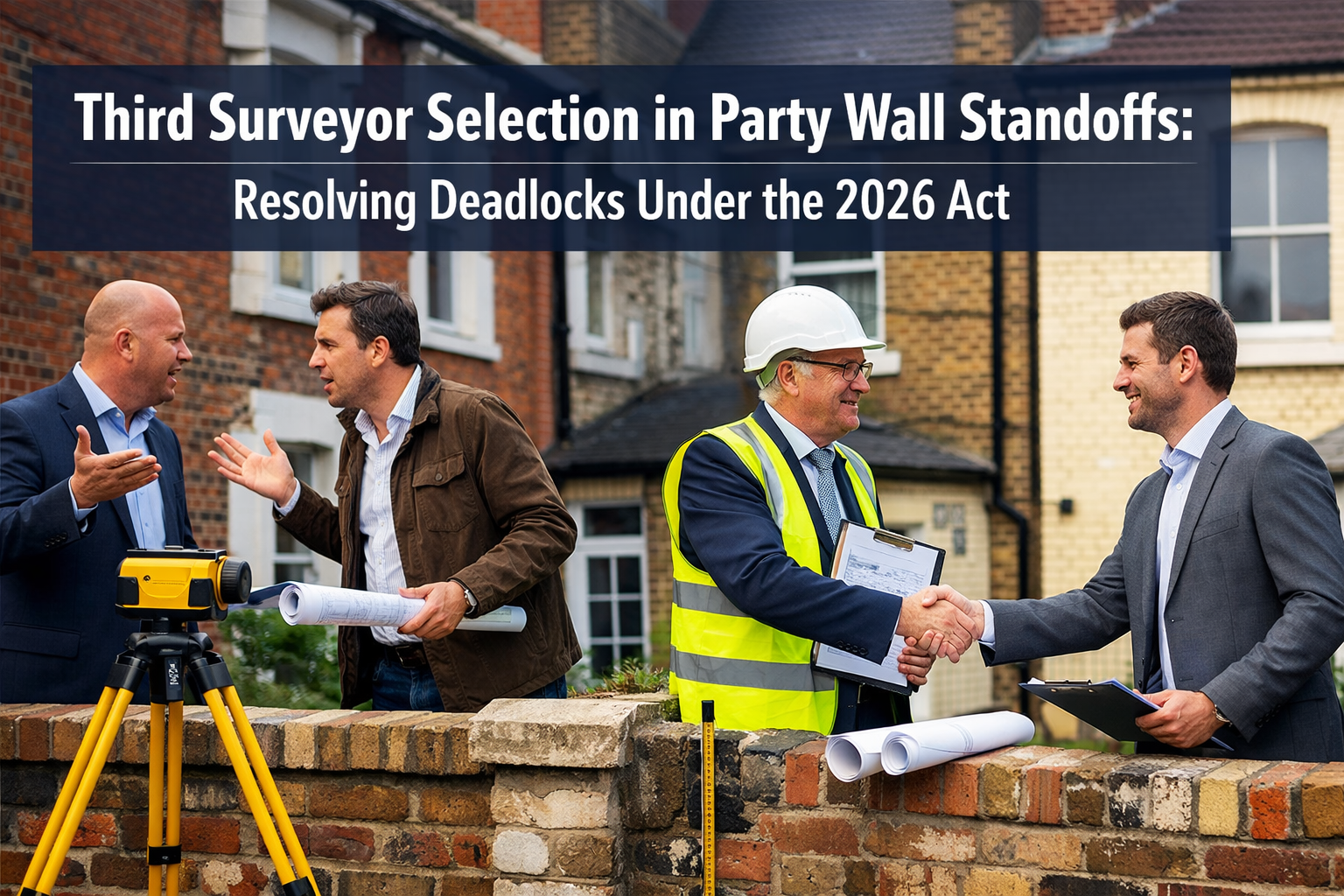

When two appointed surveyors reach an impasse over party wall matters, 99% of cases still manage to agree on a third surveyor through established protocols—but that remaining 1% reveals critical gaps in the dispute resolution framework.[4] As construction activity surges across UK housing markets in 2026, understanding the mechanisms for Third Surveyor Selection in Party Wall Standoffs: Resolving Deadlocks Under the 2026 Act has become essential for property owners, surveyors, and legal professionals navigating neighbour disputes.
The Party Wall Act 1996 establishes a clear hierarchy for resolving disagreements between appointed surveyors, yet confusion persists about selection procedures, timelines, and the impartial authority wielded by third surveyors. This comprehensive guide explores the step-by-step protocols for Third Surveyor Selection in Party Wall Standoffs: Resolving Deadlocks Under the 2026 Act, drawing on recent UK case law and practical insights from experienced party wall practitioners.
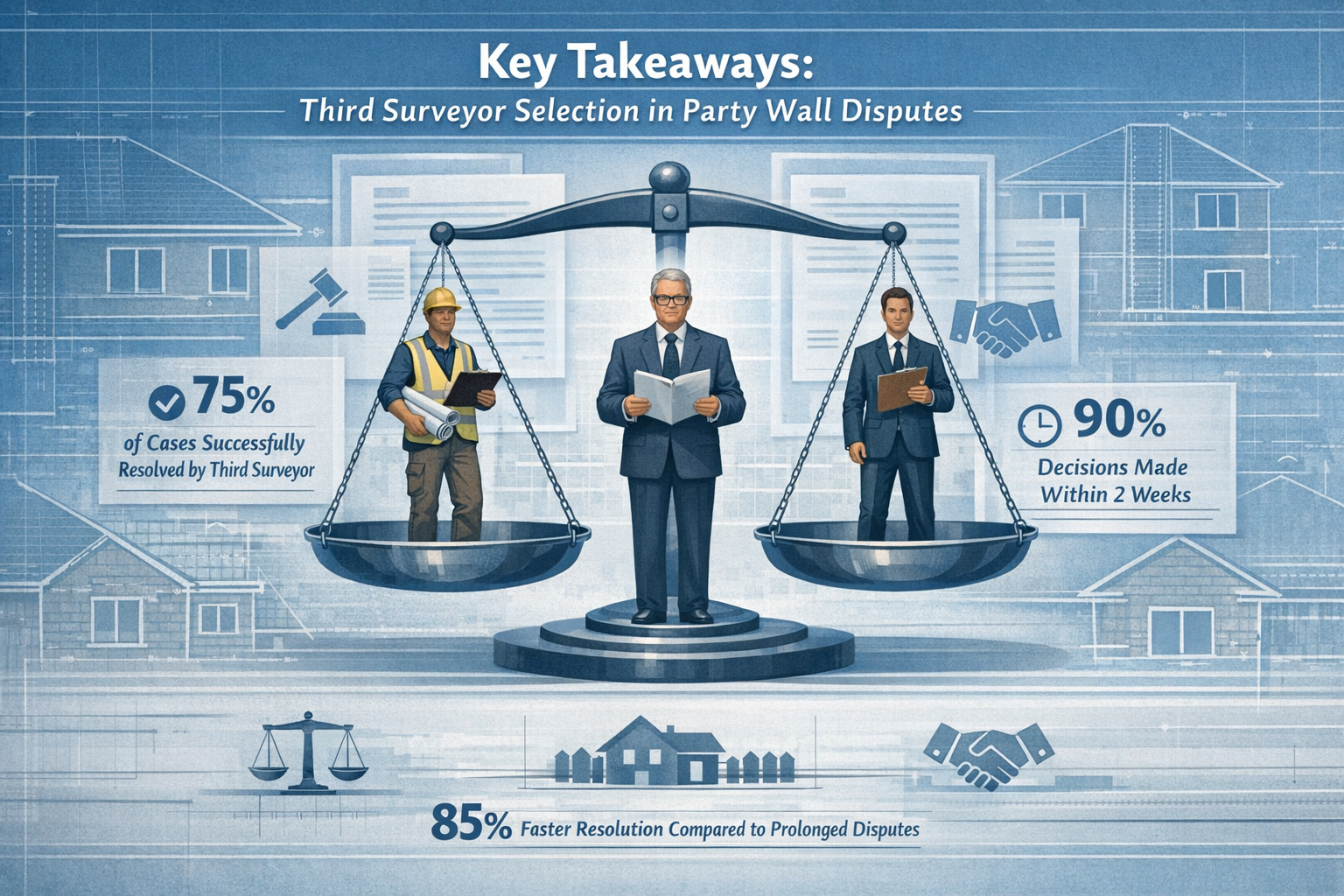
Key Takeaways
- Immediate Selection Required: Appointed surveyors must select a third surveyor "forthwith" (immediately) as their first action under Section 10(1)(b) of the Party Wall Act 1996[1][3]
- High Success Rate: Approximately 99% of cases reach mutual agreement on third surveyor selection without requiring local authority intervention[4]
- No Formal Qualifications: The Act doesn't specify required qualifications, though extensive party wall experience is essential for effective dispute resolution[2]
- 10-Day Deadline: If surveyors cannot agree within 10 days, the local authority's appointing officer steps in to make the selection[3][4][5]
- Cost Implications: The referring party typically bears initial costs, though the third surveyor's award can reassign fees based on the merits of the dispute[2][4]
Understanding the Legal Framework for Third Surveyor Selection in Party Wall Standoffs
The Party Wall Act 1996 creates a unique dispute resolution mechanism that balances neighbour rights with construction necessities. When a building owner serves notice for party wall works and the adjoining owner dissents (or fails to respond within 14 days), each party appoints their own surveyor. This triggers the requirement for Third Surveyor Selection in Party Wall Standoffs: Resolving Deadlocks Under the 2026 Act.
The "Forthwith" Requirement Under Section 10(1)(b)
Section 10(1)(b) of the Act mandates that the two appointed surveyors must select a third surveyor "forthwith"—meaning immediately and without delay.[1][3][4] This isn't merely a suggestion but a statutory obligation that forms the foundation of the entire party wall dispute resolution process.
The timing is critical: third surveyor selection should occur as the very first action after both surveyors are appointed, not after a dispute arises.[3] This proactive approach ensures that if disagreements emerge during the award preparation process, a neutral arbiter is already in place to resolve them swiftly.
Why Early Selection Matters 🕐
Many surveyors mistakenly believe they should wait until a dispute materializes before selecting a third surveyor. This approach creates several problems:
- Delays in resolution when disagreements do occur
- Tactical positioning where surveyors may try to influence third surveyor selection based on emerging disputes
- Increased costs from prolonged negotiations
- Potential bias if selection occurs after positions have hardened
For guidance on avoiding common party wall disputes, property owners should ensure their appointed surveyors comply with the forthwith requirement from the outset.
The Standard Selection Process: How Appointed Surveyors Choose a Third Surveyor
The practical mechanics of Third Surveyor Selection in Party Wall Standoffs: Resolving Deadlocks Under the 2026 Act follow an established protocol refined through decades of professional practice. Understanding this process helps all parties navigate selection efficiently.
Step-by-Step Selection Protocol
Step 1: Initial Proposal
The surveyor appointed by the building owner typically initiates the process by suggesting three potential third surveyor candidates to the adjoining owner's surveyor.[4] These candidates should possess:
- Extensive experience in party wall matters
- Demonstrated impartiality and professional standing
- Availability to act if required
- No conflicts of interest with either party
Step 2: Review and Counter-Proposal
The adjoining owner's surveyor reviews the proposed candidates and either:
- ✅ Accepts one of the three candidates (most common outcome)
- 🔄 Proposes alternative candidates if concerns exist about the initial suggestions
- 📋 Requests additional information about candidates' qualifications and experience
Step 3: Negotiation and Agreement
The surveyors continue exchanging proposals until mutual agreement is reached. In practice, this process succeeds in approximately 99% of cases.[4] Professional courtesy and recognition of qualified peers within the party wall community facilitate these agreements.
Selection Criteria: What Makes an Ideal Third Surveyor?
While the Party Wall Act 1996 doesn't specify formal qualifications for third surveyors, professional consensus identifies several essential attributes:[2]
| Criterion | Importance | Details |
|---|---|---|
| Experience | Critical | Extensive knowledge of party wall disputes and awards |
| Impartiality | Essential | No prior relationship with either party or their surveyors |
| Availability | High | Able to review disputes and issue decisions promptly |
| Professional Standing | Important | Recognized expertise and professional memberships (RICS, FPWS) |
| Local Knowledge | Beneficial | Familiarity with local construction practices and authority procedures |
Those seeking expert surveyor advice should verify their appointed surveyor follows these selection principles when choosing a third surveyor.
Common Selection Challenges
Even with the 99% success rate, certain situations complicate the selection process:
- Limited Pool: In specialized areas, few qualified third surveyors may be available
- Personality Conflicts: Previous professional disagreements between surveyors can affect candidate acceptance
- Geographic Constraints: Remote properties may require third surveyors willing to travel
- Cost Concerns: High-profile third surveyors command premium fees that may concern cost-conscious parties
Understanding party wall surveyor costs helps parties budget appropriately for potential third surveyor involvement.

The Role and Authority of Third Surveyors in Resolving Deadlocks
Once appointed, a third surveyor wields significant authority to resolve disputes that the two appointed surveyors cannot agree upon. This section examines the impartial role central to Third Surveyor Selection in Party Wall Standoffs: Resolving Deadlocks Under the 2026 Act.
When Third Surveyors Become Involved
Third surveyors don't participate in routine award preparation. They only become active when:
- Appointed surveyors disagree on a specific matter within the award
- One surveyor refers the dispute to the third surveyor in writing
- The matter falls within the scope of the Party Wall Act 1996
Common disputes referred to third surveyors include:
- 🏗️ Scope of works permitted under the notice
- 💰 Cost apportionment between building and adjoining owners
- 📋 Condition of properties and appropriate recording methods
- ⏰ Working hours and construction methodology
- 🔧 Adequacy of protective measures proposed
For complex projects like party wall matters for loft conversions, third surveyor involvement may address structural concerns that appointed surveyors view differently.
The Third Surveyor's Decision-Making Process
When a dispute is referred, the third surveyor follows a structured approach:
1. Review Documentation
- Original party wall notice
- Responses and counter-notices
- Correspondence between appointed surveyors
- Technical reports and drawings
- Schedule of condition reports
2. Consider Submissions
Both appointed surveyors present their positions, supporting evidence, and legal arguments. The third surveyor may request additional information or clarification.
3. Site Inspection (if necessary)
For disputes involving physical conditions or construction methodology, the third surveyor may conduct an independent inspection.
4. Issue Award
The third surveyor makes a binding determination that resolves the specific dispute, which is incorporated into the final party wall award.[2][3]
Impartiality and Independence 🎯
The third surveyor's most critical characteristic is complete impartiality. Unlike the appointed surveyors (who may advocate for their appointing party's interests within professional bounds), the third surveyor must:
- Consider only the merits of the dispute
- Apply the Party Wall Act 1996 objectively
- Ignore the preferences of either appointed surveyor
- Base decisions on evidence and statutory requirements
This neutral stance ensures the dispute resolution mechanism maintains credibility and fairness. Recent UK case law has reinforced that third surveyors owe duties to the statutory process itself, not to either party.[3]
Cost Attribution Powers
Third surveyors possess authority to determine who pays for their involvement. While the party referring the matter typically bears initial costs, the third surveyor's award can:[2][4]
- Assign costs to the party whose position was rejected
- Split costs proportionally based on the merits
- Order the building owner to pay all costs (common when their position is unreasonable)
- Require the adjoining owner to contribute if they raised frivolous objections
This cost-shifting power encourages parties to take reasonable positions and discourages tactical disputes.
Local Authority Intervention: The Backup Selection Mechanism
Despite the 99% success rate for mutual selection, the remaining 1% of cases require intervention for Third Surveyor Selection in Party Wall Standoffs: Resolving Deadlocks Under the 2026 Act. The Act provides a clear backup mechanism when appointed surveyors cannot agree.
The 10-Day Deadline
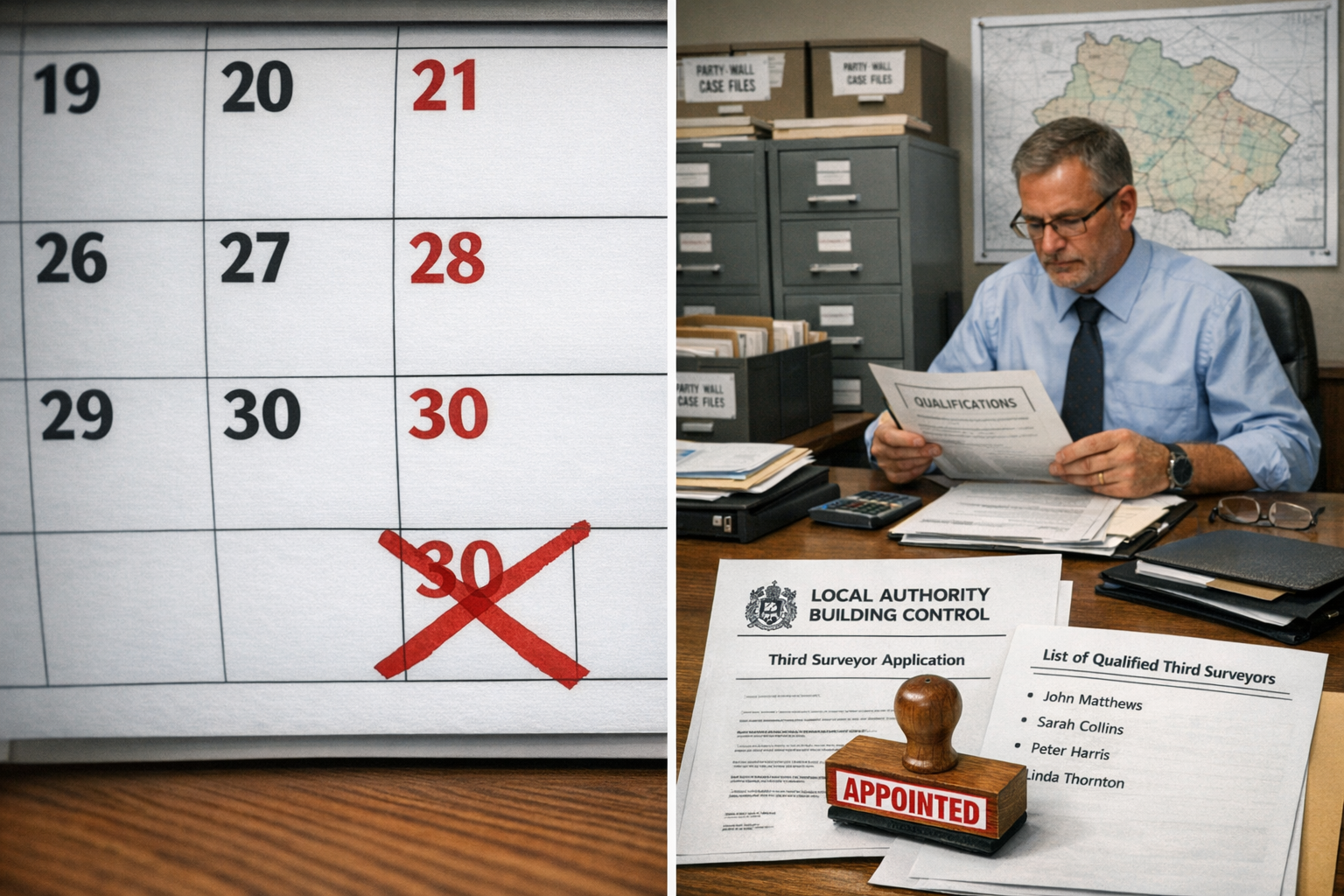
If the two appointed surveyors cannot agree on a third surveyor selection within 10 days of one surveyor requesting the other to make the selection, either surveyor may apply to the local authority for an appointment.[3][4][5]
This timeline creates urgency while allowing reasonable negotiation time. The 10-day period begins when:
- One surveyor formally requests third surveyor selection in writing
- The request is received by the other surveyor (proof of delivery recommended)
- The clock runs continuously, including weekends and holidays
The Appointing Officer's Role
Each local authority designates an "appointing officer" responsible for third surveyor selection when surveyors cannot agree. This officer is typically:[3][4][5]
- The chief building control officer
- A senior planning or legal officer
- Someone with authority to make binding appointments
The appointing officer's responsibilities include:
- Receiving applications from either appointed surveyor after the 10-day deadline expires
- Reviewing qualifications of potential third surveyors
- Making the selection based on experience, availability, and suitability
- Issuing formal appointment documentation
Application Process to Local Authority
When the 10-day period expires without agreement, the application process involves:
Required Documentation:
- Written evidence of the 10-day request and lack of response
- Details of the party wall matter requiring third surveyor appointment
- Any candidates previously proposed and reasons for rejection
- Contact information for both appointed surveyors
Local Authority Considerations:
The appointing officer evaluates:
- Professional qualifications and experience
- Previous third surveyor appointments and outcomes
- Availability and geographic proximity
- Absence of conflicts of interest
- Fee reasonableness
Timeframe:
Local authorities typically make appointments within 14-21 days of receiving complete applications, though this varies by jurisdiction.[5]
Why Surveyors Fail to Agree (The 1%)
Understanding the rare circumstances that necessitate local authority intervention helps prevent such situations:
Professional Conflicts
- Previous disputes between surveyors affecting trust
- Personality clashes that prevent constructive dialogue
- Competing interests when surveyors work in the same market
Strategic Positioning
- Deliberate delay tactics to frustrate the process
- Attempts to select a third surveyor perceived as favorable
- Unreasonable rejection of qualified candidates
Practical Constraints
- Limited pool of qualified third surveyors in specialized areas
- Geographic isolation requiring remote appointments
- Availability issues during peak construction periods
Inexperience
- Newly qualified surveyors unfamiliar with selection protocols
- Misunderstanding of the "forthwith" requirement
- Lack of awareness about the 10-day deadline
For properties in areas like South West London or Central London, the larger pool of qualified surveyors typically facilitates easier third surveyor selection.
Recent Case Law and Best Practices for 2026
As construction activity intensifies in 2026, recent developments in Third Surveyor Selection in Party Wall Standoffs: Resolving Deadlocks Under the 2026 Act provide valuable guidance for practitioners and property owners.
Emerging Trends in Party Wall Disputes
The 2026 construction boom has created unprecedented demand for party wall services, particularly in high-density urban areas.[6] This surge has revealed several trends affecting third surveyor selection:
Increased Complexity
Modern construction techniques and larger-scale residential projects create more technical disputes requiring third surveyor expertise in:
- Basement excavations and underpinning
- Complex structural alterations
- Multiple adjoining properties simultaneously affected
Professional Capacity Constraints
The limited number of highly experienced third surveyors creates bottlenecks when multiple disputes arise simultaneously in the same geographic area.
Cost Sensitivity
Rising construction costs make parties more cost-conscious about party wall surveyor fees, sometimes leading to disputes about third surveyor involvement and charges.
Best Practice Recommendations
Professional bodies and experienced practitioners recommend these protocols for Third Surveyor Selection in Party Wall Standoffs: Resolving Deadlocks Under the 2026 Act:
For Appointed Surveyors:
- ✅ Select immediately upon both appointments being confirmed
- 📋 Document the selection in writing with confirmation from both surveyors
- 🤝 Propose qualified candidates with genuine expertise and availability
- ⚖️ Consider impartiality above all other factors
- ⏱️ Respect the 10-day deadline and escalate promptly if agreement cannot be reached
For Property Owners:
- 🔍 Verify your surveyor understands third surveyor selection requirements
- 💰 Budget appropriately for potential third surveyor involvement
- 📞 Maintain communication with your appointed surveyor throughout the process
- 📄 Keep records of all notices, correspondence, and agreements
For Third Surveyors:
- 🎯 Maintain strict impartiality throughout the dispute resolution process
- 📊 Document reasoning clearly in awards to minimize appeal grounds
- ⚡ Act promptly when disputes are referred to prevent project delays
- 💼 Declare conflicts immediately if any relationship to parties emerges
Avoiding Common Pitfalls
Experience from recent cases highlights mistakes to avoid:
❌ Delayed Selection
Waiting until disputes arise before selecting a third surveyor violates the "forthwith" requirement and creates unnecessary delays.
❌ Tactical Rejections
Unreasonably rejecting qualified candidates to gain strategic advantage undermines the process and may result in cost penalties.
❌ Inadequate Documentation
Failing to document selection agreements in writing creates ambiguity if disputes later arise about who was appointed.
❌ Ignoring Conflicts
Appointing third surveyors with undisclosed relationships to parties or their surveyors compromises the entire process.
Those dealing with boundary disputes should ensure their party wall surveyors follow these best practices to minimize complications.
Practical Scenarios: Third Surveyor Selection in Action
Understanding how Third Surveyor Selection in Party Wall Standoffs: Resolving Deadlocks Under the 2026 Act operates in practice helps property owners and professionals navigate real-world situations.
Scenario 1: Straightforward Selection Success
Situation: A building owner in Richmond serves notice for a rear extension affecting a shared boundary wall. The adjoining owner appoints their own surveyor.
Selection Process:
- Day 1: Both surveyors appointed and immediately discuss third surveyor selection
- Day 2: Building owner's surveyor proposes three qualified candidates
- Day 3: Adjoining owner's surveyor accepts the second candidate
- Day 4: Both surveyors confirm selection in writing to the third surveyor
Outcome: Third surveyor confirmed within 4 days, well within statutory requirements. No disputes arise during award preparation, so the third surveyor never needs to actively intervene but remains available if required.
Scenario 2: Negotiated Agreement After Initial Disagreement
Situation: A loft conversion project in Hampstead involves complex structural work affecting multiple adjoining properties.
Selection Process:
- Day 1: Building owner's surveyor proposes three candidates
- Day 3: Adjoining owner's surveyor rejects all three due to previous professional relationships
- Day 4: Adjoining owner's surveyor counter-proposes three alternative candidates
- Day 6: Building owner's surveyor accepts one of the counter-proposals with minor reservations
- Day 7: Both surveyors confirm selection in writing
Outcome: Selection achieved within 7 days through professional negotiation. The process demonstrates how surveyors can disagree initially but still reach agreement within the 10-day window.
Scenario 3: Local Authority Intervention Required
Situation: A basement excavation project in Battersea creates tension between appointed surveyors who have previous professional conflicts.
Selection Process:
- Day 1: Building owner's surveyor proposes three candidates
- Day 5: Adjoining owner's surveyor rejects all without clear justification
- Day 6: Building owner's surveyor proposes three additional candidates
- Day 8: Adjoining owner's surveyor rejects again with vague concerns
- Day 11: Building owner's surveyor applies to local authority appointing officer
- Day 25: Local authority appoints qualified third surveyor from their approved list
Outcome: Despite the delay and additional cost, the local authority mechanism ensures the process continues. The appointed third surveyor proves effective in resolving subsequent disputes about excavation methodology.
Scenario 4: Urgent Dispute Requiring Third Surveyor Decision
Situation: During award preparation for works in Kingston, appointed surveyors disagree fundamentally about whether proposed underpinning is necessary.
Selection Process:
- Third surveyor already selected "forthwith" at appointment stage (as required)
- Dispute arises during technical review of structural engineer's report
- Building owner's surveyor refers specific question to third surveyor
- Third surveyor reviews both positions, structural evidence, and site conditions
- Third surveyor issues determination within 14 days supporting underpinning requirement
Outcome: Because third surveyor was pre-selected, dispute resolution occurs swiftly without selection delays. The proactive approach saves approximately 3-4 weeks compared to selecting a third surveyor after the dispute emerged.
Cost Implications and Fee Structures
Understanding the financial aspects of Third Surveyor Selection in Party Wall Standoffs: Resolving Deadlocks Under the 2026 Act helps parties budget appropriately and avoid cost-related disputes.
Third Surveyor Fee Structures
Third surveyors typically charge using one of these models:
Hourly Rates
- Range: £150-£400 per hour depending on experience and location
- Appropriate for: Simple disputes requiring limited review
- Risk: Costs can escalate if disputes become complex
Fixed Fees
- Range: £1,500-£5,000 per dispute determination
- Appropriate for: Defined disputes with clear scope
- Benefit: Cost certainty for all parties
Retainer Arrangements
- Annual fee for availability throughout award process
- Appropriate for: Large projects with multiple potential disputes
- Benefit: Immediate access when disputes arise
Who Pays Third Surveyor Costs?
The general principle: the party referring the matter to the third surveyor initially bears the cost.[2][4] However, the third surveyor's award can reallocate costs based on:
- Merit of positions: Party taking unreasonable position pays
- Outcome: Losing party typically bears costs
- Conduct: Tactical or obstructive behavior results in cost penalties
- Proportionality: Costs may be split if both positions have partial merit
Minimizing Third Surveyor Costs
Property owners can reduce the likelihood of incurring third surveyor costs by:
- Appointing experienced surveyors who work constructively with counterparts
- Maintaining reasonable positions on disputed matters
- Providing complete information to appointed surveyors early
- Engaging early with adjoining owners to address concerns
- Following party wall act requirements precisely
For those concerned about overall expenses, reviewing comprehensive guides to party wall surveyor costs provides realistic budget expectations.
Conclusion: Ensuring Effective Third Surveyor Selection
Third Surveyor Selection in Party Wall Standoffs: Resolving Deadlocks Under the 2026 Act represents a critical safeguard in the party wall dispute resolution framework. When appointed surveyors fulfill their statutory obligation to select a third surveyor "forthwith" and maintain professional standards throughout the process, the system functions efficiently—as evidenced by the 99% success rate for mutual selection.
The key principles for effective third surveyor selection include:
Immediate Action ⚡
Select the third surveyor as the first action after both surveyors are appointed, not after disputes arise.
Qualified Candidates 🎓
Prioritize extensive party wall experience, demonstrated impartiality, and professional standing over personal relationships or cost considerations.
Professional Cooperation 🤝
Appointed surveyors should negotiate in good faith, propose reasonable candidates, and respect the 10-day deadline for agreement.
Local Authority Backup 🏛️
When mutual selection fails, the local authority appointing officer provides an essential safety valve to prevent process breakdowns.
Cost Awareness 💰
Understanding fee structures and cost attribution principles helps parties budget appropriately and avoid unnecessary disputes about expenses.
Actionable Next Steps
For Property Owners Planning Construction Work:
- Engage an experienced party wall surveyor who understands selection protocols
- Budget for potential third surveyor involvement (£1,500-£5,000 typically)
- Serve notices promptly to allow adequate time for the full process
- Maintain open communication with adjoining owners to minimize disputes
For Appointed Surveyors:
- Select third surveyor immediately upon both appointments being confirmed
- Document selection agreements in writing with all parties
- Propose genuinely impartial candidates with relevant expertise
- Escalate to local authority promptly if the 10-day deadline expires without agreement
For Adjoining Owners Receiving Notice:
- Respond within 14 days or appoint a surveyor to protect your interests
- Verify your surveyor understands third surveyor selection requirements
- Review the agreed surveyor option as a potential cost-saving alternative
- Keep records of all correspondence and agreements
The Party Wall Act 1996 provides a robust framework for resolving neighbour disputes arising from construction work. When parties and their surveyors follow the established protocols for Third Surveyor Selection in Party Wall Standoffs: Resolving Deadlocks Under the 2026 Act, the system delivers fair, efficient outcomes that protect property rights while enabling necessary development.
As construction activity continues to intensify throughout 2026, understanding these selection mechanisms becomes increasingly valuable for anyone involved in party wall matters. Whether you're a building owner planning works, an adjoining owner receiving notice, or a surveyor navigating the appointment process, adhering to best practices for third surveyor selection ensures disputes are resolved swiftly and fairly.
For complex situations involving party wall disputes or questions about legal requirements for party walls, consulting with experienced party wall surveyors early in the process prevents complications and protects all parties' interests.
References
[1] Who Selects A Third Surveyor – https://partywallhelp.co.uk/who-selects-a-third-surveyor/
[2] The Role Of The Third Surveyor In Party Wall Disputes – https://harrisonclarke.co.uk/the-role-of-the-third-surveyor-in-party-wall-disputes/
[3] Party Wall Disputes The Third Surveyor – https://www.isurv.com/info/390/features_archive/11143/party_wall_disputes_the_third_surveyor
[4] Role Of The Third Surveyor In Party Wall Matters – https://taylor-mitchell.co.uk/blog/role-of-the-third-surveyor-in-party-wall-matters/
[5] Party Wall Third Surveyor Selection Local Authority Officer – https://thirdsurveyor.co.uk/party-wall-third-surveyor-selection-local-authority-officer/
[6] Party Wall Surveys Amid 2026 Construction Boom Handling Disputes In High Demand Uk Housing Markets – https://nottinghillsurveyors.com/blog/party-wall-surveys-amid-2026-construction-boom-handling-disputes-in-high-demand-uk-housing-markets