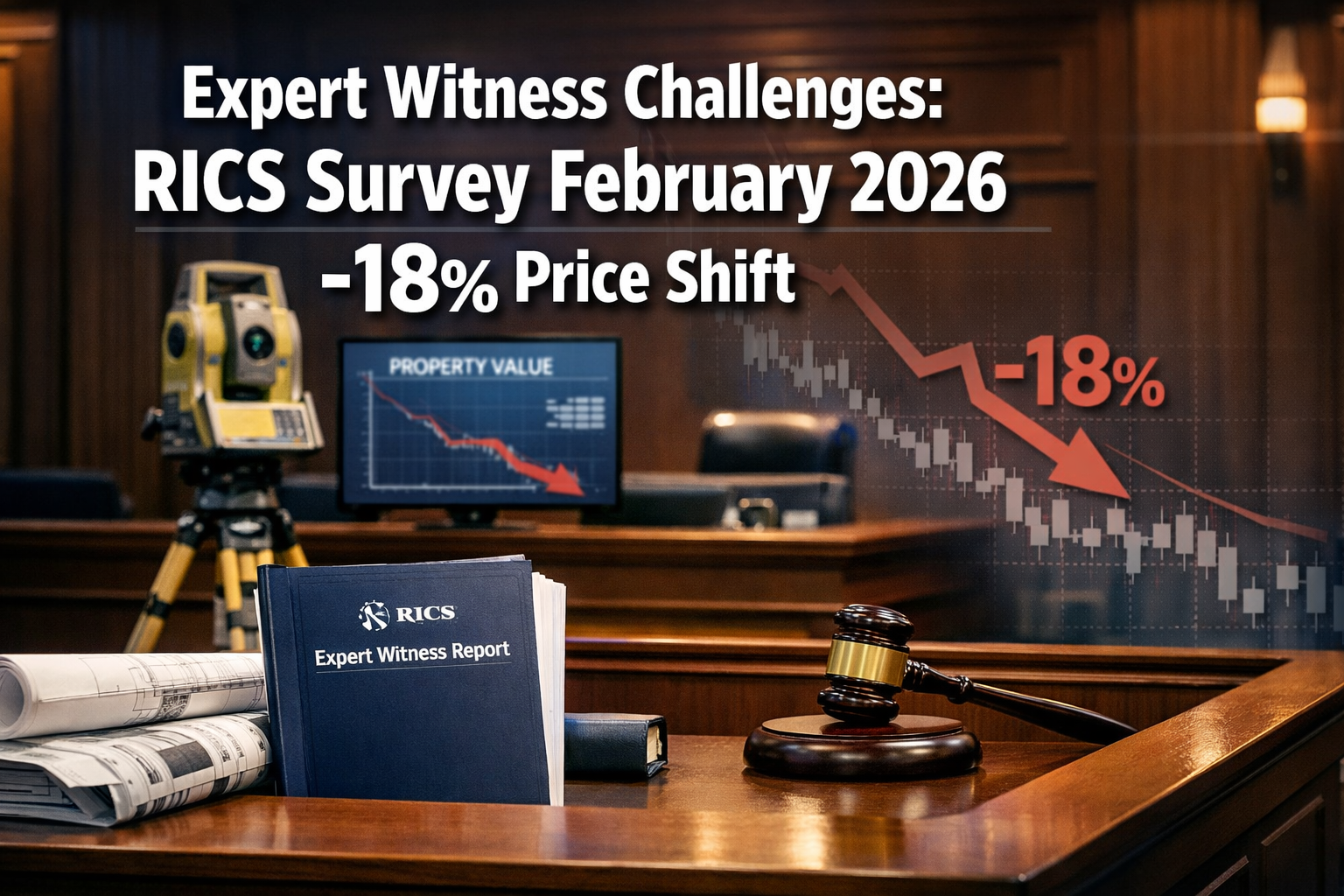
The February 2026 RICS Residential Market Survey delivered a stark reality check: price expectations plummeted by 18 percentage points, marking one of the sharpest sentiment shifts in recent property market history. For expert witnesses navigating valuation disputes, this data represents far more than a statistical blip—it fundamentally reshapes how court-ready evidence must be constructed, defended, and presented under Civil Procedure Rules (CPR) Part 35 requirements.
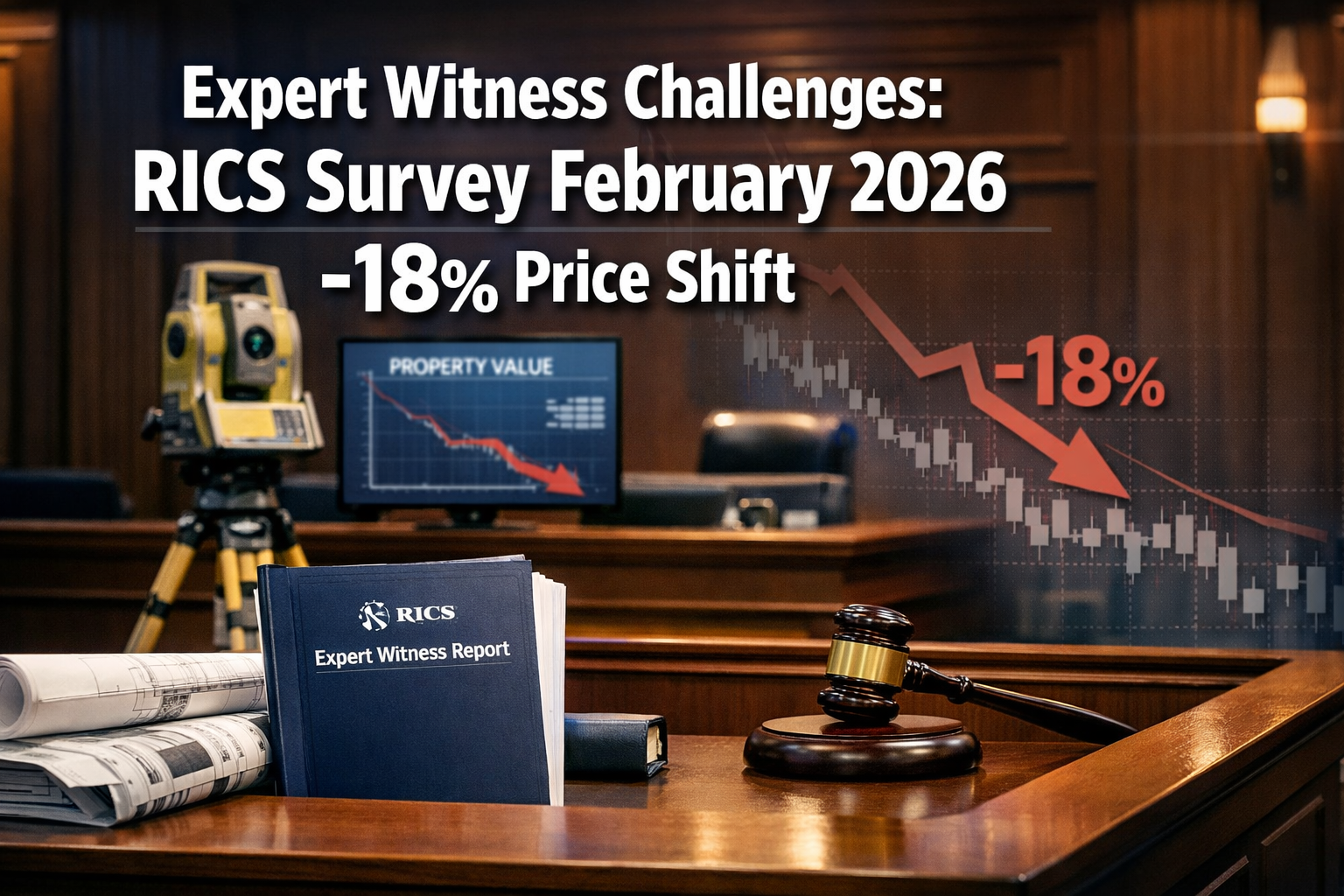
Expert Witness Challenges from February 2026 RICS Survey: Addressing -18% Price Expectation Shifts in Disputes have emerged as a critical concern for chartered surveyors, legal professionals, and property dispute specialists. This dramatic market recalibration demands immediate attention to valuation methodologies, evidence standards, and compliance frameworks that withstand rigorous cross-examination.
Key Takeaways
- 📉 February 2026 RICS data shows -18% shift in price expectations, creating unprecedented challenges for expert witness testimony in property disputes
- ⚖️ CPR Part 35 compliance requires expert witnesses to integrate current market data while maintaining independence and objectivity in valuation evidence
- 🔍 Court-ready valuation strategies must account for rapid sentiment changes and demonstrate robust methodology that addresses market volatility
- 📊 Evidence quality standards demand comprehensive documentation linking RICS survey trends to specific dispute circumstances
- 🎯 Practical implementation frameworks enable expert witnesses to deliver defensible opinions that reflect February 2026 market realities
Understanding the February 2026 RICS Survey Data and Its Impact on Expert Testimony
The Royal Institution of Chartered Surveyors publishes monthly residential market surveys that serve as authoritative barometers for property market conditions across the United Kingdom. The February 2026 survey revealed troubling indicators: new buyer enquiries weakened significantly, sales expectations declined, and most critically, price expectations dropped by 18 percentage points compared to previous measurement periods.
What the -18% Price Expectation Shift Actually Means
This substantial negative shift reflects chartered surveyors' collective assessment that property prices would decline rather than increase over the coming months. The metric represents a net balance—the percentage of surveyors expecting price rises minus those anticipating falls. A -18% reading indicates a strong majority anticipate downward price pressure.
For expert witnesses preparing expert witness reports in London and surrounding regions, this data creates several immediate challenges:
- Valuation date sensitivity: Properties valued in late 2025 versus February 2026 may require significant adjustments
- Comparable evidence reliability: Historic comparables become less relevant when market sentiment shifts dramatically
- Future loss calculations: Disputes involving development projects or lease extensions require recalibrated assumptions
- Cross-examination vulnerability: Opposing counsel will scrutinize whether expert opinions reflect current market realities
Market Context Beyond the Headlines
While the -18% figure dominates discussions, expert witnesses must understand the broader context. The shift follows a period of market uncertainty influenced by multiple factors including interest rate adjustments, regulatory changes, and evolving economic conditions. Professional surveyors working across Surrey, Buckinghamshire, and West London report varied local impacts, with some micro-markets experiencing more pronounced effects than others.
The RICS survey methodology encompasses responses from hundreds of chartered surveyors actively engaged in residential property transactions. This broad participation base provides statistical reliability that courts recognize and respect. However, expert witnesses must avoid simplistic application of national trends to specific dispute circumstances without proper analysis.
Expert Witness Challenges from February 2026 RICS Survey: CPR Part 35 Compliance Strategies
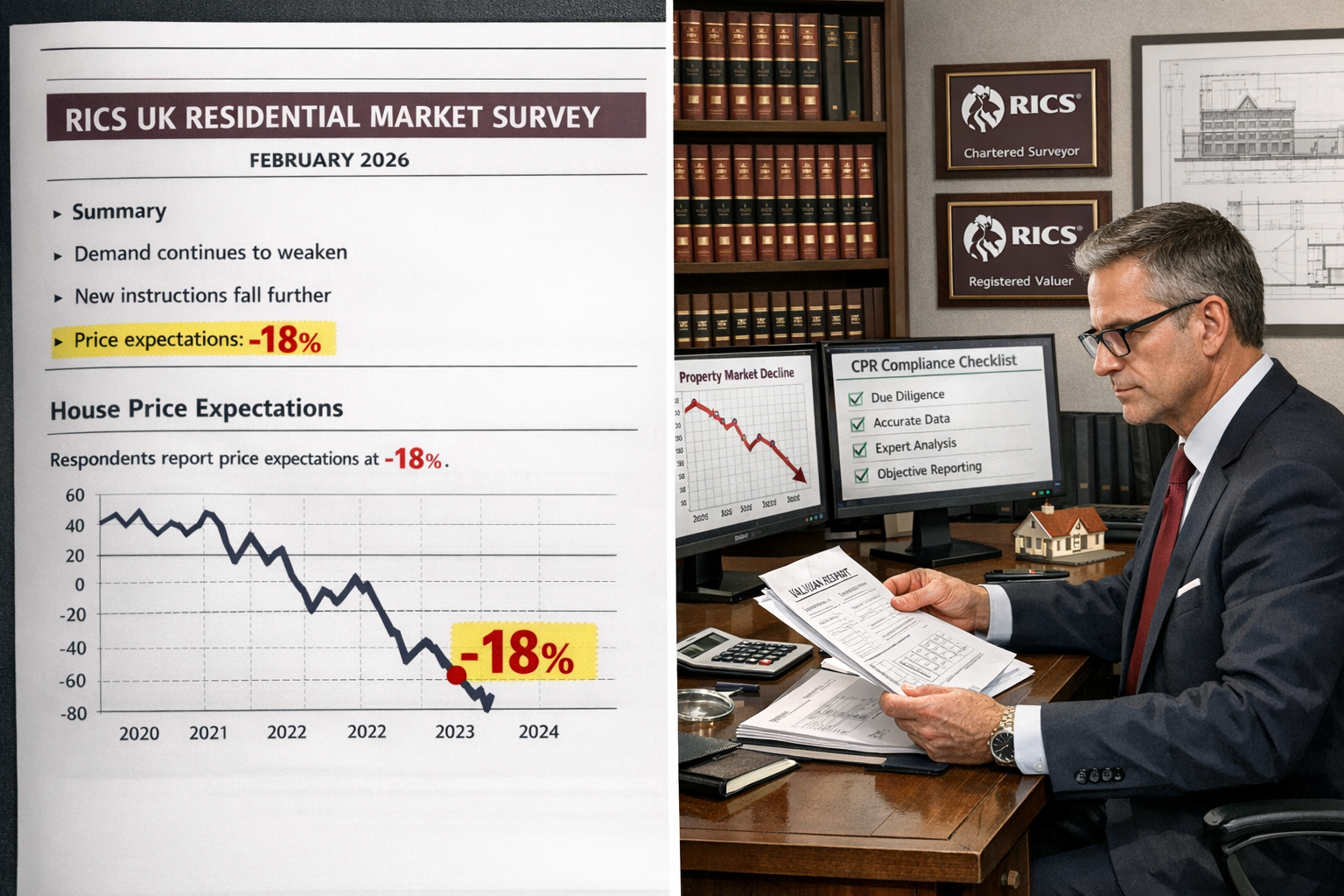
Civil Procedure Rules Part 35 establishes the fundamental framework governing expert evidence in English courts. The overriding duty requires experts to assist the court impartially, regardless of which party instructs them. When market conditions shift as dramatically as the February 2026 RICS data indicates, maintaining this independence while providing robust opinions becomes increasingly complex.
Integrating Market Data Without Compromising Independence
Expert Witness Challenges from February 2026 RICS Survey: Addressing -18% Price Expectation Shifts in Disputes require careful navigation between acknowledging market realities and avoiding predetermined conclusions. The CPR Part 35 Statement of Truth demands that expert opinions represent genuine professional judgment based on evidence, not advocacy for instructing parties.
Best practice approaches include:
- Transparent methodology disclosure: Clearly explain how RICS survey data influenced valuation assumptions
- Alternative scenario analysis: Present valuations under different market condition assumptions to demonstrate objectivity
- Limitation acknowledgment: Explicitly state where insufficient data prevents definitive conclusions
- Peer review consideration: Reference how other competent surveyors might reasonably interpret the same evidence
Documentation Standards for Court-Ready Evidence
Courts expect expert reports to meet rigorous documentation standards. When incorporating February 2026 RICS survey findings into valuation evidence, experts should:
Create comprehensive audit trails showing:
- Source documents (original RICS survey publications)
- Calculation methodologies with step-by-step workings
- Comparable evidence selection criteria
- Adjustment rationale for market condition changes
- Sensitivity analysis demonstrating valuation ranges
Address potential challenges proactively by:
- Explaining why RICS data applies to the specific property/dispute
- Distinguishing between national trends and local market conditions
- Identifying factors that might limit the survey's relevance
- Providing alternative valuation approaches for comparison
Professional surveyors handling boundary disputes and construction disputes must ensure their expert evidence demonstrates both technical competence and procedural compliance. The -18% price expectation shift adds complexity to already challenging valuation scenarios.
The Independence Paradox in Changing Markets
A subtle challenge emerges when market data strongly supports one party's position. Expert witnesses must resist pressure to downplay or overemphasize the February 2026 RICS findings based on who benefits. The solution lies in comprehensive analysis that:
✅ Acknowledges the data's significance without exaggeration
✅ Explains limitations and uncertainties transparently
✅ Provides context that helps the court understand implications
✅ Maintains consistent methodology regardless of outcome favorability
Courts increasingly scrutinize whether experts have genuinely maintained independence or subtly advocated for instructing parties. The dramatic nature of the -18% shift makes this scrutiny particularly intense in 2026 property disputes.
Practical Valuation Methodologies Addressing the -18% Price Expectation Shift
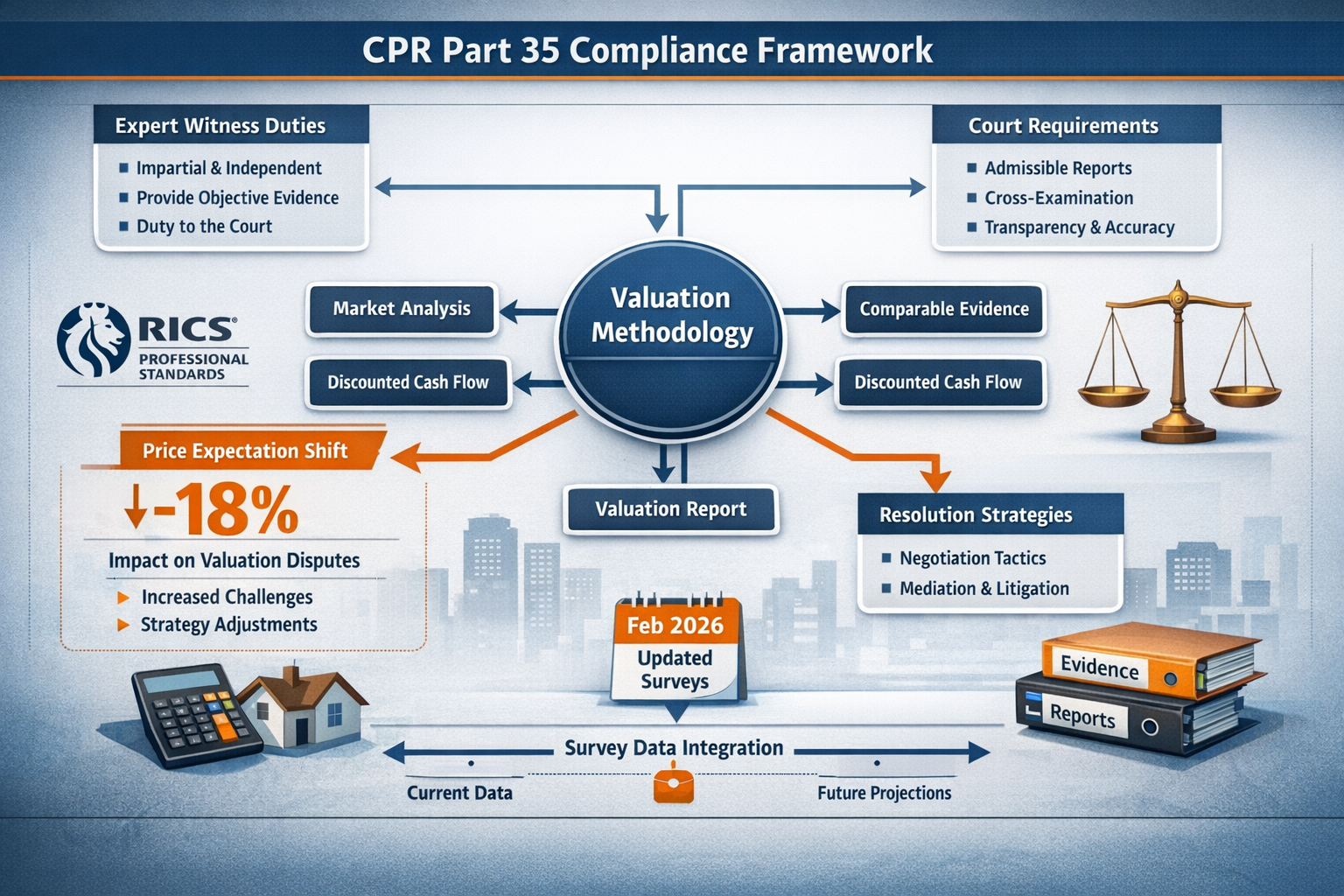
Translating RICS survey data into defensible valuation opinions requires sophisticated methodological approaches. Expert witnesses must bridge the gap between broad market sentiment indicators and specific property valuations that withstand cross-examination.
Comparable Evidence Adjustment Frameworks
Traditional comparable evidence analysis assumes relatively stable market conditions. The February 2026 RICS survey's -18% price expectation shift disrupts this assumption, requiring enhanced adjustment methodologies:
Time adjustment protocols:
- Apply graduated adjustments reflecting the pace of market sentiment change
- Weight recent comparables more heavily than historic transactions
- Consider whether comparable transactions occurred before or after sentiment shift became apparent
- Document market participant awareness levels at different time periods
Market condition adjustments:
- Separate time adjustments from market condition adjustments
- Quantify sentiment impact using multiple data sources beyond RICS surveys
- Consider property type and location-specific sensitivity to market shifts
- Apply different adjustment factors to different market segments
Scenario-Based Valuation Approaches
Given uncertainty inherent in rapidly changing markets, scenario-based methodologies provide robust frameworks for expert evidence:
Base case scenario: Assumes RICS survey accurately predicts near-term market trajectory
Optimistic scenario: Assumes market sentiment improves faster than survey indicates
Pessimistic scenario: Assumes sentiment deteriorates beyond survey predictions
Each scenario requires:
- Explicit assumption statements
- Probability weighting justification
- Sensitivity analysis showing valuation ranges
- Clear explanation of which scenario the expert considers most likely and why
This approach demonstrates objectivity while acknowledging genuine uncertainty. Courts appreciate experts who present balanced analysis rather than false precision.
Integrating Multiple Data Sources
Relying exclusively on RICS survey data creates vulnerability during cross-examination. Robust expert evidence incorporates multiple corroborating sources:
📊 Transaction data: Actual sale prices from Land Registry records
📈 Mortgage lending data: Approval rates and lending volumes
🏘️ Local market intelligence: Estate agent feedback and marketing time trends
💷 Asking price indices: Rightmove and Zoopla pricing trends
🏦 Economic indicators: Interest rates, employment data, consumer confidence
When these sources align with RICS survey findings, expert opinions gain credibility. When sources conflict, experts must explain discrepancies and justify their weighting decisions.
Special Considerations for Different Dispute Types
Expert Witness Challenges from February 2026 RICS Survey: Addressing -18% Price Expectation Shifts in Disputes manifest differently across dispute categories:
Dilapidations disputes: The market shift affects both diminution valuations and cost-of-repair assessments. Landlords seeking commercial dilapidation surveys must consider whether repair costs exceed diminution values in declining markets.
Matrimonial valuations: Matrimonial valuation disputes require careful timing considerations—whether valuations should reflect pre-shift or post-shift market conditions depending on relevant dates.
Lease extension disputes: Future rental value assumptions and capitalization rates require adjustment when market expectations deteriorate by 18 percentage points.
Professional negligence claims: Surveyors face heightened scrutiny regarding whether they should have anticipated market shifts when providing earlier valuations.
Technology-Enhanced Evidence Presentation
Modern expert witnesses leverage technology to present complex market data effectively:
- Interactive dashboards: Display RICS data alongside property-specific information
- Geographic heat maps: Visualize regional variations in market sentiment
- Time-series animations: Demonstrate market trajectory evolution
- Comparable evidence mapping: Show spatial relationships between subject property and comparables
These tools enhance court comprehension while maintaining professional credibility. However, experts must ensure technology supports rather than obscures substantive analysis.
Building Defensible Opinions in Volatile Market Conditions
The February 2026 RICS survey's dramatic findings highlight a fundamental challenge: expert witnesses must provide definitive opinions amid genuine uncertainty. This tension requires careful management through several key strategies.
Distinguishing Between Facts, Assumptions, and Opinions
CPR Part 35.10A requires experts to distinguish clearly between facts, assumptions, and opinions. In volatile market conditions, this distinction becomes critical:
Facts: "The February 2026 RICS survey showed a -18% net balance in price expectations"
Assumptions: "Assuming market sentiment continues on the trajectory indicated by the survey…"
Opinions: "In my professional judgment, the subject property's value has declined by approximately 12% since…"
Expert witnesses must avoid presenting assumptions as facts or opinions as certainties. The dramatic nature of the -18% shift tempts experts toward overconfident predictions that cross-examination will expose.
Addressing Instructing Party Pressure
Solicitors and barristers naturally prefer expert opinions that support their clients' positions. When market data creates unfavorable implications, experts may face subtle or explicit pressure to minimize or reinterpret findings. Maintaining independence requires:
🛡️ Early expectation management: Discuss potential opinion ranges before finalizing reports
📝 Written instruction protocols: Ensure instructions don't constrain legitimate professional judgment
💬 Clear communication: Explain why certain opinions cannot be supported despite party preferences
⚖️ Ethical boundaries: Withdraw from appointments rather than compromise professional standards
Professional surveyors providing RICS registered valuation services must prioritize long-term reputation over short-term client satisfaction.
Preparing for Cross-Examination
Opposing counsel will aggressively challenge expert opinions incorporating the February 2026 RICS data. Effective preparation includes:
Anticipating common challenges:
- "Isn't the RICS survey just opinion rather than fact?"
- "How do you know the survey applies to this specific property?"
- "Couldn't the market sentiment reverse quickly?"
- "Why should we trust surveyor predictions given past forecast failures?"
Developing robust responses:
- Explain RICS methodology and statistical reliability
- Demonstrate property-specific analysis beyond generic survey application
- Acknowledge uncertainty while defending reasonable professional judgment
- Reference track record of RICS survey predictive accuracy
Maintaining composure:
- Avoid defensive reactions to aggressive questioning
- Admit limitations without undermining core opinions
- Distinguish between legitimate challenges and rhetorical tactics
- Remember the duty to assist the court rather than "win" arguments
Regional Variations and Local Market Knowledge
While the RICS survey provides national data, property markets operate locally. Expert witnesses must demonstrate how national trends manifest in specific geographic areas. Chartered surveyors working across Watford, Putney, Battersea, and other London submarkets understand that the -18% national figure masks significant local variation.
Effective local market analysis includes:
- Micro-market transaction data analysis
- Local estate agent consultation
- Planning and development pipeline assessment
- Transport and infrastructure impact evaluation
- Demographic and employment trend analysis
This granular approach strengthens expert credibility by demonstrating genuine market knowledge rather than mechanical application of national statistics.
Continuous Professional Development
The rapidly evolving market conditions highlighted by the February 2026 RICS survey underscore the importance of ongoing professional development. Expert witnesses should:
✅ Regularly review RICS technical publications and guidance
✅ Attend expert witness training focused on CPR compliance
✅ Participate in market analysis seminars and webinars
✅ Engage with peer review processes
✅ Stay current with case law affecting expert evidence standards
Professional bodies including RICS provide specialized resources for expert witnesses navigating challenging market conditions. Demonstrating commitment to professional development enhances credibility when opinions face scrutiny.
Conclusion
Expert Witness Challenges from February 2026 RICS Survey: Addressing -18% Price Expectation Shifts in Disputes represent a defining moment for property valuation professionals. The dramatic market sentiment shift revealed in the February 2026 data demands sophisticated, nuanced approaches to expert evidence that balance objectivity with practical reality.
Successful navigation of these challenges requires expert witnesses to:
🎯 Integrate RICS data transparently while maintaining CPR Part 35 independence
📊 Employ robust methodologies that withstand cross-examination scrutiny
🔍 Distinguish between national trends and local market conditions through detailed analysis
⚖️ Prepare comprehensive documentation supporting every opinion and assumption
💡 Acknowledge uncertainty without undermining professional judgment credibility
The property disputes landscape in 2026 demands expert witnesses who combine technical excellence with procedural compliance and communication skills. Those who master this combination will provide invaluable assistance to courts navigating complex valuation questions amid market volatility.
Actionable Next Steps
For property professionals, legal practitioners, and parties involved in disputes:
- Review existing valuations: Assess whether reports prepared before February 2026 require updating given market sentiment shifts
- Engage qualified experts early: Ensure expert witnesses have demonstrated experience with volatile market conditions
- Request scenario analysis: Ask experts to provide valuation ranges reflecting uncertainty rather than false precision
- Verify CPR compliance: Confirm expert reports meet all Part 35 requirements including clear distinction between facts, assumptions, and opinions
- Consider settlement implications: Recognize that increased valuation uncertainty may favor negotiated resolutions over litigation
Property owners, developers, landlords, and tenants facing disputes should consult chartered surveyors with specific expert witness experience. The stakes are too high for generic valuation approaches that fail to address the unique challenges posed by the February 2026 RICS survey findings.
The -18% price expectation shift serves as a powerful reminder that property markets remain dynamic and unpredictable. Expert witnesses who embrace this reality while maintaining rigorous professional standards will continue to provide essential guidance to courts, parties, and the justice system throughout 2026 and beyond.
References
[1] Net Zero Transition Planning To Become Strategic In 2026 – https://www.cotality.com/uk/insights/articles/net-zero-transition-planning-to-become-strategic-in-2026
[2] 20260205 26 – https://kslegislature.gov/li/b2025_26/committees/ctte_h_cmrce_lbr_1/documents/testimony/20260205_26.pdf
SEO Meta Title: Expert Witness RICS Survey 2026: -18% Price Shift Disputes