
The Renters' Rights Act 2026 has fundamentally altered the landscape for landlords planning structural works on rental properties. With Section 21 "no-fault" evictions abolished and pet clauses becoming unenforceable from May 1, 2026[1], party wall procedures now intersect with tenant rights in unprecedented ways. Surveyors must navigate this complex terrain where construction timelines, tenant protections, and RICS compliance converge. Understanding the Renters' Rights Act 2026 Impact on Party Wall Works: Surveyor Strategies for Landlord Extensions and Pet-Friendly Conversions is no longer optional—it's essential for avoiding costly disputes and project delays.

Key Takeaways
- 🏗️ Section 21 abolition means landlords cannot evict tenants to facilitate party wall works, requiring careful coordination and extended notice periods for construction projects
- 🐾 Pet-friendly policies now mandatory unless reasonable grounds exist, creating new party wall considerations for noise, structural modifications, and damage assessment protocols
- ⚖️ Court possession orders required for redevelopment grounds increase project timelines by 3-6 months, affecting party wall notice scheduling and surveyor appointment strategies
- 📋 RICS-compliant documentation must now address tenant rights explicitly, including pet accommodation provisions and extended access arrangements during construction
- 💰 Valuation adjustments reflect compliance costs, with properties requiring party wall works potentially seeing 2-5% value reductions due to tenant protection complexities[4]
Understanding the Renters' Rights Act 2026 Framework
The Renters' Rights Act 2026 represents the most significant overhaul of private rental legislation in decades. For party wall surveyors and landlords planning extensions or conversions, three core changes demand immediate attention.
Section 21 Abolition and Construction Implications
The elimination of Section 21 "no-fault" evictions fundamentally changes how landlords approach building works. Previously, landlords could serve notice to regain possession before major construction projects. Now, possession requires court-approved grounds with mandatory notice periods[3].
For party wall works, this means:
- Landlords cannot remove tenants simply to facilitate construction
- Building works must proceed with tenants in situ or through negotiated voluntary departures
- Party wall notices must account for extended tenant occupation during works
- Surveyor schedules of condition must document tenant belongings and pet-related modifications
Pet Rights and Structural Considerations
From May 1, 2026, tenancy clauses prohibiting pets become unenforceable unless landlords demonstrate reasonable grounds for refusal[1]. This policy shift creates new dimensions for party wall surveyors assessing:
Structural modifications for pet accommodation:
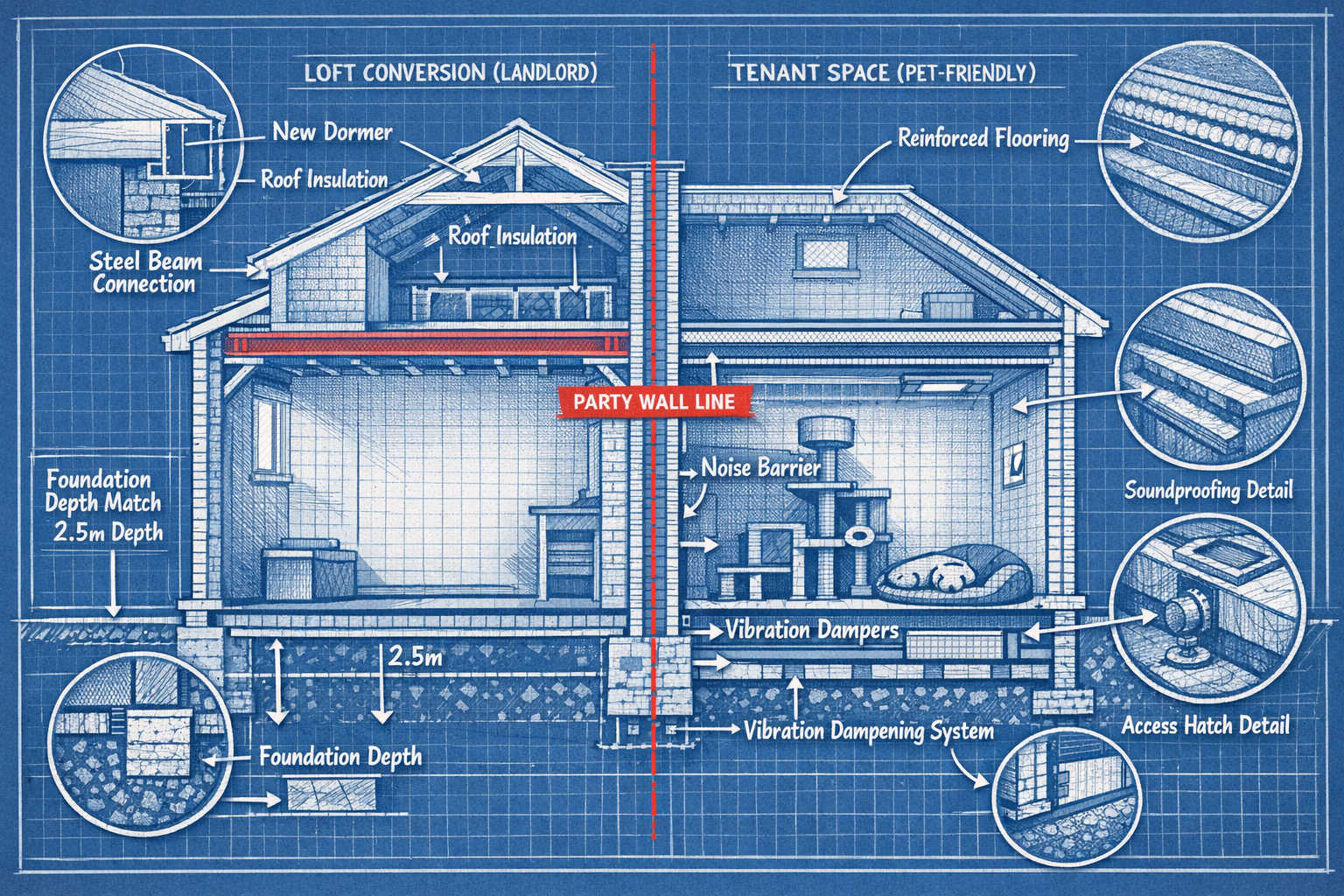
- Reinforced flooring in upper-level flats
- Soundproofing enhancements between party walls
- Garden access modifications affecting boundary structures
- Damage-resistant finishes on shared walls
Party wall implications:
- Increased wear on shared structures from pet activity
- Noise transmission considerations for adjoining owners
- Modified schedules of condition documenting pre-existing pet damage
- Enhanced dispute resolution protocols for pet-related complaints
Decent Homes Standard Extension
While implementation dates for private landlords remain unconfirmed, the Decent Homes Standard and Awaab's Law provisions will require properties to be safe, well-maintained, and in good repair[1]. This affects party wall works by:
- Mandating remediation of damp and mould issues before or during construction
- Requiring upgraded ventilation systems that may impact party wall structures
- Establishing minimum thermal performance standards affecting wall insulation
- Creating compliance documentation requirements for surveyors
Renters' Rights Act 2026 Impact on Party Wall Works: Notice Procedures and Timing
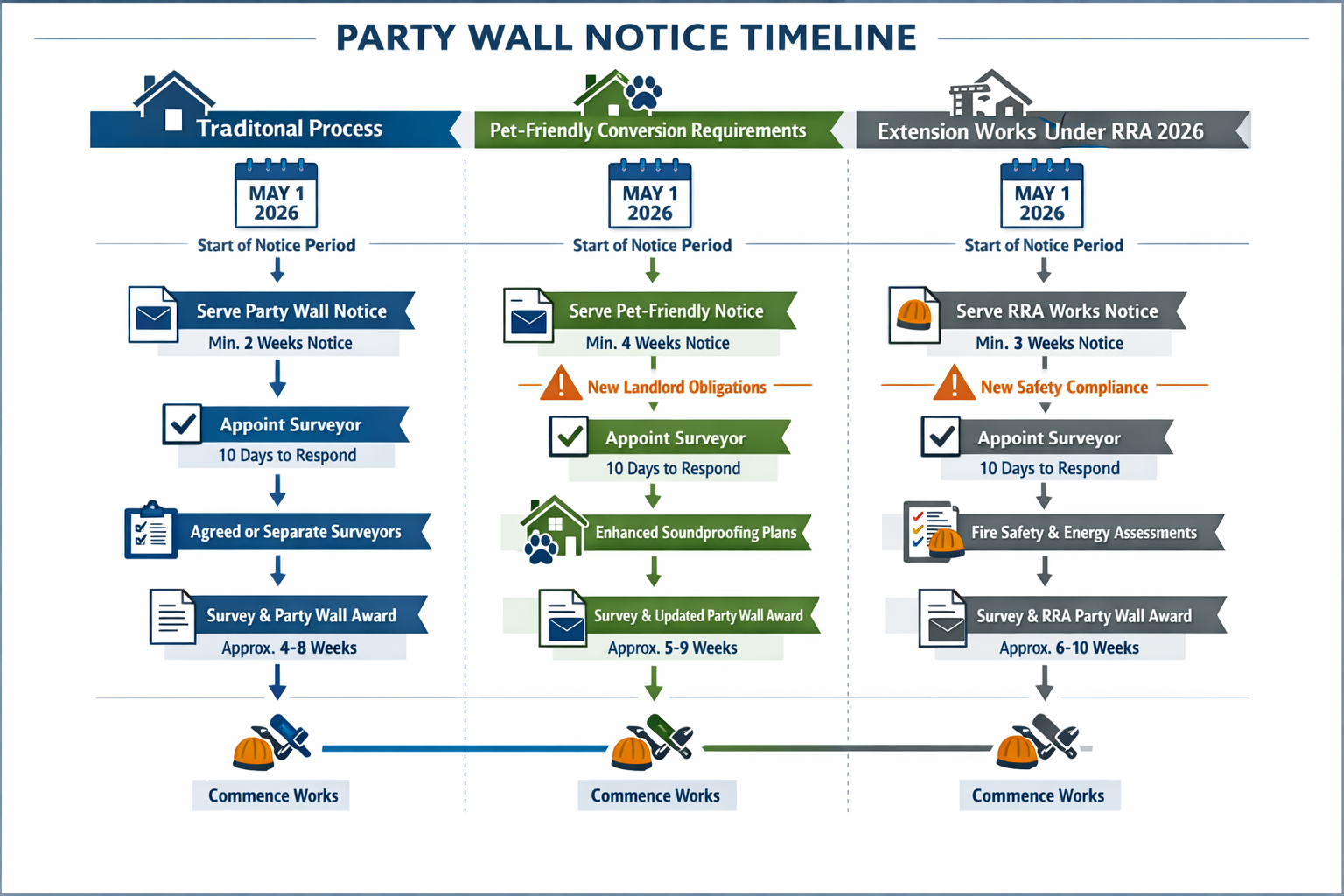
The intersection of tenant rights and party wall procedures creates complex timing challenges. Surveyors must now coordinate multiple legal frameworks simultaneously.
Modified Notice Period Strategies
Traditional party wall notice procedures assume building owners have immediate access to their properties. Under the Renters' Rights Act 2026, this assumption no longer holds.
New timeline considerations:
| Traditional Process | RRA 2026 Adjusted Process | Additional Time Required |
|---|---|---|
| Party wall notice: 2 months | Party wall notice: 2 months | No change |
| Immediate access post-consent | Tenant consultation period | 2-4 weeks |
| Works commence | Court possession if needed | 12-24 weeks |
| Standard completion | Extended completion timeline | 20-40% longer |
For landlords planning extensions or loft conversions, early engagement with tenants becomes critical. Surveyors should recommend:
- Pre-notice tenant briefings explaining construction scope and duration
- Voluntary relocation agreements with financial incentives (typically 1-3 months' rent)
- Phased construction schedules minimizing disruption to occupied units
- Formal access agreements documenting tenant cooperation terms
Coordinating Multiple Legal Frameworks
Party wall surveyors must now ensure compliance across three distinct legal regimes:
Party Wall etc. Act 1996 requirements:
- Serve notices on adjoining owners
- Appoint agreed or separate surveyors
- Produce compliant party wall awards
- Document pre-construction conditions
Renters' Rights Act 2026 obligations:
- Respect tenant occupation rights
- Accommodate pets unless unreasonable
- Provide adequate notice for access
- Maintain habitable conditions during works
Building Regulations and planning:
- Obtain necessary approvals before party wall procedures
- Ensure structural calculations account for occupied spaces
- Coordinate inspections around tenant schedules
- Document compliance for future valuations
Professional surveyors should develop integrated compliance checklists addressing all three frameworks. This prevents costly delays from overlooked requirements.
Pet-Friendly Conversion Considerations
When landlords plan conversions to accommodate pet-owning tenants, party wall works often become necessary. Common scenarios include:
Ground floor garden access modifications:
- Installing pet doors through external walls (may require party wall consent if affecting foundations)
- Creating segregated outdoor spaces impacting boundary walls
- Reinforcing fencing structures shared with neighbors
Soundproofing enhancements:
- Adding acoustic insulation to party walls (Section 2(2)(n) works)
- Installing resilient bars and additional plasterboard layers
- Upgrading floor-ceiling assemblies in flats
Damage prevention infrastructure:
- Protective wall panels on party walls in shared hallways
- Reinforced skirting and corner guards
- Moisture barriers preventing pet-related dampness transmission
Each modification requires careful assessment under the Party Wall Act to determine if notices are required. The 3-metre rule for excavations and the specific provisions for structural alterations apply regardless of the Renters' Rights Act changes.
Surveyor Strategies for Landlord Extensions Under New Legislation
Professional surveyors must adapt their methodologies to address the Renters' Rights Act 2026 Impact on Party Wall Works: Surveyor Strategies for Landlord Extensions and Pet-Friendly Conversions. This requires updated documentation, revised risk assessments, and enhanced dispute prevention protocols.
RICS-Compliant Documentation Updates
The Royal Institution of Chartered Surveyors (RICS) guidance for party wall matters must now incorporate tenant rights considerations. Updated documentation should include:
Enhanced schedules of condition:
- Photographic evidence of pet-related wear (scratched doors, marked walls)
- Documentation of pet accommodation features (gates, protective panels)
- Tenant belongings inventory to prevent damage disputes
- Specific notation of areas requiring protection during works
Modified party wall awards:
- Explicit provisions for tenant access during construction
- Pet accommodation requirements during noisy works phases
- Extended working hour restrictions to minimize disruption
- Compensation protocols for temporary tenant relocation
Tenant communication protocols:
- Mandatory pre-commencement meetings with tenants
- Weekly construction update schedules
- Emergency contact procedures for urgent issues
- Post-completion inspection procedures
Professional surveyors should maintain separate tenant liaison files documenting all communications. This creates an audit trail demonstrating compliance with both party wall procedures and tenant protection obligations.
Risk Assessment for Occupied Properties
Construction in occupied rental properties carries elevated risks. Surveyors must conduct comprehensive assessments addressing:
Health and safety considerations:
- Dust and noise exposure for tenants and pets
- Safe access routes during construction phases
- Emergency egress requirements throughout works
- Hazardous materials handling with occupants present
Structural protection priorities:
- Vibration monitoring to prevent damage to tenant possessions
- Temporary support systems not obstructing habitable spaces
- Phased demolition preventing sudden tenant exposure
- Enhanced insurance coverage for occupied works
Pet-specific risks:
- Escape prevention during construction access
- Noise sensitivity for animals during loud works phases
- Toxic material exposure risks (paints, solvents, dust)
- Temporary relocation arrangements for pet owners
The party wall surveyor cost typically increases 15-25% when works proceed in occupied rental properties due to these additional considerations.
Dispute Prevention Protocols
The combination of tenant rights and party wall procedures creates new dispute vectors. Proactive surveyors implement:
Pre-emptive tenant agreements:
- Written acknowledgment of construction scope and timeline
- Agreed compensation for significant disruptions
- Documented pet accommodation arrangements
- Clear dispute resolution procedures
Enhanced monitoring systems:
- Regular tenant welfare checks during construction
- Documented responses to tenant concerns
- Photographic progress updates shared with all parties
- Independent third-party inspections at key milestones
Rapid response mechanisms:
- 24-hour emergency contact for urgent issues
- Expedited decision-making protocols for unexpected problems
- Pre-agreed variation procedures for scope changes
- Mediation provisions before formal dispute escalation
For complex projects, engaging a party wall agreed surveyor can streamline decision-making and reduce conflict potential.
Valuation Impact Considerations
The Renters' Rights Act 2026 Impact on Party Wall Works extends to property valuations. Surveyors conducting valuations must now assess:
Compliance cost implications:
- Additional surveyor fees for tenant liaison (£500-£1,500)
- Extended construction timelines increasing holding costs
- Enhanced insurance premiums for occupied works (10-20% premium)
- Potential compensation payments to tenants
Market perception factors:
- Reduced appeal to buy-to-let investors due to complexity
- Premium for properties with completed compliant conversions
- Discount for properties requiring extensive party wall works with tenants in situ
- Enhanced value for demonstrably pet-friendly properties
Research indicates properties requiring significant party wall works with sitting tenants may experience 2-5% valuation reductions compared to vacant equivalent properties[4]. However, successfully completed pet-friendly conversions can command 3-7% premiums in high-demand rental markets.
Practical Implementation: Case Studies and Best Practices
Real-world application of these principles demonstrates how surveyors successfully navigate the Renters' Rights Act 2026 Impact on Party Wall Works: Surveyor Strategies for Landlord Extensions and Pet-Friendly Conversions.
Case Study: Terraced House Loft Conversion
Scenario: Landlord planning loft conversion on mid-terrace property with sitting tenant and two dogs.
Challenges:
- Party wall works required on both adjoining properties
- Tenant unwilling to vacate during 12-week construction
- Pet noise concerns from neighbors
- Access requirements through tenant's living space
Surveyor strategy:
- Served party wall notices 3 months before planned start (1 month buffer)
- Negotiated tenant agreement including £2,000 disruption compensation
- Scheduled noisy works (steel installation) during tenant's planned vacation
- Implemented enhanced dust barriers and daily cleanup protocols
- Arranged temporary pet boarding during critical construction phases
- Documented all arrangements in supplementary party wall award
Outcome: Project completed on schedule with no formal disputes. Tenant remained in occupation, and neighbors reported satisfaction with communication and noise management.
Case Study: Semi-Detached Rear Extension
Scenario: Ground floor extension requiring excavation within 3 metres of adjoining property, with tenant keeping cats.
Challenges:
- Party Wall Act 3-metre rule triggered notice requirements
- Tenant concerned about cats escaping during construction
- Adjoining owner worried about pet damage to shared wall
- Foundation works requiring significant disruption
Surveyor strategy:
- Comprehensive schedule of condition documenting existing cat scratches on shared wall
- Temporary internal barrier preventing cat access to construction zone
- Daily site security checks ensuring no escape routes
- Enhanced foundation protection measures documented in award
- Regular photographic updates to all parties
- Post-completion inspection confirming no pet-related damage to party wall
Outcome: Adjoining owner satisfied with protection measures. Tenant's cats remained secure throughout works. No party wall disputes arose.
Best Practice Checklist for Surveyors
✅ Pre-commencement phase:
- Confirm tenant occupation status and pet ownership
- Review tenancy agreement for any special provisions
- Conduct joint inspection with tenant present
- Document all pet-related modifications and wear
- Explain party wall procedures to tenant in plain language
- Obtain written tenant acknowledgment of construction plans
✅ Notice and award phase:
- Serve party wall notices with extended timelines
- Include tenant accommodation provisions in awards
- Specify pet protection measures explicitly
- Document compensation arrangements clearly
- Establish communication protocols with all parties
- Confirm insurance coverage for occupied works
✅ Construction phase:
- Implement daily tenant liaison procedures
- Monitor noise and dust levels rigorously
- Conduct weekly progress reviews with tenant
- Maintain photographic construction diary
- Respond to tenant concerns within 24 hours
- Coordinate access around tenant and pet schedules
✅ Completion phase:
- Joint final inspection with tenant and adjoining owners
- Document any pet-related wear during construction
- Confirm all protective measures removed safely
- Provide tenant with maintenance guidance for new works
- Archive all documentation for future reference
- Conduct post-completion satisfaction survey
Common Pitfalls to Avoid
❌ Assuming vacant possession: Always verify tenant status before scheduling works
❌ Ignoring pet considerations: Failing to address pet accommodation creates liability exposure
❌ Inadequate documentation: Poor records lead to party wall disputes and compensation claims
❌ Insufficient communication: Tenant complaints escalate quickly without regular updates
❌ Underestimating timelines: RRA 2026 provisions add 20-40% to traditional schedules
❌ Generic awards: Standard templates don't address tenant rights adequately
Future Developments and Ongoing Compliance
The legislative landscape continues evolving. Surveyors must monitor several emerging developments affecting the Renters' Rights Act 2026 Impact on Party Wall Works: Surveyor Strategies for Landlord Extensions and Pet-Friendly Conversions.
Anticipated Regulatory Changes
Decent Homes Standard implementation: Private sector rollout dates remain pending, but surveyors should prepare for:
- Mandatory energy efficiency upgrades affecting wall insulation
- Enhanced ventilation requirements impacting party wall structures
- Electrical safety standards requiring access through party walls
- Compliance certification affecting property valuations
Pet damage deposit schemes: Proposed regulations may introduce:
- Standardized pet damage assessment protocols
- Maximum deposit limits for pet-owning tenants
- Independent dispute resolution for pet-related damage claims
- Integration with party wall damage assessment procedures
Rent control provisions: While not yet implemented, potential rent caps could affect:
- Landlord willingness to invest in major works
- Cost-benefit calculations for party wall projects
- Compensation arrangements for tenant disruption
- Property values in high-demand areas
Technology Integration Opportunities
Forward-thinking surveyors are adopting technology to streamline compliance:
Digital documentation systems:
- Cloud-based party wall award management
- Photographic condition tracking with timestamps
- Automated tenant communication platforms
- Integrated compliance checklists
Remote monitoring solutions:
- Vibration sensors protecting adjoining properties
- Noise monitoring systems documenting compliance
- Security cameras preventing unauthorized access
- Environmental sensors tracking dust and air quality
Virtual inspection capabilities:
- Video conferencing for tenant consultations
- Drone surveys for roof and external works
- 3D scanning for precise condition documentation
- Virtual reality construction previews for tenants
Professional Development Requirements
Surveyors must enhance their expertise across multiple domains:
Legal knowledge:
- Renters' Rights Act 2026 provisions and case law
- Party wall legislation updates and interpretations
- Landlord-tenant relationship management
- Dispute resolution and mediation techniques
Technical skills:
- Pet-friendly construction specifications
- Noise and vibration mitigation strategies
- Occupied property construction management
- Enhanced health and safety protocols
Communication competencies:
- Tenant liaison and conflict resolution
- Plain language explanation of technical matters
- Multi-party negotiation and facilitation
- Cultural sensitivity and accessibility awareness
Professional bodies including RICS are developing specialized training modules addressing these competencies. Surveyors should pursue continuing professional development (CPD) in these areas to maintain competitive advantage.
Conclusion
The Renters' Rights Act 2026 Impact on Party Wall Works: Surveyor Strategies for Landlord Extensions and Pet-Friendly Conversions represents a fundamental shift in how construction projects proceed on rental properties. The abolition of Section 21, mandatory pet accommodation policies, and enhanced tenant protections create complex challenges requiring sophisticated surveyor responses.
Successful navigation of this new landscape demands:
🔑 Comprehensive planning that integrates party wall procedures with tenant rights from project inception
🔑 Enhanced documentation explicitly addressing pet accommodation, tenant welfare, and extended timelines
🔑 Proactive communication with all stakeholders including tenants, adjoining owners, and contractors
🔑 Risk-aware methodologies recognizing the elevated complexity of occupied property construction
🔑 Continuous professional development keeping pace with evolving legislation and best practices
Actionable Next Steps
For landlords planning extensions or conversions:
- Engage a qualified party wall surveyor with RRA 2026 expertise early in planning
- Conduct tenant consultations before finalizing construction scope
- Budget additional costs (15-25%) for occupied property works
- Obtain comprehensive insurance covering tenant-related risks
- Consider voluntary tenant relocation agreements for complex projects
For surveyors managing party wall matters:
- Update standard documentation templates to address tenant rights
- Develop tenant communication protocols and training materials
- Establish relationships with mediation services for dispute prevention
- Invest in technology solutions streamlining compliance documentation
- Pursue specialized CPD in landlord-tenant law and pet-friendly construction
For adjoining owners concerned about neighboring works:
- Request confirmation of tenant occupation status and pet policies
- Ensure party wall awards explicitly address pet-related damage risks
- Negotiate enhanced protective measures for occupied property works
- Maintain independent photographic records of shared structures
- Establish direct communication channels with appointed surveyors
The intersection of party wall legislation and tenant rights will continue evolving as case law develops and regulations mature. Surveyors who proactively adapt their practices, embrace enhanced documentation standards, and prioritize multi-stakeholder communication will position themselves as essential advisors in this complex landscape.
For expert guidance on navigating party wall matters under the Renters' Rights Act 2026, professional surveyors provide invaluable support ensuring compliance, preventing disputes, and facilitating successful project completion. The investment in specialized expertise pays dividends through reduced delays, minimized conflicts, and enhanced protection for all parties involved in construction works affecting rental properties.
References
[1] The Renters Rights Act What S Changing What It Means For Landlords And How To Mitigate Risks – https://www.kennedyslaw.com/en/thought-leadership/article/2026/the-renters-rights-act-what-s-changing-what-it-means-for-landlords-and-how-to-mitigate-risks/
[3] The Renters Rights Act And Its Impact On Single Family Rental – https://www.shoosmiths.com/perspectives/stories/articles/the-renters-rights-act-and-its-impact-on-single-family-rental
[4] Valuation Adjustments For Renters Rights Act 2026 How Building Surveyors Must Assess Landlord Tenant Compliance – https://nottinghillsurveyors.com/blog/valuation-adjustments-for-renters-rights-act-2026-how-building-surveyors-must-assess-landlord-tenant-compliance