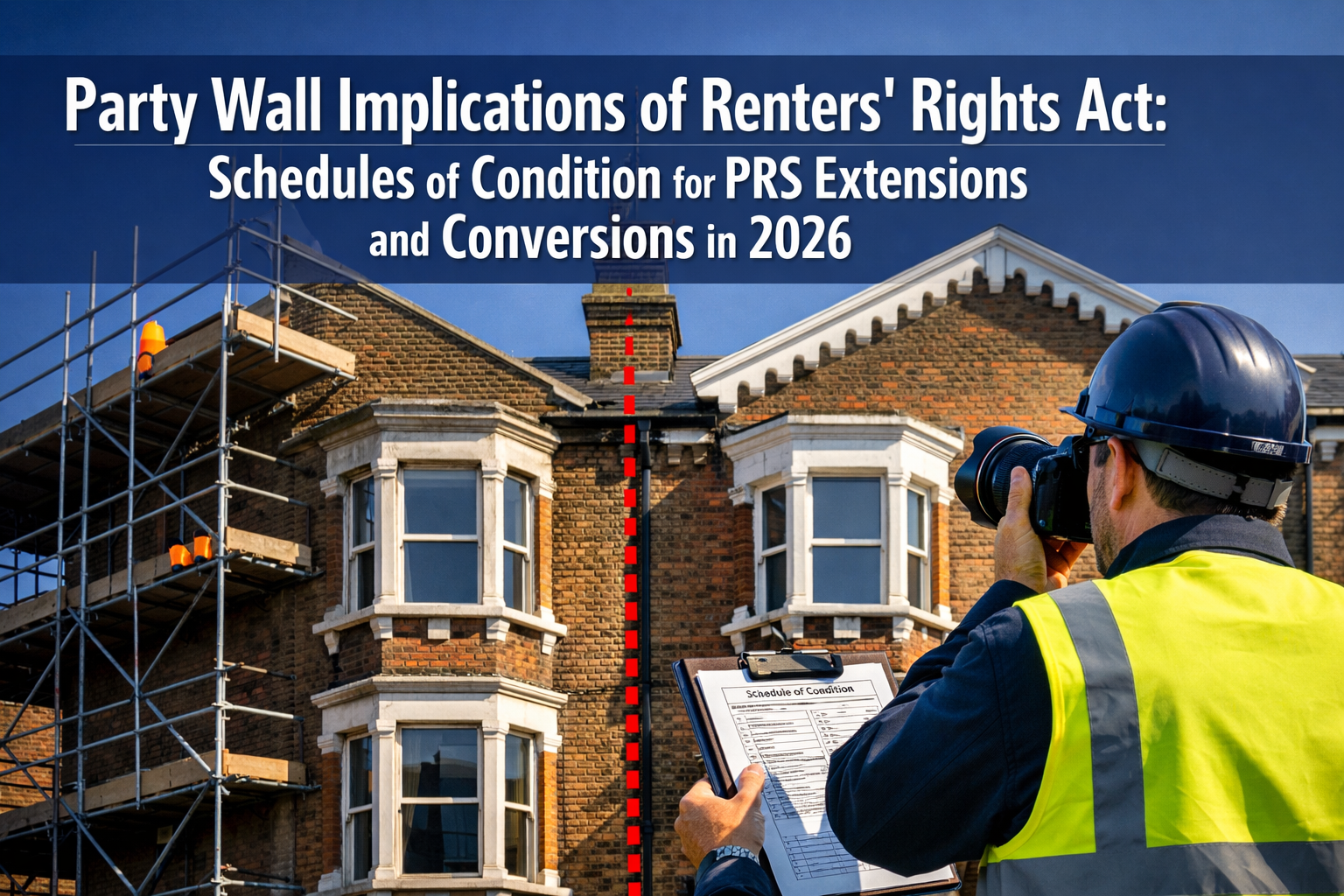
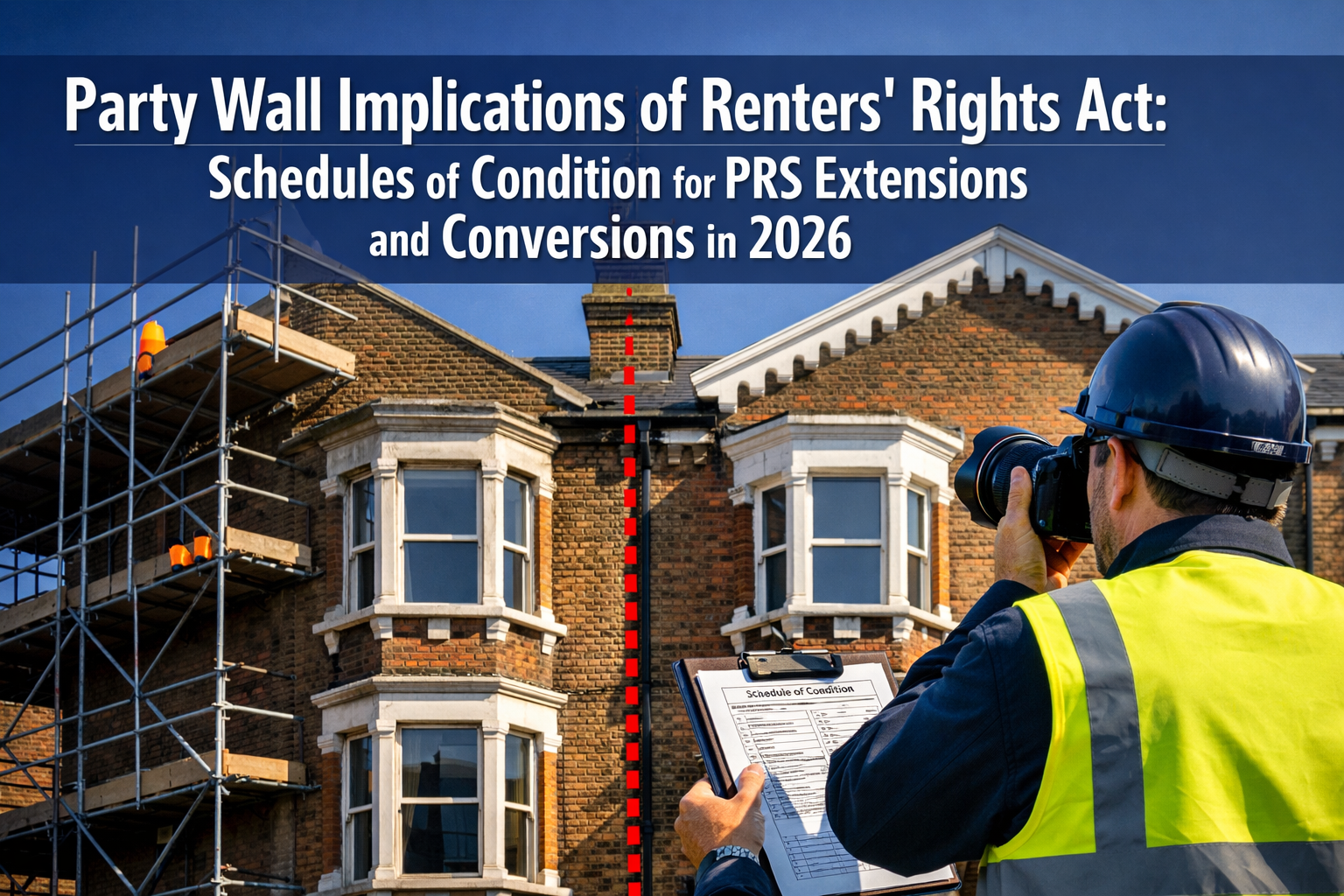
Landlords across England face a critical deadline: May 1, 2026 marks the implementation of the Renters' Rights Act, fundamentally reshaping how private rental sector (PRS) properties can be modified, extended, or converted. With section 21 "no-fault" evictions abolished and tenant protections strengthened, the intersection of party wall procedures and rental compliance has never been more complex. Understanding the party wall implications of Renters' Rights Act: schedules of condition for PRS extensions and conversions in 2026 is now essential for surveyors, landlords, and adjoining property owners navigating this new regulatory landscape.
The stakes are substantial. Landlords who fail to properly document party wall conditions before undertaking extensions or loft conversions risk civil penalties up to £7,000, while adjoining owners—many of whom are tenants with enhanced rights—can challenge works more effectively than ever before. [1] This guide provides surveyors with practical frameworks for protecting all parties' interests while ensuring compliance with both the Party Wall Act 1996 and the new rental regulations.
Key Takeaways
- 📅 May 1, 2026 brings sweeping changes to PRS tenancy rules, directly impacting how landlords can execute building works affecting party walls
- 📋 Schedules of condition become critical protective documents for both building owners and adjoining owners under the new compliance regime
- ⚖️ Section 21 abolition means landlords cannot easily remove tenants before major works, requiring more careful party wall planning
- 💷 Civil penalties up to £7,000 await landlords who fail to provide proper documentation to tenants by May 31, 2026
- 🏗️ Party wall awards don't transfer to new owners, creating additional complexity when PRS properties change hands during or after construction
Understanding the Renters' Rights Act 2026 Framework
The Renters' Rights Act represents the most significant overhaul of England's private rental sector in decades. Taking effect on May 1, 2026, the legislation fundamentally alters the relationship between landlords and tenants, with direct implications for anyone planning building works on rental properties. [1]
Core Changes Affecting Building Works
Abolition of Section 21 "No-Fault" Evictions
From May 1, 2026, landlords lose the ability to evict tenants without providing valid grounds under section 8 of the Housing Act 1988. [1] This change dramatically affects party wall procedures for PRS properties. Previously, landlords could issue section 21 notices to clear properties before major extensions or conversions. Now, they must either:
- Negotiate with existing tenants to remain during works
- Demonstrate valid grounds for possession under section 8
- Plan construction around occupied tenancies
Rent Increase Restrictions
The Act introduces a 12-month freeze on rent increases following its implementation, with subsequent adjustments limited to annual reviews through prescribed processes. [4] This restriction impacts landlords' financial calculations when planning extensions or conversions, as they cannot immediately recoup construction costs through rent increases.
Mandatory Written Terms and Compliance Deadlines
Landlords must issue written statements of terms to all tenants by May 31, 2026. Non-compliance carries civil penalties up to £7,000. [1] These statements must include details about planned or ongoing building works affecting the property, making accurate party wall schedule of condition documentation essential.
Impact on Party Wall Procedures
The convergence of rental reforms and party wall requirements creates several practical challenges:
| Challenge | Traditional Approach | 2026 Requirement |
|---|---|---|
| Vacant possession | Section 21 notice before works | Must maintain tenancy or prove section 8 grounds |
| Tenant notification | Informal communication | Written terms statement by May 31, 2026 |
| Cost recovery | Immediate rent increase | 12-month freeze, then annual review only |
| Adjoining tenant rights | Limited involvement | Enhanced protection and dispute rights |
For surveyors preparing party wall agreements, these changes necessitate more comprehensive documentation and clearer communication protocols with all affected parties.
Party Wall Implications of Renters' Rights Act: Schedules of Condition for PRS Extensions and Conversions in 2026

The intersection of party wall law and the Renters' Rights Act creates unique obligations for surveyors managing PRS extensions and conversions. Schedules of condition—detailed records documenting property state before construction begins—have evolved from optional best practice to essential protective instruments.
Legal Framework for PRS Party Wall Works
Party Wall Act 1996 Fundamentals
The Party Wall Act 1996 applies throughout England and Wales (but not Scotland or Northern Ireland) and governs three main scenarios: [3]
- Building on or at the boundary line between properties
- Working on an existing party wall or structure shared with a neighbour
- Excavating within 3 or 6 metres of a neighbouring building's foundations
For PRS properties, these scenarios most commonly arise during loft conversions, rear extensions, and basement excavations—all popular landlord investments for increasing rental yields.
Schedule of Condition Requirements
A schedule of condition is a photographic and written record documenting the existing state of adjoining properties before building work commences. [3] This document serves multiple critical functions:
✅ Establishes baseline evidence for resolving disputes about construction damage
✅ Protects building owners from false claims of pre-existing damage
✅ Safeguards adjoining owners by documenting their property's condition
✅ Provides legal evidence if party wall disputes escalate to litigation
Enhanced Importance Under 2026 Regulations
The Renters' Rights Act amplifies the importance of thorough schedules of condition in several ways:
Tenant-Occupied Properties
With section 21 abolished, most PRS extensions and conversions will proceed with tenants in situ. This creates additional documentation requirements:
- Pre-work tenant acknowledgment: Tenants must receive copies of schedules documenting their rental property's condition
- Adjoining tenant rights: When the adjoining property is also rented, those tenants gain enhanced ability to challenge works affecting their quiet enjoyment
- Landlord liability exposure: Landlords face greater risk if works cause damage to property affecting tenant occupation
Compliance Documentation
The mandatory written terms statements required by May 31, 2026, must include information about building works. [1] Surveyors should ensure schedules of condition are referenced in these statements, creating a clear audit trail demonstrating landlord compliance.
Practical Template for PRS Schedules of Condition
Surveyors should adapt their standard schedules of condition to address PRS-specific requirements:
Section 1: Property Identification
- Building owner details (landlord entity)
- Tenant details and tenancy type
- Adjoining owner details
- Adjoining tenant details (if applicable)
- Reference to Renters' Rights Act compliance
Section 2: External Condition Survey
- Photographic record of all external walls, roofs, and structures
- Detailed notes on existing cracks, settlement, or defects
- Measurements and locations of all documented features
- Date and time stamps for all evidence
Section 3: Internal Condition Survey
- Room-by-room photographic documentation
- Ceiling, wall, and floor condition notes
- Existing damage or wear documentation
- Special attention to areas adjacent to planned works
Section 4: Tenant Acknowledgment (New for 2026)
- Tenant signature confirming receipt and review
- Date of acknowledgment
- Contact information for queries during works
- Reference to written terms statement
Section 5: Adjoining Tenant Acknowledgment (If Applicable)
- Similar acknowledgment from adjoining property tenants
- Enhanced rights notification under 2026 Act
- Dispute resolution procedure information
Common PRS Extension and Conversion Scenarios
Rear Extensions on Terraced PRS Properties
Rear extensions are among the most common PRS improvements, often triggering party wall procedures when they involve work on or near the boundary. Surveyors must:
- Issue appropriate party wall notices to adjoining owners
- Prepare comprehensive schedules documenting both properties
- Obtain acknowledgment from tenants in both properties
- Coordinate access for inspections with occupied tenancies
- Monitor works to ensure compliance with the agreed award
Loft Conversions in Semi-Detached PRS Properties
Loft conversions frequently require work on party walls, especially when installing steel beams or modifying roof structures. The 2026 implications include:
- Noise and disruption management: With tenants unable to be easily relocated, works must minimize impact on quiet enjoyment
- Structural monitoring: Enhanced schedules should document ceiling and roof conditions in adjoining properties
- Fire safety compliance: Party wall works must maintain fire resistance ratings, critical for multi-occupancy buildings
Basement Excavations and Extensions
Basement works trigger party wall requirements when excavating within 3 or 6 metres of adjoining foundations (depending on depth). [3] For PRS properties, additional considerations include:
- Vibration monitoring: Essential when adjoining properties are occupied by tenants with enhanced rights
- Temporary accommodation: If works make the property uninhabitable, landlords cannot use section 21 to avoid accommodation costs
- Foundation documentation: Detailed schedules must capture existing settlement or movement before excavation begins
Protecting Adjoining Owners' Interests in the 2026 Landscape

Adjoining owners—whether owner-occupiers, landlords, or tenants—face unique challenges when neighbouring PRS properties undergo extensions or conversions. The Renters' Rights Act creates additional complexity in protecting these interests while ensuring building owners can proceed with legitimate improvements.
Adjoining Owner Rights and Protections
Statutory Rights Under Party Wall Act 1996
Adjoining owners retain all traditional rights under the Party Wall Act, including:
- Right to receive proper notice: Building owners must serve appropriate notices at least two months before work begins [3]
- Right to consent or dissent: Adjoining owners can consent to works or dissent, triggering the appointment of surveyors
- Right to appoint a surveyor: Adjoining owners can select their own surveyor or agree to share an "agreed surveyor" with the building owner
- Right to an award: The party wall award must protect adjoining owners' interests and specify how works will proceed
Enhanced Protections for Adjoining Tenants
When the adjoining property is also a rental, tenants gain additional protections under the 2026 Act:
🛡️ Quiet enjoyment rights: Tenants can challenge works that substantially interfere with their tenancy
🛡️ Landlord obligations: Adjoining landlords must ensure their tenants receive information about planned works
🛡️ Dispute escalation: Tenants can involve their landlords in party wall disputes, potentially complicating resolution
🛡️ Damage claims: Tenants may have independent claims for disruption or damage affecting their occupation
Surveyor's Role in Balancing Interests
Professional surveyors acting under party wall procedures must navigate competing interests while maintaining impartiality. Best practices for 2026 include:
Independent Documentation
Surveyors should prepare schedules of condition with meticulous independence, ensuring:
- All parties receive copies simultaneously
- Photographic evidence is comprehensive and date-stamped
- Written descriptions are objective and detailed
- Digital records are securely stored and accessible
Clear Communication Protocols
Given the increased complexity of multi-party situations, surveyors should establish:
- Primary contact lists: Identifying building owner, building owner's tenant, adjoining owner, and adjoining tenant
- Communication timelines: Setting expectations for response times and update frequency
- Escalation procedures: Defining how disputes will be addressed
- Documentation distribution: Ensuring all parties receive relevant notices and reports
Damage Prevention and Monitoring
Proactive monitoring reduces disputes and protects all parties:
- Pre-work baseline: Comprehensive schedule of condition before any work begins
- Regular inspections: Scheduled site visits during construction phases
- Immediate documentation: Photographing and recording any damage or concerns as they arise
- Post-work verification: Final inspection comparing property condition to baseline schedule
Award Transferability Issues
A critical consideration for PRS properties is that party wall awards are personal to the original parties and do not automatically transfer when properties change hands. [2] This creates specific challenges:
Mid-Construction Property Sales
If either the building owner's or adjoining owner's property is sold during construction:
- The existing award may not bind the new owner
- Fresh party wall notices may be required
- Construction delays can result while new agreements are negotiated
- Additional surveyor fees and legal costs may arise
PRS Portfolio Transactions
When PRS properties with ongoing or planned extensions change hands:
- Due diligence requirement: Buyers must investigate existing party wall awards
- Continuation agreements: Parties may negotiate award continuation clauses
- Schedule updates: New owners should commission updated schedules of condition
- Tenant notification: New landlords must inform tenants of ongoing works and their rights
Dispute Resolution in the 2026 Context
When disagreements arise about party wall works on PRS properties, resolution pathways have expanded:
Traditional Party Wall Dispute Resolution
The standard process remains:
- Adjoining owner dissents to proposed works
- Each party appoints a surveyor (or they agree on a single agreed surveyor)
- Surveyors prepare a party wall award specifying how works will proceed
- Either party can appeal the award to the County Court within 14 days
Enhanced Dispute Complexity Under Renters' Rights Act
Additional factors now include:
- Tenant involvement: Tenants may raise objections independent of their landlords
- Quiet enjoyment claims: Tenants can pursue separate legal action for excessive disruption
- Landlord liability: Building owner landlords face potential claims from their own tenants and adjoining tenants
- Compliance penalties: Failure to follow proper procedures can trigger the £7,000 penalties under the new Act [1]
Practical Dispute Prevention Strategies
Surveyors can minimize disputes through:
✓ Pre-work meetings: Bringing all parties together to discuss plans and concerns
✓ Detailed awards: Specifying working hours, noise limits, and access arrangements
✓ Regular updates: Keeping adjoining owners and tenants informed of progress
✓ Responsive communication: Addressing concerns promptly before they escalate
✓ Professional mediation: Engaging neutral mediators when tensions arise
Special Considerations for Shared Structures
Certain party wall scenarios require additional attention in the PRS context:
Shared Chimneys
When PRS extensions or conversions involve shared chimneys, surveyors must:
- Document existing condition of entire chimney stack
- Assess structural impact of proposed alterations
- Consider fire safety implications for both properties
- Coordinate access for inspections in occupied properties
Party Wall Insulation Projects
Landlords improving energy efficiency through party wall insulation must navigate:
- Reduced internal space in rental units
- Potential disruption to tenants during installation
- Coordination with adjoining property insulation works
- Compliance with building regulations and rental standards
Practical Compliance Checklist for Surveyors
To ensure full compliance with both party wall legislation and the Renters' Rights Act 2026, surveyors should follow this comprehensive checklist:
Pre-Work Phase (8-12 Weeks Before Construction)
- Identify all affected parties: Building owner, building owner's tenants, adjoining owners, adjoining tenants
- Verify tenancy status: Confirm tenancy types and rights under 2026 Act
- Review written terms statements: Ensure landlords have issued required documentation by May 31, 2026 [1]
- Prepare appropriate notices: Draft and serve party wall notices according to work type
- Schedule initial inspections: Arrange access to all affected properties
- Prepare comprehensive schedules of condition: Document all properties with photographs and written descriptions
- Obtain tenant acknowledgments: Secure signatures from all tenants confirming receipt of schedules
- Establish communication protocols: Set up contact lists and update schedules
Notice Period (2-3 Months)
- Serve formal notices: Deliver party wall notices to adjoining owners
- Track consent/dissent: Monitor responses within statutory timeframes
- Appoint surveyors: If dissent received, facilitate surveyor appointments
- Conduct detailed surveys: Complete technical assessments of proposed works
- Prepare party wall awards: Draft comprehensive awards specifying work parameters
- Address tenant concerns: Respond to questions from affected tenants
- Verify compliance: Confirm all documentation meets 2026 Act requirements
Construction Phase
- Conduct regular inspections: Visit site according to award schedule
- Document any damage: Immediately photograph and record any issues
- Monitor working hours: Ensure compliance with award restrictions
- Maintain communication: Provide regular updates to all parties
- Address complaints promptly: Respond to tenant or adjoining owner concerns
- Update schedules as needed: Document any changes or additional works
- Coordinate access: Arrange inspections with minimal disruption to tenants
Post-Work Phase
- Conduct final inspections: Compare property condition to baseline schedules
- Prepare completion reports: Document final state of all affected properties
- Address any damage claims: Investigate and resolve reported issues
- Obtain final acknowledgments: Secure tenant signatures confirming completion
- Archive documentation: Securely store all records for future reference
- Advise on ongoing obligations: Inform parties of maintenance responsibilities
- Update property records: Ensure new owners receive party wall documentation if properties are sold
Financial Implications and Cost Management
The convergence of party wall requirements and the Renters' Rights Act creates significant financial considerations for all parties:
Landlord Cost Considerations
Party Wall Procedure Costs
- Surveyor fees: £700-£2,000+ depending on work complexity
- Award preparation: £500-£1,500 for formal party wall awards
- Schedule of condition documentation: £300-£800 per property
- Dispute resolution: £2,000-£10,000+ if matters escalate
Compliance Costs
- Written terms statements: Legal fees for proper documentation
- Tenant communication: Administrative costs for required notifications
- Potential penalties: Up to £7,000 for non-compliance [1]
- Delayed rent increases: Lost income during 12-month freeze period [4]
Construction Impact Costs
- Tenant accommodation: If works require temporary relocation (cannot use section 21)
- Rent reductions: Potential claims for reduced enjoyment during works
- Extended timelines: Delays from working around occupied tenancies
- Damage remediation: Costs for repairing any construction damage
Adjoining Owner Protection
Adjoining owners should ensure:
💰 Surveyor fee protection: Party wall awards typically require building owners to pay reasonable surveyor fees for both parties
💰 Damage repair guarantees: Awards should specify building owner's obligation to repair any damage
💰 Professional documentation: Independent schedules of condition protect against false damage claims
💰 Insurance verification: Building owners should maintain adequate insurance covering party wall works
Cost-Benefit Analysis for PRS Extensions
Landlords considering extensions or conversions should evaluate:
| Cost Factor | Typical Range | 2026 Impact |
|---|---|---|
| Construction costs | £30,000-£150,000+ | Increased due to occupied property requirements |
| Party wall procedures | £2,000-£5,000 | Enhanced documentation requirements add 15-25% |
| Compliance costs | £500-£2,000 | New mandatory written terms and notifications |
| Rental income increase | 20-40% for extensions | Delayed by 12-month rent freeze [4] |
| Property value increase | 15-25% typical | Unchanged by 2026 Act |
| Payback period | 5-8 years | Extended to 6-10 years due to rent restrictions |
Case Studies: PRS Party Wall Scenarios in 2026
Case Study 1: Rear Extension on Occupied Terraced PRS Property
Scenario: Landlord plans single-storey rear extension on terraced property in South London with long-term tenant in occupation.
Challenges:
- Cannot use section 21 to gain vacant possession
- Adjoining properties on both sides are also rentals
- Tenant concerned about disruption to home working arrangements
Solution:
- Surveyor prepared comprehensive schedule of condition for all three properties
- Served party wall notices to both adjoining landlords
- Conducted joint meeting with all landlords and tenants
- Party wall award specified restricted working hours to minimize disruption
- Landlord negotiated temporary rent reduction during construction
- Works completed with minimal issues; final inspection confirmed no damage
Outcome: Successful extension increased property value by 22%; tenant renewed lease at higher rate after 12-month freeze period.
Case Study 2: Loft Conversion with Adjoining Owner Dispute
Scenario: PRS property owner plans loft conversion requiring steel beam installation through party wall.
Challenges:
- Adjoining owner (owner-occupier) dissented to works
- Concerns about structural impact and noise
- Tenant in building owner's property worried about living conditions during works
Solution:
- Each party appointed independent surveyor
- Surveyors prepared detailed party wall award with strict conditions
- Comprehensive schedules documented existing minor cracks in adjoining property
- Award required vibration monitoring and regular inspections
- Building owner provided temporary accommodation for tenant during noisiest phase
- Post-work inspection confirmed no new damage
Outcome: Works completed successfully; relationship between neighbours improved through transparent process.
Case Study 3: Basement Excavation Triggering 3-Metre Rule
Scenario: Landlord plans basement extension requiring excavation within 3 metres of adjoining property foundations.
Challenges:
- Excavation notice required under Party Wall Act
- Adjoining property is Victorian terrace with potential structural sensitivities
- Multiple tenants in both properties concerned about safety
Solution:
- Structural engineer conducted detailed foundation assessment
- Surveyor prepared extensive photographic schedule of condition
- Party wall award specified underpinning methodology and monitoring requirements
- Weekly inspection reports provided to all parties
- Building owner maintained comprehensive insurance
- Real-time vibration monitoring provided reassurance to tenants
Outcome: Basement extension completed without structural issues; thorough documentation prevented disputes.
Future Trends and Emerging Considerations
Anticipated Regulatory Developments
The Renters' Rights Act 2026 represents the first wave of rental sector reform. Surveyors should anticipate:
Decent Homes Standard Extension
Government proposals to extend Decent Homes Standards to the private rental sector may require:
- Mandatory energy efficiency improvements
- Structural upgrade requirements
- Enhanced fire safety measures
All of these could trigger additional party wall procedures on existing PRS properties.
Licensing Expansion
Additional local authorities may introduce selective licensing schemes requiring:
- Pre-licensing property inspections
- Documentation of planned improvements
- Party wall compliance verification
Digital Documentation Requirements
Future regulations may mandate:
- Electronic submission of party wall awards
- Digital schedules of condition with timestamped photographs
- Online dispute resolution platforms
Technology Integration
Surveyors should embrace emerging technologies:
Digital Survey Tools
- 3D laser scanning for precise condition documentation
- Drone surveys for roof and chimney assessments
- AI-powered damage detection and comparison
Blockchain Documentation
- Immutable records of schedules of condition
- Smart contracts for automated award compliance
- Transparent audit trails for all parties
Virtual Inspections
- Remote property assessments where appropriate
- Video documentation for tenant acknowledgment
- Real-time construction monitoring systems
Market Impact on PRS Investment
The combined effect of party wall complexity and rental restrictions may influence:
Investment Patterns
- Shift toward new-build PRS developments (avoiding party wall issues)
- Increased interest in detached properties
- Focus on internal improvements not triggering party wall requirements
Property Values
- Premium for properties with completed, documented extensions
- Discount for properties with unresolved party wall issues
- Enhanced value for properties with comprehensive condition records
Professional Services Demand
- Increased demand for specialist party wall surveyors
- Growth in PRS compliance consulting
- Expansion of tenant advisory services
Conclusion
The party wall implications of Renters' Rights Act: schedules of condition for PRS extensions and conversions in 2026 represent a significant evolution in property law, requiring surveyors to adapt their practices to protect all parties' interests. The abolition of section 21 no-fault evictions, combined with enhanced tenant protections and strict compliance deadlines, has transformed party wall procedures from straightforward technical processes into complex multi-party negotiations.
Surveyors must now serve as mediators, technical experts, and compliance advisors simultaneously. The key to success lies in meticulous documentation, transparent communication, and proactive dispute prevention. Comprehensive schedules of condition have evolved from optional best practice to essential protective instruments, safeguarding building owners, adjoining owners, and tenants alike.
Actionable Next Steps
For Surveyors:
- ✅ Update your schedule of condition templates to include tenant acknowledgment sections
- ✅ Familiarize yourself with Renters' Rights Act compliance requirements
- ✅ Establish clear communication protocols for multi-party PRS scenarios
- ✅ Invest in digital documentation tools for enhanced record-keeping
- ✅ Consider additional training in tenant rights and dispute mediation
For Landlords:
- ✅ Ensure written terms statements are issued to all tenants by May 31, 2026
- ✅ Budget for enhanced party wall procedures when planning extensions or conversions
- ✅ Engage qualified surveyors early in the planning process
- ✅ Factor in the 12-month rent increase freeze when calculating investment returns
- ✅ Maintain comprehensive insurance covering party wall works and tenant claims
For Adjoining Owners:
- ✅ Respond promptly to party wall notices to protect your rights
- ✅ Consider appointing your own surveyor for significant works
- ✅ Ensure comprehensive schedules of condition document your property before works begin
- ✅ Understand your enhanced rights if you're a tenant in the adjoining property
- ✅ Maintain copies of all party wall documentation for future reference
The 2026 regulatory landscape demands greater professionalism, more thorough documentation, and enhanced communication across all party wall procedures. Surveyors who embrace these changes and adapt their practices accordingly will not only ensure compliance but also provide superior service to all parties navigating the complex intersection of property rights, construction law, and rental regulation.
By prioritizing comprehensive schedules of condition, maintaining transparent communication, and staying current with evolving regulations, surveyors can successfully guide clients through PRS extensions and conversions while protecting the interests of building owners, adjoining owners, and the growing population of tenants with enhanced rights under the Renters' Rights Act 2026.
References
[1] Watch – https://www.youtube.com/watch?v=VuxuxHnlqQE
[2] Buying Property Party Wall Award – https://osborneslaw.com/blog/buying-property-party-wall-award/
[3] Party Wall Agreement – https://hoa.org.uk/advice/guides-for-homeowners/i-am-improving/party-wall-agreement/
[4] Valuation Adjustments For Renters Rights Act 2026 How Building Surveyors Must Assess Landlord Tenant Compliance – https://nottinghillsurveyors.com/blog/valuation-adjustments-for-renters-rights-act-2026-how-building-surveyors-must-assess-landlord-tenant-compliance