
Over 60% of neighbour disputes in England and Wales now stem from garden construction projects—yet most homeowners remain unaware that building a simple garden shed or replacing a boundary wall can trigger complex legal requirements under the Party Wall Act 1996. As property owners increasingly transform outdoor spaces with outbuildings, summer houses, and upgraded boundary structures, understanding Party Wall Notices for Garden Boundary Works: 2026 Compliance for Fencing and Outbuildings has become essential to avoid costly disputes, work stoppages, and potential legal action.
The landscape of garden development has shifted dramatically. What once seemed like straightforward DIY projects now require careful navigation of statutory notice periods, excavation rules, and neighbour consent procedures. This comprehensive guide breaks down the critical compliance requirements for Party Wall Notices for Garden Boundary Works: 2026 Compliance for Fencing and Outbuildings, helping homeowners understand when notices are required, how to serve them correctly, and what happens when the process goes wrong.
Key Takeaways
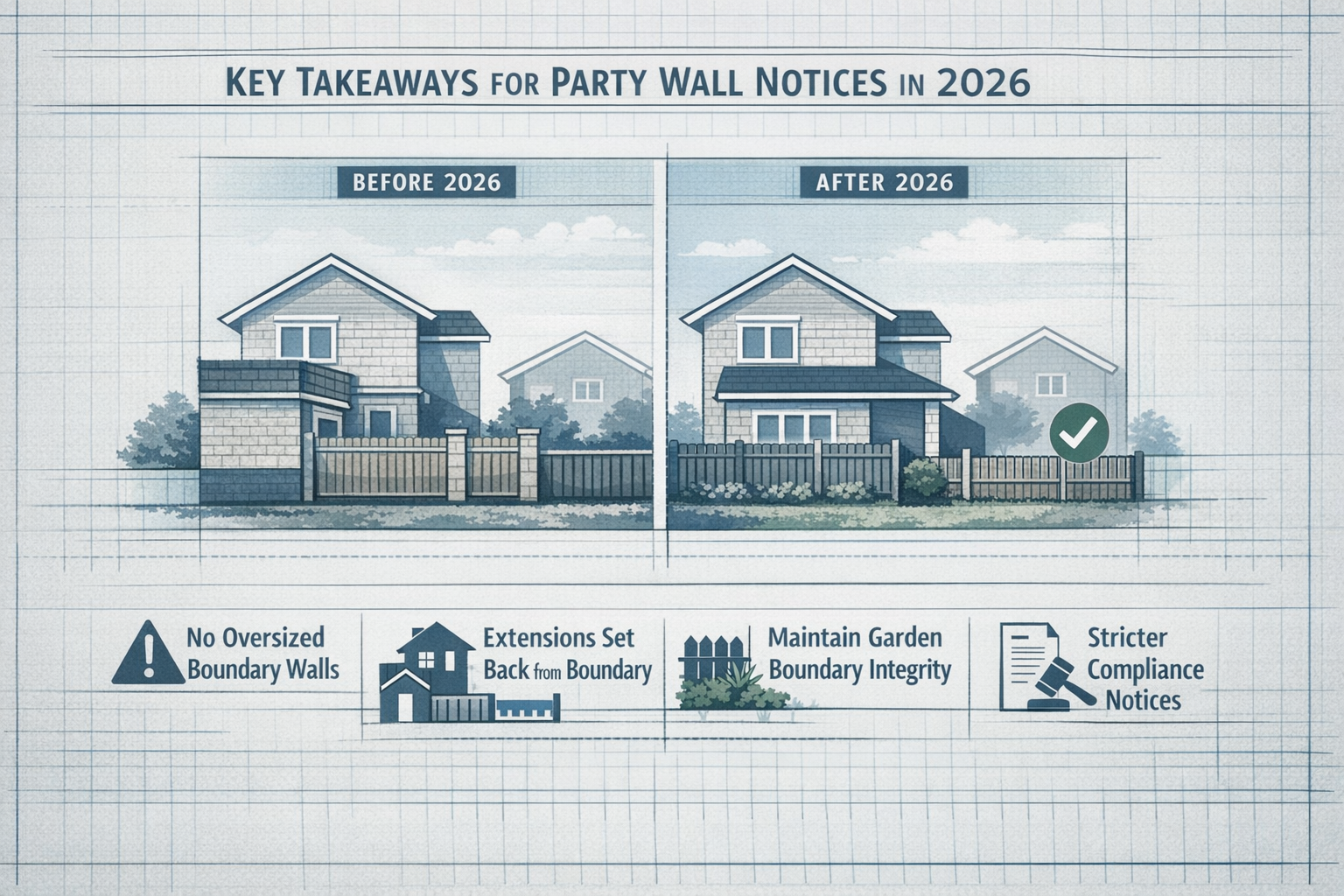
- The Party Wall Act applies to garden boundary walls but NOT fences, simplifying many fencing projects while requiring formal notices for wall construction or modification
- The 3-metre and 6-metre excavation rules trigger mandatory Section 6 Notices when digging foundations for garden outbuildings near neighbouring structures
- Neighbours have just 14 days to respond to party wall notices, and failure to serve proper notice can result in immediate work injunctions and full liability for any damage
- Schedules of Condition provide essential protection by documenting pre-work property states, preventing future disputes about damage causation
- Invalid notices are a common pitfall that can derail entire projects—understanding RICS guidance on notice validity is crucial for 2026 compliance
Understanding When Party Wall Notices for Garden Boundary Works Apply in 2026
The Party Wall Act 1996 creates specific obligations for property owners undertaking garden construction work, but understanding exactly when these requirements apply can be confusing. The critical distinction lies in the type of boundary structure and the nature of the work being undertaken.
Garden Walls vs. Fences: The Fundamental Difference
Garden boundary walls that abut or adjoin a neighbour's property fall squarely within the scope of the Party Wall Act, requiring formal notices before any construction, modification, or repair work begins.[1] These masonry structures—whether brick, stone, or concrete block—create shared boundaries that the Act specifically protects.
In contrast, boundary fences do not trigger Party Wall Act requirements.[1] This means that replacing, repairing, or installing wooden fence panels, chain-link fencing, or other non-masonry boundary markers typically proceeds without the need for formal party wall notices. This distinction significantly simplifies many garden boundary projects in 2026.
However, homeowners must exercise caution: if fence posts are set in concrete footings that extend below ground level near a neighbour's structure, excavation rules may still apply (discussed below).
The Section 6 Notice: Excavation Near Boundaries
For garden outbuildings—including sheds, summer houses, home offices, workshops, and garden studios—the excavation requirements for foundations often trigger Party Wall Act obligations through Section 6 Notices. Understanding these rules is essential for Party Wall Notices for Garden Boundary Works: 2026 Compliance for Fencing and Outbuildings.
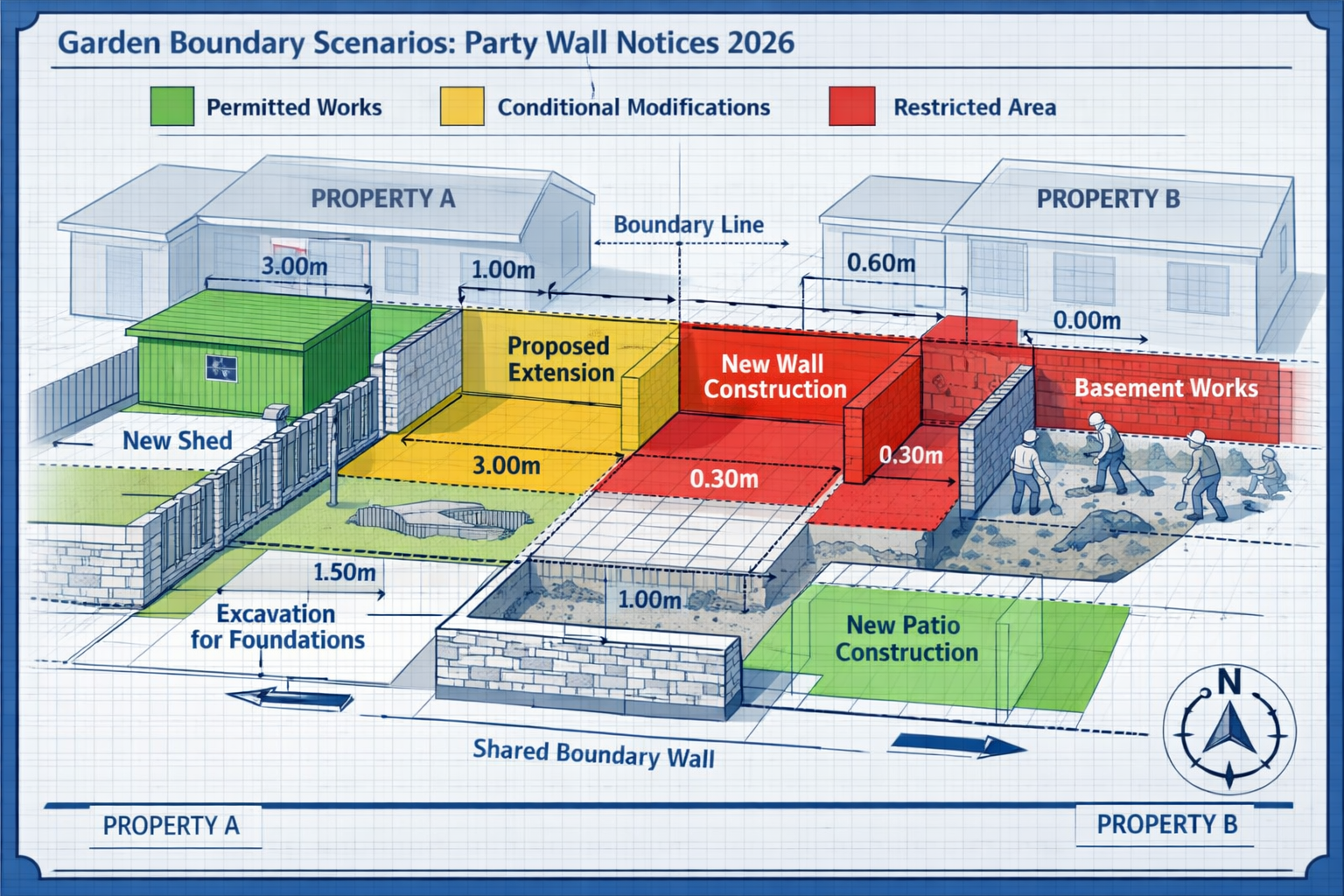
The 3-Metre Rule: If excavating foundations within 3 metres of a neighbour's building or structure, AND the new foundations will be deeper than the neighbour's existing foundations, a Section 6 Notice must be served.[1][2] This rule catches many homeowners by surprise, as even modest garden buildings often require foundations that exceed the depth of older neighbouring structures.
The 6-Metre Rule: When digging foundations within 6 metres of a neighbouring property, a Section 6 Notice is likely required regardless of comparative foundation depths, provided the excavation could affect the stability of the neighbour's structure.[2] This extended zone of influence recognizes that deeper excavations can impact soil stability and structural integrity over greater distances.
For detailed guidance on excavation notices, refer to our comprehensive resource on party wall excavation notice requirements.
Works Requiring Party Wall Notices
Beyond excavation, several other garden boundary works trigger notice requirements:
✅ Building a new boundary wall on the line of junction between properties
✅ Raising, lowering, or underpinning an existing party wall
✅ Cutting into a party wall to install beams, damp-proof courses, or other structural elements
✅ Demolishing and rebuilding a shared garden wall
✅ Installing footings or foundations that breach the 3-metre or 6-metre rules
❌ Works NOT requiring notices:
- Replacing fence panels on existing posts
- Painting or cleaning a party wall (non-structural maintenance)
- Planting hedges or trees (unless excavation affects structures)
- Installing surface-level garden features without foundations
Understanding these distinctions helps homeowners determine whether their garden project requires formal party wall notice procedures.
Serving Valid Party Wall Notices for Garden Boundary Works: 2026 Compliance Requirements
Once you've determined that your garden project requires a party wall notice, serving it correctly becomes paramount. Invalid notices represent one of the most common pitfalls in 2026 compliance, often resulting from incomplete information, incorrect timing, or failure to include essential documentation.
Minimum Notice Periods: Critical Timing Requirements
For garden boundary wall work or excavation projects under Section 6, you must serve notice at least one month before the intended start date.[1][3] This shorter notice period distinguishes garden excavation work from other party wall matters, which typically require two months' notice.
The one-month minimum provides neighbours with adequate time to:
- Review the proposed work and documentation
- Consult with surveyors or legal advisors
- Respond with consent or dissent
- Arrange for protective measures if necessary
Critical timing consideration: The notice period begins from the date the neighbour receives the notice, not from the date you send it. Using recorded delivery or hand delivery with signed acknowledgment provides proof of receipt and protects against timing disputes.
Essential Contents of a Valid Party Wall Notice
A valid notice for Party Wall Notices for Garden Boundary Works: 2026 Compliance for Fencing and Outbuildings must include specific information to satisfy statutory requirements and RICS professional standards:
1. Building Owner Details
- Full name and address of the property owner undertaking the work
- Contact information for correspondence
2. Adjoining Owner Details
- Full name and address of each affected neighbour
- Separate notices required for each adjoining owner
3. Proposed Work Description
- Clear explanation of the intended work
- Type of structure (garden wall, outbuilding, etc.)
- Materials to be used
4. Excavation Details and Drawings
- Proposed depth of foundations (measured in metres)
- Intended location of the new wall or structure
- Plans and sections detailing the excavation[2]
- Distance from neighbouring structures
- Cross-sectional drawings showing foundation depths relative to neighbour's foundations
5. Proposed Start Date
- Specific date when work will commence
- Must be at least one month after notice service
Common Invalid Notice Pitfalls (RICS Guidance for 2026)
Professional surveyors identify several recurring errors that render party wall notices invalid:
🚫 Insufficient excavation detail: Vague descriptions like "standard foundations" without specific depth measurements fail to allow neighbours to assess risk properly
🚫 Missing technical drawings: Notices without plans and cross-sections showing the relationship between new and existing foundations
🚫 Incorrect notice period calculation: Counting from the sending date rather than receipt date
🚫 Incomplete adjoining owner identification: Failing to serve notice on all affected neighbours, including those whose properties lie within the 3-metre or 6-metre excavation zones
🚫 Ambiguous work descriptions: Generic statements that don't clearly specify whether work affects party structures or involves excavation near boundaries
🚫 Failure to specify foundation depths: Omitting the critical comparison between proposed foundation depth and existing neighbouring foundation depth
For complex projects, consulting with specialists in party wall matters ensures notice validity and compliance.
The 14-Day Response Window
After receiving a valid party wall notice, each neighbouring party has 14 days to provide written consent or dissent.[1] This tight timeframe requires prompt action from all parties.
If the neighbour consents in writing: Work may proceed as described in the notice, though documenting the consent and retaining copies is essential for future reference.
If the neighbour dissents or fails to respond within 14 days: The notice is deemed to be in dispute, triggering the party wall award process (discussed in the next section).[1]
Important 2026 update: Electronic communications are increasingly accepted for party wall notices, but written confirmation—whether paper or email—remains essential. Verbal agreements or text messages do not satisfy statutory requirements.
Navigating Disputes and Protecting Your Interests: Schedules of Condition and Party Wall Awards
When neighbours dissent to a party wall notice—or simply fail to respond within the 14-day window—the dispute resolution mechanism under the Party Wall Act comes into effect. Understanding this process is crucial for Party Wall Notices for Garden Boundary Works: 2026 Compliance for Fencing and Outbuildings, as it determines how work proceeds and who bears responsibility for any damage.
The Party Wall Award Process
Once a dispute arises, both parties must appoint surveyors to prepare a Party Wall Award—a legally binding document that sets out:
- Details of the proposed work
- Timing and access arrangements
- Protective measures required
- Procedures for resolving damage claims
- Cost allocation for surveyor fees
Three appointment options exist:
- Agreed Surveyor: Both parties jointly appoint a single impartial surveyor to act for both sides, typically the most cost-effective approach
- Separate Surveyors: Each party appoints their own surveyor, who then work together to prepare the award
- Third Surveyor: If the two appointed surveyors cannot agree, they select a third surveyor to resolve specific disputes
For guidance on the agreed surveyor approach, see our article on what you need to know about party wall agreed surveyors.
The award must be prepared and served before work commences, providing legal protection for both parties and establishing clear procedures for managing the construction process.
Schedules of Condition: Essential Protection
A Schedule of Condition is a detailed record documenting the state of adjoining properties before work begins.[3] This critical document typically includes:
📸 Photographic evidence of all relevant areas of the neighbouring property
📋 Written descriptions of existing conditions, defects, and features
📏 Measurements and technical observations about structural elements
🗓️ Date-stamped documentation proving the pre-work condition
Why Schedules of Condition matter in 2026:
The Schedule of Condition serves as baseline evidence if damage claims arise during or after construction. Without this documentation, determining whether cracks, subsidence, or other defects resulted from the building work becomes extremely difficult and contentious.
For garden boundary works involving excavation near neighbouring structures, Schedules of Condition provide crucial protection by:
- Establishing pre-existing conditions: Many properties already have minor cracks, settlement, or defects unrelated to new work
- Preventing fraudulent claims: Documented evidence protects against neighbours attributing pre-existing damage to your project
- Facilitating fair resolution: When genuine damage occurs, comparing post-work conditions to the Schedule enables accurate assessment of causation and appropriate remediation
- Reducing insurance complications: Clear evidence supports insurance claims and helps determine liability
Professional surveyors recommend comprehensive Schedules of Condition for any garden project involving excavation within 6 metres of neighbouring structures, even when relationships with neighbours are excellent.
Protective Measures and Underpinning Requirements
Party Wall Awards for garden excavation work often specify protective measures to prevent damage to neighbouring properties. The most significant of these is underpinning—a process of strengthening and deepening existing foundations to prevent subsidence when nearby excavation occurs.[2]
When underpinning may be required:
- New garden outbuilding foundations significantly deeper than neighbouring foundations
- Excavation within the 3-metre zone where soil removal could undermine existing structures
- Unstable soil conditions or high water tables
- Neighbouring structures showing signs of previous settlement or structural weakness
Underpinning represents a substantial additional cost, but Party Wall Awards typically allocate this expense to the building owner undertaking the new work. Planning for potential underpinning costs during the project budgeting phase prevents financial surprises.
Consequences of Non-Compliance: Injunctions and Liability
Proceeding with garden boundary work without serving required party wall notices carries severe consequences in 2026:
⚠️ Immediate work injunctions: Neighbours can seek court orders to stop work immediately if proper notices weren't served, causing project delays of weeks or months[2]
⚠️ Full liability for all damage: Without a Party Wall Award, you bear complete responsibility for any damage occurring during work, losing the protection of the Act's dispute resolution mechanism[2]
⚠️ Legal costs exposure: Non-compliance often leads to expensive litigation, with the building owner typically bearing both parties' legal fees
⚠️ Remediation orders: Courts can require removal of completed work or expensive remedial measures to address damage caused by non-compliant construction
⚠️ Relationship breakdown: Proceeding without proper notices irreparably damages neighbour relations, creating ongoing tensions that affect property enjoyment and future resale value
For assistance with party wall disputes or concerns about non-compliance, professional surveyor intervention can often resolve issues before they escalate to legal action.
Special Considerations for 2026: Eco-Compliance and Sustainable Garden Features
As environmental consciousness shapes construction practices, garden projects increasingly incorporate sustainable features—green roofs on outbuildings, rainwater harvesting systems, solar panels, and eco-friendly materials. These innovations introduce new considerations for Party Wall Notices for Garden Boundary Works: 2026 Compliance for Fencing and Outbuildings.
Eco-Compliance Clauses in Party Wall Agreements
Emerging 2026 trend: When sustainable features affect party walls or boundaries in garden projects, eco-compliance clauses are becoming essential components of party wall agreements.[6] These clauses address:
🌱 Green infrastructure impacts: Living walls, green roofs, or extensive planting that may affect shared structures through increased moisture, root growth, or load
🌱 Renewable energy installations: Solar panels on garden buildings that cast shadows on neighbouring properties or create glare issues
🌱 Water management systems: Rainwater collection, greywater recycling, or sustainable drainage that could affect neighbouring land or structures
🌱 Sustainable materials: Use of reclaimed materials, earth construction, or innovative eco-materials that may have different structural properties than conventional materials
Including eco-compliance clauses in party wall agreements ensures that sustainability goals don't create unintended disputes or compliance issues with neighbours.
Boundary Disputes and Garden Works
While party wall procedures address statutory requirements, garden boundary works can also trigger separate boundary disputes when property lines are unclear or contested. Before undertaking significant garden construction:
✓ Verify exact boundary locations using title deeds, Land Registry plans, and professional surveys
✓ Resolve any boundary uncertainties before serving party wall notices
✓ Consider boundary agreements with neighbours to formally establish property lines
✓ Document agreed boundaries with photographs and written confirmation
Combining boundary clarification with party wall compliance provides comprehensive protection for garden development projects.
Practical Steps: Your 2026 Compliance Checklist for Garden Boundary Works
To ensure full compliance with Party Wall Notices for Garden Boundary Works: 2026 Compliance for Fencing and Outbuildings, follow this practical checklist:
Phase 1: Project Planning (8-12 Weeks Before Start)
- Determine whether your garden project involves party walls or excavation near boundaries
- Measure distances from proposed excavation to neighbouring structures
- Identify all adjoining owners who require notice
- Obtain detailed architectural drawings showing foundation depths and excavation plans
- Calculate notice periods and establish project timeline
- Budget for potential party wall surveyor fees and protective measures
Phase 2: Notice Service (6-8 Weeks Before Start)
- Prepare complete party wall notices with all required information
- Include detailed excavation drawings and cross-sections
- Serve notices on all affected neighbours using recorded delivery
- Retain proof of service and delivery confirmation
- Diarise the 14-day response deadline for each neighbour
Phase 3: Response Management (4-6 Weeks Before Start)
- Monitor for neighbour responses within 14-day windows
- If consent received, retain written confirmation
- If dissent or no response, initiate surveyor appointment process
- Arrange for Schedule of Condition surveys of neighbouring properties
- Coordinate with appointed surveyors to prepare Party Wall Award
Phase 4: Pre-Construction (2-4 Weeks Before Start)
- Ensure Party Wall Award is finalized and served
- Review all protective measures and underpinning requirements
- Brief contractors on party wall obligations and access arrangements
- Confirm Schedule of Condition documentation is complete
- Verify all statutory notice periods have elapsed
Phase 5: During Construction
- Comply with all Party Wall Award conditions
- Provide required access for neighbour's surveyor inspections
- Document work progress with photographs
- Address any concerns raised by neighbours or surveyors promptly
- Maintain communication with all parties throughout construction
Phase 6: Post-Completion
- Conduct final inspections with surveyors
- Compare property conditions to Schedule of Condition
- Address any damage claims fairly and promptly
- Retain all party wall documentation for future reference
- Provide completion notices as required by Party Wall Award
Jurisdictional Limitations and Professional Support
Critical jurisdictional note: The Party Wall Act 1996 applies only in England and Wales—it does not apply in Scotland or Northern Ireland.[3] Property owners in Scotland and Northern Ireland should consult local legal requirements for boundary works.
For complex garden projects, professional surveyor support provides invaluable protection. Expert guidance ensures:
✅ Notice validity: Properly prepared notices that satisfy all statutory requirements
✅ Fair awards: Balanced party wall agreements that protect all parties' interests
✅ Dispute resolution: Professional mediation when neighbour relations become strained
✅ Cost management: Efficient processes that minimize surveyor fees and delays
✅ Legal protection: Comprehensive documentation that protects against future claims
Professional surveyors experienced in party wall agreements can navigate the entire process from initial notice through final completion, providing peace of mind and legal certainty.
Conclusion: Protecting Your Garden Project Through Proper Compliance
Party Wall Notices for Garden Boundary Works: 2026 Compliance for Fencing and Outbuildings requires careful attention to statutory requirements, precise timing, and thorough documentation. While the process may seem complex, proper compliance protects both building owners and neighbours from disputes, work stoppages, and costly legal action.
Key principles for successful garden boundary projects:
🏡 Understand the distinction between party walls (requiring notices) and fences (typically exempt)
🏡 Apply the 3-metre and 6-metre excavation rules accurately to determine Section 6 Notice requirements
🏡 Serve complete, valid notices with detailed excavation drawings and specifications
🏡 Respect the 14-day response window and initiate surveyor appointments promptly when disputes arise
🏡 Insist on comprehensive Schedules of Condition to document pre-work property states
🏡 Budget for protective measures including potential underpinning requirements
🏡 Never proceed without proper notices—the consequences far outweigh the perceived time savings
Next Steps
If you're planning garden boundary works in 2026:
- Assess your project against the party wall criteria outlined in this guide
- Consult with professional surveyors early in the planning process
- Serve notices well in advance of your intended start date
- Maintain open communication with neighbours throughout the process
- Document everything to protect your interests and facilitate smooth project completion
For expert guidance on your specific garden boundary project, consider consulting specialists familiar with local property conditions and neighbour dynamics. Proper planning and professional support transform potentially contentious party wall procedures into straightforward administrative steps, allowing you to focus on creating the garden space you envision.
The investment in proper Party Wall Notices for Garden Boundary Works: 2026 Compliance for Fencing and Outbuildings pays dividends through avoided disputes, protected neighbour relationships, and legal certainty that your garden improvements comply with all statutory requirements.
References
[1] Garden Buildings And The Party Wall Act – https://www.bdcmagazine.com/2021/02/landlord-estate-services/building-regulations/garden-buildings-and-the-party-wall-act/
[2] Excavation And The Party Wall Act Navigating The 3 And 6 Metre Rules For Foundations – https://www.partywallslimited.com/blog/excavation-and-the-party-wall-act-navigating-the-3–and-6-metre-rules-for-foundations
[3] Party Wall Agreement – https://hoa.org.uk/advice/guides-for-homeowners/i-am-improving/party-wall-agreement/
[4] Party Wall Agreements What You Need To Know – https://www.fmb.org.uk/find-a-builder/ultimate-guides-to-home-renovation/party-wall-agreements-what-you-need-to-know.html
[5] Party Walls Building Works – https://www.gov.uk/party-walls-building-works
[6] Party Wall Notices For Sustainable Home Extensions In 2026 Eco Compliance Clauses – https://nottinghillsurveyors.com/blog/party-wall-notices-for-sustainable-home-extensions-in-2026-eco-compliance-clauses
[7] Party Fences Walls – https://legal-resources.uslegalforms.com/p/party-fences-walls
[8] Party Walls Frequently Asked Questions – https://www.lexisnexis.co.uk/legal/guidance/party-walls-frequently-asked-questions