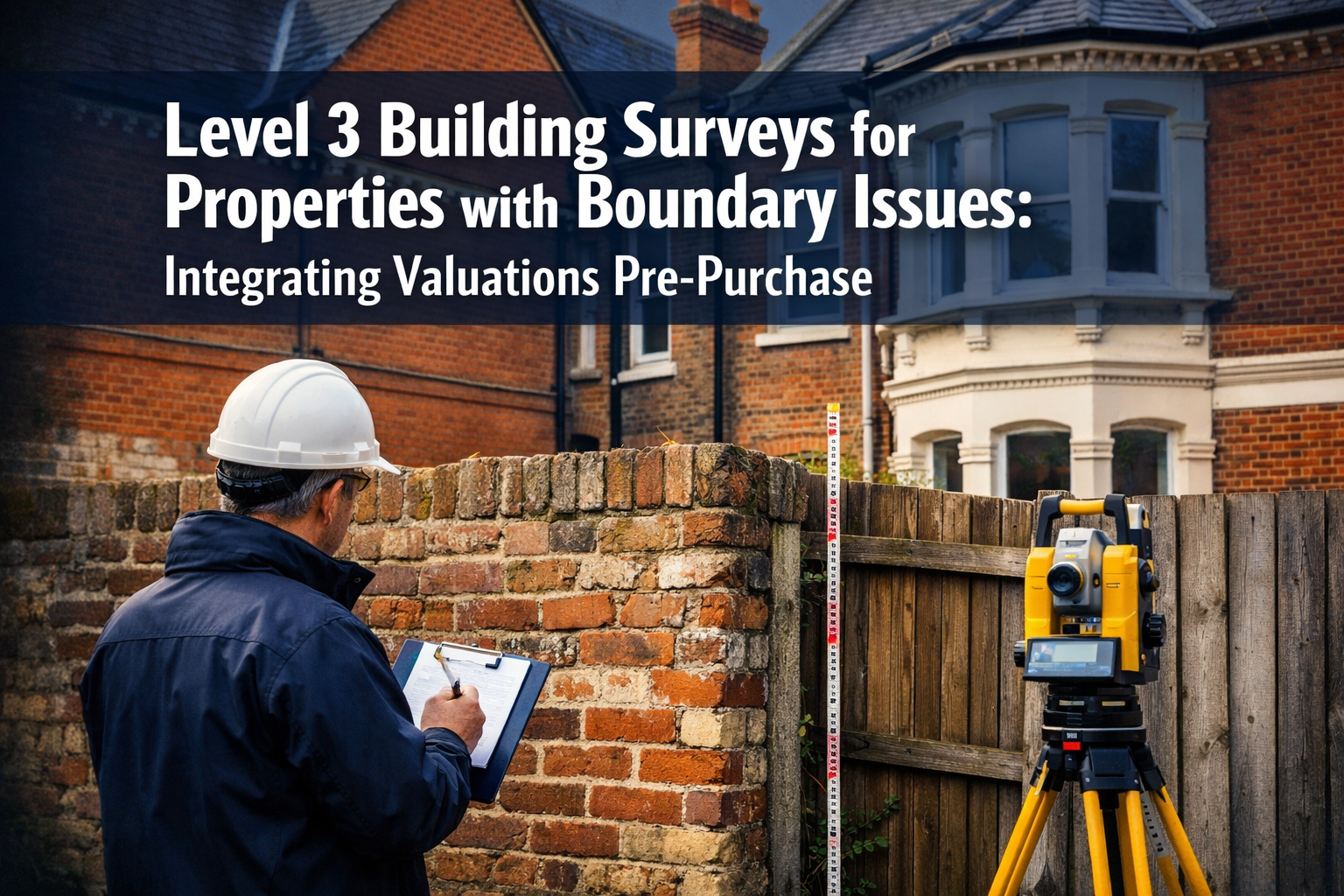

Boundary disputes reduce property values by an average of 10-20%, yet most buyers discover these issues only after exchange of contracts—when it's too late to renegotiate. In 2026's competitive housing market, particularly for terraced and semi-detached homes where boundaries are shared, understanding how Level 3 Building Surveys for Properties with Boundary Issues: Integrating Valuations Pre-Purchase can protect buyers from financial loss has never been more critical.
When purchasing a property with potential boundary complications, a comprehensive Level 3 survey combined with an integrated valuation provides the evidence needed to negotiate price reductions, request remedial works, or walk away from a problematic purchase. This approach aligns with Home Survey Standards and ensures buyers make informed decisions based on both structural condition and market value implications.
Key Takeaways
- Boundary issues can reduce property values by 10-20%, making integrated surveys and valuations essential for accurate purchase price negotiations
- Level 3 surveys identify boundary-related defects including encroachments, disputed walls, and structural issues affecting shared boundaries in terraced and semi-detached properties
- Pre-purchase valuations adjusted for boundary disputes provide documented evidence for renegotiation and protect buyers from overpaying
- Expert referrals to boundary surveyors and solicitors should be coordinated through the Level 3 survey process for comprehensive risk assessment
- RICS standards require disclosure of boundary concerns in both survey reports and valuation assessments, protecting buyer interests
Understanding Level 3 Building Surveys for Properties with Boundary Issues
What Makes Level 3 Surveys Essential for Boundary Concerns
A Level 3 Building Survey (formerly known as a Full Structural Survey) represents the most comprehensive inspection available for residential properties. When boundary issues are suspected or known, this detailed examination becomes absolutely critical. Unlike basic homebuyer reports, Level 3 surveys provide in-depth analysis of structural elements, particularly those affecting or affected by boundary lines.
Key components of Level 3 surveys addressing boundary issues include:
- 🏠 Detailed wall examination – assessment of party walls, boundary walls, and shared structures for ownership, condition, and legal compliance
- 📏 Measurement verification – comparison of physical boundaries against title deeds and Land Registry plans
- 🔍 Encroachment identification – detection of structures, fences, or extensions crossing property lines
- ⚠️ Structural defect analysis – evaluation of how boundary disputes or unclear ownership affect structural integrity
- 📋 Legal compliance review – assessment of Party Wall Act compliance and planning permission for boundary structures
For terraced and semi-detached properties built in the Victorian and Edwardian eras—common throughout London and the Southeast—boundary complications frequently arise from historical alterations, unclear title deeds, and informal arrangements between previous owners that were never properly documented.
Common Boundary Issues Identified in Level 3 Surveys
Experienced chartered surveyors routinely encounter specific boundary-related defects that significantly impact property values:
| Boundary Issue Type | Typical Impact on Value | Survey Detection Method |
|---|---|---|
| Disputed fence/wall ownership | 5-10% reduction | Title deed comparison, physical inspection |
| Encroaching extensions | 10-20% reduction | Measured survey, planning history review |
| Shared access disputes | 8-15% reduction | Rights of way verification, site observation |
| Party wall defects | 5-12% reduction | Structural assessment, compliance review |
| Unmaintained boundary structures | 3-8% reduction | Condition assessment, repair cost estimation |
Terraced properties present unique challenges because they share two boundary walls with neighbors, doubling the potential for disputes. Semi-detached homes typically share one substantial party wall, but often have more complex rear and side boundary arrangements involving gardens, access paths, and outbuildings.
The surveyor's role extends beyond simple identification. A comprehensive Level 3 survey should document photographic evidence, provide measured sketches showing boundary positions, and recommend specialist referrals when legal or technical expertise beyond the surveyor's scope is required. This might include boundary dispute specialists or structural engineers for complex party wall issues.
The Scope of Boundary Investigation in Level 3 Surveys
While Level 3 surveys are comprehensive, it's important to understand their limitations regarding boundaries. Building surveyors are not land surveyors or legal experts. Their examination focuses on physical condition and observable defects rather than definitive legal boundary determination.
A Level 3 survey addressing boundary concerns typically includes:
✅ Visual inspection of all accessible boundary structures (walls, fences, hedges)
✅ Condition assessment of party walls and shared structures
✅ Identification of obvious encroachments or discrepancies
✅ Review of available documentation (title plans, planning permissions)
✅ Recommendations for specialist input when issues are identified
❌ Not included: Definitive legal boundary determination (requires land surveyor)
❌ Not included: Legal advice on boundary disputes (requires solicitor)
❌ Not included: Detailed land surveys with precise measurements (separate service)
This distinction is crucial. When a Level 3 survey identifies potential boundary issues, the surveyor will recommend obtaining a specialist boundary survey—a separate service that can cost £300-£1,500 depending on complexity[7]. This additional survey provides the precise measurements and legal documentation needed for resolving disputes or confirming boundary positions.
Integrating Valuations with Level 3 Building Surveys for Properties with Boundary Issues
Why Pre-Purchase Valuations Matter for Boundary Disputes
The integration of professional valuations with Level 3 surveys creates a powerful tool for buyers facing properties with boundary complications. A RICS registered valuer can quantify the financial impact of boundary issues, providing concrete evidence for price renegotiation.
Standard property valuations assess market value based on comparable sales, property condition, location, and market conditions. However, when boundary disputes or defects are present, these factors create material considerations that must be reflected in the valuation figure.
Consider this scenario: A buyer agrees to purchase a Victorian terraced house for £650,000. The Level 3 survey reveals that the rear extension encroaches 30cm onto the neighbor's land, and there's no formal agreement in place. Without this discovery, the buyer would complete the purchase unaware of:
- Potential legal action from the neighbor requiring costly removal
- Difficulty obtaining mortgage finance in future sales
- Reduced marketability affecting resale value
- Insurance complications and higher premiums
A properly integrated valuation would adjust the market value downward by £65,000-£130,000 (10-20%) to reflect these risks, providing the buyer with documented justification to renegotiate or withdraw from the purchase.

The Valuation Adjustment Process for Boundary Issues
Professional valuers follow established RICS guidance when adjusting property values for boundary complications. The Red Book valuation standards require transparent disclosure of all material factors affecting value, including boundary disputes.
The adjustment methodology typically follows these steps:
- Baseline valuation – Determine market value assuming no boundary issues
- Issue categorization – Classify boundary problems by severity and resolvability
- Cost assessment – Calculate potential legal costs, remediation expenses, and risk premiums
- Market impact analysis – Evaluate how boundary issues affect marketability and buyer pool
- Adjusted valuation – Apply appropriate percentage reduction based on combined factors
Severity classifications guide adjustment percentages:
🟢 Minor issues (3-5% reduction): Unclear fence ownership with cooperative neighbors, easily resolvable through boundary agreements
🟡 Moderate issues (8-12% reduction): Disputed boundary positions requiring legal resolution, party wall defects needing remedial works
🔴 Severe issues (15-25% reduction): Active litigation, significant encroachments requiring removal, multiple disputed boundaries affecting access
The valuer's report should clearly articulate the reasoning behind adjustments, referencing the Level 3 survey findings as supporting evidence. This documentation becomes invaluable during purchase negotiations and provides protection if the buyer proceeds despite the issues.
Coordinating Survey and Valuation Timing
Strategic timing of the Level 3 survey and integrated valuation maximizes their effectiveness in the purchase process. The optimal sequence typically follows this pattern:
Week 1-2: Initial offer accepted, survey and valuation commissioned simultaneously
Week 3-4: Level 3 survey conducted, boundary issues identified
Week 4-5: Valuer reviews survey findings, conducts property inspection with boundary issues in mind
Week 5-6: Integrated reports delivered showing both structural concerns and adjusted valuation
Week 6-7: Buyer uses evidence to renegotiate price or request remedial works
Many buyers make the mistake of commissioning these services separately or sequentially, losing valuable time and creating information gaps. When the same firm provides both services—or when there's close coordination between surveyor and valuer—the resulting reports present a cohesive picture of both condition and value implications.
For properties where boundary issues are already known (disclosed by the seller or visible during viewings), requesting that the surveyor and valuer communicate directly before their inspections ensures both professionals understand the specific concerns requiring attention. This coordination aligns with best practices under Home Survey Standards and maximizes the value of both services.
The best property valuation approaches for boundary-affected properties often incorporate multiple valuation methods—comparable sales analysis adjusted for boundary issues, cost approach accounting for remediation expenses, and income approach if the property has rental potential affected by the boundary complications.
Expert Referrals and Next Steps in Level 3 Building Surveys for Properties with Boundary Issues
When to Engage Boundary Specialists and Legal Experts
A comprehensive Level 3 survey identifies when specialist input becomes necessary. Understanding these referral triggers helps buyers assemble the right professional team to address boundary complications effectively.
Boundary surveyor referral indicators:
- Significant discrepancies between physical boundaries and title plans (>50cm variance)
- Disputes with neighbors regarding fence or wall positions
- Planning to build extensions or outbuildings near boundaries
- Historical boundary movements or informal arrangements requiring formal documentation
- Preparation for boundary agreement negotiations with neighbors
Boundary surveyors (land surveyors specializing in property lines) provide measured surveys accurate to within centimeters, prepare legal plans for Land Registry applications, and can serve as expert witnesses in boundary dispute proceedings. Their fees typically range from £500-£2,000 depending on property complexity and the level of detail required[7].
Legal specialist referral indicators:
- Active disputes with neighbors involving solicitor correspondence
- Encroachments requiring adverse possession claims or negotiated agreements
- Right of way disputes affecting property access
- Party wall matters requiring formal notices under the Party Wall Act
- Covenant restrictions affecting boundary structures or alterations
Property solicitors specializing in boundary disputes work alongside surveyors to resolve legal aspects that physical surveys alone cannot address. Early engagement—ideally before exchange of contracts—provides maximum flexibility for negotiation or withdrawal.
Structural Engineers for Party Wall and Boundary Structure Issues
When Level 3 surveys identify structural defects in party walls or boundary structures, residential structural engineers provide the technical analysis needed to determine repair requirements and costs.
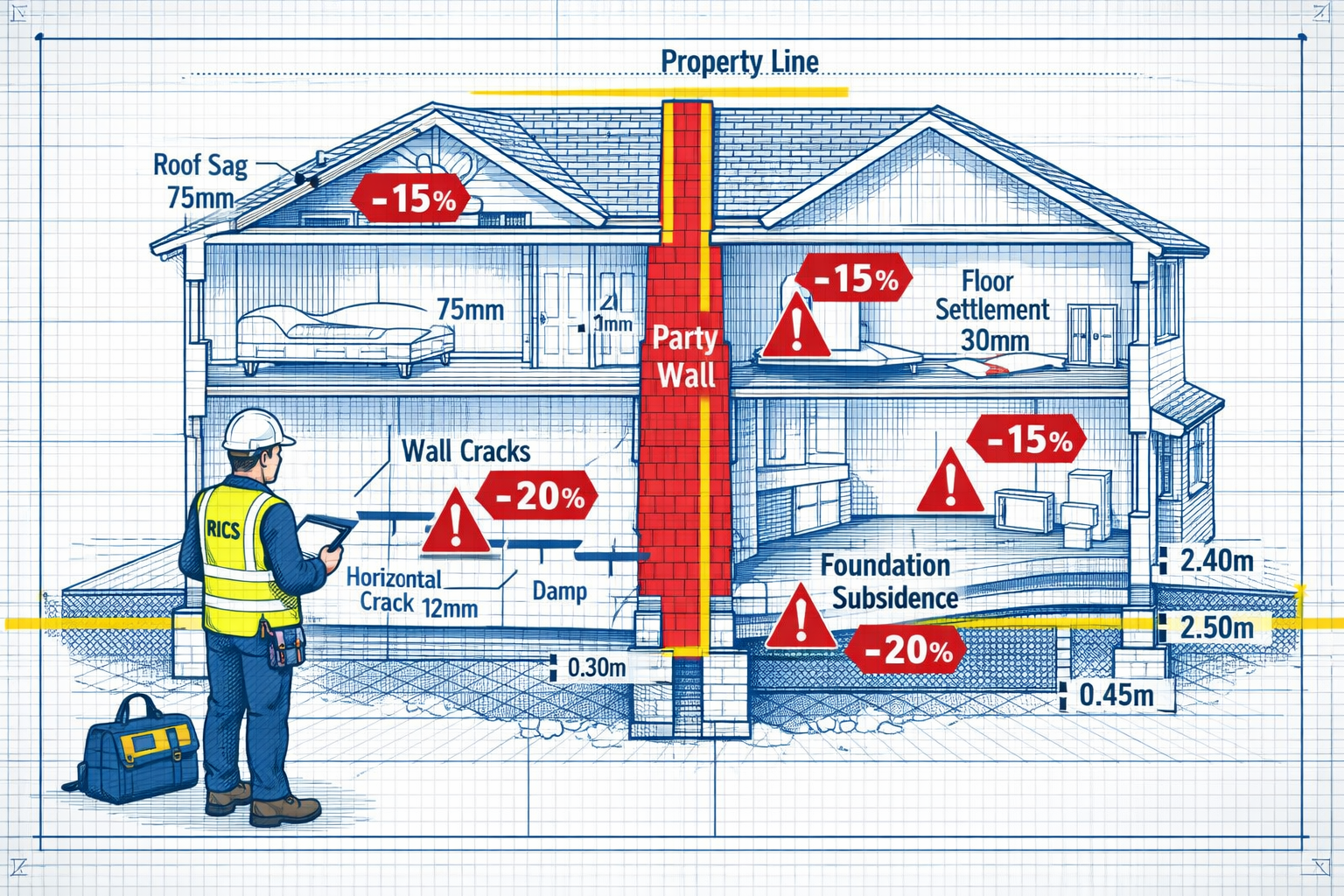
Common party wall issues requiring structural engineer input:
🔧 Cracking and movement – Differential settlement affecting shared walls between terraced properties
🔧 Dampness penetration – Water ingress through party walls due to failed damp-proof courses
🔧 Structural alterations – Previous modifications to party walls affecting load-bearing capacity
🔧 Foundation concerns – Subsidence or heave affecting shared foundations
🔧 Tie failure – Deteriorated wall ties in cavity party walls (common in 1930s-1960s construction)
The engineer's report quantifies repair costs—critical information for the valuer's adjustment calculations and the buyer's negotiation position. For example, party wall repairs requiring underpinning might cost £15,000-£40,000, directly justifying significant price reductions.
Structural engineers also assess whether boundary walls meet current building regulations, particularly important if the buyer plans future alterations. Non-compliant structures may require costly upgrades or replacement before planning permission for extensions can be granted.
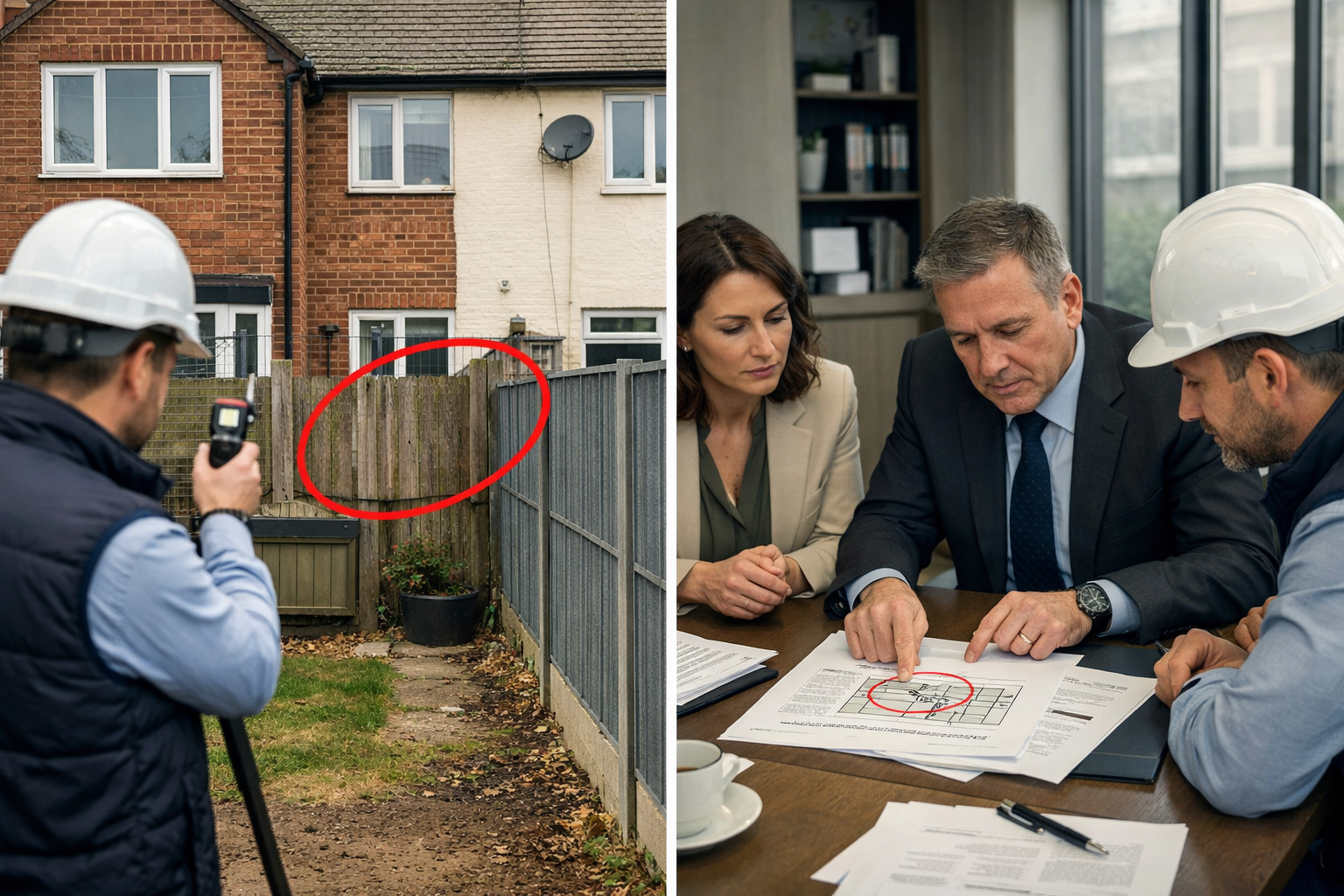
Creating an Action Plan Based on Survey and Valuation Findings
Once the Level 3 survey and integrated valuation reveal boundary issues, buyers face several strategic options. The appropriate path depends on issue severity, buyer risk tolerance, and market conditions.
Option 1: Price Renegotiation ✅ Most common approach
Use the adjusted valuation as evidence to request a price reduction matching the value impact. Present the survey and valuation reports to the seller's agent with a revised offer reflecting the documented issues. In 2026's more balanced market, sellers are increasingly willing to negotiate when presented with professional evidence.
Option 2: Request Remedial Works ✅ Suitable for resolvable issues
Require the seller to resolve boundary issues before completion—obtaining boundary agreements, removing encroachments, or completing party wall repairs. This approach works best when issues are straightforward and the seller is motivated to complete the sale.
Option 3: Proceed with Retention ⚠️ Moderate risk approach
Complete the purchase but hold back funds (typically 1.5-2x estimated resolution costs) in a solicitor's account until boundary issues are resolved post-purchase. This requires seller agreement and careful legal documentation.
Option 4: Withdraw from Purchase 🛑 Appropriate for severe issues
When boundary complications present unacceptable legal or financial risks—active litigation, multiple severe encroachments, or structural defects requiring costs exceeding the property's value—withdrawal may be the wisest choice despite sunk costs in surveys and legal fees.
Decision matrix for boundary issue responses:
| Issue Severity | Estimated Cost | Recommended Action | Success Rate |
|---|---|---|---|
| Minor | <£5,000 | Price reduction | 85% |
| Moderate | £5,000-£20,000 | Price reduction or retention | 70% |
| Severe | £20,000-£50,000 | Major renegotiation or withdrawal | 45% |
| Critical | >£50,000 | Withdrawal recommended | 20% |
Long-term Protection: Insurance and Documentation
For buyers who proceed with purchases despite identified boundary issues, proper documentation and insurance protection become essential risk management tools.
Title insurance provides financial protection against future boundary disputes, covering legal costs and potential losses if boundary issues escalate after purchase. Premiums typically range from £100-£500 for standard residential properties, with coverage amounts matching the property value.
Boundary indemnity insurance specifically protects against losses arising from:
- Disputes over boundary positions
- Encroachments discovered after purchase
- Lack of planning permission for boundary structures
- Breach of restrictive covenants affecting boundaries
This insurance doesn't prevent disputes from arising but provides financial protection if they do. It's particularly valuable for properties where boundary issues are known but considered low-risk, or where resolution would be disproportionately expensive relative to the actual risk.
Essential documentation to retain:
📄 Complete Level 3 survey report with boundary issue documentation
📄 Integrated valuation report showing value adjustments
📄 All correspondence with neighbors regarding boundaries
📄 Historical title deeds and Land Registry plans
📄 Photographs showing boundary positions at purchase
📄 Any boundary agreements or informal arrangements
📄 Planning permissions for structures near boundaries
📄 Party wall awards or agreements
Proper documentation proves invaluable if disputes arise years after purchase, particularly when selling the property and needing to demonstrate transparency with future buyers.
Understanding the Legal Framework: Party Wall Act and Boundary Law
Party Wall Act Implications for Terraced and Semi-Detached Properties
The Party Wall etc. Act 1996 governs works affecting party walls, boundary walls, and excavations near neighboring properties in England and Wales. Understanding this legislation is crucial when Level 3 surveys identify party wall issues in terraced and semi-detached homes.
The Act covers three main scenarios:
- Party Wall Works (Section 2) – Repairs, alterations, or rebuilding of existing party walls
- New Building on Boundary (Section 1) – Construction of new walls on or astride boundary lines
- Excavation Near Boundaries (Section 6) – Digging within 3-6 meters of neighboring structures
When Level 3 surveys reveal party wall defects requiring remedial works, the Act mandates specific notification procedures to affected neighbors. Failure to comply can result in injunctions halting works, legal costs, and strained neighbor relations—all factors affecting property value and marketability.
For buyers planning renovations or extensions, the survey should assess whether proposed works will trigger Party Wall Act requirements. This information feeds into the valuation factors affecting the property's worth, as Party Wall Act compliance adds time and cost to any project.
Typical Party Wall Act costs buyers should anticipate:
- Party wall surveyor fees: £700-£1,500 per property
- Building owner's surveyor: £700-£1,200
- Agreed surveyor (if neighbors cooperate): £1,200-£2,000 total
- Dispute resolution (if neighbors object): £3,000-£10,000+
These costs should be factored into renovation budgets and can influence purchase decisions, particularly for properties requiring significant party wall works identified in the Level 3 survey.
Boundary Determination and Land Registry Guidelines
Boundary positions in England and Wales operate under the "general boundaries" principle—Land Registry plans show approximate boundary positions, not exact legal lines. This inherent ambiguity creates the potential for disputes, particularly in older terraced and semi-detached properties where original boundaries may have shifted over decades.
Key principles affecting boundary interpretation:
🔍 General boundaries rule – Land Registry plans are not definitive; they show general boundary positions typically accurate to within 1-2 meters for older properties
🔍 Determined boundaries – Property owners can apply for "determined boundary" status, providing legal certainty but requiring detailed surveys and neighbor agreement
🔍 Presumptions – Legal presumptions help interpret unclear boundaries (e.g., fence posts typically on owner's side, ditches owned by party with bank)
🔍 Adverse possession – Continuous occupation of disputed land for 10-12 years may create ownership rights, complicating boundary disputes
When Level 3 surveys identify boundary discrepancies, understanding these principles helps assess the severity and likely resolution path. Minor variations within the general boundaries tolerance may not warrant concern, while significant discrepancies exceeding 50cm often require formal boundary agreements or determined boundary applications.
The surveyor's report should clearly distinguish between:
- Definite encroachments – Structures clearly beyond any reasonable boundary interpretation
- Probable issues – Discrepancies likely to cause disputes based on title plan comparison
- Possible concerns – Minor variations within general boundaries tolerance but worth monitoring
This categorization helps valuers apply appropriate adjustments and guides buyers' response strategies.
Valuation Methodologies for Boundary-Affected Properties
Comparable Sales Analysis with Boundary Adjustments
The primary valuation method for residential properties—comparable sales analysis—requires careful adjustment when boundary issues are present. Valuers identify similar properties recently sold in the area, then adjust for differences including boundary complications.
Adjustment factors for boundary-affected comparables:
If a comparable property sold for £600,000 without boundary issues, and the subject property has a moderate boundary dispute, the valuer might apply:
- Base comparable value: £600,000
- Boundary dispute adjustment: -10% (£60,000)
- Legal risk premium: -2% (£12,000)
- Marketability reduction: -3% (£18,000)
- Adjusted value: £510,000
This methodology provides transparent documentation of how boundary issues affect market value, essential for negotiation purposes. The valuation report should explicitly state these adjustments with clear reasoning.
Finding appropriate comparables becomes challenging when boundary issues are unique or severe. Valuers may need to research:
- Properties sold with disclosed boundary disputes
- Sales following boundary dispute resolution
- Properties with similar encroachment issues
- Market reaction to boundary complications in the local area
Cost Approach for Remediation and Risk Assessment
The cost approach provides a complementary valuation methodology, particularly useful for quantifying specific boundary issue impacts. This method calculates:
Total remediation cost = Legal costs + Physical works + Risk premium + Lost time value
Example calculation for terraced property with encroaching extension:
| Cost Component | Amount | Rationale |
|---|---|---|
| Legal fees (boundary agreement) | £3,500 | Solicitor fees for negotiation and documentation |
| Surveyor fees (boundary survey) | £1,200 | Detailed measured survey for agreement |
| Extension removal (if required) | £15,000 | Worst-case scenario cost |
| Reconstruction costs | £8,000 | Rebuilding within correct boundary |
| Contingency (20%) | £5,540 | Unexpected complications |
| Total potential cost | £33,240 | Used to justify 10-15% value reduction |
This cost-based approach provides concrete justification for price reductions, particularly persuasive when negotiating with sellers who may view boundary issues as minor inconveniences rather than material defects.
Market Resistance and Liquidity Impact
Beyond direct costs, boundary issues significantly affect property marketability—a factor requiring separate valuation consideration. Properties with disclosed boundary disputes face:
📉 Reduced buyer pool – Many buyers immediately exclude properties with boundary complications
📉 Mortgage difficulties – Lenders often refuse or reduce lending on properties with boundary disputes
📉 Extended marketing periods – Boundary-affected properties take 30-50% longer to sell
📉 Lower offer prices – Buyers discount for perceived hassle and risk beyond actual costs
These liquidity factors justify additional value reductions of 5-10% beyond direct remediation costs, particularly in slower markets where buyer choice is abundant.
Professional valuers incorporate these market resistance factors into their assessments, providing buyers with realistic expectations about future resale challenges if they proceed with purchase despite boundary issues.
Practical Guidance for Buyers: Navigating the Survey and Valuation Process
Selecting the Right Surveyor for Boundary-Focused Level 3 Surveys
Not all chartered surveyors possess equal expertise in boundary-related issues. When commissioning Level 3 Building Surveys for Properties with Boundary Issues: Integrating Valuations Pre-Purchase, buyers should seek professionals with specific qualifications and experience.
Essential surveyor qualifications and experience:
✅ RICS membership (AssocRICS or MRICS) ensuring professional standards compliance
✅ Building survey specialism with demonstrated experience in terraced and semi-detached properties
✅ Boundary issue expertise – ask specifically about their experience with boundary disputes
✅ Local market knowledge – understanding of typical boundary issues in the area
✅ Valuation capability – ability to provide integrated valuation or close coordination with valuers
✅ Professional indemnity insurance – minimum £1 million coverage for survey work
Questions to ask potential surveyors:
- "How many Level 3 surveys have you completed on terraced/semi-detached properties with boundary issues?"
- "Can you provide integrated valuation services or coordinate closely with a valuer?"
- "What percentage of your surveys identify boundary-related defects?"
- "Do you have experience providing expert witness testimony in boundary disputes?"
- "Can you recommend boundary specialists and solicitors if issues are identified?"
The surveyor's fee for a Level 3 survey typically ranges from £800-£2,000 depending on property size and complexity. Integrated valuations add £300-£800 to the total cost. While these fees may seem substantial, they represent excellent value compared to the potential losses from purchasing a property with undisclosed boundary issues worth tens of thousands less than the agreed price.
Preparing for the Survey: Information to Provide
Buyers can maximize the value of their Level 3 survey by providing comprehensive information to the surveyor before the inspection.
Essential documents to provide:
📋 Title deeds and Land Registry plans – showing registered boundaries
📋 Seller's Property Information Form – disclosing known boundary issues
📋 Planning permissions – for extensions or alterations near boundaries
📋 Previous survey reports – if available from earlier transactions
📋 Correspondence with neighbors – regarding boundary matters
📋 Photographs – showing boundary structures and potential issues
Information about concerns:
- Specific boundary issues observed during viewings
- Neighbor comments or concerns mentioned by the seller
- Visible discrepancies between physical boundaries and title plans
- Historical boundary movements or alterations
- Planned renovations or extensions that might affect boundaries
This preparation enables the surveyor to focus attention on specific concerns while conducting their comprehensive inspection, ensuring nothing is overlooked.
Interpreting Survey Reports and Valuation Findings
Level 3 survey reports are comprehensive documents, often 30-50 pages for typical properties. Understanding how to interpret boundary-related findings ensures buyers can make informed decisions.
Report structure typically includes:
- Executive summary – Key findings and recommendations (read this first)
- Property description – General information and construction details
- Detailed inspection findings – Room-by-room assessment with boundary focus
- Boundary-specific section – Dedicated analysis of boundary structures and issues
- Defects summary – Categorized by urgency (immediate, short-term, long-term)
- Recommendations – Specialist referrals and further investigations required
- Photographs – Visual evidence of boundary issues and defects
Understanding defect categorization:
🔴 Category 1 (Urgent) – Immediate risks requiring action before purchase (e.g., dangerous boundary walls, active disputes with injunctions)
🟡 Category 2 (Significant) – Defects requiring repair or replacement (e.g., party wall cracking, encroachments requiring resolution)
🟢 Category 3 (Minor) – Routine maintenance items (e.g., fence repairs, minor boundary vegetation management)
Boundary issues typically fall into Categories 1 or 2, signaling their importance to the purchase decision. The integrated valuation should explicitly reference these categorizations when justifying value adjustments.
Red flags requiring immediate attention:
🚩 Active legal proceedings regarding boundaries
🚩 Significant encroachments (>30cm) without formal agreements
🚩 Structural defects in party walls requiring urgent repair
🚩 Disputes preventing property access or use
🚩 Multiple boundary issues affecting several neighbors
Any of these red flags should trigger serious reconsideration of the purchase or substantial price renegotiation based on the valuation evidence.
The 2026 Context: Market Conditions and Regulatory Developments
Current Property Market Implications for Boundary Issues
The 2026 property market presents specific conditions affecting how boundary issues impact purchase decisions and valuations. Following the affordability improvements of late 2025, first-time buyers and downsizers are increasingly active, but buyer caution remains elevated[8].
Market factors influencing boundary issue significance in 2026:
📊 Increased buyer scrutiny – Post-pandemic buyers conduct more thorough due diligence, making boundary issues more likely to derail sales
📊 Mortgage lending caution – Lenders maintain conservative approaches to properties with disclosed defects, including boundary disputes
📊 Legal cost inflation – Solicitor and surveyor fees have increased 15-20% since 2023, making boundary dispute resolution more expensive
📊 Market rebalancing – Buyers have greater negotiating power than in 2021-2022's seller's market, making price reductions for boundary issues more achievable
These conditions make Level 3 Building Surveys for Properties with Boundary Issues: Integrating Valuations Pre-Purchase more valuable than ever. Buyers can leverage professional evidence to negotiate effectively, while sellers face greater pressure to disclose and resolve boundary complications before marketing.
Professional Standards and Best Practices
The Home Survey Standard, maintained by RICS, provides the framework governing Level 3 surveys in 2026. Recent emphasis on transparency and consumer protection has strengthened requirements for boundary issue disclosure.
Key standards affecting boundary issue reporting:
✅ Mandatory disclosure – Surveyors must report all observed or suspected boundary issues
✅ Clear categorization – Boundary defects must be categorized by severity and urgency
✅ Specialist referral – Recommendations for boundary surveyors, structural engineers, or solicitors must be explicit
✅ Limitations statement – Surveys must clearly state that they don't provide definitive legal boundary determination
✅ Photographic evidence – Visual documentation of boundary issues is required
These standards protect buyers by ensuring consistent, comprehensive reporting across all Level 3 surveys, regardless of which firm conducts the inspection.
Valuers follow the RICS Red Book standards, which similarly require transparent disclosure of all factors affecting value, including boundary complications. The integration of survey and valuation services under these complementary standards provides buyers with robust, professionally backed evidence for decision-making.
Technology and Innovation in Boundary Assessment
Emerging technologies are enhancing the accuracy and efficiency of boundary issue identification in 2026. Progressive surveying firms are incorporating:
🔧 Drone surveys – Aerial photography revealing boundary structures and encroachments not visible from ground level (particularly useful for roof surveys and rear boundaries)
🔧 Laser scanning – Precise 3D measurements creating detailed models for boundary comparison
🔧 Digital overlay tools – Software overlaying Land Registry plans on photographs to identify discrepancies
🔧 Historical imagery analysis – Comparing current boundaries against historical aerial photographs to track changes
🔧 Thermal imaging – Identifying party wall defects and moisture penetration affecting shared boundaries
While these technologies don't replace the surveyor's professional judgment, they provide enhanced evidence for boundary issue identification and documentation, strengthening the case for valuation adjustments when problems are discovered.
Conclusion
Level 3 Building Surveys for Properties with Boundary Issues: Integrating Valuations Pre-Purchase represent essential protection for buyers considering terraced and semi-detached properties where boundary complications can significantly impact both structural condition and market value. With boundary disputes reducing property values by 10-20% on average, the investment in comprehensive surveying and valuation services—typically £1,100-£2,800 combined—provides exceptional value compared to the potential losses from purchasing a property with undisclosed boundary issues.
The integrated approach outlined in this guide enables buyers to:
✅ Identify boundary defects through comprehensive Level 3 surveys conducted by qualified RICS professionals
✅ Quantify value impacts through professional valuations adjusted for boundary complications
✅ Negotiate effectively using documented evidence of structural issues and market value reductions
✅ Access specialist expertise through coordinated referrals to boundary surveyors, structural engineers, and property solicitors
✅ Make informed decisions based on comprehensive understanding of both condition and value implications
Immediate action steps for buyers:
- Commission early – Arrange Level 3 survey and integrated valuation immediately after offer acceptance, before significant legal costs accumulate
- Choose specialists – Select chartered surveyors with boundary expertise and valuation capability
- Provide information – Supply title deeds, Land Registry plans, and details of any observed boundary concerns
- Review thoroughly – Carefully read survey reports, focusing on boundary-specific sections and defect categorizations
- Act decisively – Use valuation evidence to renegotiate price, request remedial works, or withdraw if issues are severe
- Engage specialists – Follow surveyor recommendations for boundary dispute resolution, structural engineering input, or legal advice
- Document everything – Retain all reports, correspondence, and agreements for future reference and resale transparency
For terraced and semi-detached properties—particularly Victorian and Edwardian homes common throughout London and the Southeast—boundary issues are not rare exceptions but common complications requiring professional assessment. The 2026 market conditions favor buyers who conduct thorough due diligence, making Level 3 Building Surveys for Properties with Boundary Issues: Integrating Valuations Pre-Purchase a strategic investment in purchase protection.
Don't risk overpaying for a property with hidden boundary complications. Engage qualified professionals early in the purchase process, use their evidence to negotiate effectively, and ensure your property investment is protected by comprehensive understanding of both structural condition and market value implications. The cost of proper surveying and valuation is minimal compared to the financial and legal consequences of discovering boundary issues after completion—when it's too late to renegotiate or withdraw.
References
[1] Five Key Updates 2026 Altansps Land Title Survey Standards – https://westwoodps.com/recent-blog-posts/five-key-updates-2026-altansps-land-title-survey-standards
[2] 2026 Alta Survey Standards Updates – https://www.hklaw.com/en/insights/publications/2026/03/2026-alta-survey-standards-updates
[3] Alta Nsps Key Changes And Updates In The 2026 Standards – https://www.beneschlaw.com/insight/alta-nsps-key-changes-and-updates-in-the-2026-standards/
[4] Nsps Land Title – https://www.parkerpoe.com/news/2026/02/key-takeaways-from-the-2026-alta/nsps-land-title
[7] Blog Land Survey Costs 2026 – https://www.thelandgeek.com/blog-land-survey-costs-2026/
[8] Level 3 Building Surveys For First Time Buyers In 2026 Spotting Risks Amid Affordability Improvements – https://nottinghillsurveyors.com/blog/level-3-building-surveys-for-first-time-buyers-in-2026-spotting-risks-amid-affordability-improvements