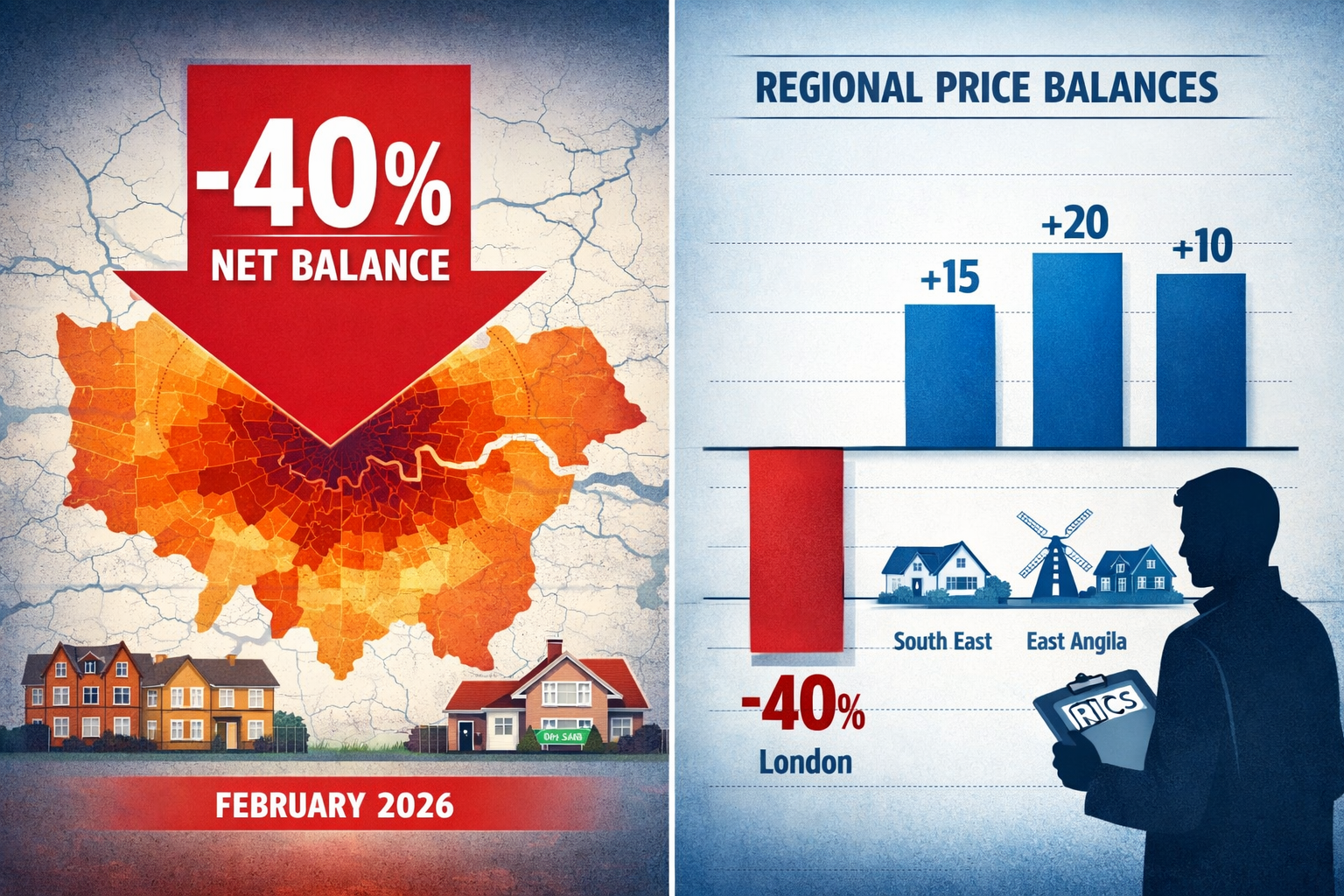
London's property market has recorded a -40% net balance for price falls in February 2026, representing the steepest regional decline in the latest RICS Residential Market Survey and signaling a dramatic shift in market dynamics that demands immediate attention from valuation professionals[1][3]. This sharp deterioration, compounded by geopolitical uncertainty and shifting interest rate expectations, presents unique challenges for surveyors navigating the London Price Cooling in RICS February 2026 Survey: Valuation Strategies for Surveyors landscape.
The capital's market sentiment has collapsed with unprecedented speed. The 12-month price expectations balance plummeted from +56% in January to just +7% in February 2026—the most dramatic reversal across all UK regions[1][3]. For chartered surveyors and valuation professionals operating across London, this cooling phase requires recalibrated methodologies, enhanced due diligence, and sophisticated risk assessment frameworks to deliver accurate, defensible valuations in an increasingly volatile environment.
Key Takeaways
- London experienced the UK's steepest price decline with a -40% net balance in February 2026, significantly outpacing other regions and marking a sharp reversal from earlier optimism[1][3]
- Sentiment collapsed dramatically as 12-month price expectations fell from +56% to +7% in just one month, driven by geopolitical instability and persistent interest rate concerns[1][4]
- Regional divergence intensified with London, South East (-24%), and East Anglia (-26%) showing acute downward pressure while national figures mask significant variation[1][3]
- Valuation professionals must adapt strategies by incorporating enhanced comparable analysis, increased market condition adjustments, and robust risk assessment protocols
- Geopolitical and macroeconomic factors including Middle East tensions and energy price volatility are directly impacting buyer confidence and mortgage rate expectations[4]
Understanding the London Price Cooling in RICS February 2026 Survey
The February 2026 RICS Residential Market Survey reveals a market in transition, with London bearing the brunt of renewed downward pressure. The -40% net balance represents the proportion of surveyors reporting price decreases minus those reporting increases, indicating widespread agreement among professionals that values are declining across the capital[1][3].
The Scale of London's Market Shift
The magnitude of London's cooling becomes clear when examining the sequential data:
| Metric | January 2026 | February 2026 | Change |
|---|---|---|---|
| 12-Month Price Expectations | +56% | +7% | -49 points |
| Near-Term Price Balance | -6% | -18% | -12 points |
| New Buyer Enquiries | -15% | -26% | -11 points |
| Agreed Sales | N/A | -12% | Weakening |
This deterioration reflects multiple converging pressures. According to Capital Economics, "events in the Middle East are dampening buyer sentiment" and have effectively halted the tentative market strengthening observed in early 2026[4]. The geopolitical instability has created a risk-averse environment where prospective buyers delay purchasing decisions, directly impacting transaction volumes and price negotiations.
Regional Context and Comparative Analysis
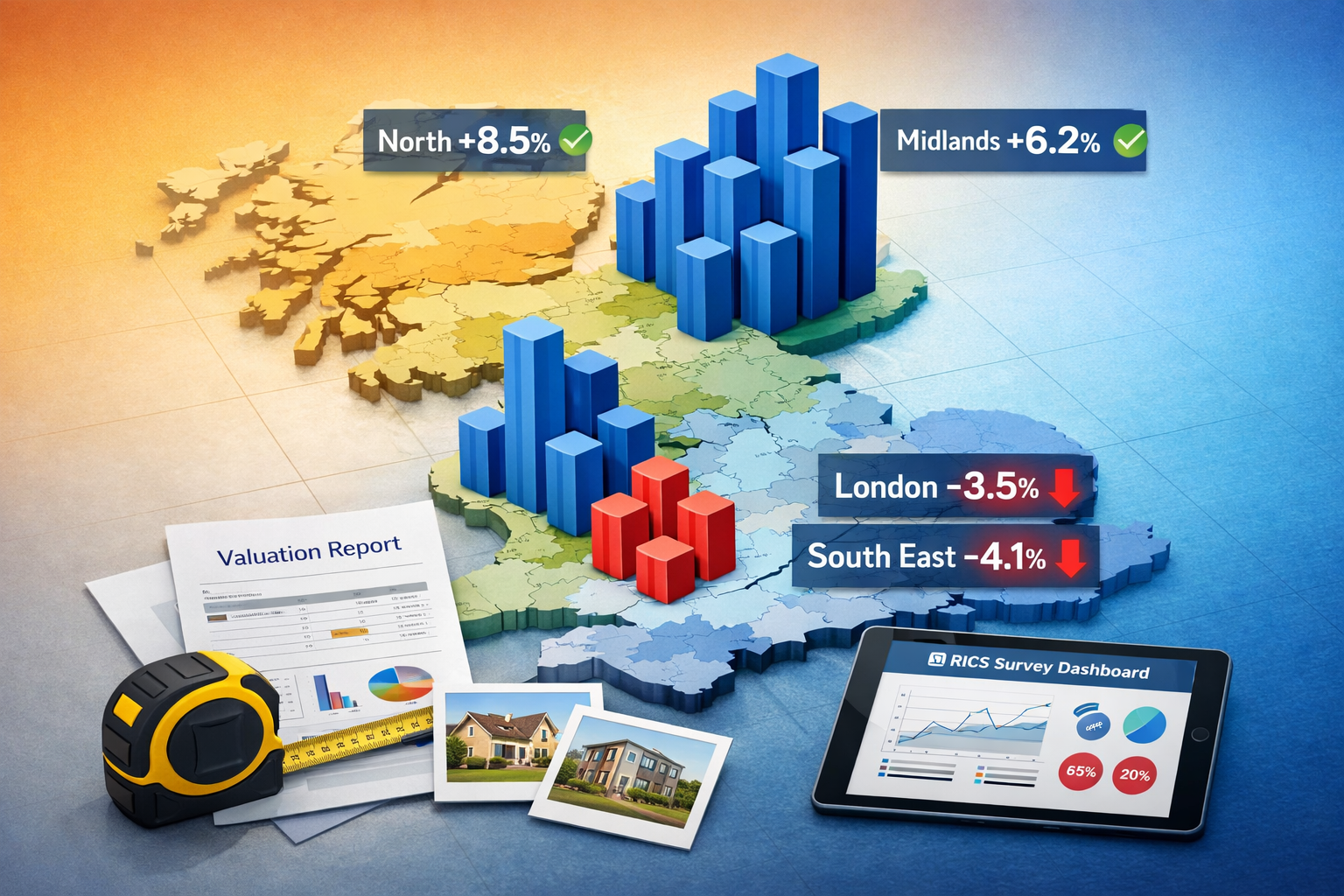
While London's -40% net balance represents the most severe regional decline, the cooling trend extends across southern England. The South East recorded -24% and East Anglia -26%, creating a geographic pattern of weakness concentrated in historically high-value markets[1][3]. This regional divergence poses specific challenges for chartered surveyors across London who must contextualize local conditions within broader market dynamics.
In contrast, the national headline price balance stood at -12% in February 2026, demonstrating how aggregate figures can obscure the intensity of localized market shifts[1]. For valuation professionals, this divergence underscores the critical importance of regional market intelligence and the limitations of applying national trends to London-specific instructions.
Valuation Challenges Arising from the London Price Cooling in RICS February 2026 Survey
The sharp sentiment shift documented in the London Price Cooling in RICS February 2026 Survey creates several distinct valuation challenges that require methodological adjustments and enhanced professional judgment.
Comparable Evidence Deterioration
The rapid pace of market cooling means that comparable sales evidence becomes outdated more quickly. Transactions agreed three to six months ago may have completed in a materially different market environment, requiring time-based adjustments that reflect the accelerated rate of change. Surveyors must:
- Weight recent comparables more heavily even if they're less similar in physical characteristics
- Apply negative time adjustments to older evidence to reflect deteriorating market conditions
- Increase the range of comparable properties analyzed to capture emerging pricing patterns
- Document market condition adjustments with explicit reference to RICS survey data and regional trends
The challenge intensifies across different London submarkets. Central London surveyors face different dynamics than those operating in North West London or South East London, requiring granular market knowledge and localized comparable analysis.
Interest Rate Sensitivity and Mortgage Availability
RICS Head of Market Research Tarrant Parsons highlighted that "the recent rise in oil and energy prices has also increased the likelihood that mortgage rates will remain higher for longer"[1]. This expectation directly impacts valuation assumptions, particularly for properties dependent on mortgage finance.
Valuation professionals must consider:
- Affordability constraints as higher mortgage rates reduce purchasing power
- Loan-to-value implications with lenders potentially tightening criteria in cooling markets
- Investment property yields as rental income becomes more critical to valuation support
- First-time buyer segments which RICS participants suggest may show relative resilience[1]
For RICS registered valuers in London, these factors require explicit consideration in valuation reports, particularly when instructed for mortgage lending purposes where loan security is paramount.

Strategic Valuation Approaches for Surveyors Amid Market Cooling
Professional surveyors must adapt their methodologies to maintain accuracy and defensibility during the London Price Cooling in RICS February 2026 Survey period. The following strategies provide a framework for navigating current market conditions.
Enhanced Market Conditions Adjustments
Traditional valuation approaches assume relatively stable market conditions between comparable transactions and the valuation date. The February 2026 RICS data invalidates this assumption for London, requiring explicit market condition adjustments.
Recommended approach:
- Establish a baseline period using RICS survey data to identify when market conditions materially changed
- Quantify the rate of change by analyzing the net balance movement (-40% in London) relative to historical norms
- Apply graduated adjustments to comparables based on their transaction dates, with larger negative adjustments for older evidence
- Document the methodology with reference to RICS survey data, Land Registry indices, and local market intelligence
For example, a comparable property that exchanged in November 2025 (before the sentiment collapse) may require a 3-5% downward adjustment to reflect the deteriorated market conditions by February 2026. This adjustment sits alongside traditional factors like location, condition, and specification.
Segmented Market Analysis
The RICS survey indicates that recovery is "likely to be led from the first-time buyer range"[1], suggesting market segmentation by price band and buyer type. Valuation professionals should:
- Stratify comparable evidence by price bracket to identify differential cooling rates
- Consider buyer profile when assessing demand characteristics for the subject property
- Analyze days-on-market trends across different segments to gauge relative liquidity
- Assess premium property vulnerability as higher-value segments often experience amplified volatility
This segmentation proves particularly relevant for valuation reports in London where the market spans from entry-level flats to multi-million pound prime properties, each responding differently to macroeconomic pressures.
Risk-Adjusted Valuation Ranges
Given the uncertainty documented in the London Price Cooling in RICS February 2026 Survey, some instructions may benefit from valuation ranges rather than single-point figures, particularly for:
- Matrimonial valuations where fairness requires acknowledging market uncertainty
- Probate and tax purposes where HMRC guidance permits ranges in volatile markets
- Portfolio valuations for institutional clients managing risk exposure
- Development appraisals where market exit assumptions carry heightened uncertainty
When providing ranges, surveyors should clearly articulate the confidence level and the specific market factors driving the uncertainty. This approach maintains professional integrity while acknowledging the limitations of precision in rapidly changing conditions.
Increased Emphasis on Rental Value Analysis
With landlord instructions remaining firmly negative at -27% in February 2026[1], rental market dynamics provide valuable cross-reference for capital value assessments. The rental shortage creates relative stability in income streams, which supports:
- Investment property valuations through yield-based approaches
- Leasehold property analysis where lease extension valuations depend on rental value assumptions
- Comparative method validation by cross-checking capital values against rental equivalents
- Market sentiment indicators as rental demand often leads capital value recovery
For surveyors conducting property valuations in London, the rental market provides a stabilizing reference point amid capital value uncertainty.
Regional Divergence and Geographic Valuation Considerations
The London Price Cooling in RICS February 2026 Survey reveals pronounced geographic variation that demands location-specific valuation approaches. While London recorded -40%, the national picture shows significant divergence[1][3].
Understanding Submarket Dynamics
London itself comprises multiple distinct submarkets, each responding differently to macroeconomic pressures:
Prime Central London:
- Most exposed to international buyer sentiment and geopolitical risk
- Higher reliance on cash purchasers reduces mortgage rate sensitivity
- Luxury segment showing amplified volatility
Outer London Boroughs:
- Greater first-time buyer concentration provides relative support
- Stronger mortgage dependency increases interest rate sensitivity
- Commuter locations affected by hybrid working patterns
Regeneration Areas:
- Development pipeline creates supply pressures
- Buyer confidence particularly vulnerable to sentiment shifts
- Help to Buy legacy effects still working through the market
Surveyors operating across North London, East London, West London, and other areas must calibrate their approaches to these submarket characteristics.
Cross-Regional Comparable Analysis
The divergence between London (-40%) and other regions creates challenges when comparable evidence is limited within a specific submarket. Surveyors may need to:
- Adjust regional comparables with explicit location premiums/discounts
- Weight local evidence more heavily even if sample sizes are small
- Reference regional RICS data to quantify differential market conditions
- Avoid inappropriate comparables from regions experiencing different trends
This geographic precision becomes critical for instructions involving properties near regional boundaries or in transitional areas where market characteristics overlap.
Supply Pipeline Implications
While new instructions remained stable at +2% nationally[1], this aggregate figure masks regional variation. London's cooling may trigger:
- Increased vendor realism as price expectations adjust downward
- Selective new listings with owners delaying sales in unfavorable conditions
- Distressed sale emergence if economic pressures force transactions
- Development scheme viability challenges affecting new-build supply
For surveyors conducting best practice property valuations, understanding the supply pipeline helps contextualize current pricing and anticipate future market direction.
Geopolitical and Macroeconomic Factors in Valuation Context
The London Price Cooling in RICS February 2026 Survey explicitly links market deterioration to geopolitical instability, requiring surveyors to incorporate macroeconomic analysis into their valuation frameworks.
Middle East Tensions and Buyer Confidence
Capital Economics noted that "events in the Middle East are dampening buyer sentiment"[4], creating a psychological barrier to transaction activity. This geopolitical risk manifests in valuation considerations through:
- Extended marketing periods as buyers delay decisions pending clarity
- Increased negotiation leverage for purchasers citing market uncertainty
- Risk premium demands particularly for investment properties
- International buyer withdrawal affecting prime London segments
While surveyors cannot predict geopolitical outcomes, they must acknowledge these factors as material influences on current market conditions and document their impact on valuation assumptions.
Energy Prices and Mortgage Rate Expectations
The rise in oil and energy prices identified by RICS research has dual impacts[1]:
- Direct cost pressures on household budgets reducing disposable income for housing
- Inflationary concerns maintaining upward pressure on interest rates and mortgage costs
For valuation purposes, this creates a negative feedback loop where:
- Higher energy costs reduce affordability
- Inflationary pressure keeps mortgage rates elevated
- Reduced affordability dampens demand
- Weakened demand drives price cooling
Surveyors must consider these interconnected factors when assessing market sustainability and the likelihood of near-term recovery.
Long-Term Market Resilience Indicators
Despite near-term cooling, +33% of surveyors nationally still expect prices to edge higher over the next 12 months[1], suggesting professional confidence in underlying market fundamentals. This longer-term optimism reflects:
- Structural housing shortage particularly in London and the South East
- Population growth maintaining underlying demand pressure
- Limited new supply due to planning constraints and construction costs
- Historical price resilience in London property across economic cycles
For surveyors preparing valuations for long-term hold strategies or development appraisals, this longer-term perspective provides important context alongside near-term cooling.
Practical Implementation for Surveyors
Translating the insights from the London Price Cooling in RICS February 2026 Survey into practical valuation work requires systematic implementation across all stages of the valuation process.
Pre-Instruction Considerations
Client communication:
- Advise clients of current market volatility and its implications for valuation certainty
- Discuss whether a single-point valuation or range is most appropriate for their purpose
- Set realistic expectations regarding comparable evidence availability and quality
- Clarify the valuation date significance in rapidly changing conditions
Scope definition:
- Determine whether additional market research is required beyond standard protocols
- Consider whether specialist expertise is needed for particular property types or locations
- Assess whether the instruction timeline allows for adequate market analysis
- Identify any assumptions or special assumptions required due to market conditions
Inspection and Data Gathering
During property inspections and market research, surveyors should:
- Document market conditions at the valuation date with specific reference to RICS data
- Gather enhanced comparable evidence with particular focus on recent transactions
- Interview local agents to understand on-the-ground sentiment and pricing trends
- Assess property-specific factors that may insulate or expose the subject to market cooling
- Photograph and document condition issues that may affect marketability in challenging conditions
Analysis and Valuation Synthesis
The analytical phase requires particular rigor during market cooling:
Comparable analysis:
- Apply time adjustments to reflect the -40% sentiment shift in London[1][3]
- Weight recent evidence more heavily than historical norms would suggest
- Consider a wider geographic search area if local comparables are limited
- Document the adjustment process with explicit reasoning
Market condition assessment:
- Reference the RICS February 2026 survey data in the market commentary section
- Quantify the regional divergence between London and national trends
- Discuss geopolitical and macroeconomic factors affecting buyer sentiment[4]
- Assess the subject property's position within the market segmentation
Valuation synthesis:
- Arrive at a concluded value that reflects current market realities
- Consider whether a valuation range is more appropriate than a single figure
- Test the capital value conclusion against rental value and yield analysis
- Ensure the valuation is defensible if market conditions continue to deteriorate
Report Preparation and Communication
The valuation report must clearly communicate the market context:
Market commentary section:
- Explicitly reference the RICS February 2026 survey findings
- Explain the -40% net balance for London and its implications[1][3]
- Discuss the dramatic sentiment shift from +56% to +7% in 12-month expectations[1]
- Address geopolitical and macroeconomic factors affecting the market[4]
Assumptions and limitations:
- Clearly state the valuation date and its significance
- Acknowledge market volatility and its impact on valuation certainty
- Specify any assumptions regarding future market conditions
- Highlight the limitations of comparable evidence in rapidly changing markets
Professional standards compliance:
- Ensure compliance with RICS Valuation – Global Standards (Red Book)
- Meet the requirements of VPS 3 (Valuation Reports) regarding market context
- Maintain independence and objectivity despite client pressure for particular outcomes
- Document the valuation approach and reasoning to withstand professional scrutiny
Conclusion
The London Price Cooling in RICS February 2026 Survey documents a significant market inflection point that demands adaptive strategies from valuation professionals. With London recording the UK's steepest regional decline at -40% net balance and 12-month price expectations collapsing from +56% to just +7%[1][3], surveyors face a challenging environment requiring enhanced methodologies, robust market analysis, and clear client communication.
The geopolitical uncertainty and persistent interest rate concerns driving this cooling phase[4] create valuation complexity that extends beyond traditional comparable analysis. Successful navigation requires:
✅ Enhanced comparable analysis with explicit time adjustments reflecting rapid market change
✅ Segmented market understanding recognizing differential impacts across price bands and locations
✅ Risk-adjusted approaches including valuation ranges where appropriate for the instruction purpose
✅ Comprehensive market commentary documenting the RICS survey findings and their implications
✅ Professional judgment balancing near-term cooling against longer-term market fundamentals
For chartered surveyors operating across London's diverse submarkets, the February 2026 RICS data provides essential context for defensible valuations. Whether conducting work in Central London, outer boroughs, or the surrounding regions, understanding this market cooling and implementing appropriate valuation strategies ensures professional standards are maintained even as conditions deteriorate.
Next Steps for Valuation Professionals
- Review current instructions to assess whether market condition adjustments are required for pending reports
- Update comparable databases with recent transactions and apply appropriate time adjustments
- Enhance market research protocols to capture sentiment shifts and emerging pricing patterns
- Strengthen client communication regarding market volatility and valuation uncertainty
- Monitor ongoing RICS surveys to track whether cooling intensifies or stabilizes in coming months
- Consider professional development in advanced valuation techniques for volatile markets
The London property market has weathered numerous cycles, and professional surveyors play a critical role in maintaining valuation accuracy and market transparency during periods of uncertainty. By implementing the strategies outlined and maintaining rigorous professional standards, valuation professionals can navigate the current cooling phase while positioning for eventual market recovery.
References
[1] Uk Residential Survey February 2026 – https://www.rics.org/news-insights/uk-residential-survey-february-2026
[2] Uk Residential Market Survey February 2026 – https://www.rics.org/content/dam/ricsglobal/documents/market-surveys/uk-residential-market-survey/UK-Residential-Market-Survey_February-2026.pdf
[3] tradingeconomics – https://tradingeconomics.com/united-kingdom/rics-house-price-balance/news/532749
[4] Uk Rics Residential Market Survey Feb 2026 – https://www.capitaleconomics.com/publications/uk-housing-market-update/uk-rics-residential-market-survey-feb-2026