
More than 12 million UK households now include pets, yet the rental sector has historically treated pet ownership as an automatic disqualifier. The Renters' Rights Act, coming into force in 2026, fundamentally rewrites this dynamic—and creates unprecedented challenges for party wall surveyors tasked with drafting awards for structural modifications that accommodate tenant-requested pet adaptations. When a tenant exercises their new statutory right to keep a pet, landlords may need to reinforce flooring, install soundproofing, or modify shared walls—work that falls squarely under party wall legislation and requires professional surveyor oversight.
Understanding Party Wall Awards for Pet-Friendly Rental Modifications: 2026 Compliance Under Renters' Rights Act Pet Requests has become essential for property professionals navigating this intersection of tenant rights, structural integrity, and neighbourly relations. The stakes are high: improper handling can trigger disputes, compliance failures, and costly delays.
Key Takeaways
- 🐕 Statutory pet requests: Tenants gain formal right to request pet permission in writing; landlords must respond within 28 days with evidence-based reasons for any refusal[1][2]
- 📋 Party wall implications: Pet-related modifications like reinforced flooring or soundproofing often trigger Party Wall Act requirements, demanding professional surveyor awards
- ⚖️ Reasonable refusal standard: Landlords can only refuse based on property size/layout, head lease restrictions, or documented nuisance risks—blanket bans are non-compliant[1][3]
- 💷 No additional charges: Landlords cannot impose separate pet deposits or fees under the new framework[2]
- 🏛️ Ombudsman enforcement: The Private Rented Sector Landlord Ombudsman will have binding authority over pet request disputes[1]
Understanding the Renters' Rights Act 2026 Pet Provisions
The Renters' Rights Act represents the most significant overhaul of private rental regulation in decades. Among its transformative provisions, the statutory right to request pet accommodation stands out as both progressive and operationally complex[5][8].
The New Pet Request Framework
Under the 2026 legislation, tenants can formally submit written requests to keep pets in their rental properties. This isn't merely a courtesy—it's a legally enforceable right that landlords must address through a structured process[1][2].
The framework operates through several key mechanisms:
Mandatory written response timeline: Landlords have exactly 28 days from receiving a pet request to provide a written response. Silence or verbal responses don't satisfy this obligation[1][2].
Evidence-based refusal requirement: Gone are the days of blanket "no pets" clauses. Landlords must now provide documented, specific reasons for refusing pet requests, grounded in one of three permissible categories[1][3]:
- Property size or layout genuinely unsuitable for the requested pet
- Head lease or superior tenancy restrictions that prohibit pets
- Evidence-based concerns about nuisance, damage, or health/safety risks
Financial protection for tenants: The Act explicitly prohibits landlords from charging separate pet deposits, pet rent, or additional fees related to pet accommodation[2]. This removes a common financial barrier that previously excluded pet owners from rental markets.
Enforcement and Dispute Resolution
The legislation establishes the Private Rented Sector Landlord Ombudsman as the enforcement authority with binding decision-making power over pet request disputes[1]. This creates real accountability: landlords who unreasonably refuse pet requests or fail to follow proper procedures face potential sanctions and compensation orders.
For property professionals, this means documentation becomes critical. Every pet request, every refusal, every modification decision must be recorded with supporting evidence.
Party Wall Act Implications for Pet-Friendly Modifications
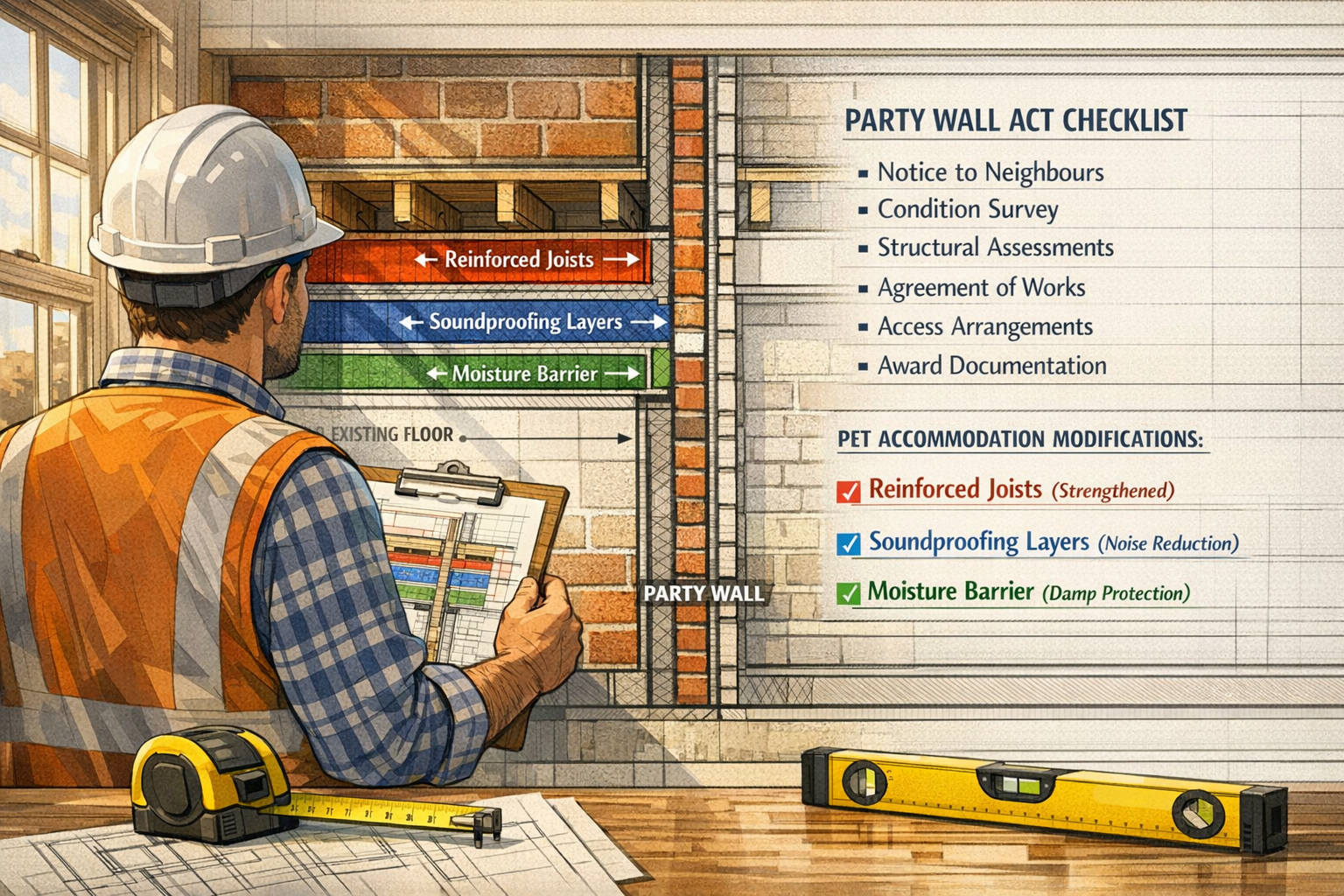
When landlords approve pet requests—or when the Ombudsman orders them to do so—the practical reality often demands physical modifications to rental properties. These alterations frequently engage the Party Wall etc. Act 1996, creating a complex intersection between tenant rights and structural surveying requirements.
When Pet Accommodations Trigger Party Wall Procedures
The Party Wall Act governs construction work affecting shared walls, boundaries, and excavations near neighbouring properties. Pet-related modifications commonly fall within its scope through several pathways:
Structural floor reinforcement: Large dogs in upper-floor flats may require reinforced joists or additional support beams to handle increased dynamic loading. Such work typically involves alterations to party walls or floors, triggering Section 2 of the Act[6].
Soundproofing installations: Acoustic underlay, resilient bars, or additional plasterboard layers on party walls to minimize pet noise transmission constitute alterations requiring formal party wall notices to adjoining owners.
Drainage and waste modifications: Installing pet washing stations or modifying drainage systems may involve work near or through party walls, particularly in terraced or semi-detached properties.
External access modifications: Creating pet-friendly entrances, installing dog flaps, or modifying shared boundary structures all potentially engage the Act's provisions.
The Surveyor's Role in Pet Modification Awards
Party wall surveyors face unique challenges when drafting awards for pet-related modifications. Unlike traditional extensions or loft conversions, these projects must balance:
✅ Structural integrity requirements: Ensuring modifications genuinely protect the building fabric and neighbouring properties
✅ Proportionality considerations: Assessing whether proposed work is reasonable relative to the pet accommodation need
✅ Noise and nuisance mitigation: Incorporating acoustic performance standards that protect adjoining owners' quiet enjoyment
✅ Reversibility provisions: Considering whether modifications should include restoration obligations if tenancies end
Professional surveyors must prepare comprehensive party wall schedules of condition documenting pre-work property states, specify acceptable construction methods, and establish monitoring protocols for sensitive installations.
Common Modification Scenarios and Award Considerations
| Modification Type | Party Wall Trigger | Award Considerations |
|---|---|---|
| Reinforced flooring | Section 2 (work to party structure) | Load calculations, joist specifications, acoustic performance standards |
| Soundproofing layers | Section 2 (alterations to party wall) | Acoustic testing requirements, material specifications, installation protocols |
| Pet access doors | Section 1 (building on boundary) | Structural integrity, weather sealing, security provisions |
| Drainage modifications | Section 2 or 6 (depending on location) | Waterproofing, access provisions, maintenance obligations |
The surveyor must also consider the Renters' Rights Act context: modifications should be proportionate to legitimate pet accommodation needs without imposing unreasonable burdens on landlords or neighbours. This requires professional judgment balancing multiple stakeholder interests.
Drafting Compliant Party Wall Awards for Pet-Friendly Rental Modifications: 2026 Compliance Under Renters' Rights Act Pet Requests
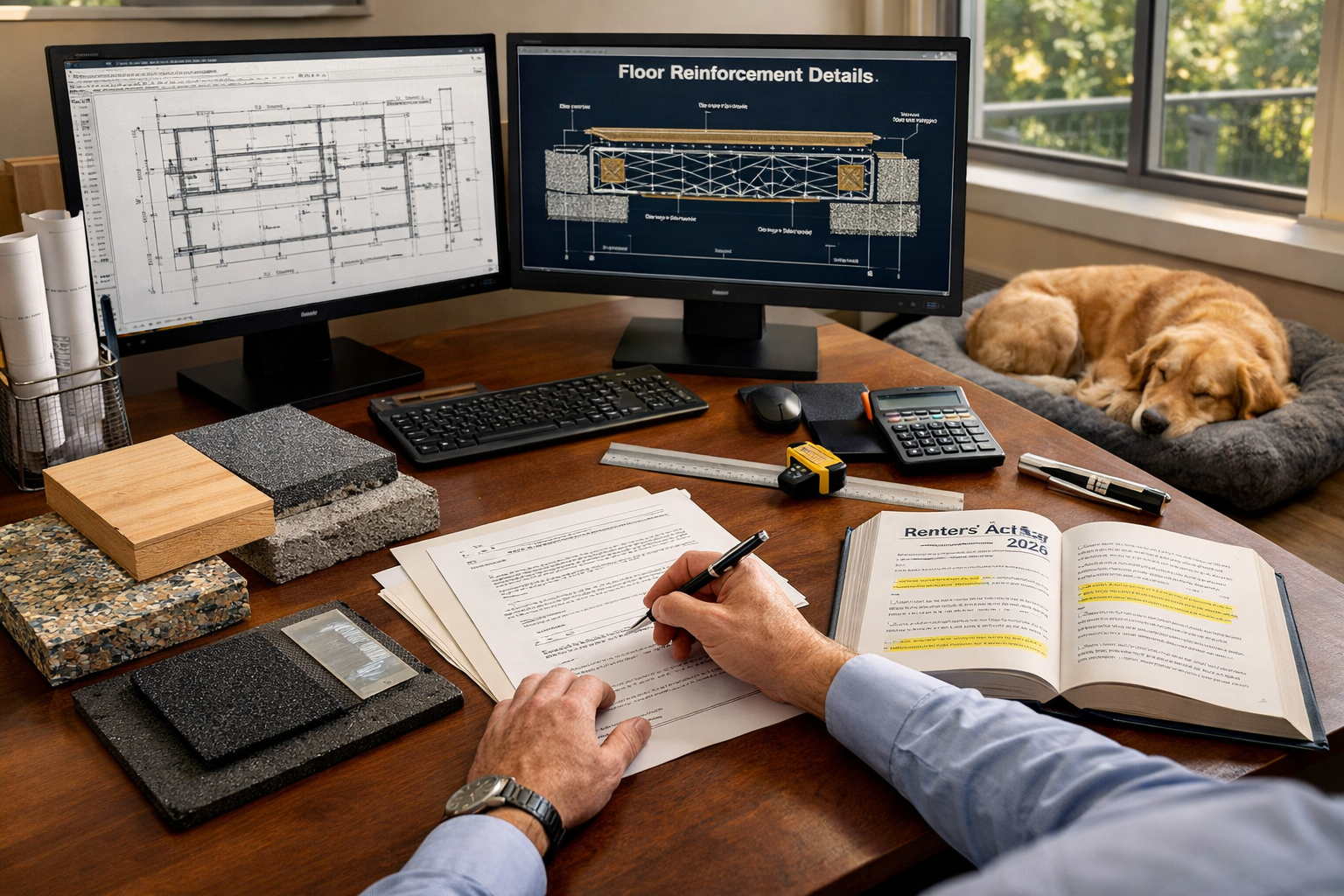
Creating effective party wall awards for pet-related modifications demands technical precision, legal awareness, and practical understanding of 2026 compliance obligations. Surveyors must navigate multiple regulatory frameworks simultaneously while protecting all parties' interests.
Essential Components of Pet Modification Awards
A comprehensive award addressing Party Wall Awards for Pet-Friendly Rental Modifications: 2026 Compliance Under Renters' Rights Act Pet Requests should include:
1. Detailed Scope of Works
Specify exactly what modifications are permitted, including:
- Structural specifications: Dimensions, materials, load ratings for reinforced elements
- Acoustic performance targets: Specific decibel reduction requirements for soundproofing installations
- Installation methods: Approved techniques that minimize disruption and protect party structures
- Quality standards: British Standards or manufacturer specifications for materials
2. Pre-Work Documentation Requirements
Before any work commences, the award should mandate:
- Comprehensive photographic schedules of condition for affected party walls and adjoining properties
- Structural surveys documenting existing loading capacities
- Acoustic baseline measurements in adjoining properties
- Drainage and moisture readings where relevant
This documentation protects all parties by establishing clear baselines for assessing any future damage claims.
3. Construction Protocols and Monitoring
The award must specify:
- Working hours: Reasonable restrictions protecting neighbours from excessive disruption
- Access provisions: Rights for surveyors to inspect work in progress
- Notification requirements: Advance warning before particularly disruptive phases
- Monitoring intervals: Scheduled inspections at critical construction stages
For pet-related modifications, surveyors should consider phased inspections: one after structural work, another after acoustic installations, and a final verification before pet occupation.
4. Performance Verification Standards
Unlike standard structural work, pet modifications require functional performance verification:
- Load testing: Confirming reinforced floors meet specified capacity ratings
- Acoustic testing: Measuring actual sound transmission reduction achieved
- Moisture resistance: Verifying waterproofing effectiveness for pet-related installations
- Durability assessment: Ensuring materials can withstand anticipated pet-related wear
Addressing Neighbour Concerns in Award Drafting
Adjoining owners often express legitimate concerns about pet-related modifications. Professional awards should proactively address these through:
Noise mitigation provisions: Specify acoustic performance standards that objectively limit sound transmission. For example: "Soundproofing installations shall achieve a minimum airborne sound insulation of 45dB DnT,w between properties, verified by post-installation acoustic testing."
Damage protection mechanisms: Include provisions for additional protective measures if initial modifications prove insufficient. This might involve conditional clauses: "If noise complaints substantiated by acoustic monitoring exceed specified thresholds within 12 months, Building Owner shall install supplementary acoustic barriers at their expense."
Maintenance access: Ensure awards preserve adjoining owners' ability to maintain their properties without interference from pet-related modifications.
Restoration provisions: Consider whether modifications should include restoration obligations if the tenancy ends and future tenants don't require pet accommodations. This balances landlord investment protection with neighbour interests.
Balancing Landlord Obligations and Practical Constraints
Surveyors drafting awards must recognize landlords' new obligations under the Renters' Rights Act while acknowledging practical limitations[5][8]. The award should:
✔️ Acknowledge the statutory context: Reference the tenant's lawful pet request and the landlord's obligation to accommodate it reasonably
✔️ Specify proportionate solutions: Ensure modifications are necessary and sufficient without gold-plating requirements
✔️ Address cost allocation: Clarify which party bears modification costs (typically the landlord as part of their accommodation obligation)
✔️ Include completion timelines: Establish reasonable deadlines that allow landlords to comply with their statutory duties
Special Considerations for Multi-Occupancy Buildings
Flats and converted properties present additional complexity for Party Wall Awards for Pet-Friendly Rental Modifications: 2026 Compliance Under Renters' Rights Act Pet Requests:
Head lease restrictions: Awards should acknowledge superior lease terms that may legitimately limit pet accommodations[3]. Surveyors must review head leases to ensure proposed modifications don't breach superior landlord covenants.
Multiple adjoining owners: In apartment buildings, modifications may affect several neighbours simultaneously. Awards must address notification and consent procedures for all affected parties.
Common area implications: Pet access may require modifications to shared spaces, engaging different approval processes beyond standard party wall procedures.
Building insurance considerations: Structural modifications can affect insurance coverage. Awards should require landlords to notify insurers and maintain adequate coverage throughout works.
Compliance Strategies for 2026 and Beyond
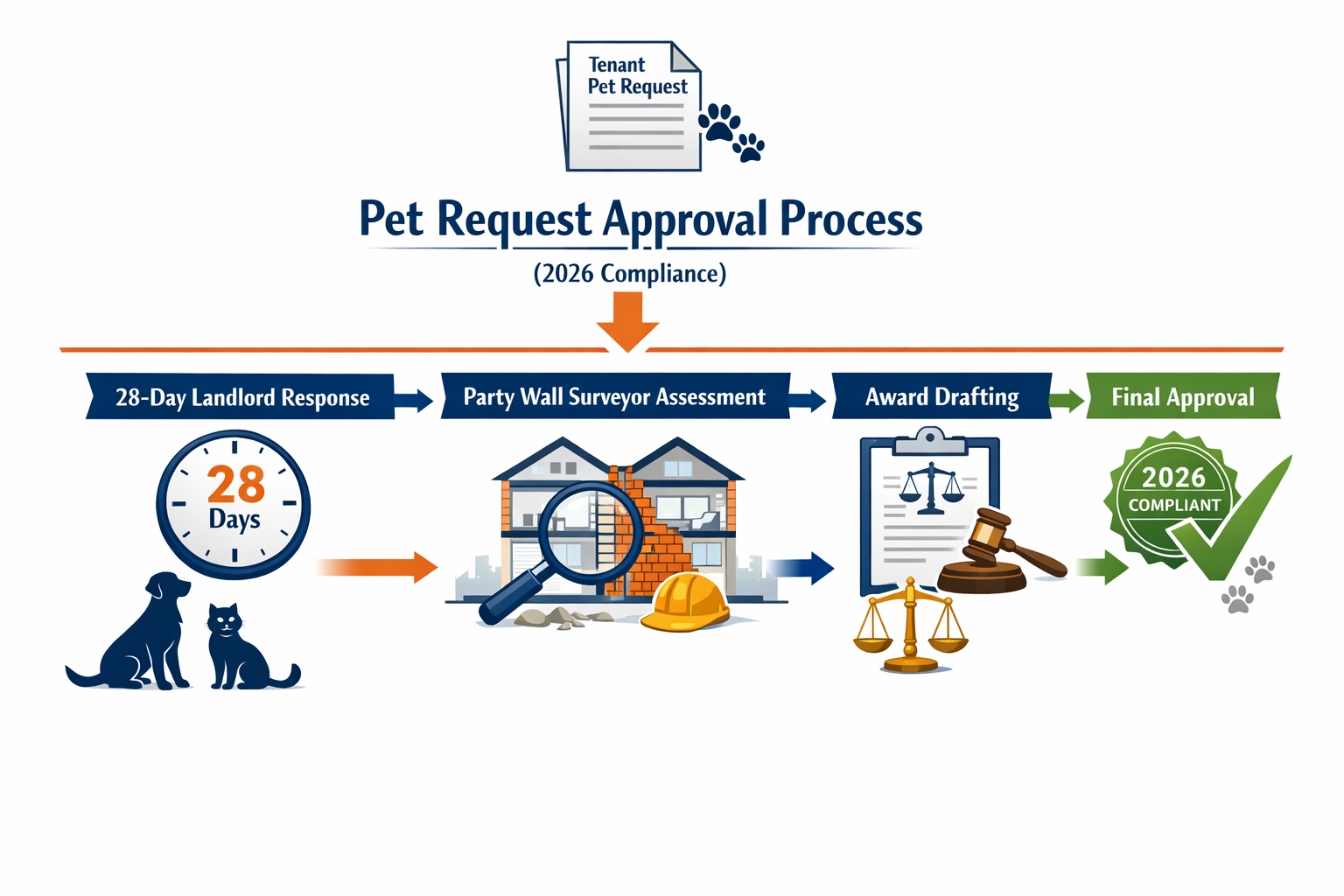
As the Renters' Rights Act implementation approaches, property professionals need practical strategies for managing the intersection of pet accommodation rights and party wall requirements.
Proactive Landlord Preparation
Forward-thinking landlords should consider:
Pre-emptive property assessments: Commission structural surveys identifying which properties can accommodate pets with minimal modification versus those requiring substantial work. This informs decision-making when pet requests arrive.
Standard modification specifications: Develop pre-approved designs for common pet accommodations (acoustic underlay systems, reinforced flooring specifications) that can be rapidly deployed when requests arise. This reduces response times and costs.
Neighbour relationship management: Engage adjoining owners early about potential pet-related modifications, explaining the new legal framework and proposed mitigation measures. Early engagement reduces neighbour disputes and streamlines party wall procedures.
Documentation systems: Implement robust record-keeping for all pet requests, responses, modifications, and party wall procedures. This evidence base proves invaluable if disputes reach the Ombudsman.
Tenant Education and Expectations
While tenants gain new rights, they also need realistic understanding of the process:
Timeline transparency: Explain that pet approval may require party wall procedures adding weeks to the process, particularly if neighbours dissent and surveyors must be appointed.
Modification limitations: Clarify that accommodation rights don't guarantee unlimited pets or modifications. Requests must be reasonable relative to property characteristics.
Behaviour obligations: Emphasize that approval doesn't eliminate tenant responsibilities for pet behaviour, noise control, and property maintenance.
Cost implications: While landlords cannot charge pet deposits, tenants remain liable for any damage beyond normal wear and tear.
Surveyor Best Practices
Professional surveyors handling pet modification awards should:
🔍 Conduct thorough site assessments: Visit properties to understand structural realities, not just review plans. Pet accommodation feasibility often depends on existing building conditions.
📊 Establish clear performance metrics: Use objective, measurable standards (decibel levels, load capacities) rather than subjective criteria. This reduces dispute potential.
🤝 Facilitate stakeholder communication: Act as neutral intermediaries explaining technical requirements to landlords, tenants, and neighbours in accessible language.
📋 Maintain comprehensive records: Document all inspections, communications, and decisions. These records protect surveyors if disputes escalate or professional liability questions arise.
🎓 Stay current on evolving guidance: As 2026 implementation proceeds, expect supplementary guidance from RICS, the Ombudsman, and courts interpreting the new framework. Continuous professional development becomes essential.
When Disputes Arise: Resolution Pathways
Despite best efforts, conflicts will occur. Understanding resolution pathways helps all parties:
Party wall dispute resolution: If neighbours dissent to pet-related modifications, the standard party wall dispute process applies: each party appoints a surveyor (or agrees on a party wall agreed surveyor), who then produce an award binding on both parties[6].
Renters' Rights Act disputes: If landlords unreasonably refuse pet requests or fail to implement required modifications, tenants can escalate to the Private Rented Sector Landlord Ombudsman for binding resolution[1].
Dual-track complexity: Some situations may involve both party wall disputes (with neighbours) and pet request disputes (between landlord and tenant) simultaneously. Careful coordination between processes becomes critical.
Expert witness roles: Surveyors may be called to provide expert witness reports if disputes reach formal adjudication or courts. Thorough documentation from the outset supports credible expert testimony.
Financial Considerations and Cost Management
Pet-related modifications involve various cost elements:
| Cost Category | Typical Range | Responsibility |
|---|---|---|
| Structural survey | £300-£800 | Landlord |
| Party wall surveyor fees | £700-£2,000+ | Shared per Act |
| Reinforced flooring installation | £1,500-£5,000 | Landlord |
| Acoustic soundproofing | £800-£3,000 | Landlord |
| Post-installation testing | £200-£600 | Landlord |
Landlords cannot recoup these costs through pet deposits or fees[2], making cost-effective solutions essential. Surveyors can add value by specifying proportionate modifications that meet compliance requirements without unnecessary expense.
Integration with Broader Property Management
Effective handling of Party Wall Awards for Pet-Friendly Rental Modifications: 2026 Compliance Under Renters' Rights Act Pet Requests requires integration with wider property management systems:
Tenancy agreement updates: Ensure agreements reflect the new legal framework, removing non-compliant blanket pet bans while preserving legitimate behaviour and damage provisions.
Maintenance protocols: Establish enhanced inspection schedules for properties with pets, identifying wear issues early before they become significant damage.
Insurance coordination: Notify insurers of pet accommodations and any structural modifications, maintaining appropriate coverage levels.
Portfolio planning: Consider pet-friendliness as a property characteristic in acquisition and development decisions, recognizing that pet-friendly properties may command premium rents in 2026's market.
Conclusion
The convergence of the Renters' Rights Act 2026 and party wall legislation creates a new professional landscape requiring technical expertise, legal awareness, and practical problem-solving. Party Wall Awards for Pet-Friendly Rental Modifications: 2026 Compliance Under Renters' Rights Act Pet Requests represents more than a regulatory obligation—it's an opportunity for property professionals to demonstrate value by facilitating lawful pet accommodation while protecting structural integrity and neighbourly relations.
Successful navigation demands:
- Proactive assessment of property suitability for pet accommodations before requests arrive
- Professional surveyor engagement early in the process to identify party wall implications
- Comprehensive award drafting that balances tenant rights, landlord obligations, and neighbour protections
- Robust documentation supporting all decisions and modifications
- Stakeholder communication explaining technical requirements in accessible terms
For landlords, the message is clear: the era of blanket pet bans has ended. Developing efficient, cost-effective processes for handling pet requests and associated modifications becomes a competitive necessity. For surveyors, this emerging practice area offers opportunities to provide specialized expertise at the intersection of structural engineering, regulatory compliance, and dispute resolution.
The 12 million UK households with pets deserve rental opportunities that don't force impossible choices between housing security and beloved companions. With professional surveying support and thoughtful compliance strategies, the rental sector can accommodate this reality while maintaining property standards and neighbourly harmony.
Next Steps
For landlords: Commission property assessments identifying pet accommodation feasibility across your portfolio. Develop standard modification specifications and engage party wall matters specialists to prepare template awards.
For tenants: Submit pet requests in writing with detailed information about your pet's size, breed, and behaviour. Be prepared for party wall procedures that may extend approval timelines but protect all parties' interests.
For surveyors: Invest in training covering both Renters' Rights Act provisions and specialized party wall procedures for pet modifications. Develop standardized assessment protocols and award templates addressing common scenarios.
For adjoining owners: Engage constructively when approached about pet-related modifications. Professional awards protect your interests through enforceable standards and monitoring provisions.
The 2026 implementation timeline approaches rapidly. Property professionals who prepare now will navigate this transition smoothly, turning regulatory change into competitive advantage while supporting the millions of responsible pet owners seeking quality rental accommodation.
References
[1] Renting With Pets – https://rentalbux.com/blogs/renting-with-pets
[2] Renting To Pet Owners What Changes In 2026 Under The Renters Rights Act – https://www.parkersproperties.co.uk/guides/landlord/renting-to-pet-owners-what-changes-in-2026-under-the-renters-rights-act/
[3] Pets And Property In The Renters Rights Era – https://www.russell-cooke.co.uk/news-and-insights/news/pets-and-property-in-the-renters-rights-era
[5] Rules For Landlords 2026 – https://www.simplybusiness.co.uk/knowledge/landlord-regulation/rules-for-landlords-2026/
[6] Party Wall Surveys Under Renters Rights Act 2026 Protocols For Landlord Improvements Without Section 21 Evictions – https://nottinghillsurveyors.com/blog/party-wall-surveys-under-renters-rights-act-2026-protocols-for-landlord-improvements-without-section-21-evictions
[8] Renters Rights Act Introduces Landmark Changes For Landlords And Tenants – https://www.edwincoe.com/renters-rights-act-introduces-landmark-changes-for-landlords-and-tenants/