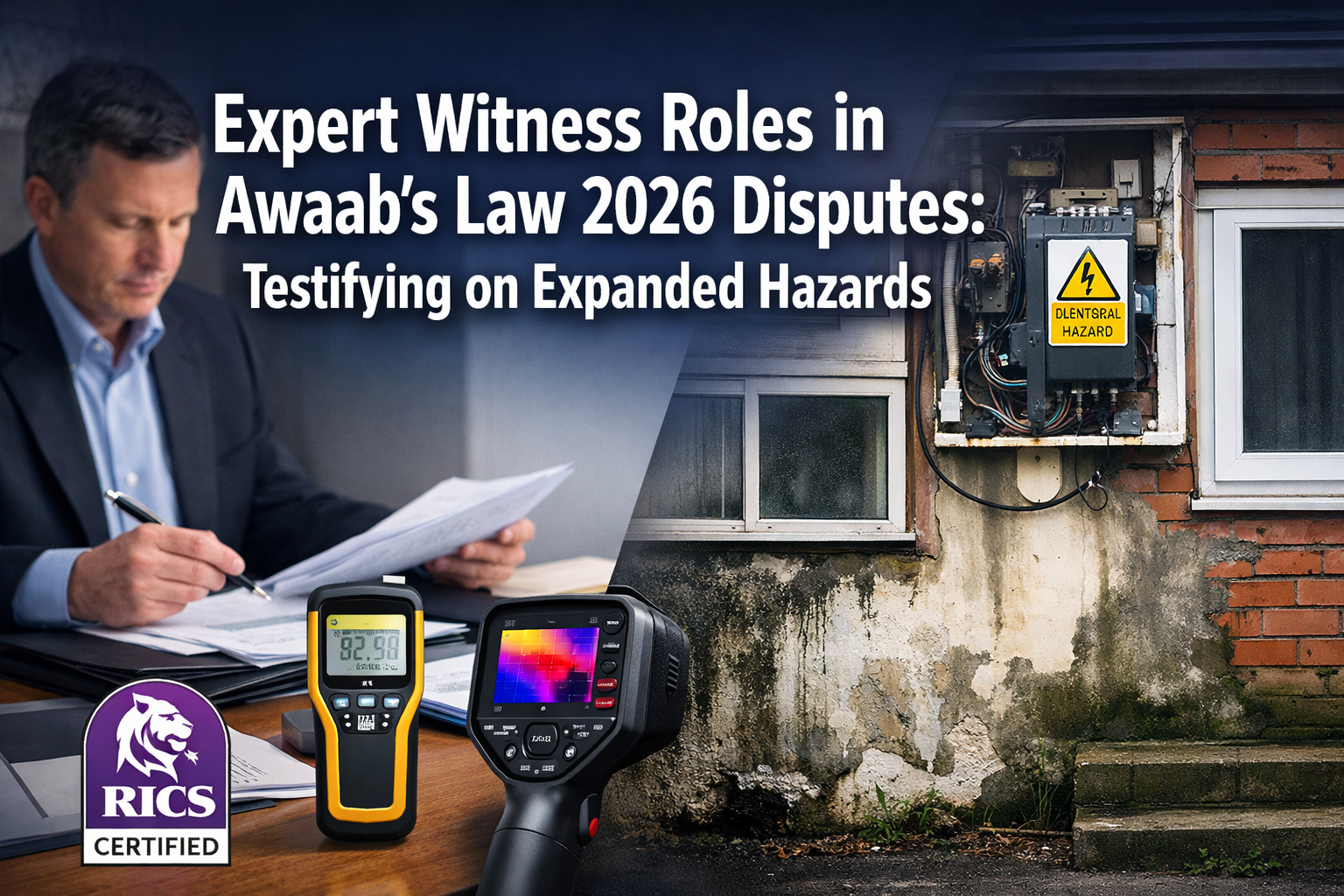
When Awaab's Law extends to private rental properties in 2026, expert witnesses will face an unprecedented surge in tribunal cases—and many are unprepared for the expanded hazard scope. While the initial 2025 phase focused on social housing and primarily addressed damp and mould, the 2026 expansion brings private landlords into scope alongside new hazard categories including electrical risks, fire safety deficiencies, and excess heat problems [3][5]. This seismic shift transforms Expert Witness Roles in Awaab's Law 2026 Disputes: Testifying on Expanded Hazards in Private Rental Properties from a niche specialism into a core competency for property surveyors and technical experts across England.
The stakes are substantial. Expert witnesses must now master evidence-gathering techniques that satisfy both Civil Procedure Rules Part 35 requirements and RICS guidance while navigating strict statutory timeframes that leave little room for ambiguity [1]. With landlords facing enforceable duties and fixed deadlines, the quality of expert testimony can determine whether a property owner demonstrates reasonable compliance or faces enforcement action.
Key Takeaways
- Expanded hazard scope: Awaab's Law 2026 covers electrical risks, fire safety, excess heat, and traditional damp/mould issues in private rentals, requiring multi-disciplinary expert knowledge [5]
- Strict evidential standards: Expert witnesses must follow Part 35 Civil Procedure Rules and Pre-Action Protocol for Housing Conditions Claims, with reports carrying significant legal weight [1]
- Statutory timeframes drive urgency: Fixed investigation and remediation deadlines mean expert assessments must be swift, thorough, and defensible under cross-examination [3]
- Professional liability increases: Surveyors face heightened accountability as their reports directly influence enforcement decisions and tribunal outcomes [5]
- RICS guidance provides framework: Evidence-based documentation following professional standards creates robust, defensible expert opinions in disputes [9]
Understanding Awaab's Law 2026 Extension to Private Rentals
The Legislative Journey and Scope Expansion
Awaab's Law originated from the tragic death of two-year-old Awaab Ishak in 2020, whose prolonged exposure to severe mould in social housing proved fatal. The initial enforcement phase commenced on 27 October 2025 under the 'Hazards in Social Housing (Prescribed Requirements) (England) Regulations 2025', establishing mandatory investigation and remediation timeframes for social housing providers [8].
The 2026 extension represents a fundamental shift in private rental sector accountability. Private landlords now face the same enforceable duties with fixed timescales that previously applied only to registered social housing providers [3]. This expansion affects approximately 4.4 million private rental households across England, creating a massive increase in potential disputes requiring expert testimony.
Key Legislative Requirements for Private Landlords
Awaab's Law inserts an implied contractual term into all private tenancy agreements, obliging landlords to act within prescribed timescales once a relevant hazard is reported [6]. The law distinguishes between three categories of response:
🔴 Emergency hazards: Immediate action required
🟡 Significant hazards: Investigation within 14 days, remediation plan within 7 days of investigation completion
🟢 Standard hazards: Investigation within reasonable timeframe based on severity
Unlike general repair obligations that allowed flexible interpretation, Awaab's Law establishes specific statutory deadlines that create clear benchmarks for expert witnesses to assess landlord compliance [6].
Expanded Hazard Categories Beyond Damp and Mould
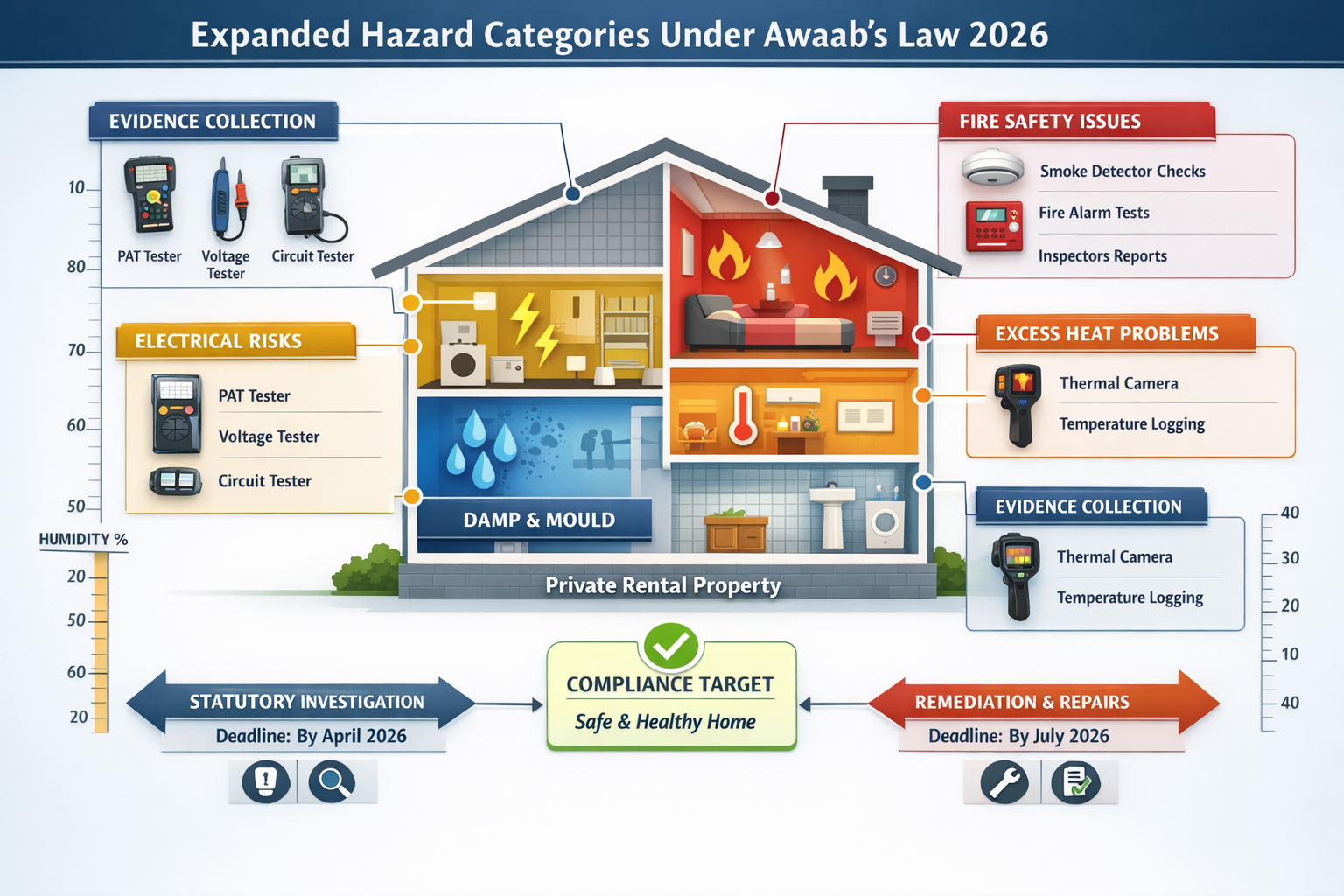
The 2026 regulations significantly broaden the hazard scope beyond the damp and mould focus of the initial phase. Expert witnesses must now assess and testify on [5]:
- Electrical hazards: Faulty wiring, inadequate earthing, overloaded circuits, non-compliant installations
- Fire safety deficiencies: Missing smoke alarms, blocked escape routes, fire door failures, combustible cladding
- Excess heat risks: Inadequate ventilation, thermal discomfort, heat-related health impacts
- Traditional damp and mould: Penetrating damp, rising damp, condensation, fungal growth
This multi-hazard approach requires expert witnesses to possess broader technical competencies or work collaboratively with specialists across different disciplines. A single property dispute may require electrical engineers, fire safety consultants, and building surveyors to provide coordinated testimony.
Expert Witness Roles in Awaab's Law 2026 Disputes: Evidence Standards and Legal Protocols
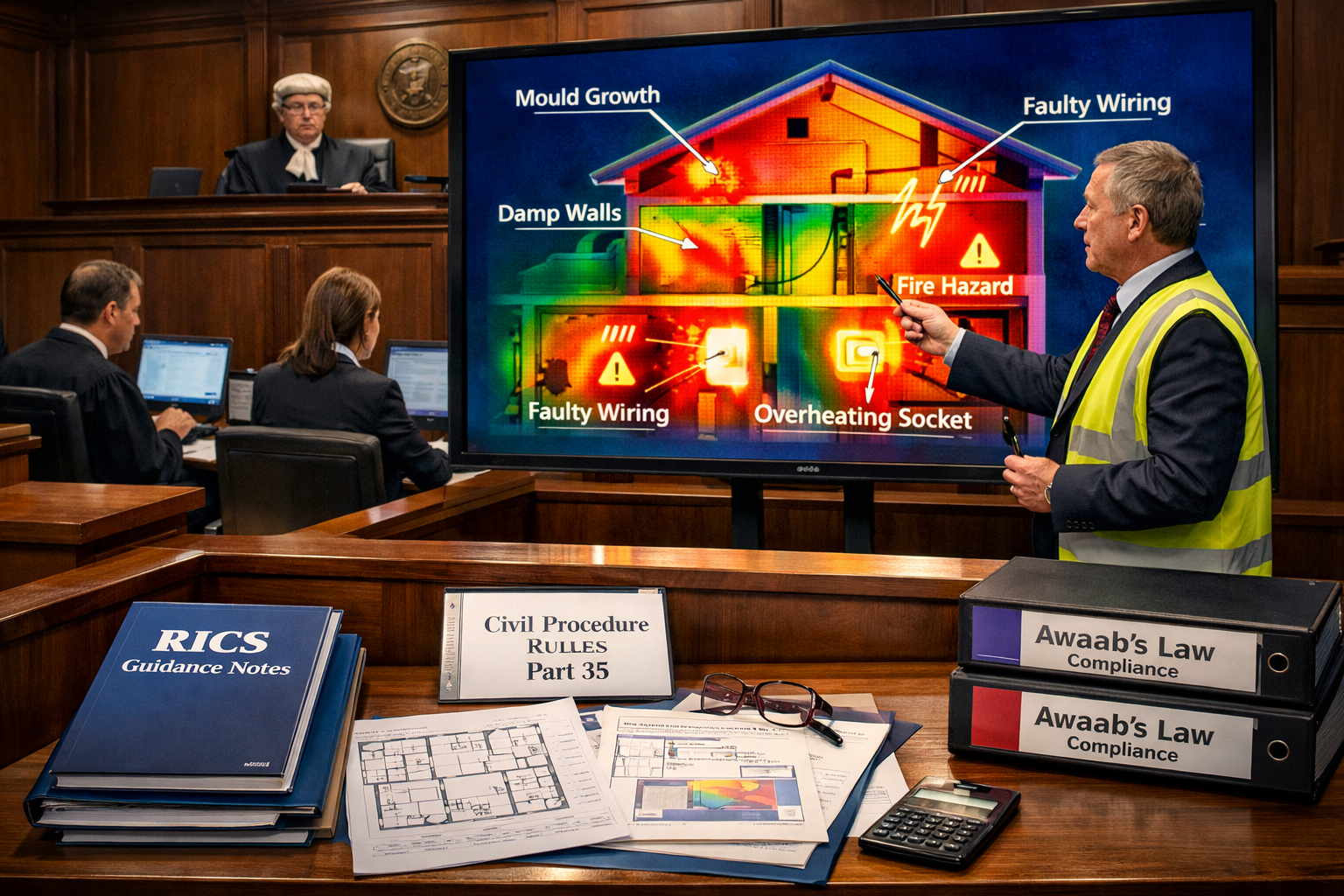
Compliance with Civil Procedure Rules Part 35
Expert witnesses in Awaab's Law disputes must strictly adhere to Part 35 of the Civil Procedure Rules, which governs expert evidence in civil proceedings [1]. This framework establishes that:
- The expert's overriding duty is to the court or tribunal, not to the instructing party
- Opinions must be based on demonstrable expertise and objective analysis
- All material facts must be disclosed, including those that contradict the expert's opinion
- The expert must state if an opinion is provisional or subject to qualification
For housing disrepair claims under Awaab's Law, this means expert witnesses cannot act as advocates for landlords or tenants. Their role is to provide impartial, evidence-based assessments of property conditions, hazard severity, causation, and appropriate remediation measures.
Many surveyors accustomed to providing expert witness reports in traditional property disputes must adjust their approach for Awaab's Law cases, where statutory timeframes and prescribed requirements create additional complexity.
Pre-Action Protocol for Housing Conditions Claims
Before proceedings commence, expert witnesses should be aware of the Pre-Action Protocol for Housing Conditions Claims, which establishes procedures for resolving housing disrepair disputes [1]. This protocol requires:
- Early disclosure: Landlords must provide relevant documents including previous inspection reports, maintenance records, and correspondence
- Professional assessments: Parties should obtain expert opinions on property condition before litigation
- Remediation proposals: Clear, costed proposals for addressing identified hazards
- Negotiation period: Reasonable time for parties to settle without court intervention
Expert witnesses who understand this protocol can structure their initial assessments to facilitate early resolution, potentially avoiding tribunal proceedings entirely. Reports should clearly identify hazards, assess compliance with Awaab's Law timeframes, and propose evidence-based remediation strategies.
RICS Guidance for Robust Expert Opinions
The Royal Institution of Chartered Surveyors (RICS) provides professional standards that underpin defensible expert testimony in Awaab's Law disputes [9]. Key RICS principles include:
📋 Competence and objectivity: Only accept instructions within your area of expertise; maintain independence from instructing parties
📊 Evidence-based methodology: Use recognized assessment techniques, calibrated equipment, and reproducible testing protocols
📝 Comprehensive documentation: Record all observations, measurements, and analytical reasoning supporting conclusions
⚖️ Proportionate investigation: Balance thoroughness with cost-effectiveness while meeting statutory requirements
Expert witnesses should reference relevant RICS guidance documents in their reports, demonstrating adherence to professional standards. This approach strengthens credibility under cross-examination and provides a defensible framework for opinions.
For complex cases involving neighbour disputes or boundary issues that intersect with Awaab's Law hazards, RICS standards provide consistent methodology across different dispute types.
Evidence-Gathering Techniques for Expanded Hazard Assessment
Multi-Disciplinary Assessment Protocols
The expanded hazard scope under Awaab's Law 2026 requires expert witnesses to deploy comprehensive assessment protocols that address all potential hazard categories [5]. A robust evidence-gathering approach includes:
Electrical Hazard Assessment
- Visual inspection: Identify damaged outlets, exposed wiring, overloaded circuits, DIY modifications
- Electrical testing: Use multifunction testers to verify earthing, insulation resistance, and RCD functionality
- Installation certification: Review existing electrical certificates and identify non-compliant work
- Thermal imaging: Detect hot spots indicating loose connections or overloaded circuits
Expert witnesses should coordinate with qualified electricians when electrical hazards exceed their competence, ensuring all testimony meets the Part 35 requirement for demonstrated expertise.
Fire Safety Evaluation
- Smoke alarm testing: Verify presence, functionality, and compliance with current regulations
- Escape route assessment: Measure corridor widths, identify obstructions, assess signage
- Fire door inspection: Check self-closing mechanisms, intumescent strips, and fire ratings
- Combustible materials: Identify fire risks from cladding, furnishings, or stored materials
Fire safety assessments in private rentals differ significantly from social housing blocks, requiring expert witnesses to understand the specific regulatory framework applicable to different property types.
Excess Heat Investigation
- Temperature monitoring: Use data loggers to record temperature variations over 24-48 hour periods
- Ventilation assessment: Evaluate natural and mechanical ventilation adequacy
- Thermal comfort analysis: Apply CIBSE guidance on acceptable temperature ranges
- Heat source identification: Assess contribution from inadequate insulation, solar gain, or mechanical systems
Excess heat has emerged as a significant health hazard in modern properties with improved airtightness but inadequate ventilation strategies. Expert witnesses must distinguish between design failures and maintenance issues when assessing liability.
Traditional Damp and Mould Assessment
- Moisture measurement: Use calibrated moisture meters to quantify dampness in building materials
- Mould identification: Document mould species, extent, and health implications
- Causation analysis: Distinguish between structural defects, maintenance failures, and lifestyle factors
- Remediation specification: Propose evidence-based solutions addressing root causes
Despite the expanded hazard scope, damp and mould remain the most common issues in Awaab's Law disputes. Expert witnesses should maintain expertise in traditional building pathology while developing competencies in newer hazard categories.
Documentation Standards for Tribunal Evidence
Expert witnesses must produce documentation that withstands scrutiny in tribunal proceedings. Essential elements include [1][9]:
📸 Photographic evidence: High-resolution images with scale references, date stamps, and location annotations
📏 Quantitative measurements: Precise readings from calibrated instruments with equipment specifications documented
🗺️ Site plans and diagrams: Clear visual representations showing hazard locations and property layout
📋 Testing protocols: Detailed methodology explaining assessment techniques and standards applied
📚 Reference materials: Citations to relevant regulations, RICS guidance, and technical standards
⏱️ Timeline documentation: Chronological record of hazard reporting, landlord responses, and investigation dates
This comprehensive documentation approach creates a defensible evidential foundation that demonstrates compliance with professional standards and supports expert opinions under cross-examination.
For properties requiring structural surveys or specific defect reports, expert witnesses should integrate Awaab's Law hazard assessments into broader property evaluations.
Coordinating Multi-Expert Testimony
Complex Awaab's Law disputes often require testimony from multiple experts across different disciplines. Effective coordination includes:
- Joint site inspections: Conduct simultaneous assessments to ensure consistent factual observations
- Shared documentation: Provide access to common evidence base including photographs, plans, and measurements
- Cross-referencing reports: Acknowledge other experts' findings and explain any differences in interpretation
- Joint statements: Where appropriate, produce agreed statements on uncontroversial facts
This collaborative approach strengthens overall evidence quality and demonstrates professional cooperation that tribunals value. Expert witnesses should maintain independence while recognizing the interconnected nature of different hazard categories.
Testifying Effectively in Awaab's Law Tribunal Proceedings
Preparing for Cross-Examination
Expert witnesses face rigorous cross-examination in Awaab's Law disputes, particularly where statutory timeframes and landlord compliance are contested. Effective preparation includes:
🎯 Know your report intimately: Review all statements, measurements, and conclusions; anticipate challenges to methodology or assumptions
📖 Understand the legal framework: Familiarize yourself with relevant Awaab's Law provisions, statutory timeframes, and enforcement mechanisms
🔍 Identify report weaknesses: Acknowledge limitations in your investigation, provisional opinions, or areas requiring further assessment
💼 Practice clear communication: Translate technical concepts into accessible language without oversimplification
📊 Prepare supporting materials: Bring additional photographs, measurements, or reference documents that may clarify testimony
The tribunal's focus will be whether the landlord acted reasonably within statutory timeframes. Expert witnesses must clearly articulate how their findings relate to these specific legal tests [6].
Common Challenges and Effective Responses
Expert witnesses in Awaab's Law disputes frequently face these challenges:
Challenge: "Your assessment was conducted months after the hazard was reported. How can you determine conditions at the time of reporting?"
Effective response: "I documented current conditions comprehensively. Based on the nature of [specific hazard], deterioration patterns, and maintenance records, I can provide an expert opinion on likely conditions at the reporting date. However, I acknowledge this involves professional judgment and have stated this limitation in my report."
Challenge: "The landlord claims the tenant's lifestyle caused the damp and mould. Do you agree?"
Effective response: "My investigation identified [specific structural defects/ventilation inadequacies]. While occupant behavior can contribute to condensation, the primary causation in this case is [specific building failure]. Even with optimal tenant behavior, the structural issues would likely produce dampness."
Challenge: "Your proposed remediation is more extensive than the landlord's contractor recommended. Why?"
Effective response: "My specification addresses root causes rather than symptoms. The contractor's proposal would provide temporary cosmetic improvement but wouldn't prevent hazard recurrence. My approach aligns with RICS guidance on evidence-based remediation and ensures long-term compliance with Awaab's Law requirements."
Addressing Statutory Timeframe Compliance
A critical aspect of Expert Witness Roles in Awaab's Law 2026 Disputes: Testifying on Expanded Hazards in Private Rental Properties involves assessing whether landlords met statutory investigation and remediation deadlines [3].
Expert testimony should address:
- Hazard categorization: Whether the reported issue constituted an emergency, significant, or standard hazard
- Investigation adequacy: Whether the landlord's investigation was sufficiently thorough and timely
- Remediation appropriateness: Whether proposed or completed works address the hazard effectively
- Timeframe compliance: Whether actions occurred within statutory deadlines
Expert witnesses must distinguish between technical property assessment and legal compliance evaluation. While experts can opine on whether investigations were professionally adequate, ultimate determinations of legal compliance rest with the tribunal.
For cases involving party wall disputes or shared property issues that intersect with Awaab's Law hazards, expert witnesses must clarify responsibility allocation between different property owners.
Professional Liability and Risk Management for Expert Witnesses
Increased Accountability Under Awaab's Law
The expanded surveyor accountability under Awaab's Law significantly increases professional liability exposure for expert witnesses [5]. Reports carry substantial legal weight in enforcement actions, potentially influencing:
- Tribunal decisions: Determinations of landlord compliance or breach
- Financial penalties: Compensation awards based on hazard severity and duration
- Enforcement orders: Mandatory remediation requirements imposed on landlords
- Reputational consequences: Public records of tribunal proceedings and outcomes
Expert witnesses must recognize that inadequate or inaccurate testimony can result in:
- Professional negligence claims from instructing parties
- Disciplinary proceedings by professional bodies (RICS, professional institutions)
- Reputational damage affecting future instruction opportunities
- Personal liability for costs if evidence is deemed unreliable or biased
Essential Professional Indemnity Insurance
Expert witnesses providing testimony in Awaab's Law disputes should maintain adequate professional indemnity insurance covering:
- Expert witness activities: Specific coverage for tribunal and court testimony
- Retroactive coverage: Protection for claims arising from past instructions
- Defense costs: Legal representation if testimony is challenged
- Adequate limits: Coverage reflecting potential claim values in housing disputes
Many standard surveyor policies exclude or limit expert witness coverage. Practitioners should review policies carefully and obtain specialist insurance where necessary.
Quality Assurance and Peer Review
Implementing robust quality assurance processes reduces liability risk and strengthens expert testimony [9]:
✅ Internal review protocols: Second surveyor reviews reports before submission, checking methodology, evidence, and conclusions
✅ Continuing professional development: Regular training on Awaab's Law developments, assessment techniques, and legal requirements
✅ Equipment calibration: Maintain calibrated testing equipment with documented certification
✅ Template standardization: Use consistent report formats incorporating all required elements under Part 35 and RICS guidance
✅ Case documentation: Maintain comprehensive file records including instructions, correspondence, and working papers
These quality measures demonstrate professional diligence and provide defensible evidence of appropriate practice standards if testimony is challenged.
Future Developments and Emerging Trends
Anticipated Regulatory Evolution
Awaab's Law represents the beginning of an evolving regulatory framework for rental property standards. Expert witnesses should anticipate:
- Expanded hazard categories: Potential inclusion of additional health and safety risks beyond current scope
- Stricter timeframes: Possible reduction in statutory deadlines as enforcement mechanisms mature
- Enhanced enforcement: Greater resources for local authorities and housing tribunals to pursue non-compliance
- Data-driven standards: Development of evidence-based thresholds for hazard categorization
Staying informed about regulatory developments ensures expert witnesses maintain current knowledge and adapt assessment protocols accordingly.
Technology Integration in Evidence Gathering
Emerging technologies are transforming evidence-gathering techniques for Awaab's Law disputes:
🔬 Advanced diagnostic tools: Thermal imaging cameras, moisture mapping systems, and air quality monitors provide objective, quantifiable data
📱 Digital documentation platforms: Mobile apps enable real-time evidence capture with automatic geolocation and timestamp verification
🤖 AI-assisted analysis: Machine learning algorithms can identify patterns in building defects and predict hazard development
☁️ Cloud-based collaboration: Secure platforms facilitate multi-expert coordination and evidence sharing
Expert witnesses who adopt appropriate technologies can enhance evidence quality while improving efficiency. However, technology should supplement rather than replace professional judgment and site-based assessment.
Professional Development Priorities
Expert witnesses should prioritize developing competencies in:
- Multi-hazard assessment: Broadening expertise beyond traditional building pathology to encompass electrical, fire, and thermal hazards
- Legal frameworks: Understanding Awaab's Law provisions, enforcement mechanisms, and tribunal procedures
- Communication skills: Translating technical findings into clear, accessible testimony for non-specialist audiences
- Cross-examination techniques: Preparing for rigorous questioning and maintaining credibility under pressure
- Collaborative practice: Working effectively with experts from other disciplines in complex cases
Organizations offering expert surveyor advice should ensure their professionals receive appropriate training in these evolving competency areas.
Practical Guidance for Landlords and Property Managers
Proactive Hazard Management
Landlords can reduce dispute risk by implementing proactive hazard management strategies:
- Regular professional inspections: Commission periodic assessments identifying potential hazards before tenant reporting
- Maintenance documentation: Maintain comprehensive records of all inspections, repairs, and remediation work
- Rapid response protocols: Establish systems ensuring statutory timeframe compliance when hazards are reported
- Professional assessments: Engage qualified surveyors for thorough investigations rather than relying on contractor opinions
Properties requiring schedule of condition reports at tenancy commencement create baseline documentation valuable in disputes about hazard timing and causation.
Selecting Qualified Expert Witnesses
When disputes arise, landlords should select expert witnesses based on:
🎓 Relevant qualifications: RICS membership, specialist certifications in relevant hazard categories
📊 Demonstrated expertise: Experience with similar property types and hazard assessments
⚖️ Tribunal experience: Familiarity with Part 35 requirements and cross-examination procedures
🔍 Independence: No conflicts of interest or prior involvement with the disputed property
📝 Report quality: Clear, comprehensive documentation meeting professional standards
Engaging appropriately qualified experts early in disputes facilitates compliance demonstration and may enable pre-tribunal settlement.
Cost-Benefit Analysis of Expert Instruction
Expert witness fees represent significant costs, but early professional instruction often proves cost-effective by:
- Avoiding enforcement action: Demonstrating reasonable compliance through professional assessments
- Facilitating settlement: Providing objective evidence supporting negotiated resolutions
- Reducing compensation: Limiting tenant claims through prompt, appropriate remediation
- Preventing recurrence: Identifying root causes requiring permanent solutions
Landlords should view expert instruction as risk management investment rather than discretionary expense, particularly given the strict statutory framework under Awaab's Law.
Conclusion
The extension of Awaab's Law to private rental properties in 2026 fundamentally transforms Expert Witness Roles in Awaab's Law 2026 Disputes: Testifying on Expanded Hazards in Private Rental Properties. Expert witnesses must now master multi-disciplinary assessment protocols covering electrical risks, fire safety deficiencies, excess heat problems, and traditional damp and mould issues while navigating strict statutory timeframes and enhanced professional accountability [5].
Success in this evolving landscape requires rigorous adherence to Civil Procedure Rules Part 35, comprehensive evidence-gathering techniques following RICS guidance, and effective communication skills for tribunal testimony [1][9]. Expert witnesses who develop competencies across expanded hazard categories, maintain robust quality assurance processes, and stay informed about regulatory developments will provide invaluable services to landlords, tenants, and tribunals navigating this complex legal framework.
Actionable Next Steps
For Expert Witnesses:
- Review and update professional indemnity insurance to ensure adequate expert witness coverage
- Pursue continuing professional development in expanded Awaab's Law hazard categories
- Implement quality assurance protocols including peer review and equipment calibration
- Develop collaborative relationships with specialists in complementary disciplines
For Landlords and Property Managers:
- Commission proactive professional inspections identifying potential hazards before tenant reporting
- Establish rapid response protocols ensuring statutory timeframe compliance
- Maintain comprehensive documentation of all inspections, maintenance, and remediation work
- Engage qualified expert witnesses early when disputes arise to facilitate compliance demonstration
For Tenants and Advocates:
- Understand statutory reporting requirements and timeframe expectations under Awaab's Law
- Document hazards comprehensively with photographs, descriptions, and health impact records
- Seek professional assessments when landlord investigations appear inadequate
- Recognize the value of expert testimony in establishing hazard severity and remediation requirements
The 2026 expansion of Awaab's Law represents a watershed moment for private rental sector accountability. Expert witnesses who embrace this challenge with professionalism, technical excellence, and commitment to impartial testimony will play a crucial role in improving housing standards and protecting tenant health across England.
References
[1] Awaabs Law Housing Disrepair Claims – https://www.expertcourtreports.co.uk/blog/awaabs-law-housing-disrepair-claims/
[3] Awaabs Law Private Landlords 2026 – https://www.idealresponse.co.uk/blog/awaabs-law-private-landlords-2026/
[5] Awaabs Law 2026 Hazard Expansions Surveyor Protocols For Electrical Fire And Excess Heat Risks In Rentals – https://nottinghillsurveyors.com/blog/awaabs-law-2026-hazard-expansions-surveyor-protocols-for-electrical-fire-and-excess-heat-risks-in-rentals
[6] Navigating Awaabs Law What Private Landlords Need To Know And Do – https://www.hja.net/expert-comments/opinion/residential-property-disputes/navigating-awaabs-law-what-private-landlords-need-to-know-and-do/
[8] Awaabs Law A New Dawn For Tenant Safety – https://beale-law.com/article/awaabs-law-a-new-dawn-for-tenant-safety/
[9] Awaabs Law Is Here The Surveyors Guide For Compliance – https://www.surventrix.com/blog/awaabs-law-is-here-the-surveyors-guide-for-compliance