The abolition of Section 21 "no-fault evictions" on May 1, 2026, has fundamentally altered the evidentiary landscape for property valuation disputes in England.[1] Expert witnesses now face unprecedented challenges in preparing robust, defensible valuations for rental properties where possession recovery timelines have extended, litigation costs have multiplied, and periodic tenancies have replaced fixed-term agreements. With civil penalties reaching £7,000 for non-compliance and Section 8 grounds requiring court-tested evidence, the standards for expert testimony have never been more rigorous.[1]
Expert Witness Preparation for Renters' Rights Act Valuation Disputes: Evidence Standards Post-Section 21 Abolition requires chartered surveyors to master new methodologies that account for regulatory changes while maintaining RICS impartiality. This comprehensive guide equips valuation professionals with case-building strategies for rent review challenges, ombudsman claims, and tribunal proceedings under the Renters' Rights Act 2025.
Key Takeaways
- Section 21 abolished May 1, 2026: All possession claims now require Section 8 grounds with court-tested evidence, fundamentally changing valuation assumptions for rental properties
- Periodic tenancies impact valuations: Fixed-term ASTs replaced by monthly rolling tenancies affect capital value calculations and investment yield projections
- RICS impartiality is paramount: Expert witnesses must demonstrate independence and objectivity when valuing properties subject to rent review disputes or ombudsman claims
- Extended possession timelines reduce values: Slower eviction processes increase holding costs and litigation expenses, requiring downward valuation adjustments
- Evidence hierarchy matters: Documentary evidence outweighs opinion evidence in tribunal proceedings, demanding meticulous preparation and comprehensive comparable analysis
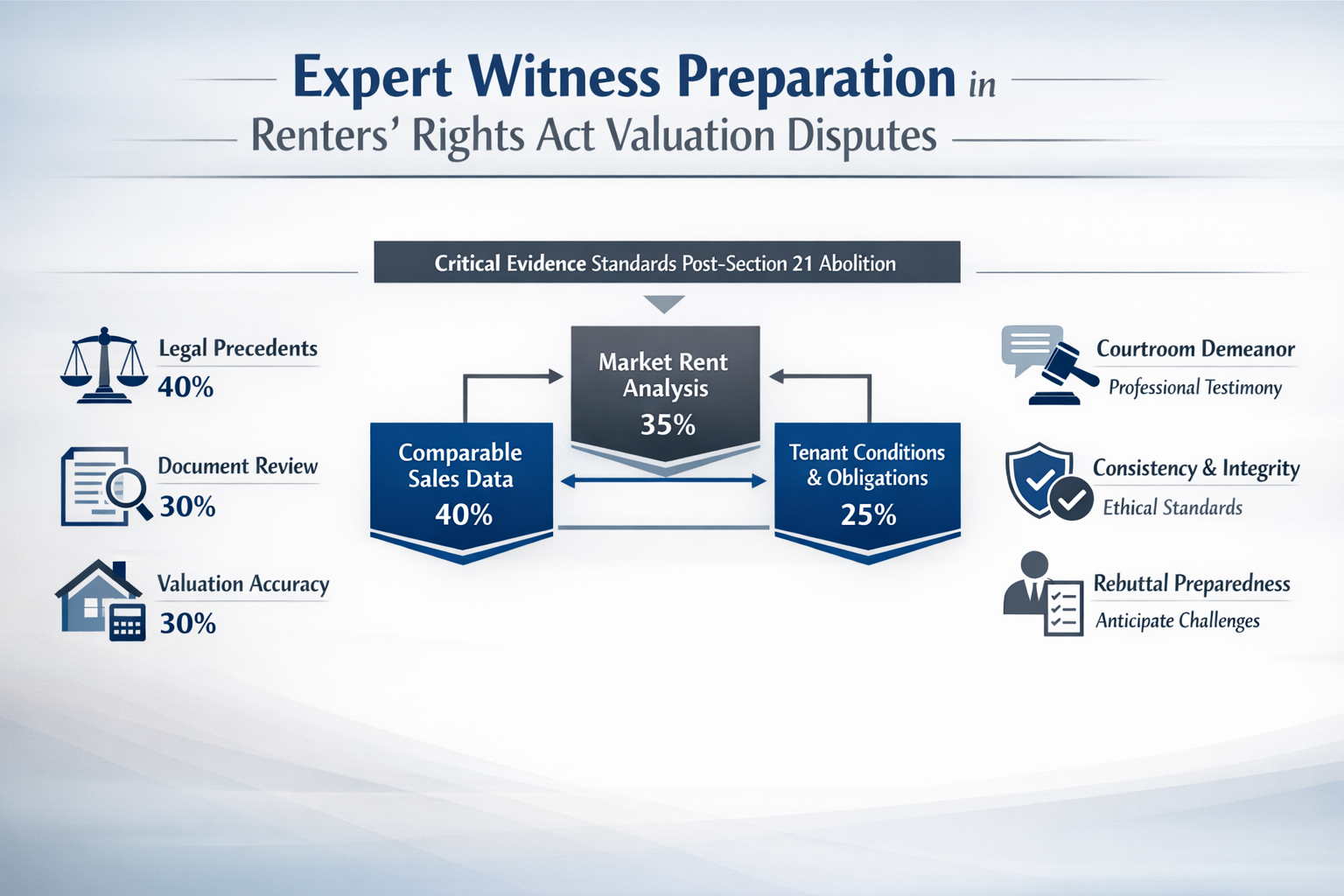
Understanding the Post-Section 21 Landscape for Expert Witness Preparation for Renters' Rights Act Valuation Disputes: Evidence Standards Post-Section 21 Abolition
The Regulatory Shift: From Section 21 to Section 8
The Renters' Rights Act 2025, which received Royal Assent on October 27, 2025, represents the most significant overhaul of landlord-tenant law in decades.[4] When Section 21 abolition takes effect on May 1, 2026, landlords lose the ability to recover possession without providing grounds. The last valid Section 21 notices can be served only until April 30, 2026.[1]
Section 8 of the Housing Act 1988 becomes the primary possession mechanism, requiring landlords to:
✅ Specify one or more legal grounds for possession
✅ Provide court-admissible evidence supporting each ground
✅ Navigate extended notice periods (4 months for Ground 1A property sales)
✅ Attend eviction hearings with legal representation
✅ Demonstrate compliance with all tenancy obligations[5]
This procedural shift creates substantial implications for property valuation. Expert witnesses must now account for:
- Increased litigation costs averaging £3,000-£8,000 per possession claim
- Extended possession timelines adding 3-6 months to recovery periods
- Higher void periods between tenancies due to legal proceedings
- Reduced landlord flexibility impacting investment attractiveness[3]
Periodic Tenancies and Valuation Methodology
All new tenancies under the Renters' Rights Act become monthly rolling periodic tenancies with no minimum term.[6] Tenants can terminate with two months' notice at any time, while landlords must use Section 8 grounds.
This fundamental change affects valuation calculations in several ways:
| Valuation Factor | Pre-Act (Fixed-Term ASTs) | Post-Act (Periodic Tenancies) |
|---|---|---|
| Income certainty | High (6-12 month terms) | Lower (monthly rolling) |
| Possession recovery | 2 months (Section 21) | 4+ months (Section 8) |
| Void risk | Predictable end dates | Unpredictable termination |
| Investment yield | Higher multiples | Reduced by 5-15%[6] |
| Litigation provision | Minimal | £3,000-£8,000 annually |
Expert witnesses preparing valuations for rent review challenges or tribunal proceedings must adjust their methodology to reflect these structural changes. The RICS has issued guidance noting that "the abolition of Section 21 may have the impact of limiting the speed with which possession will be regained, affecting property valuation calculations."[6]
Civil Penalties and Compliance Evidence
Landlords attempting to serve Section 21 notices after May 1, 2026, face civil penalties up to £7,000 per breach.[1] Local authorities have enforcement powers to investigate non-compliance and impose financial sanctions.
For expert witnesses, this creates additional evidentiary requirements:
🔍 Compliance verification: Confirming all possession proceedings follow Section 8 procedures
🔍 Documentation review: Examining notice validity and ground specifications
🔍 Penalty impact assessment: Adjusting valuations for properties with compliance histories
🔍 Risk profiling: Evaluating landlord sophistication and legal support capacity
Professional landlords and institutional investors maintain advantages in this environment, as they can afford dedicated legal teams and compliance systems.[3] Expert witnesses must differentiate between professional and amateur landlord portfolios when preparing comparable evidence.
Evidence Standards for Expert Witness Preparation for Renters' Rights Act Valuation Disputes: Evidence Standards Post-Section 21 Abolition
RICS Impartiality Requirements
The Royal Institution of Chartered Surveyors (RICS) mandates strict independence and impartiality for expert witnesses providing valuation opinions in legal proceedings. The RICS Practice Statement on Expert Witness Work requires:
- Primary duty to the tribunal: Expert's obligation is to the court/tribunal, not the instructing party
- Objectivity in analysis: Opinions must be unbiased and based on factual evidence
- Competence declaration: Experts must only accept instructions within their area of expertise
- Disclosure of conflicts: Any relationships with parties must be declared upfront
- Transparent methodology: Valuation approaches must be clearly explained and defensible[6]
For valuation professionals working on Renters' Rights Act disputes, maintaining impartiality becomes particularly challenging when:
- Instructed by landlords facing possession difficulties
- Valuing properties with contentious rent review histories
- Assessing damages in ombudsman claims against landlords
- Providing opinions on reasonable rent levels under periodic tenancies
Best practice: Expert witnesses should prepare a conflicts declaration at the outset of every instruction, documenting any previous work for the parties, properties in the same development, or related entities. This transparency protects the expert's credibility under cross-examination.
Documentary Evidence Hierarchy
In tribunal and court proceedings, evidence follows a clear hierarchy of reliability:
Tier 1: Primary Documentary Evidence ⭐⭐⭐
- Executed tenancy agreements
- Rent payment records (bank statements)
- Property condition reports with photographs
- Maintenance and repair invoices
- Formal notice documents (Section 8, rent increase)
- Local authority licensing records
Tier 2: Comparable Transaction Evidence ⭐⭐
- Recent lettings of similar properties (same area, size, condition)
- Rent review outcomes for comparable tenancies
- Market rent assessments by letting agents
- Published rental indices (ONS, Zoopla, Rightmove)
Tier 3: Expert Opinion Evidence ⭐
- Valuation reports and rental assessments
- Building condition surveys
- Market commentary and trend analysis
- Professional judgment on adjustments
Expert witnesses must build their case on Tier 1 evidence wherever possible. Opinions unsupported by documentary proof carry minimal weight in contested proceedings. When preparing expert witness reports, structure the analysis as:
- Facts established by documents (rent paid, property condition, comparable transactions)
- Adjustments required (property-specific factors, market conditions, regulatory changes)
- Valuation conclusion (rental value or capital value with supporting reasoning)
Comparable Evidence in Post-Section 21 Valuations
Identifying appropriate comparables has become more complex under the Renters' Rights Act. Expert witnesses must ensure comparables reflect:
✔️ Tenancy type: Periodic vs. fixed-term (if pre-Act comparables used)
✔️ Landlord type: Professional vs. individual (affects management quality)
✔️ Possession status: Properties with clean compliance vs. those with disputes
✔️ Location micro-factors: Local authority enforcement activity, tenant demographics
When using pre-Act comparables (lettings before May 1, 2026), experts should apply adjustments:
- -5% to -10% for transition from fixed-term to periodic tenancy
- -3% to -5% for increased possession recovery risk
- -2% to -4% for elevated litigation cost provision
These adjustments reflect the reduced investment attractiveness of rental properties under the new regulatory framework.[6] Expert witnesses should document the rationale for each adjustment with reference to market evidence and investor sentiment.
For valuation factors specific to rental properties, consider:
- Local market rental growth trends (2023-2026)
- Tenant demand indicators (void periods, application volumes)
- Landlord exit rates (portfolio sales, market supply changes)
- Professional management prevalence (agent-managed vs. self-managed)
Case-Building Strategies for Expert Witness Preparation for Renters' Rights Act Valuation Disputes: Evidence Standards Post-Section 21 Abolition
Rent Review Challenge Preparation
Rent review disputes under periodic tenancies follow specific procedures. Landlords must provide notice of rent increase with at least one month's notice for periodic tenancies.[5] Tenants can challenge proposed increases through:
- Negotiation with landlord (informal resolution)
- First-tier Tribunal (Property Chamber) (formal determination)
- Ombudsman schemes (for member landlords)
Expert witnesses instructed in rent review challenges must prepare evidence addressing:
📊 Market rent assessment: What comparable properties let for in the current market
📊 Property condition adjustment: How the subject property's condition affects rental value
📊 Tenancy terms impact: Whether periodic status affects achievable rent
📊 Local market dynamics: Supply/demand factors specific to the area
Example case structure:
A landlord proposes increasing rent from £1,200 to £1,400 per month on a 2-bedroom flat in South West London. The tenant challenges this as excessive. The expert witness should:
- Gather comparable evidence: Identify 5-8 recent lettings of similar 2-bed flats within 0.5 miles
- Adjust for differences: Property condition, parking, outdoor space, management quality
- Assess market rent: Determine the likely achievable rent for the subject property
- Consider tenancy type: Apply adjustment for periodic vs. fixed-term if relevant
- Provide opinion: State whether £1,400 is supported by market evidence
The expert's report should present comparables in a clear table format with adjustment reasoning for each factor. Transparency in methodology protects against cross-examination challenges.

Ombudsman Claim Evidence Standards
Landlord ombudsman schemes (Property Ombudsman, Property Redress Scheme) handle complaints including:
- Excessive rent increases
- Property condition disputes
- Deposit return disagreements
- Harassment or illegal eviction allegations
Expert witnesses may be instructed by either party to provide independent valuation opinions on:
- Reasonable market rent for the property in its actual condition
- Cost of repairs required to meet legal standards
- Diminution in rental value due to disrepair or defects
- Comparable evidence supporting tenant's or landlord's position
Ombudsman proceedings emphasize proportionality and fairness rather than strict legal tests. Expert witnesses should:
✅ Present evidence in accessible language (avoid excessive jargon)
✅ Acknowledge uncertainties and alternative interpretations
✅ Focus on practical outcomes rather than theoretical valuations
✅ Consider the tenant's perspective on property condition and value
RICS impartiality is critical in ombudsman work. Experts must resist pressure to advocate for the instructing party and instead provide objective analysis that assists the ombudsman in reaching a fair resolution.
Tribunal Proceedings and Cross-Examination Preparation
First-tier Tribunal (Property Chamber) hearings require expert witnesses to present evidence orally and respond to cross-examination. Effective preparation includes:
Pre-hearing preparation:
- Review all documentary evidence thoroughly
- Prepare visual aids (comparable maps, adjustment tables, photographs)
- Anticipate opposing expert's arguments and prepare rebuttals
- Practice explaining technical concepts in plain language
- Confirm all facts stated in the report are accurate and defensible
During testimony:
- Address answers to the tribunal panel, not the questioning party
- Admit limitations in evidence or methodology when appropriate
- Avoid speculation beyond the scope of expertise
- Reference specific documents when stating facts
- Maintain professional composure under aggressive cross-examination
Common cross-examination challenges:
❌ "You've been paid by the landlord, so your opinion is biased"
✅ Response: "My primary duty is to the tribunal. My fee is for time spent, not for any particular opinion. I would provide the same assessment regardless of who instructed me."
❌ "Your comparables aren't truly comparable to this property"
✅ Response: "No two properties are identical. I've made explicit adjustments for the differences in condition, location, and amenities. The tribunal can assess whether those adjustments are appropriate."
❌ "You haven't considered the impact of the Renters' Rights Act on rental values"
✅ Response: "I have considered the regulatory changes. The comparables I've used are post-Act lettings where available, and I've applied adjustments to pre-Act comparables to reflect the changed market conditions."
For professionals seeking guidance on expert witness reports in London, understanding tribunal procedures and evidentiary standards is essential for effective advocacy.
Valuation Adjustments for Possession Recovery Risk
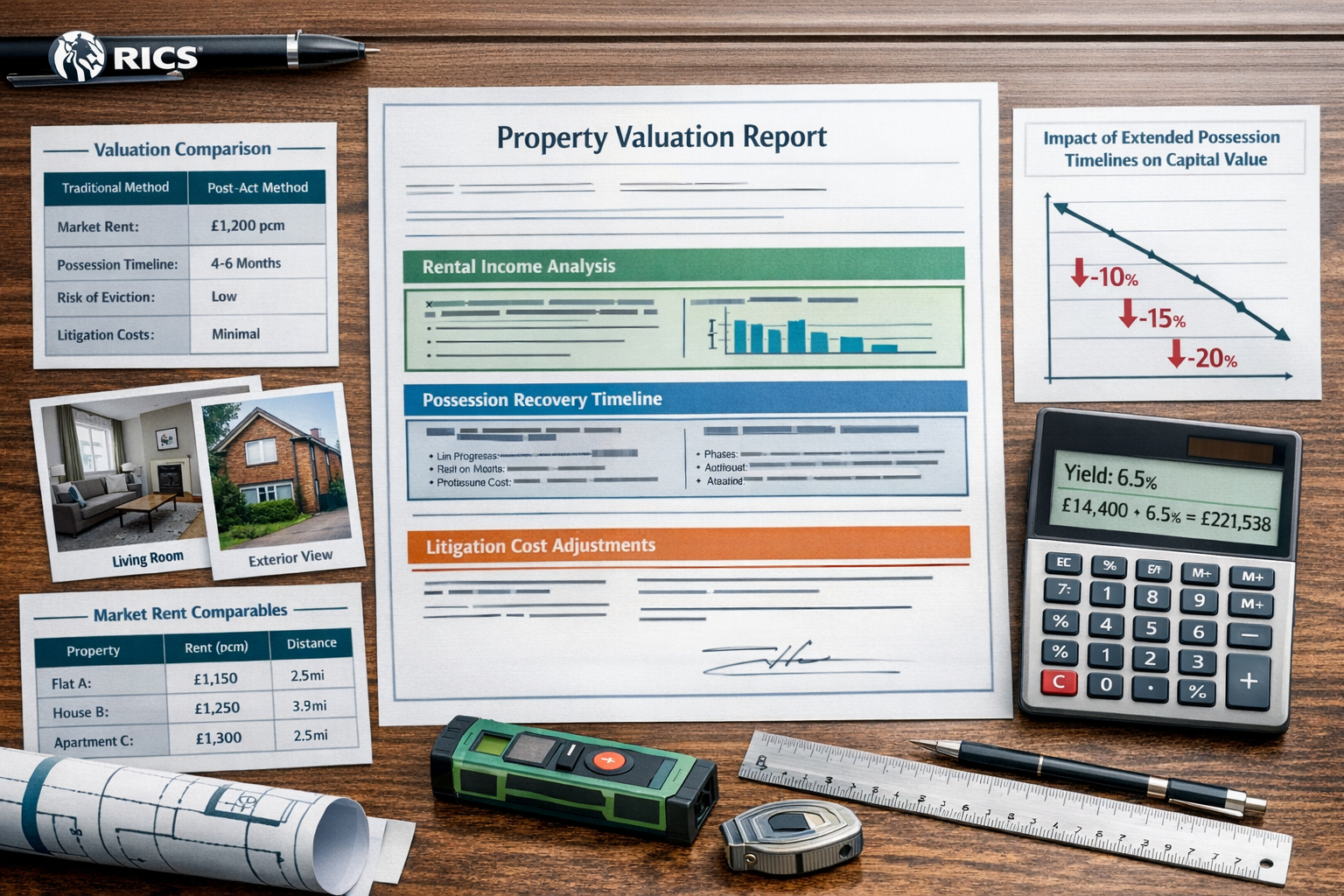
One of the most significant changes under the Renters' Rights Act is the extended timeline for possession recovery. Expert witnesses valuing rental properties must quantify this impact on capital values and investment yields.
Methodology for possession risk adjustment:
Step 1: Estimate average possession timeline
- Pre-Act (Section 21): 2-4 months from notice to possession
- Post-Act (Section 8): 6-12 months from notice to possession[3]
Step 2: Calculate additional holding costs
- Mortgage interest during extended void period
- Ongoing property costs (service charges, insurance, council tax)
- Legal fees for possession proceedings (£3,000-£8,000)
- Lost rental income during proceedings
Step 3: Apply yield adjustment
- Calculate impact on net operating income
- Adjust capitalization rate to reflect increased risk
- Typical adjustment: -5% to -15% on capital value[6]
Example calculation:
A rental property generates £18,000 annual rent with 8% gross yield (pre-Act value: £225,000).
Post-Act adjustments:
- Increased void provision: +2% annually (£450)
- Litigation cost provision: +1.5% annually (£337)
- Extended possession risk: +1% annually (£225)
- Total yield reduction: 4.5% (from 8% to 3.5% net)
Adjusted capital value: £225,000 × (3.5% / 8%) = £98,437 reduction
New valuation: £126,563 (44% decrease)
This example illustrates the substantial impact of regulatory changes on rental property values. Expert witnesses must be prepared to explain and defend such adjustments with reference to investor sentiment, market transactions, and comparable sales data.
For commercial property valuations or residential valuations, understanding the specific regulatory context is essential for accurate assessment.
Professional Standards and Continuing Competence
RICS Continuing Professional Development
Expert witnesses must maintain current knowledge of regulatory changes affecting their valuation work. The RICS requires members to complete at least 20 hours of Continuing Professional Development (CPD) annually, including:
- Updates on legislation (Renters' Rights Act implementation)
- Case law developments (tribunal decisions on rent reviews)
- Market analysis (rental trends post-Section 21 abolition)
- Technical skills (valuation methodologies for periodic tenancies)
Specific CPD topics for 2026 should include:
📚 Renters' Rights Act implications for property valuation
📚 Section 8 grounds and evidence requirements for possession claims
📚 Tribunal procedures for rent review challenges
📚 Ombudsman schemes and alternative dispute resolution
📚 RICS Practice Standards for expert witness work
Expert witnesses who fail to maintain competence risk professional sanctions and reputational damage. Tribunals increasingly scrutinize expert qualifications and recent experience in the specific area of dispute.
Insurance and Indemnity Considerations
Professional indemnity insurance (PII) for expert witness work requires careful attention. Standard surveying PII policies may exclude or limit cover for:
- Court and tribunal appearances
- Cross-examination testimony
- Negligent advice in expert reports
- Breach of RICS expert witness standards
Expert witnesses should:
✔️ Confirm PII coverage includes expert witness work
✔️ Notify insurers of tribunal instructions promptly
✔️ Maintain adequate cover limits (minimum £1 million for property work)
✔️ Document file management to defend against negligence claims
The increased complexity of post-Section 21 valuations creates higher professional liability risk. Experts who fail to properly account for regulatory changes or who provide inadequately supported opinions face potential claims from instructing parties.
Building an Expert Witness Practice
For chartered surveyors developing expertise in Renters' Rights Act disputes, consider:
Specialization areas:
- Residential rental valuations and rent reviews
- Landlord-tenant dispute resolution
- Property condition and disrepair claims
- Investment property portfolio valuations
Marketing and credibility:
- Publish articles on valuation methodology changes
- Present at professional conferences and seminars
- Develop case studies (anonymized) demonstrating expertise
- Maintain RICS Expert Witness Register listing
Practice management:
- Develop standard templates for expert reports
- Create comparable evidence databases for key areas
- Establish relationships with solicitors and tribunal representatives
- Implement quality assurance procedures for report review
The demand for expert valuation testimony will likely increase significantly as landlords and tenants navigate the new regulatory landscape. Professionals who establish credibility and demonstrate impartiality will find substantial opportunities in this evolving market.
For those seeking retrospective property valuations or matrimonial valuations, understanding the historical context of regulatory changes is equally important.
Conclusion
Expert Witness Preparation for Renters' Rights Act Valuation Disputes: Evidence Standards Post-Section 21 Abolition represents a fundamental shift in how valuation professionals approach rental property assessment. The abolition of Section 21 on May 1, 2026, has created a new evidentiary landscape where possession recovery timelines, litigation costs, and periodic tenancy structures must be carefully quantified in every valuation opinion.[1]
Key principles for expert witnesses:
🎯 Maintain RICS impartiality throughout the instruction, prioritizing duty to the tribunal over the instructing party
🎯 Build cases on documentary evidence, using Tier 1 primary sources wherever possible
🎯 Adjust valuations for regulatory impact, accounting for extended possession timelines and increased costs
🎯 Prepare thoroughly for cross-examination, anticipating challenges to methodology and comparable selection
🎯 Maintain continuing competence through targeted CPD on Renters' Rights Act implications
The transition from Section 21 to Section 8 possession proceedings has reduced rental property values by 5-15% in many markets, reflecting increased investor risk and reduced flexibility.[6] Expert witnesses who fail to account for these structural changes risk providing opinions that are disconnected from market reality.
Actionable Next Steps
For valuation professionals seeking to develop expertise in this area:
- Complete specialized CPD on Renters' Rights Act valuation implications (minimum 6 hours in 2026)
- Review RICS Practice Standards for expert witness work and impartiality requirements
- Build comparable databases for your local market, distinguishing pre-Act and post-Act transactions
- Develop adjustment methodologies for possession risk, litigation costs, and periodic tenancy impacts
- Establish tribunal relationships by attending hearings as observers to understand procedures
- Confirm professional indemnity coverage includes expert witness work and tribunal appearances
- Create standard templates for rent review and ombudsman claim expert reports
The rental market will continue to evolve as landlords, tenants, and investors adapt to the post-Section 21 environment. Expert witnesses who demonstrate rigorous methodology, transparent reasoning, and unwavering impartiality will be best positioned to provide valuable assistance to tribunals and ombudsmen navigating these complex disputes.
For professional support with expert witness reports, RICS valuations, or property valuation services, consult qualified chartered surveyors with specific experience in landlord-tenant disputes and regulatory compliance.
References
[1] Section 21 Abolition – https://theindependentlandlord.com/section-21-abolition/
[2] Section 21 Scrapped What It Means For Landlords And How To Stay Protected – https://www.whitegates.co.uk/guides/huyton/section-21-scrapped-what-it-means-for-landlords-and-how-to-stay-protected/
[3] Impacts Of The Possible Abolition Of Section 21 On The Rental Sector – https://chambers.com/articles/impacts-of-the-possible-abolition-of-section-21-on-the-rental-sector
[4] Section 21 Evictions Are Dead The Ultimate Guide To What Landlords Can And Cant Do Now – https://robertlewis.co/section-21-evictions-are-dead-the-ultimate-guide-to-what-landlords-can-and-cant-do-now/
[5] Renters Rights Act 2025 – https://www.stephens-scown.co.uk/property-disputes/renters-rights-act-2025/
[6] Consideration Of Implications Of Renters Rights Act On Valuation – https://www.rics.org/news-insights/consideration-of-implications-of-renters-rights-act-on-valuation