The property market in spring 2026 faces a paradox: regulatory standards have never been more rigorous, yet buyer and seller confidence remains fragile amid economic volatility. As new survey standards take effect and mandatory upfront assessments reshape transaction timelines, building surveyors have emerged as the critical gatekeepers of transaction certainty—the difference between deals that complete and those that collapse at the eleventh hour.
Transaction Certainty in Spring 2026: How Building Surveyors Reduce Risk in Uncertain Market Conditions represents a fundamental shift in how property professionals approach risk mitigation. With the 2026 ALTA/NSPS Standards establishing enhanced transparency requirements since February 23, 2026 [2], and homebuying reforms mandating earlier property condition assessments [1], surveyors now operate within a framework designed explicitly to reduce hidden surprises and protect all transaction participants from unnecessary financial exposure.
This comprehensive guide explores how building surveyors leverage new regulatory frameworks, advanced assessment methodologies, and transparent reporting practices to deliver the certainty that buyers, sellers, and lenders desperately need in today's uncertain market conditions.
Key Takeaways
- 🔍 New 2026 ALTA/NSPS Standards require enhanced transparency and comprehensive documentation, reducing hidden surprises in property transactions
- ⏰ Mandatory upfront surveys shift property assessments earlier in the transaction process, eliminating wasted costs when deals fail
- 📊 Enhanced coordination between surveyors and title insurers ensures more accurate boundary depiction and encumbrance disclosure
- ✅ Building Safety Act compliance creates traceable "golden thread" documentation that reduces liability throughout a property's lifecycle
- 💰 Risk-based reporting provides evidence-based valuations that give lenders and buyers confidence to transact in volatile conditions
Understanding Transaction Certainty in Spring 2026's Regulatory Landscape
The 2026 ALTA/NSPS Standards Revolution
The American Land Title Association and National Society of Professional Surveyors introduced sweeping changes to land title survey standards that took effect February 23, 2026 [2]. These updates establish new Minimum Standard Detail Requirements that fundamentally alter how surveyors document property conditions and communicate findings to transaction participants.
The most significant changes include:
Enhanced Transparency Requirements 📋
- Comprehensive notes on survey faces when discrepancies arise
- Detailed explanations for differences between recorded and measured distances
- Clear documentation of reasons requiring new legal descriptions
- Observable conditions affecting survey conclusions
Stronger Documentation Standards 📑
- Greater emphasis on researching non-public and quasi-public documents
- Mandatory coordination with title insurers regarding recorded easements
- Railroad and highway plan reviews to uncover hidden encumbrances
- Clearer certification language and presentation standards
Improved Precision Standards 🎯
- Explicit measurement precision threshold clarifications
- Enhanced boundary reporting when water features form property lines
- Date-stamped measurements acknowledging natural boundary changes
- Standardized sheet numbering, captions, and revision date protocols
These changes directly address the most common sources of transaction uncertainty: incomplete information, ambiguous boundaries, and undisclosed encumbrances that historically derailed deals at closing.
UK Homebuying Process Reforms
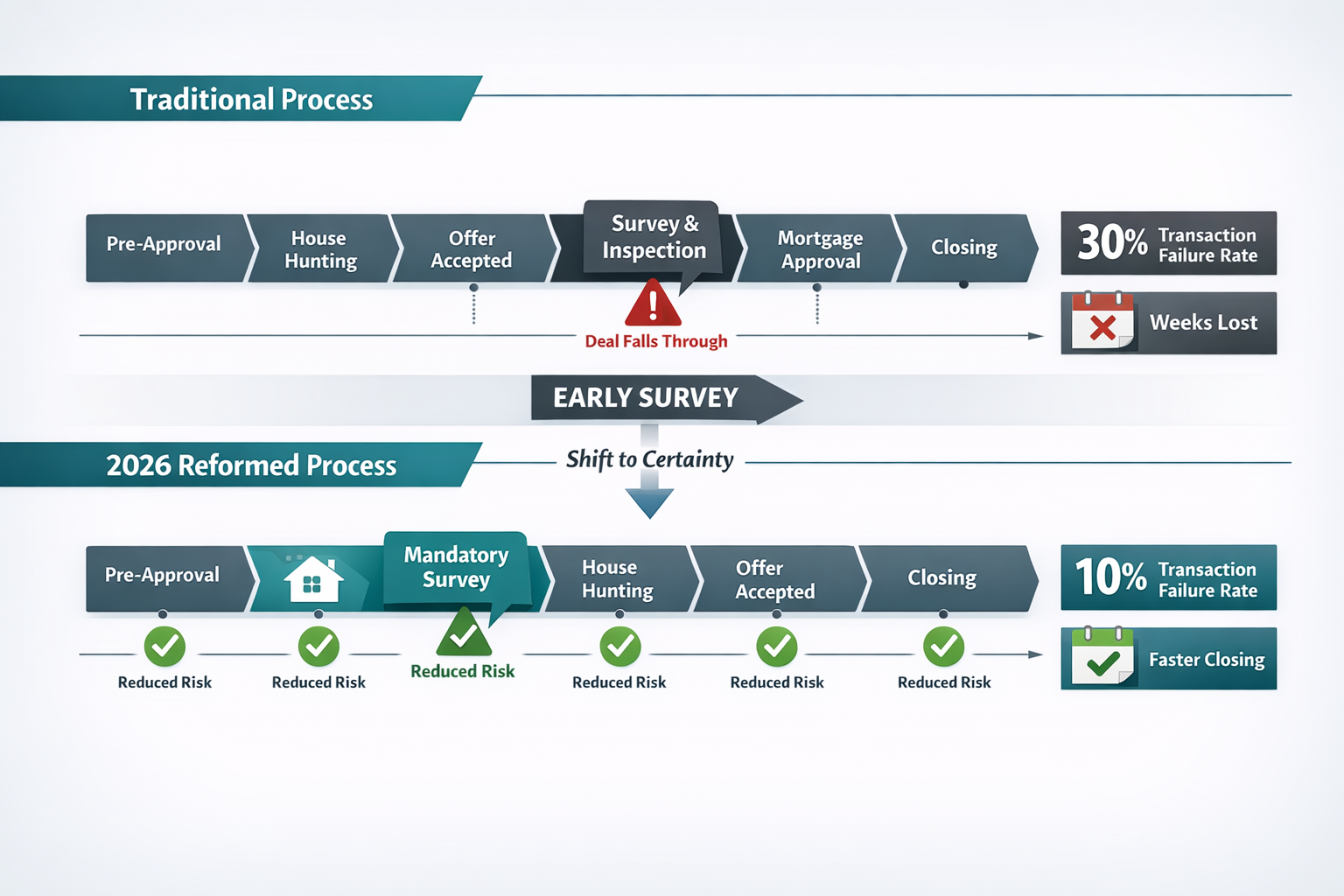
Parallel reforms in the UK property market have introduced mandatory upfront property condition assessments that reshape transaction timelines [1]. Rather than conducting building surveys after purchase agreements are signed, buyers now commission comprehensive assessments before making formal offers.
This fundamental timing shift delivers several certainty-enhancing benefits:
✅ Reduced Transaction Failures: Early identification of defects prevents collapsed deals after significant time and money investment
✅ Protected Survey Investment: If transactions fail, buyers haven't wasted survey fees on properties they ultimately reject
✅ Informed Negotiation: Buyers enter price discussions with complete knowledge of required repairs and associated costs
✅ Streamlined Timelines: Post-agreement processes move faster without awaiting survey results
Building Safety Act 2022 Implications
The Building Safety Act 2022 continues to influence property transactions throughout 2026, establishing the "golden thread" of information that ensures key details about design decisions, materials, and installation methods remain traceable throughout a building's lifecycle [4].
This regulatory framework creates:
- Clearer duty holder roles during design and construction stages
- Enhanced documentation requirements for building materials and methods
- Expanded Building Safety Regulator oversight beyond high-rise residential
- Reduced liability exposure through comprehensive record-keeping
For building surveyors, these requirements translate to more thorough documentation reviews and enhanced due diligence protocols that protect transaction participants from future compliance issues.
How Building Surveyors Reduce Risk Through Enhanced Assessment Methodologies
Comprehensive Property Condition Assessments
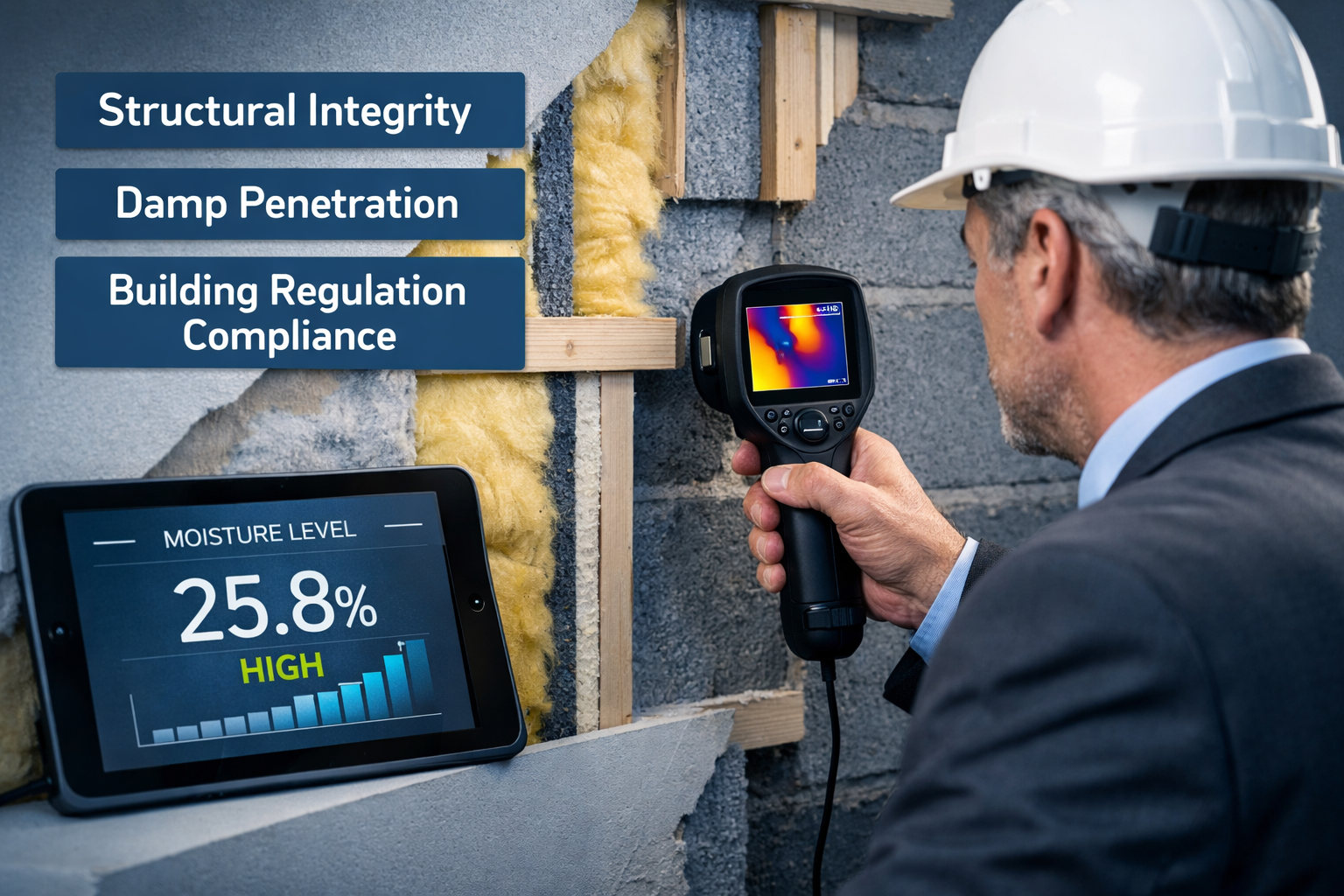
Modern building surveyors employ multi-layered assessment approaches that go far beyond traditional visual inspections. In 2026's uncertain market conditions, chartered surveyors across London and surrounding regions utilize advanced technologies and systematic methodologies to uncover hidden defects that could derail transactions.
Advanced Diagnostic Technologies 🔬
| Technology | Application | Risk Mitigation Benefit |
|---|---|---|
| Thermal Imaging | Detect moisture ingress, insulation gaps, heating system issues | Identifies hidden damp problems before they escalate |
| Moisture Meters | Measure dampness levels in walls, floors, ceilings | Quantifies water penetration severity for accurate repair costing |
| Drone Surveys | Inspect roofs, chimneys, high-level features safely | Eliminates "inaccessible areas" disclaimers that create uncertainty |
| Structural Monitoring | Track movement in cracks, subsidence, settlement | Distinguishes active structural issues from historic settlement |
| Electrical Testing | Assess wiring safety, circuit integrity, grounding | Prevents post-purchase safety hazards and rewiring costs |
These technologies enable surveyors to provide definitive assessments rather than qualified opinions hedged with caveats about inaccessible areas—a critical distinction when transaction certainty is paramount.
Risk-Stratified Reporting Frameworks
Transaction Certainty in Spring 2026: How Building Surveyors Reduce Risk in Uncertain Market Conditions depends heavily on how surveyors communicate findings. Modern reporting frameworks employ risk stratification that helps clients prioritize concerns and make informed decisions.
Three-Tier Risk Classification System 🚦
🟢 Category 1 (Green): No repair currently needed. Normal maintenance required.
🟡 Category 2 (Amber): Repairs or replacements requiring future attention, but estimates are still advised. Defects that are serious enough to require repair or replacement but are not considered urgent.
🔴 Category 3 (Red): Defects that are serious and/or need urgent repair or replacement. These defects may cause problems to other parts of the property or cause a safety hazard.
This clear visual hierarchy enables buyers to quickly assess whether a property represents an acceptable risk profile for their circumstances and budget.
Boundary and Title Verification Protocols
Property boundary disputes represent one of the most common sources of post-transaction litigation. The 2026 ALTA/NSPS Standards place greater emphasis on boundary clarity and encumbrance disclosure [2], requiring surveyors to:
- Cross-reference recorded documents with physical measurements
- Identify and explain discrepancies between deed descriptions and actual boundaries
- Coordinate with title insurers to ensure accurate easement depiction
- Document water boundary conditions with date-stamped measurements
- Research non-public records including railroad and highway plans
For properties in areas like Kingston, West London, and South West London, where property boundaries often involve complex historical easements and shared access arrangements, this enhanced verification protocol significantly reduces post-purchase dispute risk.
Building Regulation Compliance Verification
Unauthorized alterations and non-compliant building work represent hidden time bombs that can devastate property values and create legal liability. Building surveyors in 2026 employ systematic compliance verification protocols:
Key Compliance Checkpoints ✓
- Structural alterations: Verify Building Control approval for removed walls, loft conversions, extensions
- Electrical installations: Confirm Part P compliance for electrical work completed since 2005
- Drainage modifications: Check Building Control notification for drainage system changes
- Window replacements: Verify FENSA certificates or Building Control approval for post-2002 installations
- Energy efficiency: Assess compliance with current thermal performance standards
This verification process protects buyers from inheriting compliance problems that could require expensive remediation or complicate future sales.
Transaction Certainty in Spring 2026: Evidence-Based Valuation and Transparent Reporting
Evidence-Based Valuation Methodologies
In volatile market conditions, accurate property valuation becomes increasingly critical for transaction certainty. Building surveyors employ evidence-based valuation methodologies that provide defensible assessments grounded in comparable sales data, condition adjustments, and market trend analysis.
Valuation Adjustment Factors 💷
Professional valuations in 2026 incorporate systematic adjustments for:
- Structural condition: Deductions for subsidence, cracking, settlement issues
- Service condition: Adjustments for heating, electrical, plumbing system age and condition
- Compliance status: Reductions for non-compliant alterations requiring remediation
- Energy efficiency: Premiums for high-EPC properties, discounts for poor performers
- Location factors: Adjustments for flood risk, transport links, local amenities
- Market sentiment: Consideration of demand uncertainty affecting pricing [5]
These systematic adjustments ensure valuations reflect actual property condition rather than optimistic asking prices, protecting lenders from over-exposure and buyers from overpayment.
Transparent Cost Forecasting
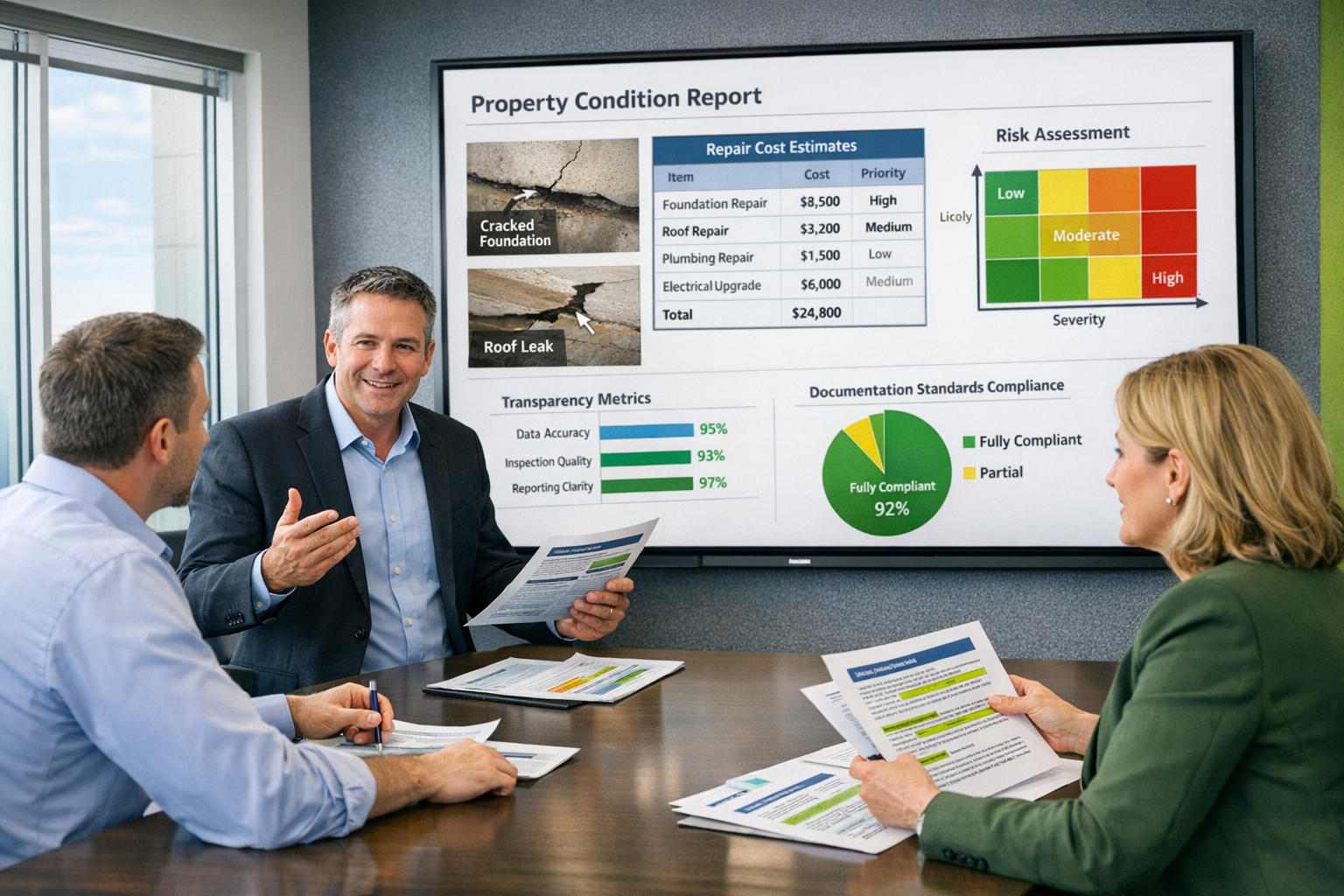
One of the most valuable certainty-enhancing services building surveyors provide is transparent repair cost forecasting. Rather than simply identifying defects, modern survey reports include:
📊 Itemized Repair Estimates
- Specific cost ranges for each identified defect
- Prioritization by urgency (immediate vs. medium-term vs. long-term)
- Identification of specialist contractors required
- Contingency allowances for hidden defects likely to emerge during work
📅 Maintenance Forecasting
- Projected replacement timelines for major building elements
- Anticipated costs for routine maintenance over 5-10 year horizons
- Lifecycle cost analysis for heating systems, roofing, windows, etc.
This financial transparency enables buyers to accurately budget for property ownership costs and negotiate purchase prices that reflect true property condition.
Enhanced Coordination with Transaction Stakeholders
Transaction Certainty in Spring 2026: How Building Surveyors Reduce Risk in Uncertain Market Conditions requires seamless coordination among all transaction participants. The 2026 standards explicitly mandate enhanced communication protocols [2]:
Surveyor-Title Insurer Coordination 🤝
- Notification of discovered easements not listed in preliminary title reports
- Collaborative determination of easement applicability and boundary impact
- Joint resolution of discrepancies between recorded and measured dimensions
- Coordinated presentation of findings to reduce conflicting information
Surveyor-Lender Communication 🏦
- Direct reporting of valuation-affecting defects
- Risk assessment summaries tailored to lending criteria
- Retention recommendations for properties requiring remediation
- Post-repair verification protocols
Surveyor-Buyer Advisory 👥
- Plain-language explanations of technical findings
- Risk-benefit analysis for properties with identified defects
- Guidance on specialist investigations when required
- Recommendations for purchase price adjustments
This multi-stakeholder coordination eliminates information silos that historically created uncertainty and transaction delays.
Digital Documentation and Accessibility
Modern building surveyors leverage digital platforms to enhance report accessibility and usability:
Digital Report Features 💻
- Interactive floor plans with defect location markers
- Embedded photographs with annotated defect identification
- Video walkthroughs for complex structural issues
- Hyperlinked reference documents and compliance certificates
- Mobile-responsive formats for on-site reference
These digital enhancements ensure all transaction participants can easily access, understand, and reference survey findings throughout the transaction process and beyond.
Specialized Survey Services for Complex Transactions
Commercial Property Assessments
Commercial property transactions involve additional complexity requiring specialized surveyor expertise. Commercial building surveys in London address unique considerations:
- Multi-tenancy implications: Assessment of demised boundaries and landlord/tenant repair responsibilities
- Business continuity: Evaluation of building systems supporting operational requirements
- Compliance complexity: Verification of fire safety, accessibility, and commercial building regulations
- Lease obligations: Review of repairing covenants and dilapidations liability
For commercial transactions, surveyors often prepare schedules of condition that document property condition at lease commencement, protecting both landlords and tenants from future disputes.
Leasehold Property Considerations
Leasehold properties present unique assessment challenges requiring specialized knowledge of lease obligations, service charge liability, and building insurance requirements. Surveyors assess:
- Lease term adequacy: Evaluation of remaining lease length for mortgage eligibility
- Service charge reasonableness: Review of historical charges and planned major works
- Building insurance: Verification of adequate coverage and freeholder compliance
- Shared structure condition: Assessment of common parts affecting leasehold value
These specialized assessments prove particularly valuable in areas like Hertfordshire, Harrow, and Hemel Hempstead, where leasehold properties represent significant portions of housing stock.
Heritage and Listed Building Surveys
Properties with listed building status or located in conservation areas require surveyors with specialized heritage expertise who understand:
- Conservation principles: Appropriate repair methodologies that preserve historic fabric
- Listed building consent: Identification of alterations requiring regulatory approval
- Specialist materials: Sourcing requirements for traditional building materials
- Enhanced maintenance: Increased upkeep requirements for historic properties
Strategic Benefits of Early Survey Commissioning
Financial Protection Through Early Assessment
The shift toward mandatory upfront surveys delivers tangible financial benefits for all transaction participants [1]:
For Buyers 💰
- Avoid wasted survey fees on properties ultimately rejected
- Negotiate purchase prices reflecting actual condition
- Budget accurately for post-purchase repairs
- Secure appropriate mortgage products based on property condition
For Sellers 🏠
- Identify and remediate defects before marketing
- Set realistic asking prices reflecting property condition
- Reduce transaction fall-through rates
- Demonstrate transparency that builds buyer confidence
For Lenders 🏦
- Reduce exposure to over-valued properties
- Make informed lending decisions based on comprehensive condition data
- Minimize default risk from unexpected repair costs
- Streamline approval processes with complete information upfront
Competitive Advantage in Uncertain Markets
Properties with comprehensive, recent survey reports gain competitive advantages in uncertain market conditions:
✨ Enhanced Marketability: Buyers perceive surveyed properties as lower-risk investments
⚡ Faster Transactions: Pre-surveyed properties progress more quickly through offer-to-completion
🎯 Serious Buyer Attraction: Comprehensive documentation attracts committed purchasers rather than speculative offers
💪 Negotiation Strength: Transparent condition disclosure reduces aggressive price reduction demands
Regional Considerations Across London and the Southeast
Building surveyors across different regions encounter area-specific challenges requiring local expertise:
Central and Inner London
Properties in areas like Islington, Camden, and Battersea present unique assessment challenges:
- Victorian and Edwardian terraces: Common structural movement, damp issues, outdated services
- Conversion properties: Verification of Building Control approval for flat conversions
- Conservation areas: Enhanced planning restrictions affecting alterations
- Shared access: Complex easement arrangements requiring careful documentation
Outer London Suburbs
Suburban locations including Ealing, Hounslow, Bromley, and Bexley feature different property types:
- Inter-war semi-detached houses: Cavity wall tie corrosion, concrete tile roofing issues
- 1960s-70s developments: Concrete construction, flat roof problems, dated systems
- Garden boundaries: Fence and wall ownership verification
- Parking and access: Driveway rights and shared access arrangements
Home Counties
Properties in Sussex, Buckinghamshire, and surrounding counties present rural and semi-rural considerations:
- Drainage systems: Private sewage treatment plants and septic tanks
- Boundary extent: Larger plot sizes requiring comprehensive boundary surveys
- Agricultural buildings: Conversion compliance and structural adequacy
- Flood risk: Enhanced assessment in river valley locations
Future-Proofing Transactions: Long-Term Risk Mitigation
Climate Resilience Assessment
Forward-thinking building surveyors in 2026 incorporate climate resilience factors into property assessments:
🌡️ Overheating Risk: Assessment of thermal performance in increasingly hot summers
💧 Flood Resilience: Evaluation of flood defense adequacy and drainage capacity
🌪️ Storm Resistance: Review of roof and structural integrity against extreme weather
🌱 Retrofit Potential: Assessment of property suitability for energy efficiency improvements
These forward-looking assessments protect buyers from properties that may become difficult to insure, mortgage, or sell as climate risks intensify.
Technology Integration and Smart Building Assessment
Modern properties increasingly incorporate smart building technologies requiring specialized assessment:
- Smart heating systems: Evaluation of installation quality and system integration
- Solar PV installations: Verification of MCS certification and structural adequacy
- EV charging points: Assessment of electrical capacity and installation compliance
- Home automation: Review of system quality and documentation
Surveyors who understand these technologies provide more comprehensive risk assessments for contemporary properties.
Selecting the Right Building Surveyor for Transaction Certainty
Professional Qualifications and Accreditations
When transaction certainty is paramount, selecting appropriately qualified surveyors proves essential:
Key Professional Credentials 🎓
- RICS Membership: Chartered status (MRICS or FRICS) ensuring professional standards
- Specialist Accreditations: Additional qualifications in historic buildings, structural engineering, etc.
- Professional Indemnity Insurance: Adequate coverage protecting clients from professional negligence
- Continuing Professional Development: Evidence of ongoing training in evolving standards and technologies
Relevant Experience and Local Knowledge
Surveyors with specific experience in relevant property types and local markets deliver superior insights:
- Property type expertise: Residential vs. commercial vs. heritage specialization
- Local market knowledge: Understanding of area-specific construction types and common defects
- Regulatory familiarity: Experience with local planning and building control requirements
- Professional networks: Relationships with local contractors for accurate repair cost estimates
Communication and Report Quality
The value of a building survey depends heavily on report clarity and accessibility:
✅ Clear language: Technical findings explained in plain English
✅ Visual documentation: Comprehensive photographs with clear defect identification
✅ Actionable recommendations: Specific guidance on remediation priorities and costs
✅ Responsive communication: Availability to answer questions and clarify findings
Conclusion
Transaction Certainty in Spring 2026: How Building Surveyors Reduce Risk in Uncertain Market Conditions represents more than regulatory compliance—it embodies a fundamental shift toward transparency, evidence-based decision-making, and proactive risk mitigation that protects all transaction participants.
The convergence of enhanced ALTA/NSPS Standards, mandatory upfront survey requirements, and Building Safety Act compliance creates an environment where building surveyors serve as essential gatekeepers of transaction certainty. Through comprehensive property assessments, advanced diagnostic technologies, risk-stratified reporting, and transparent cost forecasting, professional surveyors deliver the confidence that buyers, sellers, and lenders need to transact in volatile market conditions.
The strategic benefits extend beyond individual transactions. Properties with comprehensive survey documentation gain competitive advantages through enhanced marketability, faster transaction timelines, and reduced fall-through rates. Early survey commissioning protects financial investments, enables informed negotiation, and eliminates the costly surprises that historically derailed property purchases.
Next Steps for Transaction Certainty
For Property Buyers 🏡
- Commission comprehensive building surveys before making formal offers
- Select RICS-chartered surveyors with relevant local experience
- Review survey reports thoroughly and seek clarification on unclear findings
- Use survey findings to negotiate purchase prices reflecting actual property condition
- Budget for identified repairs and maintenance based on surveyor cost estimates
For Property Sellers 📋
- Consider pre-sale surveys to identify and remediate defects before marketing
- Gather compliance documentation for all building work and alterations
- Provide transparent disclosure of known defects to build buyer confidence
- Set realistic asking prices reflecting comprehensive property condition
- Maintain detailed records of repairs, maintenance, and improvements
For Property Professionals 💼
- Partner with qualified building surveyors to enhance client service
- Educate clients on the value of early, comprehensive property assessments
- Coordinate effectively among surveyors, title insurers, and lenders
- Advocate for transparent reporting that builds transaction certainty
- Stay informed on evolving regulatory standards affecting property transactions
In spring 2026's uncertain market conditions, building surveyors who embrace enhanced transparency requirements, leverage advanced assessment technologies, and deliver evidence-based reporting will differentiate themselves as essential partners in successful property transactions. The question is no longer whether to commission comprehensive surveys, but rather how quickly transaction participants can access the professional expertise that transforms uncertainty into confidence.
References
[1] Homebuying Process Reforms 2026 How Mandatory Upfront Surveys Will Transform Building Surveyor Workloads – https://nottinghillsurveyors.com/blog/homebuying-process-reforms-2026-how-mandatory-upfront-surveys-will-transform-building-surveyor-workloads
[2] 2026 Alta Survey Standards Updates 7956483 – https://www.jdsupra.com/legalnews/2026-alta-survey-standards-updates-7956483/
[3] Building For Certainty How Smart Planning Reduces Construction Risk – https://www.jll.com/en-us/insights/building-for-certainty-how-smart-planning-reduces-construction-risk
[4] Helping Builders Stay Compliant As Construction Rules Evolve In 2026 – https://www.propertywire.com/analysis/helping-builders-stay-compliant-as-construction-rules-evolve-in-2026/
[5] Survey Reveals Demand Uncertainty Is Changing 2026 Homebuilding Strategy – https://www.housingwire.com/articles/survey-reveals-demand-uncertainty-is-changing-2026-homebuilding-strategy/
[6] Why Alta Surveys Matter In Commercial Real Estate – https://mcsteen.com/why-alta-surveys-matter-in-commercial-real-estate/
[7] Homebuying Process Reforms 2026 Impact On Early Building Surveys And Valuation Timing – https://nottinghillsurveyors.com/blog/homebuying-process-reforms-2026-impact-on-early-building-surveys-and-valuation-timing