
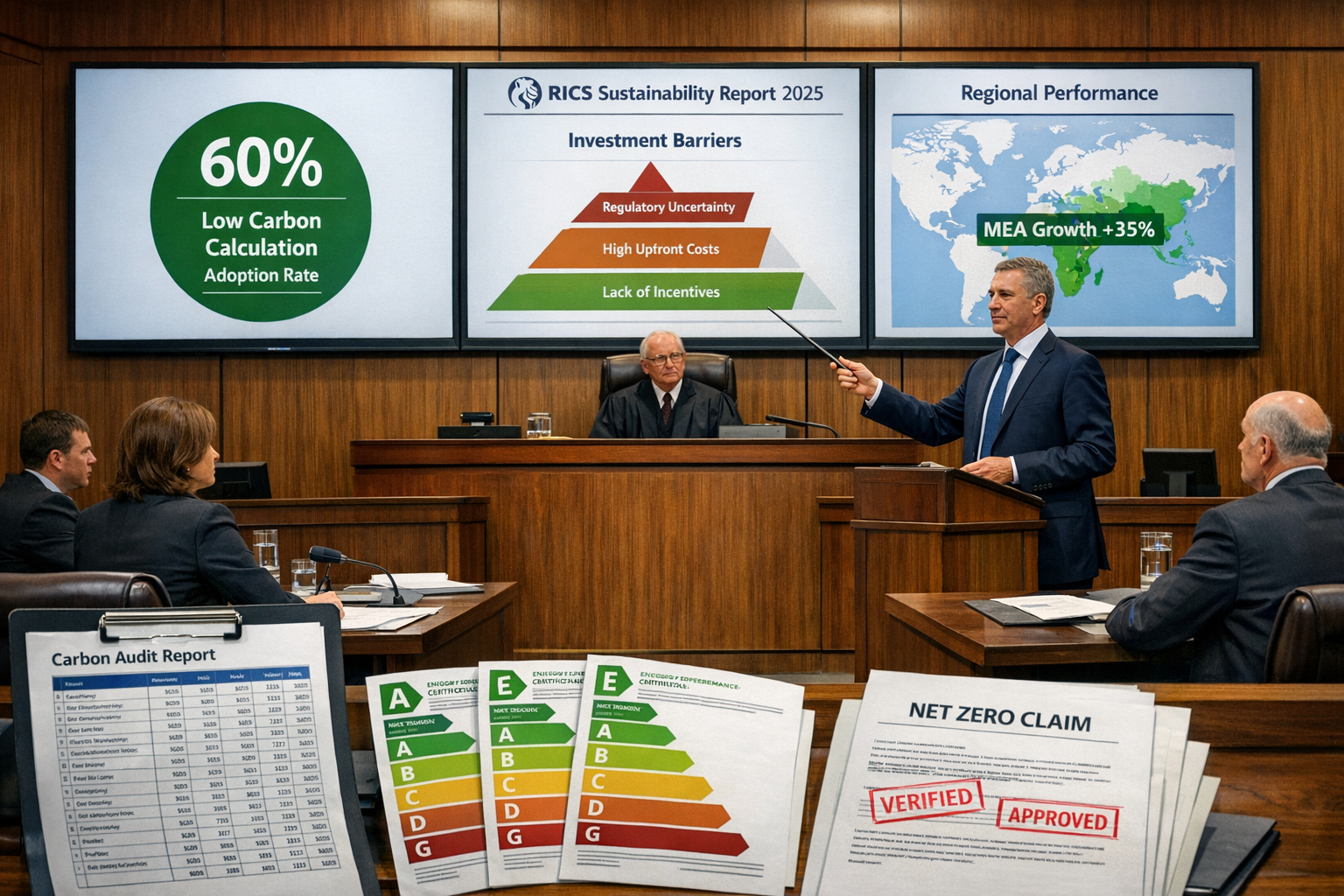
Over 60% of commercial real estate professionals admit they conduct carbon calculations and climate resilience assessments in less than half their projects—or not at all. This startling revelation from the RICS Sustainability Report 2025 exposes a critical vulnerability as mandatory ESG metrics take effect in April 2026, transforming sustainability claims from marketing statements into hard valuation evidence subject to courtroom scrutiny [3]. For chartered surveyors serving as expert witnesses, this paradigm shift demands immediate preparation for a surge in disputes over net zero claims, retrofit valuations, and green building premiums.
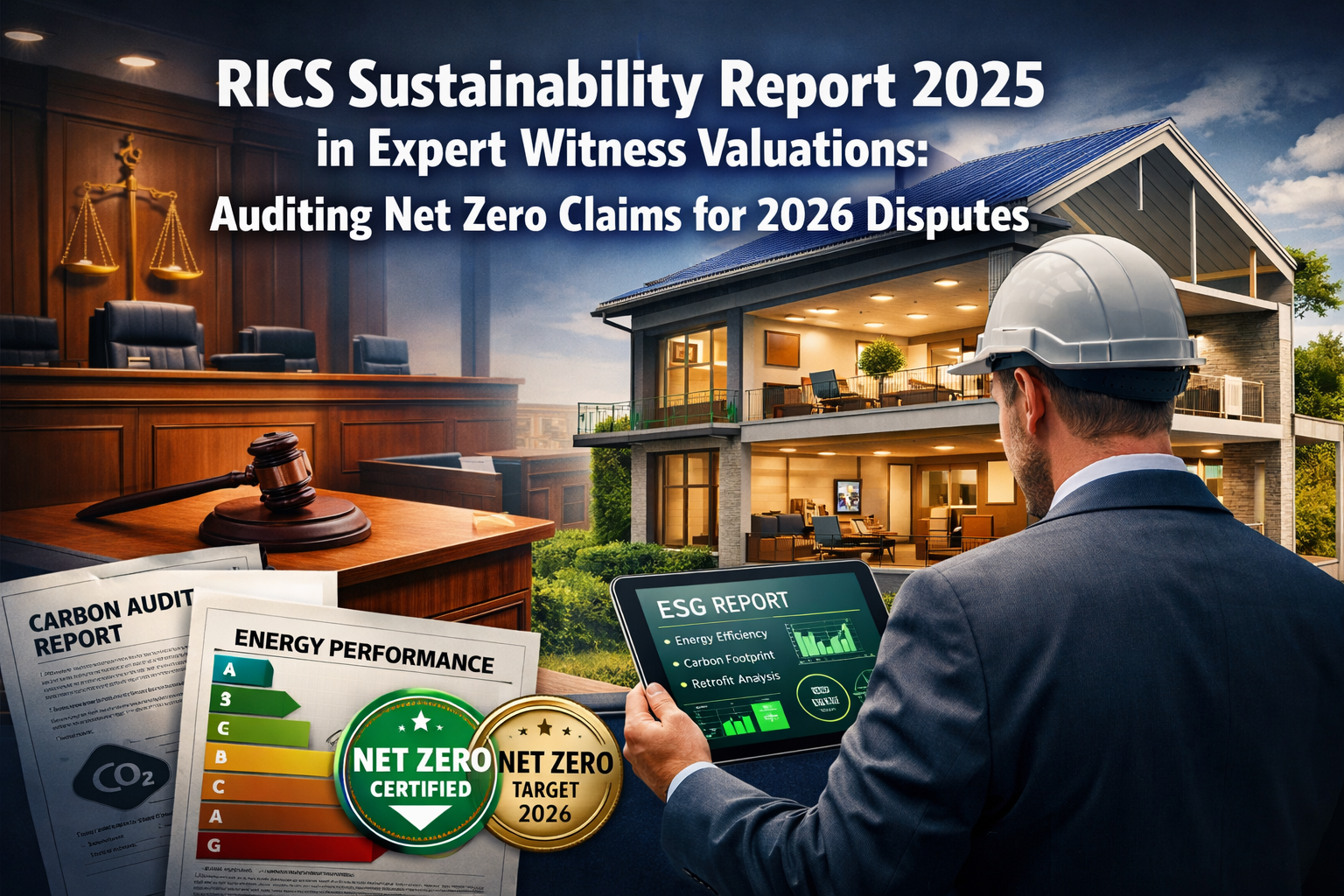
The convergence of stricter valuation standards and widespread underperformance in sustainability adoption creates a perfect storm for litigation. As RICS Sustainability Report 2025 in Expert Witness Valuations: Auditing Net Zero Claims for 2026 Disputes becomes a critical framework, surveyors must master the technical evidence, cross-examination strategies, and regulatory knowledge required to defend or challenge green property valuations in court.
Key Takeaways
- Mandatory ESG integration from April 2026 transforms sustainability from optional consideration to required valuation metric, increasing dispute likelihood
- 60%+ adoption gap in carbon calculations and climate assessments creates widespread vulnerability to challenge in expert witness testimony
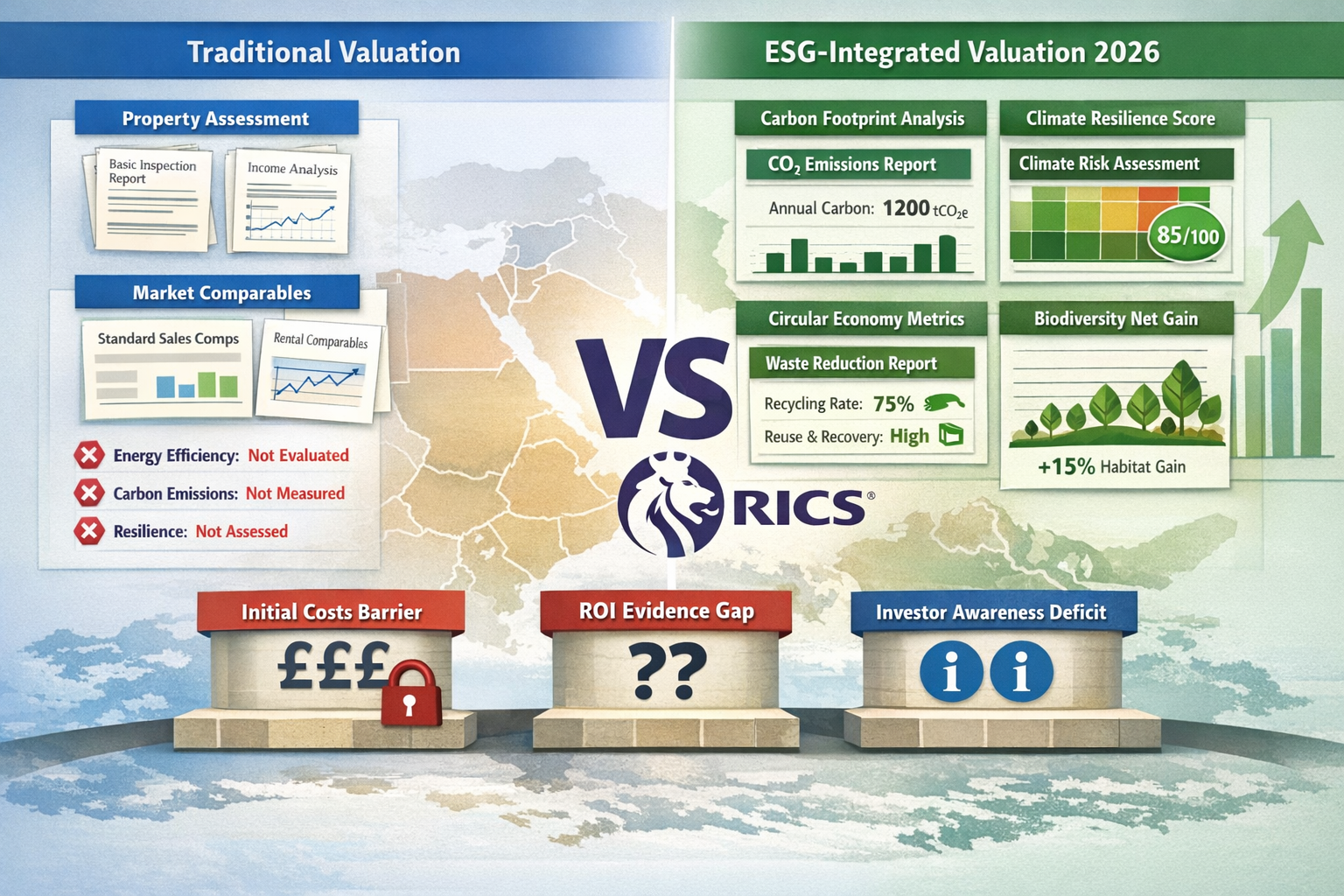
- Three primary barriers—initial costs, ROI evidence gaps, and investor awareness deficits—form the foundation of most net zero claim disputes
- Updated RICS standards for expert witnesses require enhanced skills, knowledge, and experience specifically in sustainability metrics and green building assessment
- Regional performance variance particularly in MEA markets demands geographically informed valuation approaches for international disputes
Understanding the RICS Sustainability Report 2025 Framework
The RICS Sustainability Report 2025 examined sentiments from over 3,500 global professionals across commercial real estate and construction sectors, providing the most comprehensive snapshot of industry sustainability performance to date [3]. This research forms the evidentiary foundation for understanding market standards, professional practices, and reasonable expectations in green building disputes.
Key Findings Impacting Expert Witness Work
The 2025 RICS Sustainable Building Index (SBI) reveals a troubling trend: while remaining in positive territory, demand growth for green buildings has significantly slowed, and the sector remains largely stagnant in adopting sustainable practices [3]. This stagnation directly impacts valuation disputes, as claimants often assert premium values based on sustainability features that market data may not support.
Critical adoption metrics include:
- 🔴 60%+ of respondents report conducting carbon calculations in less than half of projects or not at all
- 🔴 60%+ of professionals perform climate resilience assessments infrequently or never
- 🟢 40% regularly track waste reduction and data-sharing practices
- 🟡 Regional variance shows MEA (Middle East and Africa) outpacing other regions in demand growth [3]
These statistics establish baseline professional standards that expert witnesses must reference when assessing whether a surveyor's sustainability evaluation meets reasonable industry expectations.
The Three Investment Barriers Framework
The Report identifies three primary obstacles blocking sustainable investment, creating a structured framework for analyzing disputed valuations [3]:
| Barrier | Impact on Valuations | Expert Witness Considerations |
|---|---|---|
| Initial Costs | Inflated retrofit estimates reduce property values | Must verify actual vs. projected costs with comparable data |
| Lack of ROI Evidence | Disputed green premiums lack market support | Requires robust comparable analysis and yield calculations |
| Investor Awareness Gaps | Market perception vs. actual sustainability performance | Demands education of tribunal on market sophistication levels |
When preparing expert witness reports, surveyors must address each barrier explicitly, demonstrating how market participants actually weigh sustainability factors rather than how they theoretically should.
RICS Sustainability Report 2025 in Expert Witness Valuations: Mandatory ESG Metrics from April 2026
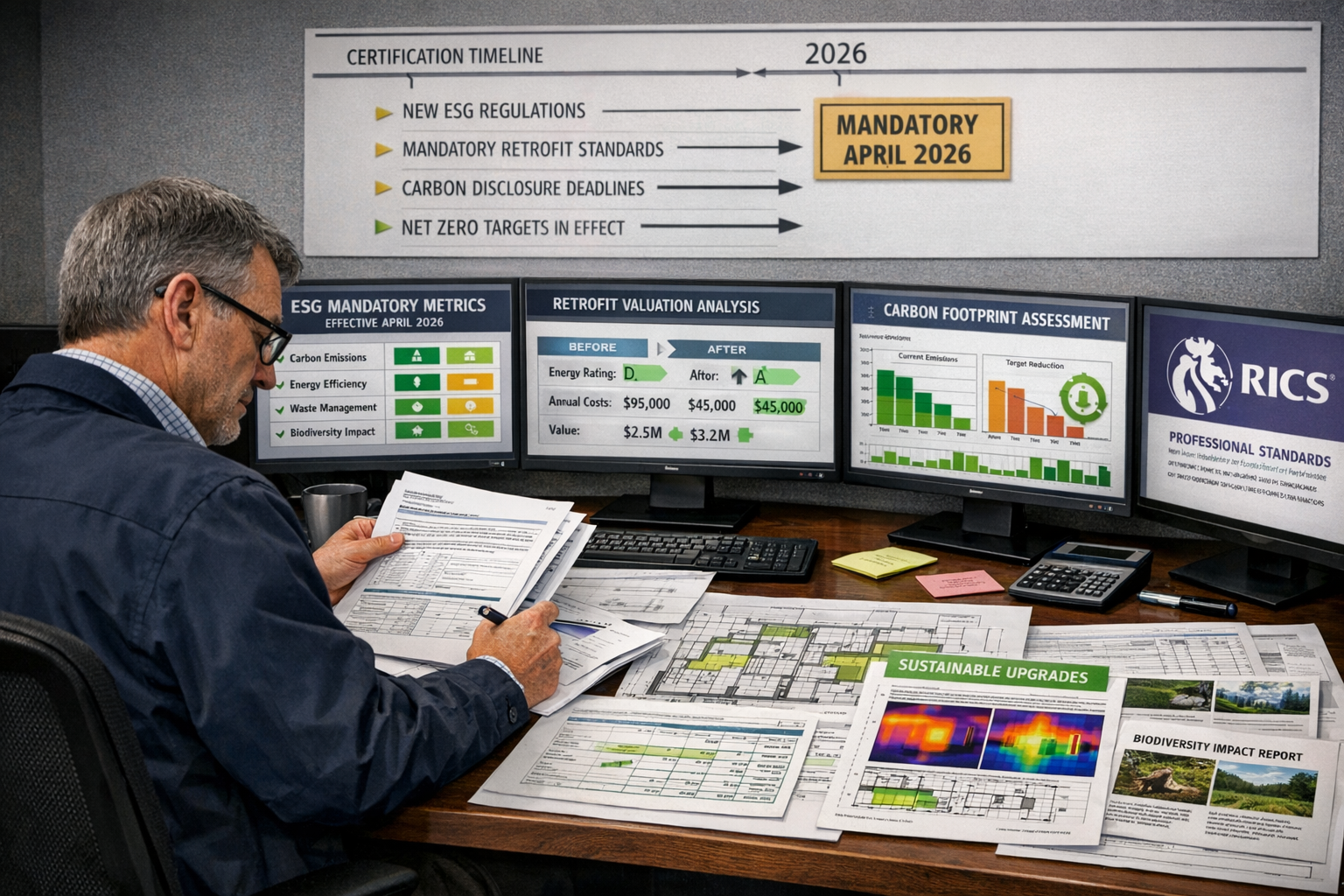
The regulatory landscape shifted dramatically in April 2026 when Environmental, Social, and Governance (ESG) factors became mandatory valuation metrics for all real estate [5][6]. This transformation elevates sustainability from a "nice-to-have" consideration to a fundamental component of property value, creating new grounds for dispute and expert challenge.
What Changed in April 2026
Previously, surveyors exercised discretion in whether and how to incorporate sustainability factors into valuations. The 2026 mandate removes this flexibility, requiring explicit consideration and documentation of:
✅ Carbon footprint calculations and reduction pathways
✅ Climate resilience assessments including flood risk, heat stress, and extreme weather adaptation
✅ Energy performance beyond basic EPC ratings
✅ Circular economy metrics including waste reduction and material reuse
✅ Biodiversity impact and net gain contributions
✅ Social value factors including community benefit and accessibility
For expert witnesses, this creates a clear standard against which to audit contested valuations. Any valuation report prepared after April 2026 that omits these factors becomes vulnerable to challenge on professional standards grounds.
Applying RICS Sustainability Report 2025 Data to Court Evidence
The Report's finding that 60%+ of professionals conduct inadequate carbon and resilience assessments [3] creates a powerful cross-examination tool. When challenging an opposing expert's valuation that claims sustainability premiums, counsel can establish:
- Industry-wide underperformance in sustainability assessment
- Lack of standardized methodology for carbon calculations
- Insufficient comparable evidence for green premiums
- Regional variation in sustainability adoption affecting market comparables
Conversely, when defending a sustainability-adjusted valuation, expert witnesses must demonstrate their methodology exceeds the baseline 40% adoption rate, placing their work in the upper tier of professional practice.
Auditing Net Zero Claims: Technical Evidence for 2026 Disputes
Net zero claims represent the highest-risk category for valuation disputes in 2026. These assertions—whether about current performance or future capability—require rigorous technical verification that many surveyors lack the specialized knowledge to provide.
The Carbon Calculation Challenge
The RICS Sustainability Report 2025 reveals that carbon calculations remain uncommon practice, with 60%+ of professionals conducting them infrequently or never [3]. This creates a knowledge gap that expert witnesses must address through:
Operational Carbon Analysis:
- Scope 1: Direct emissions from building operations
- Scope 2: Indirect emissions from purchased energy
- Scope 3: Value chain emissions including construction and materials
Embodied Carbon Assessment:
- Material extraction and manufacturing impacts
- Transportation and construction process emissions
- End-of-life disposal or recycling considerations
When auditing net zero claims in specific defect reports or valuation disputes, expert witnesses must verify whether calculations include all relevant scopes or cherry-pick favorable metrics.
Retrofit Valuation Disputes
The Report identifies initial costs as a primary investment barrier [3], making retrofit valuations particularly contentious. Common dispute scenarios include:
Scenario 1: Over-Optimistic Energy Savings
- Claimant asserts 50% energy reduction from proposed retrofits
- Expert audit reveals 20-30% realistic savings based on comparable buildings
- Valuation premium adjustment required
Scenario 2: Stranded Asset Risk
- Property valued without considering future regulatory compliance costs
- Expert evidence demonstrates retrofit requirements to meet 2030 standards
- Significant value reduction justified
Scenario 3: Green Premium Without Market Evidence
- Seller claims 15% premium for BREEAM Excellent certification
- Market analysis shows limited buyer willingness to pay premium
- Expert must educate tribunal on actual vs. theoretical market behavior
For properties requiring insurance reinstatement valuations, sustainability features create additional complexity in determining replacement cost with equivalent green specifications.
Climate Resilience Assessment Standards
With 60%+ of professionals conducting inadequate climate resilience assessments [3], disputes increasingly center on whether properties can withstand projected climate impacts. Expert witnesses must evaluate:
🌊 Flood Risk Analysis
- Current flood zone designations
- Projected changes under climate scenarios
- Adaptation measures and costs
🔥 Heat Stress Vulnerability
- Passive cooling capacity
- Overheating risk in summer months
- Retrofit requirements for habitability
💨 Extreme Weather Preparedness
- Structural resilience to high winds
- Drainage capacity for intense rainfall events
- Maintenance requirements for climate adaptation
When preparing evidence for matrimonial valuations or probate valuations, climate resilience factors increasingly affect long-term value projections that expert witnesses must defend.
Cross-Examination Preparation for Green Building Disputes
The RICS Risk Outlook Report 2025 notes increased scrutiny of expert witness services, with a Practice Alert issued in April 2025 addressing issues in high-volume litigation [2]. This heightened attention demands meticulous preparation for cross-examination on sustainability claims.
Anticipating Common Challenge Lines
Based on the RICS Sustainability Report 2025 findings, expert witnesses should prepare for these predictable challenge areas:
Challenge 1: "Isn't it true that 60% of your profession doesn't conduct carbon calculations regularly?"
Effective Response Strategy:
- Acknowledge industry-wide gaps while distinguishing your practice
- Reference specialized training and certification
- Present methodology documentation demonstrating rigorous approach
- Cite specific comparable properties where carbon calculations influenced value
Challenge 2: "How can you justify a green premium when the Report shows stagnant demand growth?"
Effective Response Strategy:
- Distinguish between overall market trends and specific property segments
- Present transaction evidence showing premium realization
- Explain regional variations (MEA outperformance) [3]
- Address future-proofing value separate from current demand
Challenge 3: "Your valuation assumes net zero capability, but what evidence supports this claim?"
Effective Response Strategy:
- Present detailed energy modeling from qualified assessors
- Reference building fabric specifications and systems capacity
- Provide comparable net zero buildings with verified performance
- Acknowledge uncertainty ranges and provide sensitivity analysis
Demonstrating Compliance with Updated RICS Standards
The global standard for surveyors acting as expert witnesses is currently being updated [2], with enhanced emphasis on:
- Skills verification in specialized areas including sustainability assessment
- Knowledge demonstration of current regulations and market practices
- Relevant experience in green building valuation and carbon auditing
Expert witnesses must proactively establish these credentials during examination-in-chief, preempting challenges to their qualification for sustainability-related opinions.
Documentation Standards for Sustainability Evidence
To withstand cross-examination, expert witnesses should maintain comprehensive documentation including:
📋 Methodology Records
- Detailed carbon calculation worksheets
- Climate resilience assessment protocols
- Comparable property selection criteria
- Adjustment rationale for sustainability factors
📋 Market Evidence Files
- Transaction data showing green premiums or discounts
- Buyer sentiment surveys and market research
- Regional performance comparisons
- Regulatory compliance cost analyses
📋 Professional Development
- Sustainability training certificates
- Continuing professional development records
- Specialist accreditations (LEED AP, BREEAM Assessor, etc.)
- Previous expert witness experience in green disputes
This documentation proves particularly valuable in divorce valuations where opposing parties may challenge sustainability adjustments affecting asset division.
Regional Considerations and International Disputes
The RICS Sustainability Report 2025 highlights significant regional performance variance, with MEA (Middle East and Africa) emerging as a strong performer in sustainability demand growth [3]. This geographic dimension adds complexity to expert witness work in international disputes.
Adapting Evidence to Regional Markets
Expert witnesses must calibrate sustainability expectations to local market conditions:
MEA Region (High Growth):
- Stronger green premiums justified by market evidence
- Government sustainability mandates driving demand
- New construction dominates, reducing retrofit complexity
- Climate resilience focus on heat and water scarcity
Europe (Mature Market):
- Established green building standards and market acceptance
- Retrofit challenges in historic building stock
- Stringent regulatory requirements affecting valuation
- Climate resilience emphasis on flooding and temperature extremes
Asia-Pacific (Mixed Performance):
- Wide variation between developed and emerging markets
- Government policy driving adoption in some jurisdictions
- Air quality considerations alongside carbon metrics
- Rapid regulatory evolution creating valuation uncertainty
When providing expert evidence for properties in central London versus international holdings, surveyors must demonstrate market-specific knowledge of sustainability adoption rates and buyer preferences.
Cross-Border Dispute Complications
International disputes involving sustainability claims require expert witnesses to address:
- Regulatory harmonization (or lack thereof) across jurisdictions
- Comparable property availability in markets with limited green building stock
- Currency and economic factors affecting retrofit cost-benefit analysis
- Cultural attitudes toward sustainability influencing market behavior
For commercial dilapidation surveys involving multinational tenants, sustainability obligations and associated costs vary significantly by jurisdiction, requiring careful expert analysis.
Practical Implementation: Preparing for the Green Dispute Surge
RICS is working with other professional bodies to address systemic risks around volume litigation [2], recognizing that sustainability disputes represent an emerging high-volume category. Surveyors must prepare now for this anticipated surge.
Building Specialist Expertise
The Report emphasizes that professional skills and knowledge development is essential for meaningful progress in sustainable practices [3]. Expert witnesses should pursue:
Technical Training:
- Carbon accounting and lifecycle assessment courses
- Climate risk modeling and adaptation planning
- Green building certification programs (LEED, BREEAM, WELL)
- Energy modeling and building physics fundamentals
Legal and Regulatory Knowledge:
- Understanding of mandatory ESG requirements from April 2026
- Familiarity with emerging sustainability litigation precedents
- Knowledge of sector-specific regulations (residential vs. commercial)
- International sustainability standards and frameworks
Market Research Skills:
- Analyzing transaction data for sustainability premiums/discounts
- Conducting buyer preference surveys and market sentiment analysis
- Tracking regional performance variations
- Monitoring policy changes affecting green building demand
Developing Robust Methodologies
To meet the heightened scrutiny anticipated in 2026 disputes, expert witnesses should develop and document standardized approaches for:
-
Carbon Footprint Verification
- Third-party data sources and validation
- Scope boundary definitions
- Calculation methodology transparency
- Uncertainty quantification
-
Climate Resilience Scoring
- Physical risk assessment frameworks
- Adaptation cost estimation
- Future scenario modeling
- Residual risk quantification
-
Green Premium Analysis
- Comparable property selection criteria
- Adjustment methodology for sustainability differences
- Market segment identification
- Temporal analysis of premium trends
-
Retrofit Valuation
- Cost estimation from multiple sources
- Energy savings verification approach
- Payback period calculations
- Value impact assessment methodology
These methodologies provide defensible frameworks when challenged during cross-examination in disputes ranging from lease extensions to freehold valuations.
Collaboration with Specialists
The complexity of sustainability assessment often exceeds traditional surveying expertise. Expert witnesses should establish relationships with:
- Energy Consultants for detailed performance modeling
- Climate Scientists for resilience assessment validation
- Sustainability Certifiers for green building standard interpretation
- Legal Counsel specializing in environmental and construction disputes
- Quantity Surveyors for retrofit cost verification
This collaborative approach strengthens expert evidence and demonstrates thoroughness when defending opinions under cross-examination.
Government Policy Recommendations and Future Outlook
The RICS Sustainability Report 2025 concludes with recommendations for government action [3], signaling likely regulatory developments that will shape future disputes:
Anticipated Policy Changes
Mandatory Carbon Assessment Reporting:
- Universal requirement for carbon calculations in valuations
- Standardized methodology reducing dispute scope
- Public disclosure requirements increasing transparency
- Penalties for non-compliance creating enforcement disputes
Decarbonization Pathway Definition:
- Clear regulatory roadmaps to net zero targets
- Phased compliance requirements affecting property values
- Retrofit mandates for existing buildings
- Stranded asset risk quantification
Green Building Investment Incentives:
- Tax benefits for sustainability improvements
- Grant programs for retrofit projects
- Preferential financing for green buildings
- Market intervention potentially distorting comparable evidence
Biodiversity Net Gain Scaling:
- Expanded requirements beyond current regulations
- Valuation impacts of on-site biodiversity measures
- Offsetting cost implications
- Disputes over measurement and compliance
Expert witnesses must monitor these policy developments, as they will fundamentally reshape the evidentiary landscape for sustainability disputes beyond 2026.
The Skills Development Imperative
The Report's emphasis on professional skills development [3] reflects recognition that current practitioner knowledge is insufficient for the mandatory ESG era. RICS has expanded training through the Dispute Resolution Service (DRS) [2], but individual surveyors must take responsibility for:
- Continuous learning in rapidly evolving sustainability science
- Methodology refinement as best practices emerge
- Peer review participation to maintain quality standards
- Research contribution advancing the evidence base for green valuations
Those who invest in specialist sustainability expertise now will be positioned as the go-to expert witnesses for the anticipated surge in green building disputes from 2026 onward.
Conclusion
The RICS Sustainability Report 2025 in Expert Witness Valuations: Auditing Net Zero Claims for 2026 Disputes represents a watershed moment for the surveying profession. With mandatory ESG metrics now in effect from April 2026, sustainability has transitioned from an optional consideration to a fundamental valuation component subject to rigorous courtroom scrutiny.
The Report's findings—particularly the 60%+ adoption gap in carbon calculations and climate resilience assessments—expose widespread vulnerability to challenge in expert witness testimony. The three primary investment barriers (initial costs, ROI evidence gaps, and investor awareness deficits) provide a structured framework for analyzing and presenting evidence in green building disputes.
Surveyors serving as expert witnesses must urgently develop specialist expertise in carbon accounting, climate resilience assessment, and green premium analysis. The updated RICS standards for expert witnesses demand demonstrable skills, knowledge, and relevant experience specifically in sustainability metrics—requirements that most practitioners cannot yet meet.
Actionable Next Steps
For Surveyors Preparing to Serve as Expert Witnesses:
- Pursue specialized training in carbon accounting, climate risk assessment, and green building certification
- Develop documented methodologies for sustainability factor integration in valuations
- Build collaborative relationships with energy consultants, climate scientists, and sustainability specialists
- Create comprehensive evidence files demonstrating market research on green premiums and buyer preferences
- Review and update professional indemnity insurance to ensure coverage for sustainability-related disputes
For Legal Teams Instructing Expert Witnesses:
- Verify specialist credentials in sustainability assessment, not just general surveying experience
- Request detailed methodology documentation before relying on sustainability-adjusted valuations
- Prepare cross-examination strategies based on RICS Report findings about industry-wide adoption gaps
- Consider joint expert appointments with complementary specialists for complex carbon and resilience issues
- Stay informed about emerging regulatory developments affecting green building valuations
The convergence of mandatory ESG requirements, widespread professional underperformance in sustainability assessment, and anticipated policy expansion creates unprecedented opportunity for surveyors who position themselves as sustainability valuation specialists. Those who act now to build expertise, develop robust methodologies, and establish credibility will lead the profession through the green dispute surge that has already begun in 2026.
For comprehensive expert witness services incorporating the latest sustainability assessment standards, professional guidance ensures your valuation evidence withstands the rigorous scrutiny of modern environmental litigation.
References
[1] Watch – https://www.youtube.com/watch?v=H7KaLmn4MAQ
[2] Srb Risk Outlook Report 2025 – https://www.rics.org/content/dam/ricsglobal/documents/about-rics/SRB-risk-outlook-report-2025.pdf
[3] Sustainability Report 2025 – https://www.rics.org/news-insights/current-topics-campaigns/sustainability/sustainability-report-2025
[4] Q4 2025 Report – https://www.rics.org/content/dam/ricsglobal/documents/about-rics/Q4-2025-report.pdf
[5] Valuation Resilience And Future Proofing How Building Surveyors Assess Energy Standards And Long Term Property Viability In 2026 – https://nottinghillsurveyors.com/blog/valuation-resilience-and-future-proofing-how-building-surveyors-assess-energy-standards-and-long-term-property-viability-in-2026
[6] Rics Verschaerft Immobilienbewertung Esg Wird Ab 2026 Wertrelevant – https://www.purpose-green.com/en/article/rics-verschaerft-immobilienbewertung-esg-wird-ab-2026-wertrelevant
[7] Sustainability Report 2025 – https://www.rics.org/content/dam/ricsglobal/documents/reports/Sustainability-report-2025.pdf