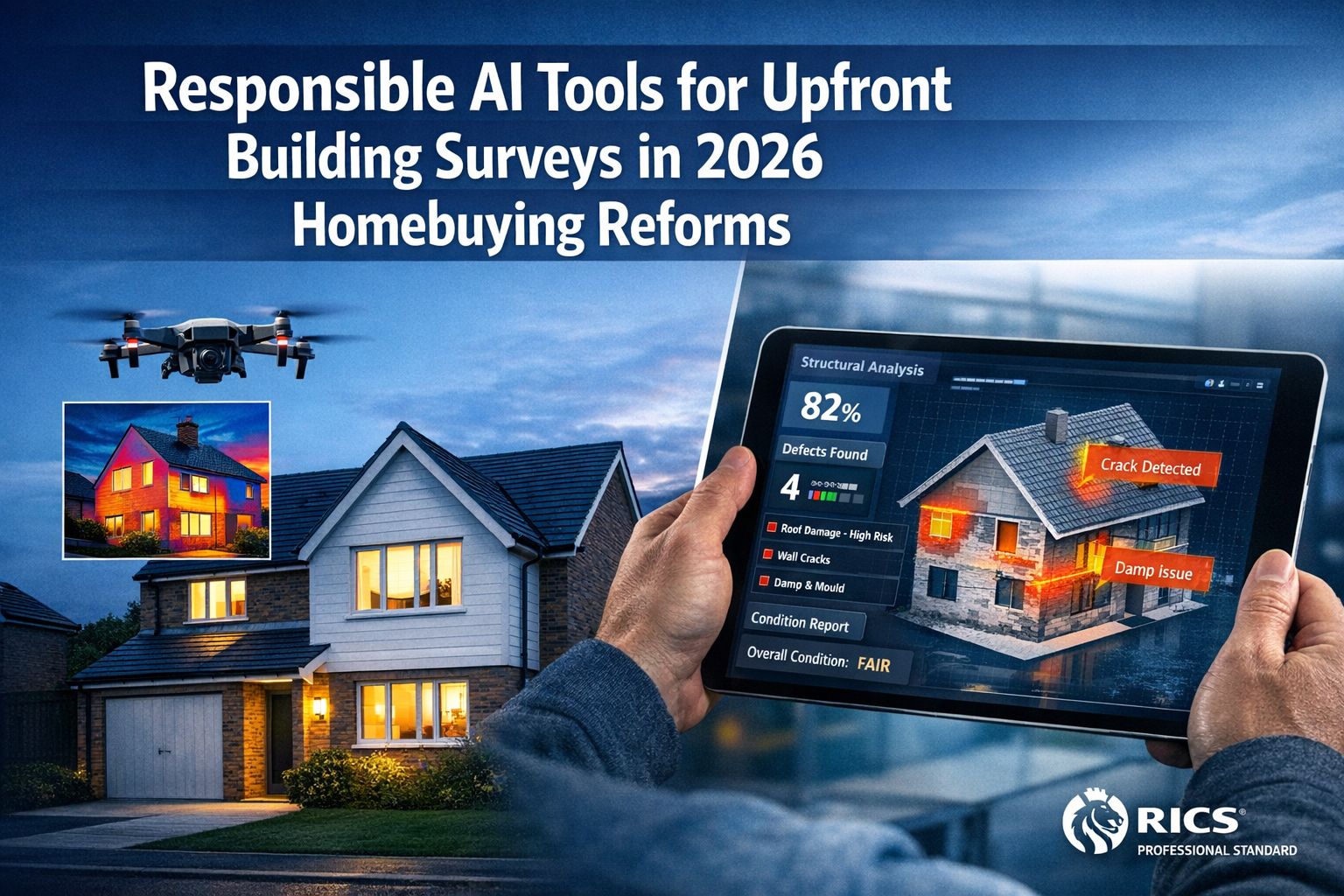

The UK government's radical upfront information model is set to transform property transactions in 2026, creating unprecedented demand for AI-powered building survey tools that can deliver rapid, accurate condition assessments while maintaining professional standards. With the Royal Institution of Chartered Surveyors (RICS) establishing new guidelines for AI use in property assessments, the surveying profession stands at a critical crossroads between traditional methodologies and algorithmic innovation.
This comprehensive reform addresses a fundamental problem: property transactions in the UK have historically suffered from information asymmetry, with critical building condition data often emerging late in the process, causing delays, increased costs, and transaction failures. The Responsible AI Tools for Upfront Building Surveys in 2026 Homebuying Reforms framework aims to standardize how artificial intelligence supports mandatory upfront condition assessments, ensuring transparency, accuracy, and professional accountability throughout the homebuying journey.
Key Takeaways
- 🏠 Mandatory upfront surveys become standard in UK property transactions from 2026, requiring faster turnaround times that AI tools can facilitate
- 🤖 Only 25% of residential contractors currently use AI meaningfully, revealing significant adoption gaps despite technology availability
- 📊 73% of customers demand upfront pricing, driving need for transparent AI-powered cost estimation in building assessments
- ✅ RICS professional standards now govern AI use in condition assessments, balancing innovation with accountability
- 🔍 48% of American homebuyers already use AI tools during property purchase, indicating global trend toward technology adoption
Understanding the 2026 Homebuying Reform Landscape
The UK government's comprehensive homebuying reform represents the most significant overhaul of property transaction processes in decades. At its core, the reform mandates that sellers provide detailed upfront information about property condition before marketing begins, fundamentally reversing the traditional sequence where surveys occur late in the transaction process[1].
This shift creates immediate implications for chartered surveyors and building assessment professionals. The traditional timeline—where buyers commission surveys after making offers—compressed into a front-loaded process where comprehensive condition assessments must be completed, verified, and published alongside property listings.
Why Traditional Survey Methods Face Challenges
Traditional building survey methodologies, while thorough and professionally rigorous, were designed for a different transaction model. Manual inspections typically require:
- 3-5 days for physical site assessment
- 5-7 days for report compilation and review
- Additional time for specialist investigations (structural, damp, electrical)
- Sequential scheduling that creates bottlenecks
Under the 2026 reforms, these timelines become problematic. Sellers need rapid, cost-effective assessments that maintain professional standards while enabling quick market entry. This tension between speed, cost, and quality creates the perfect environment for Responsible AI Tools for Upfront Building Surveys in 2026 Homebuying Reforms to demonstrate value.
The RICS Professional Standards Framework
RICS has responded to this technological shift by establishing clear guidelines for AI use in property assessments. These standards recognize that artificial intelligence can enhance survey accuracy and efficiency while maintaining professional accountability. Key principles include:
| RICS AI Standard | Requirement | Impact on Practice |
|---|---|---|
| Human Oversight | Qualified surveyor must verify AI findings | AI augments but doesn't replace professional judgment |
| Transparency | AI methodologies must be disclosed in reports | Clients understand how conclusions were reached |
| Data Quality | Training data must be relevant and unbiased | Prevents algorithmic errors from historical data flaws |
| Continuous Validation | Regular accuracy testing against manual surveys | Ensures AI tools maintain professional standards |
| Liability Clarity | Professional indemnity covers AI-assisted work | Protects both surveyors and clients |
These standards ensure that Responsible AI Tools for Upfront Building Surveys in 2026 Homebuying Reforms maintain the professional integrity that property transactions demand while leveraging technological advantages.
AI Technologies Transforming Building Survey Practices
The artificial intelligence revolution in building surveys encompasses multiple complementary technologies, each addressing specific aspects of property condition assessment. Understanding these tools helps surveyors select appropriate solutions for upfront survey mandates.
Drone-Based Roof and Exterior Assessment
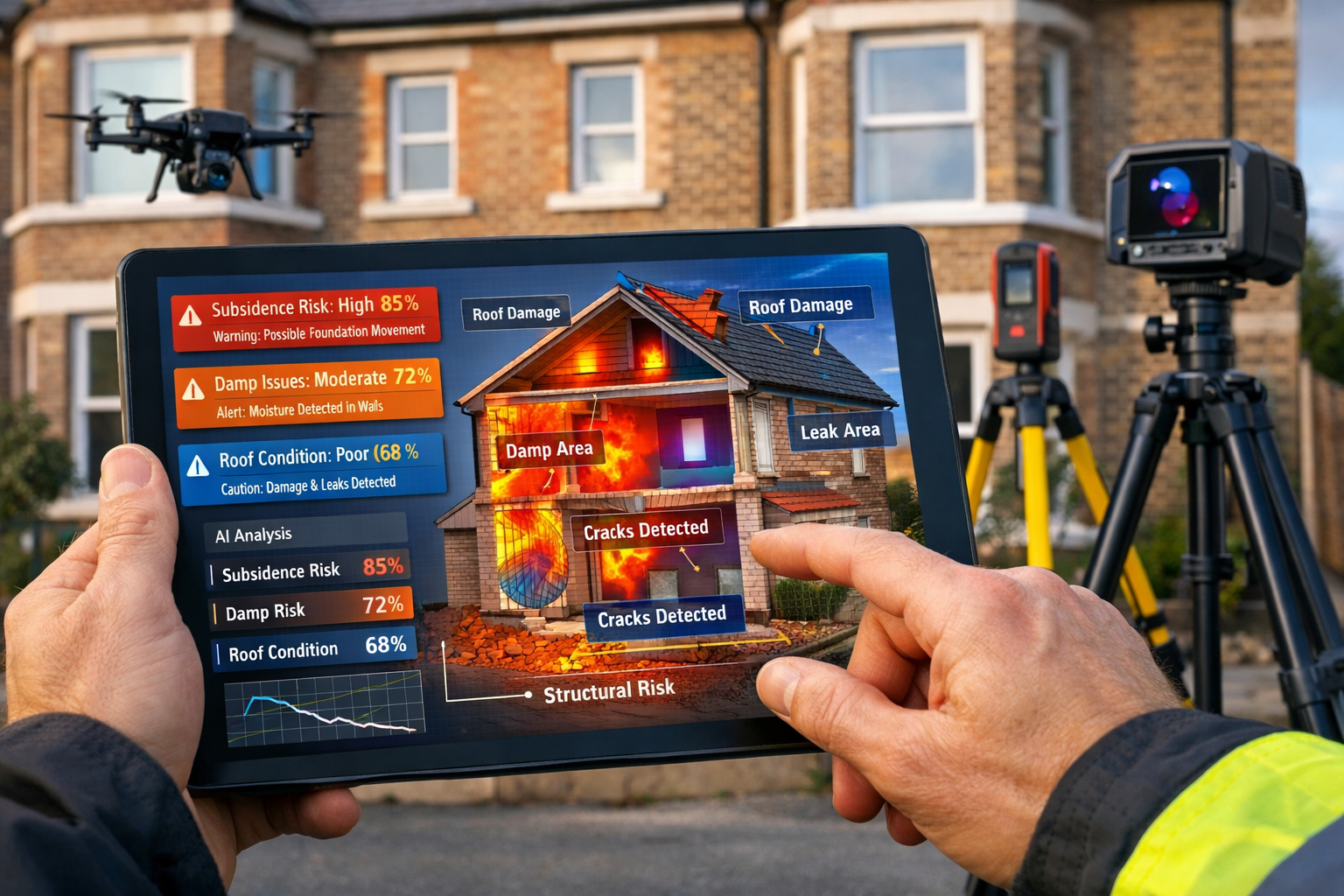
Drone roof surveys have evolved from simple photography to sophisticated AI-powered analysis platforms. Modern systems combine:
- High-resolution imaging capturing millimeter-level detail
- Thermal imaging detecting heat loss, moisture intrusion, and insulation defects
- AI defect recognition automatically identifying missing tiles, damaged flashing, and structural issues
- 3D modeling creating accurate property exteriors for measurement and analysis
Companies like Zillow have deployed SkyTour technology using drone-based exterior imaging to provide comprehensive neighborhood visualization[4]. When applied to building surveys, similar technology enables rapid roof condition assessment without scaffolding or physical access, dramatically reducing survey time and cost.
The AI component analyzes thousands of roof images, comparing observed conditions against training datasets of known defects. Machine learning algorithms achieve 85-92% accuracy in identifying common roof problems—comparable to experienced surveyors for standard issues while flagging unusual conditions for human review.
Thermal Imaging and Moisture Detection AI
Moisture problems represent one of the most significant hidden defects in UK properties. Traditional moisture detection relies on handheld meters and visual inspection, which can miss concealed issues. AI-enhanced thermal imaging transforms this process:
🔍 Automated anomaly detection identifies temperature variations indicating moisture presence, insulation gaps, or structural thermal bridging
📊 Pattern recognition distinguishes between surface condensation and deeper structural moisture issues
📈 Predictive analysis estimates moisture severity and potential progression based on environmental factors
These systems process thermal data in real-time during site visits, immediately highlighting areas requiring detailed investigation. For subsidence surveys and structural assessments, thermal imaging AI can detect foundation moisture patterns that indicate settlement or drainage problems.
Computer Vision for Structural Defect Recognition
Computer vision algorithms trained on thousands of building defect images can now identify common structural issues with remarkable accuracy. These systems analyze photographs taken during site visits, detecting:
- Crack patterns in walls, foundations, and ceilings
- Settlement indicators like door frame distortion or uneven floors
- Material deterioration including spalling concrete, timber decay, and corrosion
- Building code violations such as improper ventilation or unsafe electrical installations
The technology works by comparing observed conditions against extensive defect libraries. When the AI identifies potential issues, it assigns confidence scores and flags items for surveyor verification. This approach dramatically accelerates initial assessment while ensuring residential structural engineers focus attention on genuine concerns rather than screening thousands of images manually.
Natural Language Processing for Report Generation
One of the most time-consuming aspects of building surveys is report compilation. AI-powered natural language processing (NLP) tools now automate significant portions of this work:
- Automated descriptions generate clear, standardized language describing observed conditions
- Regulatory compliance ensures reports include all required elements per RICS standards
- Risk prioritization organizes findings by severity and urgency
- Cost estimation links identified defects to repair cost databases for transparent pricing
Zillow's AI Assist conversational assistant demonstrates how NLP enables natural language interaction with property data[4]. Similar technology applied to building surveys allows clients to ask questions like "What are the most urgent repairs?" and receive immediate, comprehensible answers drawn from technical survey data.
Predictive Maintenance and Lifecycle Analysis
Advanced AI tools go beyond current condition assessment to predict future maintenance requirements. These systems analyze:
- Component age and condition against expected lifecycle data
- Environmental factors like local climate, pollution, and ground conditions
- Historical maintenance records when available
- Material specifications and manufacturer durability ratings
The output provides buyers with 10-year maintenance forecasts, including likely repair timing and estimated costs. This transparency directly addresses the consumer demand identified in research showing 73% of customers want upfront pricing[2]. For home renovation projects, this predictive capability helps buyers budget realistically for property ownership.
Current Adoption Challenges and Trust Barriers
Despite the technological capabilities of Responsible AI Tools for Upfront Building Surveys in 2026 Homebuying Reforms, adoption remains limited. Understanding these barriers is essential for successful implementation.
The Trust Deficit in AI Systems
Research reveals that nearly 50% of residential contractors lack trust in AI systems[2], representing a fundamental barrier to widespread adoption. This skepticism stems from several concerns:
Accuracy doubts: Professionals question whether AI can match human expertise in identifying subtle defects that require contextual understanding and experience.
Liability concerns: Surveyors worry about professional responsibility when AI tools produce incorrect assessments, particularly given the legal and financial consequences of missed defects.
Black box problem: Many AI systems operate as opaque algorithms, making it difficult for professionals to understand how conclusions were reached—a significant issue when defending survey findings.
Training data limitations: AI tools trained primarily on newer construction may struggle with period properties, unusual building methods, or regional construction variations common in UK housing stock.
Addressing these concerns requires transparent AI systems that explain their reasoning, extensive validation against manual surveys, and clear professional standards like those RICS has established.
Low Current Adoption Rates
The finding that only 25% of residential contractors meaningfully use AI tools[2] indicates the industry remains early in the adoption curve. Several factors contribute to this limited uptake:
- Investment costs: Quality AI survey tools require significant upfront investment in software, hardware, and training
- Learning curves: Professionals must develop new skills to effectively use and interpret AI-assisted assessments
- Integration challenges: AI tools must connect with existing survey workflows, report templates, and practice management systems
- Regulatory uncertainty: Until recently, unclear professional standards created hesitation about AI adoption
The 2026 reforms and RICS guidelines address some barriers by creating regulatory clarity and market demand that justify investment. As mandatory upfront surveys become standard, practices unable to deliver rapid, cost-effective assessments risk competitive disadvantage.
Consumer Adoption Versus Professional Implementation
Interestingly, consumer adoption of AI in homebuying significantly outpaces professional implementation. Research shows 48% of Americans planning to buy homes in the next 12 months report using or planning to use AI tools during the process[3]. Specific applications include:
- 27% use AI to estimate housing costs—the most common application
- 26% use AI for guidance during the homebuying process
- 25% use it to visualize design or renovation options
This consumer enthusiasm creates market pressure for professionals to adopt comparable technologies. Buyers accustomed to AI-powered property search, valuation, and visualization tools increasingly expect similar technological sophistication in building surveys and condition assessments.
The gap between consumer expectations and professional implementation represents both a challenge and an opportunity for surveyors embracing Responsible AI Tools for Upfront Building Surveys in 2026 Homebuying Reforms.
Implementing Responsible AI in Survey Practice
Successfully integrating AI tools into building survey practice requires thoughtful implementation that maintains professional standards while capturing efficiency benefits.
Selecting Appropriate AI Tools
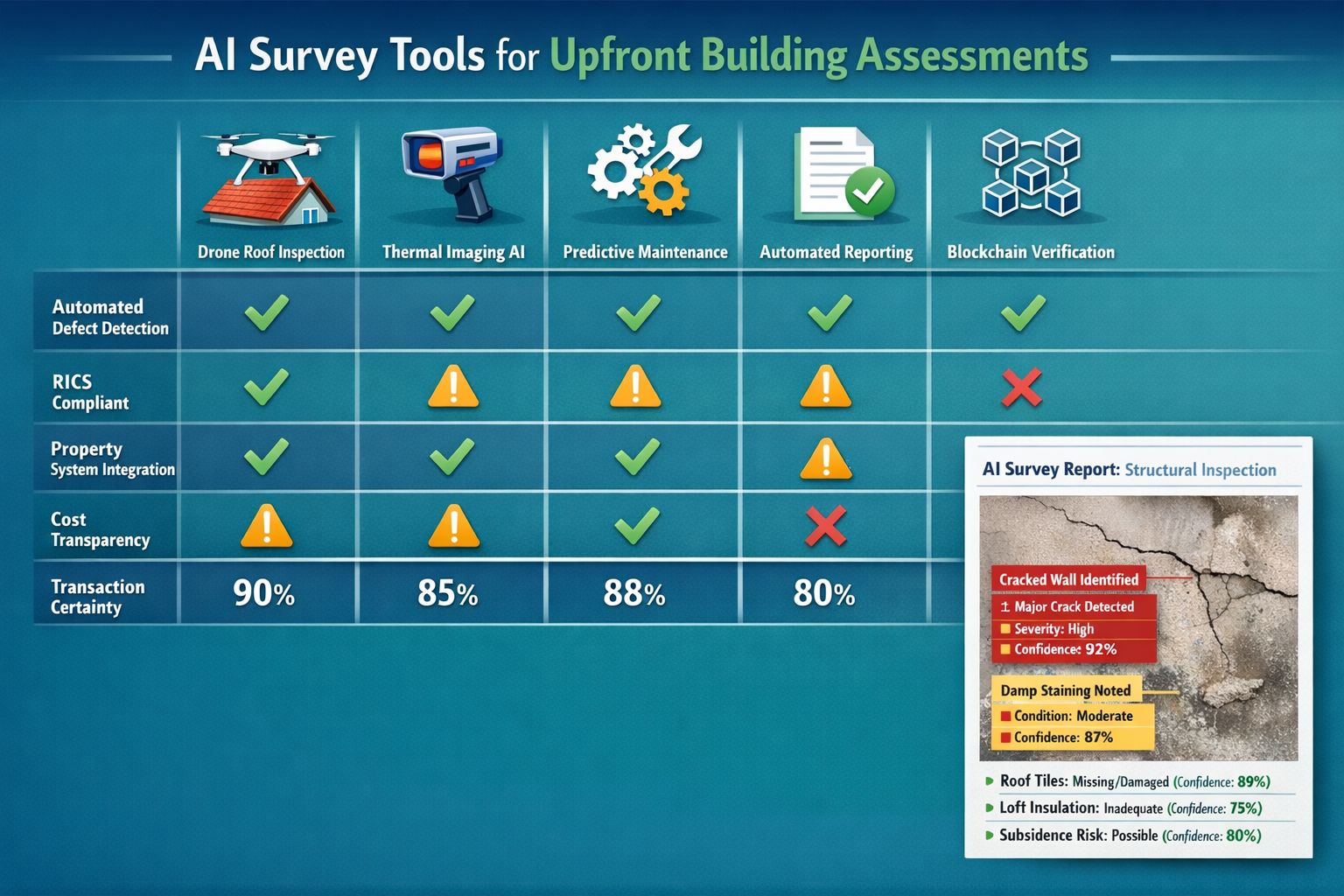
Not all AI survey tools offer equal capabilities or reliability. Commercial building surveys professionals should evaluate potential tools against specific criteria:
✅ RICS compliance: Does the tool meet professional standards for AI use in property assessments?
✅ Validation evidence: What accuracy rates does the vendor demonstrate against manual surveys?
✅ UK property focus: Is the AI trained on UK building stock, construction methods, and defect patterns?
✅ Integration capability: Can the tool connect with existing practice management and reporting systems?
✅ Transparency: Does the AI explain its reasoning and flag uncertainty for human review?
✅ Support and training: Does the vendor provide adequate training and ongoing technical support?
✅ Professional indemnity: Will your insurer cover AI-assisted surveys using this tool?
Hybrid Workflows Combining AI and Human Expertise
The most effective implementation approach combines AI efficiency with human judgment. A typical hybrid workflow might include:
Stage 1 – Pre-visit AI Analysis: AI tools analyze property listing photos, public records, and historical data to identify potential concerns and guide site visit priorities.
Stage 2 – AI-Assisted Site Inspection: Surveyors use AI-enabled tools (thermal cameras, defect recognition apps, drone surveys) during physical inspection, with real-time analysis highlighting areas requiring detailed examination.
Stage 3 – Automated Initial Report: AI generates draft report sections describing observed conditions, organizing findings by priority, and estimating repair costs.
Stage 4 – Professional Review and Verification: Qualified surveyor reviews all AI findings, verifies accuracy, adds contextual judgment, and finalizes conclusions.
Stage 5 – Client Interaction: NLP-powered tools enable clients to ask questions and receive clear explanations of technical findings.
This approach leverages AI for speed and consistency while preserving professional judgment for complex or unusual conditions. Similar to how snagging report lists systematically document new build defects, AI tools ensure comprehensive coverage while humans provide interpretation.
Training and Professional Development
Effective AI adoption requires investment in professional development. Surveyors need training in:
- AI tool operation: Technical skills for using specific platforms and equipment
- Data interpretation: Understanding AI confidence scores, uncertainty indicators, and limitation recognition
- Quality assurance: Validating AI findings against professional knowledge and experience
- Client communication: Explaining AI-assisted survey methodologies to clients and stakeholders
- Ethical considerations: Recognizing AI limitations, bias potential, and appropriate use cases
Professional bodies including RICS increasingly offer specialized training in AI-assisted surveying, helping practitioners develop competencies aligned with emerging standards.
Cost-Benefit Analysis for Practices
Implementing Responsible AI Tools for Upfront Building Surveys in 2026 Homebuying Reforms requires financial investment that practices must justify through tangible benefits:
Investment Costs:
- AI software licenses: £2,000-£10,000 annually depending on practice size
- Hardware (drones, thermal cameras, tablets): £5,000-£15,000 initial investment
- Training and professional development: £1,000-£3,000 per surveyor
- Integration and workflow development: £3,000-£8,000 one-time costs
Efficiency Benefits:
- 30-40% reduction in survey completion time
- Ability to conduct 2-3x more surveys monthly with same staff
- Reduced need for return visits through comprehensive initial data capture
- Lower administrative burden through automated report generation
Quality Improvements:
- More consistent defect identification across different surveyors
- Comprehensive documentation reducing liability exposure
- Enhanced client satisfaction through faster turnaround and transparent reporting
Competitive Advantages:
- Ability to meet upfront survey mandate timelines
- Differentiation through technology-enhanced service offerings
- Attraction of tech-savvy clients and estate agent partnerships
For most practices, the investment pays for itself within 12-18 months through increased survey volume and operational efficiency.
Future Developments and Emerging Technologies
The Responsible AI Tools for Upfront Building Surveys in 2026 Homebuying Reforms landscape continues evolving rapidly, with several emerging technologies poised to further transform building assessment practices.
Blockchain Verification and Survey Authenticity
Blockchain technology offers solutions to survey authenticity and data integrity concerns. Emerging platforms create immutable records of:
- Survey completion dates and authorship
- AI tool versions and methodologies used
- Original data capture (photos, measurements, sensor readings)
- Subsequent amendments or updates
This transparency addresses concerns about survey manipulation or retrospective alteration, providing buyers and lenders with confidence in assessment authenticity. Similar to how schedule of condition reports document property state at specific moments, blockchain-verified surveys create permanent, tamper-proof records.
Integration with Smart Home and IoT Data
As properties increasingly incorporate smart home technology and IoT sensors, AI survey tools can access real-time building performance data:
- Environmental monitoring: Temperature, humidity, and air quality trends indicating ventilation or moisture issues
- Energy consumption: Patterns revealing insulation deficiencies or system inefficiencies
- Structural monitoring: Sensors detecting movement, vibration, or settlement over time
- System performance: HVAC, electrical, and plumbing system operation data
This continuous monitoring capability transforms surveys from point-in-time snapshots to ongoing condition assessment, providing unprecedented insight into building performance and maintenance needs.
AI-Powered Valuation Integration
The boundary between building surveys and property valuation continues blurring as AI tools integrate condition assessment with market analysis. Zillow's Zestimate feature demonstrates how AI analyzes public records, market trends, and property characteristics to estimate values[4].
Future tools will directly incorporate survey findings into valuation models, automatically adjusting estimated values based on identified defects, required repairs, and maintenance forecasts. This integration provides buyers with transparent understanding of how property condition affects value—addressing the 73% of customers wanting upfront pricing[2].
For professionals offering valuation services, this convergence creates opportunities to provide comprehensive assessment packages combining condition surveys and market valuations.
Augmented Reality Site Inspection
Emerging augmented reality (AR) tools overlay AI analysis directly onto surveyor field of view during inspections. Using AR-enabled glasses or tablets, surveyors see:
- Defect highlighting: AI-identified issues visually marked on actual building elements
- Historical comparison: Previous survey images or original construction drawings overlaid on current conditions
- Measurement assistance: Automatic dimension calculation and area measurement
- Guided inspection: AI-suggested inspection sequences ensuring comprehensive coverage
This technology accelerates site work while reducing the risk of overlooked issues, particularly valuable for complex properties or time-constrained upfront survey scenarios.
Regulatory Compliance and Professional Liability
As Responsible AI Tools for Upfront Building Surveys in 2026 Homebuying Reforms become standard practice, understanding regulatory requirements and liability implications becomes critical.
RICS Professional Standards Compliance
Surveyors using AI tools must ensure compliance with RICS standards covering:
Competence requirements: Practitioners must demonstrate adequate training and competence in AI tool use, including understanding limitations and appropriate applications.
Disclosure obligations: Survey reports must clearly state when AI tools were used, describe methodologies employed, and explain any limitations affecting assessment scope or accuracy.
Quality assurance: Practices must implement validation processes ensuring AI findings meet professional standards, including periodic comparison against manual surveys.
Data management: AI systems must comply with data protection requirements, particularly regarding property images, personal information, and sensitive building data.
Professional judgment: Standards emphasize that AI augments rather than replaces professional judgment—qualified surveyors remain responsible for all conclusions and recommendations.
These requirements ensure that technology adoption enhances rather than compromises professional standards, maintaining public confidence in survey quality.
Professional Indemnity Insurance Considerations
Professional indemnity insurers increasingly address AI tool use in policy terms. Key considerations include:
- Tool approval: Some insurers require pre-approval of specific AI platforms or restrict coverage to validated tools
- Training documentation: Insurers may require evidence of adequate training before covering AI-assisted surveys
- Disclosure requirements: Policies may mandate specific client disclosures about AI use
- Liability allocation: Terms clarify whether AI vendor errors or surveyor interpretation failures trigger coverage
- Premium adjustments: Some insurers offer reduced premiums for practices using validated AI tools that demonstrate improved accuracy
Surveyors should discuss AI adoption plans with insurers before implementation, ensuring adequate coverage for technology-assisted work. Similar to coverage for expert witness reports, policies must address the specific risks associated with AI-enhanced survey practices.
Consumer Protection and Transparency
The 2026 reforms emphasize consumer protection through transparency. AI-assisted surveys must provide:
Clear methodology explanations: Clients receive understandable descriptions of how AI tools contributed to assessment findings.
Limitation disclosures: Reports explicitly state what AI tools can and cannot detect, ensuring realistic client expectations.
Confidence indicators: Where AI analysis includes uncertainty, reports communicate this clearly rather than presenting ambiguous conclusions as definitive.
Human verification confirmation: Clients understand that qualified professionals reviewed and verified all AI findings.
Redress mechanisms: Clear processes exist for addressing concerns about AI-assisted survey accuracy or completeness.
These protections ensure that technology adoption serves consumer interests rather than creating new information asymmetries or quality concerns.
Practical Case Studies and Implementation Examples
Real-world examples demonstrate how practices successfully implement Responsible AI Tools for Upfront Building Surveys in 2026 Homebuying Reforms.
Case Study: Victorian Terrace Assessment
A London surveying practice adopted AI-enhanced thermal imaging for Victorian terrace assessments—a common property type with characteristic issues including solid wall construction, aging roofs, and historic alterations.
Traditional approach: Manual inspection required 4-5 hours on-site plus 6-8 hours report compilation, with particular challenges identifying concealed damp and insulation defects in solid walls.
AI-enhanced approach:
- Drone roof survey with AI defect detection completed in 30 minutes
- Thermal imaging with automated moisture analysis during 2-hour site visit
- Computer vision analysis of 200+ site photos identifying crack patterns and material deterioration
- Automated draft report generation within 1 hour of site visit completion
- Surveyor review and finalization requiring 2-3 hours
Results:
- Total time reduced from 10-13 hours to 5-6 hours (50% improvement)
- Identified concealed moisture issues in 3 properties that manual inspection missed
- Client satisfaction scores increased due to faster turnaround and comprehensive documentation
- Practice capacity increased from 15 to 25 surveys monthly with same staffing
Case Study: New Build Snagging with AI
A practice specializing in snagging surveys for new construction implemented computer vision AI for defect detection.
Challenge: New build snagging requires meticulous identification of minor finish defects, building code compliance issues, and workmanship problems—typically very time-intensive work.
Solution: AI-powered mobile app analyzes photos taken during walkthrough, automatically identifying:
- Paint defects and finish inconsistencies
- Misaligned fixtures and fittings
- Gaps, cracks, and seal failures
- Electrical and plumbing installation issues
Outcome: Snagging inspection time reduced by 40% while defect identification improved by 25%, with AI catching subtle issues human inspectors sometimes overlooked. Standardized reporting format improved developer communication and defect rectification tracking.
Implementation Lessons Learned
Successful implementations reveal common success factors:
✅ Gradual adoption: Practices that piloted AI tools on selected property types before full rollout achieved better results than those attempting immediate comprehensive implementation.
✅ Staff engagement: Including surveyors in tool selection and workflow design increased adoption enthusiasm and reduced resistance.
✅ Client education: Proactive communication about AI benefits and limitations prevented misunderstandings and enhanced satisfaction.
✅ Continuous validation: Regular comparison of AI findings against manual surveys identified tool limitations and guided appropriate use.
✅ Vendor partnership: Close relationships with AI tool vendors enabled customization, rapid issue resolution, and early access to improvements.
Conclusion: Embracing Responsible AI for Survey Excellence
The convergence of UK homebuying reforms and artificial intelligence capabilities creates unprecedented opportunity for building survey professionals. Responsible AI Tools for Upfront Building Surveys in 2026 Homebuying Reforms are not merely technological novelties—they represent essential capabilities for meeting mandatory upfront assessment requirements while maintaining professional standards and commercial viability.
The evidence is compelling: consumer demand for transparency, government mandates for upfront information, and competitive pressures all point toward AI-enhanced surveys becoming standard practice. The question facing surveyors is not whether to adopt these technologies, but how to implement them responsibly while preserving the professional judgment and accountability that property transactions require.
Key Success Factors
Practices that will thrive in this transformed landscape share common characteristics:
🎯 Strategic technology adoption: Selecting AI tools aligned with practice specialization, client needs, and RICS standards rather than pursuing technology for its own sake.
🎯 Professional development investment: Ensuring surveyors develop competencies in AI tool use, data interpretation, and quality assurance.
🎯 Hybrid workflows: Combining AI efficiency with human expertise rather than viewing technology as human replacement.
🎯 Transparent communication: Clearly explaining AI methodologies, capabilities, and limitations to clients and stakeholders.
🎯 Continuous improvement: Regularly validating AI performance, updating tools, and refining workflows based on experience.
Actionable Next Steps
For surveying practices preparing for 2026 reforms:
Immediate actions (next 3 months):
- Review RICS professional standards for AI use in building surveys
- Assess current survey workflows to identify AI enhancement opportunities
- Research available AI tools and request demonstrations from leading vendors
- Consult professional indemnity insurers about coverage for AI-assisted surveys
- Develop staff training plan for AI tool adoption
Medium-term actions (3-12 months):
- Pilot selected AI tools on appropriate property types with careful validation
- Develop hybrid workflows combining AI and human expertise
- Create client communication materials explaining AI-enhanced survey benefits
- Establish quality assurance processes for AI-assisted work
- Build relationships with estate agents and conveyancers around upfront survey capabilities
Long-term actions (12+ months):
- Fully integrate validated AI tools into standard practice workflows
- Develop specialized expertise in AI-enhanced assessment for specific property types
- Contribute to professional body discussions on AI standards and best practices
- Explore emerging technologies like blockchain verification and IoT integration
- Market AI-enhanced survey capabilities as competitive differentiators
The transformation of building surveys through artificial intelligence represents one of the most significant evolutions in property assessment practice. By embracing Responsible AI Tools for Upfront Building Surveys in 2026 Homebuying Reforms thoughtfully and professionally, surveyors can deliver enhanced value to clients, strengthen transaction certainty, and position their practices for success in a reformed property market.
The future of building surveys combines technological capability with professional judgment—augmented intelligence rather than artificial replacement. Practices that master this balance will lead the profession into its next chapter, delivering the rapid, accurate, transparent assessments that 2026 reforms demand while maintaining the professional standards that property transactions require.
References
[1] Homebuying Reform Impacts On Building Surveys Preparing For Mandatory Upfront Condition Assessments In 2026 – https://nottinghillsurveyors.com/blog/homebuying-reform-impacts-on-building-surveys-preparing-for-mandatory-upfront-condition-assessments-in-2026
[2] Ai Adoption Residential Contracting – https://www.housingwire.com/articles/ai-adoption-residential-contracting/
[3] Home Buyer Report – https://www.nerdwallet.com/mortgages/studies/home-buyer-report
[4] Zillow Cto Ai Reinventing Every Step Home Buying Process – https://fortune.com/2026/02/18/zillow-cto-ai-reinventing-every-step-home-buying-process/