

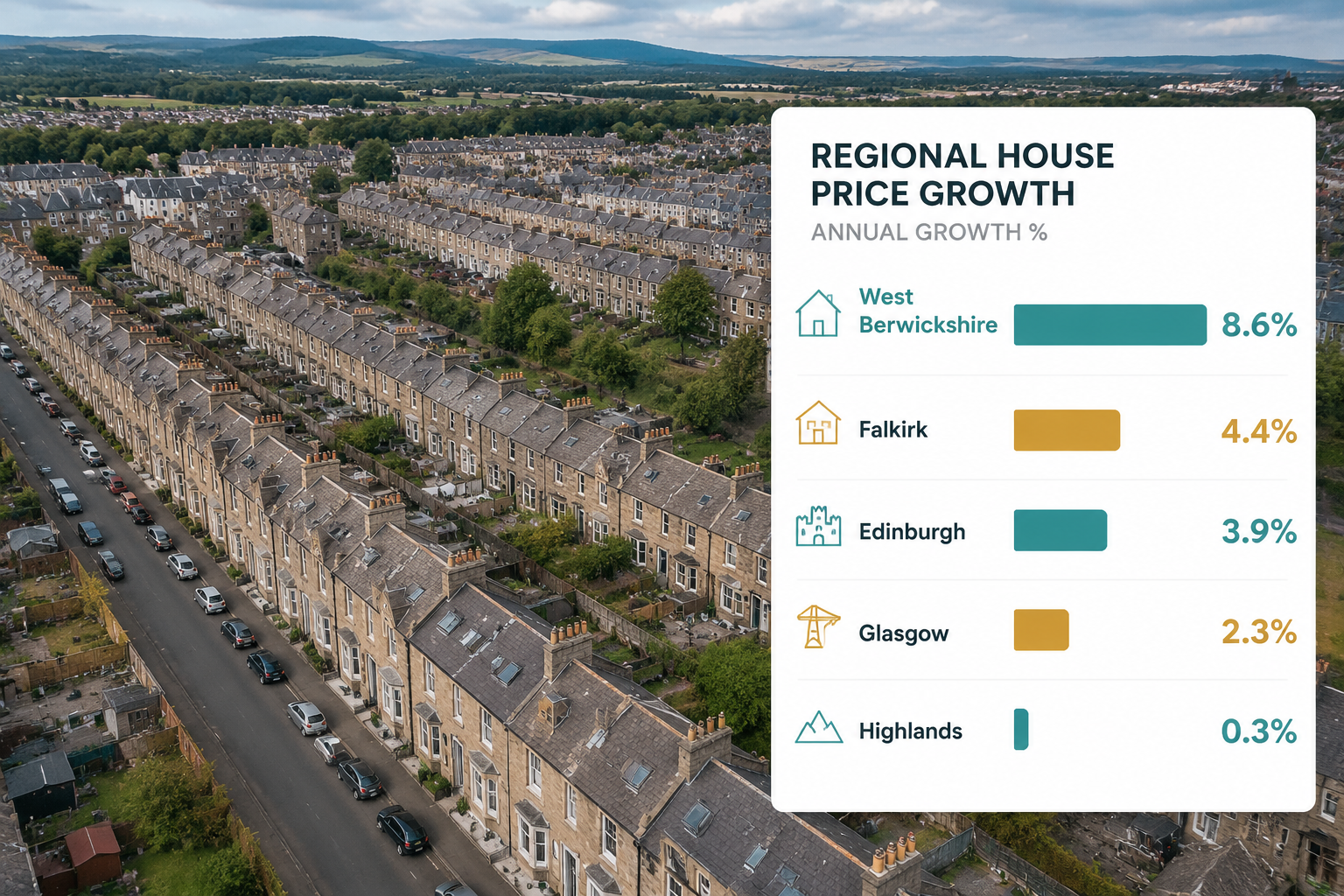
West Berwickshire house prices climbed 8.6% in a single year — a figure that would raise eyebrows in London, let alone a rural Scottish local authority. Yet this is exactly the kind of regional data now reshaping how surveyors must approach party wall procedures across Scotland's booming northern markets.
Scotland's Housing Price Surge in RICS January 2026 Survey: Party Wall Survey Protocols for High-Growth Northern Regions has become one of the most pressing professional conversations in the UK surveying sector. As RICS data confirms Scotland among the strongest regional performers nationally [3], rising transaction volumes and intensifying development activity are placing new demands on party wall practice — particularly for terraced properties and deep excavation projects in high-growth local authority areas.
This article unpacks the market data, explains why it matters for party wall compliance, and delivers practical protocol guidance for surveyors and property owners navigating Scotland's fast-moving northern housing landscape in 2026.
Key Takeaways 📋
- 26 of 32 Scottish local authority areas recorded average house price increases in the 12 months to January 2026, with West Berwickshire leading at 8.6% growth [1]
- Terraced houses showed the strongest property-type growth at 2.4%, driving higher renovation and extension activity — and therefore more party wall notices
- RICS confirmed Scotland and Northern Ireland as the UK's strongest regional performers, with 12-month price expectations reaching +43% nationally [3]
- Rising development pressure in high-growth areas means party wall surveyors must adapt their notice procedures, award drafting, and excavation checklists for increased workloads
- A proactive, protocol-driven approach to party wall surveys protects both building owners and adjoining owners in rapidly appreciating markets where disputes carry higher financial stakes
Understanding Scotland's Housing Price Surge in RICS January 2026 Survey Data
The National Picture
Scotland's overall house price growth of 1.3% in the 12 months to January 2026 matches the UK national average — but this headline figure conceals extraordinary regional variation [1]. The initial December 2025 estimate had placed Scottish growth at 3.6%, making the revised January figure a notable recalibration, though still reflective of a resilient market.
The RICS UK Residential Survey for January 2026 painted a cautiously optimistic picture. New buyer enquiries improved substantially, with the net balance rising to -15% from -21% in December and -29% in November [3]. Agreed sales recorded their least negative reading since June 2025 at -9% net balance [3], while the three-month house price net balance steadied at -10%, up from an October 2025 low of -19% [3].
💬 "Scotland and Northern Ireland identified as the strongest regional performers… with upward trends also reported in the North West and North of England." — RICS UK Residential Market Survey, January 2026 [3]
Twelve-month price expectations reached +43% — the most positive outlook since February 2025 — while 12-month sales expectations surged to +35% [3]. These figures signal that the market is not simply stabilising; it is building momentum.
Regional Breakdown: Where Growth Is Concentrated
| Local Authority / Region | Annual Growth | Average Price |
|---|---|---|
| West Berwickshire | 8.6% | £130,000 |
| Falkirk | 4.4% | £173,000 |
| Edinburgh | 3.9% | £293,000 |
| Glasgow | 2.3% | £184,000 |
| Highlands | 0.3% | £212,300 |
Source: UK House Price Index (Scotland), January 2026 [1]
Falkirk's 4.4% growth and West Berwickshire's 8.6% surge are particularly significant for party wall practice. These are areas with high concentrations of terraced and semi-detached stone properties — precisely the building types most likely to generate party wall notices when owners undertake extensions, loft conversions, or basement excavations.
Terraced houses recorded the strongest annual growth of any property type at 2.4%, reaching an average of £173,000 [1]. When property values rise, so do the financial stakes attached to construction disputes. A poorly managed party wall process in a £173,000 terraced home in Falkirk carries very different consequences than it did three years ago.
Momentum and Caution
By March 2026, Scottish market momentum had slowed somewhat, with rising borrowing costs and geopolitical uncertainty dampening buyer confidence [2]. However, conditions remained "less negative than the UK as a whole" [2] — confirming Scotland's structural outperformance relative to southern regions, particularly London and the South East.
Why Scotland's Housing Price Surge Demands Upgraded Party Wall Survey Protocols
The Development Pressure Connection
Rising house prices in high-growth northern regions create a predictable chain reaction:
- 📈 Property values increase → owners have more equity and motivation to extend
- 🔨 Renovation and extension activity rises → more works affecting shared walls
- 📄 Party wall notices multiply → surveyors face higher workloads
- ⚖️ Dispute stakes increase → errors in procedure carry greater financial consequences
This dynamic is already visible in areas like Falkirk and Edinburgh, where planning applications for rear extensions and loft conversions have accelerated alongside price growth. Understanding what triggers a party wall notice is the essential starting point for any building owner in these markets.
The Terraced Property Challenge
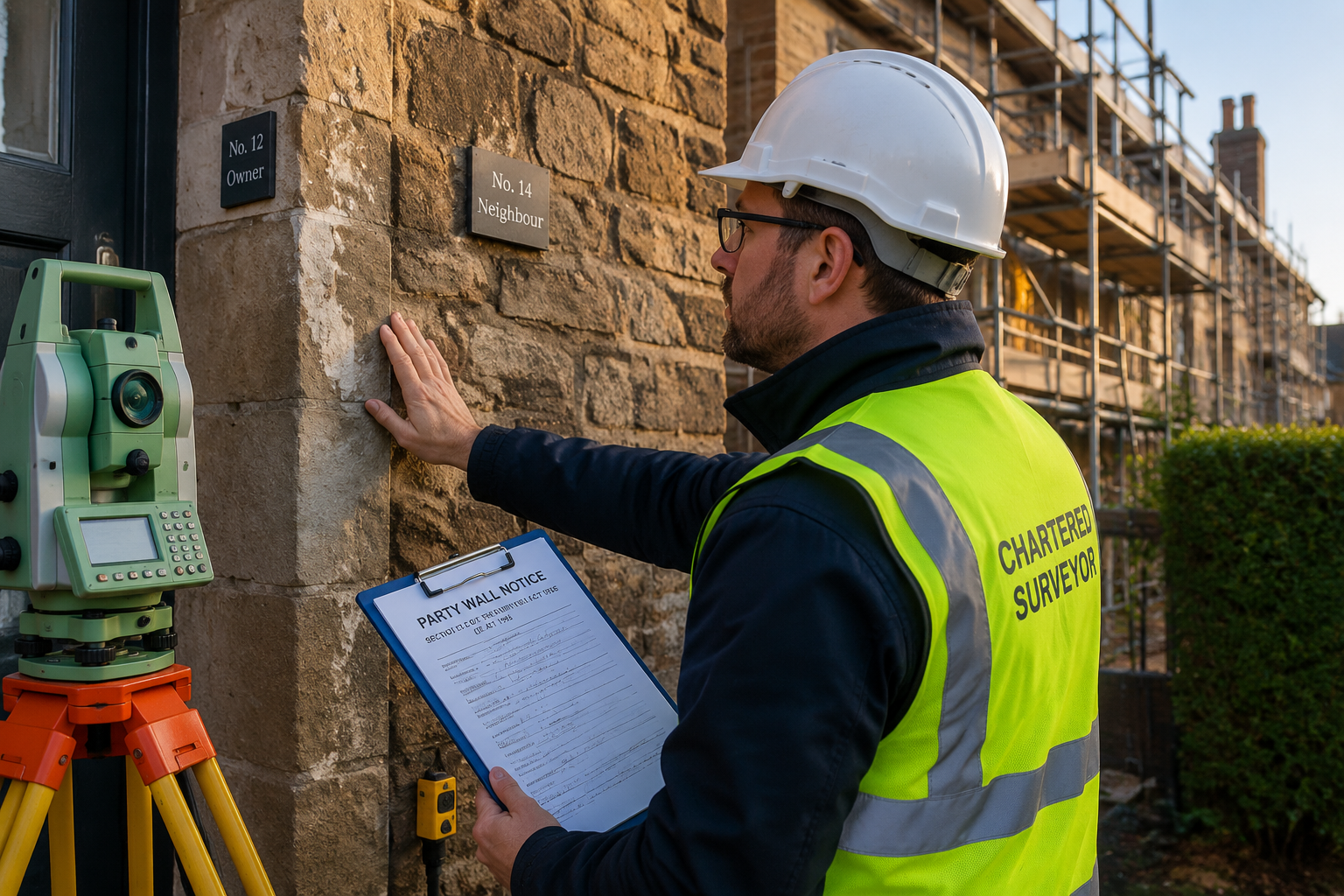
Terraced properties — the fastest-appreciating property type in Scotland's January 2026 data — present unique party wall complexities. Unlike detached homes, terraced houses share walls on both sides, meaning a single rear extension project can require notices to two sets of adjoining owners simultaneously.
Key considerations for terraced property party wall work in high-growth areas:
- Multiple notice requirements: Both left and right neighbours may need separate notices under the Party Wall etc. Act 1996
- Structural interdependence: Load-bearing shared walls in older Scottish stone terraces require careful structural assessment before any notifiable works begin
- Condensed timelines: In fast-moving markets, building owners often push for rapid commencement, creating pressure to shortcut proper notice periods
- Loft conversion complexity: Extending into roof space in terraced rows frequently involves party wall considerations for loft conversions that are easily underestimated
The 3-Metre and 6-Metre Excavation Rules in Northern Markets
Deep excavation work — increasingly common as Scottish homeowners maximise space in high-value properties — triggers specific obligations under the Party Wall etc. Act. The Party Wall Act 3-metre rule requires a party wall excavation notice when proposed foundations are within 3 metres of an adjoining owner's structure and will go deeper than their existing foundations.
In older Scottish terraced stock — particularly Victorian and Edwardian properties common in Falkirk, Edinburgh's tenement districts, and West Berwickshire market towns — foundation depths are often shallower than modern standards. This makes the 3-metre trigger far more likely to apply, even for modest extensions.
Party Wall Survey Protocols for High-Growth Northern Regions: A Practical Framework
Adapting Notice Procedures for High-Volume Markets
Scotland's Housing Price Surge in RICS January 2026 Survey data confirms that surveyors in high-growth northern regions should prepare for sustained increases in party wall instruction volumes. Efficient, robust notice procedures are no longer optional — they are a competitive and professional necessity.
Essential notice protocol checklist for Scottish high-growth areas:
✅ Confirm the correct notice type — Party Structure Notice, Line of Junction Notice, or Excavation Notice under Section 6 of the Act
✅ Verify the full extent of works — include all notifiable elements upfront to avoid supplementary notices later
✅ Identify all adjoining owners — including freeholders, leaseholders, and mortgage lenders where relevant
✅ Serve notice with correct lead times — one month for Party Structure Notices; two months for Excavation Notices
✅ Document service properly — use recorded delivery or personal service with written confirmation
✅ Record dissent promptly — if an adjoining owner dissents, appoint surveyors without delay to avoid project hold-ups
Understanding the role of an agreed surveyor can significantly streamline the process in straightforward cases, reducing costs and delays for both parties.
Drafting Party Wall Awards for High-Growth Regions
A well-drafted party wall award is the primary protection mechanism for both building owners and adjoining owners. In markets where property values are rising sharply, an inadequate award creates disproportionate risk.
Award drafting priorities for northern Scottish markets:
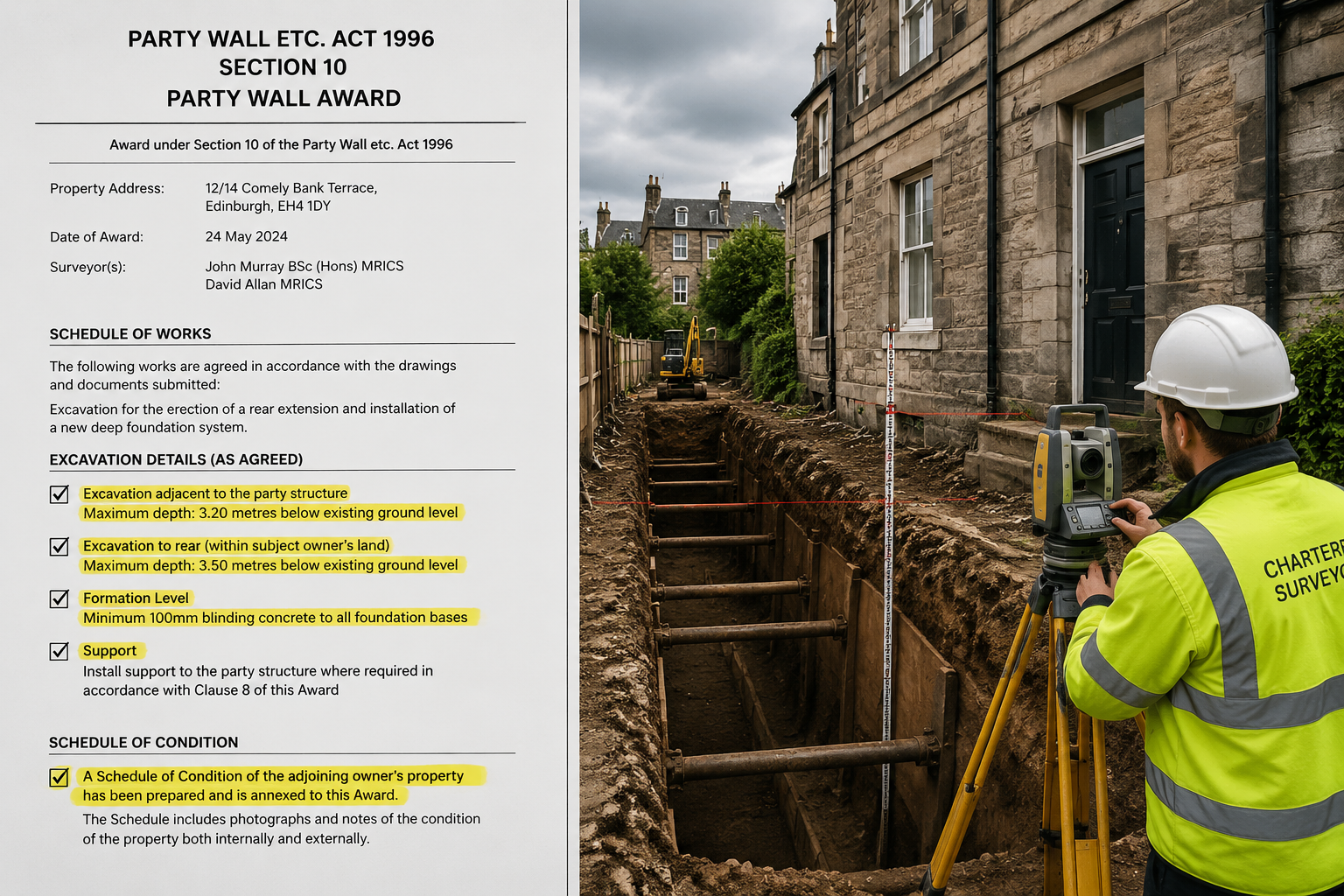
- Comprehensive schedule of condition: A detailed schedule of condition report must be completed before works begin, documenting the existing state of the adjoining property with photographs, measurements, and written descriptions. This is non-negotiable in high-value markets.
- Clear working hours and access provisions: Specify permitted working hours, access arrangements, and notification requirements for inspections during works.
- Structural methodology approval: For deep excavations or significant structural works, require the building owner's engineer to submit method statements for review before commencement.
- Damage liability provisions: Clearly define the process for reporting, assessing, and remedying any damage caused during party wall works, including timescales and dispute resolution pathways.
- Completion notification: Require written notification when works are complete, triggering a post-works inspection.
Deep Excavation Checklist for Terraced Properties
Given the prevalence of terraced housing in Scotland's highest-growth areas, the following checklist addresses the specific risks of deep excavation in attached properties:
Pre-Notice Stage:
- Commission structural engineer's assessment of existing foundation depths on both properties
- Obtain drainage plans to identify shared or adjacent drainage runs
- Check for any existing party wall agreements or awards affecting the property
- Confirm whether works fall within 3 metres or 6 metres of adjoining foundations
Notice Stage:
- Serve party wall excavation notice with full engineering drawings attached
- Allow correct statutory notice period (two months for Section 6 notices)
- Respond to any counter-notices within 14 days
Award Stage:
- Complete photographic schedule of condition for full extent of adjoining property
- Specify maximum excavation depth and lateral extent in the award
- Require underpinning methodology approval where applicable
- Include groundwater management provisions for deeper excavations
- Specify monitoring requirements (e.g., crack monitoring gauges on shared walls)
During Works:
- Conduct regular site inspections at agreed intervals
- Maintain a works log documenting any incidents or observations
- Ensure any damage is reported and assessed within agreed timeframes
Post-Works:
- Conduct post-works inspection against the schedule of condition
- Confirm in writing that works are complete and the award obligations have been met
Managing Party Wall Disputes in Rising Markets
When property values are climbing, the financial consequences of construction disputes escalate proportionally. A crack in a party wall that might have been a minor inconvenience in a flat market becomes a significant liability when that wall separates two properties that have each appreciated by 4-8%.
Understanding what constitutes a party wall dispute and how to resolve one efficiently is critical knowledge for surveyors operating in Scotland's high-growth northern regions. Early, clear communication between surveyors — and a well-drafted award that anticipates potential issues — remains the most effective prevention strategy.
Cost Considerations for Building Owners
Party wall survey costs vary depending on the complexity of works and the number of adjoining owners involved. In high-growth markets, building owners sometimes underestimate these costs when budgeting for renovation projects. Reviewing party wall surveyor costs early in the project planning stage avoids unpleasant surprises and helps ensure that party wall compliance is properly resourced.
Looking Ahead: Scotland's Market and Party Wall Practice in 2026
The RICS January 2026 data confirms a Scottish housing market that is outperforming the UK average in key northern and central regions, even as broader headwinds — rising borrowing costs, geopolitical uncertainty — moderate the pace of growth [2][3]. For party wall surveyors, this creates both opportunity and responsibility.
The opportunity: Higher transaction volumes and increased development activity in high-growth areas mean sustained demand for competent party wall services.
The responsibility: Rising property values mean that errors in party wall procedure — whether a missed notice, an inadequate award, or a poorly documented schedule of condition — carry greater financial consequences for all parties.
Surveyors operating in Scotland's northern high-growth regions should consider:
- Investing in local market knowledge: Understanding which local authority areas are experiencing the sharpest growth helps prioritise resources and anticipate workload peaks
- Standardising protocol checklists: Consistent, comprehensive checklists for notice service, award drafting, and excavation projects reduce the risk of procedural errors under time pressure
- Building relationships with structural engineers: Deep excavation projects in older terraced stock require close collaboration between party wall surveyors and structural engineers from the outset
- Educating building owner clients: Many homeowners in high-growth areas are first-time renovators who do not understand party wall obligations. Clear, early communication prevents disputes before they arise
Conclusion: Protocols That Match the Market
Scotland's Housing Price Surge in RICS January 2026 Survey data tells a clear story: northern and central Scottish regions are leading UK housing market performance, with terraced properties and local authorities like West Berwickshire, Falkirk, and Edinburgh driving exceptional growth. This is not merely a market statistic — it is a call to action for party wall surveyors.
Actionable next steps for surveyors and building owners:
- Review your notice procedures against the checklist in this article before commencing any notifiable works in high-growth Scottish areas
- Prioritise schedule of condition reports — in rising markets, pre-works documentation is your most important protective tool
- Build deep excavation expertise — terraced property renovations in Scotland's high-growth areas will increasingly involve complex foundation work requiring specialist knowledge
- Stay current with RICS guidance — the January 2026 survey data signals continued market activity; professional protocols must keep pace
- Engage early — both building owners and adjoining owners benefit from early, transparent engagement with the party wall process before disputes arise
The Scottish housing market's momentum in 2026 rewards those who are prepared. For party wall surveyors, preparation means robust protocols, comprehensive documentation, and a clear understanding of the legal framework that protects everyone involved.
References
[1] Watch (UK House Price Index Scotland January 2026) – https://www.youtube.com/watch?v=qmPRphHbz60
[2] RICS Scottish Housing Market Slows Amid Rising Borrowing Costs And Geopolitical Uncertainty – https://www.scottishhousingnews.com/articles/rics-scottish-housing-market-slows-amid-rising-borrowing-costs-and-geopolitical-uncertainty
[3] UK Resi Survey Jan 2026 Report Shows Early Signs Market Recovery Despite Caution – https://www.rics.org/news-insights/uk-resi-survey-jan-2026-report-shows-early-signs-market-recovery-despite-caution
[4] UK RICS Residential Market Survey Jan 2026 – https://www.capitaleconomics.com/publications/uk-housing-market-update/uk-rics-residential-market-survey-jan-2026
[5] UK Residential Market Survey January 2026 – https://www.rics.org/content/dam/ricsglobal/documents/market-surveys/uk-residential-market-survey/UK-Residential-Market-Survey_January-2026.pdf
[6] Royal Institution Of Chartered Surveyors Scotland Northern Ireland South East England – https://www.standard.co.uk/business/money/royal-institution-of-chartered-surveyors-scotland-northern-ireland-south-east-england-b1270672.html
[7] RICS Hails Early Signs Of Housing Market Improvement In Latest Survey – https://www.housingtoday.co.uk/news/rics-hails-early-signs-of-housing-market-improvement-in-latest-survey/5140683.article