Sales optimism in the UK residential market has climbed to a net balance of +35% over a 12-month outlook, according to the RICS UK Residential Survey for April 2026 [5]. That single figure carries significant weight for party wall surveyors: when transaction volumes rise and homeowners begin extending, renovating, and converting in greater numbers, the demand for party wall notices, schedules of condition, and formal awards accelerates in step. Party Wall Surveys in Recovering 2026 Markets: RICS Guidance for Increased Transaction Volumes and Boundary Work Demands sits at the intersection of two converging forces — a housing sector finding its footing again and a professional body issuing its most comprehensive practice update in years.
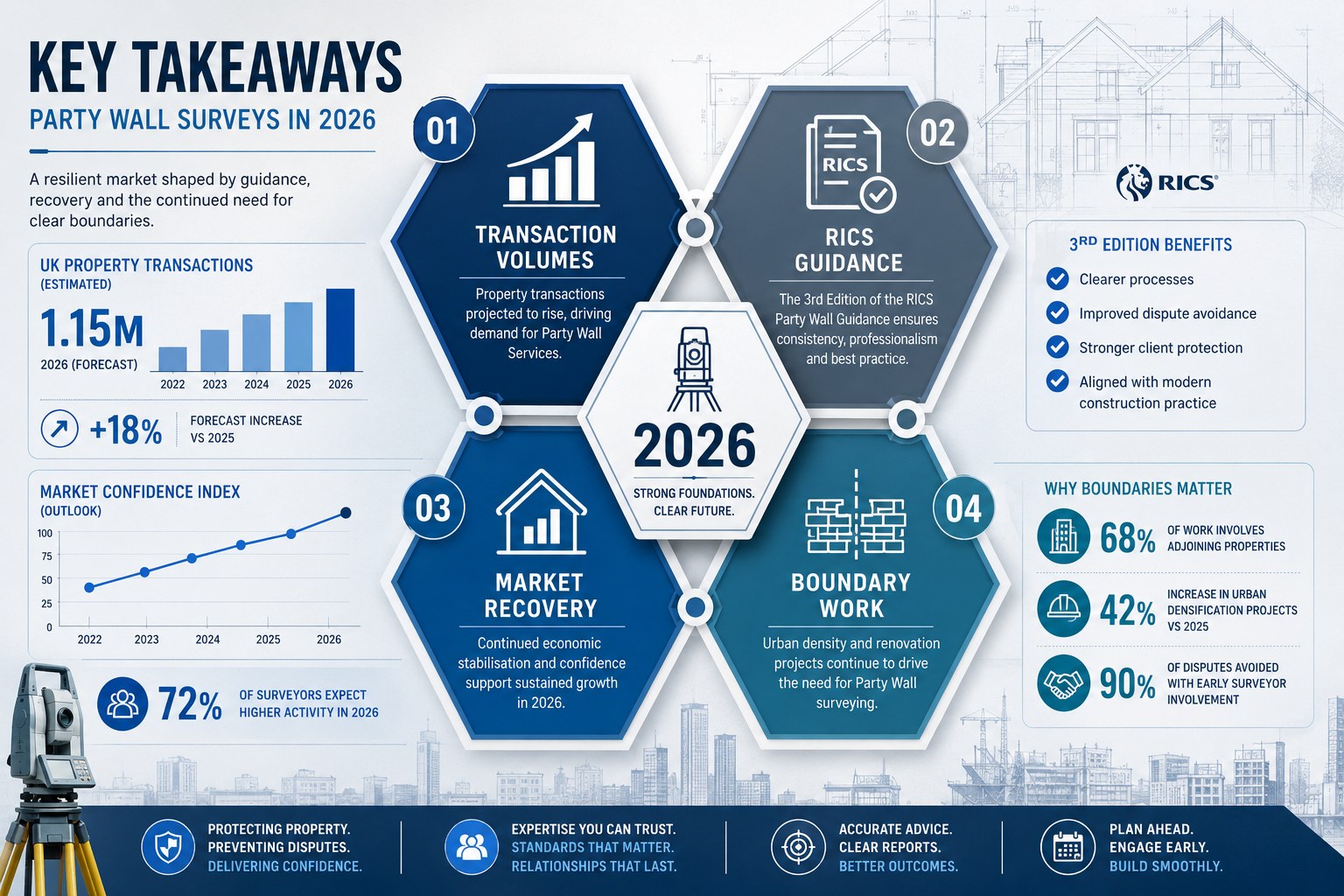
Key Takeaways
- RICS launched a consultation in April 2026 on the draft 8th edition of "Party Wall Legislation and Procedure," introducing updated award templates, revised fee disclosure requirements, and stronger guidance on surveyor independence.
- The UK housing market recovery, led by first-time buyers and regional growth in Northern England, Scotland, and Northern Ireland, is generating measurable increases in renovation and extension activity.
- The 8th edition formalizes thermal imaging as a tool for detecting hidden defects during party wall surveys, offering a non-invasive route to dispute prevention.
- Surveyors must audit notice templates, appointment letters, and award drafts promptly to align with the new guidance before high-volume project pipelines arrive.
- Public engagement and transparent fee practices are now explicitly emphasized, raising the bar for how surveyors communicate with building owners and adjoining owners alike.
The 2026 Housing Recovery and What It Means for Party Wall Demand
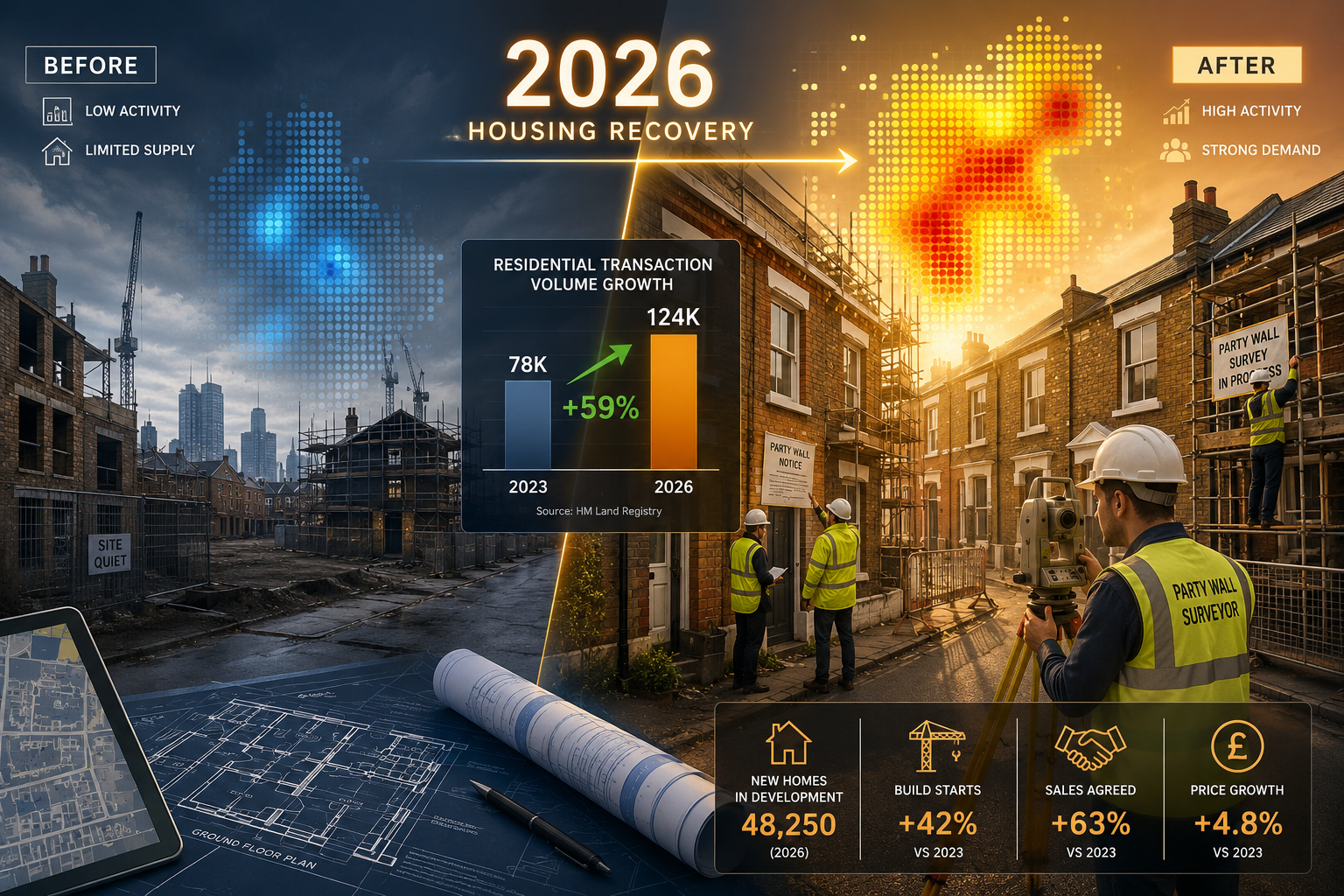
The UK housing market is not recovering uniformly, but it is recovering. Experts have described a "bottom-up" resurgence driven primarily by first-time buyers entering the market, supported by improved mortgage accessibility and stabilizing interest rate expectations [4]. Regions including Northern England, Scotland, and Northern Ireland are outperforming the national average, while the upper end of the market continues to face headwinds [5].
For party wall surveyors, this pattern matters in practical terms. First-time buyers purchasing older terraced or semi-detached stock — precisely the property types most likely to share party walls, party structures, and boundary features — are also the buyers most likely to undertake loft conversions, rear extensions, and basement excavations within the first few years of ownership. Each of those project types triggers obligations under the Party Wall etc. Act 1996.
The relationship between transaction volumes and party wall work is not incidental — it is structural. More sales mean more new owners. More new owners mean more renovation ambitions. More renovations on attached or semi-detached properties mean more notices, more schedules of condition, and more potential disputes.
Surveyors operating in London and the South East should note that even where upper-market transactions remain subdued, the mid-market renovation surge is already generating enquiries. Understanding the party wall notice process and the obligations it triggers is the starting point for any building owner entering this environment.
RICS 8th Edition: What the Consultation Covers and Why It Matters Now
In April 2026, RICS launched an eight-week consultation on the draft 8th edition of "Party Wall Legislation and Procedure" [1]. The consultation invites input from surveyors, legal professionals, and dispute resolution practitioners — a broad base that signals the scope of the changes being proposed.
The draft 8th edition is not a minor refresh. It introduces:
- Updated appendices covering procedural steps and documentation standards
- Revised letters of appointment that clarify the statutory and personal nature of a party wall surveyor's role
- An updated draft award template designed to reduce ambiguity in the way awards are drafted and served
- Strengthened guidance on fee practices and fee disclosure to adjoining owners
- Clearer protocols for the use of the Third Surveyor, including when referral is appropriate and how the process should be managed
- Revised guidance on service of notices, including electronic service considerations
- Enhanced public engagement expectations, requiring surveyors to proactively inform clients about their rights and responsibilities [1]
The consultation's timing is deliberate. As the market recovers and project pipelines grow, RICS wants the profession operating from a consistent, updated framework before high-volume periods create conditions where procedural shortcuts become tempting.
Surveyor Independence: A Critical Clarification
One of the most significant elements in the draft 8th edition is its reinforcement of surveyor independence. The guidance makes clear that a party wall surveyor's appointment is personal and statutory — it does not derive from client instruction and cannot be overridden by it [1].
This clarification responds to a pattern that has caused awards to be challenged in court: surveyors acting on the direction of the building owner who appointed them, rather than exercising independent professional judgment. In a high-volume market, where developers and contractors may apply pressure to expedite awards or minimise conditions, this guidance provides an important professional anchor.
"A party wall surveyor's duty is to the Act, not to the party who appointed them. The 8th edition makes this unambiguous."
Surveyors should review their appointment letters now. The revised letters of appointment in the 8th edition are designed to set expectations correctly from the outset. For guidance on what the agreed surveyor role entails, the party wall agreed surveyor guide provides useful context on how this appointment differs from the two-surveyor model.
Thermal Imaging, Award Drafting, and Compliance in High-Volume Periods
Thermal Imaging as a Formal Survey Tool
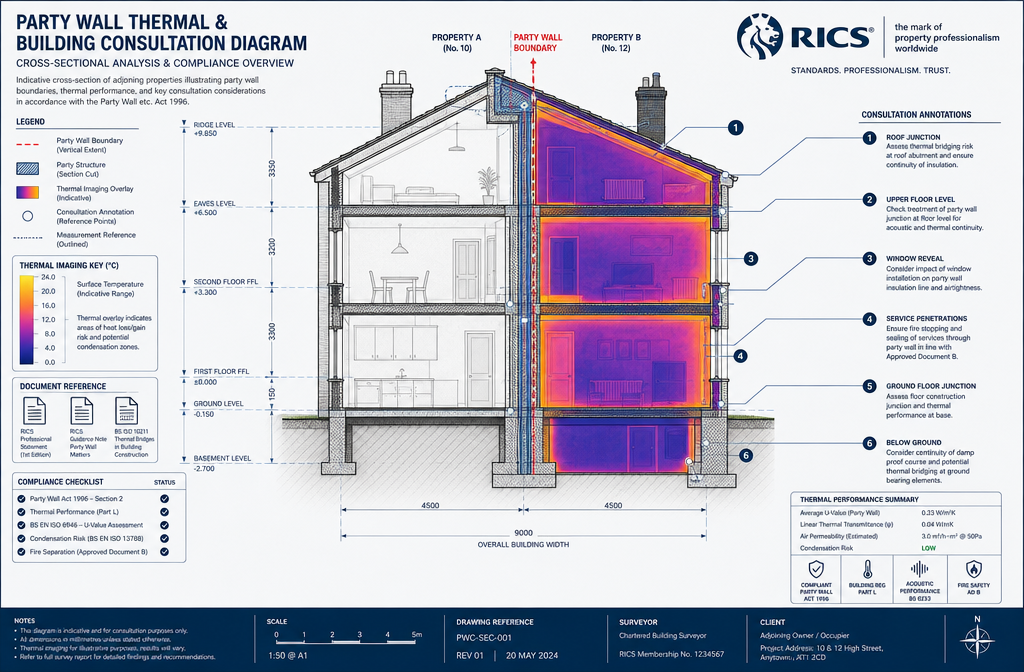
The draft 8th edition formalizes the use of thermal imaging in party wall surveys [2]. This is a meaningful shift. Thermal imaging allows surveyors to detect hidden defects — damp penetration, voids within party walls, and thermal bridges — without invasive investigation. In the context of a recovering market where adjoining owners may be particularly sensitive about damage to their properties, the ability to document pre-existing conditions accurately and non-invasively is a significant professional advantage.
The formalization of thermal imaging also has implications for schedules of condition. A schedule of condition prepared before notifiable works begin is the primary evidential tool if a dispute about damage arises later. Thermal imaging data, properly recorded and appended to the schedule, strengthens that evidence base considerably.
For surveyors handling multiple instructions simultaneously — a likely scenario as transaction volumes rise — the efficiency gains from thermal imaging are also practical. A non-invasive scan can be completed faster than manual probing and produces a digital record that integrates cleanly into award documentation.
Award Drafting Under Pressure
As instruction volumes increase, the quality of award drafting becomes a professional risk area. An award that is ambiguous, incomplete, or fails to address the specific works proposed can be challenged — and in a busy market, the temptation to rely on standard templates without sufficient tailoring is real.
The updated draft award template in the 8th edition addresses this directly [3]. Surveyors should treat the new template as a floor, not a ceiling. Key elements that must be addressed in every award include:
| Award Element | Why It Matters |
|---|---|
| Description of works | Must match the building owner's plans precisely |
| Working hours | Protects adjoining owner from unreasonable disruption |
| Access provisions | Defines when and how the building owner may access adjoining land |
| Security for expenses | Protects adjoining owner if damage occurs |
| Dispute resolution pathway | Sets out the Third Surveyor referral process |
| Thermal imaging schedule | Documents pre-existing conditions with precision |
Surveyors should also be aware that the 8th edition strengthens guidance on the Party Wall Act 3-metre rule, which governs excavation works near neighbouring structures. As basement conversions and deep foundation works become more common in urban areas, the excavation notice provisions are increasingly relevant. The party wall excavation notice requirements must be served correctly before any such works commence.
Fee Disclosure and the Adjoining Owner's Position
The 8th edition places explicit emphasis on fee transparency [1]. In practice, this means surveyors must disclose their fee basis clearly to both the building owner and the adjoining owner at the point of appointment. The guidance discourages practices where fees are set without reference to the complexity of the matter or where the adjoining owner is not informed of the likely cost exposure.
This is particularly important in the context of party wall surveyor costs, which can be a source of tension between neighbours. When adjoining owners understand the fee structure from the outset, the risk of cost-related disputes — which can derail otherwise straightforward matters — is reduced.
Practical Compliance Steps for Surveyors Facing Increased Demand
Party Wall Surveys in Recovering 2026 Markets: RICS Guidance for Increased Transaction Volumes and Boundary Work Demands requires surveyors to act before the workload peaks, not after it arrives. The following steps represent the minimum compliance actions that should be completed promptly following the consultation period [3].
1. Audit existing notice templates
Compare current notice templates against the updated appendices in the 8th edition. Pay particular attention to the language used to describe the type of works and the statutory basis for each notice type. Errors in notice drafting are a common cause of disputes and can render a notice invalid.
2. Review and update letters of appointment
The revised letters of appointment in the 8th edition clarify the personal and statutory nature of the surveyor's role. Existing templates that do not reflect this may expose surveyors to challenge if an award is later contested.
3. Integrate thermal imaging into standard practice
Surveyors who do not currently use thermal imaging should consider how to incorporate it into their schedule of condition workflow. The 8th edition's formalization of this technology means that its absence from a survey may become a point of criticism in disputed matters.
4. Update fee disclosure practices
Review how fee information is communicated to both building owners and adjoining owners. Ensure that fee disclosure happens at the point of appointment, not after the award has been drafted.
5. Familiarise with the updated Third Surveyor provisions
The 8th edition provides clearer guidance on when referral to the Third Surveyor is appropriate. In a high-volume environment, understanding this pathway is essential for managing disputes efficiently without allowing them to escalate.
For surveyors dealing with specific project types that are likely to increase in volume, the guidance on loft conversion party wall matters and party wall shared chimneys provides project-specific context that is directly relevant to the current renovation pipeline.
Regional Variations and the Boundary Work Dimension
The RICS April 2026 residential survey confirms that regional performance is uneven [5]. Northern England, Scotland, and Northern Ireland are seeing stronger price growth and transaction activity than London and the South East in some segments. However, London's density of terraced and semi-detached housing stock means that even modest increases in renovation activity translate into disproportionately high volumes of party wall instructions.
Beyond party wall matters in the strict sense, the recovery is also generating increased demand for boundary surveys in London and related boundary dispute resolution work. When neighbours are both renovating simultaneously — a pattern that emerges during market recoveries as multiple buyers in the same street undertake projects at similar times — boundary ambiguities that were previously tolerated can become flashpoints.
Surveyors should be prepared to advise clients on the relationship between party wall procedures and boundary disputes. These are legally distinct matters, but they frequently arise together, and a surveyor who can address both — or who can clearly explain where one ends and the other begins — provides considerably more value than one who can only handle the party wall element in isolation.
The guide to boundary dispute and party wall surveyors in London sets out the distinctions clearly and is a useful reference for surveyors advising clients who are uncertain which process applies to their situation.
Challenges at the Upper Market Segment
While first-time buyer activity is driving the recovery, challenges persist at the upper end of the market [4]. High-value properties often involve more complex party wall matters — larger extensions, more intrusive structural works, and adjoining owners who are more likely to appoint their own surveyor rather than agree to a single agreed surveyor. The party wall disputes that arise in this segment tend to be more contentious and more expensive to resolve.
Surveyors working in prime London markets should be particularly attentive to the 8th edition's guidance on surveyor independence and the Third Surveyor process, as these are the provisions most likely to be tested in high-value disputed matters.
Conclusion
The convergence of a recovering housing market and the RICS 8th edition consultation creates both an opportunity and an obligation for party wall surveyors in 2026. Rising transaction volumes and increased renovation activity will generate more instructions — but the profession's credibility in handling that volume depends on the quality and consistency of the work produced.
Actionable next steps for surveyors and building owners:
- Surveyors should complete a full audit of notice templates, appointment letters, and award drafts against the 8th edition guidance without delay.
- Thermal imaging should be incorporated into schedule of condition workflows as standard practice, not as an optional add-on.
- Fee disclosure processes should be reviewed and updated to meet the transparency expectations set out in the updated guidance.
- Building owners planning extensions, loft conversions, or excavation works in 2026 should engage a qualified party wall surveyor early — before works begin — to ensure notices are served correctly and the statutory timeline is respected.
- Adjoining owners who receive a party wall notice should seek independent advice promptly, understanding that their response window is limited and that their rights under the Act are meaningful.
The 8th edition is not simply a procedural update. It reflects the profession's response to a market environment where the stakes — financial, legal, and neighbourly — are rising. Surveyors who prepare now will be better positioned to serve clients well, avoid disputes, and uphold the standards that the Act was designed to protect.
References
[1] RICS Launches Consultation On Updated Party Wall Practice Guidance – https://www.rics.org/news-insights/rics-launches-consultation-on-updated-party-wall-practice-guidance?utm_source=openai
[2] Thermal Imaging Applications In Party Wall Surveys RICS 8th Edition Protocols For Hidden Defect Detection – https://wimbledonsurveyors.com/thermal-imaging-applications-in-party-wall-surveys-rics-8th-edition-protocols-for-hidden-defect-detection/?utm_source=openai
[3] RICS 8th Edition Party Wall Guidance Post Consultation Changes And Immediate 2026 Implementation For Surveyors – https://www.canterburysurveyors.com/blog/rics-8th-edition-party-wall-guidance-post-consultation-changes-and-immediate-2026-implementation-for-surveyors/?utm_source=openai
[4] Housing Market Recovery Predicted – https://www.lbc.co.uk/article/housing-market-recovery-predicted-5HjdQ5Z_2/?utm_source=openai
[5] UK Residential Survey April 2026 – https://www.rics.org/news-insights/uk-residential-survey-april-2026?utm_source=openai