A 2023 survey by the Royal Institution of Chartered Surveyors found that disputes over undetected building defects remain one of the leading sources of post-purchase litigation in the UK residential market. The rise of thermal imaging, moisture meters, and digital site records in UK building surveys has transformed what surveyors can detect and document — but better tools do not automatically produce better evidence. A thermal image misread, a moisture reading taken without context, or a digital record that lacks metadata can be as misleading as no record at all. Understanding what counts as good evidence in a modern building survey is now essential knowledge for property buyers, owners, and professionals alike.
Key Takeaways
- Thermal imaging cameras, moisture meters, and digital site records are now standard tools in high-quality UK building surveys, but each requires correct calibration, training, and contextual interpretation to produce defensible evidence.
- The UK Thermography Association (UKTA) recommends cameras with a minimum resolution of 320 x 240 pixels and operators certified to at least ISO 18436-7 Level 2 for building surveys. [4]
- Raw readings from moisture meters or thermal cameras are not conclusions — they are starting points that must be cross-referenced against construction type, ambient conditions, and visual inspection findings.
- Digital site records, including geotagged photographs, annotated thermal images, and timestamped notes, create an auditable evidence trail that supports professional opinions and, where necessary, legal proceedings.
- Choosing the right survey type for a property's age, construction, and condition remains the foundation of any effective inspection strategy.
Why Modern Survey Tools Matter More Than Ever
UK housing stock is among the oldest in Europe. Roughly 20% of all dwellings were built before 1919, and a significant proportion of the remainder date from the interwar and post-war periods. Older properties present complex defect profiles — hidden damp, failing insulation, concealed structural movement — that a visual inspection alone can easily miss.
The rise of thermal imaging, moisture meters, and digital site records in UK building surveys directly addresses this challenge. Where a surveyor once relied on a damp cloth, a penknife, and experience, they can now deploy calibrated infrared cameras, multi-mode moisture meters, and cloud-connected recording systems. The result, when used correctly, is a more complete picture of a building's condition.
However, the proliferation of affordable consumer-grade tools has also introduced risk. A surveyor armed with an uncalibrated camera and no thermography training can produce a report that appears authoritative but contains fundamental errors. This is why professional standards, certification, and interpretive skill matter as much as the technology itself.
For buyers trying to decide between survey levels, understanding which survey type suits a specific property is the logical first step before considering what tools a surveyor should bring to the job.
Thermal Imaging in UK Building Surveys: Capability and Limitations
How Thermal Cameras Work
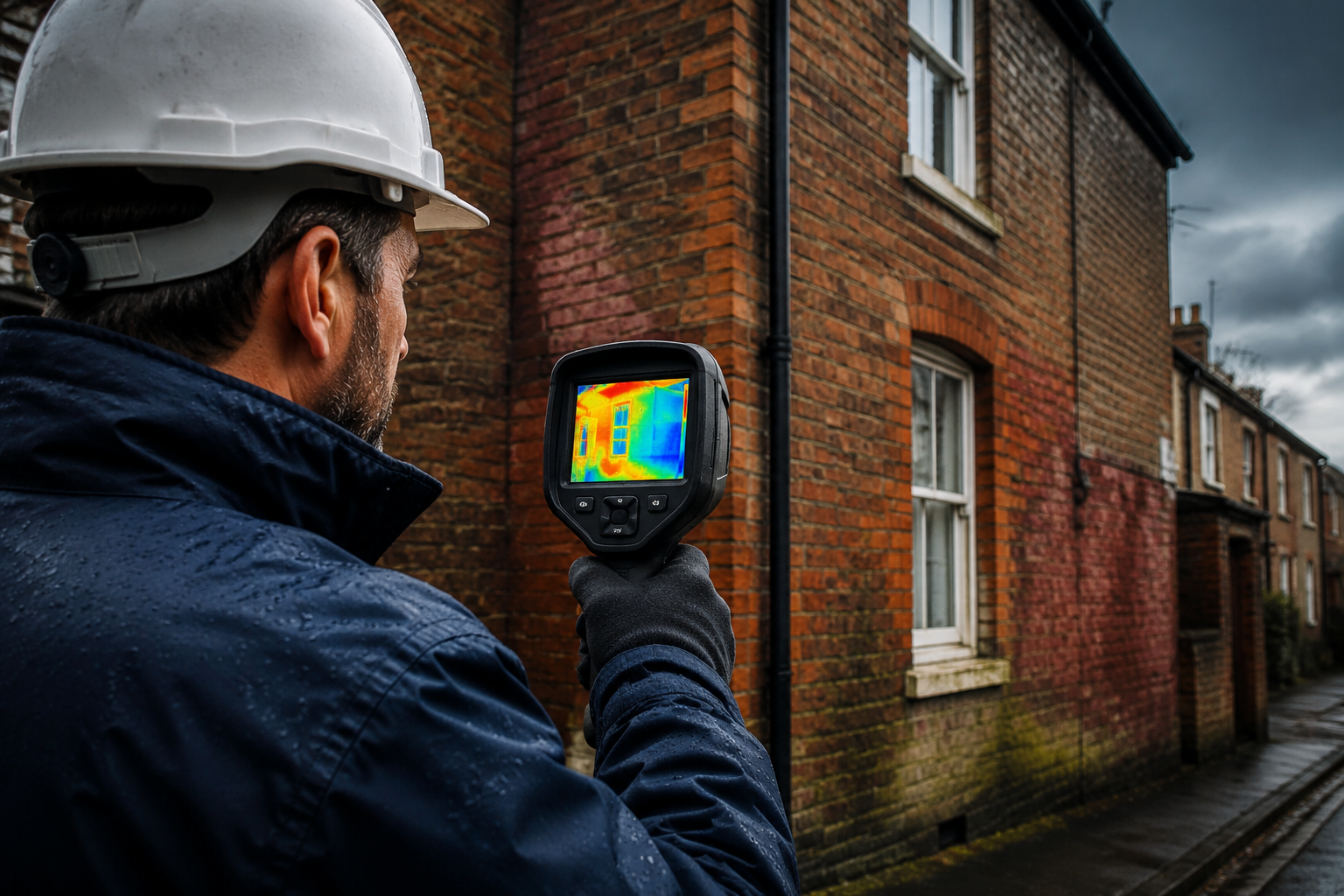
Thermal imaging cameras detect infrared radiation emitted by surfaces and convert it into a false-colour image — a thermogram. Warmer areas appear in reds and yellows; cooler areas in blues and purples. In a building context, this allows surveyors to identify:
- Heat loss through poorly insulated walls, roofs, and floors
- Cold bridging at structural junctions
- Moisture ingress indicated by evaporative cooling
- Air leakage paths around windows, doors, and service penetrations
- Concealed defects such as missing insulation behind plasterboard
Companies such as Scan Survey provide calibrated infrared surveys that produce detailed reports with annotated thermal images, enabling property owners and buyers to understand precisely where heat and moisture problems exist. [1]
The UKTA Standard: What Good Practice Looks Like
The UK Thermography Association sets clear benchmarks for building thermography. Their guidance specifies that cameras used for building surveys should have a minimum resolution of 320 x 240 pixels, and that operators should hold at least a Level 2 certification in accordance with ISO 18436-7. [4] These are not arbitrary thresholds — lower-resolution cameras produce images where small defects blend into background noise, and untrained operators frequently misinterpret normal thermal variation as defects, or vice versa.
Historic England has also published guidance on the use of infrared thermography in historic buildings, noting its value in monitoring heating systems, detecting moisture ingress, and evaluating the impact of energy efficiency improvements on older fabric. [6] This is particularly relevant given that interventions such as internal wall insulation can cause serious harm to historic structures if moisture pathways are not understood first.
Where Thermal Imaging Can Mislead
Reflective surfaces — polished metal, glazing, and some modern cladding — reflect infrared radiation from other sources, producing false readings. Solar loading on south-facing walls can mask cold bridging during the day and exaggerate it at night. Heating state is critical: a building must have been heated for several hours before a survey for meaningful temperature differentials to exist across the building envelope.
The Royal Institution of Chartered Surveyors has emphasised that surveyors must undergo proper training in thermography to interpret thermal images correctly and integrate findings into comprehensive building assessments. [7] A thermogram is not a defect report — it is a dataset that requires professional interpretation.
"A thermal image that shows a cold patch is a question, not an answer. The answer requires cross-referencing with construction drawings, moisture readings, and physical inspection."
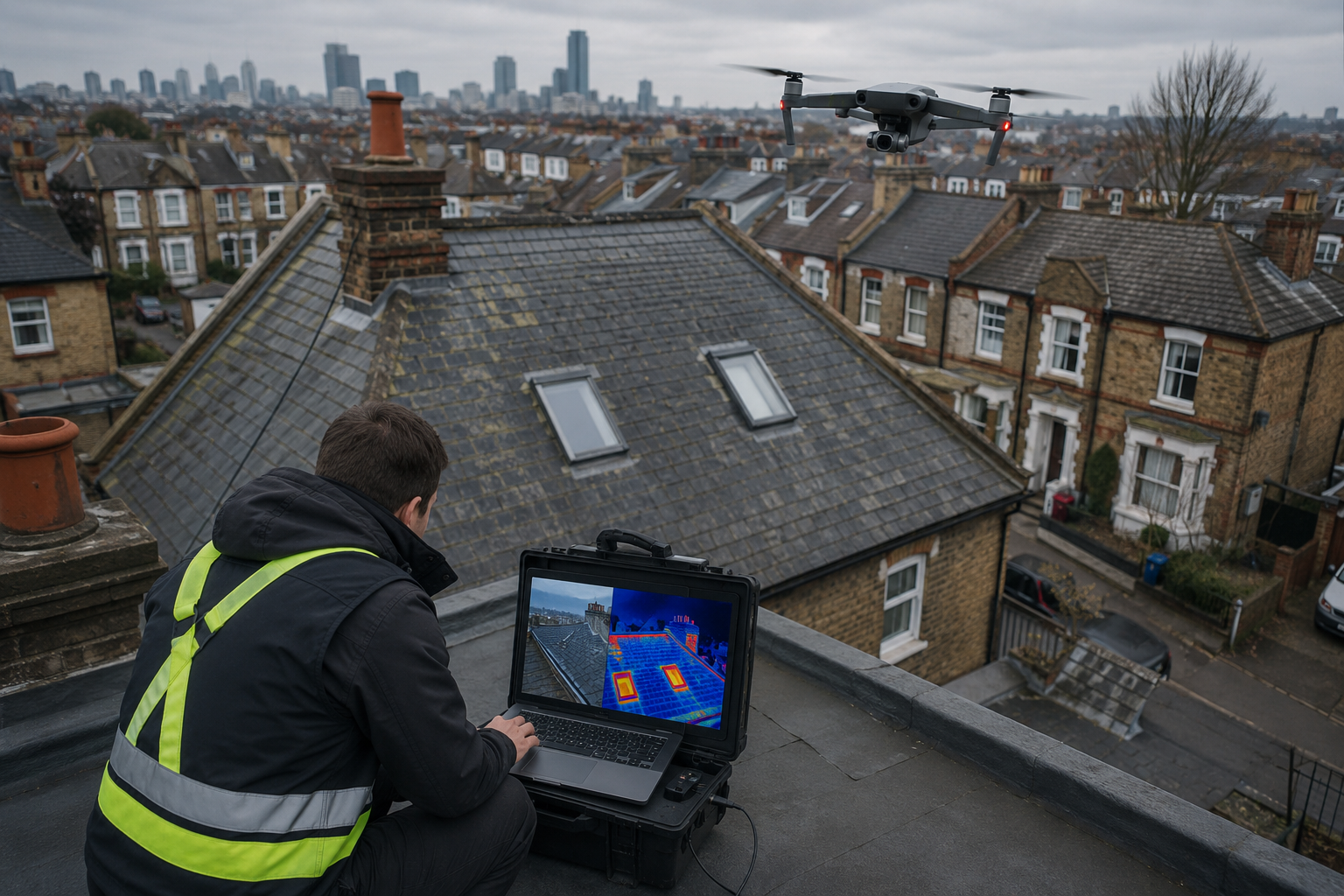
For roof-specific thermal work, a drone roof survey can extend the reach of thermal imaging to areas that are inaccessible or unsafe for direct inspection, combining aerial photography with infrared detection.
Moisture Meters: Types, Accuracy, and the Evidence They Produce
Pin-Type vs. Pinless Meters
Moisture meters fall into two broad categories:
| Type | Method | Best Use | Limitation |
|---|---|---|---|
| Pin-type (resistance) | Measures electrical resistance between two probes | Timber, plaster, masonry | Invasive; affected by salts |
| Pinless (capacitance) | Measures dielectric properties through a pad | Screening large areas quickly | Reads moisture at variable depths; less precise |
| Combination | Both modes in one device | Versatile site use | Higher cost |
Advanced devices such as the FLIR MR160 combine a built-in 80 x 60 thermal imager with both pinless and pin probe capability, allowing surveyors to screen an area thermally and then confirm moisture presence with direct measurement. [2] Suppliers such as Merlin Lazer offer a range of professional-grade moisture meters and thermal cameras for building survey use. [8]
The Problem of Salt Contamination
One of the most significant sources of error in moisture meter readings is salt contamination. Hygroscopic salts — particularly nitrates and chlorides deposited by rising damp or historic contamination — attract atmospheric moisture. A pin-type meter in a salt-contaminated wall will return elevated readings even when the wall is structurally dry, because the salts conduct electricity independently of free water content.
Independent damp survey specialists, such as Damp Surveys UK, use both thermal imaging cameras and deep-wall moisture meters to provide impartial assessments, specifically avoiding the conflict of interest that arises when a firm both diagnoses and sells remedial treatments. [3] Their approach illustrates a key principle: good evidence requires independence as well as technical competence.
Turning Readings into Defensible Conclusions
A moisture reading of, say, 25% WME (Wood Moisture Equivalent) in a ground-floor wall is not a conclusion. It becomes evidence only when combined with:
- Visual inspection of the surrounding area (staining, efflorescence, plaster condition)
- Construction context (solid wall, cavity wall, basement, ground floor slab)
- External conditions (recent rainfall, ground drainage, external render condition)
- Salt analysis if contamination is suspected
- Comparison readings from unaffected areas of the same building
For complex cases involving suspected structural movement alongside damp, a structural survey provides the broader investigative framework within which moisture data can be properly contextualised.
When a specific defect is already identified and the client needs focused investigation rather than a whole-building assessment, a specific defect report allows surveyors to deploy moisture meters and thermal cameras in a targeted and cost-effective way.
Digital Site Records: Building an Auditable Evidence Trail
What Digital Records Include
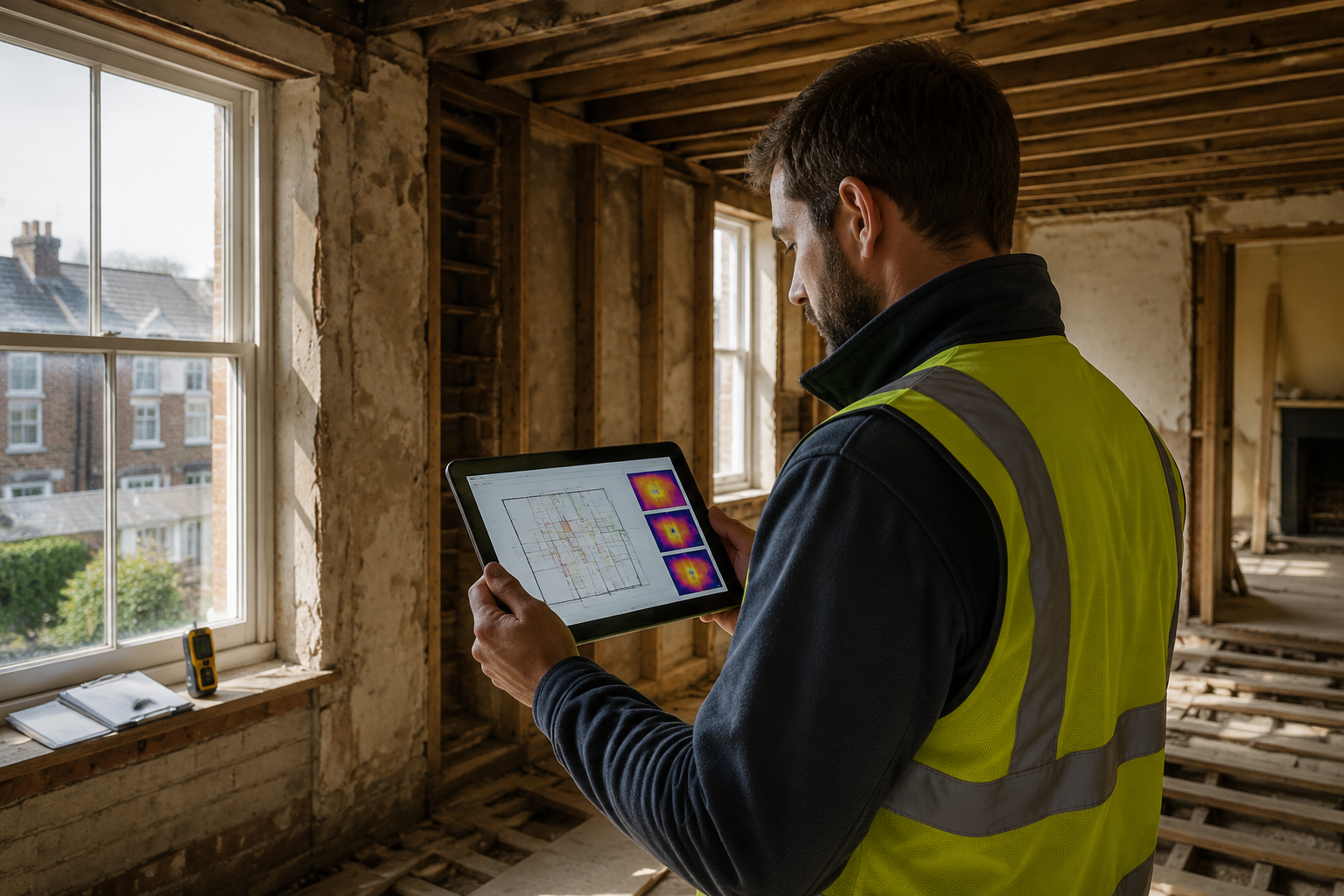
The shift from paper notebooks and film photographs to digital site records represents a fundamental change in how survey evidence is created, stored, and challenged. A modern digital site record may include:
- Geotagged photographs with embedded GPS coordinates and timestamps
- Annotated thermal images with emissivity settings and ambient temperature recorded
- Voice-to-text field notes captured in real time
- Moisture meter readings logged automatically via Bluetooth to a survey app
- Drone footage with flight logs and altitude data
- Sketch plans drawn on tablet with measurement annotations
The integration of thermal imaging data into digital records allows for more efficient documentation and analysis of building conditions, supporting better decision-making in maintenance and refurbishment projects. When a surveyor can show not just what they found, but exactly when, where, and under what conditions they found it, the resulting report carries substantially greater evidential weight.
Why Metadata Matters
A photograph without a timestamp and location is almost useless in a dispute. A thermal image without recorded ambient temperature, camera emissivity setting, and distance-to-target is equally unreliable. Professional thermal imaging services, such as those provided by iRed, produce reports that include full technical metadata alongside annotated images, enabling clients and their advisers to understand and verify the conditions under which readings were taken. [9]
Property managers increasingly use thermal imaging surveys to identify heat loss, damp ingress, and insulation gaps, with digital records enabling proactive maintenance scheduling and energy efficiency tracking over time. [10] This longitudinal use of digital records — comparing surveys taken months or years apart — is only possible when the original data is properly structured and stored.
Digital Records in Legal and Dispute Contexts
When a building defect leads to a professional negligence claim, insurance dispute, or boundary disagreement, the quality of the underlying survey evidence becomes critical. A well-constructed digital site record — with timestamped entries, calibration certificates for equipment, and a clear chain of custody for data — can be the difference between a defensible professional opinion and an unsubstantiated assertion.
For cases that reach formal dispute resolution, an expert witness report draws on exactly this kind of structured evidence. Courts and tribunals expect expert witnesses to demonstrate not just what they concluded, but how they reached that conclusion and what data supports it.
Digital records are equally important in commercial contexts. A commercial dilapidation survey that documents a tenant's breaches of repair obligations must be evidentially robust enough to withstand challenge at lease end — thermal images and moisture readings, properly recorded, add significant weight to such assessments.
Calibration, Training, and the Standards Framework
Equipment Calibration
No piece of survey equipment produces reliable evidence if it is not properly calibrated. For thermal cameras, calibration involves verifying that the sensor accurately converts infrared radiation into temperature values across the camera's operating range. For moisture meters, calibration checks ensure that the resistance or capacitance readings correspond accurately to known moisture levels in reference materials.
The UKTA's building thermography guidance specifies minimum camera performance standards and recommends that surveys be conducted by personnel certified to Level 2 in accordance with ISO 18436-7. [4] BREEAM certification processes, which assess building environmental performance, require that thermal imaging surveys be conducted by certified thermographers — uncertified surveys are not accepted as evidence for BREEAM ratings. [5]
The Role of Surveyor Competence
Technology amplifies competence but cannot substitute for it. A chartered surveyor who understands construction pathology will use a thermal camera as one tool among many, cross-referencing its output against their knowledge of building physics, material behaviour, and defect patterns. An operator who treats the camera as a defect-detection machine in its own right will produce misleading reports.
The RICS has been clear that thermography training is essential for surveyors who wish to incorporate thermal imaging into their professional practice. [7] This training covers not just camera operation but the physics of heat transfer, the interpretation of thermal anomalies, and the communication of findings in a way that clients and other professionals can understand and act upon.
For buyers comparing survey options, understanding the difference between a homebuyer report and a building survey helps clarify which level of investigation — and therefore which tools — are appropriate for a given property and transaction.
Bringing It Together: What Good Evidence Looks Like in Practice
The rise of thermal imaging, moisture meters, and digital site records in UK building surveys has raised the bar for what a high-quality survey report should contain. Good evidence in a modern building survey has the following characteristics:
It is multi-source. No single instrument reading stands alone. Thermal images, moisture meter data, visual observations, and construction history must corroborate one another.
It is contextualised. Readings are recorded alongside the conditions under which they were taken — ambient temperature, humidity, heating state, recent weather, and building construction type.
It is calibrated. Equipment used is within its calibration period, and calibration records are available.
It is produced by a competent operator. The surveyor holds appropriate qualifications and, where specialist tools are used, relevant certifications.
It is clearly communicated. The report explains what was found, what it means, and what action (if any) is recommended, in language that a non-specialist client can understand.
It is auditable. Digital records, including metadata, are retained in a format that can be reviewed, challenged, and defended.
Conclusion
The integration of thermal imaging, moisture meters, and digital site records into UK building surveys has genuinely improved the profession's ability to detect, document, and communicate building defects. However, the value of these tools depends entirely on how they are used. Raw data without context, readings without calibration, and images without trained interpretation can mislead as easily as they inform.
Actionable next steps for property buyers and owners:
- Ask your surveyor what tools they use and whether they hold relevant certifications for thermal imaging and moisture assessment.
- Request full digital records — not just a summary report — so that readings, images, and metadata are available for review.
- Match the survey type to the property: a Victorian terrace with suspected damp warrants a more thorough investigation than a modern flat; use our guide to choosing the right survey as a starting point.
- Treat elevated readings as questions, not conclusions — always ask what additional investigation is recommended before commissioning remedial work.
- Retain all survey records in digital format; they may be needed years later in a dispute, insurance claim, or resale negotiation.
The standard of evidence in UK building surveys is rising. Buyers, owners, and professionals who understand what good evidence looks like are better placed to protect their interests and make sound decisions about the properties they occupy, manage, or invest in.
References
[1] Thermal Imaging Survey – https://www.scansurvey.co.uk/thermal-imaging-survey?utm_source=openai
[2] Mr160 – https://www.flir.com/en-gb/products/mr160/?utm_source=openai
[3] dampsurveys.uk – https://www.dampsurveys.uk/?utm_source=openai
[4] Building Thermography – https://ukta.org/building-thermography/?utm_source=openai
[5] Breeam Survey – https://ired.co.uk/thermal-imaging/breeam-survey/?utm_source=openai
[6] Thermal Imaging – https://historicengland.org.uk/advice/technical-advice/building-services-engineering/installing-new-services/thermal-imaging/?utm_source=openai
[7] An Introduction To Building Thermography – https://ww3.rics.org/uk/en/journals/built-environment-journal/an-introduction-to-building-thermography.html?utm_source=openai
[8] Moisture Meters – https://www.merlinlazer.com/Moisture-Meters?utm_source=openai
[9] Thermal Imaging – https://ired.co.uk/thermal-imaging/?utm_source=openai
[10] thermalimagingsurveys.uk – https://thermalimagingsurveys.uk/?utm_source=openai