Global real estate deal volumes climbed to $888.6 billion in 2025 — a 14% year-over-year gain — yet the professionals who consistently outperform are not simply chasing volume. They are surveying smarter [2]. The discipline of site selection, structural due diligence, and geospatial analysis has never been more central to capturing the opportunities identified in PwC and the Urban Land Institute's annual flagship research. Surveying for Emerging Real Estate Markets: Lessons from PwC's 2026 Trends Report is therefore not an abstract exercise in trend-watching. It is a practical framework for translating macro intelligence into on-the-ground decisions.

Key Takeaways
- PwC's 2026 Trends Report identifies data centers, senior housing, self-storage, and select office assets as the highest-priority sectors for investors and developers this year.
- National data center vacancy rates have fallen below 2%, making site selection and power-access surveys mission-critical before any commitment.
- Senior housing is at a historic inflection point as the first baby boomers turn 80 in 2026, driving record occupancy and demand for tech-enabled facilities.
- The office sector is bifurcating sharply: top-tier assets command record rents while secondary stock faces structural vacancy challenges that only thorough structural and dilapidation surveys can quantify.
- Geospatial strategies — combining drone surveys, GIS mapping, and RICS-standard valuations — are the connective tissue between PwC's macro trends and site-level investment decisions.
What PwC's 2026 Trends Report Actually Says
PwC and ULI's annual Emerging Trends in Real Estate report draws on hundreds of interviews and surveys with developers, investors, and lenders. The 2026 edition opens with a frank acknowledgment: economic "fog" — sticky inflation, fluctuating interest rates, and policy uncertainty around trade and immigration — is clouding the path forward [3]. Despite this, the report is decidedly not pessimistic. It identifies specific sectors and geographies where fundamentals are strengthening, and it challenges investors to move beyond wait-and-see positioning.
The Top U.S. Markets for 2026
Realtor.com's companion research pinpoints Hartford, CT; Rochester, NY; and Worcester, MA/CT as the three leading U.S. housing markets for 2026, driven by affordability and strong buyer demand in secondary cities near major metro areas [4]. PwC's report reinforces this secondary-market thesis, noting that affordability constraints in gateway cities are pushing both residents and capital toward smaller, high-growth hubs.
Key market drivers highlighted in the report include:
- Affordability relative to gateway cities
- Strong employment bases in healthcare, education, and technology
- Infrastructure investment and transit connectivity
- Demographic inflows from larger metros
For surveyors and investors operating in the UK, the parallel is clear: outer London boroughs, commuter belt towns, and regional cities are experiencing similar dynamics, making local chartered surveying expertise indispensable for site assessment.
Core Sector Insights: Where the Opportunities Are in 2026
Data Centers: The Infrastructure Imperative
The data center sector is the most dramatic story in PwC's 2026 report. Driven by the rapid expansion of artificial intelligence and cloud computing, national vacancy rates in the United States have fallen below 2%, with most facilities pre-leased before construction is even complete [1]. This is not a cyclical blip — it reflects a structural shift in how economies consume digital infrastructure.
"Power access is now the single most important site-selection criterion for data center development — surpassing land cost, zoning, and proximity to fibre networks."
For surveyors, this creates a specific due diligence mandate. Before any data center site is committed to, the following assessments are essential:
| Survey Type | Purpose |
|---|---|
| Structural survey | Assess load-bearing capacity for dense server infrastructure |
| Ground investigation | Identify subsidence risk and soil bearing capacity |
| Power infrastructure audit | Confirm grid connection availability and redundancy |
| Environmental survey | Evaluate cooling water access and thermal management |
| Drone roof survey | Assess existing building condition for retrofit projects |
Power shortages and supply bottlenecks are already constraining growth in several U.S. markets [1]. In the UK context, sites with confirmed grid capacity and planning consent for high-energy use are commanding significant premiums. A structural survey in London that specifically addresses load ratings and MEP (mechanical, electrical, plumbing) capacity is no longer a box-ticking exercise — it is a value-determining document.
Senior Housing: A Demographic Tipping Point
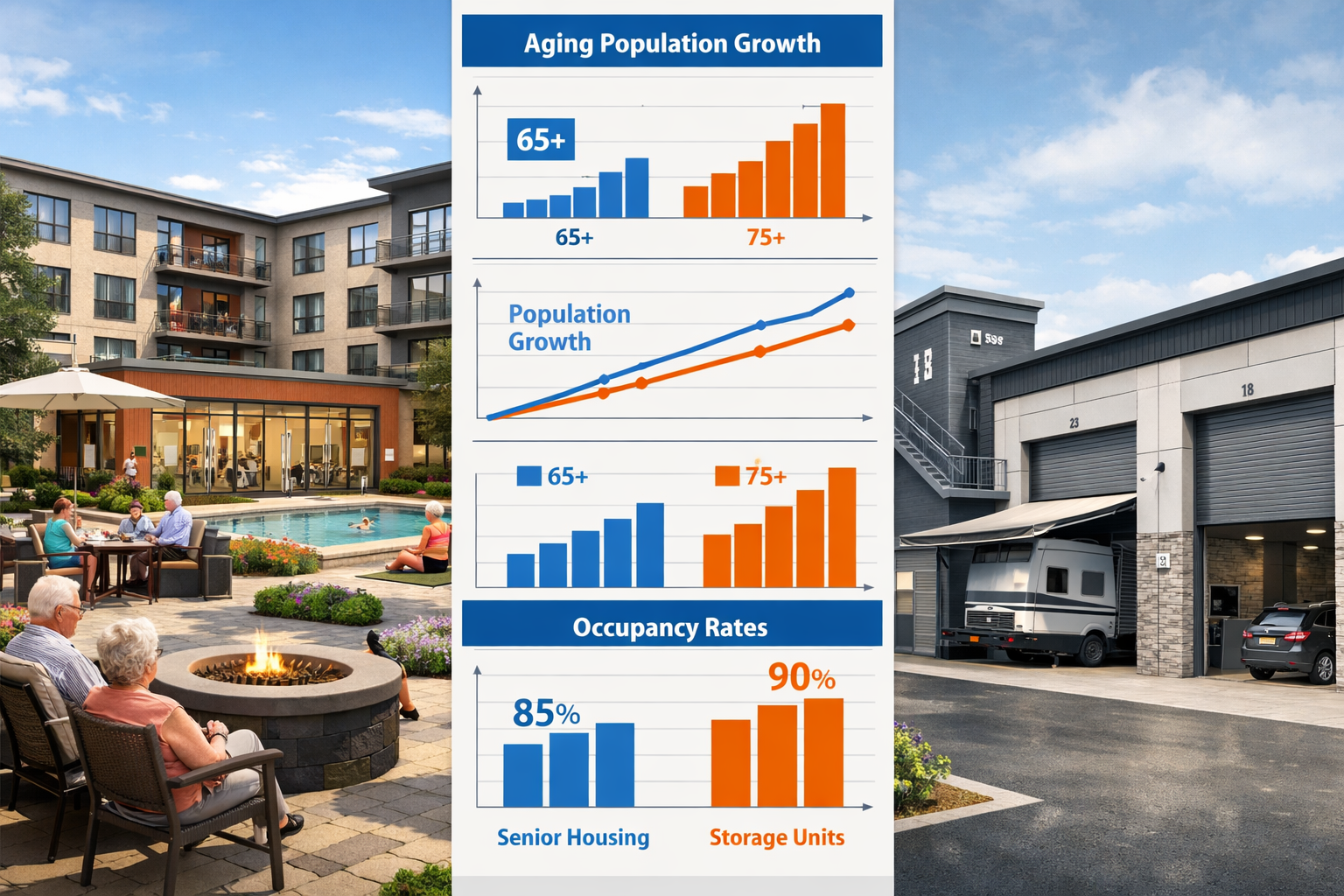
2026 marks a genuine inflection point for senior housing. The first wave of baby boomers turns 80 this year, and the demand curve is steepening faster than supply can respond [1]. Limited new development and evolving care models — including active adult communities and wellness-focused, tech-enabled facilities — are pushing occupancy to record highs.
What this means for surveyors and developers:
- Existing care home and sheltered housing stock requires thorough condition assessments before acquisition
- Adaptive reuse of commercial and retail properties for senior living is accelerating
- Accessibility compliance surveys are a non-negotiable part of due diligence
- Wellness infrastructure (natural light, air quality, green space) is now a valuation factor
For investors acquiring existing senior housing assets, a specific defect report can identify latent issues — from roof deterioration to structural movement — that would materially affect both the acquisition price and the cost of bringing a facility up to modern care standards.
Self-Storage: From Commodity to Hybrid Asset
Self-storage is quietly becoming one of the most sophisticated sectors in the PwC report. Housing constraints and lifestyle trends favouring flexibility are driving demand, while a new subsegment — storage condos — is emerging as a hybrid between industrial and personal-use space [1]. These facilities blend the investment characteristics of industrial real estate with the consumer demand patterns of residential markets.
The surveying implications are significant. Storage condo developments require:
- Precise boundary surveys to define individual unit ownership
- Structural assessments for mezzanine and high-bay configurations
- Fire safety and access compliance reviews
- Valuation methodologies that account for the hybrid asset nature
A boundary survey in London or any urban market is particularly important for storage condo schemes, where title clarity between individual units and common areas must be established from the outset to avoid future disputes.
Student Housing: Growth With Caveats
Student housing rebounded strongly in 2024, supported by simplified federal financial aid processes, a record high school graduating class, and robust international enrollment [1]. However, PwC's 2026 report introduces important caveats: demographic headwinds, visa processing delays, and rising construction costs are creating a more complex outlook.
For surveyors, this means that student housing acquisitions require a more granular approach to due diligence than in previous cycles. Proximity to universities, transport links, and the condition of existing stock all feed directly into achievable rental yields. A snagging report for newly built purpose-built student accommodation (PBSA) is essential to ensure that developers deliver what they have promised — and that investors are not inheriting defect liability on day one.
The Office Sector: Bifurcation as a Surveying Challenge
The office market in 2026 is not a single story — it is two stories running in parallel, and they are moving in opposite directions [1]. Top-tier, well-located office buildings in major markets are achieving record rents and near-full occupancy. Meanwhile, secondary and tertiary office stock continues to suffer elevated vacancies, with no clear recovery path in sight.
This bifurcation creates both risk and opportunity for surveyors:
For Grade A assets:
- Reinstatement cost valuations must reflect premium specification and fit-out costs
- Dilapidation surveys at lease end are increasingly contested, given the high cost of restoring premium finishes
For secondary and vacant stock:
- Structural surveys are critical to assess whether conversion to residential, senior housing, or mixed-use is viable
- Commercial dilapidation assessments quantify the liability gap between current condition and lease obligations
A commercial dilapidation survey in London is particularly valuable in this environment. Landlords holding secondary office stock need an accurate picture of their dilapidation exposure before deciding whether to refurbish, convert, or dispose of an asset. Tenants, equally, need independent advice to avoid overpaying on schedule of dilapidations claims.
"The gap between the best and worst office assets is now so wide that they effectively operate in different markets — and require entirely different surveying and valuation approaches."
Geospatial Strategies: Mapping PwC's Trends to Site-Level Decisions
Surveying for Emerging Real Estate Markets: Lessons from PwC's 2026 Trends Report is ultimately about translation — converting macro intelligence into site-specific action. Geospatial analysis is the bridge between the two.
GIS Mapping and Site Selection
Geographic Information System (GIS) mapping allows investors and developers to overlay multiple data layers — demographics, planning consents, infrastructure capacity, flood risk, and comparable transaction data — onto a single spatial view. This is how the secondary-market thesis from PwC's report becomes actionable: by identifying specific postcodes or local authority areas where the convergence of affordability, employment growth, and infrastructure investment creates a genuine opportunity window.
In the UK context, this means working with RICS-registered valuers who can combine market intelligence with geospatial data to produce valuations that reflect not just current market conditions but the trajectory of a micro-market over the next three to five years.
Drone Surveys for Rapid Site Assessment
The speed at which emerging markets move in 2026 means that traditional survey timelines can be a competitive disadvantage. Drone technology has transformed the initial site assessment process, enabling surveyors to capture high-resolution roof, facade, and site condition data in a fraction of the time required for traditional access-based inspections.
A drone roof survey in London can identify structural issues, drainage problems, and condition defects within hours of instruction — giving investors the information they need to move quickly and confidently on time-sensitive acquisitions.
Retrospective Valuations and Market Timing
Understanding where a market has come from is as important as knowing where it is going. Retrospective valuations — which establish the value of a property at a specific historical date — are a powerful tool for investors trying to understand the price trajectory of an emerging market, assess the performance of a previous acquisition, or resolve a dispute about historical value.
A retrospective valuation on a London property can also be essential for tax purposes, including capital gains tax calculations on assets held through a period of significant market movement.
Navigating Economic Uncertainty: The Surveyor's Role in Risk Management
PwC's 2026 report is candid about the fog of economic uncertainty [3]. Sticky inflation, interest rate volatility, and policy shifts around trade and immigration are all creating headwinds that make straightforward investment decisions harder. In this environment, the surveyor's role shifts from a transactional service to a strategic risk management function.
Practical risk management steps informed by PwC's findings:
- Commission pre-acquisition structural surveys before any offer is made on assets in high-growth sectors, particularly data centers and senior housing where structural specifications are unusually demanding.
- Use dilapidation surveys strategically at both acquisition and disposal to quantify liability and negotiate more effectively.
- Integrate subsidence risk assessments into site selection for ground-up development, particularly in areas of urban expansion where ground conditions may be less well-documented. A subsidence survey in London provides the baseline data needed to make informed development decisions.
- Obtain RICS-standard valuations that reflect current market conditions rather than relying on automated valuation models, which can lag significantly in fast-moving emerging markets.
- Understand what survey you need before instructing — different asset types and transaction structures require different survey products, and choosing the wrong one can leave material risks unidentified. A clear guide to what survey you need can save significant time and cost.
Demographic Shifts and Technology: The Long-Term Shaping Forces
Beyond the sector-specific findings, PwC's 2026 report identifies two structural forces that will shape real estate demand for the next decade: demographic change and technological integration [1].
Demographic shifts to track:
- The ageing of baby boomers is creating sustained demand for senior housing, healthcare-adjacent real estate, and accessible residential stock
- Urbanisation continues in secondary cities, driven by remote work flexibility and affordability
- Household formation patterns are shifting, with more single-person and multigenerational households influencing residential design requirements
Technology integration in real estate:
- AI-driven analytics are improving site selection accuracy and investment underwriting
- Smart building technology is becoming a standard expectation in premium office and residential assets
- Digital twin technology is enabling developers to model building performance before construction begins
- Drone and remote sensing technology is reducing the cost and time of physical surveys
For surveyors, the technology trend is an opportunity rather than a threat. Firms that integrate digital survey tools — from drone inspection to GIS-based reporting — are able to deliver faster, more accurate, and more comprehensive assessments than those relying on traditional methods alone.
Conclusion: From Trend Intelligence to Surveying Action
Surveying for Emerging Real Estate Markets: Lessons from PwC's 2026 Trends Report is not a passive exercise in reading research. The report's value lies in its translation into specific, site-level decisions — and that translation requires the expertise of qualified surveyors who understand both the macro trends and the micro-level condition of individual assets.
Actionable next steps for investors and developers in 2026:
- Prioritise structural and geotechnical surveys for data center and senior housing acquisitions, where specification demands are highest
- Commission drone surveys for rapid initial assessment of sites in fast-moving secondary markets
- Use retrospective and current market valuations to establish accurate baselines before acquisition or disposal
- Integrate GIS and geospatial data into site selection to identify the micro-markets where PwC's macro trends are most concentrated
- Engage RICS-registered surveyors early in the transaction process to ensure that due diligence keeps pace with market speed
- Review dilapidation exposure on existing office holdings, particularly secondary stock, to make informed hold-versus-dispose decisions
The markets that PwC identifies as emerging in 2026 will not wait for investors who move slowly. But speed without rigour is simply a faster route to a costly mistake. The surveyors and investors who will outperform are those who combine the strategic intelligence of the PwC report with the on-the-ground discipline of thorough, professional surveying.
References
[1] Emerging Trends In Real Estate 2026 – https://www.pwc.com/us/en/about-us/newsroom/press-releases/emerging-trends-in-real-estate-2026.html?utm_source=openai
[2] Etre Global Outlook – https://www.pwc.com/gx/en/industries/financial-services/real-estate/emerging-trends-real-estate/etre-global-outlook.html?utm_source=openai
[4] Most In Demand Housing Markets In The Us – https://www.kiplinger.com/real-estate/most-in-demand-housing-markets-in-the-us?utm_source=openai