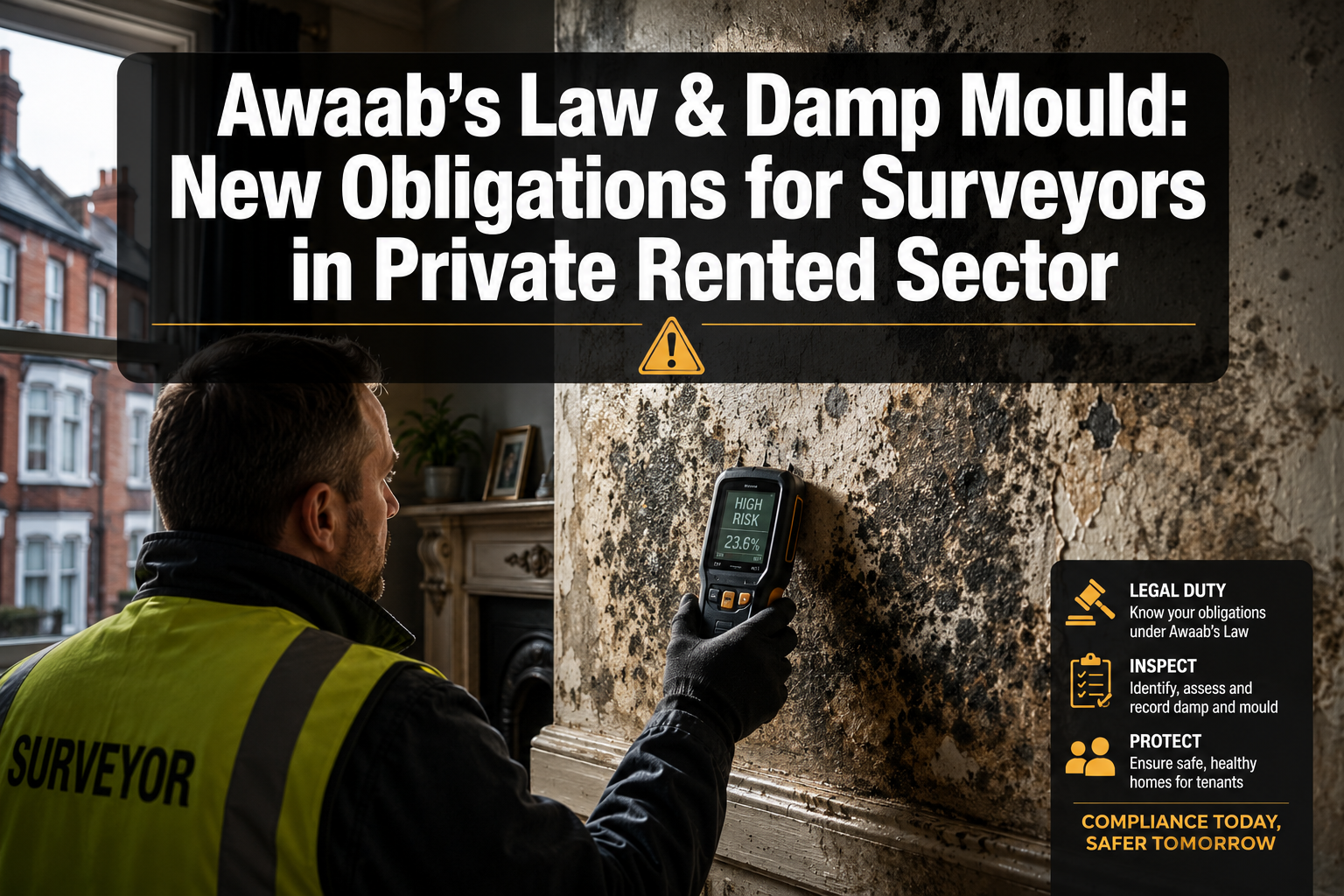

A two-year-old child died from a respiratory condition caused by prolonged exposure to black mould in a social housing flat in Rochdale. That tragedy — the death of Awaab Ishak in 2020 — became the catalyst for one of the most significant shifts in housing law England has seen in a generation. As of 1 May 2026, Awaab's Law, damp and mould: new obligations for surveyors in private rented sector building surveys have moved from a social housing concern into the mainstream of private rental practice, reshaping what landlords must do and, critically, what surveyors must report.
Key Takeaways
- Awaab's Law extended to the private rented sector (PRS) in England on 1 May 2026 under the Renters' Rights Act 2025.
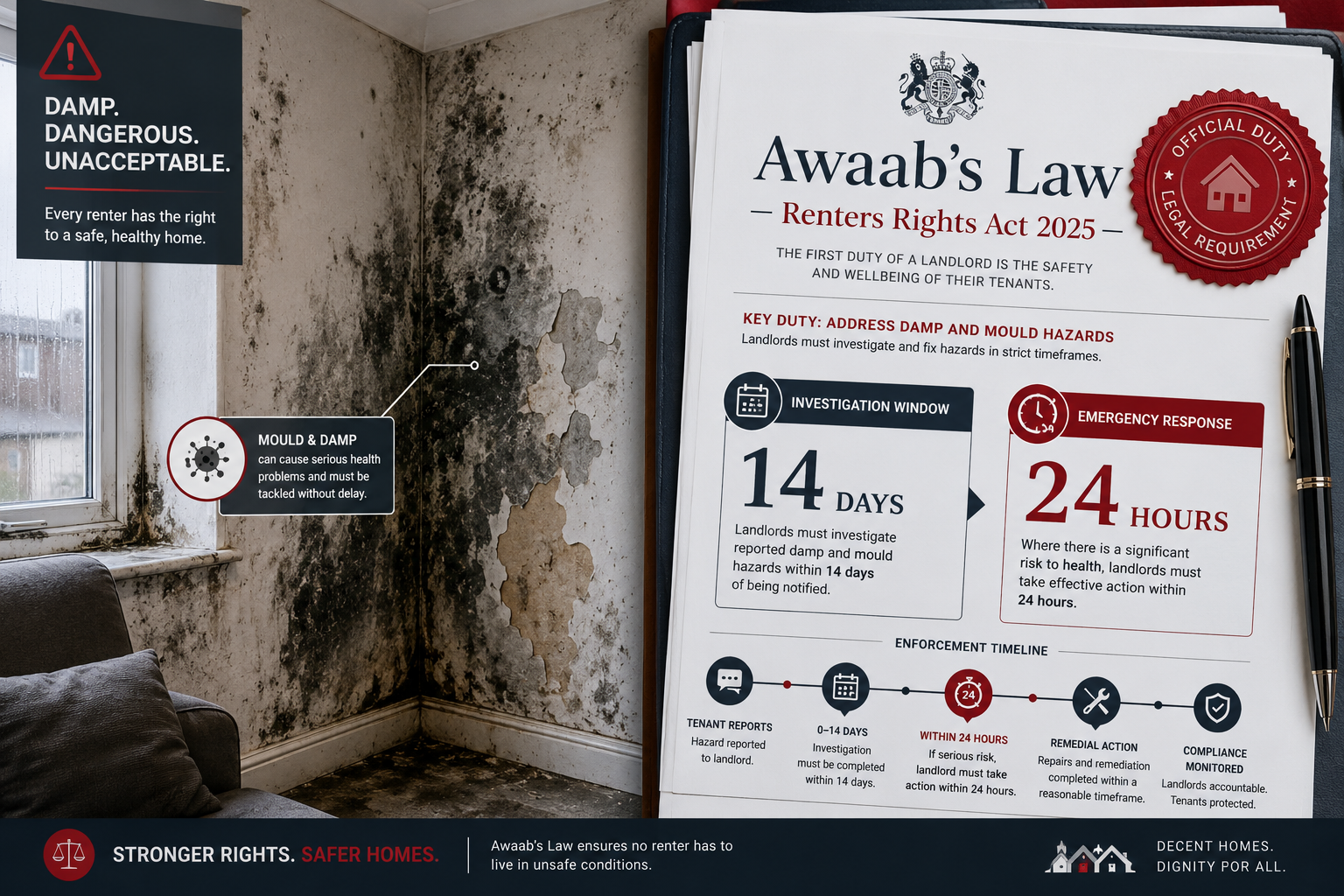
- Landlords must begin investigating hazard reports within 14 days, and address emergency risks within 24 hours.
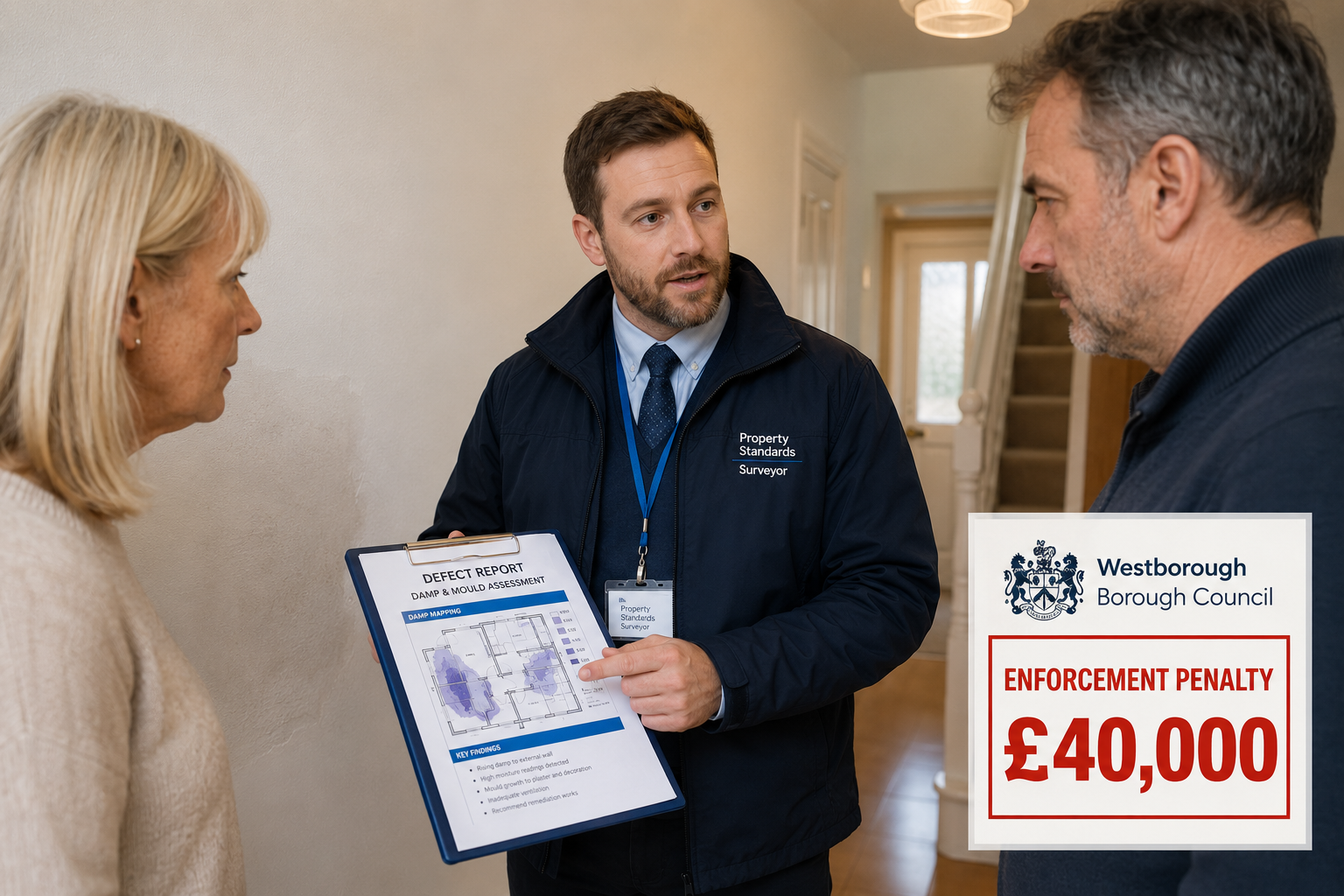
- Non-compliance can result in civil penalties of up to £40,000 and tenant disrepair claims.
- Surveyors conducting building surveys in the PRS now carry a heightened duty to identify, classify, and report damp and mould accurately.
- The Housing Health and Safety Rating System (HHSRS) remains the benchmark framework for assessing hazard severity.
What Is Awaab's Law and How Did It Reach the Private Rented Sector
Awaab's Law was first introduced through the Social Housing (Regulation) Act 2023, placing strict response obligations on registered social landlords in England. The legislation required those landlords to investigate and remedy damp, mould, and other health hazards within defined timeframes. The policy intent was clear: housing conditions that threaten life must be treated as urgencies, not administrative inconveniences.
The extension to the private rented sector was confirmed through the Renters' Rights Act 2025, with the provisions coming into force on 1 May 2026 [1]. This expansion means that the approximately 4.6 million private rented households in England are now covered by the same framework that originally applied only to social housing.
The law covers a range of health and safety hazards, but its primary and most prominent focus is on damp and mould growth — the very conditions that contributed to Awaab Ishak's death [2]. Other hazards within scope include excess cold, carbon monoxide exposure, electrical faults, and structural risks, with further phases expected to address additional categories in coming years [5].
The Mandatory Response Timeframes Every Surveyor Must Understand
At the heart of Awaab's Law is a set of legally binding response timeframes. These are not aspirational targets — they are enforceable obligations with serious consequences for non-compliance [2].
| Trigger Event | Required Action | Timeframe |
|---|---|---|
| Tenant reports a hazard | Begin investigation | Within 14 calendar days |
| Hazard poses imminent risk to life or serious injury | Address the emergency | Within 24 hours |
| Hazard confirmed after investigation | Complete remedial works | Within a reasonable timeframe based on severity |
These timeframes have direct implications for surveyors. A building survey report that identifies damp or mould in a private rented property is no longer simply a record of condition — it can serve as the formal trigger point that starts the landlord's legal clock ticking.
"A surveyor's report identifying active mould growth in a tenanted property is now, in effect, a compliance document as much as a condition document."
This means the language surveyors use, the severity ratings they assign, and the recommendations they make all carry greater legal weight than before. A vague reference to "some surface dampness noted" is no longer adequate where the evidence points to a Category 1 hazard under the Housing Health and Safety Rating System (HHSRS).
How Awaab's Law, Damp and Mould Obligations Change the Building Survey Process
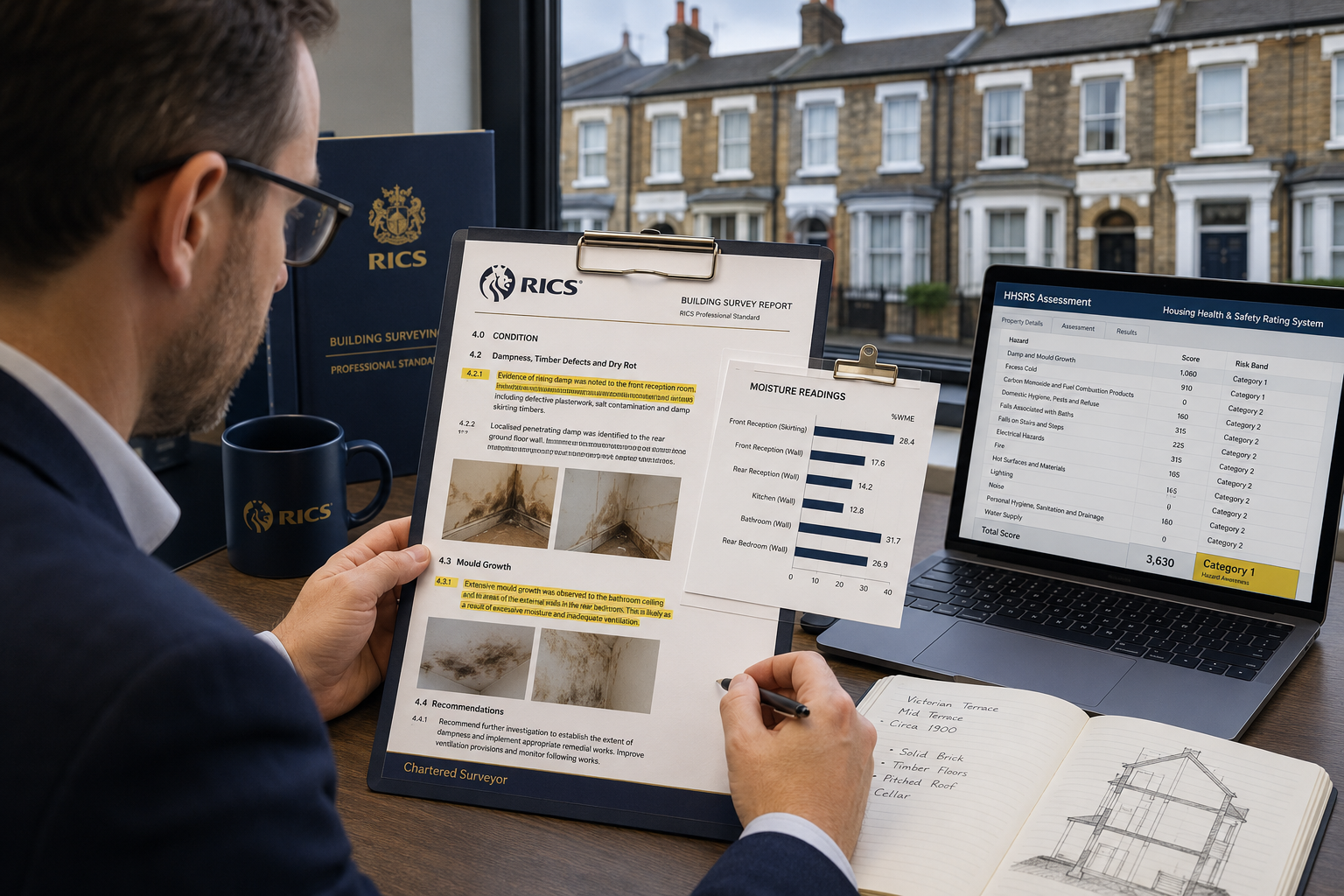
The practical impact of Awaab's Law, damp and mould: new obligations for surveyors in private rented sector building surveys falls into three distinct areas: inspection methodology, report language, and post-survey responsibilities.
Inspection Methodology
Surveyors must now approach damp and mould investigations in PRS properties with greater rigour and documentation discipline. Best practice in 2026 includes:
- Thermal imaging and hygrometer readings to detect moisture levels behind wall surfaces and in poorly ventilated spaces
- Systematic inspection of high-risk zones: bathrooms, kitchens, ground-floor rooms, north-facing walls, and roof spaces
- Distinguishing between condensation, penetrating damp, and rising damp — each has different remediation pathways and different urgency levels under HHSRS
- Photographing all findings with timestamps, as this documentation may be required in enforcement proceedings or disrepair litigation
For surveyors working across London and the South East, where Victorian and Edwardian terraced housing stock dominates the PRS, the risk of encountering multiple damp types in a single property is high. A structural survey in London must now integrate damp assessment as a core — not supplementary — component of the inspection.
Report Language and Classification
Under HHSRS, hazards are classified as either Category 1 (serious and requiring urgent action) or Category 2 (less urgent but still requiring remedy). Awaab's Law effectively operationalises this classification by attaching legal timeframes to it.
Surveyors should:
- Clearly state whether identified damp or mould constitutes a Category 1 or Category 2 HHSRS hazard
- Avoid ambiguous language such as "monitor" or "keep under review" where active mould growth is present
- Specify the likely cause of damp (structural, behavioural, or systemic) to support appropriate remediation
- Include a clear recommendation for professional remediation where mould coverage exceeds minor surface growth
A specific defect report may be appropriate where damp is the primary concern, allowing for a focused and legally robust assessment of a single issue.
Post-Survey Responsibilities
Once a report is issued, the surveyor's obligations do not necessarily end. Where a surveyor is engaged by a landlord to assess a tenanted property, the report should be shared promptly with all relevant parties. Delays in communication can themselves contribute to non-compliance with the 14-day investigation window [2].
Surveyors acting as expert witnesses in disrepair claims — an increasingly common role as tenant enforcement activity grows — should ensure their reports meet the standards required for use in legal proceedings. The expert witness report service is increasingly relevant in this context.
Enforcement, Penalties, and the Risk Landscape for Landlords
The consequences of failing to comply with Awaab's Law are substantial and multi-layered [3].
Civil penalties issued by local housing authorities can reach up to £40,000 per breach. This sits alongside the existing civil penalty regime under the Housing and Planning Act 2016, meaning landlords can face compounding financial exposure.
Remediation orders can compel landlords to carry out specific works within defined timeframes, with further penalties for failure to comply.
Tenant disrepair claims remain available under existing housing law, and Awaab's Law strengthens the evidential position of tenants who have reported hazards and received no adequate response. Where a surveyor's report exists documenting the condition at a specific point in time, it becomes a key piece of evidence in any claim [3].
Rent repayment orders are also available to tenants and local authorities where landlords have failed to comply with improvement notices.
For landlords managing multiple PRS properties, the cumulative risk is significant. A schedule of condition report prepared at the start of a tenancy provides a defensible baseline, making it easier to distinguish between pre-existing conditions and those that develop during the tenancy — a distinction that matters greatly in enforcement and litigation contexts.
What Landlords Must Do to Achieve Compliance
Awaab's Law, damp and mould: new obligations for surveyors in private rented sector building surveys create a clear compliance framework for landlords, but many are still catching up with what is required in practice [4].
Establish a formal hazard reporting system. Tenants must be able to report hazards in writing, and landlords must be able to demonstrate when they received the report. Email, a dedicated portal, or a written log all satisfy this requirement. Verbal reports alone are insufficient.
Respond within the legal timeframes. The 14-day investigation window is a minimum standard. Where mould is visible and extensive, a faster response is both legally prudent and practically necessary.
Maintain detailed records. Every communication, inspection visit, contractor instruction, and completed repair must be documented with dates. This paper trail is the primary defence in any enforcement action or disrepair claim [4].
Engage qualified surveyors proactively. Rather than waiting for tenant complaints, landlords are increasingly commissioning pre-tenancy and mid-tenancy surveys to identify and remediate damp issues before they escalate. Chartered surveyors in London and across the South East are well-placed to provide this service.
Ensure properties meet HHSRS standards. The Housing Health and Safety Rating System remains the technical benchmark. Landlords who can demonstrate HHSRS compliance — ideally supported by a professional survey — are in a significantly stronger position if challenged.
A dilapidations survey at the end of a tenancy can also help landlords separate genuine disrepair from tenant-caused damage, particularly where damp-related deterioration is disputed.
The Broader Picture: HHSRS, Decent Homes, and Future Phases
Awaab's Law does not operate in isolation. The Renters' Rights Act 2025 also introduced the Decent Homes Standard into the private rented sector for the first time, requiring PRS properties to meet minimum habitability criteria. Damp and mould are central to this standard — a property with a Category 1 HHSRS hazard cannot meet the Decent Homes threshold.
Future phases of Awaab's Law are expected to extend mandatory response timeframes to a broader range of hazards beyond damp and mould, including excess cold, fire risk, and structural defects [5]. Surveyors should anticipate that the compliance landscape will continue to evolve, and that the rigour now expected in damp reporting will eventually apply to the full spectrum of HHSRS hazards.
For surveyors operating across the South East — whether in Surrey, Essex, or East London — the concentration of older PRS housing stock means that damp-related instructions are likely to form an increasing proportion of caseload in 2026 and beyond.
Conclusion: Actionable Steps for Surveyors in 2026
The extension of Awaab's Law to the private rented sector marks a genuine inflection point for building surveyors. Damp and mould reporting is no longer a peripheral element of a building survey — it is a legally consequential act that can trigger enforcement timelines, support or defeat disrepair claims, and determine whether a landlord faces penalties of up to £40,000.
Surveyors should take the following steps now:
- Update inspection protocols to include systematic damp and mould assessment with moisture meter readings and photographic evidence as standard practice on all PRS instructions.
- Revise report templates to include explicit HHSRS hazard classification for any damp or mould findings, with clear language distinguishing Category 1 from Category 2 hazards.
- Brief landlord clients on the legal timeframes triggered by a survey report that identifies active damp or mould, so they understand the compliance obligations that follow.
- Consider pre-tenancy and mid-tenancy survey services as a proactive compliance product for landlord clients managing multiple PRS properties.
- Stay current with forthcoming regulatory phases, as additional hazard categories are expected to be brought within Awaab's Law scope in the near future.
The buildings have not changed. The legal framework around them has. Surveyors who adapt their practice to reflect Awaab's Law obligations will be better placed to serve their clients, support tenant safety, and protect their own professional standing in an increasingly regulated sector.
References
[1] Awaabs Law Landlords 2026 – https://letsafeuk.co.uk/awaabs-law-landlords-2026?utm_source=openai
[2] Awaabs Law Landlords 2026 – https://letsafeuk.co.uk/guides/awaabs-law-landlords-2026?utm_source=openai
[3] Awaabs Law Private Rented Sector Claims – https://www.remedylegal.ai/blog/awaabs-law-private-rented-sector-claims?utm_source=openai
[4] Damp And Mould – https://www.landlorder.co.uk/topics/damp-and-mould?utm_source=openai
[5] Awaabs Law – https://www.westberks.gov.uk/awaabs-law?utm_source=openai