

A ransomware attack on a mid-sized surveying firm can freeze every active project, expose confidential client boundary data, and cost upwards of six figures in recovery — all within 72 hours. As the surveying profession moves deeper into cloud-hosted platforms and AI-assisted GIS workflows, the attack surface grows wider every year. Understanding the cybersecurity essentials for property surveyors: protecting GIS and cloud-based data in 2026 is no longer optional — it is a professional and legal obligation.
This guide outlines the most pressing cyber risks facing the surveying sector today, and provides a structured, practical framework for defending sensitive spatial and client data against modern threats.
Key Takeaways
- GIS platforms and cloud storage systems used by surveyors hold highly sensitive data that is increasingly targeted by cybercriminals.
- A zero-trust security model, multi-factor authentication, and AES-256 encryption form the non-negotiable baseline for any surveying firm in 2026.
- Least privilege access controls and regular cloud configuration audits dramatically reduce the risk of a breach.
- Backup repositories must be treated as high-value targets, protected with immutable storage and air-gapped configurations.
- Staff training and a centralised Security Information and Event Management (SIEM) system are critical for early threat detection and response.

Why Property Surveyors Face Unique Cybersecurity Risks in 2026
The surveying profession has undergone a quiet digital transformation. Chartered surveyors — whether conducting homebuyer reports or full building surveys or navigating complex boundary disputes and party wall matters — now rely heavily on cloud-based project management tools, drone-captured spatial data, and AI-driven GIS platforms to deliver their work.
This digital shift creates a specific and underappreciated threat landscape:
- High-value data: GIS datasets contain precise boundary coordinates, ownership records, structural assessments, and valuation data. This information has significant commercial and legal value, making it attractive to both financially motivated hackers and competitors.
- Distributed workforces: Surveyors routinely access project data from client sites, vehicles, and home offices — often over unsecured networks.
- Third-party integrations: Cloud platforms frequently connect with local authority portals, Land Registry APIs, and client management systems, creating multiple potential entry points for attackers.
- Regulatory exposure: A data breach involving client property records can trigger enforcement action under UK GDPR, resulting in substantial fines and reputational damage.
"The question for surveying firms is no longer whether they will be targeted, but whether they will be prepared when they are."
The combination of sensitive data, mobile working patterns, and complex software ecosystems makes the cybersecurity essentials for property surveyors: protecting GIS and cloud-based data in 2026 a subject that demands immediate, structured attention.
The Evolving Threat Landscape for Surveying Firms
Cyber threats targeting professional services firms have grown sharply in sophistication. The most common attack vectors affecting surveying practices include:
| Threat Type | Description | Surveying-Specific Risk |
|---|---|---|
| Ransomware | Encrypts files and demands payment | Locks GIS project files, survey reports, and client records |
| Phishing | Deceptive emails targeting credentials | Targets cloud platform logins and email accounts |
| Misconfigured cloud storage | Publicly exposed buckets or folders | Leaks boundary data, valuations, and client PII |
| Insider threats | Malicious or negligent staff access | Overprivileged accounts accessing sensitive datasets |
| Supply chain attacks | Compromised third-party software | GIS plugins or survey software updates containing malware |
Understanding these vectors is the starting point for building a resilient defence.
Core Security Measures: The Technical Framework
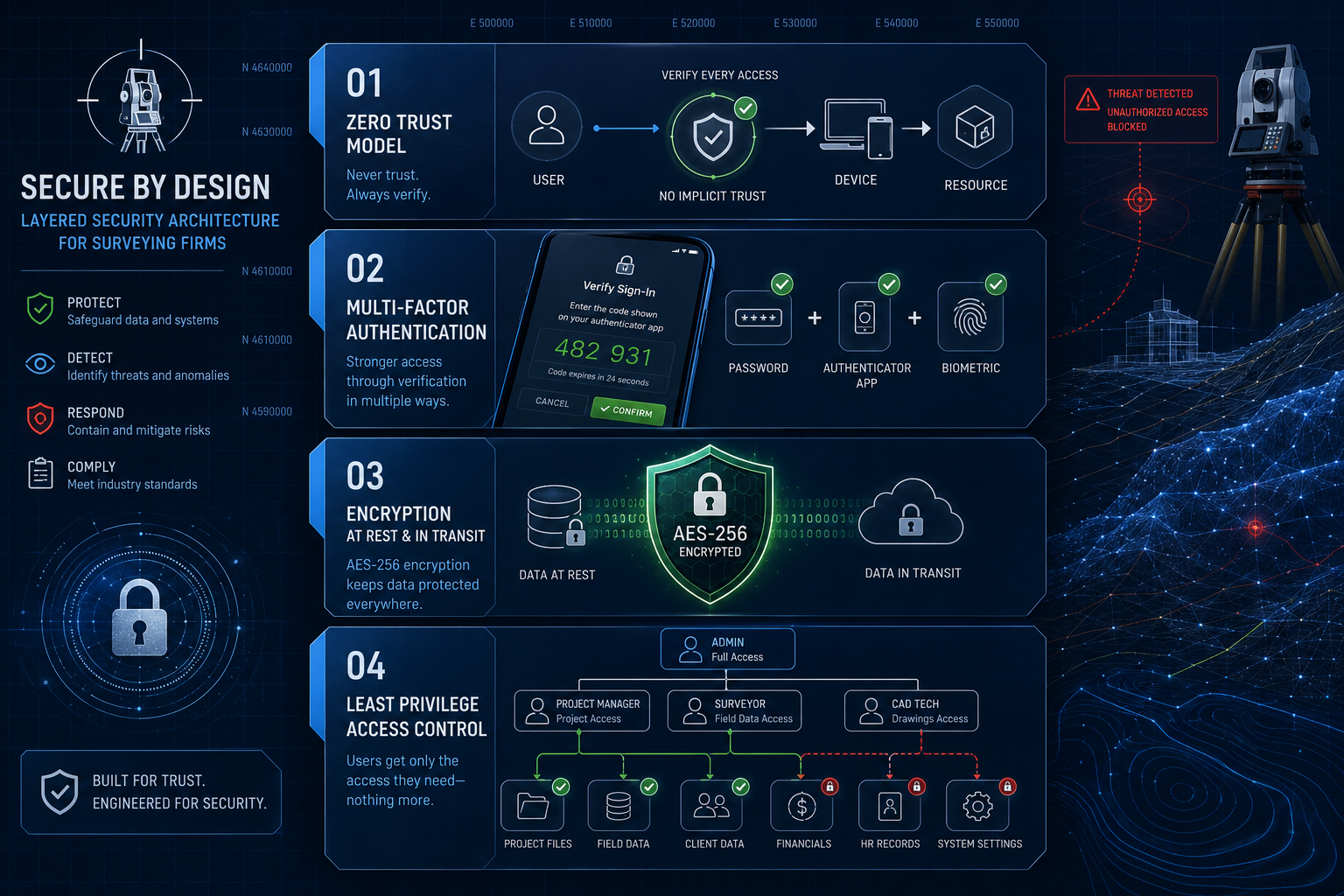
Adopt a Zero-Trust Security Model
The traditional "castle and moat" approach to network security — where everything inside the perimeter is trusted — is fundamentally incompatible with cloud-based surveying operations. A zero-trust model operates on a single principle: never trust, always verify. Every access request, whether it originates from inside or outside the office network, must be authenticated and authorised before access is granted [1].
For surveying firms, this means:
- Verifying device health before allowing access to GIS platforms
- Requiring re-authentication when users switch between applications
- Applying continuous behavioural monitoring to detect anomalous access patterns
- Segmenting networks so that a compromised device cannot move laterally to other systems
Zero-trust is particularly relevant for firms whose staff access cloud-hosted project data from multiple locations — a near-universal reality in 2026.
Enforce Multi-Factor Authentication Across All Systems
Multi-factor authentication (MFA) is one of the single most effective controls available to surveying firms [1]. By requiring a second verification factor — such as a time-based one-time password (TOTP) or a hardware security key — MFA renders stolen credentials largely useless to an attacker.
MFA should be enforced across:
- Cloud storage platforms (AWS S3, Microsoft Azure, Google Cloud)
- GIS software portals (ArcGIS Online, QGIS Cloud)
- Email accounts, particularly those used for client communications
- Remote desktop and VPN connections
- Any third-party platform that stores or processes client data
Firms that have not yet deployed MFA universally should treat this as their first priority. The implementation cost is low; the risk reduction is substantial.
Encrypt Data in Transit and at Rest
Encryption is the last line of defence if an attacker gains access to stored or transmitted data. Surveying firms should adopt AES-256 encryption as the standard for data at rest, and TLS 1.3 for all data in transit [2].
Practical steps include:
- Ensuring cloud storage buckets are configured with server-side encryption enabled by default
- Using encrypted file transfer protocols rather than standard FTP or unencrypted email attachments
- Encrypting local copies of GIS datasets on surveyor laptops and mobile devices
- Verifying that third-party GIS platforms and cloud providers meet encryption standards contractually
Unencrypted GIS data transmitted over public Wi-Fi — a common scenario for field surveyors — is trivially intercepted using widely available tools. Encryption eliminates this risk [2].
Implement Least Privilege Access Controls
The principle of least privilege holds that every user, application, and system should have access only to the data and functions strictly necessary for their role [3]. In a surveying context, this means a junior surveyor conducting a schedule of condition report should not have access to financial valuation databases or other clients' boundary records.
Key implementation steps:
- Conduct a full audit of current user permissions across all cloud platforms
- Remove or downgrade overprivileged accounts immediately
- Implement role-based access control (RBAC) tied to job function
- Review and recertify permissions quarterly, and immediately upon staff changes
- Apply the same principle to service accounts and API integrations
Overprivileged accounts are among the most exploited vulnerabilities in cloud environments [3]. Addressing this requires discipline but no additional technology investment.
Operational Security: Monitoring, Backups, and Staff Awareness

Regularly Audit and Monitor Cloud Configurations
Cloud misconfigurations are responsible for a significant proportion of data breaches in professional services. A single misconfigured storage bucket can expose thousands of client records to the public internet without any active attack being required [4].
Surveying firms should:
- Run automated cloud security posture management (CSPM) tools to detect misconfigurations in real time
- Conduct manual configuration reviews at least quarterly
- Ensure that no cloud storage containers are set to public access unless explicitly required
- Monitor for unusual data egress patterns that may indicate exfiltration
Regular auditing is not a one-time exercise. Cloud environments change frequently as new projects are onboarded, new staff join, and integrations are added. Continuous monitoring is the only reliable approach [4].
Classify and Inventory Sensitive Data
Before data can be protected, it must be found. Many surveying firms hold sensitive data across multiple systems — cloud platforms, local servers, email archives, and portable drives — without a clear picture of what exists where [6].
A structured data classification programme should:
- Conduct discovery scans across all storage environments
- Classify data by sensitivity: public, internal, confidential, and restricted
- Apply appropriate controls to each classification tier
- Document data flows to understand where sensitive information travels
- Ensure compliance with UK GDPR data minimisation requirements
For firms handling probate valuations or matrimonial valuations, the sensitivity of client data is particularly acute. These engagements involve personal financial and legal information that carries heightened regulatory obligations.
Protect Backup Repositories as High-Value Targets
Modern ransomware attacks specifically target backup systems before encrypting primary data, knowing that destroying backups eliminates the victim's recovery options [1]. Surveying firms must treat backup repositories with the same — or greater — security rigour as primary systems.
Best practices for backup security include:
- Air-gapped backups: Maintain at least one backup copy that is physically or logically isolated from the main network
- Immutable storage: Configure backups using write-once, read-many (WORM) settings that prevent modification or deletion
- Encryption: Apply the same AES-256 standard to backup data as to primary data
- Access controls: Restrict backup management access to a minimal number of named administrators
- Regular restore testing: Verify that backups can actually be restored — a backup that cannot be recovered is worthless
The 3-2-1 backup rule remains the industry standard: three copies of data, on two different media types, with one copy stored off-site.
Centralise Security Monitoring with a Managed SIEM
For surveying firms without dedicated IT security staff — which describes the majority of practices — a managed Security Information and Event Management (SIEM) system provides centralised visibility across all digital assets [5]. A SIEM aggregates log data from cloud platforms, email systems, GIS software, and network devices, applying correlation rules to detect suspicious patterns that would be invisible in isolation.
Key capabilities to look for in a managed SIEM include:
- Real-time alerting on failed authentication attempts and privilege escalation
- Detection of unusual data access or download volumes
- Integration with cloud provider security logs (AWS CloudTrail, Azure Monitor)
- Automated incident response playbooks for common attack scenarios
- Compliance reporting for UK GDPR and ISO 27001 frameworks
The cost of a managed SIEM service is a fraction of the average cost of a data breach, which for UK professional services firms regularly exceeds £100,000 when regulatory fines, recovery costs, and client compensation are factored in [5].
Staff Training: The Human Firewall
Technology controls alone cannot eliminate cyber risk. The majority of successful attacks begin with a human action — clicking a phishing link, using a weak password, or sending data to the wrong recipient. Regular, role-specific security awareness training is essential.
Effective training programmes for surveying firms should cover:
- Recognising phishing and social engineering attempts
- Secure handling of client data in the field
- Password hygiene and the use of password managers
- Reporting procedures for suspected incidents
- Safe use of public Wi-Fi and personal devices
Training should be conducted at least annually, with phishing simulation exercises run quarterly to maintain awareness. New staff should complete security training before being granted access to any client data.
Building a Cybersecurity Culture in Your Surveying Practice
The cybersecurity essentials for property surveyors: protecting GIS and cloud-based data in 2026 are not solely a technical challenge — they require a cultural shift within surveying practices. Firms that treat security as a compliance checkbox rather than a professional standard will remain vulnerable regardless of the tools they deploy.
Leadership commitment is the foundation. When senior surveyors and practice directors visibly prioritise security — attending training, enforcing policies, and allocating budget — the message cascades through the organisation.
Practical steps for building a security-conscious culture include:
- Appointing a named individual as the data protection and security lead (this need not be a full-time role in smaller firms)
- Establishing a clear, written incident response plan before an attack occurs
- Conducting annual risk assessments that include cyber risk alongside traditional professional indemnity considerations
- Engaging a specialist cybersecurity consultant to conduct penetration testing on cloud environments at least once per year
For firms operating across multiple regions — from chartered surveyors in Surrey to chartered surveyors in central London — the challenge of maintaining consistent security standards across distributed teams is real. Centralised policy management and cloud-based security tooling are the most practical solutions.
Staying current with evolving cloud security guidance is also essential [7]. The threat landscape changes faster than most annual review cycles can accommodate. Subscribing to sector-specific threat intelligence feeds and engaging with RICS guidance on data security helps firms stay ahead of emerging risks.
Conclusion
The cybersecurity essentials for property surveyors: protecting GIS and cloud-based data in 2026 can be distilled into a clear set of priorities. The risks are real, the regulatory consequences are serious, and the technical solutions are well-established and accessible to firms of all sizes.
Actionable next steps for surveying firms:
- Audit current access controls — identify and remove overprivileged accounts across all cloud platforms this week.
- Deploy MFA universally — no cloud platform or email account should be accessible with a password alone.
- Encrypt everything — verify that AES-256 encryption is active on all stored data and that TLS is enforced for all data transfers.
- Test your backups — confirm that air-gapped, immutable backups exist and can be restored within your recovery time objective.
- Schedule a cloud configuration audit — use automated CSPM tooling or engage a specialist to review your cloud environment for misconfigurations.
- Invest in staff training — run a phishing simulation before the end of the quarter and address the results honestly.
- Develop an incident response plan — document exactly what steps will be taken if a breach is detected, including who is notified and when.
Surveyors who take these steps will not only protect their clients and their practices — they will build a competitive advantage in a market where data security is increasingly a client expectation and a procurement requirement.
References
[1] Cybersecurity Essentials For Surveyors Protecting Gis And Cloud Data In 2026 – https://nottinghillsurveyors.com/blog/cybersecurity-essentials-for-surveyors-protecting-gis-and-cloud-data-in-2026?utm_source=openai
[2] Data Transfer Security – https://www.filecloud.com/blog/data-transfer-security/?utm_source=openai
[3] 1aws Cloud Security Best Practices Guide – https://blog.qualys.com/product-tech/2026/04/09/1aws-cloud-security-best-practices-guide?utm_source=openai
[4] Data Storage Security Best Practices For Avoiding Cyberattacks – https://www.techtarget.com/searchstorage/tip/Data-storage-security-best-practices-for-avoiding-cyberattacks?utm_source=openai
[5] 21 Top Cloud Security Best Practices – https://www.huntress.com/cybersecurity-insights/21-top-cloud-security-best-practices?utm_source=openai
[6] Cloud Data Security Risks Best Practices – https://orca.security/resources/blog/cloud-data-security-risks-best-practices/?utm_source=openai
[7] Cloud Security – https://www.dexpose.io/cloud-security/?utm_source=openai