
A single damp bedroom in a Rochdale social housing flat became the catalyst for one of the most significant reforms to residential property law in a generation. The death of two-year-old Awaab Ishak in 2020 from prolonged mould exposure prompted Parliament to embed strict hazard remediation timelines directly into tenancy law. By 2026, the full weight of Awaab's Law is reshaping how tribunals assess property disputes — and the expert witness has become the central figure in determining how remediation costs translate into enforceable valuations.
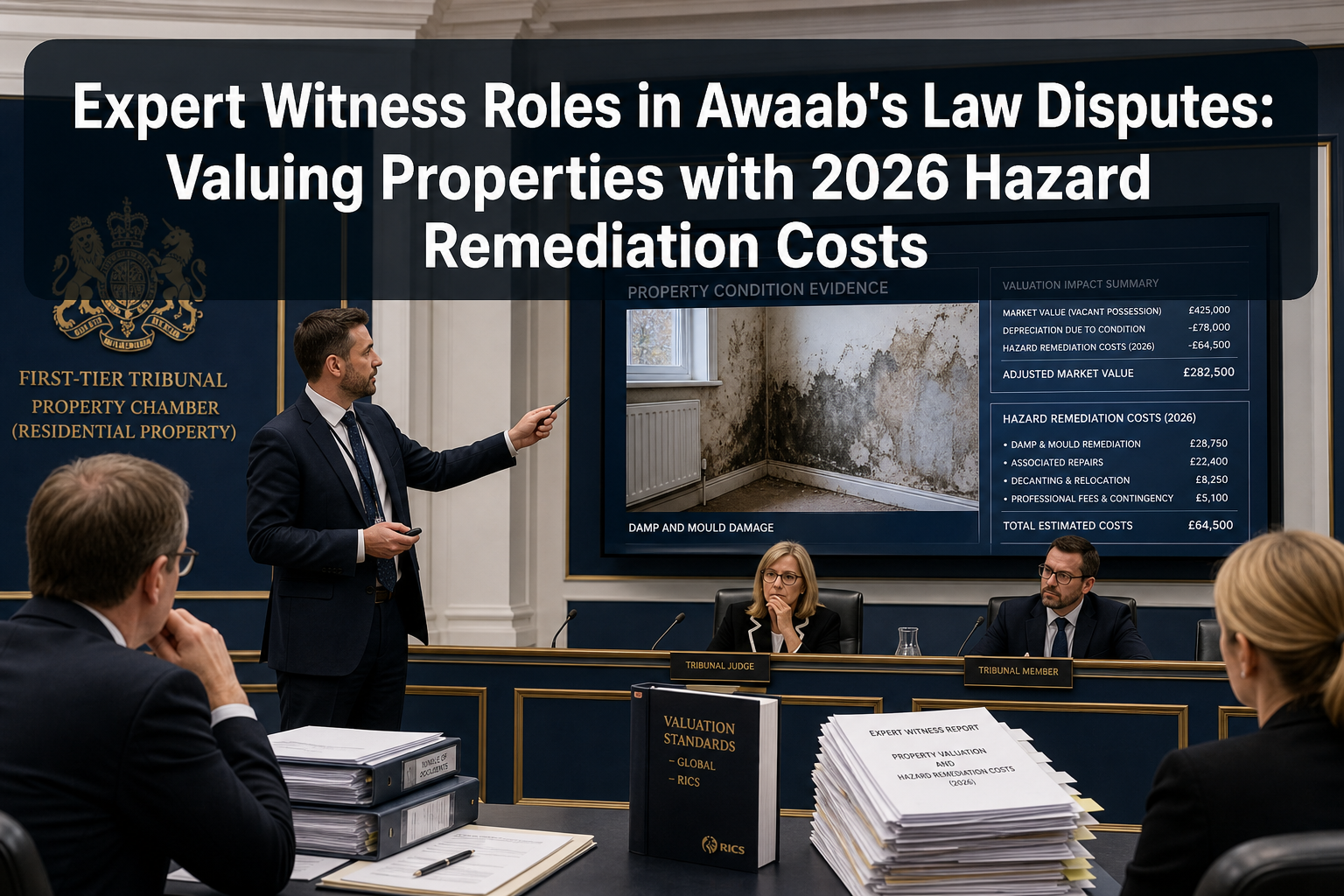
This article examines Expert Witness Roles in Awaab's Law Disputes: Valuing Properties with 2026 Hazard Remediation Costs in depth, with particular focus on strategies for quantifying repair costs for newly expanded hazard categories, including fire risks, structural defects, and excess cold, using current RICS data across both social and private rental sectors.
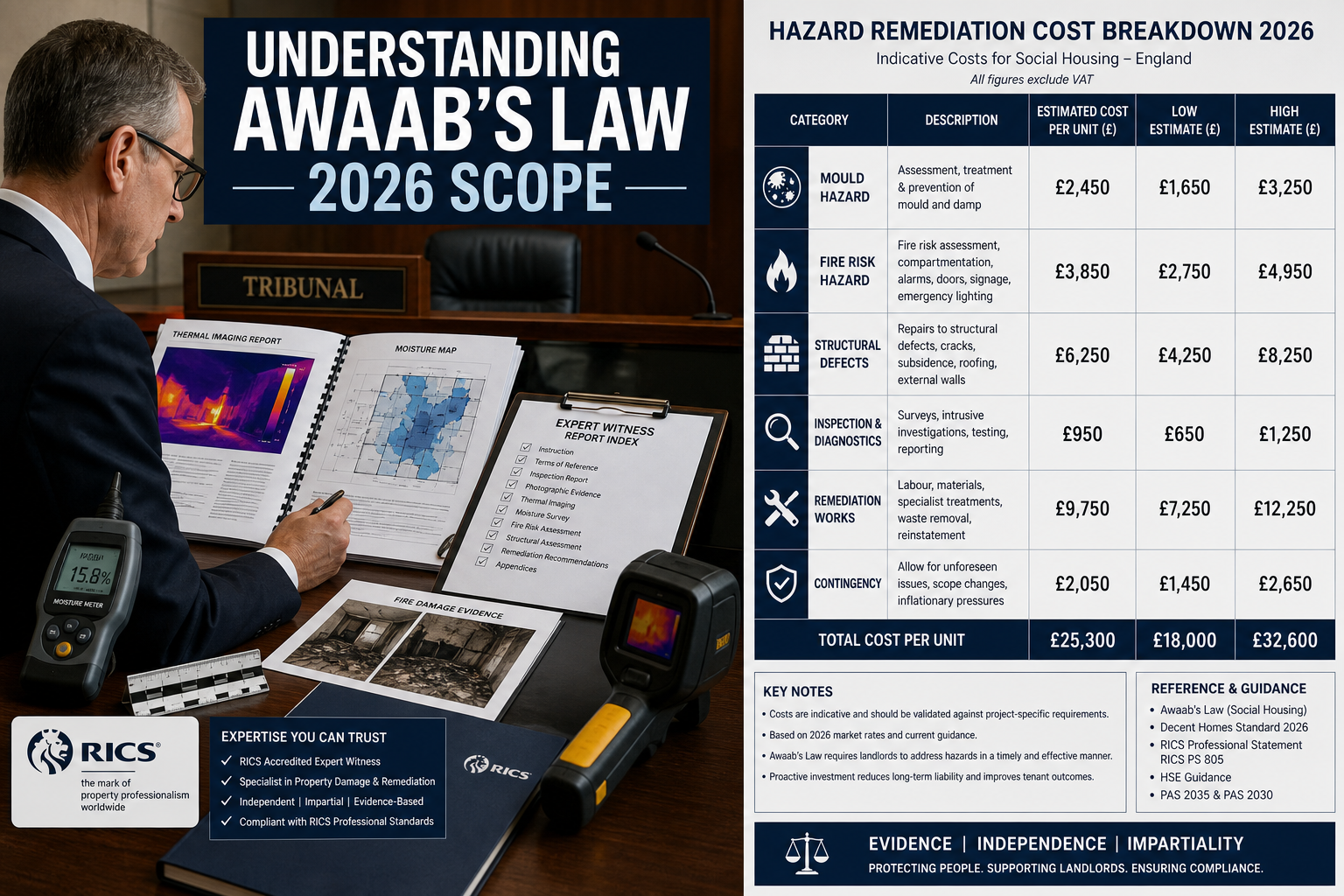
Key Takeaways
- Awaab's Law 2026 has expanded the range of hazards that expert witnesses must assess, moving well beyond damp and mould to include fire risks, structural instability, and deferred maintenance deterioration.
- Expert witnesses must follow rigorous evidence collection protocols — including timestamped photography, calibrated measurements, and environmental sampling — to produce tribunal-ready reports.
- Quantifying remediation costs requires RICS-compliant methodologies that account for direct repair costs, rental income loss, regulatory compliance expenditure, and liability exposure.
- Professional liability for expert witnesses has increased significantly; inadequate testimony can trigger negligence claims and disciplinary action.
- Collaborative dispute resolution models, including joint expert appointments, are reducing adversarial proceedings and improving outcomes for all parties.
Understanding the Scope of Awaab's Law in 2026
Awaab's Law was introduced through the Social Housing (Regulation) Act 2023 and has been progressively implemented, with 2026 marking a critical phase of full enforcement across both social and private rental sectors. The legislation compels landlords to investigate hazard reports within 14 days and begin remediation within a further 7 days for urgent risks.
Critically, the expanded hazard categories under the 2026 framework now require expert witnesses to assess a far broader range of conditions than the original damp-and-mould focus suggested. Structural stability, foundation performance, seismic resilience, fire safety compliance, excess cold, falls risks, and deterioration from deferred maintenance all fall within scope [1]. This expansion fundamentally changes the nature of expert witness instructions in housing tribunal cases.
For professionals providing expert witness reports in London, this means instructions now routinely require multi-hazard assessments rather than single-defect investigations. An expert instructed to assess a property for damp may simultaneously need to address fire door compliance, cold bridge performance, and structural cracking — all within a single defensible report.
The Dual-Sector Challenge
The law applies differently across sectors. In social housing, registered providers face regulatory scrutiny from the Regulator of Social Housing, with compliance failures carrying reputational and financial consequences beyond the tribunal. In the private rented sector, enforcement typically runs through local authority Environmental Health Officers and the First-tier Tribunal (Property Chamber).
Expert witnesses operating across both sectors must understand these procedural differences. The HHSRS (Housing Health and Safety Rating System) remains the primary scoring framework, but the 2026 enforcement environment demands that experts translate HHSRS scores directly into quantified remediation costs — a step that was previously less rigorously enforced.
Evidence Collection Standards and Technological Requirements
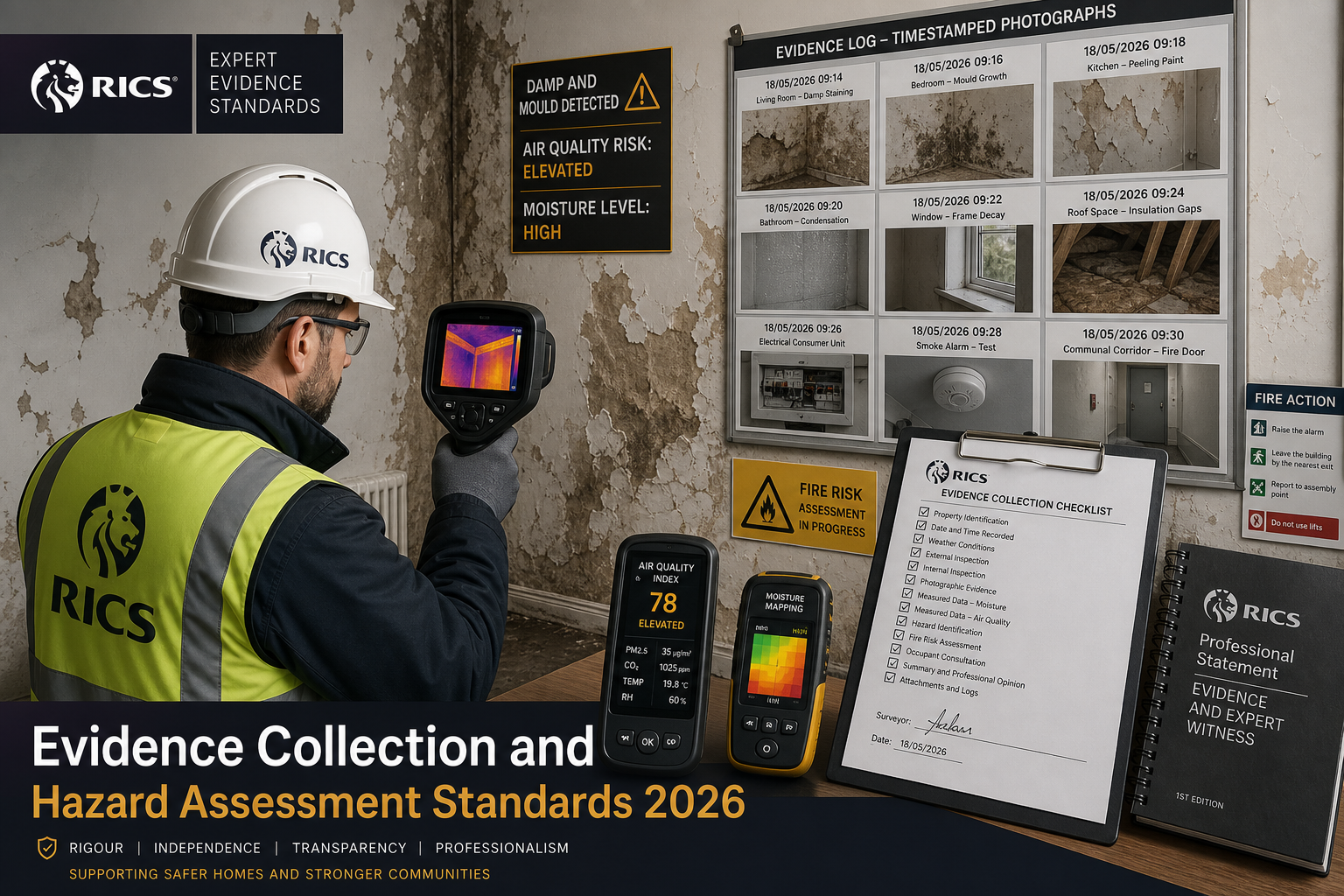
The quality of an expert witness's evidence is now subject to greater scrutiny than at any previous point in housing tribunal practice. Awaab's Law disputes increasingly turn on the precision and objectivity of the evidence presented, rather than on professional opinion alone [2].
Mandatory Evidence Protocols
Tribunals in 2026 expect expert witnesses to demonstrate that their findings are grounded in objective, reproducible data. The following evidence types have become standard requirements:
- Timestamped photographic evidence with GPS metadata where possible
- Quantitative measurements taken with calibrated instruments (hygrometers, thermal imaging cameras, anemometers)
- Environmental sampling for mould spore counts, VOC levels, and air quality indicators
- Detailed site plans showing the location and extent of each hazard
- Moisture mapping across affected surfaces, not merely spot readings
The adoption of thermal imaging cameras, moisture mapping systems, and air quality monitors has become essential rather than optional [3]. These tools provide objective, quantifiable data that can withstand cross-examination and support the financial figures presented in remediation cost schedules.
Evidence Preservation Under Compressed Timelines
One of the most significant practical challenges under Awaab's Law is the compressed investigation timeframe. Statutory deadlines for landlord action mean that conditions may change rapidly between the initial complaint and the expert's inspection. Experts must document conditions thoroughly on first visit, anticipating that remediation works may already have begun by the time a dispute reaches tribunal [2].
This requires a disciplined site visit protocol. Experts should produce a contemporaneous inspection record that captures the condition of every relevant element at the time of visit, supported by the technological evidence described above. Failure to do so can undermine the credibility of the entire report.
For disputes involving construction and property defects, this evidence-preservation discipline is equally critical, particularly where structural works have altered the original defect conditions.
Quantifying Remediation Costs and Property Valuation Impact
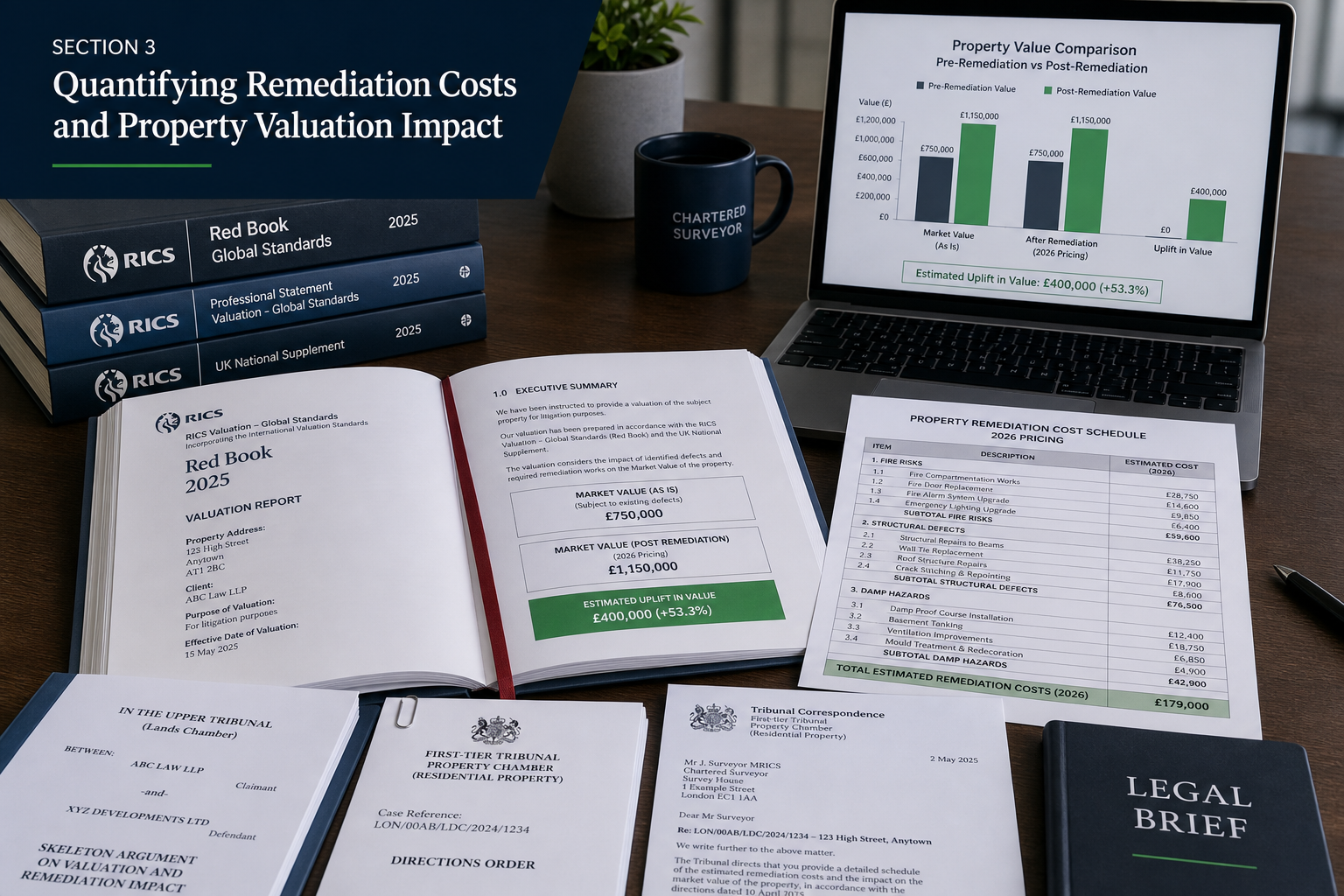
The most technically demanding aspect of Expert Witness Roles in Awaab's Law Disputes: Valuing Properties with 2026 Hazard Remediation Costs is the translation of physical hazard findings into defensible financial figures. Tribunals require more than a list of defects; they require a costed remediation schedule that can be tested for proportionality and accuracy.
Using RICS Data to Build Cost Schedules
RICS publishes cost data through its Building Cost Information Service (BCIS), which provides regional cost indices for repair and maintenance works across residential property types. In 2026, these indices reflect significant increases in labour and materials costs, particularly for specialist remediation works such as fire stopping, damp proofing, and structural underpinning.
Expert witnesses should structure remediation cost schedules around the following categories:
| Cost Category | Description | Data Source |
|---|---|---|
| Direct repair costs | Materials and labour for physical remediation | BCIS regional indices |
| Consequential damage | Damage caused by the hazard prior to remediation | Inspection findings |
| Rental income reduction | Loss of rent during works or due to reduced marketability | Comparable rental evidence |
| Regulatory compliance costs | Fire safety upgrades, HHSRS compliance works | Building regulations schedules |
| Liability exposure | Estimated costs of tenant health claims | Legal cost data |
| Insurance implications | Premium increases post-hazard notification | Insurance market data |
When multiple hazards coexist — as is common in older social housing stock — experts must assess their combined impact on property valuation rather than treating each hazard in isolation [2]. A property with simultaneous fire risk, structural cracking, and excess cold deficiencies will suffer a compounded valuation reduction that exceeds the sum of individual remediation costs.
Fire Risk Quantification: A Worked Approach
Fire risk has emerged as one of the most contested hazard categories under the 2026 framework. The expert witness must assess not only the physical cost of fire safety remediation — replacement of fire doors, upgrading of detection systems, compartmentation works — but also the regulatory compliance costs arising from the Building Safety Act 2022 and associated secondary legislation.
A defensible fire risk cost schedule for a typical mid-terrace social housing property in London in 2026 might include:
- Fire door replacement (FD30S standard): approximately £800-£1,200 per door, including installation
- Intumescent seal and smoke brush upgrades: £150-£300 per door set
- Automatic fire detection upgrade to Grade D, LD2 standard: £400-£800 per unit
- Compartmentation survey and remediation: £1,500-£4,000 depending on construction type
- Fire risk assessment (post-remediation): £300-£600
These figures should be cross-referenced against current BCIS data and adjusted for regional cost variations. London and the South East consistently attract a cost premium of 15-25% above national averages, a factor that expert witnesses instructed in these areas must explicitly account for in their reports.
For those seeking guidance on property valuation in London, understanding how hazard remediation costs feed into market value reductions is increasingly important for both landlords and tenants navigating tribunal proceedings.
Tenant Vulnerability and Valuation Adjustments
Expert witnesses must also account for tenant vulnerability when assessing the impact of hazards. Landlords frequently challenge tenant-instructed experts on the grounds that vulnerability assessments require specialist medical or occupational health knowledge [2]. The expert witness should be explicit about the limits of their competence in this area while still addressing the HHSRS vulnerability weighting that applies to the relevant household type.
For example, a property housing an elderly tenant with respiratory conditions will attract a higher HHSRS hazard score for damp and mould than the same property occupied by a healthy adult. This score difference directly affects the urgency of remediation and, consequently, the costs that a tribunal may order a landlord to bear.
Reporting Standards and Professional Obligations
Structuring a Compliant Expert Witness Report
Reports produced for Awaab's Law tribunal proceedings must adhere to recognised professional frameworks. RICS Professional Standards and HHSRS Operating Guidance provide the primary reference points [4]. A compliant report should contain the following sections in sequence:
- Expert's declaration confirming independence and compliance with CPR Part 35 (or equivalent tribunal rules)
- Instructions received and the questions the expert has been asked to address
- Documents reviewed and their dates
- Inspection methodology, including equipment used and calibration records
- Findings, organised by hazard category with supporting evidence
- HHSRS assessment with numerical scores and category ratings
- Remediation cost schedule with RICS data references
- Expert opinion on valuation impact
- Limitations and caveats
The expert's declaration is particularly important. It must confirm that the expert understands their overriding duty to the tribunal, not to the instructing party. Any departure from this principle — even the appearance of advocacy — can result in the report being given reduced weight or excluded entirely.
For professionals providing expert surveyor advice in contested property matters, maintaining this independence is both a professional obligation and a practical necessity for the credibility of the evidence.
Professional Liability in 2026
Expert witnesses now face heightened accountability under the 2026 enforcement environment. Inadequate or inaccurate testimony can lead to professional negligence claims, disciplinary action by RICS or other professional bodies, and significant reputational damage [3]. Comprehensive professional indemnity insurance is strongly advised, with cover specifically extending to expert witness work.
The increase in Awaab's Law disputes has also increased the frequency with which opposing experts produce conflicting cost schedules. Tribunals are becoming more sophisticated in identifying methodological weaknesses, and expert witnesses who cannot defend their RICS data references under questioning face serious credibility risks.
Collaborative Approaches and the Future of Expert Evidence
Joint Expert Appointments and Early Neutral Evaluation
A significant trend in 2026 is the move towards collaborative dispute resolution models. Joint expert appointments — where a single expert is instructed by both parties — are increasingly favoured by tribunals in lower-value disputes where the cost of adversarial expert evidence would be disproportionate [1]. Early neutral evaluation, where an independent expert provides a non-binding assessment before proceedings commence, is also gaining traction.
These models require expert witnesses to operate with even greater transparency and neutrality than in adversarial proceedings. The joint expert must be able to explain their methodology and cost figures to both parties simultaneously, without any appearance of favouring one side's position.
For disputes that escalate to formal proceedings, the dilapidations survey process provides a useful structural model for how remediation costs can be documented and presented in a format that both parties can interrogate.
Specialised Training and Continuous Development
The evolving demands of Awaab's Law require expert witnesses to pursue specialised training in multi-hazard assessment, legal frameworks, and effective communication skills [3]. RICS and other professional bodies are developing structured CPD pathways for members working in this area.
Future regulatory developments are likely to include stricter enforcement mechanisms, further expansion of hazard categories, and data-driven standards that will require experts to demonstrate statistical competence as well as technical surveying skills [3]. Expert witnesses who invest in this training now will be better positioned to meet tribunal expectations as the law continues to evolve.
Those working across construction disputes resolution will find that the evidence standards being developed in Awaab's Law proceedings are beginning to influence expectations in related areas of property dispute work.
Cost Recovery and Proportionality
Tribunals typically order unsuccessful parties to bear the successful party's reasonable costs, including expert witness fees [1]. However, costs are scrutinised for proportionality relative to the dispute's value and complexity. An expert witness who produces a disproportionately expensive report for a low-value dispute may find that their fees are not fully recovered, even if their client succeeds.
This proportionality requirement reinforces the importance of scoping expert instructions carefully at the outset. For schedule of dilapidations work and similar cost-intensive assessments, agreeing the scope of the expert's investigation with both parties in advance — where possible — reduces the risk of cost challenges later.
Conclusion
Expert Witness Roles in Awaab's Law Disputes: Valuing Properties with 2026 Hazard Remediation Costs demand a level of technical rigour, financial precision, and procedural discipline that has no precedent in earlier housing tribunal practice. The expansion of hazard categories, the introduction of strict remediation timelines, and the heightened scrutiny of expert evidence have collectively raised the bar for every professional operating in this field.
The following actionable steps are recommended for expert witnesses and those instructing them in 2026:
- Commission multi-hazard assessments from the outset rather than single-defect investigations, given the expanded scope of Awaab's Law.
- Invest in calibrated diagnostic technology — thermal imaging, moisture mapping, and air quality monitoring — to produce objective, tribunal-ready evidence.
- Build remediation cost schedules using current BCIS data, with explicit regional adjustments and separate line items for each cost category.
- Address tenant vulnerability within the HHSRS framework, being transparent about the limits of the expert's competence in medical or occupational health matters.
- Consider joint expert appointment in lower-value disputes to reduce costs and improve the prospects of early resolution.
- Maintain comprehensive professional indemnity insurance that specifically covers expert witness work.
- Pursue structured CPD in multi-hazard assessment and tribunal procedure to stay ahead of regulatory developments.
The expert witness who combines technical excellence with procedural compliance and financial rigour will be the most effective advocate for accurate, fair outcomes in Awaab's Law disputes — and the most credible voice in any tribunal room.
References
[1] Expert Witness Roles In Structural Collapse Disputes Under Awaabs Law 2026 Evidence Standards For Party Wall Awards – https://wimbledonsurveyors.com/expert-witness-roles-in-structural-collapse-disputes-under-awaabs-law-2026-evidence-standards-for-party-wall-awards/?utm_source=openai
[2] Expert Witness Challenges In Awaabs Law 2026 Disputes Testifying On Expanded Hazards In Rental Valuations – https://manchestersurveyors.com/expert-witness-challenges-in-awaabs-law-2026-disputes-testifying-on-expanded-hazards-in-rental-valuations/?utm_source=openai
[3] Expert Witness Roles In Awaabs Law 2026 Disputes Testifying On Expanded Hazards In Private Rental Properties – https://kingstonsurveyors.com/expert-witness-roles-in-awaabs-law-2026-disputes-testifying-on-expanded-hazards-in-private-rental-properties/?utm_source=openai
[4] Expert Witness Challenges In Awaabs Law 2026 Hazard Extensions Evidence Standards For Excess Cold Falls And Fire Risks – https://wimbledonsurveyors.com/expert-witness-challenges-in-awaabs-law-2026-hazard-extensions-evidence-standards-for-excess-cold-falls-and-fire-risks/?utm_source=openai