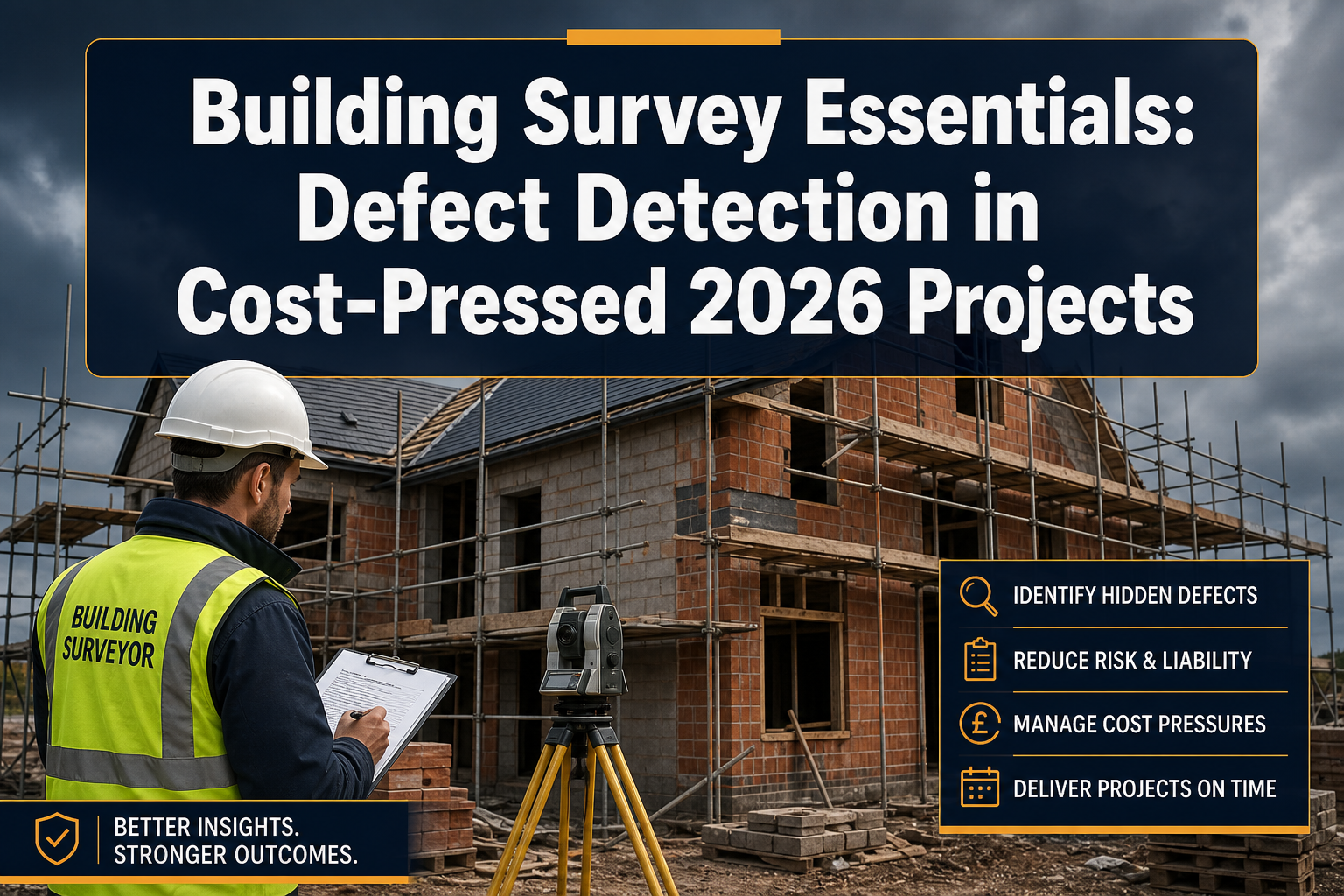

Nearly one in three newly completed residential properties in the UK contains defects serious enough to require remedial work before occupation — a figure that regulators and insurers are using to justify what many in the industry now call an ongoing "building defect crisis" [1]. For small builders operating on thin margins in 2026, that statistic is not an abstract industry concern. It is a direct financial and legal threat.
This guide addresses Building Survey Essentials for Small Builder Struggles: Defect Detection in Cost-Pressed 2026 Projects head-on. It provides a practical, Level 3 survey-focused framework for small developers and their appointed surveyors, with particular attention to regional and northern UK opportunities where cost pressures are acute and defect liability exposure is long.
Key Takeaways
- Defect liability periods in 2026 extend up to 10 years, meaning missed defects on cost-pressed builds create severe long-term financial exposure for small builders.
- A Level 3 (Full Building Survey) checklist remains the most legally defensible inspection tool for high-value or complex small-developer projects.
- Thermal imaging, drone roof inspection, and moisture mapping are no longer optional extras — they are standard practice in defensible defect detection workflows.
- Regional and northern UK developments carry specific structural and environmental risks that require tailored survey checklists.
- Early defect detection through structured snagging and dilapidation reporting saves significantly more money than post-completion remediation.
Why 2026 Is a Defining Year for Small Builder Defect Risk
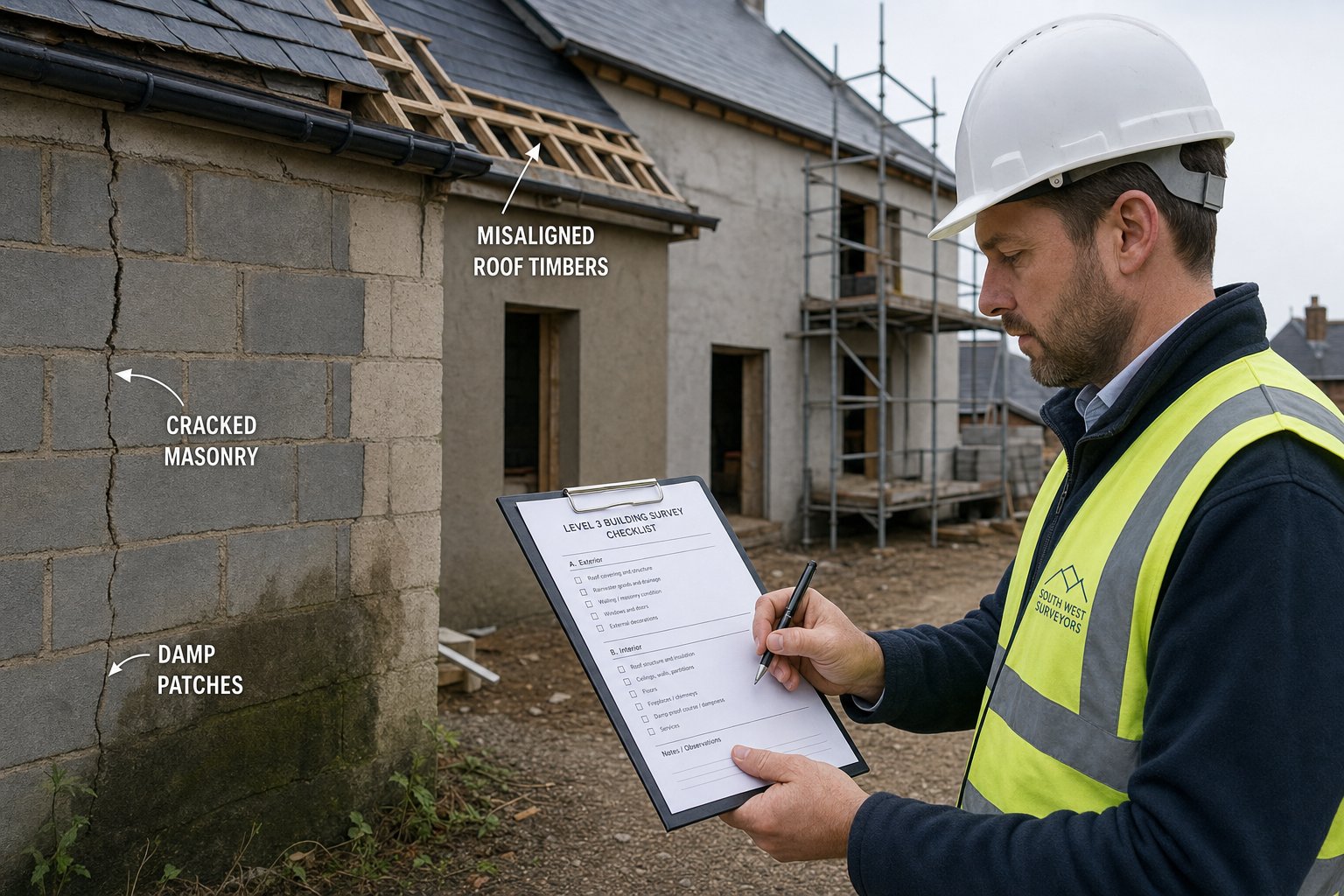
The construction sector entered 2026 under compounding pressure. Material costs remain elevated following supply chain disruptions, skilled labour shortages persist across most regions, and planning delays have compressed build programmes. For small builders — typically defined as those delivering fewer than 100 units per year — these pressures translate directly into corners being cut, inspections being rushed, and defects going undetected until they become expensive disputes.
Regulators and insurers are responding. The Building Safety Act 2022 continues to reshape accountability frameworks, and insurers are increasingly scrutinising defect reporting workflows before issuing structural warranties. A project that cannot demonstrate a rigorous, documented inspection process may face higher premiums or outright warranty refusal [2].
The financial stakes are compounded by liability timelines. Under standard NHBC Buildmark warranties and most structural warranty products available in 2026, defect liability periods extend up to 10 years from completion. A defect missed during a cost-pressed build in 2026 can generate a legal claim in 2034. For a small builder without robust reserves, that is an existential risk [1].
The Regional Opportunity and Its Hidden Risks
Northern England, the Midlands, and parts of Wales present genuine development opportunities in 2026. Land values remain lower than in the South East, planning authorities in some areas are actively incentivising residential development, and demand for affordable housing is strong.
However, regional builds carry specific defect risks that London-centric survey frameworks sometimes underweight:
- Older subsoil profiles in former industrial areas, including contamination and unpredictable bearing capacity
- Higher rainfall exposure increasing the risk of penetrating damp and roof drainage failures
- Victorian and Edwardian building stock being converted or extended, with inherent structural complexity
- Legacy construction methods — including solid brick walls, slate roofs, and lime mortar — that behave differently from modern cavity construction
A survey checklist designed for a new-build apartment in Central London will not adequately protect a small builder converting a mill building in Yorkshire or extending a terrace in Salford.
Building Survey Essentials for Small Builder Struggles: The Level 3 Checklist Framework
A Level 3 Full Building Survey is the most comprehensive inspection available to property developers and buyers in the UK [6]. Unlike a Homebuyer Report, it does not follow a standardised template — it is a bespoke assessment of every accessible element of a structure. For small builders delivering high-cost or complex projects in 2026, commissioning or conducting a Level 3 equivalent inspection at key build stages is the single most effective risk management tool available.
Understanding the difference between survey types is critical before commissioning any inspection. A comparison of Homebuyer Reports and Building Surveys clarifies when a full structural assessment is necessary versus when a lighter-touch report suffices.
Structural Integrity Elements
The structural checklist for a cost-pressed 2026 project must cover the following with specific documentation:
| Element | Key Defect Risks | Inspection Method |
|---|---|---|
| Foundations | Subsidence, heave, inadequate depth | Visual + trial pit where accessible |
| Load-bearing walls | Cracking patterns, bulging, inadequate ties | Visual + crack gauge measurement |
| Roof structure | Rafter spread, purlin failure, truss damage | Visual + probe testing |
| Floor joists | Rot, beetle infestation, inadequate bearing | Visual + moisture meter |
| Lintels | Corrosion, cracking above openings | Visual + hammer test |
| Party walls | Inadequate fire separation, movement | Visual + document review |
For projects involving ground-floor extensions or basement works, subsidence survey assessment becomes a mandatory rather than optional component. Soil movement risks in clay-heavy northern and Midlands soils are particularly significant during dry summers.
Fabric and Envelope Defects
The building envelope — roofs, walls, windows, and drainage — accounts for the majority of defects found in newly completed small-developer projects [2]. A rigorous envelope checklist includes:
Roof
- Tile or slate alignment, cracking, and slippage
- Ridge, hip, and valley mortar condition
- Flashings at all abutments, chimney stacks, and dormers
- Guttering falls, joint integrity, and downpipe connections
- Flat roof membrane condition and drainage outlets
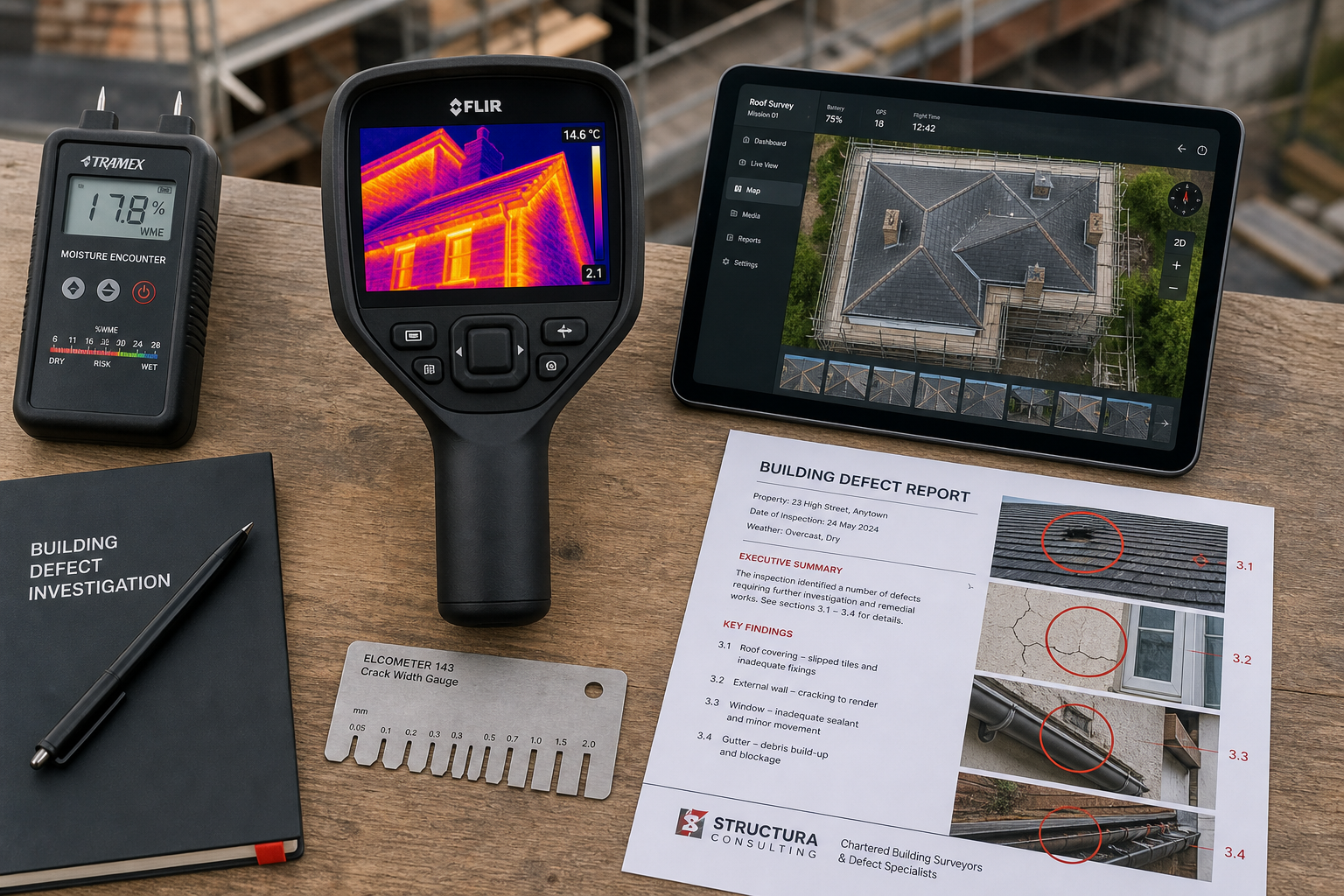
For inaccessible roofs, a drone roof survey provides high-resolution imagery that satisfies insurer requirements without the cost and delay of scaffolding. This technology has become standard practice in defensible defect workflows across 2026 projects [7].
External Walls
- Cavity wall tie condition in older conversions
- Render adhesion and cracking
- DPC continuity and bridging
- Window and door frame seals and reveals
Internal Fabric
- Moisture readings at all external wall bases (threshold: above 20% on a resistance meter requires investigation)
- Condensation risk assessment at cold bridges
- Plasterwork adhesion and cracking patterns
Services and Mechanical Systems
Services defects are among the most expensive to remediate post-completion [4]. The checklist must include:
- Electrical installation condition report (EICR) — mandatory for all completed projects
- Gas Safe certification for all gas installations
- Boiler flue termination and ventilation adequacy
- Drainage flow tests and CCTV survey where drain runs are newly installed or disturbed
- Cold water storage and hot water cylinder condition
- Mechanical ventilation performance in high-airtightness builds
Snagging and Finish Quality
For new-build completions, a structured snagging report captures cosmetic and minor defects that, if left unaddressed, become warranty claims. In 2026, snagging lists are increasingly being used as legal documents in disputes between developers and purchasers, making completeness and photographic evidence essential [2].
"A snagging report completed before legal completion gives the developer control over the remediation process. One completed after handover gives that control to the buyer's solicitor."
Practical Defect Detection Workflows for Cost-Pressed Projects

Understanding Building Survey Essentials for Small Builder Struggles: Defect Detection in Cost-Pressed 2026 Projects requires more than a checklist — it requires a workflow that fits within the financial and time constraints of small developer projects.
Stage Gate Inspections
Rather than relying solely on a completion-stage survey, small builders should implement stage gate inspections at the following points:
- Pre-construction — Condition survey of existing structure (where applicable) and schedule of condition report for neighbouring properties
- Substructure completion — Foundation depth, DPC installation, and drainage layout
- Superstructure completion (wind and watertight) — Roof structure, external envelope, and structural openings
- First fix completion — Services installation before boarding
- Practical completion — Full snagging and defect survey
This approach distributes inspection costs across the programme and catches defects when they are cheapest to fix. A crack in a masonry wall identified at superstructure stage costs a fraction of the same crack identified after plastering and decoration.
Technology-Assisted Defect Detection
The cost of defect detection technology has fallen significantly, making it accessible to small builders and their surveyors in 2026 [7]:
- Thermal imaging cameras (available from approximately £300 for entry-level devices): Identifies heat loss, cold bridges, and moisture ingress invisible to the naked eye
- Drone roof surveys: Eliminates scaffolding costs for initial roof inspections
- Moisture meters: Essential for all external wall and floor junctions
- Borescope cameras: Allows inspection of cavities and voids without destructive investigation
For projects involving structural complexity — steel frame inserts, underpinning, or significant alterations — engaging residential structural engineers provides an additional layer of technical scrutiny that satisfies warranty provider requirements.
Documenting for Legal Defensibility
In 2026, the standard for defect documentation has risen materially. Insurers and warranty providers expect:
- Photographic evidence with GPS coordinates and timestamps for all defects identified
- Measured crack records using a standardised gauge, with dates enabling monitoring
- Written condition descriptions cross-referenced to a numbered location plan
- Remediation records confirming how each defect was addressed and by whom
A specific defect report from a chartered surveyor provides the legally defensible documentation that protects small builders against future claims. This is particularly important where a defect has been identified, assessed, and remediated — the record of that process is the defence against a later allegation of negligence.
Party Wall Considerations in Tight Urban Sites
Many small builder projects in 2026 involve terraced or semi-detached properties where party wall obligations apply. Failure to comply with the Party Wall etc. Act 1996 before commencing work is one of the most common and costly procedural errors made by small developers. Understanding the Party Wall Act 3 metre rule is essential for any project involving excavation or foundation work near a boundary.
A pre-construction schedule of condition for adjoining properties, combined with a properly served party wall notice, protects the small builder from claims that their works caused damage to neighbouring structures — claims that can arise years after completion.
Dilapidations and End-of-Defect-Liability Inspections
For small builders who retain or manage completed properties during a defect liability period, a dilapidations survey at the end of the liability period provides a structured assessment of what requires remediation before the warranty period closes. This is a frequently overlooked step that can result in small builders absorbing costs that should have been captured under warranty.
Regional Survey Considerations: Northern and Midlands Builds
The angle of Building Survey Essentials for Small Builder Struggles: Defect Detection in Cost-Pressed 2026 Projects that most generic guides miss is the regional dimension. Survey checklists developed for southern England do not automatically transfer to northern and Midlands contexts.
Specific Northern Risk Factors
Coal mining legacy: Large parts of Yorkshire, Lancashire, the East Midlands, and the North East sit above historical coal workings. The Coal Authority's interactive map should be consulted for any site in these areas, and a mining risk assessment incorporated into the pre-construction survey. Subsidence from abandoned workings is not covered by standard structural warranties.
Sandstone and limestone geology: These substrates behave differently from the London Clay that dominates southern survey experience. Drainage patterns, foundation behaviour, and the risk of solution features (sinkholes) require specific assessment.
Exposed elevation and wind-driven rain: Properties in elevated northern locations face significantly higher wind-driven rain exposure than the national average. Wall U-values, window seal integrity, and roof fixing specifications all require upward adjustment in the survey checklist.
Older building stock: Northern cities contain proportionally more pre-1919 housing than the national average. Conversion and extension projects involving this stock require assessment of original lime mortar joints, solid wall construction, and original drainage systems that may not be mapped.
For small builders working across multiple regions, engaging chartered surveyors in Hertfordshire or equivalent regional specialists ensures that survey checklists reflect local conditions rather than generic national templates.
Conclusion: Actionable Steps for Small Builders in 2026
The combination of elevated material costs, compressed build programmes, and extended defect liability periods makes 2026 a high-stakes environment for small builders. The good news is that the risk is manageable — but only through structured, documented, technology-assisted defect detection at every stage of the build process.
Actionable next steps for small builders and their project teams:
-
Commission a Level 3 survey or equivalent stage gate inspections for every project, not just high-value completions. The cost of a survey is a fraction of the cost of a single warranty claim.
-
Build a regional-specific checklist that accounts for local geology, building stock age, and exposure conditions. Do not rely on generic national templates.
-
Invest in thermal imaging and drone survey capability — either in-house or through a surveying partner — to detect defects that visual inspection misses.
-
Document everything to a legally defensible standard: photographs, measurements, dates, and remediation records.
-
Comply with party wall obligations before commencing any work near a boundary or shared structure. The procedural cost is minimal; the litigation cost of non-compliance is not.
-
Schedule an end-of-defect-liability inspection to capture warranty-covered remediation before the liability period closes.
-
Engage a chartered surveyor with regional expertise who understands the specific risks of the local building stock and geology.
Small builders who treat survey and defect detection as a core project management function — rather than an optional compliance exercise — will be better positioned to protect their margins, their reputation, and their long-term viability in a market that is becoming less forgiving of defect-related failures.
References
[1] Australia S Building Defect Crisis What Inspectors Must Know In 2026 – https://www.inspectpro.co.nz/blog/australia-s-building-defect-crisis-what-inspectors-must-know-in-2026
[2] 10 Things Your New Build Snagging Survey Should Include In 2026 – https://www.snagitltd.com/content-types/blog/10-things-your-new-build-snagging-survey-should-include-in-2026/
[4] Ultimate Guide Building Surveying – https://www.numberanalytics.com/blog/ultimate-guide-building-surveying
[6] Building Surveys Explained A Clear Guide For Uk Buyers En – https://www.surveymerchant.com/blog/building-surveys-explained-a-clear-guide-for-uk-buyers-en
[7] Structural Surveys A Technical Guide To Asset Diagnostics And Life Extension – https://www.fibrwrap-ccuk.com/blog/structural-surveys-a-technical-guide-to-asset-diagnostics-and-life-extension/