More than 300 UK shopping centres have been flagged by investors as structurally undervalued since the post-pandemic retail rebase, and a growing proportion of those assets are now entering active redevelopment pipelines. When construction cranes arrive at a mall that shares walls, foundations, and service cores with neighbouring freeholders, the Party Wall etc. Act 1996 moves from a background compliance tick-box to a front-line project risk. Party Wall Surveys for Shopping Centre Revivals: Managing Disputes in 2026's Undervalued Retail Assets is not just a professional niche — in 2026, it is one of the most technically demanding and commercially sensitive areas of UK surveying practice.
Key Takeaways
- Shopping centres repositioned as mixed-use assets routinely trigger the Party Wall etc. Act 1996 through deep foundations, structural alterations, and vertical extensions.
- RICS updated its party wall guidance in 2025-26 to reflect the complexity of commercial and mixed-use redevelopments, making professional compliance more demanding.
- Disputes in retail revival projects are more complex than residential cases because multiple freeholders, long leaseholders, and adjoining occupiers may all hold notifiable interests.
- A robust party wall award and a detailed schedule of condition are the primary tools for protecting all parties in large-scale retail redevelopments.
- Early appointment of a specialist commercial party wall surveyor — ideally before planning submission — dramatically reduces the risk of injunctions and cost overruns.
Why Shopping Centres Are Triggering More Party Wall Disputes in 2026
The economics are straightforward. Retail yields compressed sharply after 2020, and secondary and tertiary shopping centres traded at significant discounts to replacement cost. By 2025, value-add investors were targeting 20-30% returns by repurposing these assets — adding residential floors, leisure decks, co-working space, and food-and-beverage clusters above or beside existing retail units [9]. The construction work required to deliver those returns is precisely the kind of work that engages the Party Wall etc. Act 1996.
Common triggers on shopping centre revival projects include:
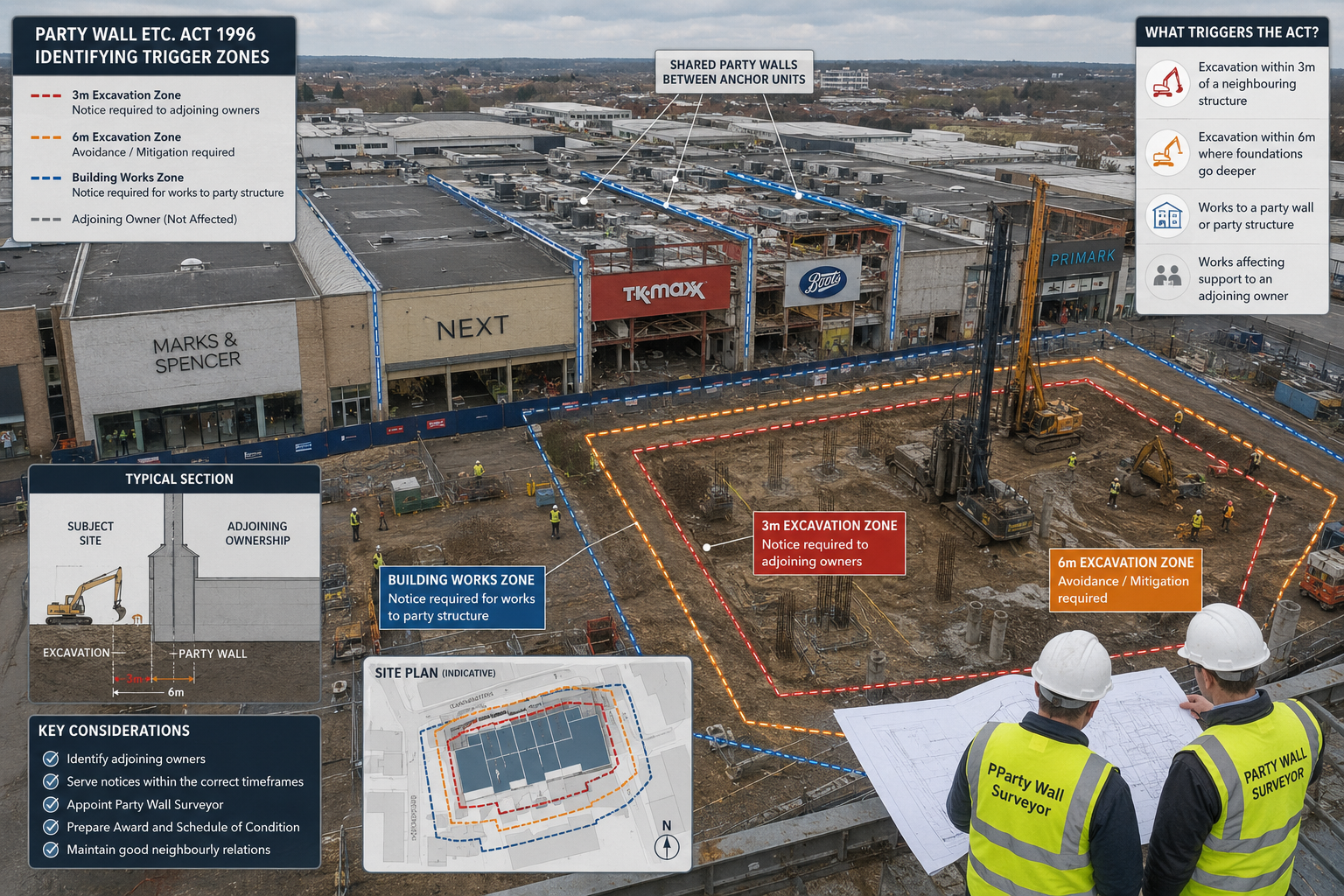
- New piled or basement foundations within 3-6 metres of an adjoining owner's land
- Structural alterations to shared walls between anchor units and neighbouring freeholders
- Rooftop additions that load onto party structures
- Façade retention schemes that temporarily transfer loads to shared elements
- Creation of new openings in existing party walls to connect reconfigured retail units
Commercial party wall specialists confirm that instructions increasingly involve "shopping centres, retail parades and mixed-use blocks being reconfigured or extended," with party wall issues arising from deep new foundations and structural alterations to shared walls [8]. This trend is accelerating in 2026 as more assets move from planning approval into active construction.
The challenge is compounded by the ownership complexity typical of mature retail assets. A single shopping centre may sit across multiple freehold titles, with long leaseholders, sub-tenants, and adjoining landowners all holding interests that must be identified and served with the correct notices before works begin.
Understanding the Legal Framework: The Party Wall etc. Act 1996 in a Commercial Context
The Party Wall etc. Act 1996 applies equally to commercial and residential property. However, the practical application on a large retail asset is considerably more involved than on a standard residential extension. Understanding what a party wall dispute involves is essential before any redevelopment programme begins.
What Works Are Notifiable?
Under the Act, three categories of work require formal notice:
| Work Type | Relevant Section | Typical Shopping Centre Example |
|---|---|---|
| Works to a party wall or party fence wall | Section 2 | Cutting into a shared structural wall to create a new retail entrance |
| New building on or at the boundary | Section 1 | Constructing a new mixed-use wing up to the boundary line |
| Excavation near neighbouring structures | Section 6 | Piling within 3-6 m of an adjoining owner's foundations |
On a shopping centre project, all three categories may be triggered simultaneously across different parts of the site. This means the building owner (typically the developer or asset manager) must serve multiple notices, potentially to different adjoining owners, with different response deadlines running in parallel.
The Adjoining Owner Problem in Retail Assets
In residential party wall cases, the adjoining owner is usually a single household. In a shopping centre revival, the adjoining owner could be:
- A neighbouring retail freeholder
- A local authority that owns an adjoining car park or civic building
- A residential block that abuts the mall's rear service yard
- A long leaseholder with a qualifying interest under the Act
Each of these parties has the right to dissent from a party wall notice and appoint their own surveyor, triggering a formal dispute resolution process. Understanding how party wall disputes are managed in advance allows developers to budget correctly for surveyor fees and programme delays.
How RICS Guidance Changes Are Reshaping Party Wall Surveys for Shopping Centre Revivals: Managing Disputes in 2026's Undervalued Retail Assets
In February 2025, RICS launched a public consultation to revise its Party Wall guidance note, explicitly citing "the increasingly complex nature of commercial and mixed-use developments" as a primary driver. The revised guidance, expected to be adopted through 2025-26, will serve as the main professional reference for party wall surveyors dealing with large-scale structural alterations, vertical extensions, and change-of-use schemes in undervalued retail assets [9].
Key changes anticipated in the revised RICS guidance include:
- Stronger requirements for pre-notice structural assessments on complex commercial schemes
- Clearer protocols for multi-owner scenarios where a single development affects several adjoining titles simultaneously
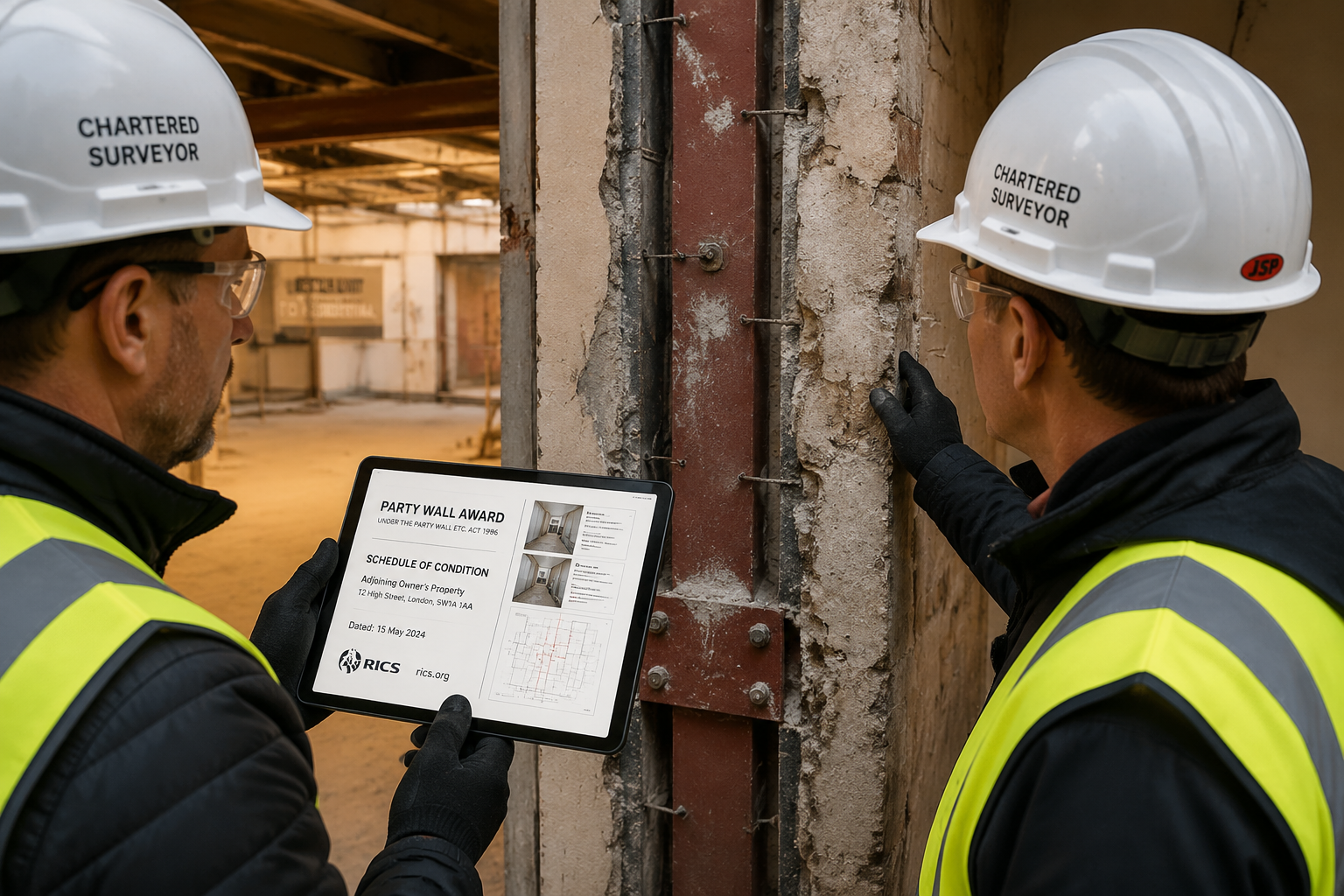
- Greater emphasis on digital schedule-of-condition records, including video walkthroughs and 3D laser scans
- Updated guidance on the use of agreed surveyors in commercial contexts
The role of the party wall agreed surveyor — a single surveyor appointed by both the building owner and the adjoining owner — is particularly relevant in shopping centre revivals. Where relationships between adjoining owners are commercial rather than personal, the agreed surveyor route can reduce costs and speed up the award process. However, it requires both parties to have confidence in the surveyor's impartiality, which is harder to achieve when significant commercial interests are at stake.
The Schedule of Condition: A Non-Negotiable on Large Retail Sites
A party wall schedule of condition records the pre-works state of an adjoining owner's property. On a shopping centre revival, this document is critical. The adjoining structure may already have existing defects — cracked facades, differential settlement, aging waterproofing — and without a detailed pre-works record, any subsequent damage claim becomes a contested liability.
Industry predictions for 2026 indicate that schedules of condition on complex retail projects will increasingly incorporate video evidence and 3D scan data, making them far more robust as legal documents than traditional photographic reports [9]. Developers who skip or rush this step face disproportionate exposure if disputes escalate to the property chamber or the courts.
Practical Dispute Management Strategies for 2026's Retail Revival Projects
The volume and complexity of party wall disputes on shopping centre projects is expected to increase through 2026, driven by the pipeline of value-add retail investments now moving into construction [9]. The following strategies reflect current best practice for managing these disputes effectively.
Appoint a Commercial Party Wall Surveyor Before Planning Submission
The most common mistake on retail revival projects is treating party wall compliance as a pre-construction formality rather than a design-stage consideration. A specialist commercial property surveyor with party wall expertise can identify notifiable works at the concept design stage, allowing the project team to:
- Adjust foundation designs to avoid triggering Section 6 notices where possible
- Identify all adjoining owners and begin early engagement before formal notices are served
- Budget accurately for surveyor fees, which on a multi-owner retail site can be substantial
- Programme the notice periods (typically 1-2 months) into the construction timeline
Understand the Notice Periods and Stick to Them
| Notice Type | Minimum Notice Period | Consequence of Non-Compliance |
|---|---|---|
| Section 1 (new wall at boundary) | 1 month | Works cannot lawfully proceed |
| Section 2 (works to party wall) | 2 months | Adjoining owner can seek injunction |
| Section 6 (excavation near boundary) | 1 month | Works cannot lawfully proceed |
Failure to serve valid notices before commencing works is one of the most serious errors a developer can make. An adjoining owner who discovers that notifiable works have begun without notice can apply to the courts for an injunction to halt the project. On a large retail scheme, even a short injunction can cost hundreds of thousands of pounds in programme delay.
If a neighbour is already carrying out work that affects your boundary, understanding what to do when party wall work affects your property is equally important for adjoining owners in retail settings.
Managing Multi-Owner Negotiations
Shopping centres that share boundaries with multiple freeholders create a scenario where the developer must manage several parallel party wall processes simultaneously. Best practice in 2026 includes:
- Appointing a lead party wall surveyor with experience in multi-owner commercial schemes to coordinate the process
- Using a single surveyor where possible to reduce costs and improve consistency across awards
- Establishing a dispute resolution protocol at the outset, agreed between all parties, to handle disagreements about the scope of works or the content of awards
- Maintaining a central register of all notices served, responses received, and awards made, updated in real time
"Large mixed-use and commercial schemes will dominate the most complex party wall appointments in 2026, driven by retail-to-residential conversions and intensification in town-centre sites." [9]
The Party Wall Award: Getting It Right First Time
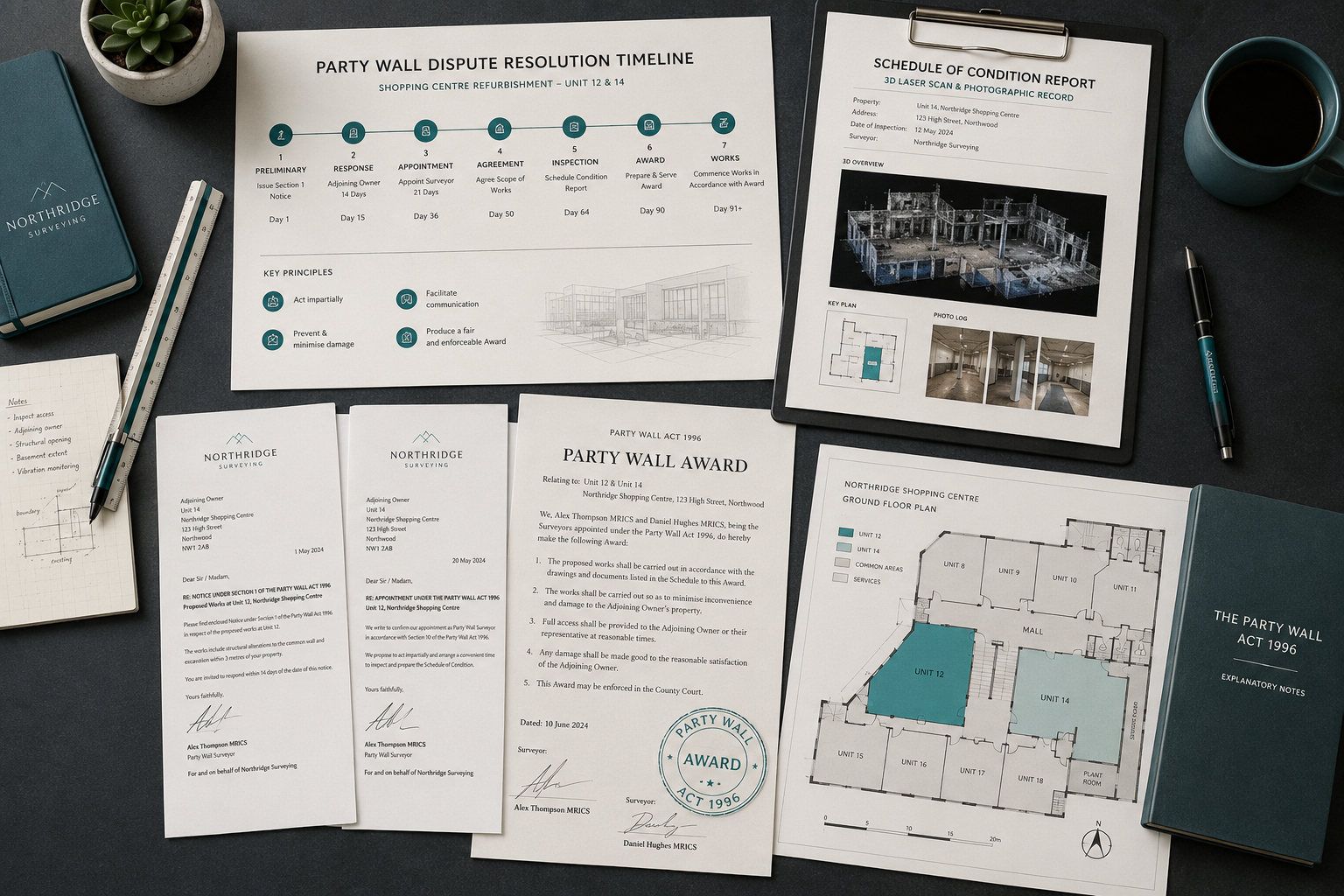
The party wall award is the legally binding document that sets out how works are to be carried out, what protections are in place for the adjoining owner, and how any damage will be assessed and compensated. On a shopping centre revival, a well-drafted award should address:
- The specific works covered, with reference to approved drawings
- Hours of working, particularly where the adjoining owner is an operating retailer
- Vibration and noise monitoring requirements during piling or demolition
- Access rights for the surveyor to inspect works during construction
- The mechanism for assessing and compensating damage claims
A poorly drafted award that fails to address these issues creates ambiguity that almost inevitably leads to disputes during construction. The cost of getting the award right at the outset is trivial compared to the cost of litigating a disputed damage claim mid-project.
Boundary Disputes and Licence to Alter: Related Risks on Retail Revival Sites
Party wall compliance does not exist in isolation. On complex retail sites, it frequently intersects with boundary disputes and licence to alter requirements.
Boundary disputes arise when the precise location of the boundary between the shopping centre and an adjoining title is unclear. This is common on older retail assets where the original conveyancing plans were drawn at small scale and do not resolve ambiguities in the physical boundary. A boundary dispute that is unresolved when party wall notices are served can invalidate those notices if the wrong party is identified as the adjoining owner.
Licence to alter requirements arise where the shopping centre developer holds a leasehold interest and the proposed works require the freeholder's consent. The licence to alter process runs in parallel with the party wall process but is governed by the lease rather than the Act. Failing to obtain both consents before commencing works can leave the developer exposed to both statutory enforcement action and lease forfeiture.
What Adjoining Owners Should Know: Protecting Your Position
The focus in retail revival discussions tends to be on the developer's obligations. But adjoining owners — whether neighbouring retailers, residential freeholders, or local authorities — have significant rights and should understand how to exercise them.
Key rights for adjoining owners include:
- The right to receive formal written notice before notifiable works begin
- The right to appoint their own surveyor at the building owner's expense
- The right to a schedule of condition before works commence
- The right to compensation for damage caused by the notifiable works
- The right to appeal a party wall award to the county court within 14 days of service
Adjoining owners who receive a party wall notice in connection with a shopping centre revival should seek specialist advice promptly. The notice periods are short, and the window for appointing a surveyor and influencing the content of the award is limited. For a detailed overview of the process, the party wall matters resource provides a solid foundation for understanding obligations and rights.
Conclusion: Actionable Next Steps for 2026's Retail Revival Projects
Party Wall Surveys for Shopping Centre Revivals: Managing Disputes in 2026's Undervalued Retail Assets represents a convergence of investment opportunity and legal complexity that demands specialist expertise from the earliest stages of a project. The pipeline of undervalued retail assets moving into active redevelopment is substantial, and the party wall risks on these projects are materially greater than on standard residential or commercial schemes.
Actionable next steps for developers, asset managers, and adjoining owners in 2026:
-
Engage a commercial party wall surveyor at concept design stage — not after planning permission is granted. Early involvement shapes the design to reduce notifiable works and allows proper programming of notice periods.
-
Conduct a thorough adjoining owner audit before serving any notices. Identify every freehold and qualifying leasehold interest that could be affected by the proposed works, including interests that may not be immediately obvious from title registers.
-
Commission a detailed schedule of condition for every adjoining property before works begin. Invest in video and 3D scan technology where the adjoining structure is complex or already shows signs of distress.
-
Draft party wall awards with commercial precision. Ensure awards address operating hours, monitoring requirements, access rights, and damage assessment mechanisms in terms that reflect the commercial reality of the project.
-
If you are an adjoining owner, do not ignore party wall notices. Appoint a surveyor, review the proposed works carefully, and ensure your interests are protected in the award before construction begins.
-
Stay current with RICS guidance. The revised party wall guidance note adopted through 2025-26 sets the professional standard against which surveyors' conduct will be judged. Both building owners and adjoining owners benefit from surveyors who work to that standard.
The revival of undervalued retail assets is one of the most significant property stories of 2026. Getting the party wall process right is not a bureaucratic hurdle — it is a fundamental part of delivering these projects on time, on budget, and without the legal disputes that can derail even the most carefully planned redevelopment.
References
[8] Commercial Party Wall Surveyor London – https://www.houricanassociates.com/party-wall-surveyor-services/commercial-party-wall-surveyor/
[9] The Party Wall Surveyors 2025 Guide – https://www.simplesurvey.co.uk/uncategorised/the-party-wall-surveyors-2025-guide/