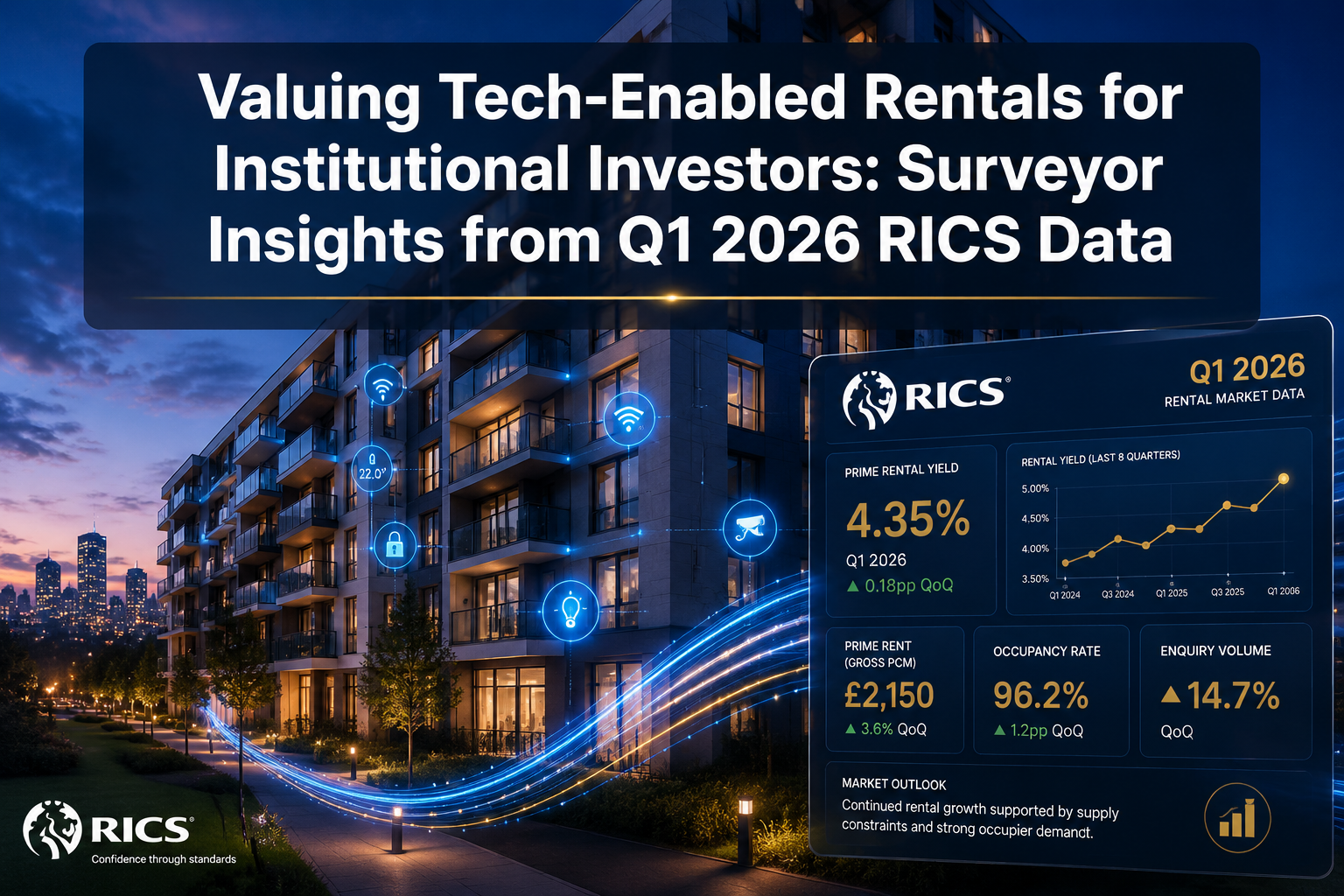

Institutional investors increased their share of multi-tenant property acquisitions to 27% in Q1 2026 — a 13% rise since 2023 — and a growing portion of those deals involve properties fitted with smart-home and IoT technology [3]. The question that RICS-registered surveyors are now being asked more frequently is a precise one: how do you translate a smart thermostat, a connected access system, or a building-wide energy management platform into a defensible, evidence-based valuation figure? The challenge of valuing tech-enabled rentals for institutional investors: surveyor insights from Q1 2026 RICS data sits at the intersection of traditional valuation methodology and a rapidly evolving rental market where technology is no longer a luxury feature — it is a core asset attribute.
This article draws on Q1 2026 RICS survey data, Altus Group European analysis, and sector-specific research to give institutional investors and their advisors a structured framework for approaching smart-home build-to-rent (BTR) valuations in the current market.
Key Takeaways
- The RICS Q1 2026 Commercial Property Monitor recorded a credit conditions indicator of -44%, the weakest since Q3 2023, creating a more selective investment environment where tech-enabled assets must demonstrate clear income premiums [1].
- Prime office and industrial rents are expected to grow by 2% to 2.1% over the next 12 months, while alternative sectors such as data centers lead with 3.5% projected rental growth [1].
- Institutional investors now account for 27% of multi-tenant acquisitions, with operational efficiency and technology integration cited as key acquisition drivers [3].
- RICS valuation standards formally incorporated ESG factors as of April 2026, directly affecting how energy-efficient, tech-enabled properties are assessed [5].
- The investment method — converting rental income streams into present value — remains the primary RICS-endorsed technique for income-producing rental assets, with IoT premiums requiring specific comparable evidence [5].
Why Q1 2026 RICS Data Matters for Tech-Enabled Rental Valuations
The Q1 2026 RICS UK Commercial Property Monitor delivered a sobering set of headline numbers. The credit conditions indicator dropped sharply to -44%, down from +9% in Q4 2025, representing the weakest reading since Q3 2023 [1]. Geopolitical tensions and rising bond yields were cited as the primary drivers. Twelve-month capital value expectations across all property types moved to a net balance of -18%, compared with -5% in the prior quarter [1].
For institutional investors targeting tech-enabled rental assets, these figures carry a specific implication: the days of broad-based capital appreciation masking income underperformance are over. In a tighter credit environment, rental income quality and its sustainability become the primary valuation drivers. A property fitted with smart-home infrastructure that demonstrably reduces void periods, attracts higher-quality tenants, and supports premium rents is not simply a better asset — it is a more defensible asset in a RICS-compliant valuation report.
The Occupier Market: A Stabilising Anchor
Despite the investment market headwinds, the occupier side of the market has remained broadly stable. The headline Occupier Sentiment Index stood at -10 in Q1 2026, essentially unchanged from the previous quarter, with tenant demand at the all-property level recording a net balance of -8% against -9% in Q4 2025 [1]. This relative stability matters for surveyors tasked with valuing BTR portfolios, because it suggests that rental income projections — particularly for well-located, well-specified assets — carry reasonable reliability.
Prime rental expectations by sector (12-month forward projections, Q1 2026):
| Sector | Projected Rental Growth |
|---|---|
| Prime London offices | +2.5% |
| Prime offices (all-UK) | +2.0% |
| Prime industrial | +2.1% |
| Prime retail | -0.5% |
| Data centers | +3.5% |
Source: RICS UK Commercial Property Monitor Q1 2026 [1]
The outperformance of data centers — projected at 3.5% rental growth and 3.3% capital value appreciation — is instructive. These assets are, in effect, highly tech-integrated rental properties. Their valuation premium over conventional commercial property is directly attributable to their operational infrastructure. The same logic applies, at a different scale, to smart-home residential BTR assets.
For professional landlords and institutional buyers seeking RICS-compliant assessments across London and the South East, engaging a chartered surveyor in Central London with specific BTR experience is an important first step in establishing defensible valuations.
How RICS Surveyors Approach Valuing Tech-Enabled Rentals for Institutional Investors: Surveyor Insights from Q1 2026 RICS Data
The valuation of tech-enabled rental properties does not require an entirely new methodology. What it requires is the disciplined application of established RICS methods — primarily the investment method and the discounted cash flow (DCF) approach — with careful attention to how IoT and smart-home features affect the four key inputs: passing rent, estimated rental value (ERV), yield, and void assumptions.
The Investment Method and IoT Premiums
The investment method converts a rental income stream into a capital value by applying a yield derived from comparable market transactions. The formula is straightforward:
Capital Value = Net Annual Rent / Yield
The challenge with tech-enabled rentals is twofold. First, comparable evidence for smart-home premiums in the BTR sector is still relatively thin, particularly outside major urban centres. Second, the premium itself is not uniform — it depends on the type of technology installed, its integration depth, and whether it delivers measurable tenant benefits.
RICS guidance, updated to incorporate ESG factors formally from April 2026, now requires valuers to consider energy performance and operational efficiency as material valuation inputs [5]. A property with a building-wide energy management system that demonstrably reduces utility costs for tenants can support a higher ERV because tenants are willing to pay more for lower total occupancy costs. This is the "all-in cost" argument that institutional investors in the BTR sector have been making for several years, and it is now formally supported within the RICS valuation framework.
Key IoT features and their valuation relevance:
- Smart access control: Reduces management costs, supports premium positioning, lowers void risk through improved tenant experience.
- Connected energy management: Directly supports EPC ratings, increasingly material under RICS ESG-integrated standards.
- Predictive maintenance systems: Reduces capital expenditure uncertainty, a material input in DCF models.
- High-speed connectivity infrastructure: Supports ERV premiums in markets where remote working demand remains elevated.
- Smart metering and sub-metering: Improves operating expense transparency, reduces service charge disputes, supports net income reliability.
For investors acquiring tech-enabled BTR assets in West London, working with a West London surveyor familiar with local comparable evidence is essential when quantifying these premiums within a formal valuation report.
Yield Selection in a Tighter Credit Environment
The Q1 2026 data presents a specific challenge for yield selection. With credit conditions at their weakest since Q3 2023 [1], there is upward pressure on yields across most commercial property sectors. For institutional-grade BTR assets with strong tech credentials, the question is whether the quality premium is sufficient to resist this broader yield expansion.
Altus Group's Q1 2026 pan-European analysis showed a 0.7% increase in commercial property values — the seventh consecutive quarter of positive appreciation — driven primarily by cash flow improvements rather than yield compression [4]. This is a significant finding for tech-enabled rental valuations. It confirms that in the current environment, income quality is doing the heavy lifting that capital markets can no longer provide. A BTR asset with demonstrably stable, growing rents supported by technology-driven operational efficiency is better positioned to hold its valuation than a conventional asset relying on speculative yield compression.
Discounted Cash Flow Models for Smart-Home BTR
For larger institutional portfolios, the DCF approach provides a more granular framework for capturing the time-varying benefits of tech-enabled features. Key considerations include:
- Rent review assumptions: Smart-home BTR assets in prime locations can support above-inflation rent reviews, particularly where tenant demand remains stable as evidenced by the Q1 2026 Occupier Sentiment data [1].
- Void period assumptions: Technology-enhanced properties typically support lower void assumptions, but surveyors must justify these with local market evidence.
- Capital expenditure for technology refresh: IoT systems have defined lifecycles. A robust DCF model must account for technology replacement costs, typically on a 7-10 year cycle for core infrastructure.
- Exit yield assumptions: In a market where credit conditions are under pressure, conservative exit yield assumptions are warranted. The -18% net balance on 12-month capital value expectations [1] suggests that surveyors should avoid optimistic terminal value assumptions.
For clients requiring a formal RICS valuation report in London, these DCF inputs should be clearly documented and cross-referenced with the most recent RICS monitor data to demonstrate methodological rigour.
Regional Variations and Sector-Specific Insights for Institutional Buyers
The Q1 2026 data reveals significant regional divergence that directly affects how tech-enabled rental assets should be valued in different markets. The RICS February 2026 survey recorded a net balance of -40% in London market sentiment, while the North West showed positive figures [6]. This is not simply a headline statistic — it has direct implications for yield selection, ERV growth assumptions, and void rate inputs in any RICS-compliant valuation.
London: Premium Assets in a Cooling Market
London's prime office sector is expected to see rents grow by 2.5% over the next 12 months, down from the 3.3% anticipated in Q4 2025 [1]. For residential BTR in prime London locations, the directional signal is similar: growth expectations are moderating, but prime, well-specified assets retain relative resilience.
"In a market where broad sentiment is negative, the quality differential between a well-specified tech-enabled asset and a conventional equivalent becomes more — not less — important to the valuation."
For institutional investors with BTR assets in prime London locations, the current environment rewards precise, evidence-based valuations. Engaging RICS registered valuers in London with specific BTR experience ensures that technology premiums are properly captured and defended in formal reports.
Surrey, the South East, and Commuter Belt Markets
Outside prime London, the picture is more nuanced. Markets such as Surrey, Hertfordshire, and the wider South East continue to attract institutional interest in BTR, driven by strong commuter demand and a relative undersupply of professionally managed rental stock. Tech-enabled BTR assets in these markets can command meaningful ERV premiums over conventional stock, particularly where broadband infrastructure, smart energy management, and automated building management systems are in place.
Institutional buyers active in these markets should consider working with chartered surveyors in Surrey or chartered surveyors in Hertfordshire who have direct access to local comparable evidence and can contextualise Q1 2026 RICS data within specific submarket conditions.
Alternative Sectors: The Data Center Benchmark
The projected 3.5% rental growth and 3.3% capital value appreciation for data centers [1] provides a useful benchmark for understanding how markets price operational technology. While data centers are a distinct asset class, their valuation dynamics — where infrastructure quality directly supports rental premiums and reduces void risk — are increasingly referenced by surveyors valuing high-specification BTR assets.
Institutional investors should note that the same ESG integration requirements that now apply to conventional commercial property also apply to tech-enabled residential assets. As of April 2026, RICS valuation standards formally require ESG factors — including energy efficiency ratings — to be considered as material inputs [5]. A smart-home BTR asset with a strong EPC rating, supported by connected energy management technology, is not simply a better-performing asset; it is a more RICS-compliant asset in the current regulatory environment.
Practical Framework for Valuing Tech-Enabled Rentals for Institutional Investors: Surveyor Insights from Q1 2026 RICS Data
The following framework consolidates the surveyor insights from Q1 2026 RICS data into a practical checklist for institutional investors and their advisors.
Pre-Instruction Checklist
- Confirm the valuation basis (Market Value, Investment Value, or Fair Value) and ensure it aligns with the investor's reporting requirements.
- Identify all IoT and smart-home systems installed and obtain technical specifications, maintenance records, and warranty documentation.
- Gather at least three comparable lettings for the submarket, with notes on any technology-related premiums achieved.
- Review the property's EPC rating and assess whether smart-home systems support a higher rating than the base building specification would otherwise achieve.
- Confirm whether the asset falls within a RICS-designated ESG-sensitive category under the April 2026 updated standards [5].
Valuation Report Requirements
A RICS-compliant valuation report for a tech-enabled BTR asset should include:
- Technology schedule: A formal schedule of all IoT and smart-home systems, their operational status, and estimated remaining useful life.
- ERV analysis: A clear explanation of any premium applied to the ERV for technology features, supported by comparable evidence.
- Yield commentary: A specific discussion of whether the technology specification supports a tighter yield than comparable conventional assets, with reference to current market conditions.
- ESG commentary: A section addressing how the property's energy performance and smart systems interact with the April 2026 RICS ESG valuation requirements [5].
- Sensitivity analysis: For DCF-based valuations, a sensitivity table showing the impact of varying technology refresh cost assumptions and void rate inputs.
Understanding the factors that affect property valuation is essential context for any institutional investor commissioning a formal RICS report on a tech-enabled BTR asset.
Rent Review Considerations
For institutional investors holding existing BTR portfolios, rent reviews on tech-enabled properties require specific attention. Where leases or tenancy agreements include provisions for upward-only rent reviews, the surveyor must assess whether the technology premium embedded in the passing rent is sustainable and supportable by current market evidence. The rent review process in London involves specific procedural steps that can affect the timing and outcome of any premium justification.
Conclusion
The Q1 2026 RICS data presents a challenging but navigable environment for institutional investors targeting tech-enabled rental assets. Credit conditions are at their weakest in over two years, capital value expectations have declined, and regional sentiment varies significantly [1]. Against this backdrop, the case for tech-enabled BTR assets is not weakened — it is sharpened. In a market where income quality drives valuation rather than speculative yield compression, properties that demonstrably deliver stable rents, lower voids, and measurable operational efficiency are better positioned than conventional stock.
Actionable next steps for institutional investors:
- Commission a RICS-compliant valuation from a registered valuer with specific BTR and smart-home experience before any acquisition or portfolio refinancing.
- Ensure all IoT and smart-home systems are formally documented and included in the valuation instruction, not treated as chattels or excluded items.
- Review existing rent review provisions in light of Q1 2026 market data and the April 2026 ESG valuation standard updates.
- Apply conservative exit yield assumptions in DCF models, consistent with the -18% net balance on 12-month capital value expectations recorded in Q1 2026 [1].
- Engage regional specialists in target acquisition markets — particularly in London, Surrey, and the South East — to ensure comparable evidence is current and submarket-specific.
The integration of technology into rental assets is no longer a differentiator in the marketing sense. In 2026, it is a valuation input that RICS surveyors are increasingly required to quantify, defend, and report on with the same rigour applied to any other material asset attribute.
References
[1] RICS UK Commercial Property Monitor Q1 2026 – https://www.rics.org/news-insights/rics-uk-commercial-property-monitor-q1-2026?utm_source=openai
[2] New RentRedi Survey Shows Rental Investors Are Cautiously Optimistic About 2026 – https://www.globenewswire.com/news-release/2026/01/28/3227424/0/en/new-rentredi-survey-shows-rental-investors-are-cautiously-optimistic-about-2026.html?utm_source=openai
[3] Q1 2026 MarketSnapshot Multi-Tenant Overall Market – https://www.northmarq.com/insights/research/q1-2026-marketsnapshot-multi-tenant-overall-market?utm_source=openai
[4] Altus Group Releases Q1 2026 Pan-European Dataset Analysis on CRE Valuation Trends – https://www.altusgroup.com/press-releases/altus-group-releases-q1-2026-pan-european-dataset-analysis-on-cre-valuation-trends/?utm_source=openai
[5] Valuing BTL Properties for Professional Landlords in Stabilising Markets: RICS Checklists Post Q1 2026 RICS Survey – https://wimbledonsurveyors.com/valuing-btl-properties-for-professional-landlords-in-stabilising-markets-rics-checklists-post-q1-2026-rics-survey/?utm_source=openai
[6] Valuation Insights from RICS February 2026 Survey: Northern Resilience vs London Cooling in Cautious Spring Markets – https://manchestersurveyors.com/valuation-insights-from-rics-february-2026-survey-northern-resilience-vs-london-cooling-in-cautious-spring-markets/?utm_source=openai